Day 21 — nftables vs iptables
Today’s mission: see why nftables exists, write a real ruleset that does multiple useful things, and understand how the same hooks expose two completely different rule engines — including the tiny register-based VM, two verdict namespaces, three set backends, and the generation double-buffer that make the headline features real. Total time: ~110 minutes.
Two generations of the same idea
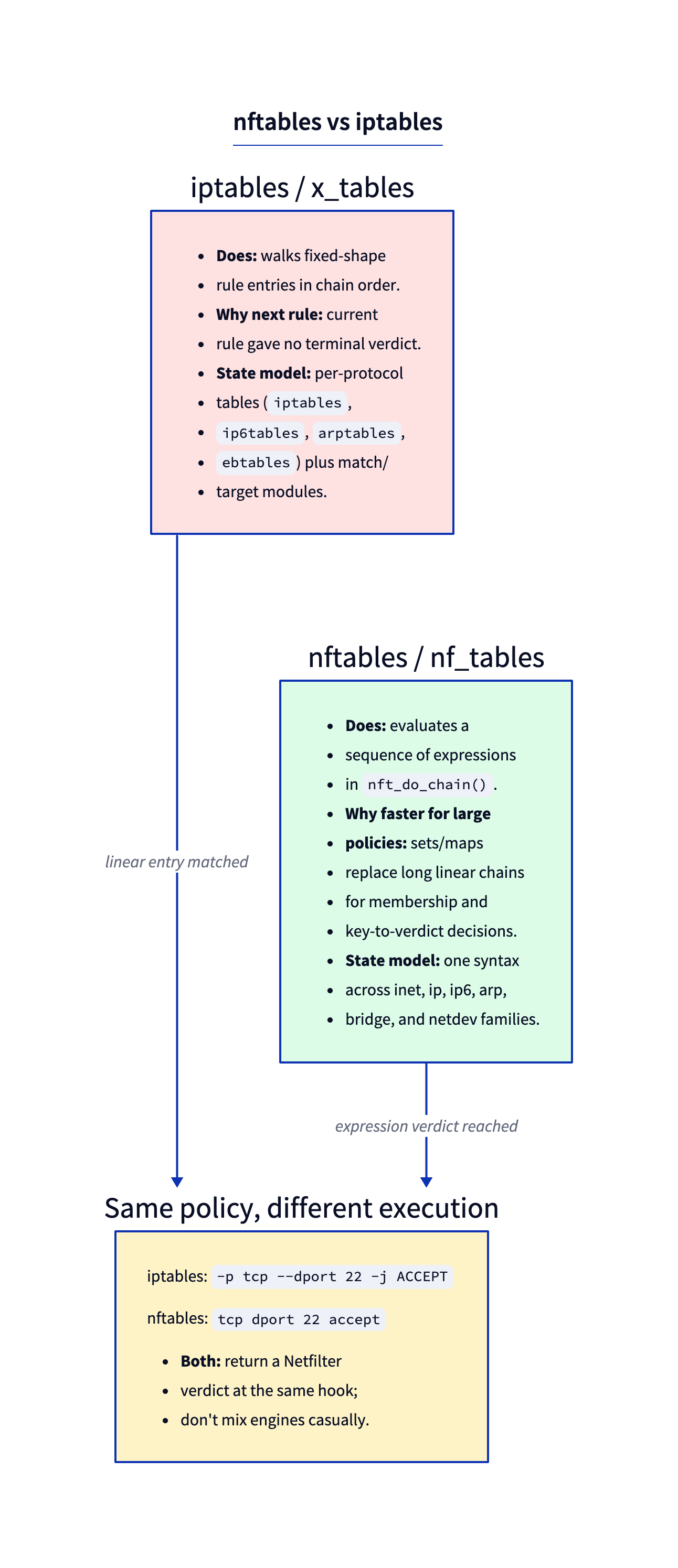
Both iptables and nftables hook into the same Netfilter framework (Day 20). They differ in how rules are stored, matched, and executed — which has cascading effects on syntax, performance, and feature surface.
iptables (legacy, 2001)
- Per-protocol tools:
iptables(IPv4),ip6tables(IPv6),arptables(ARP),ebtables(bridged Ethernet). Four parallel binaries with similar but not identical syntax. - Linear matching: rules in a chain are an array of fixed-shape entries (
struct ipt_entry+ match + target). For each packet, the kernel walks the array top-to-bottom evaluating each rule’s matches. Match modules (xt_*) are kernel modules. - Implementation:
ipt_do_table(net/ipv4/netfilter/ip_tables.c:223). The “fast path” is a manually-unrolled loop over rule entries. - Storage:
xt_table_infoarrays are large pre-allocated buffers; updates require allocating a whole new buffer and atomic swap. Adding one rule rewrites the entire table.
nftables (modern, since 3.13 / 2014)
- One tool:
nft. Single syntax for inet (IPv4+IPv6 unified), arp, bridge, netdev (per-iface). - Expression VM: rules compile to compact expression sequences run by
nft_do_chain(net/netfilter/nf_tables_core.c:250). Each rule is a sequence ofnft_exprops operating on a small register file; common expressions have fast paths, but this is not a BPF-style JIT. (We dissect this VM in detail below — it’s the one idea that makes “rules compile to expressions” click.) - Native sets and maps: hash sets, interval/range sets (red-black tree), concatenated-range sets (pipapo), key→value maps as first-class types. Membership tests are O(1) or O(log N) instead of O(N) linear walks. (These are three separate kernel modules — we’ll see which one the kernel picks and why.)
- Atomic updates: changes are applied transactionally via netlink; no full-table rewrite for one rule add. (Backed by a generation double-buffer + RCU — covered below.)
- Implementation:
nft_do_chain(net/netfilter/nf_tables_core.c:250). Reads the chain’s expression list, runs each.
Performance difference
For a simple “drop traffic from these 100 IPs” rule:
- iptables: a chain of 100
-s IP -j DROPrules. Each packet walks all 100 (until match or end). O(N) per packet. - nftables: one rule using a set of exact IPs:
ip saddr @denylist drop. That set is a hash table. O(1) per packet regardless of size.
For 100 IPs the difference is noticeable; for 100k IPs (e.g., a denylist), iptables is unusable, nftables is fine. The O(1) claim holds for a set of exact /32 keys; a denylist of CIDR ranges instead uses the interval/rbtree backend at O(log N) — see the set-backends section for why a range can’t be a hash. We’ll see exactly which data structure backs that “hash table” claim later in the chapter.
Basic nft ruleset
# Create an inet table (covers both IPv4 and IPv6)
sudo nft add table inet filter

# Add chains for the standard hook positions, with default policies.
# Run this only in a VM/netns lab: policy drop on host input can lock you out.
sudo nft 'add chain inet filter input   { type filter hook input   priority 0 ; policy drop ; }'
sudo nft 'add chain inet filter forward { type filter hook forward priority 0 ; policy drop ; }'
sudo nft 'add chain inet filter output  { type filter hook output  priority 0 ; policy accept ; }'

# Allow established + related (conntrack — black box today, explained just below / Day 22)
sudo nft add rule inet filter input ct state established,related accept

# Allow loopback
sudo nft add rule inet filter input iif lo accept

# Allow ICMP (so ping works)
sudo nft add rule inet filter input meta l4proto { icmp, icmpv6 } accept

# Allow specific TCP ports
sudo nft add rule inet filter input tcp dport { 22, 80, 443 } accept

# Drop the rest (covered by chain policy 'drop')

# Inspect
sudo nft list ruleset
The inet family is special — same chain matches both v4 and v6 traffic, so you don’t write rules twice.
About
ct state established,related accept. That very first substantive rule leans on conntrack, the connection-tracking subsystem.ct stateis a stateful match: it asks conntrack “have I seen this flow before, and in what state?” The states you’ll meet arenew(first packet of a flow),established(a flow conntrack already tracks), andrelated(a helper flow, like FTP data or an ICMP error tied to an existing connection) — the kernel names themIP_CT_NEW,IP_CT_ESTABLISHED,IP_CT_RELATEDinenum ip_conntrack_info(include/uapi/linux/netfilter/nf_conntrack_common.h), and thectexpression’s keys live inenum nft_ct_keys(include/uapi/linux/netfilter/nf_tables.h:1159). Treat conntrack as a black box today — we dissect the whole mechanism tomorrow (Day 22). All you need now: this rule lets reply traffic for connections you initiated back in without you having to write a matching reverse rule for every flow.
Sets and maps
Native data structures, not afterthoughts.
Anonymous set inline
sudo nft add rule inet filter input ip saddr { 10.0.0.1, 10.0.0.2, 10.0.0.3 } accept
The {...} creates an anonymous hash set, used by this rule only.
Named set (mutable from CLI)
sudo nft add set inet filter blocked { type ipv4_addr \; flags interval \; }
sudo nft add element inet filter blocked { 1.2.3.4 }
sudo nft add element inet filter blocked { 5.6.7.0/24 }

sudo nft add rule inet filter input ip saddr @blocked drop
The set persists, can be added to/removed from at runtime, and the rule references it by name.
Map (key → value)
sudo nft add map inet filter port_to_action { type inet_service : verdict \; }
sudo nft add element inet filter port_to_action { 22 : accept, 80 : accept, 443 : accept, 25 : drop }

sudo nft add rule inet filter input tcp dport vmap @port_to_action
vmap (verdict map) translates the matched value into a verdict via lookup. Replaces a chain of if dport == X jump Y else....
Interval sets (ranges)
sudo nft add set inet filter trusted_nets { type ipv4_addr \; flags interval \; }
sudo nft add element inet filter trusted_nets { 10.0.0.0/8, 192.168.0.0/16, 172.16.0.0/12 }
Backed by an interval/range tree, not a hash. Lookup is O(log N) but supports CIDR. (Next section explains why it can’t be a hash.)
What actually backs a set: three kernel modules, not one
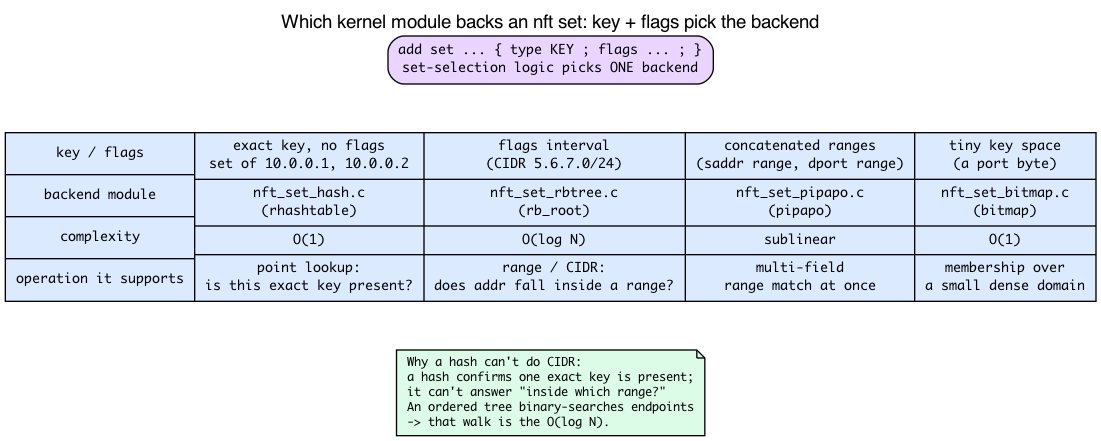
The chapter keeps saying “hash set,” “interval tree,” “pipapo” and quoting O(1) / O(log N) — but those aren’t hand-waving. They are three distinct kernel modules, and when you add set ... { type ... ; flags ... ; }, the kernel picks one based on the key type and flags. List them on the devbox:
net/netfilter/nft_set_hash.c      # exact-match sets
net/netfilter/nft_set_rbtree.c    # interval / range sets
net/netfilter/nft_set_pipapo.c    # concatenated-range sets
net/netfilter/nft_set_bitmap.c    # small key spaces, ≤ 2 bytes (e.g. a 16-bit port)
Ground each one:
-
Exact-match sets (a plain
{ 10.0.0.1, 10.0.0.2 }, noflags interval) use an rhashtable — the kernel’s generic resizable hash table. Opennft_set_hash.cand you’ll seestruct nft_rhash { struct rhashtable ht; ... }(net/netfilter/nft_set_hash.c:24-25), with#include <linux/rhashtable.h>at the top. A hash answers exactly one question — “is this exact key present?” — in O(1). -
Interval sets (
flags interval, used above for CIDRs) use a red-black tree keyed on range endpoints:struct nft_rbtree { struct rb_root root; ... }(net/netfilter/nft_set_rbtree.c:31). Here’s why a hash can’t do this job: a CIDR like5.6.7.0/24must match a whole range of addresses, not one exact key. A hash can only confirm a single key is present; it can’t answer “does this address fall inside one of my stored ranges?” An ordered structure can — you binary-search the endpoints. That ordered tree walk is exactly the O(log N) the chapter quotes, and it’s why CIDR membership is a tree walk, not a hash probe. The bare complexity number now has a reason behind it. -
Concatenated ranges (matching on, say, (saddr range, dport range) at once) use pipapo — “PIle PAcket POlicies,” whose header comment reads “PIPAPO: PIle PAcket POlicies: set for arbitrary concatenations of ranges” (
net/netfilter/nft_set_pipapo.c:3). One sentence is enough today; if you’re curious, that file’s opening comment is one of the best-documented algorithm write-ups in the tree.
This is just general data-structure intuition (ordered tree → log-N range lookup, hash → O(1) point lookup) wearing kernel clothes — nothing exotic. The set-selection logic chooses the backend; you choose the behavior by picking flags and key types.
Counters and quotas
sudo nft add rule inet filter input tcp dport 22 counter accept
# show stats
sudo nft list table inet filter
counter accumulates packets/bytes. Built-in; no separate “counter table” required.
You’ve now built a real inet filter table whose input chain has policy drop, plus several named sets and maps. When you’re done experimenting, tear the whole thing down in one transaction so you don’t leave a drop-policy firewall (and stray sets/maps) loaded — exactly the “you forgot the other ruleset is running” trap the check question warns about:
# Removes all chains, rules, named sets, and maps in this table at once
sudo nft delete table inet filter
That “in one transaction” is not marketing copy. To see why deleting a whole table mid-traffic is safe, we need to understand how nftables makes runtime updates atomic — coming up after the VM.
How nft_do_chain works: a tiny register VM
nft_do_chain (net/netfilter/nf_tables_core.c:250) is the runtime entry. Before we read its loop, we need the one idea everything hinges on: the register file.
What a register actually is
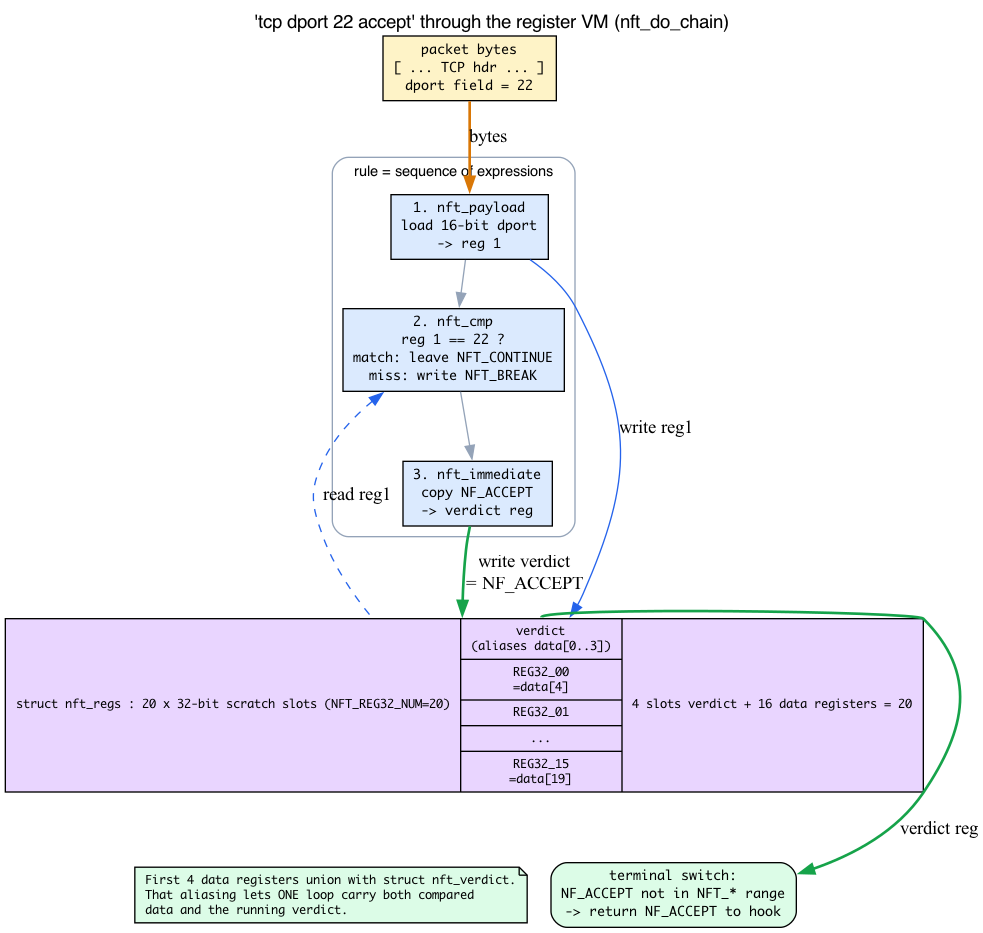
Think of how a CPU works: it has a handful of named scratch slots (registers), and instructions communicate by one instruction writing a register and a later one reading it. nftables borrows that idea in miniature. A register is just a slot in a small per-packet scratch array. Each expression in a rule is like a tiny instruction: it reads some registers, maybe writes one, and the next expression sees what the previous one left behind. That’s the entire model — “rules compile to a sequence of expressions” means “rules compile to a sequence of tiny instructions that pass values through a shared register file.”
In v7.1 that array is struct nft_regs (include/net/netfilter/nf_tables.h:122):
#define NFT_REG32_NUM 20            /* include/net/netfilter/nf_tables.h:112 */

struct nft_regs {
    union {
        u32              data[NFT_REG32_NUM];   /* 20 × 32-bit scratch slots */
        struct nft_verdict verdict;             /* aliases the FIRST slots */
    };
};
Two things to notice, both load-bearing:
- The scratch array is 20
u32wide, but there are only 16 addressable data registers.struct nft_regsholdsNFT_REG32_NUM = 20u32 slots — but those are not 20 independent data registers. The first 4 slots (data[0..3]) are consumed by the verdict register that aliases them (see point 2), leaving 16 addressable 32-bit DATA registers:NFT_REG32_00..NFT_REG32_15. The UAPI makes this explicit —NFT_REG32_COUNT == 16and the comment reads “The data registers have been changed to 16 registers of size 4” (include/uapi/linux/netfilter/nf_tables.h:16-21,30-55). So 16 is the right count of data registers; the array is 20 wide only because 4 + 16 = 20. - The verdict register overlaps the first data registers. It’s a
union:data[NFT_REG32_NUM]and astruct nft_verdictshare the same storage. The kernel comment spells it out: “The first four data registers alias to the verdict register” (include/net/netfilter/nf_tables.h:119-120).struct nft_verdict { u32 code; struct nft_chain *chain; }(:100) is 16 bytes = 4 u32 slots wide, so it lays overdata[0..3]and the 16 real data registers live atdata[4..19]. This aliasing is why a single loop can carry both the data being compared and the running verdict — they live in the same register file, just viewed two different ways.
Two kinds of verdict — don’t confuse them
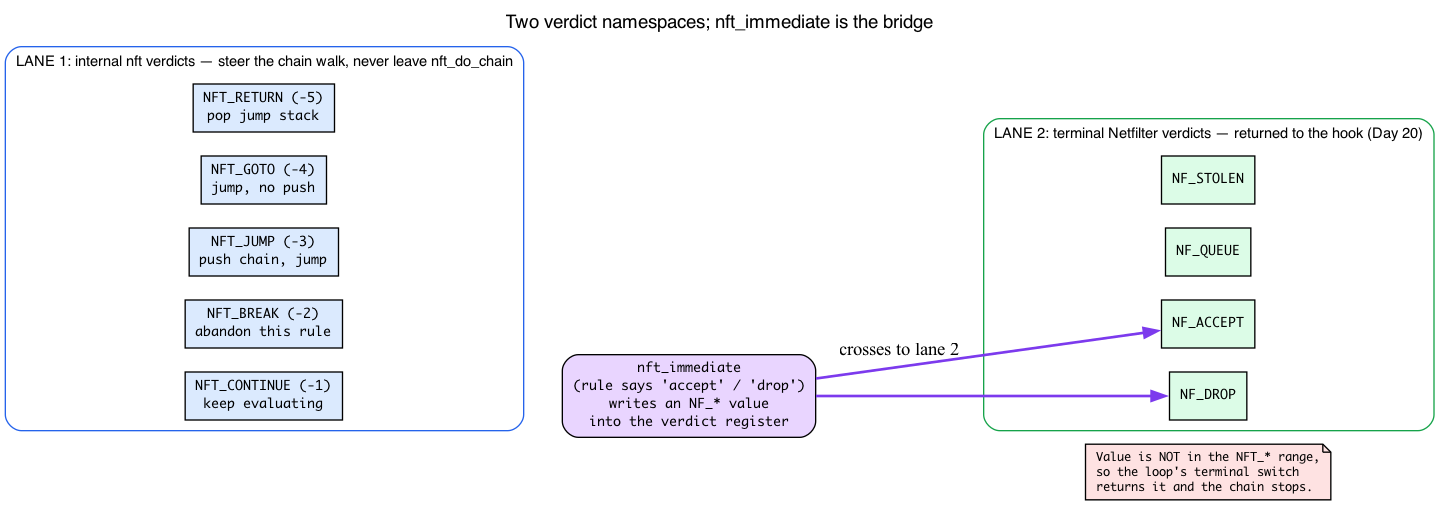
Day 20 taught the Netfilter verdicts a hook returns to the framework: NF_ACCEPT, NF_DROP, NF_QUEUE, NF_STOLEN. nftables adds a second, internal verdict namespace used only to steer the chain walk — these never escape nft_do_chain (enum nft_verdicts, include/uapi/linux/netfilter/nf_tables.h:68-73):
enum nft_verdicts {
    NFT_CONTINUE = -1,   /* keep evaluating */
    NFT_BREAK    = -2,   /* abandon THIS rule, go to the next */
    NFT_JUMP     = -3,   /* push chain, jump to another */
    NFT_GOTO     = -4,   /* jump without pushing */
    NFT_RETURN   = -5,   /* pop the jump stack */
};
So there are two lanes:
- Internal nft verdicts (
NFT_CONTINUE/BREAK/JUMP/GOTO/RETURN) — chain flow control, never returned to the hook. - Terminal Netfilter verdicts (
NF_ACCEPT/NF_DROP/NF_QUEUE/NF_STOLEN) — the values a hook hands back to Netfilter (Day 20).
The bridge between the lanes is nft_immediate: when a rule says accept or drop, the nft_immediate expression writes a Netfilter verdict into the verdict register. Because that value is not in the NFT_* range, the loop’s terminal switch returns it and the chain stops.
The real loop
Now nft_do_chain’s core reads cleanly. Here is the actual v7.1 loop, lightly trimmed (net/netfilter/nf_tables_core.c:273-313):
next_rule:
regs.verdict.code = NFT_CONTINUE; /* :274 — seed each rule with CONTINUE */
for (; !rule->is_last ; rule = nft_rule_next(rule)) {
nft_rule_dp_for_each_expr(expr, last, rule) {
/* fast-path dispatch for the common expressions ... */
if (expr->ops == &nft_cmp_fast_ops)
nft_cmp_fast_eval(expr, ®s);
else if (expr->ops != &nft_payload_fast_ops ||
!nft_payload_fast_eval(expr, ®s, pkt))
expr_call_ops_eval(expr, ®s, pkt); /* generic: expr->ops->eval(...) */
if (regs.verdict.code != NFT_CONTINUE) /* :287 — an expr changed it */
break;
}
switch (regs.verdict.code) {
case NFT_BREAK: /* :291 — abandon this rule */
regs.verdict.code = NFT_CONTINUE;
continue; /* ...move to next rule */
case NFT_CONTINUE:
continue;
}
break; /* anything else: leave the rule loop */
}
switch (regs.verdict.code & NF_VERDICT_MASK) { /* :306 — terminal dispatch */
case NF_ACCEPT:
case NF_QUEUE:
case NF_STOLEN:
return regs.verdict.code;
case NF_DROP:
return NF_DROP_REASON(pkt->skb, SKB_DROP_REASON_NETFILTER_DROP, EPERM);
}
/* NFT_JUMP/GOTO/RETURN handled below ... */
Read it with the two namespaces in mind:
- Every rule is seeded with
regs.verdict.code = NFT_CONTINUE(:274). If no expression touches the verdict, the rule “passes through” and evaluation continues to the next rule. - Each expression runs; right after,
if (regs.verdict.code != NFT_CONTINUE) break;(:287) bails out of the expression loop the instant anything wrote the verdict. - The inner
switchhandles the internal verdicts:NFT_BREAKresets toCONTINUEand moves to the next rule;NFT_CONTINUElikewise. Anything else (a JUMP/GOTO/RETURN, or a terminal NF_ verdict) breaks out of the rule loop entirely. - The final
switch (regs.verdict.code & NF_VERDICT_MASK)(:306) is the terminal dispatch:NF_ACCEPT/NF_QUEUE/NF_STOLENare returned to the hook,NF_DROPbecomes a drop-with-reason. This is the line that makesacceptanddropterminal.
About the if/else ladder at the top: don’t let it spook you. nft_cmp_fast_ops, nft_payload_fast_ops, etc. are just inlined fast paths for the most common expressions. The fallback expr_call_ops_eval(expr, ®s, pkt) is the generic expr->ops->eval(expr, regs, pkt) call — the exact dispatch the simplified pseudocode shows. So the model “every expression is expr->ops->eval(expr, regs, pkt)” is faithful; the ladder is an optimization, not a different design.
Walking tcp dport 22 accept through the real loop
Now the headline claim — “rules compile to a sequence of expressions” — becomes concrete. tcp dport 22 accept compiles to three expressions, each tied to one op:
nft_payloadloads the 16-bit TCP destination-port field from the packet into a data register (say reg 1). (Implementation innft_payload.c; the fast path isnft_payload_fast_eval.)nft_cmpreads that register and compares it against the constant22. On a match, it leaves the verdict atNFT_CONTINUE(fall through to the next expression). On a mismatch, it writesNFT_BREAKinto the verdict register — and becauseverdict.code != NFT_CONTINUE, the loop breaks out of this rule and moves on, never reaching theaccept. (That’s why a non-port-22 packet skips this rule cleanly.)nft_immediatewrites the terminal verdict. Its eval is one line:nft_data_copy(®s->data[priv->dreg], &priv->data, priv->dlen);(net/netfilter/nft_immediate.c:24, insidenft_immediate_evalwhich begins at:18) — it copiesNF_ACCEPTinto the destination register, which (for a verdict) is the verdict register thanks to the aliasing. The terminalswitchthen returnsNF_ACCEPT.
That spine — payload writes a reg, cmp reads it and may set BREAK, immediate sets the verdict — is the model behind the whole “~50 expression types” zoo. A few common ones:
nft_payload— load packet bytes into a register.nft_meta— load skb metadata into a register.nft_cmp— compare a register against a constant (may writeNFT_BREAK).nft_lookup— set membership test (uses the backends above).nft_immediate— write a value or a verdict into a register.nft_counter— bump packet/byte counts; leaves the verdict atNFT_CONTINUE.- …~50 more expression types.
Why ordering matters: counter before the verdict
This control flow directly explains a rule everyone trips over: a counter must come before the terminal verdict, not after.
counter leaves regs.verdict.code == NFT_CONTINUE, so evaluation flows on to the next expression. drop/accept (via nft_immediate) set a terminal NF_* verdict, and the loop returns immediately — any expression after it is never reached. So:
tcp dport 22 counter accept→ counter bumps, then accept returns. ✅ counter fires.tcp dport 22 accept counter→ accept returns; the trailing counter is dead code. ❌ counter never fires.
Newer nft versions reject the second form at parse time with “Statement after terminal statement has no effect” — the parser is encoding the exact control-flow fact you just read in the loop. Same reasoning explains why meta nftrace set 1 (which also leaves the verdict at NFT_CONTINUE) must precede the drop in today’s experiment.
The generation double-buffer: what “atomic update” really means
One headline remains ungrounded: “atomic transactional updates — adding one rule doesn’t rewrite the whole table.” How does an in-flight packet see a consistent ruleset while you’re editing it?
First, the refresher: the config channel is netlink — the AF_NETLINK socket interface we taught in Day 8 (rtnetlink). nft talks to the kernel over netlink to submit a batch of changes. We won’t re-teach netlink; the genuinely new mechanism is what happens to the runtime ruleset during that batch.
Look back at the top of nft_do_chain (net/netfilter/nf_tables_core.c:259-270):
bool genbit = READ_ONCE(net->nft.gencursor);   /* :259 — which generation is live? */
...
if (genbit)
    blob = rcu_dereference(chain->blob_gen_1);  /* :268 */
else
    blob = rcu_dereference(chain->blob_gen_0);  /* :270 */
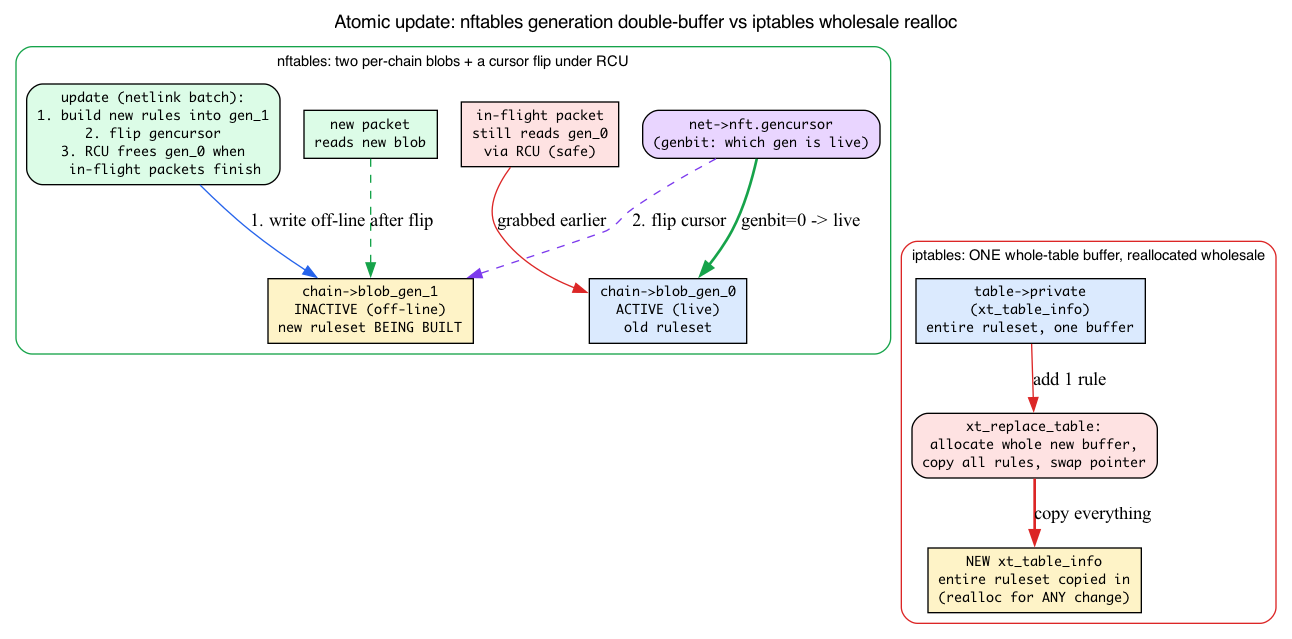
Each chain keeps two compiled rule blobs: blob_gen_0 and blob_gen_1. A per-net generation cursor (net->nft.gencursor) says which one is currently live. The packet path reads the cursor and dereferences the active blob via RCU (RCU — the read-mostly scheme from Day 11: readers take no lock; a writer defers freeing until every in-flight reader finishes its grace period). When you submit an update:
- The kernel builds the new ruleset into the inactive generation’s blob (the one packets aren’t using).
- It flips
net->nft.gencursor— a single cursor write — so new packets start reading the new blob. - In-flight packets that already grabbed the old blob keep using it safely, because RCU won’t free the old blob until they finish.
That double-buffer + RCU is “atomic, no full-table rewrite”: no packet ever sees a half-applied ruleset, and adding one rule touches only the off-line generation, never the whole live table. Deleting a table mid-traffic (as the cleanup step does) is safe for the same reason.
Contrast iptables. ipt_do_table reads the whole-table buffer table->private (READ_ONCE(table->private), net/ipv4/netfilter/ip_tables.c:260), a single struct xt_table_info (include/linux/netfilter/x_tables.h:244). To change anything, iptables must allocate a whole new xt_table_info, copy the entire ruleset into it, and atomically swap the pointer (xt_replace_table). One big buffer, reallocated wholesale for every change — versus nftables’ two small per-chain blobs and a cursor flip.
Read net/netfilter/nf_tables_core.c:250 for the actual loop — it’s only ~100 lines, and you now know every moving part: the register file, the two verdict namespaces, and the generation cursor.
There are no Dumb Questions
Q: If nftables is strictly better, why does iptables still exist?
A: Thirty years of muscle memory and shell scripts. Countless firewall configs, container runtimes, and cloud images emit
iptablescommands; you can’t rewrite them all overnight. Theiptables-nftshim bridges the gap — it parses legacyiptablessyntax and programs nftables underneath, so old tooling keeps working while the real engine is the modern one.Q: My anonymous set
{ 10.0.0.1, 10.0.0.2 }— is that the hash backend or the tree?A: The hash (
rhashtable, O(1)). They’re plain exact keys with noflags interval, so the set-selection logic picksnft_set_hash.c. You’d only get the rbtree backend by asking for ranges (flags interval, e.g. a CIDR) — exactly the backend-selection rule from the sets section.Q: Can one rule mix a data register and the verdict if they alias?
A: Yes — that’s precisely what the
unionbuys. A rule freely writes data into registersNFT_REG32_00..15(which live atdata[4..19]) while the verdict register occupiesdata[0..3]. They don’t collide, so a single chain run carries both the values being compared and the running verdict in one register file.
iptables compatibility
Modern systems ship iptables-nft — a compatibility shim that translates legacy iptables commands into nftables rules under the hood. The legacy iptables-legacy (which uses the xt_tables backend) still exists but is deprecated.
update-alternatives --display iptables # shows which backend you have
If iptables-nft is the active alternative, your iptables commands populate nftables tables (visible via nft list tables). If iptables-legacy, they go to the old ip_tables backend.
Today’s experiment
# Inspect what's running
sudo nft list tables
sudo nft list ruleset

# Build a small ruleset
sudo nft add table inet test
sudo nft 'add chain inet test myinput { type filter hook input priority 0 ; }'
# nftrace/counter must precede the terminal drop (see "Why ordering matters" above):
# once drop fires, nft_do_chain returns and any later expression/rule never runs.
sudo nft add rule inet test myinput meta nftrace set 1
sudo nft add rule inet test myinput tcp dport 12345 counter drop

# In another terminal, monitor
sudo nft monitor trace &

# Test (connect-scan + 2s timeout so each command returns on its own — no Ctrl-C)
nc -z -w2 localhost 12345 ; echo "exit=$?"   # blocked: hangs ~2s then times out, exit!=0
nc -z -w2 localhost 22    ; echo "exit=$?"   # allowed: exit 0 if sshd is listening

# See counters — the dport 12345 rule's counter should show at least one packet
# per nc -z attempt (each SYN to the dropped port is counted before the verdict)
sudo nft list table inet test
#   ...
#   chain myinput {
#       type filter hook input priority filter; policy accept;
#       meta nftrace set 1
#       tcp dport 12345 counter packets 6 bytes 360 drop
#   }
# (packets/bytes scale with how many times you ran nc; 0 here would mean the
#  counter was placed after the verdict and never evaluated — see the note above.)

# Clean up — kill the background monitor too, then drop the table
sudo pkill -f 'nft monitor trace'
sudo nft delete table inet test
nftrace causes packets matching the rule to be logged via nft monitor trace. Because the nftrace rule runs before the terminal drop, the trace for nc -z localhost 12345 shows the tcp dport 12345 match followed by the drop verdict — the whole point of the experiment. (Had nftrace been added after the drop rule, the dropped packet would never reach it and only port-22 traffic would be traced.) This is the control flow from the VM section made visible: meta nftrace set 1 leaves the verdict at NFT_CONTINUE, so evaluation continues to the drop, which sets NF_DROP and returns.
Note that nftables drop sends no RST, so a blocked connection shows up as a ~2-second hang (the nc -w2 timeout) and a non-zero exit, not an instant “connection refused”. Port 22 only succeeds if sshd is actually listening; if it isn’t, start it first or expect a fast “refused”.
See iptables-nft conversion
# If iptables is the nft compat shim:
sudo iptables -A INPUT -p tcp --dport 12346 -j DROP
sudo nft list ruleset    # see the rule appear in an nft table named 'ip filter'

sudo iptables -D INPUT -p tcp --dport 12346 -j DROP   # clean up exactly this rule
What to read in the kernel
-
net/netfilter/nf_tables_core.c:250—nft_do_chain. The runtime VM. Read end to end (~100 lines). Notice thenft_regsstructure — each chain run gets a fresh register file backed by a 20-u32scratch array (NFT_REG32_NUM = 20), whose first four slots alias the verdict register, leaving 16 addressable data registers (NFT_REG32_00..15,NFT_REG32_COUNT == 16). The generic dispatch pattern (expr_call_ops_eval→expr->ops->eval(expr, regs, pkt)) is how each kind of expression contributes; thenft_cmp_fast_ops/nft_payload_fast_opsladder is just an inlined fast path for the common ones. The per-ruleregs.verdict.code = NFT_CONTINUEseed (:274), theif (regs.verdict.code != NFT_CONTINUE) break;(:287), and the terminalswitch (... & NF_VERDICT_MASK)(:306) are the whole control-flow story. The generation cursor (net->nft.gencursor,:259) selectingblob_gen_0/blob_gen_1(:268-270) is the atomic-update mechanism. -
include/net/netfilter/nf_tables.h—struct nft_regs(line 122),#define NFT_REG32_NUM 20(line 112, the scratch-array width),struct nft_verdict(line 100), and the kernel comment “The first four data registers alias to the verdict register” (lines 119–120). The 16 addressable data registers andNFT_REG32_COUNT == 16live in the UAPI header (include/uapi/linux/netfilter/nf_tables.h:30-55). -
net/netfilter/nf_tables_api.c— netlink interface for adding/removing rules. ~12000 lines. Don’t read straight; key entries:nf_tables_newrule,nf_tables_delrule,nf_tables_dump_chains. This is where the transactional, generation-flipping updates are processed. -
net/netfilter/nft_*.c— individual expression implementations. Pick a few short ones to read:nft_immediate.c— sets a register value or a verdict (nft_immediate_evalat line 18 is a one-liner).nft_payload.c— loads packet bytes into a register.nft_cmp.c— compares a register against a constant.nft_lookup.c— set membership test.nft_meta.c— loads skb metadata.
Sizes vary (
nft_lookup.c~290 lines;nft_payload.candnft_meta.cover 1000), but each is self-contained; reading 2-3 teaches you the expression model. -
net/netfilter/nft_set_hash.c/nft_set_rbtree.c/nft_set_pipapo.c— the three set backends.nft_set_hash.cwraps anrhashtable(line 25);nft_set_rbtree.cwraps anrb_root(line 31);nft_set_pipapo.c’s header comment (line 3) documents the concatenated-range algorithm beautifully. Reading the first few lines of each shows the O(1)/O(log N) claims are literally different data structures. -
include/uapi/linux/netfilter/nf_tables.h— UAPI definitions.enum nft_verdicts(lines 68–73:NFT_CONTINUE/BREAK/JUMP/GOTO/RETURN),enum nft_ct_keys(line 1159), expression IDs, etc. -
net/ipv4/netfilter/ip_tables.c:223—ipt_do_table. The legacy iptables runtime. Compare againstnft_do_chain. Notice it has its own micro-loop withxt_matchandxt_targetplugging in, and that it reads the whole-tabletable->privatebuffer (:260) — the singlext_table_info(include/linux/netfilter/x_tables.h:244) that any change must reallocate wholesale. ~140 lines for the hot path. -
man nft— comprehensive but dense. Use the nftables wiki (https://wiki.nftables.org) for examples. -
Documentation/networking/doesn’t have a dedicated nftables doc; the wiki is canonical.
Bullet Points
- nftables = modern (since 3.13); iptables = legacy (still works via
iptables-nftshim). - Single tool
nft; one syntax for v4, v6, ARP, bridge, netdev. - Expression VM (
nft_do_chain) replaces the fixed-shape linear rule walk ofipt_do_table. Each expression is a tiny instruction over a register file backed by a 20-u32scratch array (struct nft_regs,NFT_REG32_NUM = 20); the first four slots alias the verdict register, leaving 16 addressable data registers (NFT_REG32_COUNT == 16). That aliasing is how one loop carries both compared data and the running verdict. - Two verdict namespaces: internal nft verdicts (
NFT_CONTINUE/BREAK/JUMP/GOTO/RETURN) steer the chain walk and never leavenft_do_chain; terminal Netfilter verdicts (NF_ACCEPT/DROP/QUEUE/STOLEN) are returned to the hook.nft_immediateis the bridge. This is whydrop/acceptare terminal andcounter/nftraceare not — and why acountermust precede the verdict. - Native sets and maps are real, distinct kernel modules: exact keys →
rhashtable(O(1));flags interval→ red-black tree (O(log N), because a CIDR is a range a hash can’t answer); concatenated ranges → pipapo. - Atomic transactional updates = a per-chain generation double-buffer (
blob_gen_0/blob_gen_1) selected bynet->nft.gencursor, flipped under RCU. Adding one rule builds the off-line generation and flips a cursor — never the whole-table reallocation iptables’xt_table_inforequires. ct state established,relatedis a stateful conntrack match — a black box today, dissected Day 22.- The same Netfilter hooks (Day 20); different rule engines.
nft list rulesetto inspect;nft monitor traceto debug rule evaluation.
Check question
You write nft add rule inet filter input tcp dport 22 accept and iptables -A INPUT -p tcp --dport 22 -j ACCEPT on the same system. Do they conflict? Do they behave the same?
Click to reveal answer
Answer: Depends on which iptables is installed. If it’s iptables-nft (the compatibility shim, default on modern distros), both commands ultimately add rules to nftables tables — but to different tables (iptables-nft uses its own table named filter in family ip; your nft command added to inet filter). They coexist and both fire — the same packet is evaluated by both rule sets at the LOCAL_IN hook. Whichever has the lower priority (or comes first if same priority) runs first. If both ACCEPT, the packet proceeds; if either DROPs, the packet dies.
If iptables is the legacy binary (iptables-legacy), it uses the entirely separate ip_tables backend (ipt_do_table). Both fire at the same LOCAL_IN hook with priority 0 (filter); both are evaluated. Functionally still coexisting.
To avoid surprises: pick one. Don’t have both your firewall config and your nftables ruleset loaded — debugging “why isn’t my rule working?” gets very hard when you forgot the other one is also running.
Tomorrow
Day 22: conntrack — the stateful firewall machinery that lets ct state established,related accept work.