Day 23 — Traffic control: qdiscs, classes, fq_codel
Today’s mission: understand what sits between IP and the driver, why bufferbloat exists, and how to inspect/configure egress queueing. Along the way you’ll learn the four algorithms the whole subsystem rests on — the token bucket (rate limiting), deficit round robin (fair queueing), CoDel’s control law (latency-bounded dropping), and tc’s classful handle tree (how
1:10-style names and filters work) — plus HTB, which is just two token buckets stacked — so everytccommand in the labs reads like a sentence, not a spell. Total time: ~120 minutes.
What a qdisc is
When IP wants to transmit a packet via dev_queue_xmit (Day 3), the packet doesn’t go straight to the driver. It goes to the device’s qdisc — a queueing discipline. The qdisc decides:
- Which packet leaves next (priority, fairness, scheduling).
- When (rate limiting, pacing).
- Whether to drop a packet (full queue, deliberate AQM — active queue management, see Background 3).
- How to spread packets across multiple flows (per-flow fairness).
Conceptually a qdisc is a function pair:
int  enqueue(struct sk_buff *skb, struct Qdisc *q, struct sk_buff **to_free);
struct sk_buff *dequeue(struct Qdisc *q);
Plus management functions (init, destroy, stats, change-config). Per-qdisc-type implementations are in net/sched/sch_*.c.
How qdiscs are driven
Day 3 introduced __dev_queue_xmit and __qdisc_run. The full picture for egress:
__dev_queue_xmit(net/core/dev.c) picks a TX queue, finds the root qdisc, and callsenqueue.__qdisc_run(net/sched/sch_generic.c:440) is the “pump” — it dequeues and transmits. While there are packets and the qdisc is unlocked, it loops:dequeue→sch_direct_xmit(net/sched/sch_generic.c:344) →netdev_start_xmit(driver).- If
__qdisc_runruns too long, it defers the rest toNET_TX_SOFTIRQto avoid hogging the CPU.
The pump is invoked from two places:
- The xmit path (after a successful enqueue, while still in process context).
- The TX softirq (when the device frees skbs and signals “more room”).
That’s the recap. Everything below is the policy layer: the dequeue function gets to be clever, and the cleverness is built from a small handful of algorithms. We’ll teach each one before the lab that leans on it.
Background 1: The token bucket — how rate limiting actually works
Most of today’s labs revolve around one idea, and the word for it appears in the name of two qdiscs (tbf = token bucket filter; HTB = Hierarchical Token Bucket) — yet it’s never defined. Let’s fix that first, because once you have it, rate, burst, ceil, and “why does it drop instead of queue?” all become obvious.
The intuition: a bucket of permission slips
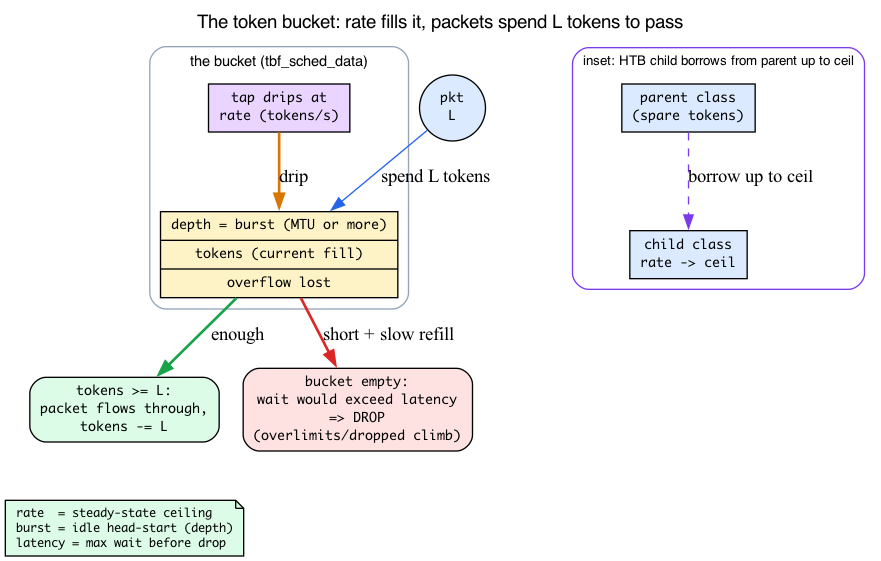
Imagine a bucket that a tap drips coins into at a constant rate — say 1 million coins per second. The bucket has a maximum depth: once full, extra coins overflow and are lost. To send a packet of length L bytes, you must spend L coins from the bucket. If the bucket holds at least L, the packet goes out immediately and L coins are removed. If it doesn’t, the packet has to wait until enough coins have dripped in.
Those coins are called tokens. This gives you three knobs:
rate— how fast the tap drips. This is the long-run steady-state ceiling: averaged over time, you can’t send faster than the tap fills the bucket.burst(a.k.a.buffer, the bucket depth) — how many unused tokens can pile up while you’re idle. After a quiet period the bucket is full, so you can send a short burst faster thanrate— exactly as fast as you can drain a full bucket — before settling back to the drip rate.latency— an iproute2-only knob (there is nolatencyfield in the kernel struct). At configuration timetcconverts it into a backlog byte limit (roughlyrate * latency + burst) and hands the kernel thatlimit, which sizes a bounded inner FIFO. A token-short packet is queued in that FIFO, not dropped; a tightlatencyjust makes the FIFO shallow.
Two consequences fall right out of this picture:
burstmust be ≥ one MTU. A bucket too shallow to ever hold a single packet’s worth of tokens can never send that packet — there’s no amount of waiting that fills a bucket past its own depth. The kernel comment says so literally.- A shallow bucket + tight latency drops sooner under sustained overload. A tight
latencyyields a smalllimit, hence a shallow inner FIFO. Token-short packets are backlogged there and drained as tokens accrue; but once that shallow FIFO fills, further arrivals are dropped at enqueue. So a tightlatencydoesn’t drop “instead of” queuing — it gives you a small queue that overflows quickly. This is the behavior you’ll observe in today’stbflab.
The concrete struct: tbf in v7.1
Open net/sched/sch_tbf.c. The per-qdisc state is exactly the bucket model:
struct tbf_sched_data {
    u32  limit;
    u32  max_size;
    s64  buffer;     /* Token bucket depth/rate: MUST BE >= MTU/B   (sch_tbf.c:102) */
    s64  mtu;
    struct psched_ratecfg rate;
    struct psched_ratecfg peak;
    /* Variables */
    s64  tokens;     /* Current number of B tokens                  (sch_tbf.c:108) */
    s64  ptokens;    /* Current number of P tokens                  (sch_tbf.c:109) */
    s64  t_c;        /* Time check-point */
    ...
};
buffer is the bucket depth (burst), tokens is the current fill level. (There’s a second bucket — ptokens/peak — used when you configure a peakrate, an optional second, faster ceiling. Ignore it for the basic case.)
Now read the dequeue path (sch_tbf.c:285 onward). It’s the bucket model in code:
s64 toks;
s64 ptoks = 0;
...
now  = ktime_get_ns();
toks = min_t(s64, now - q->t_c, q->buffer);   /* drip: add tokens for elapsed time, cap at depth */
toks += q->tokens;
if (toks > q->buffer)
    toks = q->buffer;                          /* overflow: can't exceed bucket depth */
toks -= (s64) psched_l2t_ns(&q->rate, len);    /* spend: this packet costs `len` worth of tokens */

if ((toks|ptoks) >= 0) {                        /* enough tokens? send it. */
    ...
    q->tokens = toks;                           /* commit the spend */
    return skb;
}
qdisc_watchdog_schedule_ns(&q->watchdog, now + max_t(long, -toks, -ptoks));  /* else: wait */
Tokens are accounted in time units here (nanoseconds of rate), which is just a unit change from “bytes” — psched_l2t_ns converts a packet length to “how long the rate takes to earn that many tokens.” When toks goes negative, the qdisc schedules a watchdog timer for when enough tokens will have accrued and returns NULL; the packet stays backlogged in the inner FIFO until then. It is dropped only at enqueue — when it exceeds max_size/burst (sch_tbf.c:253) or when the inner FIFO is already full (sch_tbf.c:261, qdisc_qstats_drop). Note overlimits (bumped at sch_tbf.c:331 on every token-short dequeue) counts deferred dequeues — rate-limiting events — which is distinct from dropped. On a tight tbf you see all three of Sent/overlimits/dropped climb: overlimits because nearly every dequeue is rate-limited, dropped once the shallow FIFO overflows.
The default: fq_codel
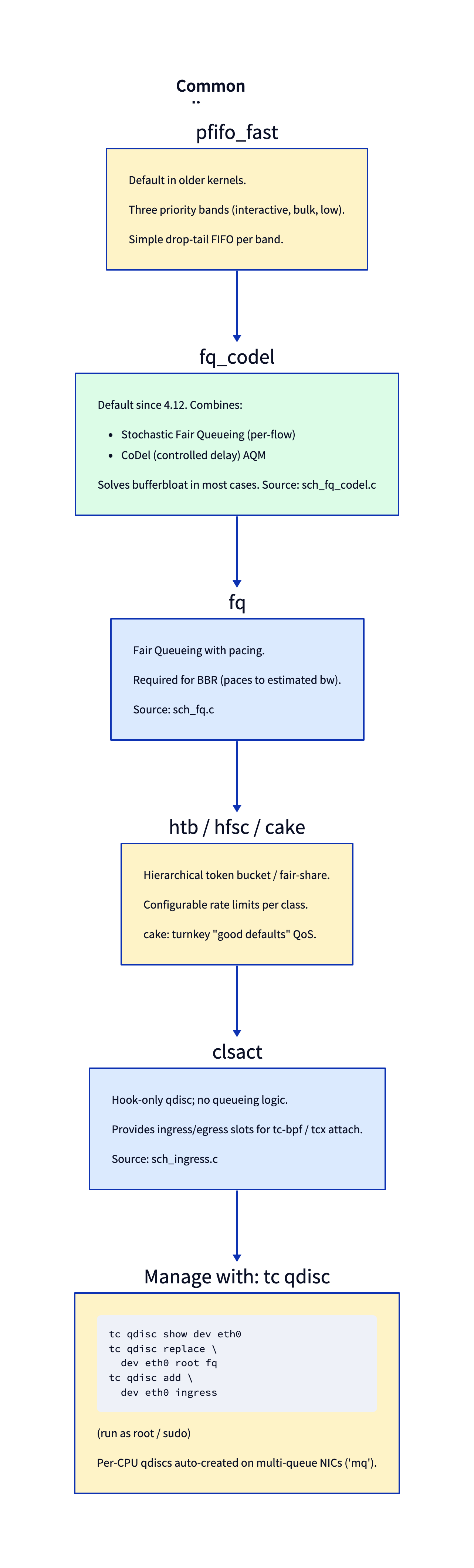
The de-facto default on most Linux distros (systemd sets net.core.default_qdisc=fq_codel; the upstream kernel default is still pfifo_fast, sch_generic.c:37), and a sensible default for almost all workloads. net/sched/sch_fq_codel.c. Combines two ideas — fair queueing and CoDel — each of which is its own algorithm. Let’s teach both before reading the combined qdisc.
Background 2: Deficit Round Robin — fairness measured in bytes
fq_codel hashes each flow’s 5-tuple into one of N buckets (default 1024), each with its own FIFO. The hard part is the scheduler: when N buckets all have packets waiting, whose packet leaves next? “Round robin — one packet from each, in turn” sounds fair but isn’t.
Why plain round-robin is unfair
Suppose flow A sends 1500-byte packets and flow B sends 60-byte packets, both as fast as they can. Plain round-robin gives each one packet per turn — so over 1000 turns, A sends 1,500,000 bytes and B sends 60,000 bytes. A got 25× the bandwidth despite “equal turns.” Round-robin is only fair if every packet is the same size, which on a real link they never are.
The fix is to schedule in bytes, not packets. That algorithm is Deficit Round Robin (DRR).
The deficit counter
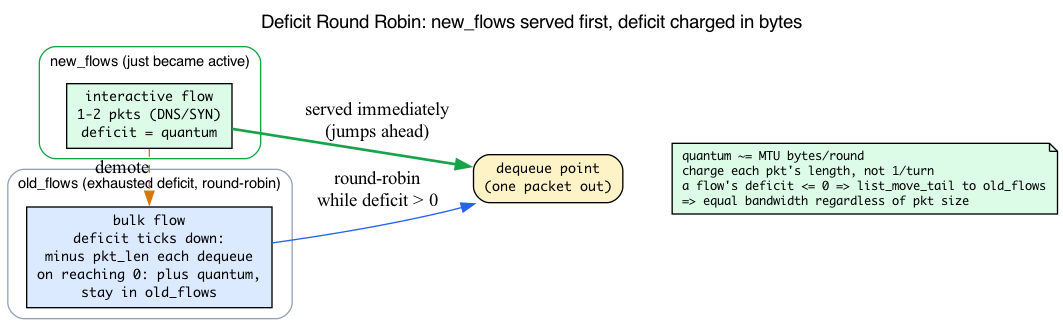
Each flow carries a credit called its deficit. The scheduler walks the flows; when it visits a flow it adds quantum bytes to that flow’s deficit, then dequeues packets while deficit > 0, subtracting each packet’s length from the deficit. When the deficit goes ≤ 0, the flow has spent its allowance for this round; it yields its turn and waits to be topped up next time around.
Over many rounds, every backlogged flow gets approximately quantum bytes per round — equal bandwidth, independent of packet size. The big-packet flow simply gets fewer packets per round to stay within the same byte budget. The default quantum is the device MTU, so a flow sends roughly one MTU worth of bytes per round.
The new/old split — the latency trick
DRR alone is fair but not snappy. fq_codel adds a second idea: it keeps two flow lists. A flow that just became active is appended to new_flows and served first; a flow that has exhausted its deficit drops down to old_flows and round-robins there. So a single DNS query, or a TCP SYN, or one HTTP request — a flow with one or two packets — lands in new_flows and jumps ahead of a long-running bulk transfer parked in old_flows. A forced pass back through old_flows prevents the bulk flows from ever starving.
The concrete struct: fq_codel in v7.1
In net/sched/sch_fq_codel.c, each flow holds:
struct fq_codel_flow {
    ...
    int  deficit;    /* per-flow credit                     (sch_fq_codel.c:46) */
    ...
};
and the qdisc holds:
u32  quantum;        /* psched_mtu(qdisc_dev(sch));          (sch_fq_codel.c:56) */
struct list_head new_flows;  /* list of new flows           (sch_fq_codel.c:66) */
struct list_head old_flows;  /* list of old flows           (sch_fq_codel.c:67) */
On activation a flow is credited (sch_fq_codel.c:213):
WRITE_ONCE(flow->deficit, q->quantum);
and the dequeue loop is the DRR algorithm verbatim (sch_fq_codel.c:290-319, begin: label through the deficit charge):
begin:
    head = &q->new_flows;          /* serve new flows first */
    if (list_empty(head)) {
        head = &q->old_flows;      /* then old flows */
        ...
    }
    flow = list_first_entry(head, struct fq_codel_flow, flowchain);

    if (flow->deficit <= 0) {                              /* out of credit? */
        WRITE_ONCE(flow->deficit, flow->deficit + q->quantum);  /* top up */
        list_move_tail(&flow->flowchain, &q->old_flows);   /* demote new -> old */
        goto begin;
    }
    skb = codel_dequeue(...);                              /* CoDel runs HERE — see below */
    if (!skb) {
        /* force a pass through old_flows to prevent starvation */
        if ((head == &q->new_flows) && !list_empty(&q->old_flows))
            list_move_tail(&flow->flowchain, &q->old_flows);
        ...
        goto begin;
    }
    WRITE_ONCE(flow->deficit, flow->deficit - qdisc_pkt_len(skb)); /* charge the bytes */
q->quantum is set to the device MTU at init (sch_fq_codel.c:481: q->quantum = psched_mtu(qdisc_dev(sch));).
Background 3: CoDel’s control law — latency-bounded dropping
Notice the codel_dequeue(...) call buried in that loop. That’s the AQM — Active Queue Management — running inside each flow’s bucket. Where DRR decides which flow sends, CoDel decides whether to drop to keep latency down.
Recall bufferbloat from Day 16 (Day 16, Background 5): oversized buffers add standing delay because loss-based TCP only backs off when the buffer overflows — so a too-big buffer fills, stays full, and every packet inherits the full queueing delay. CoDel is the answer to that. We won’t re-teach bufferbloat; we’ll teach the control law that fixes it, which is new.
Sojourn time, not queue length
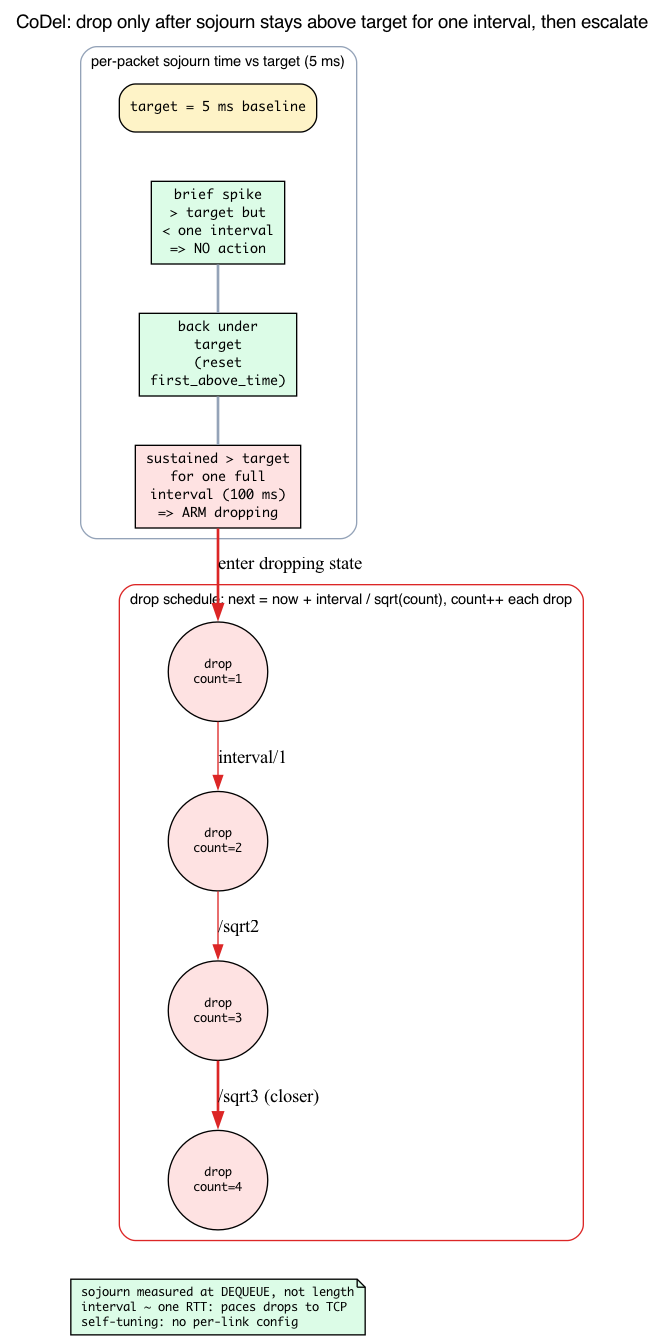
The naive AQM watches queue length and drops when it’s “too long.” CoDel instead measures each packet’s sojourn time — how long it actually sat in the queue — computed at dequeue time. Length is a poor proxy (a long queue draining fast is fine); the time a packet waited is the thing you actually care about.
The two numbers: target and interval
CoDel has exactly two parameters, and they’re set once for all links (include/net/codel_impl.h:56-57):
params->interval = MS2TIME(100);   /* 100 ms */
params->target   = MS2TIME(5);     /*   5 ms */
target(5 ms) is the standing-queue delay CoDel tries to bound. A momentary spike above 5 ms is fine — bursts happen.interval(100 ms) is the patience. CoDel only acts once sojourn time stays abovetargetcontinuously for oneinterval. That’s thefirst_above_timetest (include/net/codel.h:124/ field:134): on the first crossing above target the field is set to a deadline = (the moment sojourn first exceeded target) + oneinterval(codel_impl.h:139); dropping arms only oncenowpasses that deadline (codel_impl.h:140).intervalis roughly one worst-case RTT, giving TCP time to react to each drop before the next.
The escalation: drops that get closer together
Once CoDel enters dropping state, it does not drop everything. It drops on a schedule that escalates. The next drop time is
/* codel_control_law: next drop at t + interval/sqrt(count)   (codel_impl.h:97-102) */
return t + reciprocal_scale(interval, rec_inv_sqrt << REC_INV_SQRT_SHIFT);
i.e. next = t + interval / sqrt(count). count increments per drop (codel_impl.h:186: WRITE_ONCE(vars->count, vars->count + 1);). Crucially, for each escalating drop t is the previous drop_next (codel_impl.h:191-194, :210-213), not the current time — only the very first drop after arming is measured from now (codel_impl.h:253). Re-basing each drop on the previous scheduled time is what keeps the spacing steady at interval/sqrt(count) instead of drifting. So the more drops it takes to bring latency back under target, the faster the subsequent drops come — a gentle nudge that ramps into firmer pressure. The kernel avoids an actual sqrt/divide by maintaining 1/sqrt(count) with a Newton-step approximation (codel_Newton_step, codel_impl.h:80, called right after the increment at :187).
This target + interval pair is why CoDel is self-tuning — no per-link configuration. target bounds the standing queue; interval ≈ one RTT paces the drops to TCP’s reaction time. And it complements DRR: DRR isolates flows from each other; CoDel keeps each flow’s own bucket shallow. fq_codel wires the defaults in at sch_fq_codel.c:484 (codel_params_init(&q->cparams);).
Combined
fq_codel runs DRR-based fair queueing (the “FQ”) as the per-flow scheduling — with new/old-flow prioritization for latency — and CoDel as the AQM inside each bucket. You get fairness and latency control. Inspect:
tc qdisc show dev eth0
# qdisc fq_codel 0: root refcnt 2 limit 10240p flows 1024 quantum 1514 target 5ms
limit = max packets across all flows; flows = number of buckets; quantum = the DRR round-robin credit (≈ MTU); target = CoDel’s 5 ms latency target.
fq — for BBR pacing
net/sched/sch_fq.c. Different from fq_codel. Per-flow pacing: each packet has a “send time” computed from the socket’s pacing rate (set by BBR via sk_pacing_rate). The qdisc holds packets back so they emit at exactly that rate.
BBR requires fq (or hardware pacing). Without it, BBR’s bandwidth estimate is corrupted by burstiness. If you sysctl tcp_congestion_control=bbr, also tc qdisc replace dev <dev> root fq. (Pacing and the bufferbloat motivation were taught in Day 16 Background 5 — we lean on them here, not re-teach.)
Background 4: tc’s classful tree — handles, classes, and filters
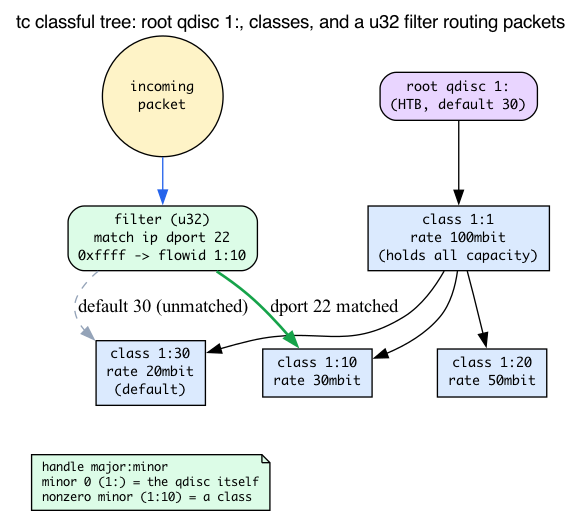
The HTB and clsact labs below hand you a dense thicket of colon-numbered names — handle 1:, classid 1:1, parent 1:1 classid 1:10, default 30, flowid 1:10 — plus a cryptic u32 match ip dport 22. None of it is hard once you know the naming scheme. Here it is.
Handles: major:minor
Every qdisc and class on a device is named by a 32-bit handle, written major:minor. Both halves are 16-bit (include/uapi/linux/pkt_sched.h:68-72):
#define TC_H_MAJ_MASK (0xFFFF0000U)
#define TC_H_MIN_MASK (0x0000FFFFU)
#define TC_H_MAJ(h) ((h)&TC_H_MAJ_MASK)
#define TC_H_MIN(h) ((h)&TC_H_MIN_MASK)
#define TC_H_MAKE(maj,min) (((maj)&TC_H_MAJ_MASK)|((min)&TC_H_MIN_MASK))
The convention:
- The major number identifies the qdisc.
- Minor 0 (written
1:) is the qdisc itself. - A nonzero minor (
1:10) is a class living inside that qdisc. rootis the special reserved handleTC_H_ROOT=0xFFFFFFFF(pkt_sched.h:75).
Classless vs classful
A classless qdisc (pfifo_fast, fq_codel, tbf) is a single black box: packets in, packets out, no internal structure you can name. A classful qdisc (HTB) is a tree: the root qdisc holds classes, and each class can hold child classes or a leaf qdisc. The tc syntax mirrors the tree:
parent 1: classid 1:1— “create class1:1directly under the root qdisc1:.”parent 1:1 classid 1:10— “create class1:10under parent class1:1.”default 30— “any packet that no filter classifies lands in class1:30.”
Filters: who decides which class a packet enters?
A class doesn’t grab packets by itself — a filter (classifier) routes them. tc filter ... u32 match ip dport 22 0xffff flowid 1:10 reads: “packets whose TCP destination port is 22 → send to class 1:10.” u32 is a classifier that matches raw header bytes by offset and mask — fast and general. The BPF-based classifier is cls_bpf / tcx (that’s what the clsact lab’s bpf da obj prog.o invokes).
Background 5: HTB — two token buckets per class, plus borrowing
Now HTB makes sense. net/sched/sch_htb.c. It divides bandwidth among classes hierarchically. The classic example: “give SSH 30 Mbps reserved, mail 50 Mbps, everything else 20 Mbps; allow each class to burst into unused capacity.”
That “burst into unused capacity” is the whole point, and it’s built from the token bucket you already learned — except HTB gives each class two buckets (sch_htb.c:97-98, 120):
struct psched_ratecfg rate;
struct psched_ratecfg ceil;                          /* sch_htb.c:97 */
s64 buffer, cbuffer;   /* token bucket depth/rate     (sch_htb.c:98) */
...
s64 tokens, ctokens;   /* current number of tokens    (sch_htb.c:120) */
rate+tokens/buffer— the guaranteed rate bucket.ceil+ctokens/cbuffer— the ceiling bucket, the absolute max.
A class is always in one of three modes (sch_htb.c:70-71, field cmode at :136):
enum htb_cmode {
    HTB_CANT_SEND,    /* class can't send and can't borrow */
    HTB_MAY_BORROW,
    HTB_CAN_SEND,
};
A class first sends from its own rate tokens (HTB_CAN_SEND). When those run out but the ceil bucket still has room, it enters HTB_MAY_BORROW and borrows unused tokens from its parent, up to ceil. That borrow-up-to-ceil is exactly the “burst into spare capacity” the example promises — a class with light siblings can climb from its guaranteed rate all the way to ceil, because the parent has tokens to lend.
# Use a lab interface, not your real uplink.
sudo ip link add tc-lab type dummy
sudo ip link set tc-lab up
sudo tc qdisc add dev tc-lab root handle 1: htb default 30
sudo tc class add dev tc-lab parent 1: classid 1:1 htb rate 100mbit
sudo tc class add dev tc-lab parent 1:1 classid 1:10 htb rate 30mbit ceil 100mbit
sudo tc class add dev tc-lab parent 1:1 classid 1:20 htb rate 50mbit ceil 100mbit
sudo tc class add dev tc-lab parent 1:1 classid 1:30 htb rate 20mbit ceil 100mbit
sudo tc filter add dev tc-lab parent 1: protocol ip prio 1 u32 \
    match ip dport 22 0xffff flowid 1:10
# cleanup
sudo ip link del tc-lab
Reading it with the four backgrounds in hand: handle 1: is the root HTB qdisc; 1:1 is a 100mbit parent class holding all the capacity; 1:10/1:20/1:30 are leaf classes with guaranteed rates that may each borrow up to ceil 100mbit; the u32 filter steers SSH (dport 22) into 1:10; everything unmatched falls to default 30 → class 1:30. rate = guaranteed minimum; ceil = max if there’s spare capacity. Powerful but complex; for most users fq_codel is simpler and as effective.
clsact — the BPF hook scaffold
net/sched/sch_ingress.c (~376 lines, mostly registration). A special qdisc that has no queueing logic — it reuses the classful filter machinery from Background 4 but does no scheduling. All it does is expose the reserved ingress and egress hook minors so tc-bpf classifier programs can attach to both directions of a device. Those reserved minors are (pkt_sched.h:80-81):
#define TC_H_MIN_INGRESS  0xFFF2U
#define TC_H_MIN_EGRESS   0xFFF3U
Day 16/17 of the eBPF book covered classic tc-bpf section names such as SEC("tc_ingress") and the modern tcx replacement.
sudo ip link add tc-lab type dummy
sudo ip link set tc-lab up
sudo tc qdisc add dev tc-lab clsact
sudo tc filter add dev tc-lab ingress bpf da obj prog.o sec tc_ingress
# cleanup
sudo ip link del tc-lab
Modern code uses tcx (bpf link-based) instead, which doesn’t need clsact setup.
Bufferbloat — the problem fq_codel solves
The experiment below makes bufferbloat visible: saturate the uplink and watch ping RTT under fq_codel versus pfifo_fast. The mechanism (loss-based TCP fills an oversized buffer and every packet inherits the standing delay) was taught in Day 16 Background 5; CoDel’s control law in Background 3 above is the per-flow cure.
Test it (needs iperf3: sudo apt install -y iperf3; replace some-server with a host you can saturate):
# Capture the current qdisc so we can put it back exactly.
orig=$(tc qdisc show dev eth0 | head -1); echo "was: $orig"

# Default: fq_codel
ping -c 5 8.8.8.8                  # baseline RTT, say 30ms
iperf3 -c some-server -t 60 &      # saturate uplink
ping -c 5 8.8.8.8                  # should stay close to 30ms — fq_codel keeps queue short
pkill -f 'iperf3 -c'               # stop this saturator BEFORE changing qdiscs (clean contrast)

# Force pfifo_fast (drop-tail, no AQM)
sudo tc qdisc replace dev eth0 root pfifo_fast
iperf3 -c some-server -t 60 &
ping -c 5 8.8.8.8                  # may shoot up to seconds
pkill -f 'iperf3 -c'               # stop the saturator

# Restore the qdisc your interface had before this test (commonly fq_codel).
sudo tc qdisc replace dev eth0 root fq_codel
The contrast is stark on home networks with cable modems. Better routers ship fq_codel (or its variant cake) by default precisely to fix this.
There are no Dumb Questions
Q: If
burstlets me send faster thanrate, can I just set a hugeburstto never be limited?A: No —
burstonly buys you a one-time head start equal to the bucket depth, accumulated while idle. Once you’re sending steadily, the bucket drains as fast as the tap fills it, so your sustained rate is pinned torateregardless ofburst. A hugeburstjust means a longer initial spike before you settle. (It also costs latency: a deep bucket can hold a deep backlog.)Q: DRR gives every flow
quantumbytes per round. Doesn’t a flow sending tiny packets get cheated, since it can’t fill a whole quantum?A: It carries the leftover forward — that’s the deficit. A flow that under-spends its quantum this round starts next round with the unspent credit still on the books, so over time it gets its full byte share. The deficit is precisely the memory that makes “bytes per round” fair even when packets don’t divide evenly.
Q: Why does CoDel measure sojourn time at dequeue and not when the packet arrives?
A: Because the thing that hurts is how long the packet actually waited, which you only know when it leaves. Measuring at enqueue would tell you the queue’s length, not its delay — and a long-but-fast-draining queue has low delay. CoDel deliberately ignores length and acts on realized latency.
Q:
fq_codelis fair and low-latency. Why would anyone use HTB?A: When you need policy, not just fairness.
fq_codelshares bandwidth equally among active flows; it can’t express “SSH is guaranteed 30 Mbps even when the bulk transfer wants everything.” HTB’s classes andrate/ceilencode that contract. Many setups use both: HTB to carve guarantees, withfq_codelas the leaf qdisc inside each class.
Today’s experiment
# Inspect current qdiscs
tc qdisc show
tc -s qdisc show dev eth0     # with stats

# Count qdisc pump invocations (the dequeue/transmit loop, __qdisc_run).
# __qdisc_run is the DEQUEUE side, not enqueue — enqueue is the qdisc's
# ->enqueue op called from __dev_xmit_skb, which this probe does not count.
# Your own SSH egress keeps it firing, so expect a small non-zero count every
# 5s (~6-40 on an idle box). Generate traffic (ping -f, iperf3) to watch it
# climb. Runs until you press Ctrl-C.
sudo bpftrace -e '
fentry:__qdisc_run { @ = count(); }
interval:s:5 { print(@); clear(@) }'

# Add a token-bucket rate limit (lab on lo). lo's default qdisc is `noqueue`,
# so that is what we restore to.
trap 'sudo tc qdisc replace dev lo root noqueue 2>/dev/null || true; pkill -f "iperf3 -s" 2>/dev/null || true' EXIT
sudo tc qdisc replace dev lo root tbf rate 1mbit burst 32kbit latency 50ms

# Test: should be slow (~1 Mbit/s). Needs iperf3: `sudo apt install -y iperf3`.
iperf3 -s -p 5201 &
sleep 0.5                                   # let the server start listening
iperf3 -c 127.0.0.1 -p 5201 -t 30 &         # run long enough to sample the queue

# While it runs, sample the qdisc. This tbf (1mbit / 32kbit burst / 50ms) is
# tight enough that its shallow inner FIFO overflows under load, so the reliable
# observables are the CUMULATIVE counters, not the instantaneous backlog.
# (Background 1 explains WHY: latency 50ms sizes a small byte `limit`, so the
# inner FIFO is shallow; token-short packets queue there briefly, and once it
# fills, further arrivals are dropped at enqueue. `overlimits` climbs on every
# rate-limited dequeue — a deferral, distinct from a drop.)
tc -s qdisc show dev lo
# qdisc tbf 8001: root refcnt 2 rate 1Mbit burst ... lat 50ms
#  Sent <bytes> bytes <pkt> pkt (dropped <N>, overlimits <N> requeues 0)
#  backlog 0b 0p requeues 0
# `dropped`/`overlimits`/`Sent` all climb as the tbf rate-limits and SURVIVE
# after the transfer ends (`overlimits` counts deferred dequeues, `dropped`
# counts FIFO overflows at enqueue — distinct signals); `backlog` is
# instantaneous and drains back to `0b 0p` once the client stops, so don't
# expect to "watch it grow" on this tight limit.

wait                                        # let the client finish
pkill -f 'iperf3 -s'                        # stop the background server

# Restore loopback's usual noqueue qdisc
sudo tc qdisc replace dev lo root noqueue
Switch CC to BBR and confirm fq pacing is active
old_cc=$(cat /proc/sys/net/ipv4/tcp_congestion_control)
trap 'sudo sysctl -w net.ipv4.tcp_congestion_control=$old_cc; sudo tc qdisc replace dev lo root noqueue 2>/dev/null || true; pkill -f "iperf3 -s" 2>/dev/null || true' EXIT
sudo modprobe tcp_bbr
sudo sysctl -w net.ipv4.tcp_congestion_control=bbr

# BBR needs fq (or hardware pacing) for its sk_pacing_rate to be honored.
sudo tc qdisc replace dev lo root fq

# Self-contained server for this block (needs iperf3: `sudo apt install -y iperf3`).
iperf3 -s -p 5201 &
sleep 0.5
iperf3 -c 127.0.0.1 -p 5201 -t 20 &        # background it so we can sample mid-flight
sleep 2

# Congestion control must be sampled WHILE the transfer is in flight.
# ss prints the cc as a BARE token (`bbr`), NOT `ca:bbr`; cwnd and pacing_rate
# are on the same per-socket info line:
ss -tin dst 127.0.0.1:5201 | grep -E 'bbr|cwnd'
# Example (from a real bbr socket):
#   bbr wscale:6,10 ... cwnd:37 ... bbr:(bw:...,pacing_gain:2.88672,cwnd_gain:2.88672) pacing_rate 21003088bps
wait
pkill -f 'iperf3 -s' 2>/dev/null || true

# NOTE: loopback has no bandwidth bottleneck, so this confirms BBR is *active*
# (the `bbr` token + a live pacing_rate) and that `fq` is installed — but you
# cannot measure an fq-vs-fq_codel pacing *difference* here. For a real contrast
# you need an actual NIC or a veth+netem bottleneck (see Day 16).

sudo sysctl -w net.ipv4.tcp_congestion_control=$old_cc
sudo tc qdisc replace dev lo root noqueue    # restore
What to read in the kernel
-
net/sched/sch_generic.c:440—__qdisc_run. The pump. Compact (~17 lines): aqdisc_restartloop with budget tracking and the deferred-to-softirq path. Read the helpers it drives (qdisc_restart,sch_direct_xmit) for the full picture. -
net/sched/sch_generic.c:344—sch_direct_xmit. The “actually push to driver” call. Handles the requeue case when the driver returns BUSY. -
net/sched/sch_tbf.c:285— thetbfdequeue path. The token-bucket model in code: drip (now - q->t_c), cap atq->buffer, spendpsched_l2t_ns(&q->rate, len), send iftoks >= 0else schedule the watchdog. The bucket depth isbuffer(:102), the fill leveltokens(:108). -
net/sched/sch_fq_codel.c:185—fq_codel_enqueue. Hash the flow, find the bucket, append (and link the flow intonew_flowsif it just became active). Good warm-up before the DRR dequeue logic. -
net/sched/sch_fq_codel.c:283—fq_codel_dequeue. The interesting one — the DRR new/old-flow loop (:299-318) with the per-flowdeficitaccounting, wrapped aroundcodel_dequeuewhich runs CoDel’s AQM. Walk through to see fairness and latency control in one function. -
include/net/codel_impl.h— CoDel’s control law.codel_params_initsetsinterval = 100 ms,target = 5 ms(:56-57);codel_control_lawreturnst + interval/sqrt(count)(:97-102); the escalation iscount + 1at:186pluscodel_Newton_step(:80) avoiding the divide. -
net/sched/sch_fq.c—fqfor BBR. Read the per-flow pacing logic. Noticef->time_next_packet(sch_fq.c:94) per flow tracks “earliest send time” to honor the pacing rate; the qdisc-wide field isq->time_next_delayed_flow. -
net/sched/sch_htb.c— HTB. Long file (~2000 lines) but the core is clear: classful tree (htb_classifyat:219,htb_lookup_leafat:815), per-class two token buckets (tokens/bufferforrate,ctokens/cbufferforceil,:98/:120), three-mode borrowing (enum htb_cmodeat:70), dequeue picks the highest-priority class with tokens. -
net/sched/sch_ingress.c— clsact. ~376 lines; mostly registration. It exposes the reserved ingress/egress hook minors (TC_H_MIN_INGRESS/TC_H_MIN_EGRESS,include/uapi/linux/pkt_sched.h:80-81). The actual BPF dispatch is viatcx(modern) or the tc-bpf classifier incls_bpf.c. -
include/uapi/linux/pkt_sched.h:68-75— the handle macros (TC_H_MAJ/TC_H_MIN/TC_H_MAKE) andTC_H_ROOT. This is themajor:minornaming scheme behind every1:10-style id. -
include/net/sch_generic.h—struct Qdisc,struct Qdisc_ops. The vtable each qdisc implements. -
Source comments in
net/sched/sch_fq_codel.candinclude/net/codel*.hare short and clear; for background see RFC 8289 and bufferbloat.net (the per-qdiscDocumentation/networking/sch_*.txtfiles no longer exist in the tree). -
External: bufferbloat.net has the canonical writeup of the problem fq_codel solves.
Bullet Points
- qdiscs sit between IP and driver; control queueing, pacing, dropping on egress.
- A token bucket refills
tokensatrateup to depthburst; a packet spends its length in tokens and waits (backlogged in a bounded inner FIFO) if short.burstmust be ≥ MTU. Thelatencyknob is iproute2-only —tcconverts it to that FIFO’s bytelimit(≈rate*latency + burst); a packet is dropped at enqueue only when it exceedsburst/max_sizeor the FIFO is full. This istbf(sch_tbf.c:102/108) and the heart of HTB. - De-facto distro default (via systemd; upstream kernel default is
pfifo_fast):fq_codel= DRR fair queueing + CoDel early-drop AQM. - DRR schedules in bytes: each flow gets
quantum(≈MTU) credit per round and is charged each packet’s length, so packet size doesn’t skew fairness. Thenew_flows/old_flowssplit lets sparse interactive flows jump ahead (sch_fq_codel.c:46/66/299). - CoDel measures per-packet sojourn time, drops only once it stays above
target(5 ms) for oneinterval(100 ms), then escalates drops atinterval/sqrt(count)(codel_impl.h:56/97/186). Self-tuning, no per-link config. fq: per-flow pacing; required for BBR’s bandwidth estimate to work.- Handles are
major:minor: minor 0 = the qdisc, nonzero = a class;root=TC_H_ROOT(pkt_sched.h:68-75). Classful qdiscs (HTB) form a tree; filters (u32, cls_bpf) classify packets into classes. - HTB: per-class two token buckets (
rateandceil); classes borrow up fromratetowardceilviaHTB_MAY_BORROW(sch_htb.c:70/98/120). Hierarchical bandwidth division for classful QoS. clsactis a hook scaffold for tc-bpf (no queueing logic); exposes ingress/egress hook minors (pkt_sched.h:80-81).- The dispatch loop is
__qdisc_run(net/sched/sch_generic.c:440), driven from xmit and fromNET_TX_SOFTIRQ. - Inspect with
tc -s qdisc show dev DEV. Modify withtc qdisc replace dev DEV root <type>. - Bufferbloat is the problem AQMs (CoDel, FQ_PIE, CAKE) solve.
Check question
You set tc qdisc replace dev eth0 root pfifo_fast and saturate the uplink. SSH becomes unresponsive. Why?
Click to reveal answer
Answer: pfifo_fast is drop-tail with three priority bands and no AQM. Bulk transfer fills the buffer (say 1000 packets); SSH packets queue behind the bulk, waiting for it to drain. With ms-per-packet drain rate at typical uplinks, latency goes from ms to seconds. The buffer hides loss from TCP — TCP keeps pushing more bytes because it sees no drops. Only when the buffer overflows does TCP get a signal, and by then the queue has been steady-state full for a long time.
fq_codel solves both halves:
- Per-flow fairness (DRR): SSH and bulk hash into different buckets, dequeued by deficit round robin in bytes — and SSH, being sparse, sits in
new_flowsand is served first. Bulk can’t starve SSH even if it wants to. - Early drop (CoDel): when a packet’s sojourn time stays above the 5 ms target for one 100 ms interval, CoDel drops, escalating at
interval/sqrt(count). TCP sees the drops and backs off; the buffer drains.
Restore with tc qdisc replace dev eth0 root fq_codel.
Tomorrow
Day 24: SO_REUSEPORT and socket steering. Multi-process servers without thundering herd.