Day 1 — First fentry program with ringbuf
Today’s mission: spy on every file deletion on your system, in real time, with a program that runs inside the kernel and can’t crash it. Along the way, meet the whole machine that makes this possible — the BPF virtual CPU, the one syscall that loads everything, the just-in-time compiler, and the little code-patching trick that lets you tap a running kernel without a hiccup. Total time: ~120 minutes.
So you want to spy on a kernel function
You’d think this would be hard. The kernel is busy. It runs thousands of functions per second across dozens of CPUs. It does not know you exist. How do you get it to tap you on the shoulder every time something calls filename_unlinkat?
You install a doorbell. That’s fentry.
Here’s the secret on x86_64 builds with function tracing enabled. Traceable kernel functions reserve an entry patch site, often shown as a 5-byte NOP slot. It sits there doing nothing until ftrace/BPF turns it into an entry call path.
filename_unlinkat:
    nop   nop   nop   nop   nop      ← these 5 bytes are reserved for you
    push  %rbp                       ← the actual function body starts here
    mov   %rsp, %rbp
    ...
Whose 5 bytes are those, anyway?
That slot is not BPF’s, and BPF didn’t put it there. It exists because the kernel is built with function-entry instrumentation (-pg / -mfentry): the compiler emits a call __fentry__ at the top of every traceable function (the entry stub is SYM_FUNC_START(__fentry__) at arch/x86/kernel/ftrace_64.S:148). At boot, ftrace — the kernel’s built-in function tracer, around since 2008 — overwrites each of those call sites with a 5-byte NOP. The NOP it writes is literally x86_nops[5] (ftrace_nop_replace() returns it at arch/x86/kernel/ftrace.c:66; the table is at arch/x86/kernel/alternative.c:91).
So the patch site is ftrace’s. fentry/BPF doesn’t own it — it borrows it by registering an ftrace “direct call” that repoints the site at your trampoline. You don’t need to learn ftrace today; just hold the one-line model: the compiler reserves the slot, ftrace owns it, fentry hangs your program off it.
When you attach an fentry program, the kernel atomically patches that reserved site into the architecture’s ftrace/BPF entry path. That path reaches a generated trampoline. The trampoline saves arguments, calls your BPF program with them, restores everything, and then lets filename_unlinkat run as if nothing happened. The exact instruction is architecture- and config-dependent; the important model is patch site → trampoline → original function body.

What the trampoline is actually for: an ABI bridge
“Saves arguments, calls your program with them” sounds like magic until you ask: why does it need to save anything? The answer is that the function being traced and your BPF program are called two incompatible ways.
filename_unlinkat is an ordinary C function. On x86-64, the System V ABI says its first argument arrives in register rdi, its second in rsi, and so on:
int filename_unlinkat(int dfd, struct filename *name)   /* fs/namei.c:5536 */
/*                        ↑ rdi          ↑ rsi                              */
A BPF program, by contrast, is not called with arguments spread across native registers. By convention every BPF program receives exactly one pointer — a pointer to a u64[] context array — in its first BPF register, R1 — the BPF VM’s registers get their full introduction in “Meet the cast” below; for now just hold “R1 = the one pointer your program is handed.” R1 → ctx, and that’s it. The program reads ctx[0], ctx[1], … to get its inputs.
Those two calling conventions don’t line up. Native code puts dfd in rdi; BPF code expects it as ctx[0]. Bridging that gap is the trampoline’s entire job:
- On entry it spills the native argument registers into a
u64 ctx[]array on the stack:ctx[0] = rdi (dfd),ctx[1] = rsi (name). - It calls your BPF program with
R1pointing at that array. - On return it restores the registers and falls through into the real body of
filename_unlinkat.
That ctx[] array is the “argument array” the BPF_PROG macro unpacks. When you write
int BPF_PROG(on_unlink, int dfd, struct filename *name)
the macro (at tools/lib/bpf/bpf_tracing.h:672) expands to read ctx[0] as dfd and ctx[1] as name, casting each to the type you declared. This is the concrete payoff of BTF (below): BTF tells fentry the argument types, so the trampoline knows how many slots to spill and BPF_PROG knows how to cast them.
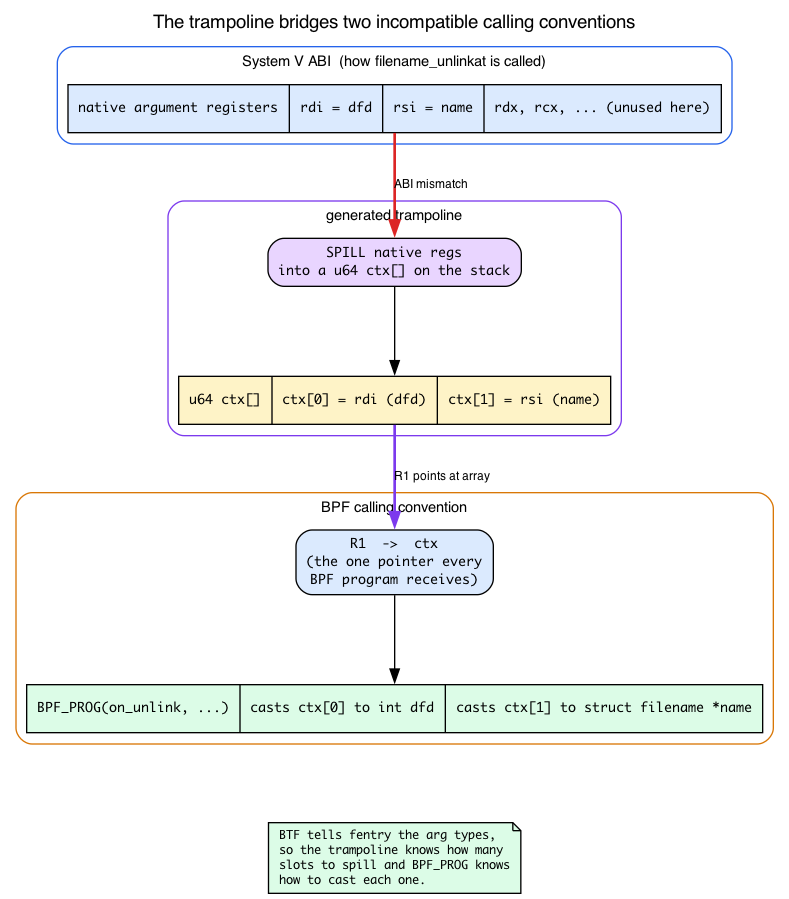
The trampoline isn’t per-program, either: there’s one trampoline per attach target, reference-counted and shared across every program attached there. That’s why the kernel keys them in a hash table — the “What to read” pointer about bpf_trampoline below. Frame it this way: the trampoline’s first job is the argument marshalling; the hash-table bookkeeping is just how the kernel avoids building a second one for the same target.
There are no Dumb Questions
Q: Patching kernel code while it’s running. Isn’t that lunacy?
A: It would be, except the kernel has been doing this since 2008 — it’s how
ftraceworks. The 5-NOP slot is reserved by the compiler at build time specifically so the kernel can patch it later. The patch goes through the kernel’s int3-based text-poke machinery, which is safe against concurrent instruction fetches on every CPU (the file:line specifics are in the “What to read” trampoline bullet at the end). You can install and remove fentry hooks while the kernel runs your browser, a database, and a video call without a hiccup.Q: Why not use kprobe? I keep seeing kprobe in old tutorials.
A: kprobe predates fentry and works differently. It overwrites the function’s first instruction with a software breakpoint (
int3on x86). The CPU traps, a handler runs your code, then it emulates the original instruction and continues. Works on any function. The trap is expensive; fentry’s direct entry path is typically several times cheaper than a kprobe trap, though exact numbers vary by CPU and kernel config. Use fentry whenever it’s available; kprobe only for the rare functions that lack BTF.Q: What does “BTF” mean, and why do you keep mentioning it?
A: Hold that thought — we’ll meet BTF properly in a moment. For Day 1: trust that BTF is what tells fentry the argument types of
filename_unlinkat, so your program can declareint dfd, struct filename *nameand have the kernel hand them over correctly typed.
Sharpen your pencil
On x86_64, the compiler often reserves a 5-byte NOP slot at the start of a traceable function. Why 5? What instruction size is that designed to fit?
.
.
.Answer: a near relative
callorjmpon x86_64 is 5 bytes — 1 opcode byte plus a 4-byte signed offset. The reservation is sized so ftrace can patch the site without moving the function body. Other architectures use their own patch-site shape.
Meet the cast
Before you write code, here’s the full cast of characters.
eBPF in 90 seconds
A BPF program is C code compiled to a stripped-down virtual instruction set (BPF) and loaded into the kernel through the bpf() syscall. Before the kernel runs it, a static analyzer called the Verifier proves the program is safe — it terminates, never reads uninitialized memory, never deref’s a pointer it hasn’t proven valid, and stays within a bounded instruction count. If the program passes, the kernel JITs it to native instructions and runs it whenever the chosen attach point fires. The program cannot crash the kernel and cannot read arbitrary memory — every load is verified at load time. Programs talk to userspace through maps (typed shared data structures).
That paragraph hides three machines worth meeting properly: the virtual CPU your program runs on, the syscall that gets it into the kernel, and the compiler that makes it fast. Let’s take them one at a time — you’ll be reading their fingerprints in error messages within the hour.
The BPF virtual machine: 11 registers and an 8-byte instruction
“A stripped-down virtual instruction set” deserves more than a hand-wave, because the very first error you’ll hit today (Break 1) prints register names at you. So: BPF is a 64-bit RISC-like virtual ISA. It has exactly 11 registers, R0 through R10, each 64 bits wide (BPF_REG_0 = 0 … BPF_REG_10, __MAX_BPF_REG at include/uapi/linux/bpf.h:74). Every instruction is a fixed 8-byte encoding — struct bpf_insn at include/uapi/linux/bpf.h:80 — packing an opcode, a destination register, a source register, an offset, and an immediate.
The registers aren’t interchangeable. They have a calling convention, and you must know it to read verifier output:
| Register | Role |
|---|---|
R0 | Return value — your program’s return, and the return value of any helper you call |
R1–R5 | Argument / scratch registers passed into helpers (and R1 = the ctx pointer on entry) |
R6–R9 | Callee-saved — preserved across helper calls |
R10 | Read-only frame pointer to a fixed 512-byte stack (MAX_BPF_STACK = 512, include/linux/filter.h:98) |
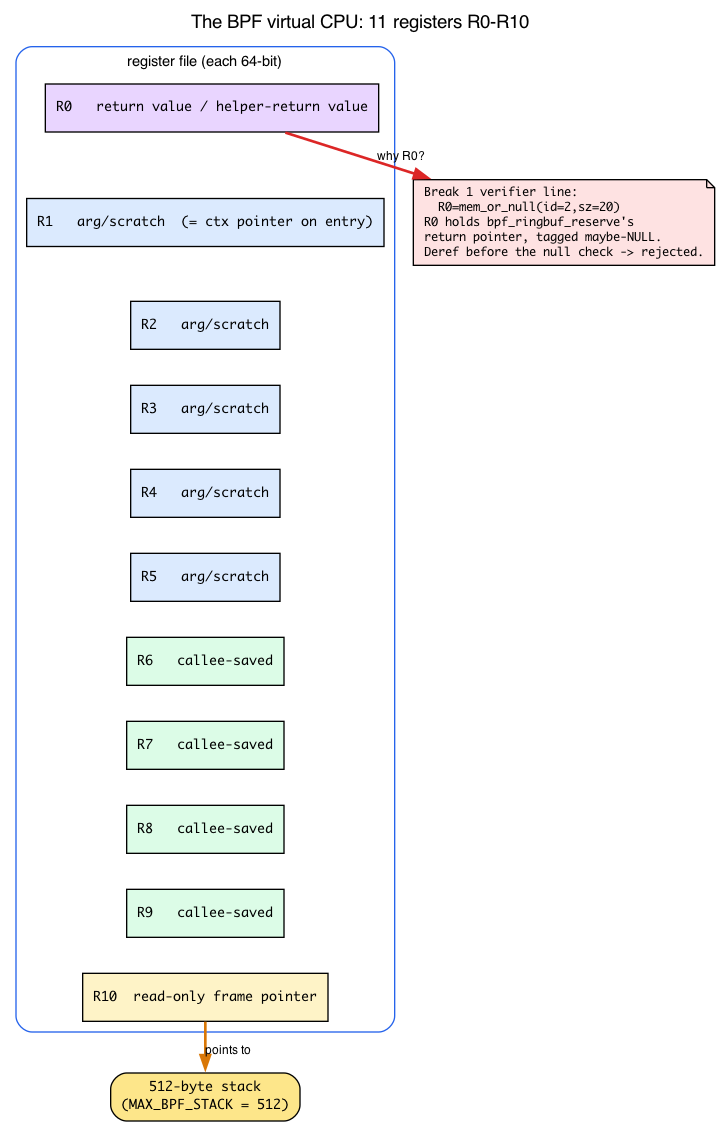
Two things fall straight out of this table. First, R0 = helper return value is exactly why, in Break 1, the result of bpf_ringbuf_reserve lands in R0. Second, when the verifier prints R0=mem_or_null, it’s telling you: R0 holds the pointer the helper returned, and the verifier has tagged it “might be NULL.” Dereferencing it (writing *(u32 *)(r0+0)) without first checking for NULL is the instruction it rejects.
How does the verifier know R0 might be NULL? Because it walks your program one instruction at a time and tracks a type and value-range for every register as it goes. That bookkeeping lives in struct bpf_reg_state and is updated by routines like check_reg_arg in kernel/bpf/verifier.c — the same engine that prints the R0=mem_or_null text you’ll see in Break 1. (You’ll meet the Verifier as a character on Day 4; today you just need to recognize the register names when it complains.)
One more distinction that saves confusion later: there are two different instruction streams in play. The BPF bytecode is what the verifier reads and what struct bpf_insn encodes. The native machine code is what actually runs on the CPU — and a separate stage, the JIT, produces it. Don’t conflate them.
The bpf() syscall: one door, many commands
Everything — creating a map, loading a program, attaching it — enters the kernel through a single syscall: bpf(). There is exactly one entry point, SYSCALL_DEFINE3(bpf, int, cmd, union bpf_attr __user *, uattr, unsigned int, size) at kernel/bpf/syscall.c:6385, and it’s multiplexed by a command enum (the first argument, cmd):
BPF_MAP_CREATE— create a map and return a file descriptor. Dispatches tomap_create()(kernel/bpf/syscall.c:1362).BPF_PROG_LOAD— submit a program’s instructions + BTF, run the Verifier, and return a file descriptor. Dispatches tobpf_prog_load()(kernel/bpf/syscall.c:2864).BPF_LINK_CREATE/ the various attach commands — wire a loaded program to an attach point.
libbpf issues these for you, in sequence: create the maps, then load the program, then attach. (The command names live in include/uapi/linux/bpf.h.)
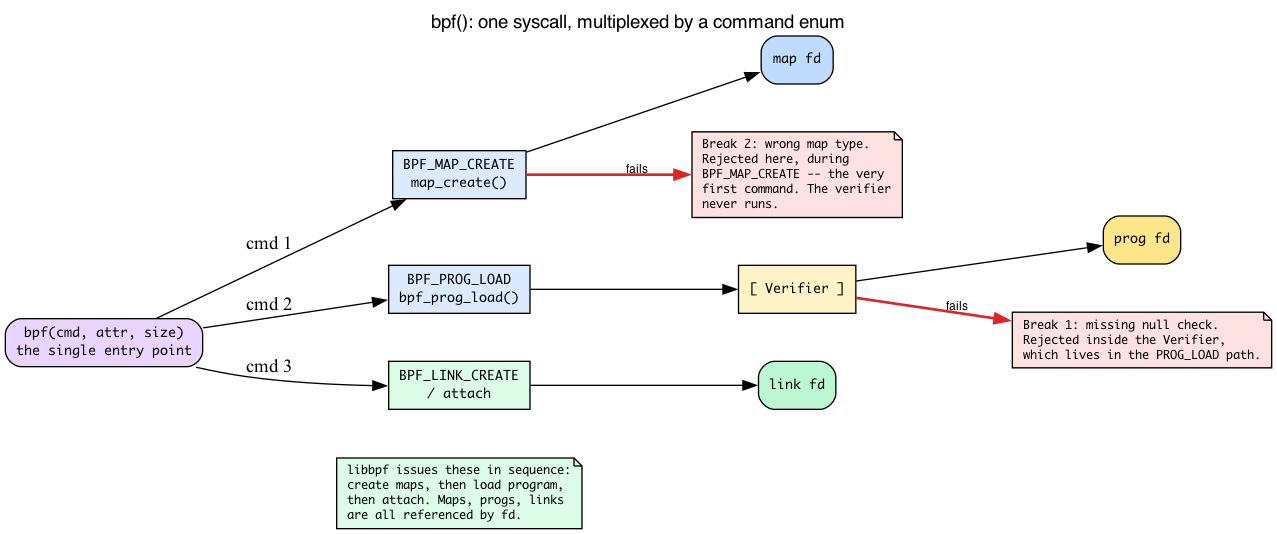
That map creation and program loading are separate commands is the whole reason Break 2 behaves the way it does. When you give the map the wrong type, the kernel rejects it during BPF_MAP_CREATE — before BPF_PROG_LOAD is ever issued, so the Verifier (which lives inside the load path) never even runs. “Fails at the loader, before the verifier” is not hand-waving; it’s literally a different cmd.
And notice the recurring noun: file descriptor. Maps, programs, and links are all referenced by fd returned from bpf(). That’s the substrate under everything you’ll touch in userspace — skel->maps.rb and bpf_map__fd(skel->maps.rb) in hello.c are just typed wrappers around a map fd. A map, in general, is a kernel-resident typed key/value object created by BPF_MAP_CREATE and shared between kernel and userspace by that fd. Ringbuf (below) is one map type; BPF_MAP_TYPE_ARRAY (the one Break 2 mis-uses) is another.
JIT: BPF bytecode becomes native machine code
Once the Verifier accepts your bytecode, the kernel doesn’t interpret it event by event — that would be slow. Instead the BPF JIT (“just-in-time” compiler) rewrites each BPF instruction into the equivalent native CPU instructions (x86-64 here). The translator is bpf_int_jit_compile() at arch/x86/net/bpf_jit_comp.c:3718; it walks the program in do_jit() (around :1652), emitting native code into a buffer described by struct jit_context (:310).
Three things to internalize:
- The JIT runs once, at load time, inside the
BPF_PROG_LOADpath — not on every event. When the attach point fires, it jumps straight into already-compiled native code. - On most production kernels the JIT is on by default, controlled by the
bpf_jit_enablesysctl; setting it to2additionally dumps the JIT image for debugging (if (bpf_jit_enable > 1)atarch/x86/net/bpf_jit_comp.c:3843). An interpreter fallback exists, but it’s the slow path. - This is why fentry + JIT is cheap enough to leave attached on a busy machine — the “no hiccup” claim from the first Dumb Question. At the attach point, there’s no trap and no interpreter loop: just native code calling native code.
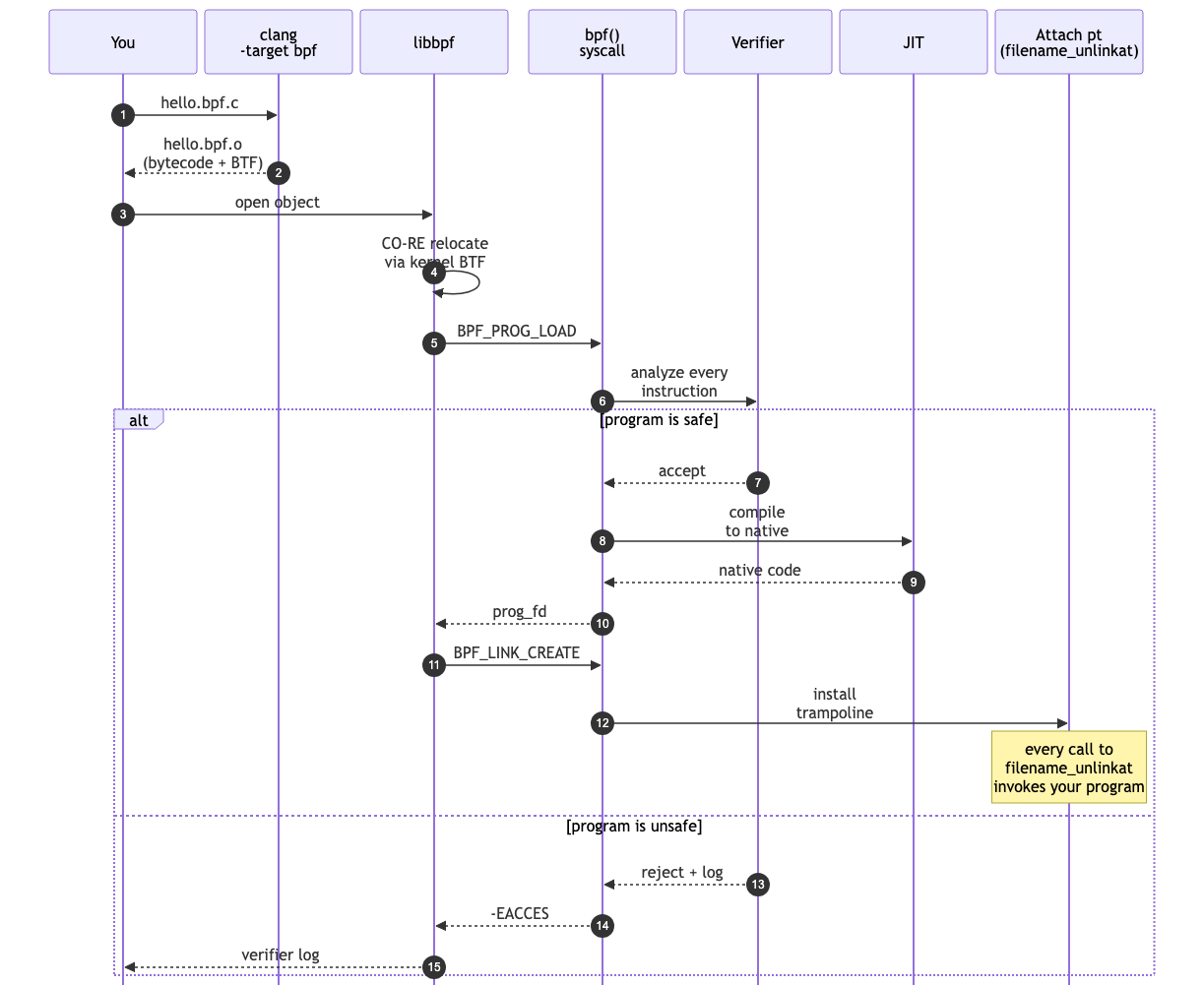
(In that lifecycle picture, the JIT stage sits between “Verifier accepts” and “runs at attach point”: it turns the verified BPF bytecode into native x86 instructions, which is what actually executes when filename_unlinkat is called.)
The Verifier (a recurring character)
The Verifier: Hi. I’m the gatekeeper. Nothing runs in the kernel until I prove it’s safe. I read your program one instruction at a time. I track every register’s type. I track every memory region’s bounds. I track every reference you take. If you do something I can’t prove safe — touch a pointer that might be NULL, run a loop I can’t bound, leak a refcount — I reject your program. My error messages aren’t always pretty, but every one tells you the exact instruction where I lost faith. Read carefully. We’ll be working together a lot.
You’ll meet the Verifier on Day 4. For now, write code that pleases it without trying. (And now you know what “track every register’s type” means literally — R0 through R10, one type each, updated instruction by instruction.)
SEC() — the section-name convention
Every BPF program belongs to a section in the compiled object. The section name tells libbpf how to load and attach the program. The prefix is the program type; the suffix is the attach target:
SEC("fentry/filename_unlinkat")    // type=fentry, attach to kernel symbol filename_unlinkat
SEC("xdp")                    // type=xdp, attach point provided by userspace
SEC("tp/sched/sched_switch")  // type=tracepoint, on the sched_switch tracepoint
The full table lives in tools/lib/bpf/libbpf.c — search static const struct bpf_sec_def section_defs[] (:9987). Bookmark it. Whenever a SEC() “doesn’t work”, that’s the file you check.
BTF (BPF Type Format)
BTF is a compact debug-info-like format the kernel exposes about itself. The running kernel ships its complete type information at /sys/kernel/btf/vmlinux. BPF objects ship BTF about their own types. BTF powers four things you’ll use constantly:
- Verifier type-checking of typed pointers (
PTR_TO_BTF_ID). - CO-RE field-offset relocation at load time.
- Typed argument unpacking for fentry/fexit/tp_btf programs — the ABI bridge from earlier, made concrete: it’s what lets
BPF_PROG(on_unlink, int dfd, struct filename *name)resolve to the right slots and casts. - Kfunc signature matching (Day 20).
Source: kernel/bpf/btf.c.
vmlinux.h
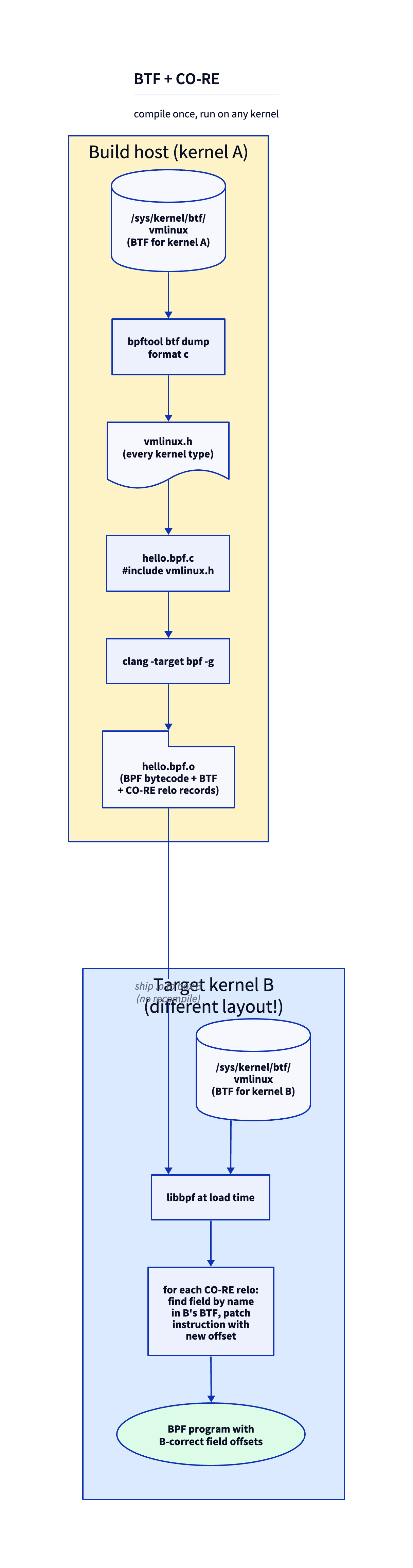
A C header generated from kernel BTF, containing the kernel types a BPF program can name. You can generate one from a running host with bpftool btf dump file /sys/kernel/btf/vmlinux format c.
The repo-owned labs compile against the architecture header pinned with libbpf-bootstrap, not a file regenerated on every reader’s machine. That gives CI and local builds one stable type universe; at load time CO-RE still resolves the accessed fields against the running kernel’s /sys/kernel/btf/vmlinux. If you are developing outside this scaffold, generating vmlinux.h from a known reference kernel is the equivalent workflow.
CO-RE — Compile Once, Run Everywhere
The whole reason BPF programs aren’t fragile across kernel versions. You compile once against vmlinux.h from one kernel; libbpf relocates field offsets at load time using the target kernel’s BTF. The same .bpf.o runs on kernel 6.6 and kernel 7.1 even if struct layouts changed.
libbpf
The userspace library at tools/lib/bpf/. Opens your .bpf.o, applies CO-RE relocations using the running kernel’s BTF (bpf_object__relocate_core at tools/lib/bpf/libbpf.c:6082), calls the bpf() syscall to load programs and create maps — issuing BPF_MAP_CREATE then BPF_PROG_LOAD then the attach commands, in that order — attaches them, and returns handles. It is the canonical loader. Do not write your own.
Skeleton (*.skel.h)
An auto-generated header produced by bpftool gen skeleton hello.bpf.o > hello.skel.h. It gives userspace typed accessors for every map and program in your BPF object: skel->maps.rb, skel->progs.on_unlink. Under the hood each of those is a wrapper around the fd that bpf() returned. The generated file is ~200 lines of straightforward code — open it once, it stops feeling magic.
ringbuf — the event channel you’ll use today
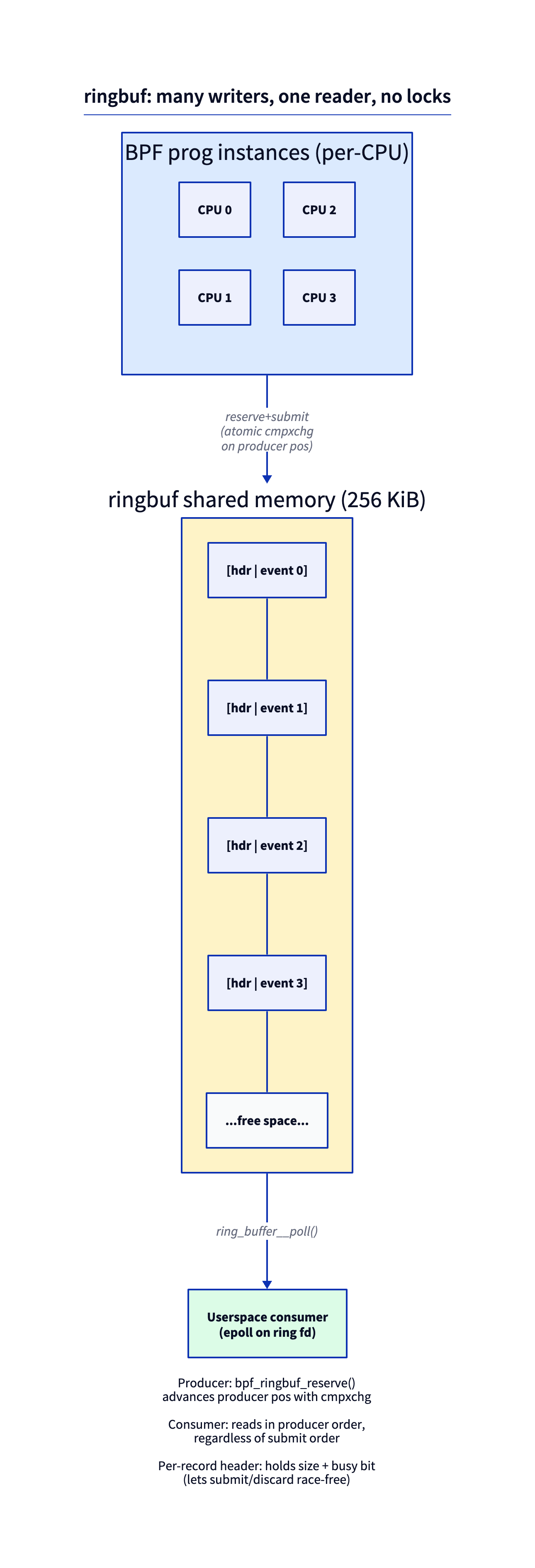
A kernel→userspace event channel, and one map type among many. Multi-producer (any CPU), single-consumer (one userspace reader), preserves cross-CPU ordering. Producers don’t run fully lock-free: inside __bpf_ringbuf_reserve they serialize briefly via an internal per-ringbuf spinlock (raw_res_spin_lock_irqsave on rb->spinlock, kernel/bpf/ringbuf.c:478) while advancing the producer position, then each caller writes into its own disjoint slice.
Two APIs:
bpf_ringbuf_output(&rb, data, sz, 0)— copy-style. Easy.bpf_ringbuf_reserve(&rb, sz, 0)→ write directly →bpf_ringbuf_submit(ev, 0)— zero-copy. Preferred.
Replaced perfbuf (BPF_MAP_TYPE_PERF_EVENT_ARRAY) for most uses. Perfbuf is per-CPU, requires N userspace consumers, loses ordering across CPUs. Use perfbuf only if peak per-CPU write rate matters more than ordering. Source: kernel/bpf/ringbuf.c.
The lab
Setup (one time)
Start with the Lab environment page, then run these commands from the books repository on your Linux lab host:
git submodule update --init --recursive
cd ebpf/labs
./scripts/preflight.sh
make hello
The repository pins libbpf-bootstrap and all of its nested dependencies. The shared Makefile builds that exact libbpf and bpftool, selects the pinned vmlinux.h for your architecture, compiles day01/hello.bpf.c, generates .output/day01/hello.skel.h, and links .output/day01/hello. Nothing is installed system-wide.
You still need Clang 17 or newer with -target bpf, a C compiler and Make, plus libelf and zlib development headers. preflight.sh checks those inputs but never installs packages or invokes sudo.
hello.h — the shared event record
The producer and consumer include one header, so a layout change cannot silently desynchronize the two sides:
#ifndef PRACTICAL_EBPF_HELLO_H
#define PRACTICAL_EBPF_HELLO_H

struct hello_event {
    unsigned int pid;
    char comm[16];
};

#endif
hello.bpf.c — the kernel side
This listing is included from the file the lab build and CI compile:
#include "vmlinux.h"
#include <bpf/bpf_helpers.h>
#include <bpf/bpf_tracing.h>

#include "hello.h"

char LICENSE[] SEC("license") = "GPL";

struct {
    __uint(type, BPF_MAP_TYPE_RINGBUF);
    __uint(max_entries, 256 * 1024);
} rb SEC(".maps");

SEC("fentry/filename_unlinkat")
int BPF_PROG(on_unlink, int dfd, struct filename *name)
{
    struct hello_event *event;

    (void)dfd;
    (void)name;

    event = bpf_ringbuf_reserve(&rb, sizeof(*event), 0);
    if (!event)
        return 0;

    event->pid = bpf_get_current_pid_tgid() >> 32;
    bpf_get_current_comm(&event->comm, sizeof(event->comm));
    bpf_ringbuf_submit(event, 0);
    return 0;
}
Walkthrough of every line that’s new:
#include "vmlinux.h"— pulls in every kernel type, includingstruct filenameused in the prototype.char LICENSE[] SEC("license") = "GPL";— a load-time gate, not legal advice. The kernel rejects a non-GPL program only if it calls a GPL-only helper. Many of the most useful helpers are GPL-only (bpf_probe_read_kernel,bpf_get_current_task,bpf_get_stackid, …), but the four simple helpers this lab uses are not — so this line has no teeth yet today (see Break 3).#include "hello.h"— the sharedstruct hello_eventsent through ringbuf. Ringbuf transports raw bytes, so both sides must agree on this layout.- The
SEC(".maps")block — modern map declaration syntax. The__uint(...)macros frombpf_helpers.hproduce BTF the loader uses to know it’s a 256-KiB ringbuf. (This is the BTF that drives theBPF_MAP_CREATEcommand libbpf issues forrb.) SEC("fentry/filename_unlinkat")— attach point.filename_unlinkatis infs/namei.c, called on everyunlink()andunlinkat()syscall.BPF_PROG(on_unlink, int dfd, struct filename *name)— macro frombpf_tracing.hthat unpacks the trampoline’s argument array into the typed parametersdfdandname(the ABI bridge from earlier, made concrete).bpf_ringbuf_reservereturns either a valid pointer or NULL (when the ringbuf is full). The return value lands inR0, the Verifier tags itmem_or_null, and it requires the null check before you write through it.bpf_get_current_pid_tgid()— reads the currently-running task (more on “the task” just below). The result is packed(tgid << 32) | pid; Linux’s userspace “PID” is the kernel’s TGID.>> 32extracts the user-visible PID.bpf_get_current_comm— copies up to 16 bytes of the task’scommfield. Always 16, always null-padded.bpf_ringbuf_submitmakes the reserved entry visible to the consumer.
A one-paragraph refresher: “the task” and where 16 comes from
Two of those helpers read “the current task,” and the magic number 16 shows up with no explanation — so, briefly: every schedulable thread in the kernel is represented by a struct task_struct. What BPF calls current is simply the task_struct of the thread running on this CPU right now, and bpf_get_current_pid_tgid / bpf_get_current_comm both read fields out of it. The comm field is a fixed-size, NUL-padded short thread name — the rm you’ll see in the lab output — declared as char comm[TASK_COMM_LEN] in struct task_struct (include/linux/sched.h:1173). And TASK_COMM_LEN is 16 (include/linux/sched.h:325). So the 16 in sizeof(event->comm) isn’t arbitrary; it’s the kernel’s compile-time size of that field. That’s the whole refresher — we’ll do a proper task_struct tour another day; today you just need “always 16” and “the task’s comm” to stop being unexplained constants. (The pid-vs-tgid split above already covered why we shift by 32.)
hello.c — the userspace side
The loader checks each libbpf step, validates the ringbuf record size, handles SIGINT/SIGTERM, and releases both the consumer and skeleton on every exit path:
#include <errno.h>
#include <signal.h>
#include <stdio.h>
#include <string.h>

#include <bpf/libbpf.h>

#include "hello.h"
#include "hello.skel.h"

static volatile sig_atomic_t exiting;

static void handle_signal(int signal_number)
{
    (void)signal_number;
    exiting = 1;
}

static int install_signal_handlers(void)
{
    const struct sigaction action = {
        .sa_handler = handle_signal,
    };

    if (sigaction(SIGINT, &action, NULL) != 0 ||
        sigaction(SIGTERM, &action, NULL) != 0) {
        fprintf(stderr, "failed to install signal handlers: %s\n",
                strerror(errno));
        return -errno;
    }

    return 0;
}

static int handle_event(void *ctx, void *data, size_t size)
{
    const struct hello_event *event = data;

    (void)ctx;
    if (size != sizeof(*event)) {
        fprintf(stderr, "unexpected ringbuf record size: %zu\n", size);
        return 0;
    }

    printf("PID %u %.*s deleted a file\n", event->pid,
           (int)sizeof(event->comm), event->comm);
    return 0;
}

int main(void)
{
    struct hello_bpf *skel = NULL;
    struct ring_buffer *ringbuf = NULL;
    int err;

    setvbuf(stdout, NULL, _IOLBF, 0);

    err = install_signal_handlers();
    if (err)
        return 1;

    skel = hello_bpf__open();
    if (!skel) {
        fprintf(stderr, "failed to open hello BPF skeleton\n");
        return 1;
    }

    err = hello_bpf__load(skel);
    if (err) {
        fprintf(stderr, "failed to load hello BPF programs: %s\n",
                strerror(-err));
        goto cleanup;
    }

    err = hello_bpf__attach(skel);
    if (err) {
        fprintf(stderr, "failed to attach hello BPF programs: %s\n",
                strerror(-err));
        goto cleanup;
    }

    ringbuf = ring_buffer__new(bpf_map__fd(skel->maps.rb), handle_event,
                               NULL, NULL);
    err = libbpf_get_error(ringbuf);
    if (err) {
        ringbuf = NULL;
        fprintf(stderr, "failed to create ringbuf consumer: %s\n",
                strerror(-err));
        goto cleanup;
    }

    puts("Tracing unlink calls; press Ctrl-C to stop.");
    while (!exiting) {
        err = ring_buffer__poll(ringbuf, 100);
        if (err == -EINTR) {
            err = 0;
            continue;
        }
        if (err < 0) {
            fprintf(stderr, "ringbuf poll failed: %s\n", strerror(-err));
            goto cleanup;
        }
    }

    err = 0;

cleanup:
    ring_buffer__free(ringbuf);
    hello_bpf__destroy(skel);
    return err != 0;
}
bpf_map__fd(skel->maps.rb) is exactly the map fd that BPF_MAP_CREATE returned during load — the userspace side polls it; the kernel side writes into it.
Run it
make hello
sudo ./.output/day01/hello
# in another terminal:
scratch=$(mktemp -d /tmp/ebpf-day01.XXXXXX)
touch "$scratch/one" "$scratch/two"
rm "$scratch/one" "$scratch/two"
rmdir "$scratch"
Expected output:
PID 13421 rm deleted a file
PID 13421 rm deleted a file
On a busy machine you’ll also see lines whose comm is something other than rm — package managers, editors saving over temp files, /tmp churn. That’s not a bug; it’s the whole point. Your doorbell fires on every unlink/unlinkat in the system, not just yours. Pick out the two lines whose comm is rm.
Congratulations. You just installed a doorbell on a kernel function.
What to break, in order
This is the part you don’t skip. Every break teaches one concept.
Break 1 — Drop the null check
Remove the if (!event) return 0;. Rebuild. The verifier rejects with something like:
0: (85) call bpf_ringbuf_reserve#131
1: R0=mem_or_null(id=2,sz=20)
2: (7b) *(u32 *)(r0 +0) = r1
R0 invalid mem access 'mem_or_null'
That’s the Verifier saying: your register R0 is a pointer that might be NULL; you can’t dereference it without proving it isn’t. You now know exactly why it’s R0 and not some other register — R0 is where a helper’s return value lives by calling convention, so bpf_ringbuf_reserve’s maybe-NULL pointer is sitting in R0 when instruction 2 tries to write through it.
To see this with full detail, set kernel_log_level = 1 in your loader options:
LIBBPF_OPTS(bpf_object_open_opts, opts, .kernel_log_level = 1);
skel = hello_bpf__open_opts(&opts);
Or use bpftool prog load file.o /sys/fs/bpf/x and read stderr.
Break 2 — Wrong map type
Change BPF_MAP_TYPE_RINGBUF to BPF_MAP_TYPE_ARRAY. Now the loader fails before the Verifier even runs:
libbpf: map 'rb': failed to create: Invalid argument
This is the BPF_MAP_CREATE-vs-BPF_PROG_LOAD split from the syscall section, made visible. An ARRAY map needs a key size and value size that a bare SEC(".maps") ringbuf-style declaration doesn’t supply, so the kernel rejects it during BPF_MAP_CREATE — the very first command libbpf issues. BPF_PROG_LOAD, where the Verifier lives, never runs. That’s the difference between loader-time errors (map config wrong) and verifier-time errors (program logic unsafe). Different layers, different commands, different failure modes. Get used to noticing which one bit you.
Break 3 — Remove the LICENSE
Try the obvious thing first: delete the char LICENSE[] SEC("license") = "GPL"; line and rebuild. The program loads and runs exactly as before. Surprised? The GPL gate fires only when your program calls a GPL-only helper, and none of the four helpers in hello.bpf.c (bpf_ringbuf_reserve, bpf_ringbuf_submit, bpf_get_current_pid_tgid, bpf_get_current_comm) are GPL-only.
To make the gate bite, first give it something to gate on. Add a GPL-only helper call inside on_unlink:
(void)bpf_get_current_task(); // bpf_get_current_task is a GPL-only helper
Now delete the LICENSE line again and rebuild. This time the load fails:
cannot call GPL-restricted function from non-GPL compatible program
The lesson: the license string is a load-time gate with teeth only for GPL-only helpers. Put the LICENSE line back (and you can drop the bpf_get_current_task call again) before moving on.
Break 4 — Reserve more than you write
Sharpen your pencil
Before you run anything: what is
sizeof(struct hello_event)? The struct is a 4-byte__u32 pidfollowed by a 16-bytechar comm[16]. Add them up — you’ll see this number printed assize=in a moment.. . .
Answer: 20. There’s no padding to worry about here — a
__u32needs 4-byte alignment andchar[16]needs only 1, so the 4 + 16 layout packs with no gaps. Hold “20” in mind; the20 → 21shift is the whole point of this break.
The lesson here is that ringbuf records are sized at reserve time, not at submit time. The checked-in handle_event() deliberately rejects any size other than sizeof(*event), so replace that equality check with a lower-bound check and print the delivered size:
if (size < sizeof(*event)) {
    fprintf(stderr, "short ringbuf record: %zu\n", size);
    return 0;
}
printf("PID %u %.*s deleted a file (size=%zu)\n", event->pid,
       (int)sizeof(event->comm), event->comm, size);
Rebuild and run the unmodified program. Each line now ends with the record size:
PID 13421 rm deleted a file (size=20)
sizeof(struct hello_event) is 20 — a 4-byte pid plus a 16-byte comm. Now over-allocate the reservation while still writing only sizeof(*event) bytes:
event = bpf_ringbuf_reserve(&rb, sizeof(*event) + 1, 0);
The Verifier accepts it (you reserved enough). Rebuild, run, delete a file again:
PID 13421 rm deleted a file (size=21)
The record is one byte larger even though you wrote the same bytes — the length is fixed when you reserve, not when you submit. (That trailing byte is uninitialized; we don’t print it, the 20 → 21 size delta is the observable signal.) Restore the original sizeof(*event) reservation and exact-size consumer check before moving on.
What to read in the kernel
Open these files in your ~/code/linux checkout. Skim, don’t memorize.
kernel/bpf/trampoline.c— top of the file. Findarch_prepare_bpf_trampolineandbpf_trampoline_get. The trampoline is per-(target, prog-list), reference-counted, and rebuilt when programs attach or detach (bpf_trampoline_update,kernel/bpf/trampoline.c:607). Noticebpf_trampolineis not just one stub — it’s a hash table keyed by attach target. (The arg-spill/restore code itself is emitted byarch_prepare_bpf_trampolineatarch/x86/net/bpf_jit_comp.c:3536, with the real work in__arch_prepare_bpf_trampolineat:3213— this is the ABI bridge from the trampoline section, in the flesh.) The patch that repoints the site is installed by the int3-based text-poke machinery,smp_text_poke_*(smp_text_poke_int3_handleratarch/x86/kernel/alternative.c:2838, driving the batchedstruct smp_text_poke_locarray at:2781) — safe against concurrent instruction fetch on every CPU.kernel/bpf/ringbuf.c—bpf_ringbuf_reserveis short. Note the per-record header (struct bpf_ringbuf_hdr,:88) and theBUSYbit (BPF_RINGBUF_BUSY_BIT, set at:529) that letssubmitanddiscardfinalize race-free.tools/lib/bpf/libbpf.c— searchfind_sec_def(:10212). Scroll thesection_defs[]table (:9987). You now know every prefix that exists. This file is also where CO-RE relocation gets kicked off (bpf_object__relocate_core,:6082).
Optional: read the generated skeleton
./.output/bpftool/bootstrap/bpftool gen skeleton .output/day01/hello.bpf.o
It prints the same skeleton stored at .output/day01/hello.skel.h. Read it once. You’ll see it’s just stamped-out boilerplate calling bpf_object__find_map_by_name and friends. Demystified.
Bullet Points
- BPF is a 64-bit virtual ISA: 11 registers
R0–R10, fixed 8-bytestruct bpf_insn.R0= return/helper-return value,R1–R5= args,R6–R9= callee-saved,R10= read-only frame pointer to a 512-byte stack. The Verifier tracks a type per register — that’s whereR0=mem_or_nullcomes from. bpf()is one syscall, multiplexed by a command enum:BPF_MAP_CREATE(→ map fd),BPF_PROG_LOAD(runs the Verifier → prog fd), attach commands. Maps, progs, and links are all fds. libbpf issues them in sequence — which is why a bad map fails before the Verifier (Break 2).- After the Verifier accepts bytecode, the JIT translates it to native machine code once at load time; the attach point then runs native code at native speed.
- BPF programs are C compiled to a verified-then-JITed instruction set; they cannot crash the kernel.
- fentry patches the 5-byte NOP slot — reserved by the compiler’s
-mfentryinstrumentation and owned by ftrace, borrowed by BPF via an ftrace “direct call” — with a jump to a generated trampoline. The trampoline bridges the ABI: it spills native arg registers (rdi,rsi, …) into au64 ctx[]array, calls your program withR1 → ctx, andBPF_PROGcasts the slots back to typed args. Typically several times cheaper than a kprobe trap. - The patch is installed by the kernel’s int3-based text-poke machinery,
smp_text_poke_*, safe against concurrent instruction fetch on every CPU. - Use fentry wherever possible. Use kprobe only for functions without BTF.
SEC()is the section-name convention libbpf uses to load and attach. The prefix names the program type and tells libbpf where to attach.- vmlinux.h is generated from kernel BTF and gives you every kernel type by name; BTF also tells fentry the argument types so the trampoline and
BPF_PROGagree on the slots. - CO-RE lets you compile once and run on any kernel; libbpf relocates field offsets at load time.
- ringbuf is one map type — multi-producer single-consumer with cross-CPU ordering — your default kernel→userspace channel.
currentis the running thread’sstruct task_struct;commis its 16-byte (TASK_COMM_LEN) NUL-padded name — that’s where “always 16” comes from.- Two failure layers exist: loader-time (map/object misconfigured) and verifier-time (program logic unsafe).
- Always check the return of
bpf_ringbuf_reserveandbpf_map_lookup_elem— both can return NULL (inR0) and the Verifier knows it.
Check question
If two CPUs concurrently call bpf_ringbuf_reserve(&rb, 64, 0), can the records overlap?
Click to reveal answer
Answer: No. Inside __bpf_ringbuf_reserve the producers serialize briefly via an internal per-ringbuf spinlock while advancing the producer position, so each caller gets a disjoint slice. Submit/discard order may differ from reserve order, which the consumer handles via the BUSY bit on each record header. The consumer does not see a record until BUSY is cleared by submit/discard.
Tomorrow
Day 2: add a hash map. Per-PID counters. The first lesson on map element lifecycle (and how a tracer that doesn’t clean up its maps becomes a slow ENOSPC poison-pill).