Day 4 — Meet the Verifier (PTR_TO_MAP_VALUE_OR_NULL boot camp)
Today’s mission: stop being surprised by the most common BPF rejection. Trip over
PTR_TO_MAP_VALUE_OR_NULLin five different shapes; read the log on each; learn what “register state” means — down to the individual registers and opcode bytes the log is built from. Total time: ~120 minutes. No new functionality today — this is pure verifier intuition.
Why a whole day on one error
Because you’ll see this rejection more than any other. Days 1–3 dodged it by always writing if (!cnt) return 0; immediately after lookups. That’s the trained-monkey response. Today is when that response becomes understanding.
The Verifier is not arbitrary. It runs an abstract interpreter over your program — for every instruction it tracks each register’s type, bounds, reference state, and which branch you’re on. When it can’t prove a memory access safe, it rejects. The error log tells you exactly which register and which instruction; if you can read register state, you can fix any rejection in under a minute.
But there’s a catch. Every line of that log is dense with notation the BPF tutorials never explain: R0, R10, (79), *(u64 *)(r0 +0), id=2, fp0. Today is titled a “register state boot camp,” so before we break anything we’re going to actually learn the alphabet: the eleven registers, the opcode bytes, and the two kinds of id. Then the five rejections read themselves.
The eleven registers: BPF’s whole register file
Every line in a verifier log mentions registers named R0 through R10. That is not a sampling — that is the entire register file. BPF has exactly eleven 64-bit registers, no more: ten general-purpose registers (R0–R9) plus one read-only frame pointer (R10):
/* include/uapi/linux/bpf.h:62-74 */
enum {
    BPF_REG_0 = 0,
    BPF_REG_1,
    ...
    BPF_REG_10,
    __MAX_BPF_REG,
};
/* include/uapi/linux/bpf.h:77-78 */
/* BPF has 10 general purpose 64-bit registers and stack frame. */
#define MAX_BPF_REG  __MAX_BPF_REG   /* == 11 slots: R0-R9 + R10 */
The Verifier keeps a struct bpf_reg_state for each of these eleven slots, at every instruction, on every path. When the log prints R0=map_value_or_null(...) R10=fp0, it’s dumping that per-register state table.
What makes the eleven registers legible is that they aren’t interchangeable — they follow a fixed calling convention, and the Verifier enforces it. This convention is the single most useful thing to memorize today, because it explains nearly every register name you’ll read:
| Register | Role | What the Verifier enforces |
|---|---|---|
| R0 | return value | A helper’s result always lands here. This is why bpf_map_lookup_elem’s OR_NULL pointer is always in R0. |
| R1–R5 | arguments / scratch | Caller passes args here. Clobbered across every helper call — reset to unreadable. |
| R6–R9 | callee-saved | State preserved across calls. Stash anything you need to survive a helper call here. |
| R10 | frame pointer | Read-only. Points at the top of the 512-byte BPF stack. You can’t reassign it. |
The kernel documentation states the call rule directly:
After kernel function call, R1-R5 are reset to unreadable and R0 has a return type of the function. Since R6-R9 are callee saved, their state is preserved across the call. —
Documentation/bpf/verifier.rst:32-35
And R10:
Though R10 is correct read-only register and has type PTR_TO_STACK… —
Documentation/bpf/verifier.rst:81-85
R10’s type is PTR_TO_STACK — “reg == frame_pointer + offset” (include/linux/bpf.h:996). You can read and write stack slots through it (*(u32 *)(r10-4)), but you can never reassign R10 itself — the Verifier rejects writes to it. The stack it points at is capped:
/* include/linux/filter.h:98 */
#define MAX_BPF_STACK 512
512 bytes. That’s your entire automatic-storage budget per program frame.
Why does R0 have to be the return register? Because the ABI says so, full stop:
BPF allows only register R0 to be used as return value. —
Documentation/bpf/bpf_design_QA.rst:41
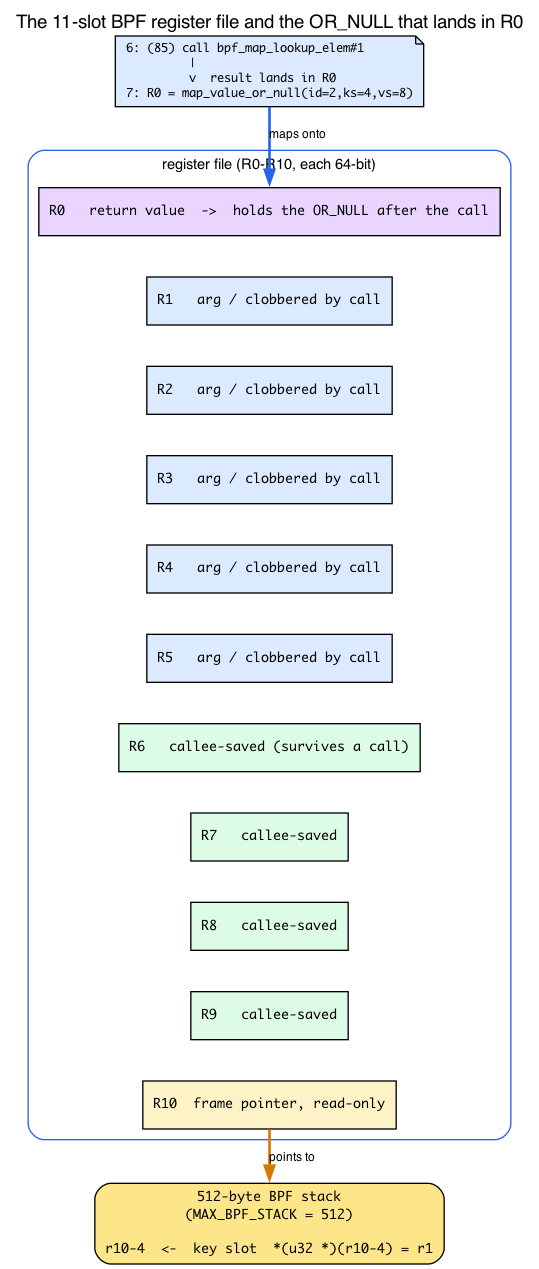
Hold onto one consequence, because it bites later today: a lookup result you copy with r0 → r6 survives a later helper call (R6 is callee-saved), but r0 → r1 does not (R1 is clobbered by the next call). That’s also why the Verifier’s id tracking — covered in “Two different ids” below — has to follow a value as it hops between registers.
Reading the pseudo-assembly: the (hex) opcode and the instruction format
Every trace line looks like 7: (79) r1 = *(u64 *)(r0 +0). Three parts: the instruction index (7:), the raw opcode byte in parentheses ((79)), and a human-readable spelling of what it does. The opcode byte is the part nobody explains — let’s decode it, because the whole rejection hinges on recognizing one opcode.
A BPF opcode is one byte, built by OR-ing three fields: instruction class | mode/op | source/size. You don’t need the full table; you need the handful that appear in these labs:
| Byte | Means | Spelled in the log as |
|---|---|---|
(b7) | ALU64 MOV immediate | r1 = 0 |
(bf) | ALU64 MOV register | r2 = r10 |
(07) | ALU64 ADD immediate | r2 += -4 |
(63) | STX MEM word store | *(u32 *)(r10-4) = r1 |
(18) | LD IMM double-word (16-byte insn) | r1 = 0xffff... (loads a map address) |
(85) | JMP CALL | call bpf_map_lookup_elem#1 |
(15) | JMP JEQ immediate (if r0 == 0 goto) | if r0 == 0 goto +N — the NULL check |
(55) | JMP JNE immediate (if r0 != 0 goto) | if r0 != 0 goto +N — the NULL check, other form |
(79) | LDX MEM double-word load | r1 = *(u64 *)(r0 +0) — the deref |
The (15)/(55) jumps are the comparison-against-zero that mark_ptr_or_null_regs keys off: spotting one of them between the (85) call and a (79) load is how you tell, by eye, whether the OR_NULL → MAP_VALUE transition had a chance to fire.
These bytes are just the header constants OR’d together. From include/uapi/linux/bpf_common.h (classes BPF_LD 0x00, BPF_LDX 0x01, BPF_ST 0x02, BPF_STX 0x03, BPF_ALU 0x04, BPF_JMP 0x05; modes BPF_IMM 0x00, BPF_MEM 0x60; sizes BPF_W 0x00, BPF_DW 0x18) and include/uapi/linux/bpf.h (BPF_ALU64 0x07, BPF_MOV 0xb0, BPF_DW 0x18, BPF_CALL 0x80):
(79)=BPF_LDX(0x01) | BPF_MEM(0x60) | BPF_DW(0x18)— a load.(85)=BPF_JMP(0x05) | BPF_CALL(0x80)— a call.(b7)=BPF_ALU64(0x07) | BPF_MOV(0xb0)with the K (immediate) source.
You do not have to memorize the table. You need exactly one reflex: any LDX opcode (0x61/0x69/0x71/0x79) is a load — a dereference. And a dereference is precisely what the OR_NULL rule forbids until you’ve checked for NULL.
The size suffix in *(u64 *) vs *(u32 *) is the size field: BPF_W = word/4 bytes, BPF_DW = double-word/8 bytes. That’s not noise — it echoes your C types directly. The key store is *(u32 *) because the map key is __u32 (4 bytes); the value deref is *(u64 *) because the value is __u64 (8 bytes). The widths in the log are your struct, reflected back.
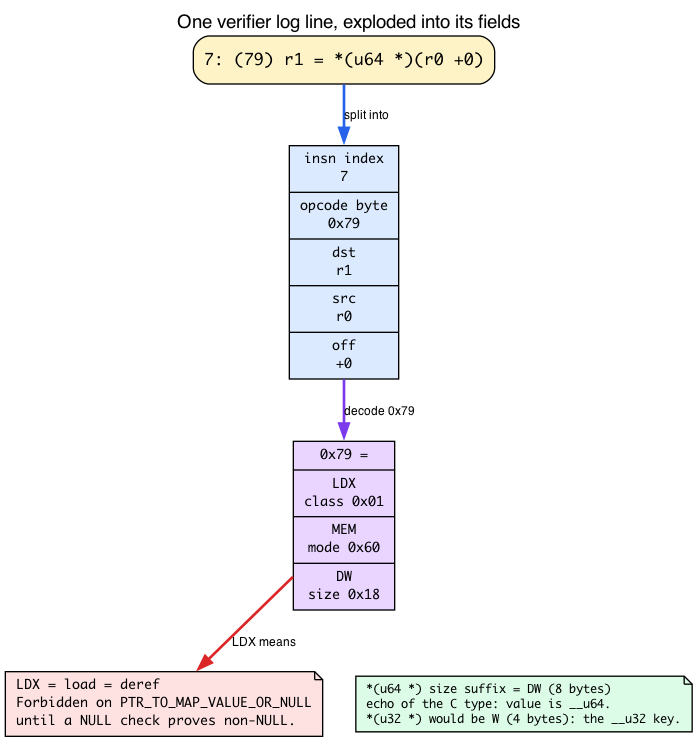
Practical reading rule: when a rejection names a register, scan the opcode column for the LDX/STX (0x6x/0x7x) instruction that touches it. In all five rejections today that instruction is the same: (79) r1 = *(u64 *)(r0 +0) — the single load through R0 that the missing check failed to protect.
How the Verifier walks your program
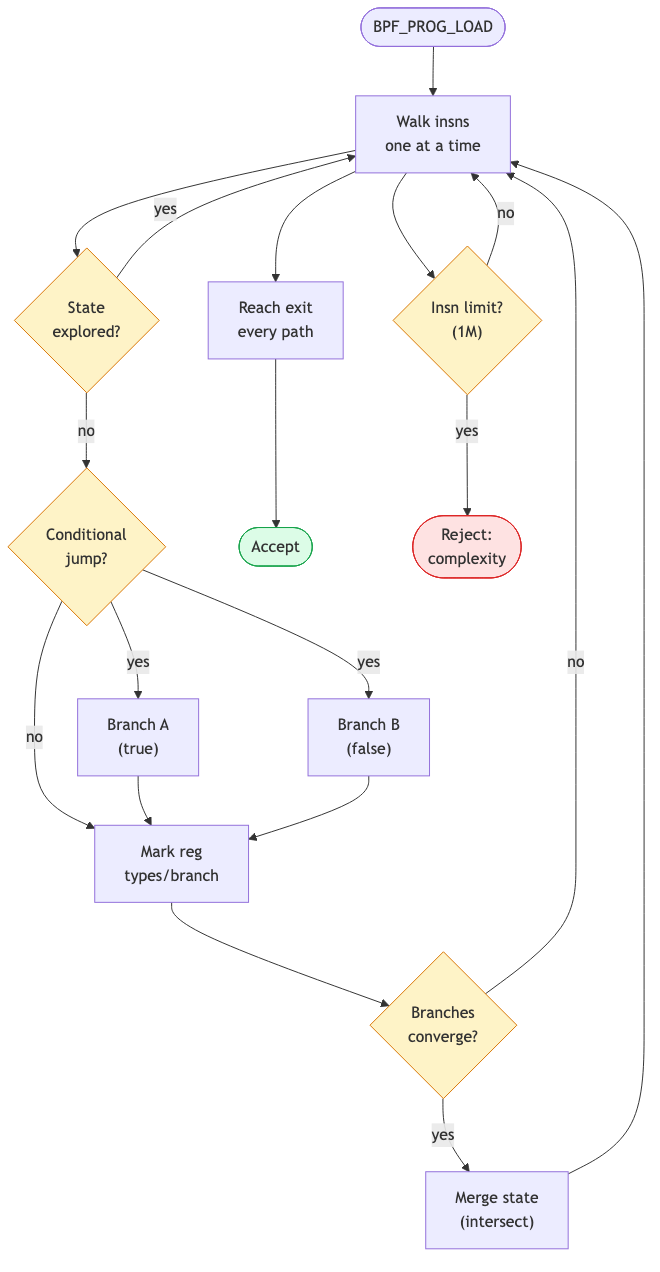
The Verifier starts at instruction 0 with default register state. For each instruction:
- It updates register types based on the operation (add, load, call, etc.).
- On conditional jumps, it forks: explores both branches with appropriate state (e.g., on
if (!r0), the false branch knowsr0 != 0; the true branch knowsr0 == 0). - When two branches reconverge, it merges register states (intersection).
- State pruning. If the current state is “compatible with” a previously-explored state at the same instruction, it stops — it already knows this leads to acceptance. (This is the verifier’s key efficiency trick — without it, branchy programs explode exponentially.)
- If it hits the complexity budget (1M instructions explored across all paths), it gives up:
BPF program is too large. - Every path must reach a
return/exit instruction safely.
Source: kernel/bpf/verifier.c. The function do_check is the main loop; bpf_is_state_visited (in kernel/bpf/states.c:1202, split out of verifier.c in the 2025 refactor) is the pruning check; mark_ptr_or_null_regs is what we’ll focus on today. The 1M budget is BPF_COMPLEXITY_LIMIT_INSNS (include/linux/bpf.h:2261 — #define BPF_COMPLEXITY_LIMIT_INSNS 1000000 /* yes. 1M insns */), checked against env->insn_processed in do_check (verifier.c:17705).
The state machine for bpf_map_lookup_elem’s return value
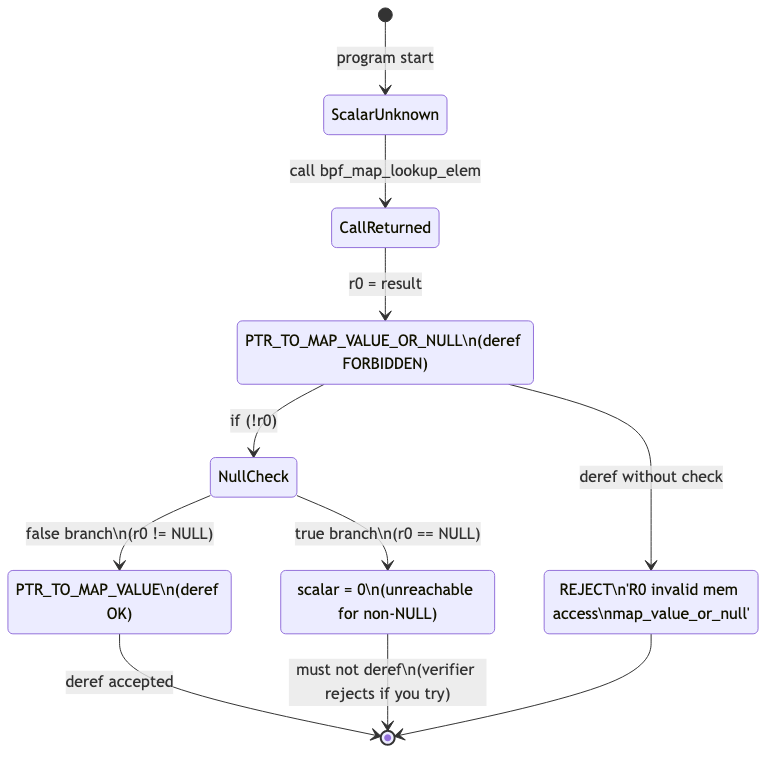
When you call bpf_map_lookup_elem, R0 is marked PTR_TO_MAP_VALUE_OR_NULL with an id attached. That id links the not-yet-resolved-NULL nature of this pointer across all flow paths (more on what kind of id, next). The Verifier treats:
PTR_TO_MAP_VALUE_OR_NULL— deref forbidden.PTR_TO_MAP_VALUE— deref OK, with bounds equal to the map’s value size.SCALAR_VALUE = 0— what the register becomes inside ther == 0branch.
The transition PTR_TO_MAP_VALUE_OR_NULL → PTR_TO_MAP_VALUE happens via mark_ptr_or_null_regs after a comparison against zero — but only on the branch where the comparison would prove non-NULL.
In v7.1 these types are just a base type OR’d with a “maybe NULL” flag (include/linux/bpf.h:1026-1034):
PTR_TO_MAP_VALUE_OR_NULL = PTR_MAYBE_NULL | PTR_TO_MAP_VALUE,
PTR_TO_SOCKET_OR_NULL    = PTR_MAYBE_NULL | PTR_TO_SOCKET,
PTR_TO_BTF_ID_OR_NULL    = PTR_MAYBE_NULL | PTR_TO_BTF_ID,
The helper that produces our OR_NULL says so in its prototype (kernel/bpf/helpers.c:54): bpf_map_lookup_elem_proto has .ret_type = RET_PTR_TO_MAP_VALUE_OR_NULL. That’s where R0’s type comes from — check_helper_call reads it off the proto.
Two different ids: nullness-linkage vs acquired reference
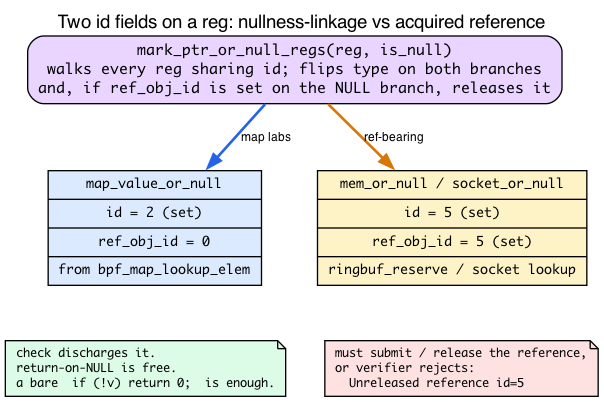
Here’s a subtlety that the logs blur together. A struct bpf_reg_state carries two distinct u32 fields (include/linux/bpf_verifier.h:155 and :195):
id— general linkage. Links registers that share a not-yet-resolved property, e.g. the same maybe-NULL-ness.ref_obj_id— a handle on an acquired reference that must be explicitly released before the program exits.
For bpf_map_lookup_elem, the OR_NULL pointer carries an id only. It is free — no release required — so a bare if (!v) return 0; fully discharges it. That’s why all of today’s labs need nothing but a NULL check. The number you read as id=2 in the log is this general linkage id.
That is the whole intuition you need for today. The rest of this section — how the release machinery works for the reference-bearing OR_NULL types — is an optional going-deeper aside. Today’s map-value labs never trigger it; you can skip to “The Lab” and come back when a later chapter rejects a socket or ringbuf program with an “Unreleased reference” error.
Going deeper (optional): how releases actually fire
Now look at what
mark_ptr_or_null_regsactually does (kernel/bpf/verifier.c:16060-16078):static void mark_ptr_or_null_regs(struct bpf_verifier_state *vstate, u32 regno, bool is_null) { struct bpf_func_state *state = vstate->frame[vstate->curframe]; struct bpf_reg_state *regs = state->regs, *reg; u32 ref_obj_id = regs[regno].ref_obj_id; u32 id = regs[regno].id; if (ref_obj_id && ref_obj_id == id && is_null) /* regs[regno] is in the " == NULL" branch. */ WARN_ON_ONCE(release_reference_nomark(vstate, id)); bpf_for_each_reg_in_vstate(vstate, state, reg, ({ mark_ptr_or_null_reg(state, reg, id, is_null); })); }It consults both fields. The
bpf_for_each_reg_in_vstateloop walks every register sharing the comparison’sidand flips its type on each branch — that’s the universal part. But theifabove it checksref_obj_id: if the OR_NULL register held a real acquired reference and we just proved it NULL, it releases that reference. Map-value-or-null never minted aref_obj_id(its proto doesn’t acquire), so that branch is skipped.This sharpens the chapter’s later “all OR_NULL types follow the same pattern” claim. The NULL-check transition is universal. But only the reference-bearing OR_NULL types carry a
ref_obj_idyou must additionally resolve:
Type idref_obj_idObligation PTR_TO_MAP_VALUE_OR_NULLset 0 check discharges it; return-on-NULL is free PTR_TO_SOCKET_OR_NULLset set must release, or “Unreleased reference” PTR_TO_MEM | PTR_MAYBE_NULL(ringbuf reserve)set set must submit/discard, or “Unreleased reference” So if a future chapter shows you a
bpf_ringbuf_reserveor socket lookup that loads clean but still gets rejected with an unreleased-reference error, that’s theref_obj_idtalking — same number space in the log, completely different obligation. Today’s map-value labs never hit it.
There are no Dumb Questions
Q: Why does the verifier need an “id” on the pointer? Isn’t the type enough?
A: The id links multiple registers that share the same not-yet-resolved-NULL state. If you copy
r0tor6before checking, then checkr0, the Verifier needs to knowr6’s NULL-ness was resolved too. The id is howbpf_for_each_reg_in_vstatefinds every register to flip. (For map values this is the linkageid; reference-bearing types additionally carry aref_obj_id— see above.)Q: What if I check
r0 != NULLinstead of!r0?A: Same effect. The Verifier tracks the comparison and applies the
OR_NULL → not-OR-NULLtransition on the branch that proves non-NULL, regardless of which boolean form you used.Q: Is
PTR_TO_MAP_VALUE_OR_NULLthe only “OR_NULL” type?A: No — there are several.
PTR_TO_SOCKET_OR_NULL,PTR_TO_SOCK_COMMON_OR_NULL,PTR_TO_TCP_SOCK_OR_NULL, andPTR_TO_BTF_ID_OR_NULL(some kfuncs) are all explicit register types inenum bpf_reg_type(include/linux/bpf.h:1026-1034). Ringbuf-reserve memory is OR_NULL too, but at the helper-prototype level (RET_PTR_TO_RINGBUF_MEM_OR_NULL,include/linux/bpf.h:908) — there is noPTR_TO_MEM_OR_NULLregister type, justPTR_TO_MEM | PTR_MAYBE_NULL. They all follow the same NULL-check pattern: deref forbidden until proven non-NULL via a check. The reference-bearing ones (socket, ringbuf mem) also require you to release the reference — the deref rule is shared, the release obligation is not. (Packet pointers are not in this family:skb->datais neverOR_NULL; its bounds are proven by comparing againstPTR_TO_PACKET_ENDviafind_good_pkt_pointers, a different mechanism — there is noPTR_TO_PACKET_OR_NULLtype.)
The Lab: five rejections in five shapes
You don’t need a working program today. You need a single source file you mutate and reload.
Setup
Use any of yesterday’s programs as the base. We’ll mutate it in place.
reject.bpf.c — the base that loads clean, straight from the lab tree:
#include "vmlinux.h"
#include <bpf/bpf_helpers.h>
#include <bpf/bpf_tracing.h>

char LICENSE[] SEC("license") = "GPL";

struct {
    __uint(type, BPF_MAP_TYPE_HASH);
    __uint(max_entries, 1024);
    __type(key, __u32);
    __type(value, __u64);
} m SEC(".maps");

SEC("fentry/filename_unlinkat")
int BPF_PROG(rej)
{
    __u32 key = 0;
    /* WE WILL EDIT THE BODY BELOW FIVE TIMES */
    __u64 *v = bpf_map_lookup_elem(&m, &key);
    if (!v) return 0;
    *v += 1;
    return 0;
}
Build it once. It loads. Now break it five ways and read the log each time.
Set verbose loading in your reject.c:
LIBBPF_OPTS(bpf_object_open_opts, opts, .kernel_log_level = 1);
struct reject_bpf *skel = reject_bpf__open_opts(&opts);
if (reject_bpf__load(skel)) {
    fprintf(stderr, "load failed (this is expected)\n");
    return 1;
}
Or load with bpftool prog load reject.bpf.o /sys/fs/bpf/x and the log goes to stderr.
A successful load pins the program at
/sys/fs/bpf/x. Rejected loads don’t pin, but the ones that load clean (the base program, Rejection 5’s first snippet, Rejection 3 with a compile-time-constant key) do — so the next successful load to the same path fails withError: failed to pin program: File exists, which is not a verifier problem. Remove the pin before re-loading:sudo rm -f /sys/fs/bpf/x.
Rejection 1 — The bare deref
__u64 *v = bpf_map_lookup_elem(&m, &key);
*v += 1;       // no null check
return 0;
Expected log (essence):
0: (b7) r1 = 0           ; key = 0
1: (63) *(u32 *)(r10-4) = r1
2: (bf) r2 = r10
3: (07) r2 += -4
4: (18) r1 = 0xffff...   ; map fd
6: (85) call bpf_map_lookup_elem#1
7: R0=map_value_or_null(id=2,off=0,ks=4,vs=8) R10=fp0
7: (79) r1 = *(u64 *)(r0 +0)
R0 invalid mem access 'map_value_or_null'

processed 8 insns ...
How to read this — and now you can read every token:
- Lines 0–6 are the instruction trace, and you can decode each opcode:
(b7)MOV-imm setskey = 0;(63)STX-word stores it to the stack slotr10-4(that’s the&keyyou’ll pass);(bf)MOV-reg copies the frame pointerr2 = r10;(07)ADD-imm doesr2 += -4so R2 now holds&key;(18)LD-imm-dw loads the map address into R1;(85)CALL invokesbpf_map_lookup_elem. The calling convention is right there: key in R2, map in R1, result in R0. - Line 7 shows register state right after the call:
R0ismap_value_or_nullwithid=2(the linkage id —ref_obj_idis 0, unprinted), offset 0, key size 4 (ks=4, fromverbose_a("ks=%d,vs=%d", ...)atkernel/bpf/log.c:675), value size 8 (vs=8).R10=fp0just means R10 is the frame pointer at offset 0 — read-only, as always. - The next line is
(79)— LDX-dw, a load through R0. That’s the dereference. R0 is stillmap_value_or_null. Forbidden. - The violation line:
R0 invalid mem access 'map_value_or_null', emitted byverbose(env, "R%d invalid mem access '%s'\n", ...)atkernel/bpf/verifier.c:6408(and a twin at:6565). It names the register (R0) and the type that failed (map_value_or_null).
The Verifier did exactly what the diagram showed. You skipped the mark_ptr_or_null_regs transition. Fix: add if (!v) return 0;.
Rejection 2 — Deref before check
__u64 *v = bpf_map_lookup_elem(&m, &key);
*v += 1;       // deref before check
if (!v) return 0;
Same log as Rejection 1. The Verifier walks instructions in order; the late check doesn’t help the early deref. The (79) load still executes while R0 is map_value_or_null. Lesson: the null check must be before the deref. Compiler-style “this branch makes the early line unreachable” doesn’t apply — the Verifier evaluates instructions in program order.
Rejection 3 — Conditional null check (verifier path tracking)
__u64 *v = bpf_map_lookup_elem(&m, &key);
if (key == 0) {
    if (!v) return 0;
}
*v += 1;       // is v guaranteed non-NULL here?
(For this to demonstrate anything, key must be runtime-unknown — change the base to __u32 key = bpf_get_current_pid_tgid();. If key were the compile-time 0 from the setup, Clang would constant-fold if (key == 0) to always-true and the program could actually load.)
Verifier rejects. Why? Inside if (key == 0), you proved v non-NULL. But the Verifier explores both branches:
key == 0branch:vis checked, then*v += 1runs withvproven non-NULL. OK.key != 0branch: skips the innerif, falls through to*v += 1.vis stillmap_value_or_null. Reject.
The error message points at the deref instruction, with state showing R0 is still or-null:
N: R0=map_value_or_null(id=2,off=0,ks=4,vs=8) ...
N: (79) r1 = *(u64 *)(r0 +0)
R0 invalid mem access 'map_value_or_null'
The failing instruction number N is higher than Rejection 1 (the extra if (key == 0) branch adds instructions), but the violation line is identical: on the key != 0 fall-through path R0 never made the OR_NULL → MAP_VALUE transition. (Exact instruction numbers and the id= value vary by kernel version and path.) The Verifier is right — your code is buggy. Fix:
if (!v) return 0;
*v += 1;
Or check unconditionally before deref. Always make the check dominate the use.
Rejection 4 — Reset id by reassignment
__u64 *v = bpf_map_lookup_elem(&m, &key);
if (!v) return 0;
v = bpf_map_lookup_elem(&m, &key);  // re-lookup
*v += 1;                             // does the second result need a new check?
Yes. Each call to bpf_map_lookup_elem returns a fresh PTR_TO_MAP_VALUE_OR_NULL with a new id. The first check resolved the first lookup. The second lookup is unrelated. Verifier rejects the deref of the second result:
N: R0=map_value_or_null(id=3,off=0,ks=4,vs=8) ...   ; note id=3 — a NEW id
N: (79) r1 = *(u64 *)(r0 +0)
R0 invalid mem access 'map_value_or_null'
Compare the id= to Rejection 1’s id=2: the second bpf_map_lookup_elem minted a brand-new linkage id the first if (!v) never resolved, and it fails at a higher instruction number than Rejection 1’s deref. That fresh id is the concrete signal of “new check needed per call.” Remember from the register-file section: the first check flipped every register sharing id=2; nothing was sharing the new id=3. (Exact id values and instruction numbers vary by kernel version.)
Lesson: null state is per-call, not per-variable name. Re-check after every lookup, even if you wrote the same code.
Rejection 5 — Loop and lose track
__u64 *v;
for (int i = 0; i < 3; i++) {
    v = bpf_map_lookup_elem(&m, &key);
    if (!v) continue;
    *v += 1;
}
return 0;
This loads on a modern verifier: v is assigned once per iteration, and every iteration continues past the deref when v is NULL, so the single check dominates the loop body. Now move the guard so each iteration mints a fresh OR_NULL that a once-only check can’t cover:
__u64 *v;
for (int i = 0; i < 3; i++) {
    v = bpf_map_lookup_elem(&m, &key);  // fresh OR_NULL each iteration
    if (i == 0 && !v) return 0;         // only checked on iteration 0
    *v += 1;                            // iterations 1, 2: v unchecked
}
return 0;
This is rejected. The if (i == 0 && !v) guard only covers the first iteration; on iterations 1 and 2 the re-lookup hands back a fresh PTR_TO_MAP_VALUE_OR_NULL that nothing checked before *v += 1:
N: R0=map_value_or_null(id=N,off=0,ks=4,vs=8) ...
N: (79) r1 = *(u64 *)(r0 +0)
R0 invalid mem access 'map_value_or_null'
Contrast the two snippets: the first loads because v is checked-then-used with no skipped check, so the check dominates every unrolled iteration; the second rejects because the per-iteration re-lookup creates an unchecked OR_NULL on the i > 0 paths. (Exact instruction numbers and id= values vary by kernel version.)
Lesson: the check must dominate the use on every execution path. Loops, branches, retries — all paths.
How to read a verifier log fast
Verbose logs look intimidating. They’re really three things stacked:
- Instruction trace. Each line shows one BPF instruction in pseudo-assembly:
index: (opcode) spelling. You now know the opcode bytes — scan the(xx)column for an LDX/STX (0x6x/0x7x) to find the loads and stores. - Register state. After interesting instructions (calls, jumps, exits) the Verifier prints the per-register table:
R0,R1, …R10. Recall the calling convention from “The eleven registers” above — R0 returns, R1–R5 are clobbered scratch, R6–R9 survive calls, R10 is the read-only frame pointer. - Final error. A one-line rejection naming the offending register, type, and offending instruction.
Tactics:
- Search the log for “R0 invalid” or “R0 type=”. That’s where the violation is.
- Walk backward from there a few instructions to see what the Verifier knew — find the
(85) callthat produced the OR_NULL, and check whether a NULL-comparison jump appears between it and the failing(79)load. - The instruction numbers match
llvm-objdump-21 -doutput of your.bpf.o— you can correlate to source if you compile with-g.
The full log goes to kern_log if your loader doesn’t capture it; sudo dmesg | tail -200 after a load failure usually has it (reading the kernel buffer needs root when kernel.dmesg_restrict=1, which is the default on this box).
What to read in the kernel
include/uapi/linux/bpf.h— the register enum (BPF_REG_0 .. BPF_REG_10, lines 62-78) and the opcode constants (BPF_ALU64,BPF_MOV,BPF_DW,BPF_CALL). The instruction classes and modes live ininclude/uapi/linux/bpf_common.h. Skim both once so the(79)/(85)notation stops being opaque.kernel/bpf/verifier.c:do_check— the main loop. Don’t read it all; just see the structure and theBPF_COMPLEXITY_LIMIT_INSNScheck (:17705).mark_ptr_or_null_regs(:16060) — ~20 lines. The function that flipsOR_NULLtypes after a comparison, and (for reference-bearing types) releases theref_obj_id.check_helper_call— how the Verifier knows what type a helper returns. The metadata comes from each helper’sbpf_func_proto(e.g.bpf_map_lookup_elem_protoinkernel/bpf/helpers.c:50).
include/linux/bpf.h— seeenum bpf_reg_typenearPTR_TO_MAP_VALUE_OR_NULL(:1026). Read the comment. This is the canonical list of register types — bookmark it.MAX_BPF_STACK = 512is ininclude/linux/filter.h:98.include/linux/bpf_verifier.h—struct bpf_reg_state, in particularu32 id(:155) andu32 ref_obj_id(:195). The two-id distinction lives here.tools/testing/selftests/bpf/progs/verifier_map_ret_val.c— each test is a 3-line program intended to be rejected, with the expected error embedded. Line 39 has__failure __msg("R0 invalid mem access 'map_value_or_null'")— the exact rejection you produced today.
Today’s experiment
Beyond mutating reject.bpf.c five times, watch the real opcodes:
# Disassemble your compiled object and find the (79) load:
# (the binary is versioned — use the one matching your clang toolchain)
llvm-objdump-21 -d reject.bpf.o
The byte columns there match the (xx) in the verifier log one-to-one. Find the LDX double-word load and confirm it’s the instruction the rejection names. Then add if (!v) return 0;, recompile, and watch that the load now appears after a (15)/(55) JEQ/JNE-against-zero jump — the comparison that lets mark_ptr_or_null_regs flip R0 before the deref.
Bullet Points
- BPF has exactly eleven registers, R0–R10, and the Verifier tracks a
bpf_reg_statefor each. R0 = return value, R1–R5 = args/scratch (clobbered by calls), R6–R9 = callee-saved, R10 = read-only frame pointer over a 512-byte stack. - A verifier log line is
index: (opcode) spelling. The(xx)is the raw opcode byte; LDX opcodes (0x6x/0x7x) are loads = dereferences, exactly what OR_NULL forbids. The*(u64*)/*(u32*)width echoes your C types. - The Verifier walks every path of your program with abstract interpretation.
- Every register has a type (e.g.,
SCALAR_VALUE,PTR_TO_MAP_VALUE_OR_NULL,PTR_TO_BTF_ID). PTR_TO_MAP_VALUE_OR_NULLcannot be dereferenced until a NULL check transitions it toPTR_TO_MAP_VALUEviamark_ptr_or_null_regs.- A reg carries two ids:
id(nullness linkage, what map-value uses — free to discharge) andref_obj_id(an acquired reference you must release, used by socket/mem-or-null). A bareif (!v) return 0;fully discharges a map value. - Each
bpf_map_lookup_elemcall returns a fresh OR_NULL with a newid— re-check every time. - Null check must dominate every dereference path — branches, loops, retries.
- Verifier log = instruction trace + register state + final error. Search the log for “invalid mem access” to land on the violation.
- All these rules apply to every OR_NULL type: socket-or-null, sock-common-or-null, tcp-sock-or-null, ringbuf-mem-or-null, btf-id-or-null, etc. The deref rule is shared; reference-bearing types additionally demand a release. (Packet pointers are not OR_NULL — they’re range-checked against
PTR_TO_PACKET_ENDinstead.) - The Verifier’s complexity budget is 1M instructions explored (
BPF_COMPLEXITY_LIMIT_INSNS). Hit it and you get “BPF program is too large.” (Day 5 covers this.)
Check question
The Verifier’s mark_ptr_or_null_regs runs after each conditional jump that compares an OR_NULL register against zero. Why does it have to run on both branches, not just the “non-NULL” one?
Click to reveal answer
Answer: Because the “NULL branch” needs the register marked as scalar zero — otherwise the Verifier wouldn’t know that subsequent code on that branch dealing with the register knows it’s NULL. Concretely, on the NULL branch, the Verifier wants to allow you to e.g. do return 0 (which doesn’t touch the pointer), or even further conditional logic that depends on having proved NULLness. And for reference-bearing OR_NULL types, the NULL branch is exactly where the acquired ref_obj_id gets released (the if (ref_obj_id && ref_obj_id == id && is_null) arm). Both transitions matter; the function name says “regs” plural because bpf_for_each_reg_in_vstate marks every register sharing the id, on both branches.
Tomorrow
Day 5: bounded loops. The verifier’s other big “I can’t prove this terminates” rejection. We meet bpf_loop, #pragma unroll, and the path-explosion problem (where the 1M BPF_COMPLEXITY_LIMIT_INSNS budget bites and you get “BPF program is too large”). End of phase 1: workflow + verifier intuition. Phase 2 (tracing specialization) starts Day 6.