Day 1 — struct sk_buff: the universal packet container
Today’s mission: understand the most-touched data structure in Linux networking. Learn its anatomy, lifecycle, and the layout games it plays — and the hardware and memory machinery underneath that make those games necessary. Total time: ~75 minutes.
Phase 1 starts here. Days 1–5 cover the foundations: sk_buff, the RX/TX paths, NAPI, segmentation offloads, network namespaces. By Day 5, you’ll be able to read the kernel’s RX path top-to-bottom without losing the thread.
Why sk_buff matters more than any other structure
Every packet that crosses any layer of the kernel network stack rides in an sk_buff. RX from the NIC, TX to the wire, packet filtering, routing, encapsulation, segmentation — all operate on this structure. Knowing how it works is the difference between reading kernel networking code fluently and getting lost two function calls deep.
The structure lives at include/linux/skbuff.h (line 886 in 7.1) and the implementation at net/core/skbuff.c (~7500 lines as of 7.1 — about 80% of the file is utility functions).
Here’s the thing, though: the sk_buff doesn’t exist in a vacuum. It is the kernel’s answer to a very physical problem — a network card just dumped some bytes into your RAM, and now several different subsystems each want to look at those bytes without copying them around. To really understand why sk_buff is shaped the way it is, you need four pieces of background that most tutorials skip:
- How a NIC actually delivers a packet into memory (descriptor rings + DMA).
- How the kernel hands out memory in fixed-size pools (the slab allocator).
- How physical memory is chopped into pages, and why you can’t always get a big contiguous chunk.
- How the CPU reads memory in 64-byte lines, which dictates field ordering.
We’ll teach each of these as we hit the part of sk_buff that depends on it. By the end you’ll be able to read __alloc_skb and build_skb and know exactly what every line is fighting against.
Where packets come from: the NIC, descriptor rings, and DMA
Before we open the struct, let’s follow the bytes. When a frame arrives on the wire, the CPU is not involved in copying it into memory. That job belongs to the NIC itself, working through a mechanism called DMA.
DMA (Direct Memory Access) means the device reads and writes host RAM on its own, without the CPU moving bytes one load/store at a time. The CPU just tells the device where in RAM to put things; the device’s DMA engine does the transfer and signals when it’s done. For this to be safe, the buffer must be dma_map’d first: the kernel gives the device a bus address it can use, and the mapping makes sure CPU caches and device view of memory stay coherent.
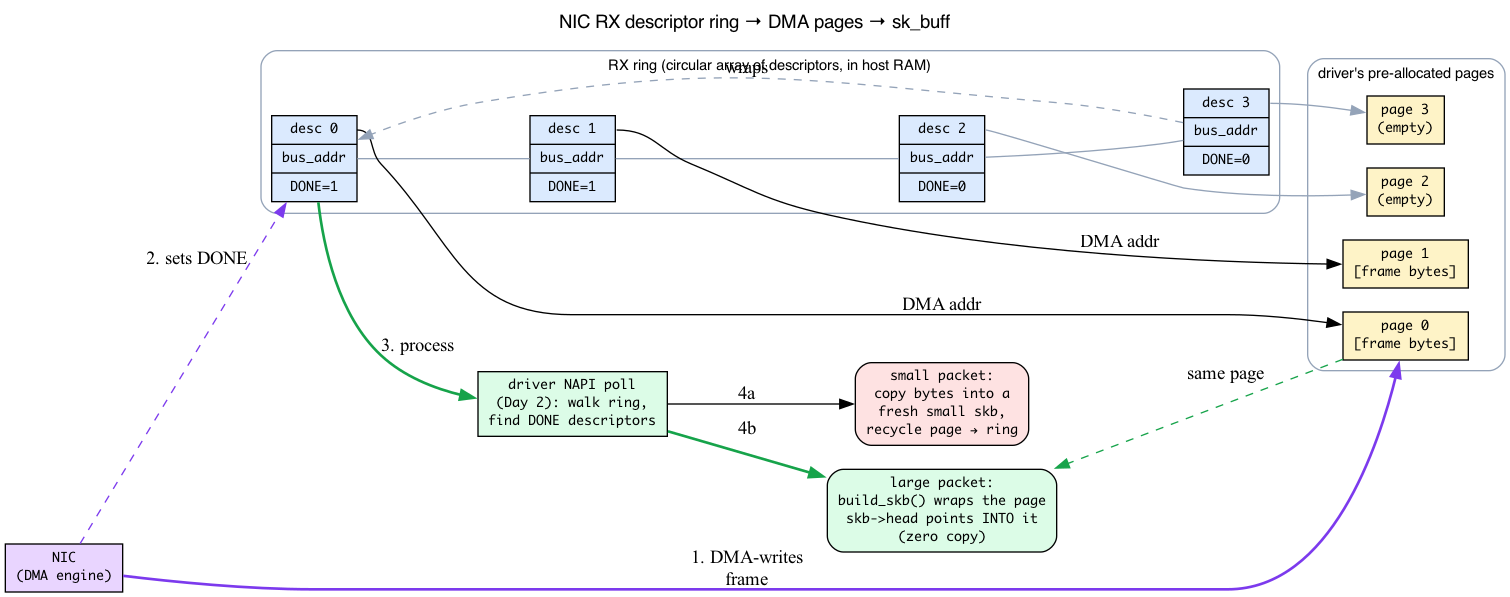
So how does the NIC know where to put incoming frames? Through a RX descriptor ring:
- A ring is a fixed-size circular array of descriptors, living in host memory, that the driver sets up at init time.
- Each descriptor is a small record holding a DMA (bus) address plus status bits.
- At startup the driver pre-allocates a buffer (typically one page, or a slice of a page) for each descriptor and writes that buffer’s bus address into the descriptor. These are the “driver’s preallocated pages” you’ll see referenced everywhere.
- When a frame arrives, the NIC’s DMA engine writes the frame bytes directly into the buffer named by the next free descriptor, then flips a DONE bit in that descriptor and (eventually) raises an interrupt.
The crucial consequence: by the time the CPU runs, the packet bytes are already sitting in a page in RAM. The driver didn’t copy them there — the hardware did. The driver’s job in its receive routine (which on Linux runs inside NAPI poll — Day 2’s whole topic) is to walk the ring, find descriptors with the DONE bit set, and turn each already-populated DMA page into an sk_buff the stack can process.
That last step is where sk_buff enters, and it has two strategies:
- Small packets (e.g. a 64-byte ACK): copy the few bytes out of the DMA page into a fresh, small skb buffer, and immediately recycle the DMA page back into the ring. Cheap, because the copy is tiny.
- Large packets: don’t copy at all. Wrap the existing DMA page in an skb so that the skb’s
datapointer points into the page the NIC already filled. This is the zero-copy receive path, and it’s exactly whatbuild_skb()exists to do. We’ll meet it below.
TX is the mirror image. To transmit, the driver takes an outgoing skb, dma_maps its linear buffer and each page fragment, writes those bus addresses into TX-ring descriptors, and kicks the NIC. The NIC’s DMA engine reads the bytes straight out of those pages and onto the wire, then raises a completion so the driver knows it can unmap and free the skb.
Hold onto one idea: a packet’s payload often lives in independent pages that the kernel wants to reference, not copy — DMA pages on RX, file-cache pages on sendfile() TX. That single fact is why sk_buff is split into a small “descriptor + headers” part and a list of “page fragments,” which we’ll see in a moment.
Connect forward: Day 2’s RX path starts in the driver’s NAPI poll draining this exact ring. Today we only need to know the ring exists and that it leaves packet bytes pre-positioned in pages.
A common zero-copy RX path: DMA page → skb window
Here’s the part most treatments skip, and it’s the part that makes everything else click. On a common high-performance receive path, the driver gives the NIC a kernel-owned buffer for DMA, then wraps that same storage in an skb instead of copying the frame. This is an important path — not a contract every driver must follow.
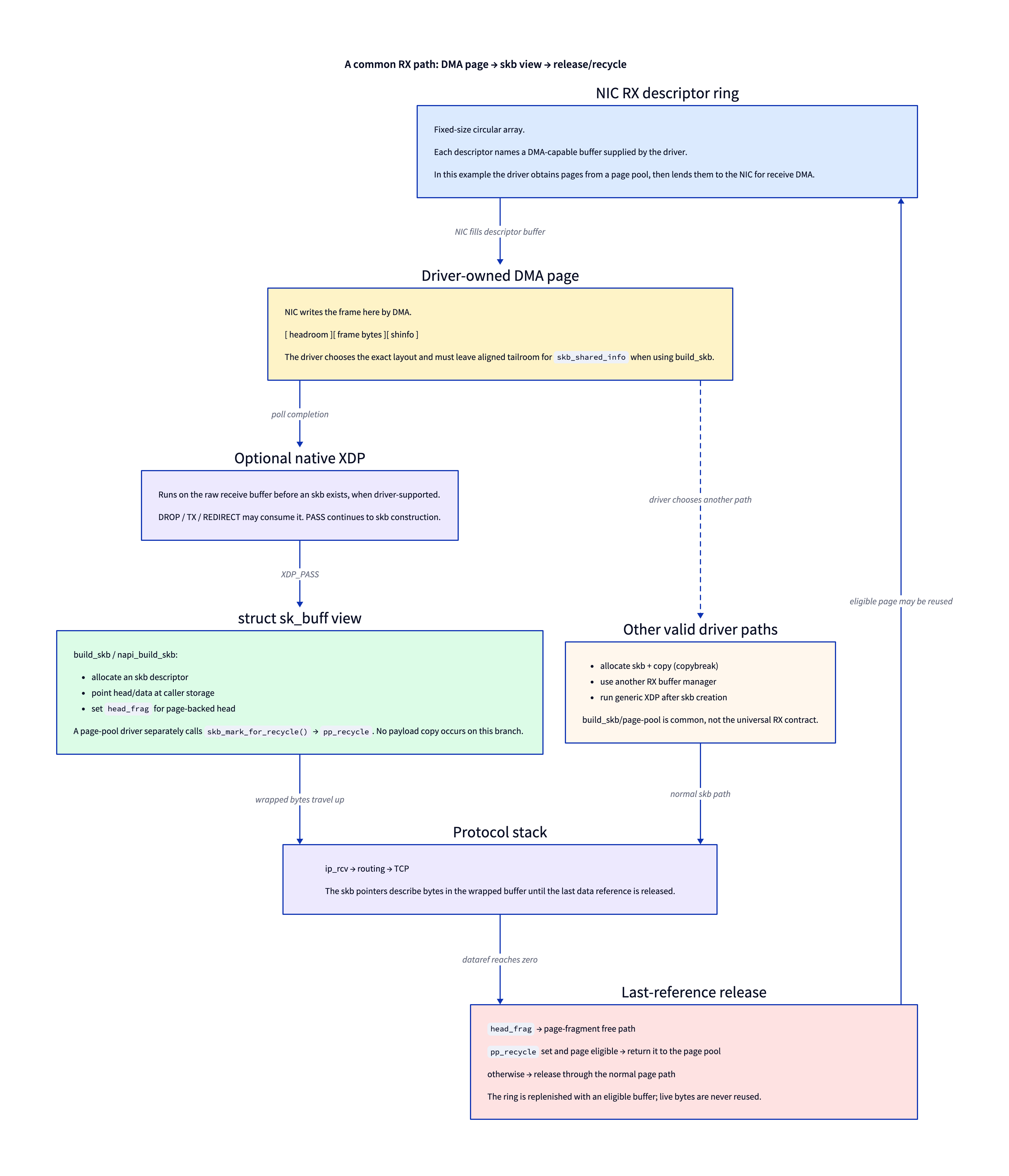
A modern NIC and its driver commonly communicate through a descriptor ring: a fixed-size circular array where each receive descriptor names a DMA-capable buffer. In a page-pool-based driver, the handshake looks like this:
- Before a packet arrives, the driver obtains a page (often from a page pool), maps it for DMA, and writes its DMA address into a free receive descriptor. The kernel owns the memory; the descriptor lends it to the NIC.
- A frame lands. The NIC DMA-engines the bytes into that buffer, marks the descriptor done, and eventually causes NAPI polling to run.
- The driver processes the completion. Native XDP, when supported and attached, can inspect the raw buffer here. After
XDP_PASS, many drivers callbuild_skbornapi_build_skb: the helper allocates an skb descriptor and pointsskb->headat the caller-provided storage. That branch avoids a payload copy. - The skb travels up the stack —
ip_rcv, routing, TCP — with its pointers describing bytes in that buffer. - The last data reference releases the head.
head_fragtellsskb_free_head()that the head came from a page or page fragment. Separately, a page-pool-aware driver callsskb_mark_for_recycle(), settingpp_recycle; only then does the free path try to return the page to its page pool. Without that marker, the page-fragment free path releases it normally.
The alternatives matter. Some drivers allocate an skb with napi_alloc_skb() and copy a small frame into it (a receive copybreak); others use different buffer managers. Generic XDP also runs later, after an skb already exists. So build_skb means “wrap caller-provided storage,” not “all RX is page-pool zero-copy.”
This is why build_skb exists alongside __alloc_skb. __alloc_skb allocates a descriptor plus fresh linear storage. build_skb allocates the descriptor around storage supplied by its caller; that storage may be a DMA-filled page, but the helper itself neither knows about a NIC ring nor opts the skb into page-pool recycling.
Three consequences fall out of the common page-backed path:
head_fragandpp_recycleanswer different questions.head_fragselects page-fragment release rather thankfree;pp_recycleasks the page-pool path to reclaim eligible storage.- Native XDP can run before skb construction. A drop or redirect can therefore avoid allocating the skb descriptor at all. (Day 27.)
- The driver reserves headroom and tailroom deliberately.
NET_SKB_PAD-style headroom permits laterskb_push; tailroom must include alignedskb_shared_info. The exact layout is driver-specific.
The transmit side uses a related ring but not a perfect ownership mirror (Day 3). TCP may retain its original skb in the retransmit tree while a charged clone travels through IP, the qdisc, and the driver. The driver maps that downstream skb for a TX descriptor, and completion releases the downstream reference.
Hold onto the qualified picture: RX descriptor → driver-owned DMA buffer → optional native XDP → skb view (or copy) → stack → release/recycle. Days 2 and 3 walk it function by function.
The descriptor and the data
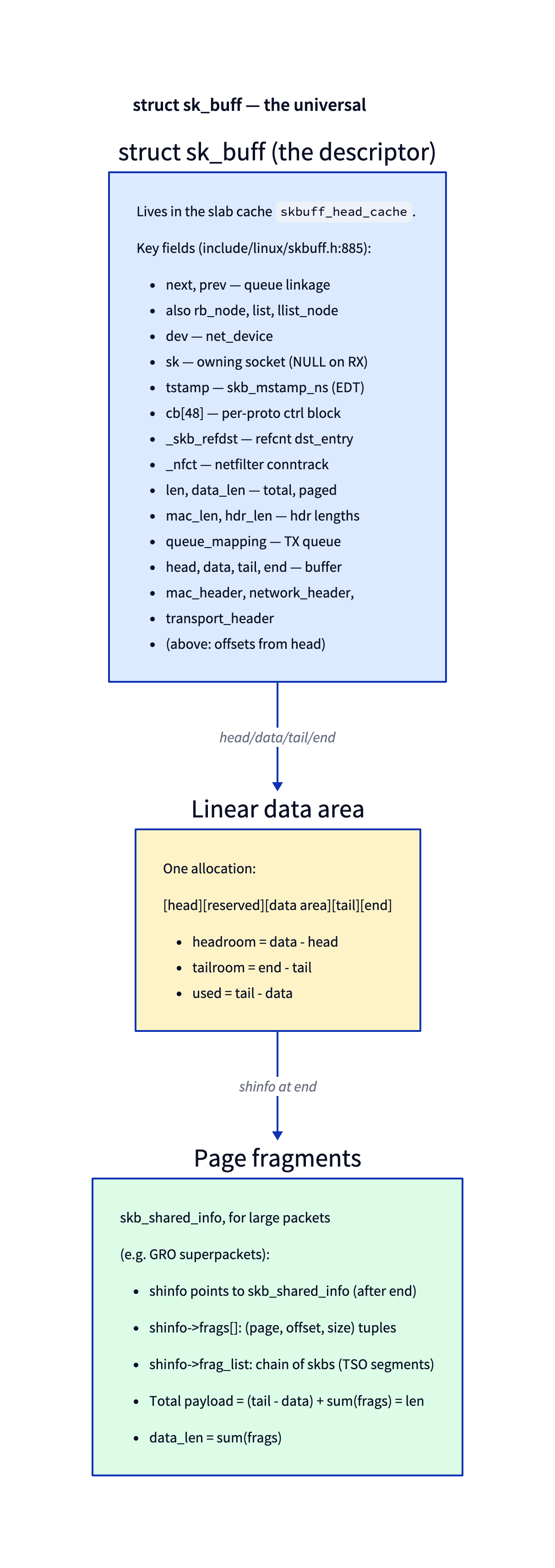
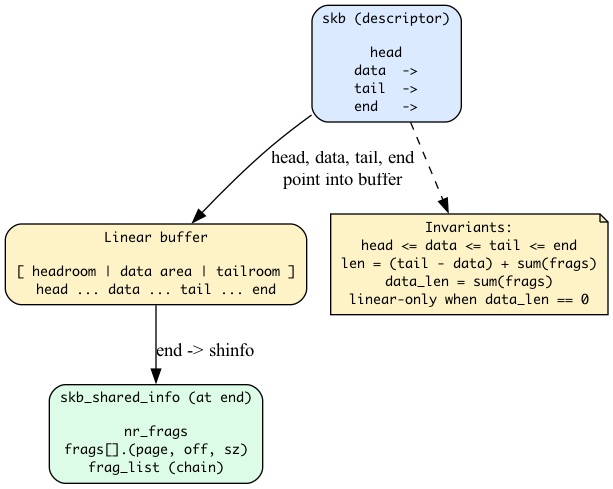
The sk_buff itself is a descriptor. The packet bytes live elsewhere — in a separately-allocated linear buffer plus, optionally, a tail of page fragments.
Four pointers in sk_buff define the linear region:
head— start of the allocation. Doesn’t move after creation.data— first valid byte of the current header view. Moves as you push/pull headers.tail— one past the last valid byte.end— the boundary; theskb_shared_infotrailer (fragment list + buffer refcounts, defined below) lives here.
The invariants:
head ≤ data ≤ tail ≤ endheadroom = data - head,tailroom = end - tail- For linear-only skbs,
len == tail - dataanddata_len == 0.
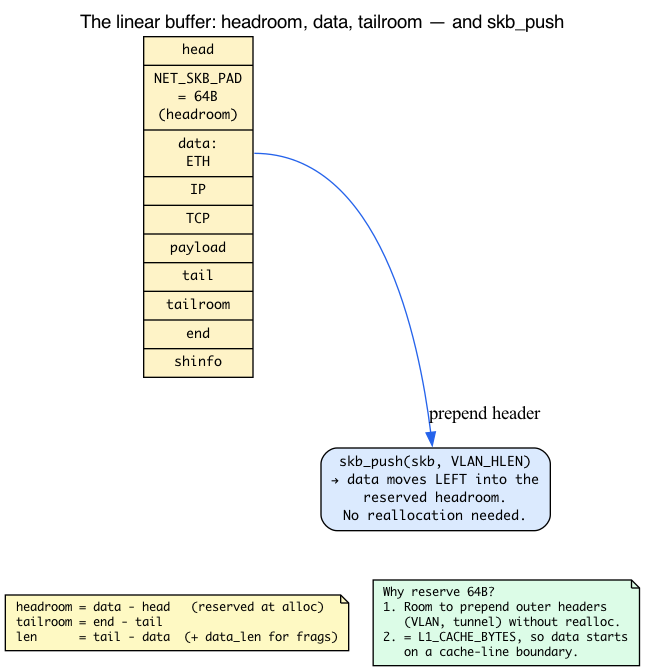
When the kernel pushes an outer header (e.g., adding an IP header to encapsulate), it does skb_push(skb, header_len) — which decrements data. Headroom shrinks; the prepended bytes are now part of the packet. The opposite is skb_pull — increment data, used when stripping a header you’ve already processed.
Why reserve headroom at all? NET_SKB_PAD explained
Notice that skb_push only works if there’s empty space before data to push into. That empty space is the headroom, and on the receive path the driver deliberately reserves some up front. Why?
Because as a received packet climbs the stack, layers frequently need to prepend bytes: re-insert a hardware-stripped VLAN tag, wrap the packet in an outer IP/UDP header for a tunnel, and so on. If there’s no headroom, each skb_push would have to reallocate the whole buffer (via pskb_expand_head) just to make room — expensive. Reserving a little headroom at allocation time means those pushes are nearly free.
The amount reserved by the RX allocators is NET_SKB_PAD, and it is not a magic constant — it’s defined relative to the cache line:
#define NET_SKB_PAD max(32, L1_CACHE_BYTES) /* include/linux/skbuff.h:3319 */
On x86_64, L1_CACHE_BYTES is 64 (CONFIG_X86_L1_CACHE_SHIFT=6 → 1 << 6 = 64), so NET_SKB_PAD = 64. Two things are happening with that value:
- Enough room for outer headers. 64 bytes comfortably covers a VLAN tag, a tunnel header, etc., so the common prepends never reallocate.
- Cache alignment. Because the pad equals the cache-line size, the packet’s first byte (
data, where the Ethernet header begins) starts on a cache-line boundary — which the receive path andmemcpys benefit from. (We’ll explain cache lines fully later; for now: aligned data is faster to touch.)
A separate, smaller pad you’ll see is NET_IP_ALIGN. Some architectures want the IP header 4-byte aligned. Since the Ethernet header is 14 bytes, a 2-byte pad before data makes byte 14 (the start of the IP header) land on a 4-byte boundary. But NET_IP_ALIGN = 2 (skbuff.h:3295) is only the generic fallback — it’s defined under #ifndef NET_IP_ALIGN. On x86 the arch overrides it to 0 (arch/x86/include/asm/processor.h:46: #define NET_IP_ALIGN 0), so no IP-alignment pad is inserted there at all — it’s not a per-driver choice to “skip” a 2-byte pad, the constant is simply zero. That’s why napi_alloc_skb reserving NET_SKB_PAD + NET_IP_ALIGN (skbuff.c:886) comes out to 64 + 0 = 64 on x86, matching the “~64 bytes” the headroom experiment promises. The 2-byte pad is honored only on alignment-sensitive architectures, where it costs nothing extra.
Keep NET_SKB_PAD = 64 in mind — it shows up again in the headroom experiment and in today’s Check question.
Page fragments — for big packets and zero-copy
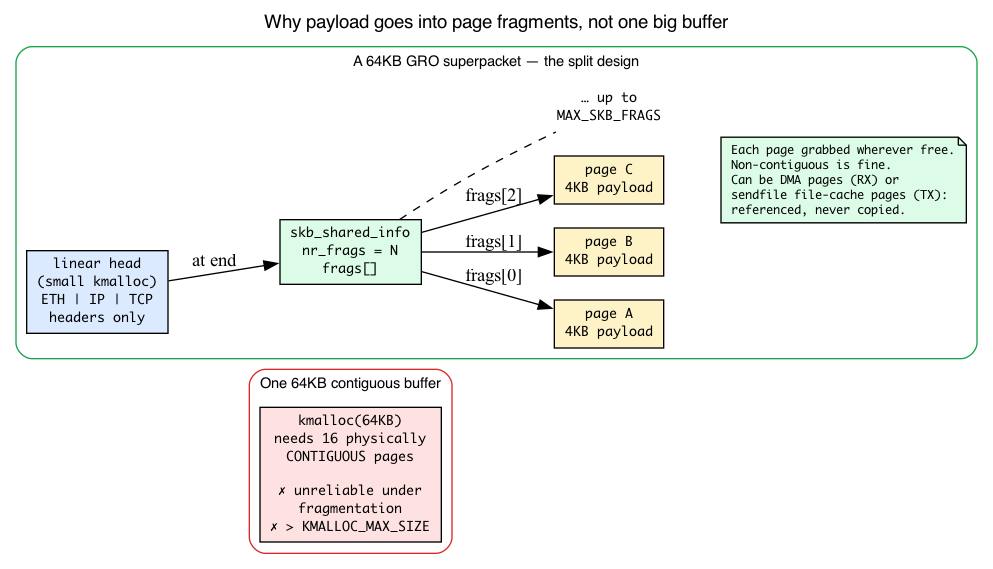
Many real packets — especially large outbound ones from sendfile() or large GRO inbounds — don’t fit in one allocation. The kernel uses skb_shared_info (placed right after the linear buffer’s end) to chain page fragments:
struct skb_shared_info {
    __u8 nr_frags;
    skb_frag_t frags[MAX_SKB_FRAGS];   /* (netmem, offset, len) tuples; see below */
    struct sk_buff *frag_list;         /* chain of skbs (TSO) */
    /* ... */
};
data_len holds the byte count in fragments. len = (tail - data) + data_len. Most code uses helpers (skb_frag_size, skb_frag_page) rather than touching the fields directly.
What a “page” is, and why payload goes into frags
To see why the kernel bothers with a separate fragment list instead of one big buffer, you need the kernel’s unit of physical memory: the page.
- Physical RAM is managed in fixed page frames of
PAGE_SIZE(4 KB on x86_64). Every allocation of physical memory is ultimately some number of these frames. - The buddy allocator hands out runs of 2^order contiguous pages: order 0 = 4 KB, order 1 = 8 KB, order 3 = 32 KB, and so on. Higher orders require more physically contiguous memory.
kmallocreturns physically contiguous memory and is therefore capped at a maximum size (KMALLOC_MAX_SIZE,slab.h:591). AboveKMALLOC_MAX_CACHE_SIZE(slab.h:593)kmallocstops using the size-bucketed slab caches and goes straight to the buddy/page allocator (still physically contiguous); the hard upper bound on one allocation isKMALLOC_MAX_SIZE. Asking for, say, one 64 KB physically contiguous block is unreliable on a busy system: there may be plenty of free pages, but not 16 of them in a row. That condition — free memory that isn’t contiguous — is fragmentation pressure.
Now the design makes sense. Think of a skb_frag_t as a (page, offset, size) reference — some bytes inside a page — which is the right first approximation. The literal struct in 7.1 is a (netmem, offset, len) tuple: struct skb_frag { netmem_ref netmem; unsigned int len; unsigned int offset; } (skbuff.h:361). The netmem_ref (include/net/netmem.h:140) is an opaque reference that encodes either a struct page or a net_iov (non-page memory, e.g. devmem-TCP), which is why a frag isn’t guaranteed to be backed by a struct page at all — skb_frag_page() first checks skb_frag_is_net_iov(frag) and returns NULL for the non-page case. Always touch a frag via the helpers skb_frag_page() / skb_frag_off() / skb_frag_size(), never the fields directly. The memory referenced by different frags need not be contiguous with each other or with the linear head. So a 64 KB GRO superpacket becomes:
- a tiny linear head holding just the Ethernet/IP/TCP headers (a small
kmalloc, easy to satisfy), plus - up to
MAX_SKB_FRAGSpage fragments holding the payload — each an ordinary 4 KB page grabbed from wherever it was free.
No 64 KB contiguous allocation needed, ever. And it’s exactly this structure that makes zero-copy possible: the frag pages can be the NIC’s DMA pages on RX, or sendfile()’d file-cache pages on TX — referenced, never copied.
MAX_SKB_FRAGS bounds how many frags one skb_shared_info holds. In v7.1 it’s configurable:
/* include/linux/skbuff.h */
#ifndef CONFIG_MAX_SKB_FRAGS
# define CONFIG_MAX_SKB_FRAGS 17
#endif
#define MAX_SKB_FRAGS CONFIG_MAX_SKB_FRAGS
and net/Kconfig declares config MAX_SKB_FRAGS with range 17 45 and default 17 — raising it helps GRO/BIG TCP pack more payload per skb.
There are no Dumb Questions
Q: Why isn’t the linear buffer just always big enough?
A: Because each skb potentially allocates its linear buffer at packet receive. For 64-byte ACKs that don’t carry payload, a 1500-byte allocation would waste memory. For 64KB GRO superpackets, a 64KB linear buffer is impractical (kmalloc max-order limits, fragmentation pressure). The split design lets the kernel allocate just enough for headers linearly and use page fragments for payload.
Q: What’s the cb[48] for?
A: It’s a per-packet scratchpad. Each protocol layer can stash state there. TCP uses
TCP_SKB_CB(skb)to keep sequence numbers, flags, and SACK info. Acrossskb_clonethecbcontents are copied verbatim into the clone —__copy_skb_header(net/core/skbuff.c:1552) doesmemcpy(new->cb, old->cb, sizeof(old->cb))— so the clone starts with the same control data. Layers that need clone-independent state must resetcbthemselves. 48 bytes is generous — most layers use a fraction.Q: How big is a fresh sk_buff descriptor?
A: Around 230 bytes on x86_64 (verify:
pahole sk_buffin your build directory after compiling — exact size is config-dependent). The structure has been carefully cache-line-aligned and the fields ordered for hot/cold separation. Read the comments around the field declarations to see what’s “RX hot” vs “TX hot.”
How the kernel hands out memory: the slab allocator
We’re about to read the allocation path, and it names several “caches.” Before that pays off, you need the slab allocator (Linux’s is called SLUB).
A general-purpose malloc is flexible but has overhead: it tracks variable-sized blocks, searches free lists, and fragments over time. The kernel allocates the same few object types over and over — millions of sk_buffs, for instance — so it uses a specialized scheme:
- The slab allocator carves whole pages into fixed-size object slots.
- A
kmem_cacheis a pool specialized for one object size/type. Allocation is essentially “pop a free slot,” free is “push it back” — O(1), with excellent cache behavior because objects of the same type cluster together. - General-purpose
kmalloc(n)is built on top of a set of size-bucketed caches (kmalloc-512,kmalloc-2k, …).kmalloc(n)roundsnup to the next bucket and pulls from that cache.
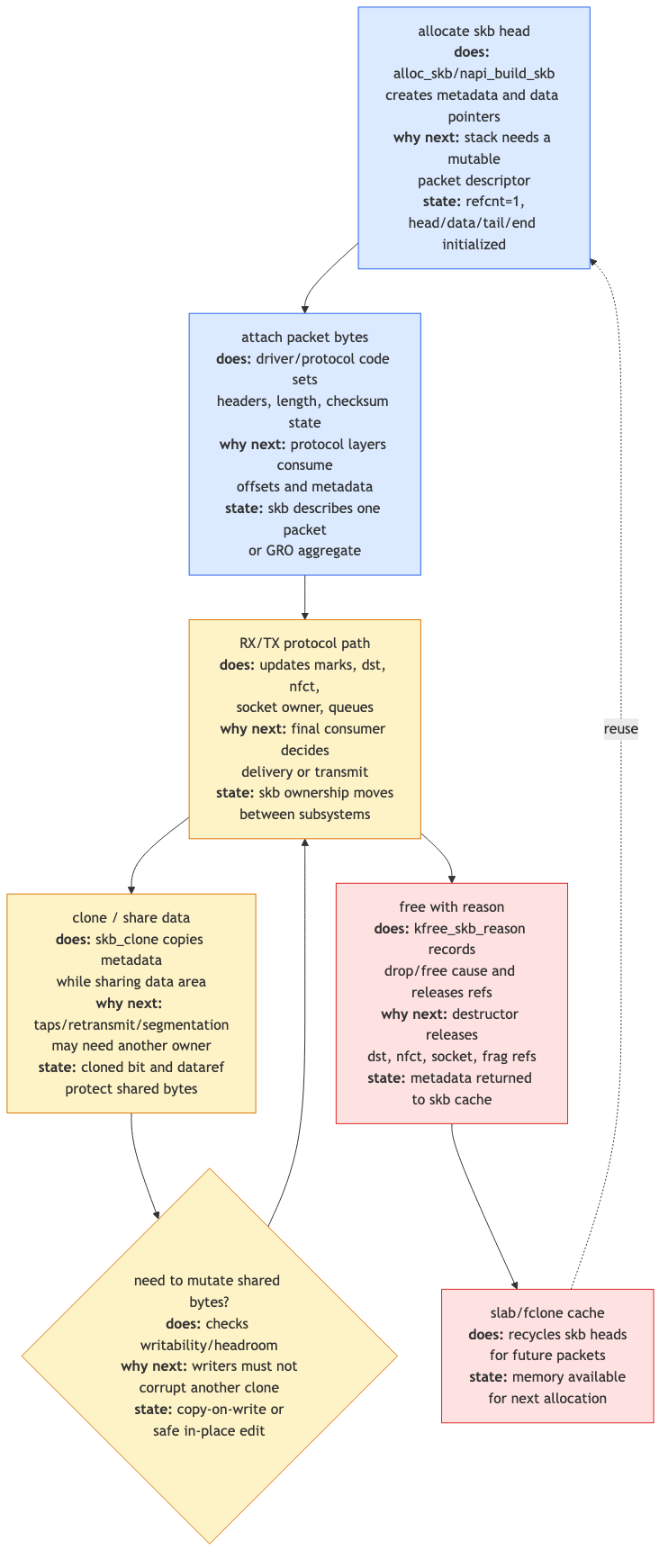
Now here’s the key structural insight about sk_buff: the descriptor and the data come from two different allocators.
-
The descriptor (
struct sk_buffitself) comes from a dedicated, fixed-size cache so every skb is the same size and stays hot in cache. In v7.1 this cache is named"skbuff_head_cache"and reached vianet_hotdata.skbuff_cache:/* net/core/skbuff.c:5189, in skb_init() */ net_hotdata.skbuff_cache = kmem_cache_create_usercopy("skbuff_head_cache", sizeof(struct sk_buff), 0, SLAB_HWCACHE_ALIGN | SLAB_PANIC | FLAG_SKB_NO_MERGE, ...); -
The linear data buffer is a separate allocation, sized to the packet. That’s why
__alloc_skballocates twice.
There are three skb-related caches created in skb_init():
| Cache (v7.1 name) | What it holds | Created at |
|---|---|---|
skbuff_head_cache | the struct sk_buff descriptor (fixed size) | skbuff.c:5189 |
skbuff_fclone_cache | a struct sk_buff_fclones = two skbs + a refcount | skbuff.c:5199 |
skb_small_head_cache (slab name "skbuff_small_head") | small linear data buffers (SKB_SMALL_HEAD_CACHE_SIZE) | skbuff.c:5208 |
Fclones. When code knows it will clone an skb soon (TCP does this constantly — it keeps a copy for retransmission while sending a clone down the stack), it sets SKB_ALLOC_FCLONE. That allocates from skbuff_fclone_cache, whose object is a struct sk_buff_fclones { struct sk_buff skb1; struct sk_buff skb2; refcount_t fclone_ref; } (skbuff.h:1396). The anticipated clone (skb2) is right there in the same allocation — no second descriptor allocation needed when the clone happens.
Per-CPU fast path. RX is hot, so there’s a per-CPU stash of recycled descriptors called the napi_alloc_cache (a per-CPU skb_cache[] array, skbuff.c:231). napi_skb_cache_get() (skbuff.c:284) pops from it; when empty it refills in bulk via kmem_cache_alloc_bulk(net_hotdata.skbuff_cache, ...). Allocating an skb with SKB_ALLOC_NAPI (or simply allocating in softirq context) pulls a descriptor from this per-CPU cache and skips the slab allocator’s slow path entirely. That’s the “per-CPU caching” the NAPI allocator advertises.
GFP flags. Every allocation takes a gfp_mask (e.g. GFP_KERNEL, GFP_ATOMIC). It tells the allocator what it’s allowed to do — most importantly, whether it may sleep. The RX path runs in softirq/IRQ (atomic) context where sleeping is forbidden, so it uses GFP_ATOMIC. That’s why the allocation functions thread a gfp_mask (and a NUMA node) through everything.
sk_buff lifecycle: cradle to grave
Now the allocation paths read cleanly, because you know what every cache and flag means.
Allocation paths (all in net/core/skbuff.c):
__alloc_skb(size, gfp_mask, flags, node)— the workhorse. Allocates the descriptor fromnet_hotdata.skbuff_fclone_cache(whenSKB_ALLOC_FCLONEis set, useful for skbs you’ll clone) or the defaultskbuff_head_cache— or, withSKB_ALLOC_NAPI, from the per-CPUnapi_alloc_cache. Then allocates the linear buffer separately viakmalloc_reserve(skbuff.c:604), which pulls fromskb_small_head_cachefor small heads or falls back to the size-bucketedkmalloccaches for larger ones. Two allocations, two allocators — exactly as the slab section predicted. (__alloc_skbis atskbuff.c:672.)__netdev_alloc_skb(dev, len, gfp_mask)— drivers’ RX-side allocator. Its buffer “hasNET_SKB_PADheadroom built in” (the kernel doc comment says so verbatim atskbuff.c:753) for cheap header insertion.napi_alloc_skb(napi, len)— NAPI fast-path allocator with the per-CPU descriptor caching described above; also reservesNET_SKB_PAD.build_skb(data, frag_size)/slab_build_skb(data)— wrap a pre-existing buffer (the driver’s preallocated DMA page) into an skb. This is the zero-copy receive path from the NIC section. Instead of allocating a data buffer and copying the frame in, it allocates only a descriptor (kmem_cache_alloc(net_hotdata.skbuff_cache, ...)) and points the skb at the page the NIC already filled.__build_skbis atskbuff.c:488;build_skbatskbuff.c:506then setsskb->head_frag = 1(the skb’s head is a page fragment,skbuff.h:828) and callsskb_propagate_pfmemalloc(...).napi_build_skb()(skbuff.c:574) is the NAPI-context variant that also sources its descriptor from the per-CPU cache. The doc comment on__build_skbspells out the RX model we taught: “Before IO, driver allocates only data buffer where NIC put incoming frame… RX rings only contain data buffers, not full skbs.”
Cloning paths — and to read these you need the refcount model, so let’s build it first.
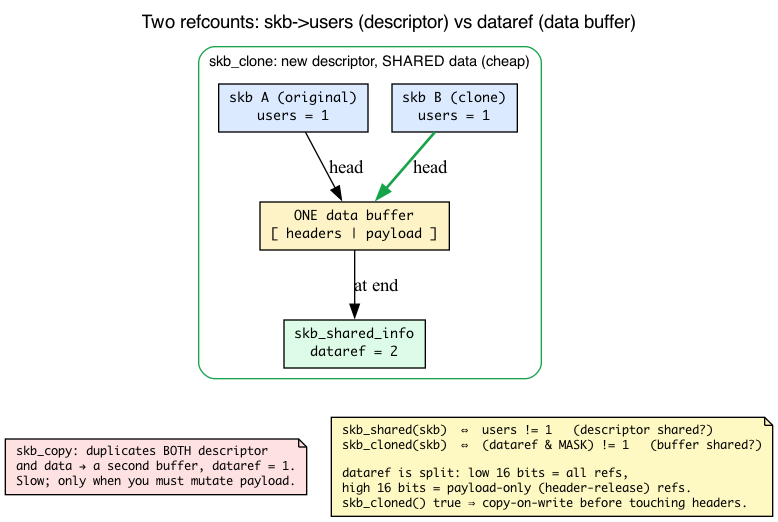
Two refcounts, not one: skb->users vs dataref
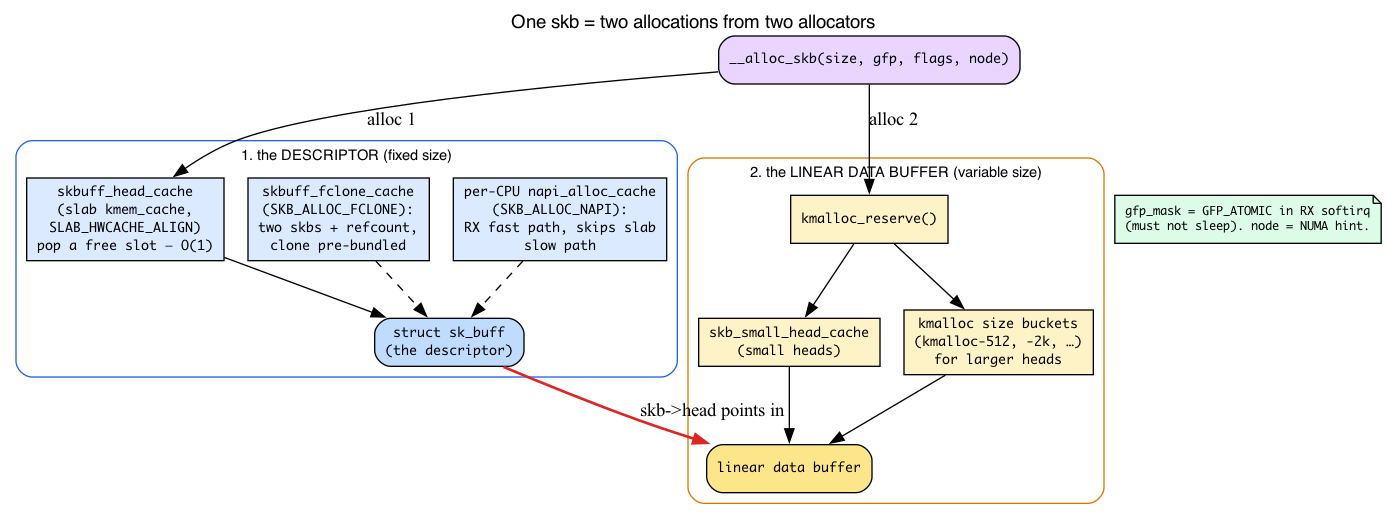
skb_clone makes a cheap copy of an skb. To understand why it’s cheap and what it’s safe to do afterward, you must know that an skb tracks two completely separate reference counts.
1. skb->users — references to the descriptor.
refcount_t users; /* include/linux/skbuff.h:1099 */
This counts how many places hold this sk_buff pointer. skb_get() bumps it; kfree_skb() decrements it and only actually frees when it hits zero. skb_shared(skb) is literally refcount_read(&skb->users) != 1 (skbuff.h:2112). Two subsystems queuing the same skb use this.
2. skb_shared_info.dataref — references to the data buffer.
atomic_t dataref; /* include/linux/skbuff.h:612 */
This counts how many sk_buff descriptors point at the same data buffer. This is the one skb_clone touches: a clone gets a brand-new descriptor but, instead of copying the bytes, increments dataref. That is why cloning is cheap — no payload copy.
Because clones share the buffer, you must not blindly write to a cloned skb’s headers — you’d corrupt the other holder’s view. So dataref is cleverly split into two halves (SKB_DATAREF_SHIFT = 16, skbuff.h:658):
- the low 16 bits count the overall number of references to the buffer;
- the high 16 bits count how many of those are payload-only (header-release) references.
The kernel’s own doc block (skbuff.h, “DOC: dataref and headerless skbs”) explains it: TCP marks an skb nohdr via __skb_header_release(), which sets dataref = 1 + (1 << SKB_DATAREF_SHIFT) (skbuff.h:2101) so lower layers know they may prepend headers into the shared buffer safely. skb_header_cloned() (skbuff.h:2070) computes (dataref & MASK) - (dataref >> SHIFT) to decide whether the headers are safe to modify in place.
This gives you the precise meaning of two helpers you’ll see everywhere:
skb_cloned(skb)(skbuff.h:2031) is true when the data buffer is shared ((dataref & SKB_DATAREF_MASK) != 1). If it’s true, you must not write headers without first doing a copy-on-write viapskb_expand_head.skb_shared(skb)tests the descriptor count (users != 1), a different question entirely.
With that, the cloning paths are obvious:
skb_clone(skb, gfp)(skbuff.c:2088) — new descriptor, shares the data buffer (bumpsdataref). Cheap. Used heavily in packet sockets (tcpdump) and netfilter LOG. (If an fclone is available it reuses the pre-allocatedskb2— no descriptor allocation at all.)skb_copy(skb, gfp)— full copy of both descriptor and data (fresh buffer,dataref = 1). Slow; only when you must mutate the payload.pskb_copy(skb, gfp)— copies the linear head but shares the frag pages (bumps the pages’ refcounts).
This two-level scheme is why tcpdump, which clones every packet, stays cheap per packet yet still shows up measurably at high rates — today’s clone-tracing experiment makes that visible.
Free paths:
kfree_skb(skb)— the standard release. Decrements refcounts (bothusersand, whenusershits zero,datarefon the buffer); frees the data only if it’s the last reference.kfree_skb_reason(skb, reason)— newer; takes aenum skb_drop_reasonso the kernel’s drop monitor can attribute the drop. Always prefer this in new code. The reason enum is ininclude/net/dropreason-core.h.consume_skb(skb)— same askfree_skbbut doesn’t trigger drop tracepoints (used for “successful” disposals).
The CPU’s view of memory: cache lines and field ordering
One last piece of background, and it explains the comments you’ll read in the struct and the whole point of today’s pahole lab.
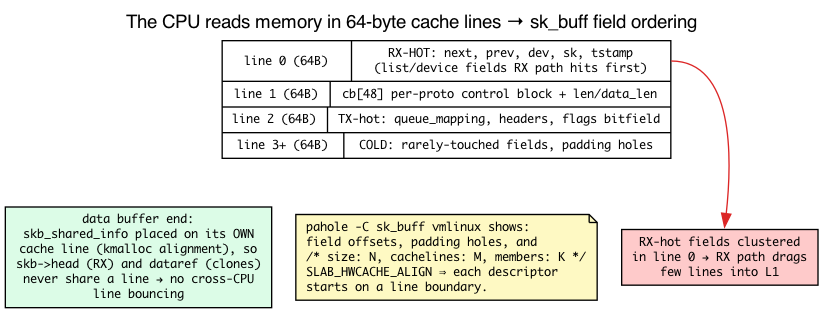
The CPU does not read memory one byte at a time. It moves memory in fixed cache-line units — L1_CACHE_BYTES, 64 bytes on x86_64. Touch a single field and the CPU pulls that field’s entire 64-byte line into L1 cache. Touch a field in a different line, that’s a second line fetched.
This has a direct performance consequence for a struct touched as often as sk_buff:
-
Hot/cold separation. If the fields a given code path uses are scattered across many cache lines, the path drags many lines into cache. If they’re grouped into the same line(s), the path touches few lines and runs faster. So
sk_buffis laid out so that RX-hot fields cluster, TX-hot fields cluster, and rarely-used (cold) fields sit apart so they don’t pollute hot lines. That’s why the very first fields arenext,prev, and thedev/skarea (skbuff.h:886) — the list-and-device fields the RX path hits first. -
Bit-packed flags. Boolean state like
cloned:1, nohdr:1, fclone:2, head_frag:1, pfmemalloc:1, …is packed into shared__u8bitfields (skbuff.h:956) partly to keep the hot section dense — many flags in one byte instead of one byte each. -
Descriptor alignment. Remember
skbuff_head_cachewas created withSLAB_HWCACHE_ALIGN? That makes every descriptor start on a cache-line boundary, so a given field’s offset maps predictably to a line. -
Separating head from
skb_shared_info. Look again at the comment inside__alloc_skb(right beforekmalloc_reserve):/* We do our best to align skb_shared_info on a separate cache line. * It usually works because kmalloc(X > SMP_CACHE_BYTES) gives aligned * memory blocks ... Both skb->head and skb_shared_info are cache line aligned. */The kernel places
skb_shared_infoat a cache-line boundary at the end of the data buffer so thatskb->head(written on RX) andskb_shared_info(refcount fields touched by clones) don’t share a line — otherwise the line would bounce between CPUs.
Tie it back to NET_SKB_PAD = max(32, L1_CACHE_BYTES): that’s the same L1_CACHE_BYTES, used so the data start lands on a line boundary. The cache line is the hidden constant behind half the layout decisions in this file.
This is precisely what pahole reveals: it prints each field’s offset, the padding holes, and a /* size: N, cachelines: M, members: K */ footer showing how the struct fills its lines. Today’s lab teaches you to read that.
Today’s experiment
You don’t write code today. You inspect what’s already running.
See sk_buff allocations live
sudo bpftrace -e 'kprobe:__alloc_skb { @[comm, kstack] = count(); } interval:s:5 { exit(); }' | head -50
5 seconds of skb allocations grouped by caller. You’ll see drivers and protocol layers calling in.
Watch drops with reasons
sudo perf trace --no-syscalls -e skb:kfree_skb -- sleep 5
Output shows where in the kernel each dropped skb was disposed of, plus the drop reason if kfree_skb_reason was used.
Inspect skb size on your build
cd ~/code/linux
# After building vmlinux once (needs CONFIG_DEBUG_INFO_BTF=y or DWARF):
pahole -C sk_buff vmlinux
pahole reads the struct layout from the compiled vmlinux’s debug info, not from the header source — a .h has no offsets or padding until the compiler lays the type out. -C sk_buff selects just that struct (no grep needed); it prints the field-by-field layout with a /* size: N, ... */ footer. Reveals the size, padding, and field-by-field layout. Note how next, prev, dev, sk are at the top — that’s the cache-hot section that the RX path touches first. Now that you know what a cache line is, read the padding holes and the cachelines: count as a map of the hot/cold separation we just discussed.
Trace a packet’s headroom journey
sudo bpftrace -e '
fentry:ip_rcv { @h[comm] = lhist((uint64)args->skb->data - (uint64)args->skb->head, 0, 256, 16); }
interval:s:5 { exit(); }'
Histogram of headroom on packets entering ip_rcv. You’ll see most packets have ~64 bytes of headroom (NET_SKB_PAD). That 0 vs 64 split is the whole point of the headroom section: the RX allocators (__netdev_alloc_skb, napi_alloc_skb) pre-reserve NET_SKB_PAD so later skb_pushes of outer headers don’t reallocate, while plain __alloc_skb reserves nothing (some drivers reserve more on top for crypto offload or XDP).
Watch clones share-count under tcpdump
A packet socket capture clones every packet. Start a capture (-w /dev/null discards packets so tcpdump doesn’t spam your terminal):
sudo tcpdump -i any -w /dev/null &
Then trace skb_clone:
sudo bpftrace -e 'fentry:skb_clone { @[kstack] = count(); } interval:s:5 { exit(); }' | head -30
skb_clone fires on every packet because the capture path clones each one. Each clone is a fresh descriptor that merely bumps the buffer’s dataref (not a payload copy), which keeps per-packet cost low — yet at high packet rates even that cheap clone is measurable, which is why tcpdump adds overhead. Stop the capture when done:
sudo pkill tcpdump
What to read in the kernel
include/linux/skbuff.h—struct sk_buffdefinition (line 886). Read the field comments. Then look at the helpers (skb_push,skb_pull,skb_reserve,skb_put). Also skim the bitfield block (~line 955) and the “DOC: dataref and headerless skbs” comment.net/core/skbuff.c—__alloc_skb(line 672),__build_skb(line 488),kfree_skb_reason,skb_clone(line 2088). Note the three caches created inskb_init(lines 5189–5208). ~7500 lines total, but the allocation path is < 100 lines.include/linux/skbuff_ref.h— refcount helpers; quick read.include/net/dropreason-core.h— theenum skb_drop_reasonlist (~124 reasons in 7.1). Skim. This is what you’ll see inperf trace.Documentation/networking/skbuff.rst— the official reference. One-time read.
Bullet Points
- A NIC delivers packets by DMA into pre-allocated pages named by RX-ring descriptors — bytes are in RAM before the CPU runs. The driver turns each done descriptor into an skb.
sk_buffis the descriptor; data lives in a linear buffer + optional page fragments. A frag is a(netmem, offset, len)tuple —netmemreferences a page or a net_iov (useskb_frag_page()/skb_frag_off()/skb_frag_size()) — so payload can be non-contiguous pages — DMA pages orsendfilepages — and need never be copied.- Pointer invariant:
head ≤ data ≤ tail ≤ end.headroom,tailroom,len,data_len. RX allocators pre-reserveNET_SKB_PAD = max(32, L1_CACHE_BYTES) = 64soskb_pushof outer headers doesn’t reallocate. - A 64KB linear buffer is impractical because
kmallocreturns physically-contiguous memory capped atKMALLOC_MAX_SIZE, and fragmentation makes big contiguous runs scarce — hence the linear-head + page-frags split. - The slab allocator gives O(1) fixed-size pools. The skb descriptor comes from
skbuff_head_cache; the linear buffer fromskb_small_head_cache/kmallocbuckets — two allocations.skbuff_fclone_cachepre-bundles a clone; the per-CPUnapi_alloc_cachefeeds the RX fast path.GFP_ATOMICis used in atomic RX context. cb[48]is the per-packet scratchpad each protocol layer uses.- Allocate via
__alloc_skb/napi_alloc_skb/build_skb(zero-copy wrap of a DMA page); free viakfree_skb_reason. - Two refcounts:
skb->userscounts descriptor references (skb_shared);skb_shared_info.datarefcounts how many descriptors share the data buffer (split into all-refs / payload-only halves).skb_clonebumpsdatarefand shares data;skb_copyduplicates everything (dataref = 1).skb_cloned()⇒ copy-on-write before touching headers. enum skb_drop_reasonis the new-and-required way to attribute drops.- The structure is large (~230 bytes; verify with pahole, config-dependent); the CPU reads memory in 64-byte cache lines, so fields are cache-line ordered for RX-hot/TX-hot/cold separation, the descriptor is
SLAB_HWCACHE_ALIGNed, andskb_shared_infois placed on its own line — read the comments, and readpahole’scachelines:footer.
Check question
You receive a packet at the NIC. The driver allocates an skb via napi_alloc_skb(napi, 1500). The packet is 100 bytes of Ethernet + IP + TCP. Walk through what the four pointers (head, data, tail, end) look like just after the driver finishes setup but before ip_rcv runs.
Click to reveal answer
Answer: head points at the start of the linear allocation. data points at the start of the Ethernet header (driver placed bytes there after reserving NET_SKB_PAD = 64 bytes of headroom). tail points at byte 100 past data (the packet bytes). end is at the linear buffer’s end (1500 + alignment). So: headroom = 64, len = 100, data_len = 0, tailroom = ~1400. By the time ip_rcv runs, eth_type_trans has advanced data past the Ethernet header (adjusting mac_header etc.), so data now points at the IP header. (In the zero-copy build_skb case the bytes were never copied — head would point into the NIC’s DMA page and skb->head_frag would be set — but napi_alloc_skb here allocates a fresh linear buffer the driver copies the small frame into.)
Tomorrow
Day 2: the RX path. NAPI poll → driver → __netif_receive_skb → ip_rcv. We trace a packet through every stage and see where each skb_* helper gets called — starting in the driver’s NAPI poll, draining the very RX descriptor ring we met today.