Day 2 — The RX path: from wire to ip_rcv
Today’s mission: trace a packet from the moment it hits the NIC to the moment it enters
ip_rcv. See every step — and learn the five mechanisms the path is built on (softirqs, NAPI, XDP, GRO, packet_type demux) so nothing along the way is a black box. Total time: ~110 minutes.
The journey at a glance
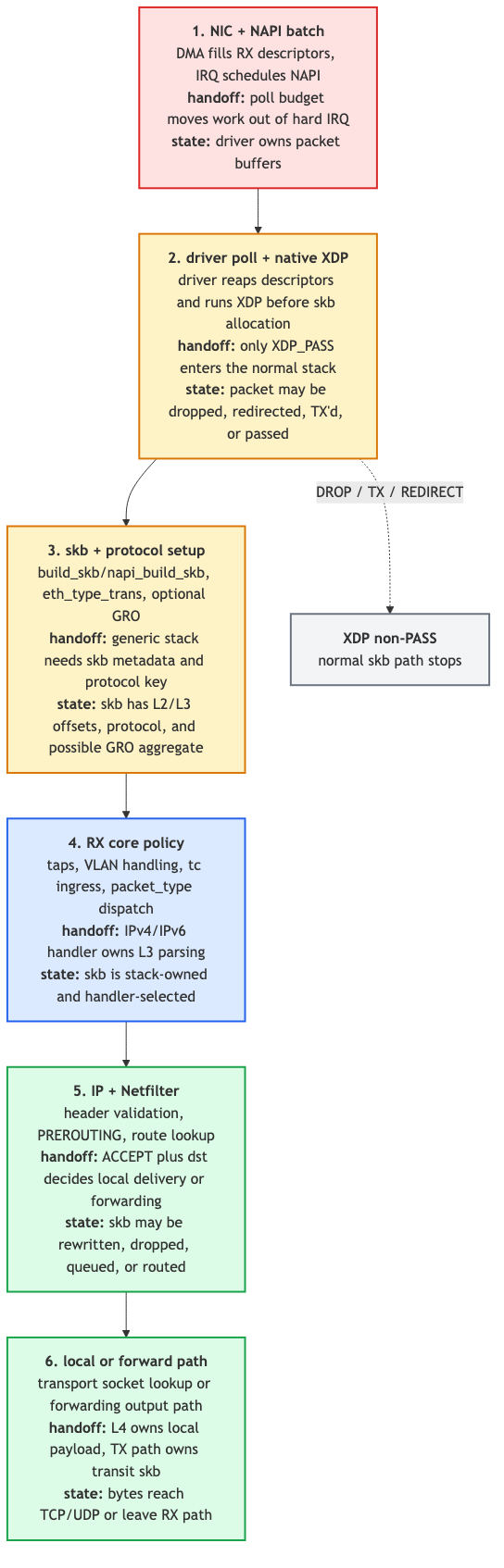
Every received packet on a typical Linux box traverses a sequence of handoffs. Hardware DMAs the frame into kernel-owned RX memory, the IRQ only schedules work, NAPI polls the driver under a budget, native XDP can decide before an skb exists, XDP_PASS becomes an sk_buff, GRO may coalesce related TCP segments, and the core stack dispatches the packet to the right L3 protocol handler.
That sentence names five things that this whole chapter leans on but that you’ve never been formally taught: a softirq, the NAPI state machine, XDP, the GRO accumulator, and packet_type demultiplexing. Day 1 forward-referenced all of them but taught none. So before we walk the path, we’ll teach each one — intuition first, then the concrete v7.1 struct or function — and only then trace the packet, with every stage resting on something you already understand.
We’ll anchor everything to a specific file/function in your ~/code/linux checkout (line numbers from kernel 7.1).
Two things from Day 1 are load-bearing today and will not be re-taught:
- The RX descriptor ring + DMA. Recall from Day 1 — the NIC’s DMA engine writes each frame into a pre-allocated page named by an RX-ring descriptor and flips a DONE bit; the driver’s NAPI poll drains those done descriptors. The bytes are in RAM before the CPU runs.
build_skbzero-copy wrap.build_skbwraps that already-filled DMA page (head_frag = 1) instead of copying it, giving zero-copy receive. We met it in Day 1’s lifecycle section.
Background 1: What a softirq actually is
The whole RX path runs in a softirq. Before we can say “the IRQ raises NET_RX_SOFTIRQ and the softirq runs net_rx_action,” you need to know what that machinery is.
The problem: a hardware IRQ handler must be tiny
When a NIC raises an interrupt, the CPU drops whatever it was doing and jumps to the driver’s IRQ handler. That handler runs in a brutally constrained world:
- It preempts the currently-running task (which never agreed to be interrupted).
- It runs on a small, dedicated IRQ stack.
- It cannot sleep — no blocking allocations, no waiting on locks that might sleep.
- It runs with interrupts of the same priority masked, so while it runs, other devices at that level are stalled.
Doing the full receive path — route lookup, netfilter, BPF, delivering to a socket — inside that handler would be a disaster: it would stall the machine and starve everything else. So Linux splits interrupt work into two halves:
- The top half is the actual hardware IRQ handler. It does the absolute minimum: acknowledge the device and schedule deferred work. Then it returns.
- The bottom half is that deferred work, run later in a relaxed context where it’s allowed to take its time.
A softirq is Linux’s primary bottom-half mechanism.
What “softirq” means concretely
A softirq is a statically-defined, per-CPU bottom half. “Statically defined” matters: there is a fixed, small enum of softirq vectors compiled into the kernel — you cannot create one at runtime. Here is the entire list (include/linux/interrupt.h:550):
enum
{
    HI_SOFTIRQ=0,
    TIMER_SOFTIRQ,
    NET_TX_SOFTIRQ,
    NET_RX_SOFTIRQ,
    BLOCK_SOFTIRQ,
    IRQ_POLL_SOFTIRQ,
    TASKLET_SOFTIRQ,
    SCHED_SOFTIRQ,
    HRTIMER_SOFTIRQ,
    RCU_SOFTIRQ,    /* Preferable RCU should always be the last softirq */
    NR_SOFTIRQS
};
Networking owns two of them: NET_RX_SOFTIRQ (receive) and NET_TX_SOFTIRQ (transmit). Each vector has one action function registered at boot via open_softirq() (kernel/softirq.c:806). The networking subsystem registers its two in net/core/dev.c:
open_softirq(NET_TX_SOFTIRQ, net_tx_action);   // net/core/dev.c:13288
open_softirq(NET_RX_SOFTIRQ, net_rx_action);   // net/core/dev.c:13289
So net_rx_action is the receive bottom half. The rest of today is mostly the story of what net_rx_action does.
Raising vs. running — they are not the same
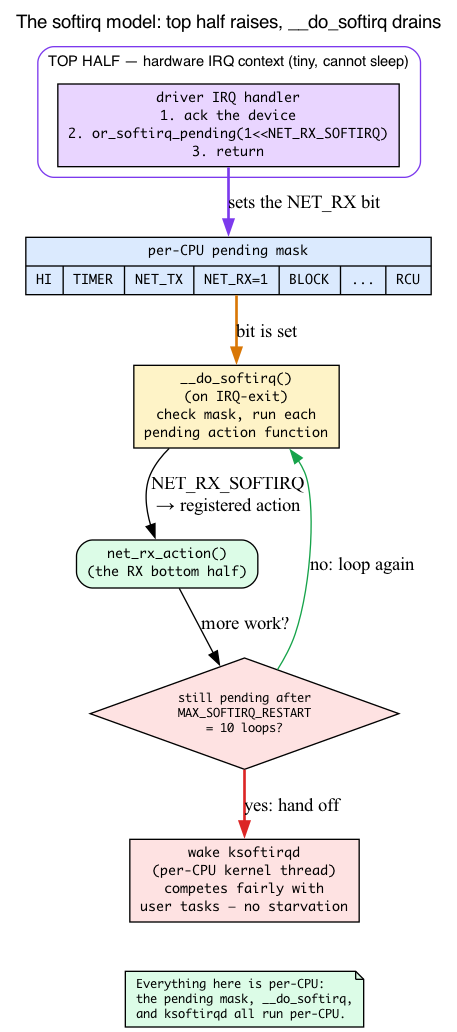
Here’s the subtlety that trips people up. “Raising” a softirq does not run anything. It just sets a per-CPU pending bit. The hot-path raise is raise_softirq_irqoff (kernel/softirq.c:773) → __raise_softirq_irqoff (:799), which does exactly one meaningful thing:
or_softirq_pending(1UL << nr); // kernel/softirq.c:803
That’s it — OR a bit into this CPU’s pending mask. The actual draining happens elsewhere: __do_softirq (kernel/softirq.c:654) checks the pending mask and runs each pending vector’s action function. It’s invoked on IRQ-exit (right after the top half returns) and from a few other points. So the top half “raises” (sets the bit and returns); moments later, on the way out of interrupt context, __do_softirq notices the bit and calls net_rx_action.
Why a packet flood can’t freeze your shell: ksoftirqd
Softirqs run at higher priority than user threads — so what stops an endless packet flood from making __do_softirq loop forever and starving your login shell? A safety valve. __do_softirq will restart processing at most MAX_SOFTIRQ_RESTART = 10 times (kernel/softirq.c:544). If softirqs are still pending after that, it gives up and wakes a per-CPU kernel thread, ksoftirqd (run_ksoftirqd, kernel/softirq.c:1068), to finish the work as a normal schedulable thread. That thread competes fairly with user tasks, so softirq work can be intense but can never indefinitely lock out user space. This hand-off is the concrete meaning of “softirqs are lower priority than hardware IRQs but a notch above user threads.”
Per-CPU is the through-line
Notice the recurring word: per-CPU. Each CPU has its own pending mask, runs its own __do_softirq, and has its own ksoftirqd. This is why everything downstream is per-CPU too — the poll_list NAPI uses, the softnet_data struct, the /proc/net/softnet_stat counters. When you see “per-CPU” later, it traces straight back to here.
Background 2: NAPI and the two budgets
You’ll constantly read “napi_schedule,” “poll_list,” and “the poll function processes packets under a budget.” Time to make those real — and to kill a common confusion: there are two different budgets, not one.
The NAPI idea: stop interrupting, start polling
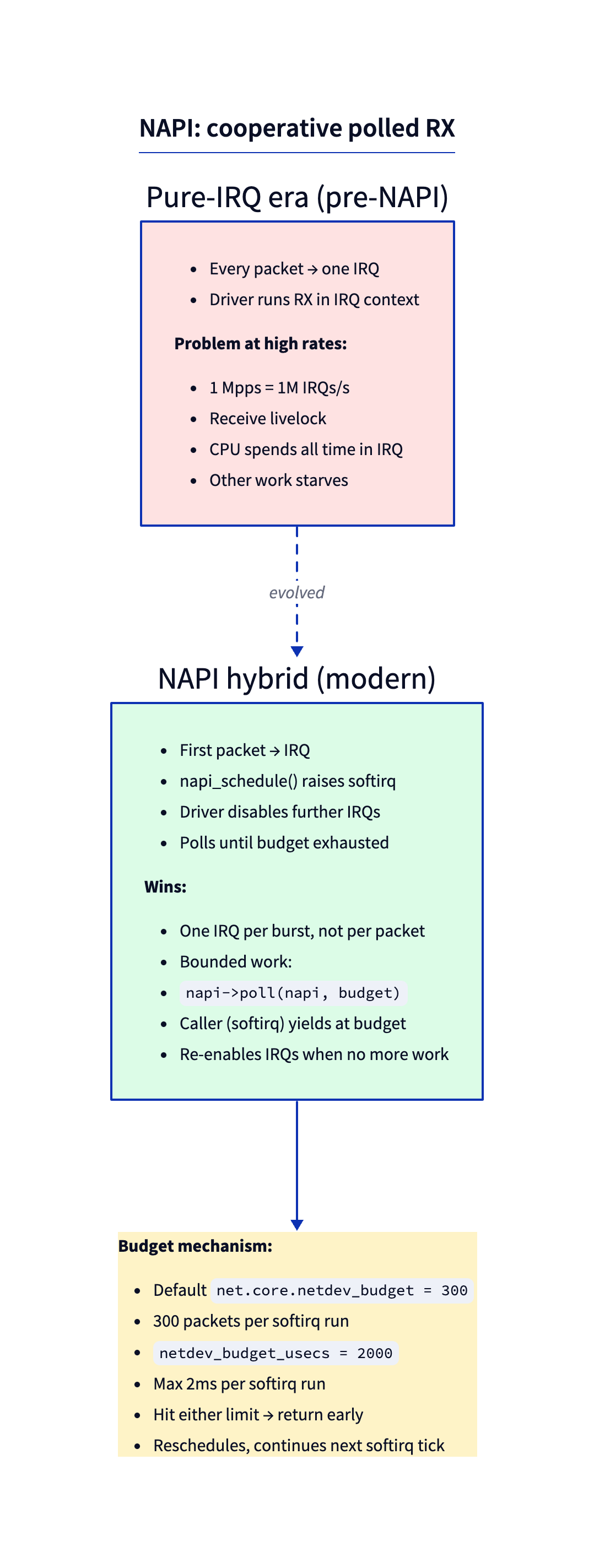
A 10/40/100-Gbit NIC under load can raise millions of interrupts per second. Even with a tiny top half, that’s death by a thousand cuts — the IRQ overhead alone melts a CPU (“receive livelock”). NAPI (“New API,” though it’s been the API for ~20 years) fixes this with a trade: at the first packet, mask the device’s RX interrupt and switch to polling. The kernel then repeatedly asks the driver “got more?” until the ring drains, and only then re-enables the interrupt. One IRQ per burst, instead of one per packet.
struct napi_struct: the per-queue polling context
Each NIC receive queue registers a struct napi_struct — the context that ties a driver’s poll routine to the core’s polling loop (include/linux/netdevice.h:381):
struct napi_struct {
    unsigned long       state;       /* NAPI_STATE_SCHED bit lives here */
    struct list_head    poll_list;   /* links onto the per-CPU poll_list */
    int                 weight;      /* per-poll packet cap (default 64) */
    int                 (*poll)(struct napi_struct *, int);  /* driver callback */
    struct net_device   *dev;
    struct sk_buff      *skb;
    struct gro_node     gro;         /* the GRO accumulator (Background 4) */
    /* ... timers, ids, control-path fields ... */
};
The four fields that matter today: state (holds the NAPI_STATE_SCHED bit — “I’m scheduled to be polled”), poll_list (the list node that hangs this napi off the per-CPU poll list), weight (the per-poll budget — more below), and poll (the driver’s drain routine, e.g. e1000_clean, mlx5e_napi_poll).
The schedule → poll → complete cycle
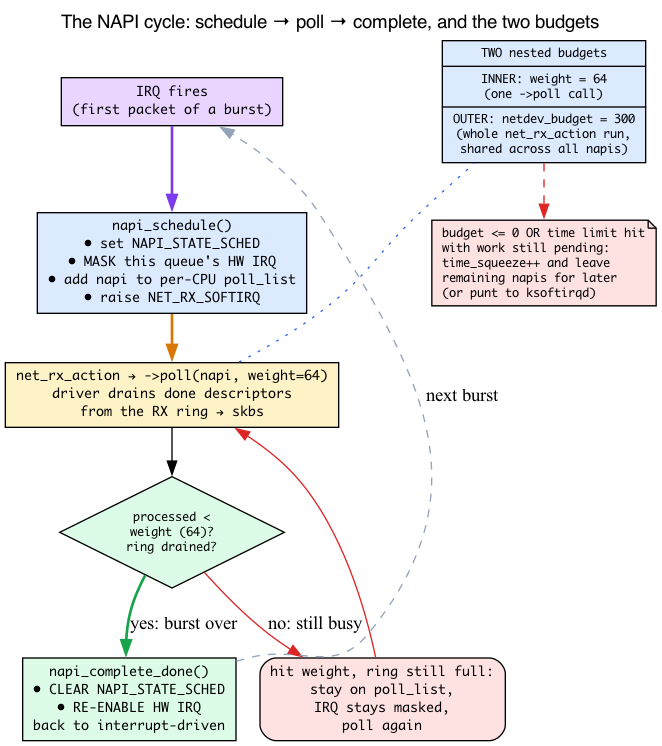
Here is the full loop. Follow the NAPI_STATE_SCHED bit and the hardware IRQ as they flip:
-
IRQ fires. The driver’s top half calls
napi_schedule(or__napi_schedule_irqoffon the hot path). Its first step,napi_schedule_prep(net/core/dev.c:6736), atomically setsNAPI_STATE_SCHED(and setsNAPI_STATE_MISSEDifSCHEDwas already set). Then____napi_schedule(net/core/dev.c:4957) adds the napi to this CPU’s poll list —list_add_tail(&napi->poll_list, &sd->poll_list); // net/core/dev.c:4984 ... raise_softirq_irqoff(NET_RX_SOFTIRQ); // net/core/dev.c:4990— and raises
NET_RX_SOFTIRQ(there’s the Background-1 mechanism). The driver also masks its own RX interrupt at this point. From now until step 3, this queue generates no IRQs. -
Softirq runs
net_rx_action, which walks the poll list and calls each napi’s->poll(napi, weight). The driver drains done descriptors from the ring (the Day-1 ring), turning each into an skb. -
Ring drained below
weight. When the driver finds fewer packets than its weight, it knows the burst is over and callsnapi_complete_done(net/core/dev.c:6771). That clearsNAPI_STATE_SCHEDand returnstrueto tell the driver the burst is over; the driver then re-enables its hardware RX interrupt (e.g.if (napi_complete_done(napi, work)) <write the device's IRQ-enable register>). Back to interrupt-driven mode until the next packet.
This is the exact mechanism behind “one IRQ per burst.” If instead the driver hits its weight (ring still full), it does not complete — it returns the full weight, stays on the poll list, and gets polled again. The interrupt stays masked while traffic is heavy.
Two budgets: weight (64) vs netdev_budget (300)
This is the part everyone conflates. There are two separate caps:
-
weight— caps how many packets one->pollcall may process. It’s the value passed into->poll. Default isNAPI_POLL_WEIGHT= 64 (include/linux/netdevice.h:2839). The per-NAPI poll wrapper reads it (__napi_poll,net/core/dev.c:7719):weight = n->weight; work = n->poll(n, weight);. -
netdev_budget— caps the total packets across all napis in a singlenet_rx_actionsoftirq run. Default 300 (net/core/hotdata.c:14). There’s also a time cap,netdev_budget_usecs(net/core/hotdata.c:16, = 2 jiffies).
So in one softirq run, net_rx_action starts with a budget of 300 and spends it across however many queues are pending, where each individual poll call can claim at most 64. The loop (net/core/dev.c:7914):
int budget = READ_ONCE(net_hotdata.netdev_budget);   // 300, the OUTER budget
...
n = list_first_entry(&list, struct napi_struct, poll_list);
budget -= napi_poll(n, &repoll);                     // each poll capped at weight=64
Picture it as nested limits: the inner ring (one poll) holds 64; the outer ring (one softirq run) holds 300 spread across all queues.
time_squeeze and softnet_data
When net_rx_action exits the loop because budget went to zero or the time limit expired while work was still pending, it bumps a counter called time_squeeze and leaves the remaining napis to be polled in a later softirq (or punted to ksoftirqd). That counter is exactly what today’s softnet_stat lab watches: a rising time_squeeze means receive work is outrunning a single softirq window.
All of this per-CPU bookkeeping lives in struct softnet_data (DEFINE_PER_CPU_ALIGNED(struct softnet_data, softnet_data), net/core/dev.c:462): the poll_list, the processed/drop/time_squeeze counters. /proc/net/softnet_stat prints one line per CPU straight from these fields (net/core/net-procfs.c:145).
Stage 1: NIC → IRQ → softirq
Now Stage 1 reads as plain English. Modern NICs use interrupt coalescing: several packets per IRQ, configurable via ethtool -c. When the IRQ fires, the driver doesn’t process packets in IRQ context (Background 1 told you why it can’t). Instead its top half calls napi_schedule() (or __napi_schedule_irqoff on the hot path), which (Background 2):
- Sets
NAPI_STATE_SCHED(vianapi_schedule_prep). - Adds the napi to the per-CPU
poll_list. - Raises
NET_RX_SOFTIRQ.
Separately, the driver masks its own RX interrupt in its IRQ handler (Background 2, step 1) — napi_schedule itself touches no hardware.
The softirq runs net_rx_action (net/core/dev.c:7914), which iterates the per-CPU poll list, calling each napi’s poll function under the two budgets you just learned (Background 2): the inner weight (64) per ->poll call, and the outer netdev_budget (300) across all napis in the run.
The core napi_poll wrapper invokes the driver’s registered ->poll (e.g. e1000_clean, mlx5e_napi_poll), which in turn call RX helpers like e1000_clean_rx_irq / mlx5e_poll_rx_cq.
Background 3: What XDP is
Stage 2 is built around XDP, and Day 27 covers it in full. But the RX narrative is load-bearing on the basics, so here’s just enough to follow the handoff.
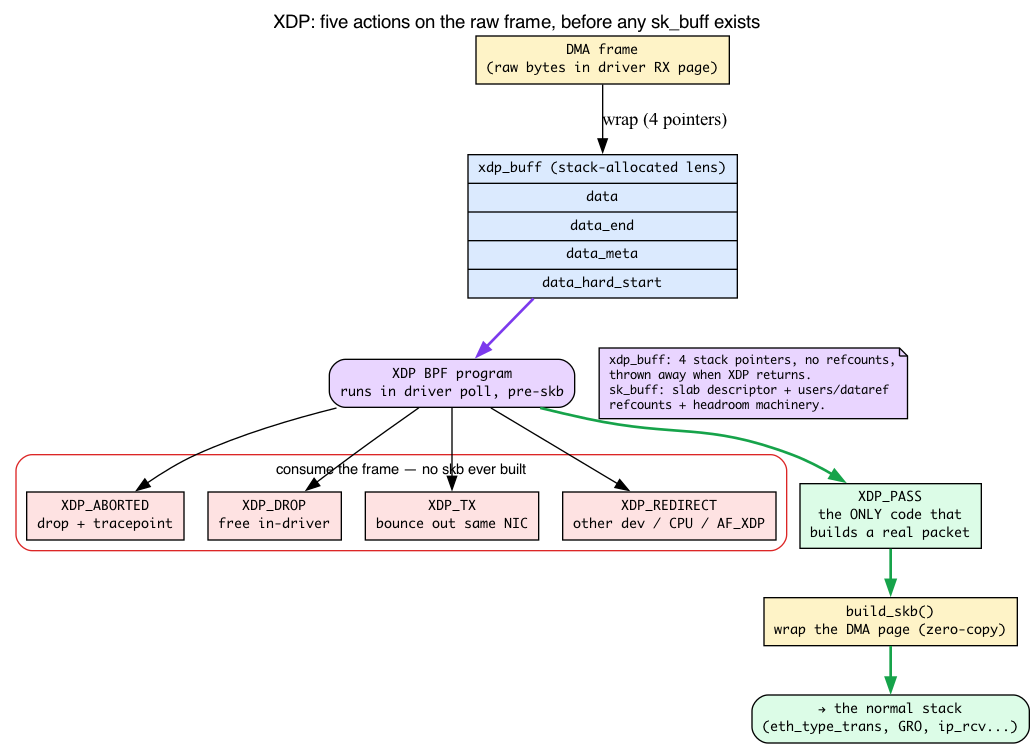
XDP (eXpress Data Path) is an eBPF program the driver runs on the raw RX frame, before any sk_buff exists — the earliest possible software hook. Because it runs pre-skb, it can drop or redirect at line rate without paying the cost of skb allocation (the slab work and refcount machinery you learned in Day 1). That’s the whole point: a DDoS-drop or load-balancer redirect that never even builds a packet object.
What does XDP look at? An xdp_buff — a lightweight, stack-allocated descriptor over the DMA region (include/net/xdp.h:86):
struct xdp_buff {
    void *data;            /* first byte of the frame */
    void *data_end;        /* one past the last byte */
    void *data_meta;       /* scratch metadata area */
    void *data_hard_start; /* start of the buffer */
    /* ... */
};
Contrast that with the sk_buff you spent Day 1 on: no slab allocation, no users/dataref refcounts, no headroom-reservation machinery — just four pointers into the DMA page. The xdp_buff is thrown away the moment XDP returns. It’s a temporary lens over bytes, not a packet object.
An XDP program returns one of five action codes (enum xdp_action, include/uapi/linux/bpf.h:6548):
enum xdp_action {
    XDP_ABORTED = 0,   /* error path — drop + tracepoint */
    XDP_DROP,          /* free the frame in-driver, no skb ever built */
    XDP_PASS,          /* the ONLY code that proceeds to build an sk_buff */
    XDP_TX,            /* bounce the frame back out the same NIC */
    XDP_REDIRECT,      /* send to another device / CPU / AF_XDP socket */
};
XDP_ABORTED, XDP_DROP, XDP_TX, and XDP_REDIRECT all consume the frame right there — the normal stack never sees it. XDP_PASS is the single code that says “turn this into a real packet” — only then does the driver build an skb and enter the path the rest of this chapter describes. Stage 2’s entire handoff hinges on that one return value.
Native vs. generic. Native XDP runs inside the driver’s poll on the DMA buffer, pre-skb — fast, the design intent. Generic XDP (do_xdp_generic → netif_receive_generic_xdp, net/core/dev.c:5656/:5576) is a fallback for drivers without native support: it runs later, in the core stack, after an skb already exists. It’s slower (you’ve already paid for the skb) — which is why the chapter notes generic XDP “runs later.” Full XDP programming, maps, and AF_XDP are Day 27; this is just enough to read the RX handoff.
Stage 2: Driver → native XDP → skb → GRO
Inside the driver’s poll, for each completed RX descriptor (recall from Day 1 — the descriptor’s DONE bit is set and the frame is already DMA’d into its page):
- Build an
xdp_buffview of the DMA buffer. Native XDP runs while the packet is still just bytes in driver-owned RX memory — nosk_buffhas been allocated yet (Background 3). - Call XDP if attached.
XDP_DROP,XDP_TX, andXDP_REDIRECTconsume the packet at the driver/XDP layer. OnlyXDP_PASSsays, “turn this into a normal kernel packet.” - Wrap the DMA buffer in an skb. After
XDP_PASS, modern drivers usebuild_skb/napi_build_skb(recall from Day 1: zero-copy — the driver already DMAed bytes into a page, so the skb’shead/data/tailjust point at it andhead_frag = 1). Generic XDP is the exception: it runs later on an already-created skb (net/core/dev.c:5576). - Set
skb->protocolviaeth_type_trans(net/ethernet/eth.c:155) — it resetsmac_headerto point at the Ethernet header (skb_reset_mac_header), pulls the 14-byte Ethernet header offdatasodatanow points at the L3 header (eth_skb_pull_mac→skb_pullETH_HLEN), and returns the EtherType. Hold that thought: the value it returns becomes the demux key in Stage 3. - Pass to GRO: the driver calls
napi_gro_receive(napi, skb), astatic inlineininclude/linux/netdevice.h:4286that funnels intogro_receive_skb(&napi->gro, skb)(anddev_gro_receive) on the napi’s GRO accumulator. What GRO merges is the next section (Background 4).
Background 4: what GRO merges, and where 64KB lives
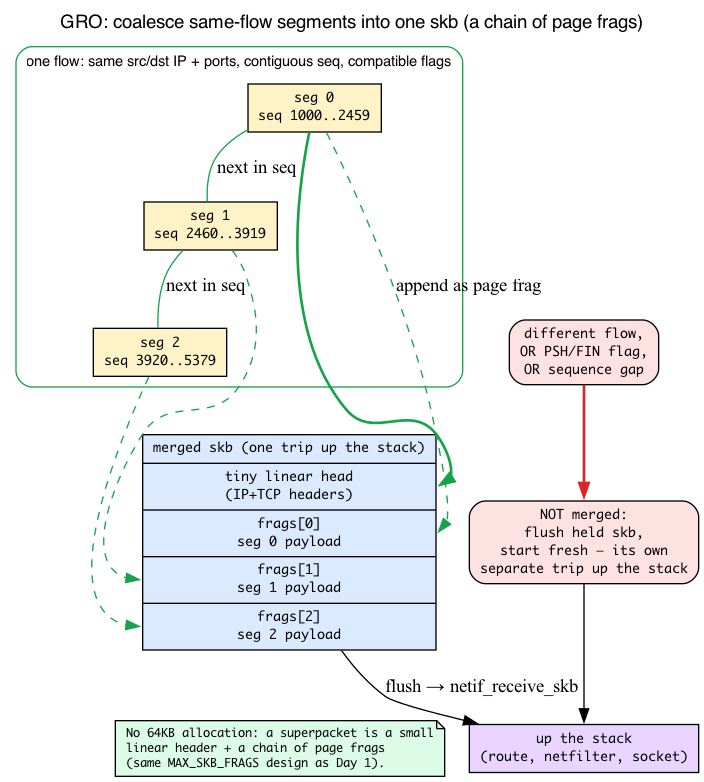
GRO (Generic Receive Offload) tries to merge consecutive segments of the same flow into one big skb before the stack sees it. A 64KB GRO superpacket means one trip up the stack instead of 40-something — you pay the route lookup, netfilter, and socket delivery once instead of per-segment.
Two prerequisites the bare phrase “merge same-flow segments” hides:
-
What counts as “the same flow”? For GRO it’s the L3/L4 identity: matching src/dst IP, protocol, and TCP ports, with in-order, contiguous sequence numbers and compatible flags.
gro_list_prepare(net/core/gro.c:355) builds the comparison key, and per-protocol callbacks (tcp4_gro_receive,net/ipv4/tcp_offload.c:419) make the final mergeability call. A packet with mismatched flags (PSH/FIN) or a sequence gap is not merged — it flushes the held skb and starts fresh. So GRO is comparing flow identity and sequence continuity, not just “two TCP packets.” -
How does 64KB fit without a 64KB allocation? It doesn’t grow a linear buffer — each merged segment’s payload is appended as page fragments onto the held skb. (Refresher only — this is exactly the linear-head +
MAX_SKB_FRAGSpage-fragment design from Day 1; a 64KB superpacket is a tiny linear header plus a chain of page frags, no contiguous 64KB ever allocated.)
The accumulator is napi->gro (a struct gro_node, include/linux/netdevice.h:358). It flushes — handing the assembled skb onward via netif_receive_skb — when any of these happen: NAPI budget/weight is exhausted, gro_normal_one is called (net/core/gro.c:299), a non-mergeable packet arrives, or the GRO flush timeout fires (__gro_flush, net/core/gro.c:324).
Code to read: net/core/gro.c — dev_gro_receive (the workhorse, :474), the exported gro_receive_skb, gro_list_prepare, gro_complete. Tracing caveat: napi_gro_receive itself is a static inline in include/linux/netdevice.h (:4286), so it is not fentry-traceable — attach to gro_receive_skb instead.
Background 5: packet_type demultiplexing
Stage 3 says __netif_receive_skb_core “calls each registered packet_type” and “pt_prev->func dispatches to the L3 handler.” To read that you need to know what a packet_type is, how the kernel picks ip_rcv out of a list, and what the pt_prev trick buys.
A packet_type is a registration record
When a protocol wants to receive packets, it registers a struct packet_type (include/linux/netdevice.h:2968):
struct packet_type {
    __be16  type;        /* EtherType, e.g. htons(ETH_P_IP) — the demux key */
    /* ... */
    int     (*func)(struct sk_buff *, struct net_device *,
                    struct packet_type *, struct net_device *);  /* the callback */
    /* ... */
    struct list_head list;
};
It pairs an EtherType (type) with a callback (func). IPv4 registers one in net/ipv4/af_inet.c:1881:
static struct packet_type ip_packet_type __read_mostly = {
    .type = cpu_to_be16(ETH_P_IP),
    .func = ip_rcv,                  // af_inet.c:1883
};
...
dev_add_pack(&ip_packet_type);       // af_inet.c:2006
So ip_rcv isn’t called by name from the core — it’s looked up by EtherType. Where does that EtherType come from? eth_type_trans in Stage 2. It returned the frame’s EtherType into skb->protocol, and that value is the key the core hashes on now. That’s the connection Stage 2 set up.
Two lists: ptype_all and ptype_base
The kernel keeps protocol receivers in two structures:
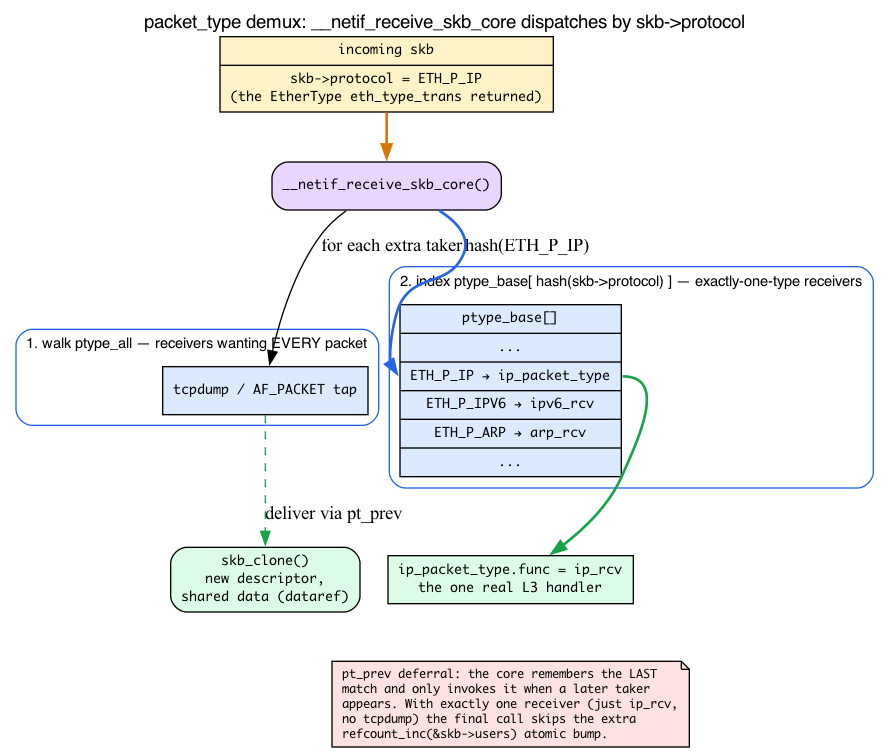
ptype_all— receivers that want every packet regardless of type. This is howAF_PACKETsockets andtcpdumptap the path.ptype_base[]— a hash table keyed by EtherType (net/core/dev.c:172), where exactly-one-type receivers live:ip_rcv(ETH_P_IP), the IPv6 handler, ARP. The bucket isptype_base[ntohs(pt->type) & PTYPE_HASH_MASK](net/core/dev.c:608).
__netif_receive_skb_core walks ptype_all first (taps), then indexes ptype_base by skb->protocol to find the one real L3 handler.
The pt_prev deferral trick
Watch how the core dispatches. Instead of calling each matching handler immediately, it remembers the last match in a pointer pt_prev, and only actually invokes a handler when it discovers a subsequent taker exists. The invoke goes through deliver_skb (net/core/dev.c:2485):
static int deliver_skb(struct sk_buff *skb, struct packet_type *pt_prev,
                       struct net_device *orig_dev)
{
    ...
    refcount_inc(&skb->users);                        // bump the descriptor refcount
    return pt_prev->func(skb, skb->dev, pt_prev, orig_dev);
}
Why the indirection? Because deliver_skb does a refcount_inc(&skb->users) (the descriptor refcount from Day 1) for each receiver. In the overwhelmingly common case of exactly one receiver (just ip_rcv, no tcpdump running), the deferral lets the core call that single handler without the extra atomic bump — it knows there’s no other taker. This is precisely why Stage 3 dispatches via pt_prev->func() rather than calling ip_rcv directly.
Cross-link to Day 1: when there are multiple takers (e.g. tcpdump’s ptype_all socket and ip_rcv), deliver_skb gives each earlier taker another reference to the same skb descriptor by incrementing skb->users; it does not call skb_clone. The final taker consumes the original reference without that extra atomic increment.
Scope and batching beyond the global bucket
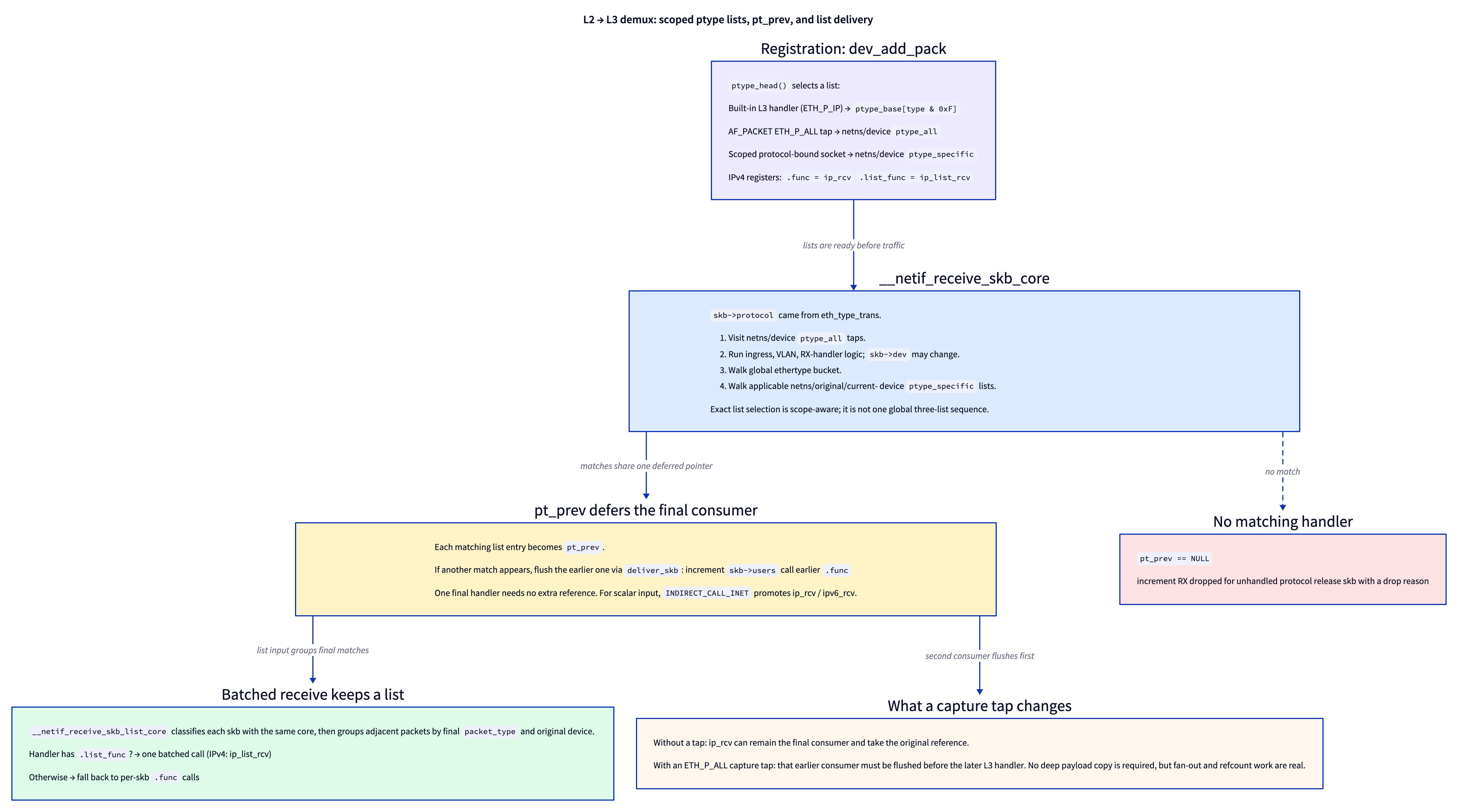
The two global structures are only the first layer. AF_PACKET adds scoped lists rather than making every socket another global protocol handler. ETH_P_ALL capture taps live in the receive network namespace’s ptype_all list or a device’s ptype_all; protocol-bound packet sockets can live in namespace/device ptype_specific lists. __netif_receive_skb_core visits all-protocol taps early, before ingress processing may redirect or change skb->dev. After ingress, VLAN, and any RX handler, it walks the global ethertype bucket and then the applicable namespace/original/current-device protocol-specific lists. ip_rcv is normally the final match from the global bucket.
The pt_prev deferral spans all of those walks. deliver_ptype_list_skb flushes the previous match with deliver_skb only when it discovers a subsequent one; deliver_skb increments skb->users before invoking that earlier callback. With one matching L3 handler and no tap, the final pt_prev reaches __netif_receive_skb_one_core, which dispatches it with INDIRECT_CALL_INET(..., ipv6_rcv, ip_rcv, ...) and avoids the extra reference operation entirely. Adding an ETH_P_ALL capture tap means the tap must be flushed before the later L3 consumer, which is one reason packet capture has measurable cost.
There is also a list receive path. IPv4 registers .list_func = ip_list_rcv alongside .func = ip_rcv. __netif_receive_skb_list_core classifies each skb through the same core, groups adjacent packets with the same final packet_type and original device, then calls that list callback. Handlers without one fall back to per-skb .func calls. The scalar deferral and list batching are two layers of the same optimization: avoid unnecessary references for one consumer, then preserve batches for a consumer that can process them together.
If no handler matches, pt_prev remains NULL, dev_core_stats_rx_dropped_inc records the unhandled protocol, and kfree_skb_reason releases the packet.
Stage 3: GRO → netif_receive_skb → __netif_receive_skb_core
When NAPI’s poll budget is exhausted (or gro_normal_one is called), accumulated GRO superpackets are flushed via netif_receive_skb:
int netif_receive_skb(struct sk_buff *skb) // net/core/dev.c:6454
Which calls into:
static int __netif_receive_skb_core(struct sk_buff **pskb, bool pfmemalloc,
                                    struct packet_type **ppt_prev)  // line 5972
This is the function that does most of the work, and with Background 5 in hand every line of it makes sense:
- VLAN/ingress hook handling (
__skb_pushto re-add VLAN if hardware-stripped). - Calls each registered
packet_type— walkptype_all(tcpdump’s AF_PACKET socket, AF_BRIDGE, etc.) then theptype_basebucket forskb->protocol. - tc ingress hooks run here (
tcx/tc-bpfingress). pt_prev->func()dispatches to the L3 protocol handler via the deferral trick.
For IPv4 packets, pt_prev->func is ip_rcv — registered statically in net/ipv4/af_inet.c as static struct packet_type ip_packet_type (Background 5).
Stage 4: ip_rcv and netfilter
int ip_rcv(struct sk_buff *skb, struct net_device *dev,
           struct packet_type *pt, struct net_device *orig_dev)  // net/ipv4/ip_input.c:603
{
    struct net *net = dev_net(dev);
    skb = ip_rcv_core(skb, net);
    if (skb == NULL)
        return NET_RX_DROP;
    return NF_HOOK(NFPROTO_IPV4, NF_INET_PRE_ROUTING,
                   net, NULL, skb, dev, NULL,
                   ip_rcv_finish);
}
ip_rcv_core (net/ipv4/ip_input.c:499) does sanity checks (IP header length, version, checksum if not hw-validated) and trims the skb to the IP header’s claimed tot_len. Then NF_HOOK(NFPROTO_IPV4, NF_INET_PRE_ROUTING, ...) runs all netfilter chains on PREROUTING (this is where iptables/nftables/conntrack get involved). Day 20 covers netfilter in detail.
If the hooks pass the skb, ip_rcv_finish (net/ipv4/ip_input.c:478) is called. It does the route lookup (ip_route_input_noref → FIB lookup) and then dst_input(skb), which calls ip_local_deliver (net/ipv4/ip_input.c:250) for local sockets, or ip_forward for routed traffic.
Where BPF can attach
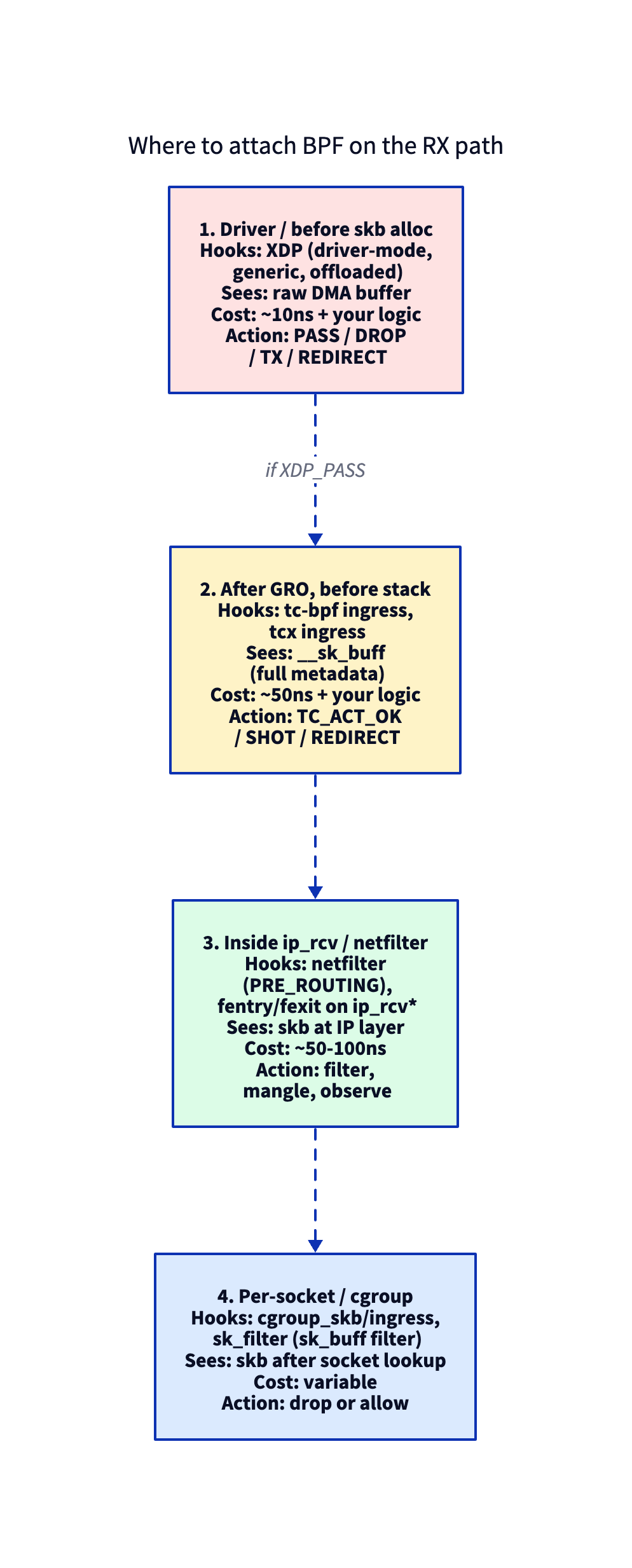
The kernel exposes BPF hook points at four positions along the RX path: XDP at the driver (Background 3 — pre-skb), tcx at __netif_receive_skb_core, fentry on ip_rcv itself, cgroup_skb after socket lookup. We won’t write any BPF today — this map is here so the attach points have a clear place in this path. Today’s labs use one-liner BPF tools (bpftrace) only as an inspection mechanism, not for authoring.
There are no Dumb Questions
Q: If raising a softirq just sets a bit, what actually runs
net_rx_action?A:
__do_softirq(kernel/softirq.c:654). It’s invoked on the way out of interrupt context (and a few other points), checks the per-CPU pending mask, and calls each pending vector’s action function. The top half only set theNET_RX_SOFTIRQbit and returned;__do_softirqdoes the draining moments later. If it has to restart more thanMAX_SOFTIRQ_RESTART(10) times, the rest is handed toksoftirqd.
Q: I keep seeing “budget.” Which budget — 64 or 300?
A: Both, at different scopes.
weight(64) is per single->pollcall — the cap passed into the driver.netdev_budget(300) is pernet_rx_actionsoftirq run, shared across all napis polled in that run. One softirq run can poll several queues; each individual poll claims at most 64, and the run stops once the cumulative 300 (or the time limit) is hit — bumpingtime_squeezeif work remains.
Q: Why does
__netif_receive_skb_coredispatch throughpt_prev->func()instead of just callingip_rcv?A: The
pt_prevdeferral (Background 5). It defers each delivery so it can skip an atomicskb->usersbump in the common single-receiver case.ip_rcvis reached by EtherType lookup inptype_base, not by name — the EtherType being the valueeth_type_transstored inskb->protocolback in the driver.
Q: An XDP program returned
XDP_PASS. What changed?A: Nothing yet —
XDP_PASSis the only action that lets the driver proceed to build ansk_buffand enter the normal stack. The other four (ABORTED/DROP/TX/REDIRECT) consumed the frame while it was still just anxdp_buffover the DMA page, with no skb ever allocated.
Today’s experiment
Trace a real packet’s path.
Use ftrace to see the call chain
trace-cmd is not installed by default — sudo apt-get install -y trace-cmd (it needs
CONFIG_FUNCTION_GRAPH_TRACER, on by default in typical kernels). This needs two terminals: the
recorder blocks for 5 seconds, and you must fire the packet during that window.
In terminal 1, start recording:
sudo trace-cmd record -p function_graph \
    -g netif_receive_skb \
    -e net:netif_receive_skb \
    -O nofuncgraph-overhead \
    -O funcgraph-tail \
    sleep 5
In terminal 2, within those 5 seconds, generate one packet:
ping -c 1 8.8.8.8
After the recorder exits, render the trace:
sudo trace-cmd report | head -100
You’ll see the function-call tree: netif_receive_skb → __netif_receive_skb_one_core → __netif_receive_skb_core.constprop.0 → ip_rcv → ip_rcv_core → nf_hook_slow → ip_rcv_finish_core → ip_local_deliver → icmp_rcv. (The compiler appends a .constprop.N/.isra.N suffix to some of these symbols, and the outer ip_rcv_finish wrapper is inlined so what you actually see in the trace is ip_rcv_finish_core.) The leaf is icmp_rcv because a ping echo reply is an ICMP packet — icmp_rcv then calls icmp_echo. (Trigger a TCP flow instead — e.g. curl -s http://example.com >/dev/null — and the leaf becomes tcp_v4_rcv.) The pt_prev->func() dispatch (Background 5) goes through deliver_skb, but on this kernel deliver_skb is inlined into __netif_receive_skb_core so it does not show up as its own node in function_graph — don’t go hunting for it. To observe the dispatch directly, attach a kprobe instead: sudo bpftrace -e 'kprobe:deliver_skb { @[comm]=count(); }'.
Or use BPF for a custom view
sudo bpftrace -e '
fentry:ip_rcv { @ip[args->skb->dev->name] = count(); }
fentry:tcp_v4_rcv { @tcp[args->skb->dev->name] = count(); }
fentry:udp_rcv { @udp[args->skb->dev->name] = count(); }
interval:s:6 { exit(); }' &

# Generate receives during the window, then let it exit:
ping -c 5 -i 0.3 8.8.8.8 >/dev/null; curl -s http://example.com >/dev/null
wait
Per-protocol receive counts per interface. Typical output:
@ip[lo]: 4
@tcp[eth0]: 21
@udp[eth0]: 2
@udp[lo]: 4
@tcp/@udp are the reliable signal. Note the @ip map: on some virtual NICs (cloud/virtio)
fentry:ip_rcv attaches but may not fire for the physical interface — you may see only @ip[lo] (or
nothing) even with eth0 traffic flowing. On other boxes @ip[eth0] populates normally. Either way it’s a
tracing-environment quirk, not a missing-packet problem; trust @tcp[eth0]/@udp[eth0] to confirm receives
are happening.
Inspect the per-CPU RX state
cat /proc/net/softnet_stat
One line per CPU — these are the per-CPU softnet_data counters from Background 2. Every field is a 32-bit counter printed in hexadecimal (zero-padded %08x) with
no header line — don’t read the values as decimal. In order the columns are: packets processed,
dropped, time_squeeze (budget exhaustions), then several zeros, with received_rps near the end (exact
trailing columns are kernel-version-dependent — see net/core/net-procfs.c:145). Convert one to decimal with
printf '%d\n' 0x<value>. High time_squeeze means a softirq run kept hitting budget <= 0 (or the time
limit) with work still pending — i.e. your netdev_budget is too small for the load.
Adjust the budget. Set it (in its own step, so you can observe the box running at the new value):
old_budget=$(cat /proc/sys/net/core/netdev_budget)
echo 600 | sudo tee /proc/sys/net/core/netdev_budget
cat /proc/sys/net/core/netdev_budget   # confirm it changed
Then, under sustained RX load (e.g. iperf3 -c <host> -P 16 from another box, or a packet flood),
re-read /proc/net/softnet_stat repeatedly and watch the time_squeeze column. Be honest with
yourself about what you’ll see: on an idle host time_squeeze never moves — it only increments when
a softirq actually exhausts its budget under heavy receive load, and even under load it can stay flat on
fast CPUs / multi-queue NICs. A non-moving counter is normal, not a sign the change failed (you already
confirmed the change with the cat above).
Restore the original budget so the host isn’t left with changed RX scheduling behavior:
echo "$old_budget" | sudo tee /proc/sys/net/core/netdev_budget
What to read in the kernel
kernel/softirq.c— the softirq engine.__do_softirq(line 654),raise_softirq_irqoff(line 773) →__raise_softirq_irqoff(line 799),open_softirq(line 806),run_ksoftirqd(line 1068), and#define MAX_SOFTIRQ_RESTART 10(line 544).net/core/dev.c— the central RX dispatch.____napi_schedule(line 4957) — adds topoll_list(line 4984), raisesNET_RX_SOFTIRQ(line 4990). (TheNAPI_STATE_SCHEDbit is set earlier, bynapi_schedule_prepat line 6736.)net_rx_action(line 7914) — the softirq loop; reads the 300 budget (line 7920).__napi_poll(line 7719) — per-NAPI poll; readsweightand calls->poll.__netif_receive_skb_core(line 5972) — the workhorse; the packet_type walk.netif_receive_skb(line 6454) — entry from drivers/GRO.deliver_skb(line 2485) — thept_prev->func()dispatch +usersbump.napi_complete_done(line 6771) — clears SCHED, returnstrueso the driver can re-arm its IRQ.
net/core/hotdata.c—netdev_budget = 300(line 14),netdev_budget_usecs(line 16).net/core/gro.c— GRO machinery. Readdev_gro_receive(line 474),gro_receive_skb,gro_list_prepare(line 355),gro_complete,__gro_flush(line 324). (napi_gro_receiveis astatic inlineinnetdevice.h:4286, not here — not fentry-traceable.)net/ipv4/ip_input.c— IPv4 receive.ip_rcv(line 603),ip_rcv_core(line 499),ip_rcv_finish(line 478),ip_local_deliver(line 250).net/ipv4/af_inet.c— searchip_packet_type(line 1881), see howip_rcvis registered viadev_add_pack(line 2006).include/linux/netdevice.h—struct napi_struct(line 381),NAPI_POLL_WEIGHT 64(line 2839),struct packet_type(line 2968),struct gro_node(line 358).include/linux/interrupt.h— the softirq vector enum (line 550).include/net/xdp.h—struct xdp_buff(line 86);include/uapi/linux/bpf.h—enum xdp_action(line 6548).
Bullet Points
- A softirq is a statically-defined, per-CPU bottom half. The top half (hardware IRQ) only acks the device and raises a pending bit;
__do_softirqlater runs the action. Networking’s RX vector isNET_RX_SOFTIRQ→net_rx_action. Overflow (>10 restarts) is punted toksoftirqdso user space can’t starve. - NAPI turns IRQ floods into one IRQ per burst:
napi_schedulesetsNAPI_STATE_SCHED+ queues the napi (the driver masks the IRQ in its handler);napi_complete_doneclearsSCHEDand returnstrueso the driver re-enables the IRQ when the ring drains. State machine driven by theNAPI_STATE_SCHEDbit. - Two budgets, not one:
weight(NAPI_POLL_WEIGHT= 64) caps one->pollcall;netdev_budget(300) caps the total across all napis in onenet_rx_actionrun.time_squeezecounts budget/time exhaustions with work still pending. - Native XDP runs on an
xdp_buff(4 stack pointers, no refcounts) before any skb exists; onlyXDP_PASSproceeds to build an skb.DROP/TX/REDIRECT/ABORTEDconsume the frame in-driver. build_skbwraps a pre-existing DMA buffer into an skb (zero-copy receive — recall Day 1).- GRO (
net/core/gro.c) coalesces consecutive same-flow segments (matching IP/proto/ports + contiguous sequence) into one skb whose payload is a chain of page frags (recall Day 1) — one trip up the stack instead of dozens. - A
packet_typepairs an EtherType with a callback;ip_rcvis registered asip_packet_typeand reached by hashingskb->protocol(the valueeth_type_transreturned).ptype_all= taps (tcpdump);ptype_base[]= the L3 hash table. Thept_prevdeferral skips an atomicusersbump in the single-receiver case. - The single most-touched RX function is
__netif_receive_skb_coreatnet/core/dev.c:5972. - After
ip_rcv→ netfilter PREROUTING →ip_rcv_finish→ routing →ip_local_deliverorip_forward.
Check question
Why does the kernel run softirqs (and thus most of the RX path) outside of hardware IRQ context?
Click to reveal answer
Answer: Hardware IRQ context has strict constraints: it preempts the running task, runs with limited stack, blocks other IRQs at the same priority, and cannot sleep. Doing the full RX path (route lookup, BPF programs, conntrack, packet delivery) in IRQ context would (1) starve other CPU work — receive livelock under high traffic; (2) impose a tight time budget that complex paths can’t meet; (3) force every helper called from the RX path to be IRQ-safe. Softirqs run at a slightly higher priority than user threads but lower than IRQs, with their own per-CPU stack, and can be preempted by IRQs. If softirq work itself becomes excessive, __do_softirq caps its restarts at MAX_SOFTIRQ_RESTART (10) and hands the rest to the ksoftirqd kernel thread, which competes fairly with user tasks — so RX processing can be intense but can’t indefinitely lock out user space. NAPI splits the RX work along this seam: the IRQ just signals “more work” (sets NAPI_STATE_SCHED, raises NET_RX_SOFTIRQ); the softirq does the actual processing under a budget.
Tomorrow
Day 3: the TX path. From sendmsg to the wire. Socket buffer accounting, queue disciplines, the driver’s ndo_start_xmit.