Day 3 — The TX path: from sendmsg to the wire
Today’s mission: trace a TCP packet from a userspace
send()to the moment it leaves the NIC — and meet the four structures that gate it on the way out: the socket and its send buffer, the windows that decide what may go now, the qdisc that schedules it, and the neighbour entry that finally stamps on a MAC address. Total time: ~110 minutes.
The journey, mirrored
Yesterday’s RX path went wire → driver → IP → socket. Today’s TX path goes the other direction:

Six layers of work between your send() syscall and the bytes hitting the wire. Each one has a job and a place to fail.
But there’s a deeper asymmetry, and it’s worth naming up front because it reshapes how you read the code. The RX path is skb-centric. The TX path is sock-centric.
On RX, a packet arrived out of nowhere — the NIC DMA’d some bytes into a page, the driver wrapped them in an sk_buff (Day 1), and that skb climbed the stack as a self-contained object. Nothing “owned” it until a socket claimed it at the very top.
On TX, the story starts the other way around. The bytes begin life inside a process that already has an open connection — a long-lived object that remembers the peer’s address, the sequence numbers, how much the network can take, how much the receiver will accept. That object is struct sock, and on the way out, every skb is something the sock produces and owns. So before we can read a single line of tcp_sendmsg, we need to meet the sock.
Stage 0: the connection object — struct sock
Day 1 taught you the sk_buff: one packet. Day 2 followed packets up the RX path. But neither ever introduced the thing that owns packets on a connection. That’s the gap we close first, because the entire TX path hangs off it.
Here’s the intuition. A TCP connection is not a packet — it’s a relationship that lives for seconds, minutes, or hours and carries thousands of packets. Somebody has to remember, between one send() and the next:
- who the peer is, and the route to reach it,
- the next sequence number to use,
- how many bytes are out on the wire unacknowledged,
- how much buffer the kernel is still allowed to spend on this connection,
- a chain of packets that are queued up but not yet (fully) sent.
That somebody is struct sock — “the sock.” Where an sk_buff is one envelope, a sock is the whole mailbox: a long-lived endpoint object that owns a list of skbs and all the bookkeeping around them.
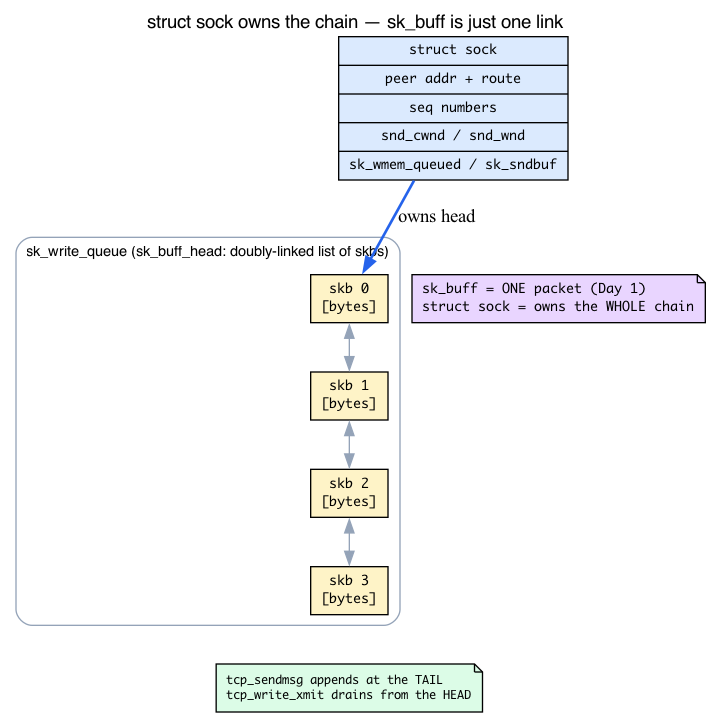
The send-side fields we care about today all live in include/net/sock.h:
struct sk_buff_head  sk_write_queue;   /* include/net/sock.h:491 — the chain of queued skbs */
int                  sk_wmem_queued;   /* include/net/sock.h:484 — memory charged for unfreed send-side skbs */
int                  sk_sndbuf;        /* include/net/sock.h:526 — the cap on those bytes */
sk_write_queue is an sk_buff_head — the same doubly-linked list of skbs you saw on RX queues — except here it hangs off the socket and holds packets that TCP has built but not yet handed to the wire. tcp_sendmsg appends to its tail; tcp_write_xmit drains from its head.
How one sock reaches the right protocol code: the proto vtable
When userspace calls send(), the kernel has a generic struct sock in hand but needs to run TCP’s send logic — not UDP’s, not raw IP’s. It avoids a giant if (protocol == TCP) ladder with a classic trick: a vtable of function pointers.
Every sock carries sk->sk_prot, a pointer to a struct proto:
struct proto {                              /* include/net/sock.h:1291 */
        int  (*sendmsg)(struct sock *sk, struct msghdr *msg, ...);  /* :1321 */
        /* ...recvmsg, connect, close, ... */
};
For a TCP socket, sk_prot points at tcp_prot, whose .sendmsg slot is wired to tcp_sendmsg:
/* net/ipv4/tcp_ipv4.c:3353 */
.sendmsg = tcp_sendmsg,
So sock_sendmsg → inet_sendmsg → sk->sk_prot->sendmsg(...) lands in tcp_sendmsg with no branching. The exact same indirection reappears one layer down at L3: the connection keeps an icsk->icsk_af_ops->queue_xmit pointer (include/net/inet_connection_sock.h:36) that, for AF_INET sockets, is ip_queue_xmit. Keep this vtable picture in mind — “dispatch by pointer, not by if” is how the whole stack stays protocol-agnostic.
Stage 1: syscall to socket
When userspace calls send(fd, buf, len, 0) (or write(fd, ...) on a socket), the kernel walks:
sys_sendto / sys_write
  → sock_sendmsg
    → inet_sendmsg
      → sk->sk_prot->sendmsg     // dispatch by protocol (the vtable above)
For TCP that’s tcp_sendmsg at net/ipv4/tcp.c:1447. The function locks the socket, then calls tcp_sendmsg_locked (line 1117) which is where the real work happens.
Stage 2: copy and queue
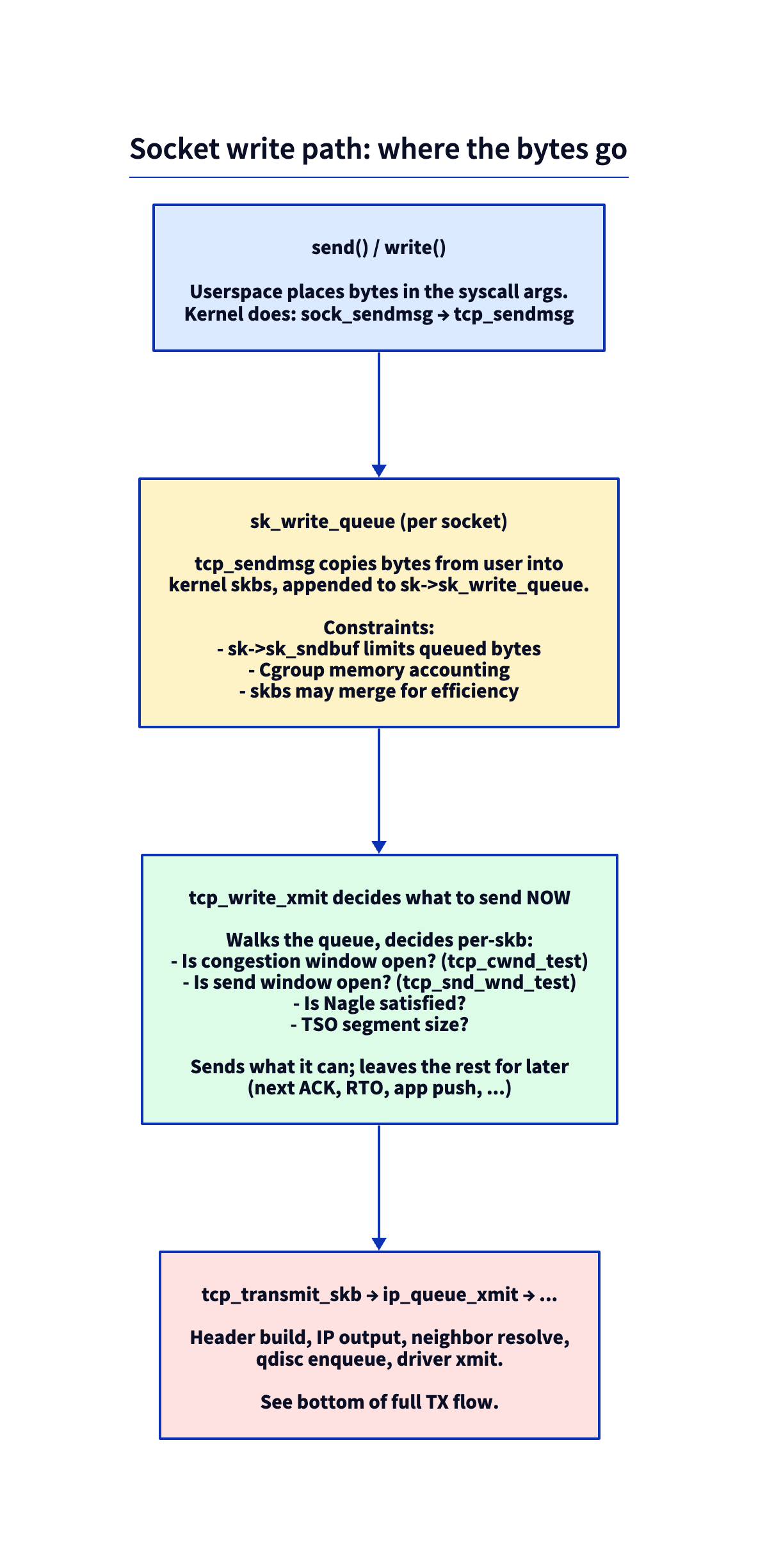
tcp_sendmsg_locked does two distinct things:
-
Copy bytes from userspace into kernel skbs. Allocate skbs via
tcp_stream_alloc_skb, copy data viacopy_from_iter(or, withMSG_ZEROCOPY, pin the user pages and point skb frags at them — no copy; recall the page-fragment design from Day 1). Append each skb tosk->sk_write_queue. -
Maybe trigger transmission. Calls
tcp_push(net/ipv4/tcp.c:741) which eventually invokestcp_write_xmit(line 2963 intcp_output.c).
The split matters: queueing is cheap; sending is gated. Appending to sk_write_queue just costs a copy and a list insert. Actually putting bytes on the wire requires the congestion window to be open, the receive window to permit it, Nagle constraints to be satisfied (all three explained in the next stage). So one send() may queue 1 MB of bytes but only transmit 64 KB right now — the rest sits in sk_write_queue waiting for ACKs.
The send buffer: sk_wmem_queued vs sk_sndbuf
If a socket could queue unbounded data, a fast writer talking to a slow network would balloon kernel memory without limit. So every sock has a send-buffer cap, and accounting to enforce it:
sk_wmem_queued— total memory (the sum ofskb->truesize) charged for every send-side skb the kernel hasn’t freed yet. That spans two queues: skbs still unsent insk_write_queueand skbs already transmitted but not yet ACKed, which in v7.1 have migrated to the separate retransmit queuetcp_rtx_queue(an rbtree). It’s freed only when the data is finally ACKed. Note this is a memory figure — it includes headroom and per-skb overhead, not just payload bytes.sk_sndbuf— the cap on that memory.
The check is a one-liner in the header:
static inline bool __sk_stream_memory_free(const struct sock *sk, int wake)
{                                                  /* include/net/sock.h:1413 */
        if (READ_ONCE(sk->sk_wmem_queued) >= READ_ONCE(sk->sk_sndbuf))
                return false;                      /* buffer full → not free */
        /* ... */
}
When the buffer is full, tcp_sendmsg_locked consults sk_stream_memory_free (net/ipv4/tcp.c:1248) and then either:
- blocks —
sk_stream_wait_memory(net/ipv4/tcp.c:1405) sleeps the calling thread until ACKs free space (default, blocking socket); or - returns
EAGAIN— for a non-blocking socket, so an event loop can come back later.
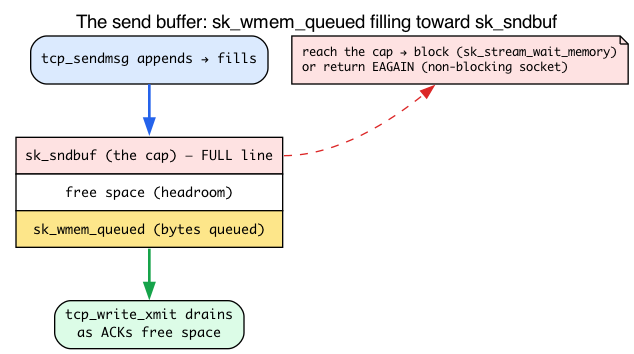
sk_sndbuf isn’t a fixed number — the kernel auto-tunes it per socket between the bounds of the net.ipv4.tcp_wmem (min, default, max) sysctl, growing it for connections that can productively use more. This is exactly the accounting ss -tim surfaces: the w value inside skmem:(...) is sk_wmem_queued (charged memory) and tb is sk_sndbuf. The Send-Q column is a separate quantity — write_seq - snd_una, the count of unacknowledged sequence (payload) bytes — closer in spirit to the in-flight/unsent backlog than to the memory counter. The two correlate but are measured in different units (payload sequence bytes vs charged memory, which includes per-skb overhead). Lab 2 makes them move.
Stage 2.5: what actually gates transmission
Stage 2 said sending is “gated” by three things. Those three terms — congestion window, receive window, Nagle — get a full treatment later (congestion control is Days 16–17), but you can’t read tcp_write_xmit today without a working picture, so here it is in one pass. The goal is narrow: understand why one send() can queue 1 MB yet transmit far less right now.
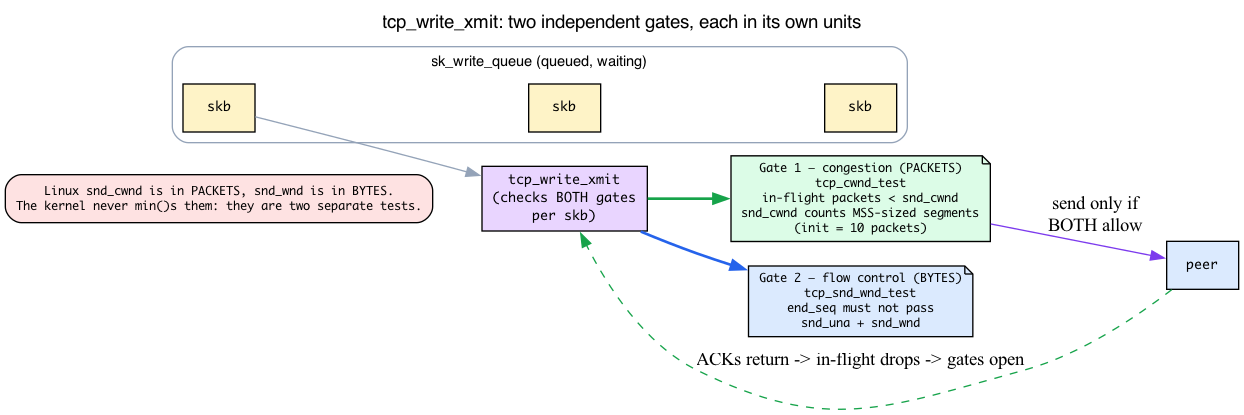
Think of the path to the peer as a pipe. Two separate limits decide how much may be “in the pipe” (sent but not yet acknowledged) at once — and, crucially, Linux measures them in different units and enforces them with two separate tests, never a single min():
-
Congestion window —
snd_cwnd(include/linux/tcp.h:225), measured in packets (MSS-sized segments — initial valueTCP_INIT_CWND= 10 packets, not a byte count like the textbook cwnd). The sender’s own estimate of how many segments the network path can hold in flight without dropping. Nobody negotiates it; the sender grows it as ACKs arrive and shrinks it on loss. It’s the sender protecting the network from itself. Enforced bytcp_cwnd_test(net/ipv4/tcp_output.c:2323): in-flight packets must be belowsnd_cwnd. -
Receive window —
snd_wnd(include/linux/tcp.h:223, commented “The window we expect to receive”), measured in bytes. The amount of buffer the peer advertised it can accept. This is flow control — it stops a fast sender from overrunning a slow receiver. Enforced bytcp_snd_wnd_test(net/ipv4/tcp_output.c:2380): the segment’s end sequence number must not passsnd_una + snd_wnd(tcp_wnd_end).
The rule that combines them:
A segment may go out only if it passes both independent gates: in-flight packets <
snd_cwnd(the congestion test, in packets) and its end sequence ≤snd_una + snd_wnd(the flow-control test, in bytes).
New data may go out only while there’s room under both tests. As ACKs return, in-flight drops, the gates open, and tcp_write_xmit releases more from sk_write_queue. The in-flight quantity the congestion test uses is tcp_packets_in_flight(tp) = packets_out − (sacked + lost) + retrans (include/net/tcp.h:1502). ss -tim’s unacked column (= tp->packets_out) approximates it; the two are equal only on a clean connection with no SACKed, lost, or retransmitted segments.
The third gate is Nagle’s algorithm. Intuition: if an app does many tiny writes (think a character at a time over SSH), naively each becomes its own minimum-size segment and floods the wire with “tinygrams,” mostly header. Nagle says: don’t send a new small segment while a previous small one is still unacknowledged — coalesce instead. Whether it’s disabled is recorded in tp->nonagle (include/linux/tcp.h:291); TCP_NODELAY sets it to “off” for latency-sensitive apps.
All three are applied in one loop:
/* net/ipv4/tcp_output.c:2963 */
static bool tcp_write_xmit(struct sock *sk, unsigned int mss_now, int nonagle, ...)
tcp_write_xmit walks sk_write_queue from the head and, for each skb, asks: does cwnd allow it? does snd_wnd allow it? does Nagle allow it? (And how big a TSO chunk to cut — Day 4.) It stops at the first skb the gates reject; the rest stay queued. The connection even records whether it was the cwnd that stopped it, in is_cwnd_limited (include/linux/tcp.h:234).
Forward reference: the mechanics of how cwnd grows and collapses (slow start, congestion avoidance, the CUBIC/BBR algorithms) are Phase 3, Days 13–19. Today you only need: queue is cheap, transmit is gated, and ACKs are what reopen the gate.
What stops one flow from drowning the qdisc: TCP Small Queues
Here’s a tension the staging above quietly creates. One send() can charge a megabyte of TCP write memory, while tcp_write_xmit may have a large congestion window available. Why doesn’t one bulk flow push that entire window into the qdisc and device queues at once? TCP Small Queues (TSQ) applies per-socket backpressure before each new transmit.
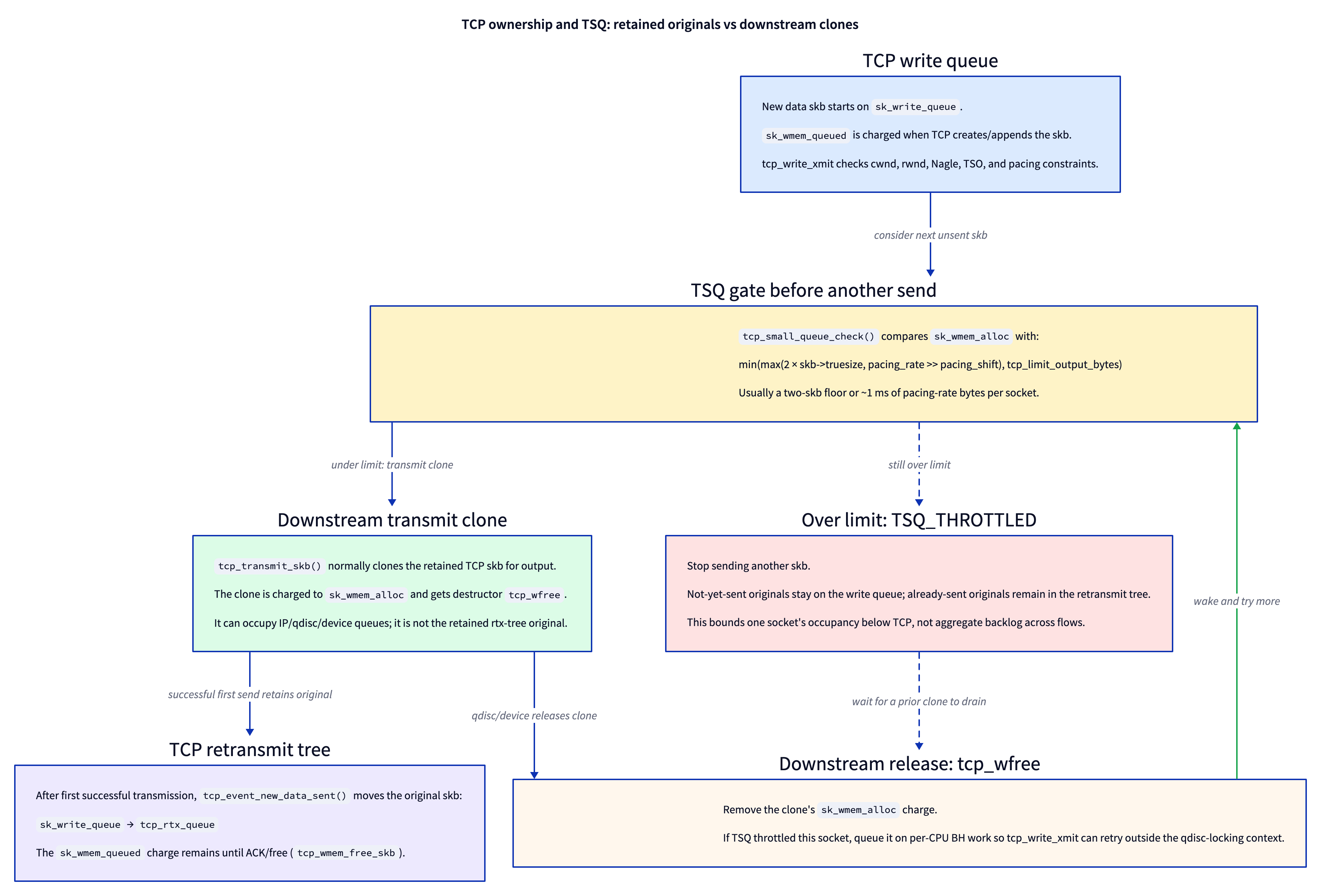
First separate two lifetimes that are easy to collapse into one “send queue”:
- A newly built data skb starts on
sk_write_queueand is charged tosk_wmem_queued. - After its first successful transmission,
tcp_event_new_data_sent()unlinks that original skb fromsk_write_queueand inserts it intotcp_rtx_queue, where TCP retains it until ACK/free for possible retransmission. Itssk_wmem_queuedcharge persists across that move;tcp_wmem_free_skb()removes the charge only when TCP releases the skb. tcp_transmit_skb()normally sends a clone of that retained TCP skb down through IP. The downstream clone is charged tosk_wmem_allocand getstcp_wfreeas its destructor. This second counter represents memory still held by qdisc/device-side references, not the bytes TCP retains in its write and retransmit queues.
TSQ uses the downstream counter as its gate:
- Before sending another skb,
tcp_small_queue_check()computesmin(max(2 * skb->truesize, sk_pacing_rate >> sk_pacing_shift), tcp_limit_output_bytes). With the usual shift of 10, the pacing term is about one millisecond of bytes, while the two-skb floor prevents tiny limits. Retransmit paths can multiply the limit. There is also an escape for an empty or single-entry retransmit tree so delayed completions cannot deadlock progress. - If
sk_wmem_allocremains above the limit, TSQ setsTSQ_THROTTLEDandtcp_write_xmitstops. Unsent originals stay onsk_write_queue; already-sent originals remain intcp_rtx_queue. Neither queue is the qdisc backlog. - When a downstream skb is freed,
tcp_wfree()removes its charge. If the socket was throttled, it queues the socket on a per-CPU BH workqueue so TCP can trytcp_write_xmitagain outside the qdisc-locking context.
The payoff is bounded per-flow occupancy below TCP: one socket cannot dump an arbitrary congestion window into qdisc and driver queues. That usually keeps latency much lower, but it is not a promise that the whole qdisc is empty — many flows can still build aggregate backlog, and some devices (notably Wi-Fi aggregation) need enough queued bytes for throughput. BBR’s deliberate pacing rate feeds the TSQ limit, while a pacing qdisc such as fq separately schedules when packets leave.
Stage 3: TCP header and the IP layer
tcp_transmit_skb builds the TCP header (sequence number, ACK, flags, window, checksum if not offloaded) on the skb being sent. (tcp_transmit_skb is a thin wrapper inlined into __tcp_transmit_skb, so that’s the name you’ll actually see in ftrace output.) Then it calls into IP via the L3 vtable slot we met in Stage 0:
icsk->icsk_af_ops->queue_xmit(...)
  → ip_queue_xmit                  // net/ipv4/ip_output.c:546
ip_queue_xmit builds the IP header (after a route lookup if the route isn’t cached), sets TTL/DSCP, then:
ip_local_out                       // net/ipv4/ip_output.c:125
  → __ip_local_out
    → NF_HOOK(NFPROTO_IPV4, NF_INET_LOCAL_OUT, ...)
  → dst_output
    → ip_output                    // net/ipv4/ip_output.c:428
      → NF_HOOK(NFPROTO_IPV4, NF_INET_POST_ROUTING, ...)
      → ip_finish_output
        → ip_finish_output2        // net/ipv4/ip_output.c:200
Two netfilter hooks on the way out
You already met the NF_HOOK machinery on RX (Day 2, Stage 4, where NF_INET_PRE_ROUTING fires inside ip_rcv; full netfilter treatment is deferred to Day 20). The TX path has its own two hook points — same mechanism, different positions:
NF_INET_LOCAL_OUT(include/uapi/linux/netfilter.h:46) fires in__ip_local_out, just after the IP header is set for locally-generated packets.NF_INET_POST_ROUTING(:47) fires inip_output, after routing, just before the device — the last place iptables/nftables can touch the packet.
No need to re-learn what a hook is; just place these two on the path.
The last L3 step: turning a next-hop IP into a MAC
ip_finish_output2 is where the packet finally gets a link-layer destination — and this is a subsystem no earlier chapter has introduced, so here’s the background you need.
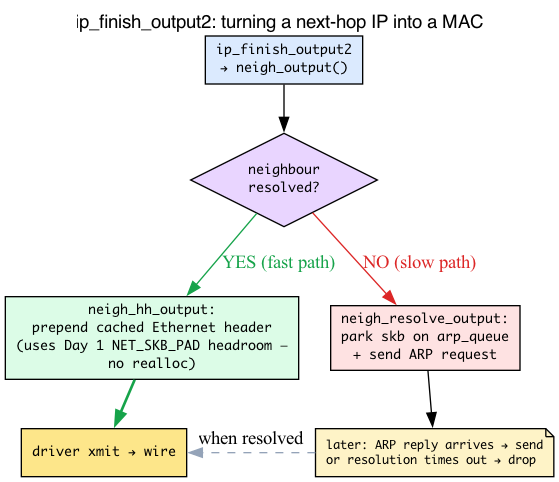
Routing produced a next-hop IP address (the gateway, or the destination if it’s on-link). But the NIC can’t send to an IP — Ethernet frames are addressed by MAC address. Something must map next-hop-IP → MAC. That something is the neighbour subsystem: ARP for IPv4, NDP for IPv6. It resolves the mapping once and caches it in a struct neighbour, so the second packet to the same next hop doesn’t pay for resolution again.
Two outcomes when ip_finish_output2 calls neigh_output (include/net/neighbour.h:547):
-
Resolved (fast path). If the neighbour is reachable and has a cached hardware header,
neigh_hh_output(include/net/neighbour.h:507) just prepends the precomputed Ethernet header and sends. This is the moment the L2 header is finally pushed onto the skb — and it’s free becausetcp_stream_alloc_skb(net/ipv4/tcp.c:927) reservedMAX_TCP_HEADERheadroom up front (alloc_skb_fclone(MAX_TCP_HEADER)thenskb_reserve).MAX_TCP_HEADERbakes inMAX_HEADER/LL_MAX_HEADER— the link-layer header space — so there’s already room in front ofdatato push the Ethernet header with no reallocation. (This is the same principle as Day 1’s headroom reservation, but the TX-side constant isMAX_TCP_HEADER, not the RX allocators’ much smallerNET_SKB_PAD.) -
Unresolved (slow path).
neigh_resolve_output(include/net/neighbour.h:364) parks the skb on the neighbour’sarp_queueand fires an ARP request. The packet is sent later, when the reply arrives — or dropped if resolution times out. This is why a brand-new flow to a fresh next hop can briefly stall right here.
Forward reference: the neighbour subsystem in full — ARP/NDP state machine,
NUD_*states, garbage collection — is a Phase 2 topic (Days 6–12). Today you only need: this is where the MAC is resolved and the Ethernet header is built, and where a packet can stall.
Stage 4: the device queue and the qdisc
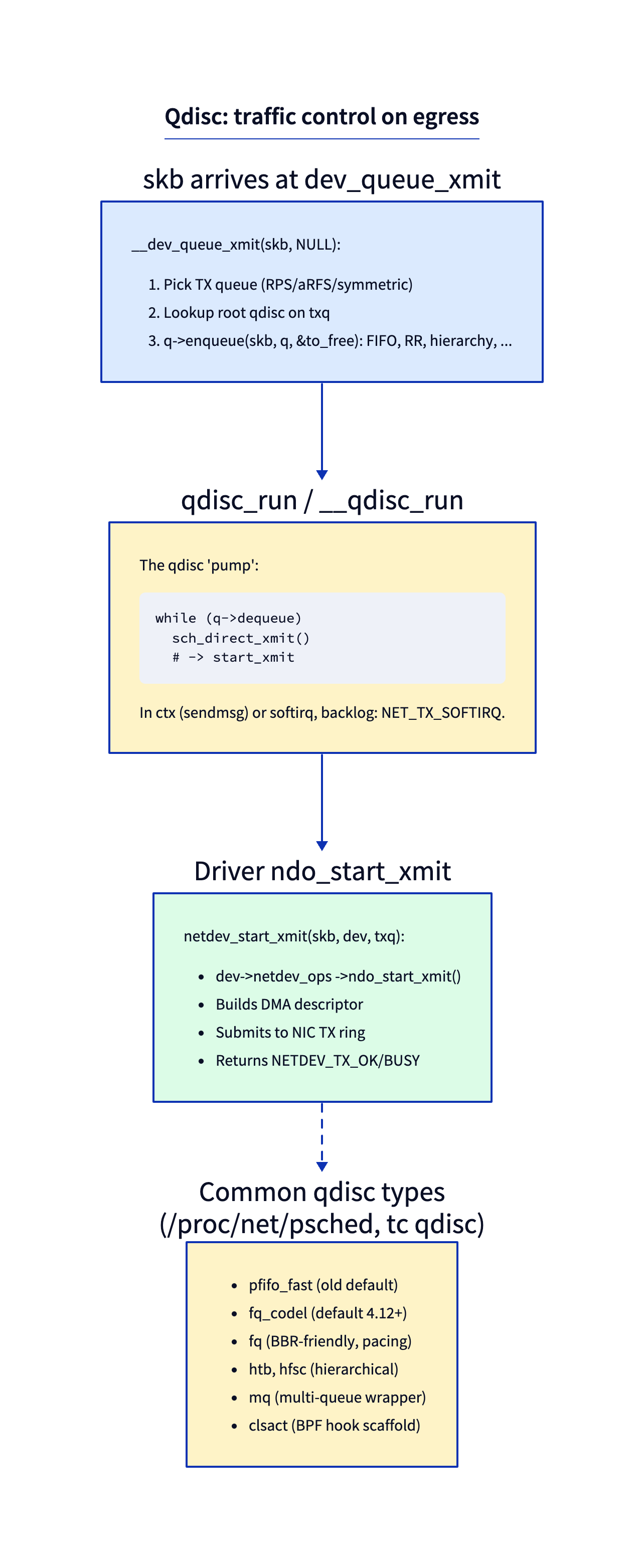
dev_queue_xmit (a wrapper for __dev_queue_xmit at net/core/dev.c:4766) is the boundary between L3 and the device layer. Three new ideas live here: an egress BPF hook, TX-queue selection, and the qdisc — the software packet scheduler. Let’s build them in the order the code hits them.
Step 1 — the egress BPF hook (one line)
First, __dev_queue_xmit runs sch_handle_egress (net/core/dev.c:4524, called at dev.c:4807), which runs any attached tcx / tc-bpf egress programs via tcx_run (dev.c:4439). This is simply the egress sibling of the tcx ingress attach point you saw on the RX path (Day 2, “Where BPF can attach”). It runs before queue selection and the qdisc. No new BPF to learn here.
Step 2 — pick a TX queue (multi-queue NICs)
A modern NIC doesn’t have one transmit path — it exposes many hardware TX queues so different CPUs can transmit in parallel without fighting over a single lock. Before touching any qdisc, __dev_queue_xmit must decide which TX queue (and therefore which root qdisc) this skb uses:
queue_index = netdev_pick_tx(dev, skb, sb_dev); /* net/core/dev.c:4736 */
netdev_pick_tx (net/core/dev.c:4691) chooses in priority order:
- an explicit
skb->queue_mappingif something upstream set one (e.g. XPS or socket steering) — that wins; - otherwise a flow hash, so every packet of one connection lands on the same queue and TCP’s ordering is preserved.
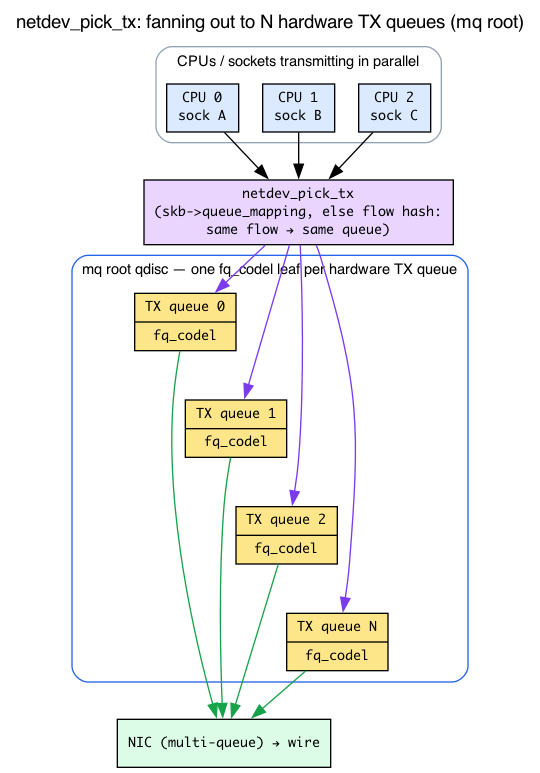
This is exactly why the Lab 3 output shows an mq root with one fq_codel leaf per hardware queue: one qdisc per TX queue.
Step 3 — the qdisc: what it is and why it exists
Here’s the new structure. Between the IP/device layer and the driver sits a queueing discipline (qdisc) — a per-TX-queue software FIFO-plus-scheduler. It exists because the driver/NIC can’t always take a packet this instant (the ring may be full, or you may want to rate-limit or fairly interleave flows). The qdisc is the kernel’s buffer-and-scheduling stage in front of the hardware: it can hold packets, reorder them, rate-limit them, and pick which flow goes next.
The whole qdisc abstraction comes down to two function pointers in struct Qdisc_ops:
int             (*enqueue)(struct sk_buff *skb, struct Qdisc *q,   /* include/net/sch_generic.h:314 */
                           struct sk_buff **to_free);
struct sk_buff *(*dequeue)(struct Qdisc *q);                       /* include/net/sch_generic.h:317 */
enqueue— the stack hands a packet in.__dev_queue_xmitcallsq->enqueue(skb, q, &to_free)on the chosen queue’s root qdisc.dequeue— the pump pulls the next packet out to give the driver.
The pump is qdisc_run → __qdisc_run (net/sched/sch_generic.c:440), a loop that calls q->dequeue, then sch_direct_xmit (net/sched/sch_generic.c:344), then netdev_start_xmit, then the driver — draining the queue as fast as the device will accept.
So the per-queue stats tc -s qdisc prints map directly onto this machinery:
- backlog — packets currently sitting in the qdisc, enqueued but not yet dequeued.
- drops — packets the qdisc threw away (queue full, or an active-queue-management algorithm like CoDel decided to).
- requeues — packets handed back because the driver returned
NETDEV_TX_BUSY(ring full); the qdisc holds them to retry.
On an idle box all three read 0. That’s not a bug — it means nothing is backing up. Lab 4 forces backlog non-zero on purpose so you can watch it move.
Default qdisc: built-in vs configured
There’s a subtlety worth getting right. The kernel’s compiled-in default qdisc is pfifo_fast — a simple 3-band priority FIFO:
/* net/sched/sch_generic.c:37 */
const struct Qdisc_ops *default_qdisc_ops = &pfifo_fast_ops;
But most distributions change the runtime default to fq_codel (fair-queuing with CoDel AQM) via the net.core.default_qdisc sysctl, handled by set_default_qdisc (net/core/sysctl_net_core.c:595). So:
Default qdisc on most modern systems is
fq_codel(selected via thenet.core.default_qdiscsysctl; the kernel’s built-in default is stillpfifo_fast).
Day 23 covers qdiscs in detail.
The steps inside __dev_queue_xmit, summarized
- tcx/tc-bpf egress hook runs first (before TX queue selection and the qdisc lookup).
- Pick a TX queue.
netdev_pick_txuses the socket’s cached TX queue (sk_tx_queue_get), then XPS (get_xps_queue), then a flow hash (skb_tx_hash). Modern NICs have many TX queues for parallelism. - Find the root qdisc on that queue (
txq->qdisc). - Enqueue:
q->enqueue(skb, q, &to_free). - Pump:
qdisc_run→__qdisc_run→q->dequeue→sch_direct_xmit→netdev_start_xmit→ driver’sndo_start_xmit.
Stage 5: driver and hardware
netdev_start_xmit(skb, dev, txq, more) (include/linux/netdevice.h:5371) calls dev->netdev_ops->ndo_start_xmit(skb, dev) (include/linux/netdevice.h:1441). Each driver implements this differently — but fundamentally it’s the mirror of Day 1’s RX descriptor ring, run in reverse: build a DMA descriptor, write it into the TX ring, ring the NIC’s doorbell register. The NIC’s DMA engine then reads the bytes straight out of the skb’s pages and puts them on the wire (recall: zero-copy, the payload pages are referenced, not copied).
Return value:
NETDEV_TX_OK(include/linux/netdevice.h:135) — submitted to the NIC.NETDEV_TX_BUSY(include/linux/netdevice.h:136) — the TX ring is full, so the driver refuses the skb; the qdisc holds it and retries (this is the requeues counter from Stage 4).
There are no Dumb Questions
Q: Where does TSO/GSO fit into this?
A: Day 4. Briefly: TSO (TCP Segmentation Offload) lets the kernel hand a 64KB skb to the NIC, and the NIC chops it into MSS-sized packets. GSO (Generic Segmentation Offload) does the same in software when the NIC doesn’t support TSO. Both happen late — at the qdisc/driver boundary, not during
tcp_sendmsg.Q: Why does the kernel sometimes block sendmsg vs return EAGAIN?
A: Socket flag. Default sockets block (sleep until space) — that’s
sk_stream_wait_memoryfrom Stage 2. Non-blocking sockets (O_NONBLOCK) returnEAGAINinstead.epoll-based servers use non-blocking +EPOLLOUTnotifications to know when the send buffer has drained enough to retry.Q: What about MSG_ZEROCOPY?
A: A flag for
send(). The kernel pins the user pages, points skb fragments at them directly (no copy intosk_write_queue— the frags reference the user pages), and notifies userspace via the socket’s error queue when transmission completes. Useful for very large transfers; userspace must hold the buffers until the notification.
Today’s experiment
Lab 1 — Trace a TCP send all the way through
Run the trigger inside the recorded command so the send is guaranteed to fire during the capture window — no second terminal, no race against sleep:
sudo trace-cmd record -p function_graph \
    -g tcp_sendmsg \
    -O nofuncgraph-overhead \
    -O funcgraph-tail \
    bash -c 'echo hello | nc -q 1 example.com 80; sleep 1'

sudo trace-cmd report | head -200
Prerequisite: this needs outbound TCP reachability and a completed handshake during the capture — any host you can actually reach works.
example.com:80reliably accepts the connection;8.8.8.8:80is filtered on many networks, so the handshake never completes and the payloadtcp_sendmsgnever fires.-q 1is a BSD/traditionalncflag — on nmap’sncat, drop it (usenc example.com 80).
You’ll see the call tree from tcp_sendmsg down through tcp_write_xmit, tcp_transmit_skb, ip_queue_xmit, eventually dev_hard_start_xmit, then the driver’s xmit. trace-cmd is global, so unrelated sends (e.g. background sshd) may appear too — your nc send is the one that ends in the full ip_queue_xmit → ... → dev_hard_start_xmit chain.
Lab 2 — Watch socket buffer accounting
On an idle box ss -tim shows only your SSH session, with the buffer/window counters static and near zero — the send-buffer accounting from Stage 2 is invisible until something is actively transmitting. So generate a sustained send first, then snapshot:
# Sustained upload so the send buffer actually has bytes in flight:
curl -s -o /dev/null -T /dev/zero --max-time 4 https://speed.cloudflare.com/__up &
ss -tim                      # watch the uploading socket while curl runs
Per-socket you get: send buffer used, congestion window, RTO, retransmits. ss does not print a field literally named wmem_queued; it surfaces the charged send-side memory (the sk_wmem_queued from Stage 2) as the w value inside skmem:(...). The Send-Q column is a different quantity — write_seq - snd_una, unacknowledged payload sequence bytes — which tracks the same backlog but in payload bytes rather than charged memory. While curl runs, the uploading socket (to :https, not your idle SSH session) shows a large Send-Q and skmem w, plus cwnd, unacked, and pacing_rate:
ESTAB  0  2765014  10.0.0.4:36872  162.159.140.220:https
  skmem:(r0,rb131072,t0,tb4194304,f2858,w2811094,o0,bl0,d0) cubic wscale:13,10
  ... cwnd:1950 ... unacked:266 ... pacing_rate 1.42Gbps delivery_rate 120Mbps
unacked (= tp->packets_out) is segments sent but not yet ACKed — it approximates the in-flight quantity from Stage 2.5 that the congestion test bounds (the exact figure is tcp_packets_in_flight(); the two diverge under loss/SACK). The skmem w value is the memory charged for not-yet-freed send-side skbs (sk_wmem_queued). Those are exactly the Stage 2 / Stage 2.5 quantities the check question asks you to compare. (Your cc may read bbr instead of cubic depending on net.ipv4.tcp_congestion_control.) If you have no internet egress, a local sink works but won’t fully exercise the buffer cap (loopback has no bottleneck, so it drains as fast as it fills).
Lab 3 — Inspect qdisc statistics
tc -s qdisc show dev eth0
Drops, requeues, current backlog — the three counters from Stage 4. On an idle box every one of these reads 0 — that is expected, not a failure:
qdisc mq 0: root
 Sent 1279377437 bytes 1467116 pkt (dropped 0, overlimits 0 requeues 0)
 backlog 0b 0p requeues 0
qdisc fq_codel 0: parent :1 limit 10240p flows 1024 quantum 1514 ...
 Sent 895133146 bytes 775553 pkt (dropped 0, overlimits 0 requeues 0)
 backlog 0b 0p requeues 0
(On a multi-queue NIC the root is mq with one fq_codel leaf per hardware TX queue — exactly the netdev_pick_tx fan-out from Stage 4, step 2 — so you’ll see several stanzas.) The next experiment forces backlog non-zero so you can actually watch it move.
Lab 4 — Force a backlog and watch
Warning: this throttles all egress on
eth0. If you are connected over that interface, your SSH/management traffic competes with the test transfer for the same 1mbit and the session may stall — run this on a throwaway VM or a non-management NIC.
First capture the qdisc that is actually there so you can restore it exactly (the live default here is mq, not fq_codel), then apply the rate limit:
ORIG=$(tc qdisc show dev eth0 | awk 'NR==1{print $2}')   # remember the real default
sudo tc qdisc replace dev eth0 root tbf rate 1mbit burst 32kbit latency 50ms
# now egress is rate-limited; large transfers back up at the qdisc
Drive traffic that actually leaves eth0. The backlog only grows for traffic egressing this device — a 127.0.0.1 transfer goes through the lo qdisc and shows backlog 0b 0p, so loopback is not a substitute. On a second machine run iperf3 -s, then here:
iperf3 -c <that-host-IP> -t 30 &
watch -n1 'tc -s qdisc show dev eth0'   # the `backlog ...b ...p` line climbs
No second machine or iperf3? Any sustained upload over eth0 backs up the qdisc the same way:
curl -s -o /dev/null -T /dev/zero --max-time 20 https://speed.cloudflare.com/__up &
watch -n1 'tc -s qdisc show dev eth0'
Restore (drop back to whatever was really there, and stop the transfer):
kill %1 2>/dev/null                       # stop the backgrounded transfer
sudo tc qdisc del dev eth0 root           # restores the kernel/runtime default
# or, to put back exactly what you captured: sudo tc qdisc replace dev eth0 root "$ORIG"
What to read in the kernel
include/net/sock.h—struct socksend-side fields:sk_write_queue(491),sk_wmem_queued(484),sk_sndbuf(526); thestruct protovtable (1291) and itssendmsgslot (1321);__sk_stream_memory_free(1413).net/ipv4/tcp.c—tcp_sendmsg(line 1447),tcp_sendmsg_locked(line 1117),tcp_push(741), the send-buffer wait at 1248/1405. The core of TCP user-side semantics.net/ipv4/tcp_output.c—tcp_write_xmit(line 2963),tcp_transmit_skb. Decides what to send when, applying cwnd/snd_wnd/Nagle.include/linux/tcp.h—snd_wnd(223),snd_cwnd(225),is_cwnd_limited(234),nonagle(291).net/ipv4/ip_output.c—ip_queue_xmit(line 546),ip_local_out(line 125),ip_output(428),ip_finish_output2(200) and itsneigh_outputcall (237).include/net/neighbour.h—neigh_output(547),neigh_hh_output(507),neigh_resolve_output(364).net/core/dev.c—__dev_queue_xmit(line 4766),sch_handle_egress(4524),netdev_pick_tx(4691), the qdisc dance.net/sched/sch_generic.c—__qdisc_run(440),sch_direct_xmit(344),pfifo_fast_ops(942), the qdisc pump; thedefault_qdisc_ops = &pfifo_fast_opsline (37).include/net/sch_generic.h—Qdisc_ops.enqueue(314) /dequeue(317).include/linux/netdevice.h—ndo_start_xmit(line 1441),netdev_start_xmit(5371),NETDEV_TX_OK/NETDEV_TX_BUSY(135–136).Documentation/networking/scaling.rst— how multi-queue TX works.
Bullet Points
- TX is sock-centric where RX was skb-centric: a
struct sockis the long-lived connection that owns a chain of skbs; ansk_buffis just one packet. - TX path:
sendmsg → tcp_sendmsg → tcp_write_xmit → tcp_transmit_skb → ip_queue_xmit → dev_queue_xmit → qdisc → driver → wire. - Protocol dispatch is a vtable:
sk->sk_prot->sendmsgistcp_sendmsg;icsk->icsk_af_ops->queue_xmitisip_queue_xmit. Noif-ladder. sk_write_queueholds queued-but-not-yet-transmitted skbs; after transmission, TCP retains the originals intcp_rtx_queueuntil ACK/free.sk_wmem_queuedspans both queues and counts their charged memory (skb->truesize) against thesk_sndbufcap. Full buffer ⇒ block (sk_stream_wait_memory) orEAGAIN. Auto-tuned bytcp_wmem.tcp_write_xmitdecides what to send now based on cwnd, snd_wnd, Nagle, TSO size. A segment goes out only if it clears two independent gates: in-flight packets <snd_cwnd(congestion, in packets —tcp_cwnd_test) and its end sequence ≤snd_una + snd_wnd(flow control, in bytes —tcp_snd_wnd_test). Linux’ssnd_cwndis in MSS-sized packets, so the two can’t bemin()’d. ACKs reopen the gates. (Full congestion control: Days 16–17.)- Two netfilter hooks on TX:
NF_INET_LOCAL_OUTandNF_INET_POST_ROUTING. - Neighbour resolution (ARP/NDP) happens in
ip_finish_output2: resolved ⇒neigh_hh_outputprepends the cached Ethernet header (using Day 1’s headroom); unresolved ⇒ skb parked onarp_queue+ ARP sent. (Full neighbour subsystem: Phase 2.) __dev_queue_xmitruns tcx/tc-bpf egress, picks a TX queue (netdev_pick_tx), then enqueues to that queue’s root qdisc.- A qdisc is a per-TX-queue software FIFO+scheduler with
enqueue/dequeue;__qdisc_runpumps it to the driver. backlog/drops/requeues are its counters. Multi-queue NICs show anmqroot with anfq_codelleaf per queue. - Default qdisc on modern Linux is
fq_codel(vianet.core.default_qdisc); the built-in default is stillpfifo_fast. - Driver’s
ndo_start_xmitis the final hand-off: write the TX-ring descriptor, ring the doorbell, NIC DMAs out.NETDEV_TX_BUSY= ring full ⇒ qdisc requeues.
Check question
You call send(fd, buf, 1MB, 0) on a TCP socket whose RTT is 100ms and whose BDP — bandwidth-delay product, the bandwidth times the round-trip time, i.e. the most data that can usefully be in flight at once — is much smaller than 1MB. The send returns immediately with the full 1MB written. Where are those bytes physically right now?
Click to reveal answer
Answer: In several send-side stages, not necessarily all in one queue. Bytes not yet transmitted remain in sk_write_queue; originals already transmitted but not ACKed sit in tcp_rtx_queue; transient transmit clones may be below TCP in IP/qdisc/device queues or on the wire. Because the BDP is small, most of the 1 MB will usually still be unsent when send() returns, but the exact split can change concurrently. The call returned because sk_sndbuf was big enough to accept the charged memory — not because the bytes left the box. If you read /proc/<pid>/status you’d see that memory in kernel TCP accounting, not in the process RSS. To inspect the split, run ss -tim: unacked counts sent-but-unacknowledged segments, while skmem w reports sk_wmem_queued across TCP’s retained send-side skbs. Send-Q is the related-but-distinct write_seq - snd_una payload-byte count.
Tomorrow
Day 4: GRO, GSO, TSO. Why a 64KB packet enters ip_rcv even though Ethernet’s MTU is 1500.