Day 5 — Network namespaces and struct net
Today’s mission: understand what a namespace even is, how a process is bound to one, and how the kernel keeps multiple independent network stacks isolated. Then create a network namespace, give it a virtual interface, run a process inside it, and watch one get born and die under bpftrace. End of Phase 1. Total time: ~110 minutes.
What a namespace IS (before we touch the network kind)
Days 1–4 never said the word namespace, so let’s build the idea from scratch — it’s the one piece of background everything today rests on.
A namespace is a kernel-wide scoping mechanism. Take one global resource — say, “the list of network interfaces,” or “the set of mounted filesystems,” or “the table of process IDs” — and make it appear as N independent copies instead of one shared thing. Two processes in different namespaces of the same kind look at the same global resource and each sees a private, isolated view. It’s the same trick a hypervisor plays with whole machines, except the kernel does it per-resource, in software, with almost no overhead.
Linux has several kinds of namespace, each scoping a different resource:
| Namespace | Scopes |
|---|---|
mnt | the mount table (which filesystems are visible where) |
pid | process IDs (PID 1 inside ≠ PID 1 outside) |
net | the entire network stack — today’s topic |
uts | hostname and domain name |
ipc | System V IPC / POSIX message queues |
time | clock offsets (boottime, monotonic) |
cgroup | the cgroup root a process sees |
A container is, at bottom, just a process whose mnt, pid, net, … pointers have been swapped to fresh namespaces. There is no “container” object in the kernel — there’s a process holding a bundle of namespace pointers. Today we care about exactly one of those pointers: net.
The network namespace scopes the whole stack. Each one has its own:
- list of network interfaces,
- routing tables,
- netfilter rules (the kernel’s packet-filtering/firewall framework; nftables is its modern ruleset),
- sockets and bound ports,
- proc/sysctl views,
- conntrack table (connection tracking — the kernel’s record of active flows, used by NAT and stateful firewalling).
This is what makes containers and VMs (with TAP/MACVTAP) practical. Every Docker/Podman/Kubernetes pod runs in its own netns. Linux can spin up tens of thousands of them at once.
How a process is bound to its namespaces: nsproxy
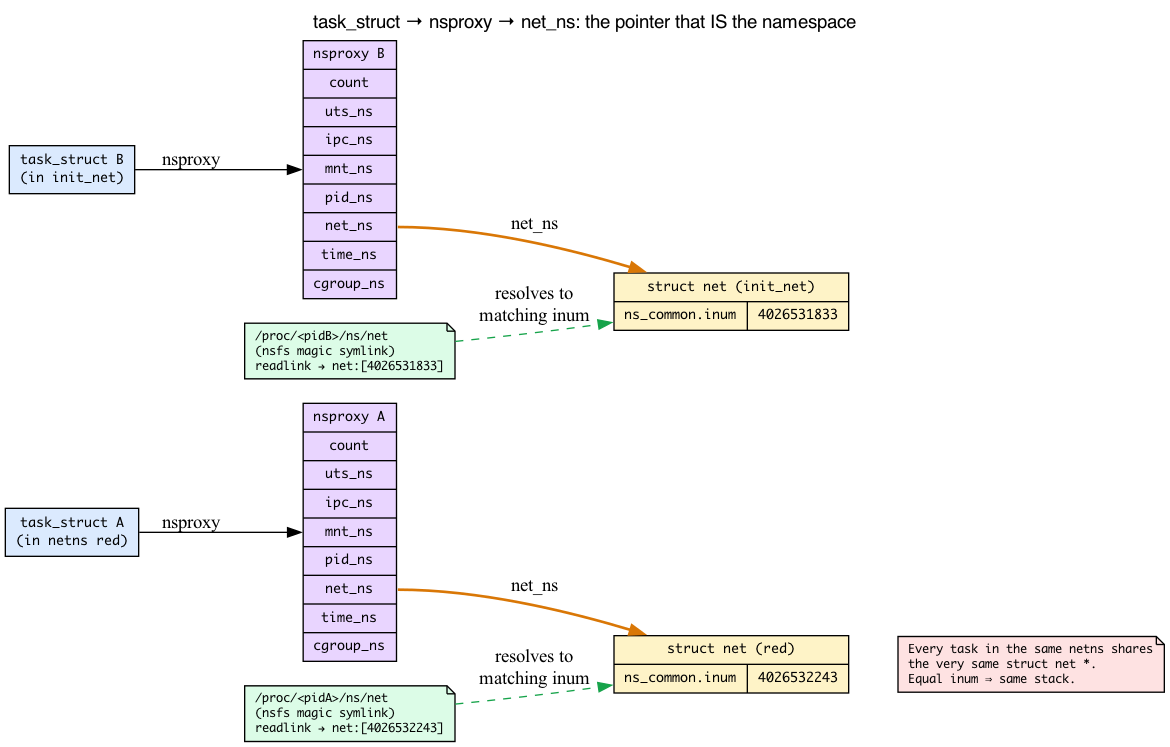
So where does a process keep the pointer that says “this is my netns”? Not directly in task_struct. Every task points at a small shared bundle called struct nsproxy, which holds one pointer per namespace kind:
/* include/linux/nsproxy.h:32 */
struct nsproxy {
	refcount_t count;
	struct uts_namespace *uts_ns;
	struct ipc_namespace *ipc_ns;
	struct mnt_namespace *mnt_ns;
	struct pid_namespace *pid_ns_for_children;
	struct net           *net_ns;        /* <-- the network namespace */
	struct time_namespace *time_ns;
	struct time_namespace *time_ns_for_children;
	struct cgroup_namespace *cgroup_ns;
};
The field that matters today is net_ns, a struct net *. Every task in the same netns shares the very same struct net * — that pointer is the namespace. The nsproxy itself is refcounted (count) and shared between tasks that happen to have identical namespace bundles, which is why fork without CLONE_NEW* is cheap: the child just bumps the parent’s nsproxy.
So the chain you’ll see in code is: task_struct → nsproxy → net_ns → struct net. When kernel code wants “the current task’s network namespace” it walks exactly that path (the helper is current->nsproxy->net_ns, usually behind sock_net(sk) or dev_net(dev)).
struct net — one per namespace
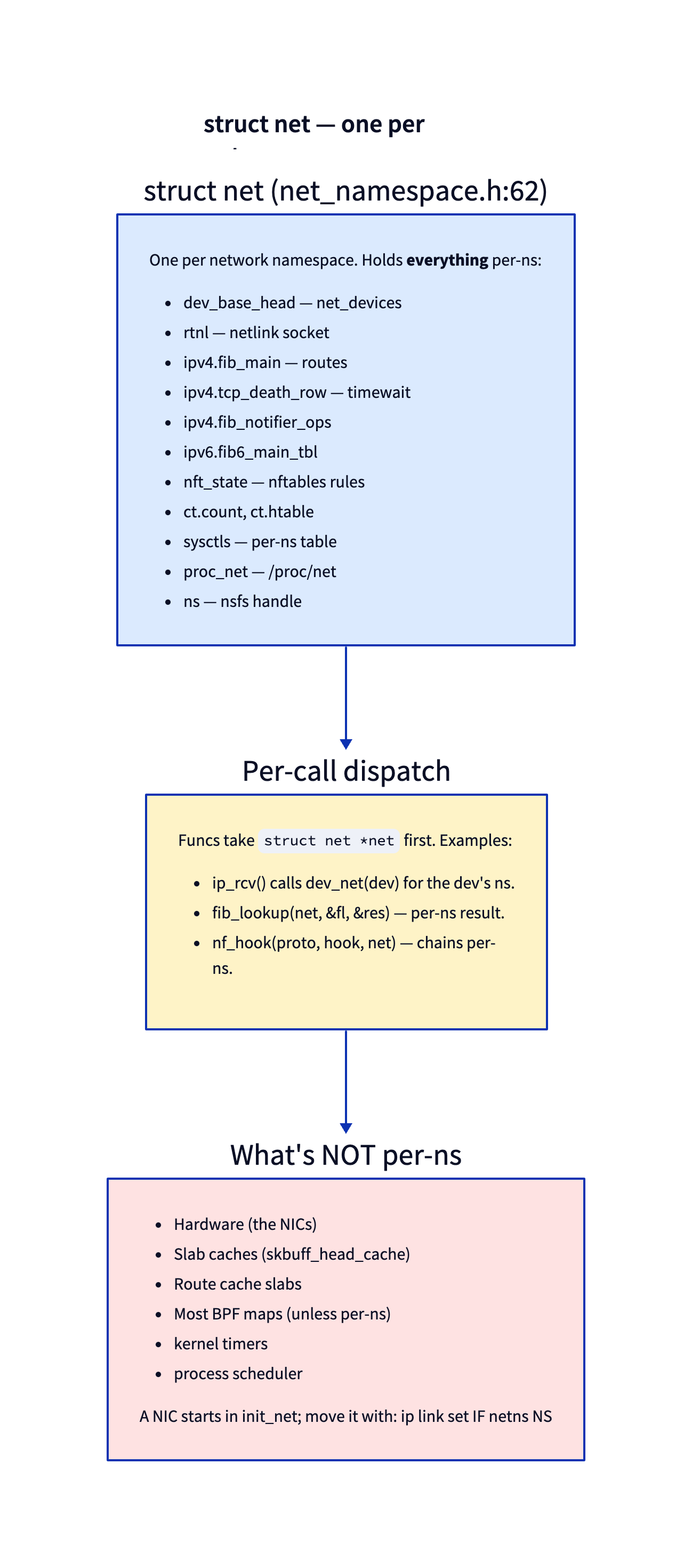
Each namespace is one struct net (defined at include/net/net_namespace.h:62). Kernel networking functions take struct net *net as a first-class parameter — anywhere a function needs a routing table, a netfilter chain, a port allocator, it’s looked up via net. (We’ll see why that one pointer is enough to reach every subsystem’s per-ns state when we get to pernet_operations below.)
The “default” namespace at boot is init_net (net/core/net_namespace.c:49: struct net init_net;). The kernel’s first netdev (loopback, then physical NICs) all start there. New namespaces are empty until you put devices in them.
The inode that names a namespace: ns_common and nsfs
Here’s the part that makes today’s first lab make sense. Embedded inside struct net is a small common header shared by all namespace kinds:
/* include/net/net_namespace.h:97 — inside struct net */
struct ns_common	ns;
And ns_common carries the namespace’s identity, an inode number:
/* include/linux/ns/ns_common_types.h:111 */
struct ns_common {
	struct { refcount_t __ns_ref; } ____cacheline_aligned_in_smp;
	u32 ns_type;
	struct dentry *stashed;
	const struct proc_ns_operations *ops;
	unsigned int inum;          /* <-- the unique identity */
	/* ... */
};
That inum is a unique inode number assigned when the namespace is created. Be careful about which identity it is, though. Internally, the kernel identifies a namespace by its struct net * pointer, not by inum. “Are these two in the same netns?” is answered by net_eq(net1, net2), which is literally return net1 == net2 (include/net/net_namespace.h:302) — a pointer compare — and same-netns checks throughout the stack (e.g. inet_bind_bucket matching) call net_eq on pointers. The inum is the userspace-facing name, surfaced through nsfs as net:[<inum>]. Because each live struct net is assigned a unique inum, userspace can compare two net:[...] strings to answer “same netns?” and get the right answer for currently-live namespaces — but that is a userspace convenience built on a 1:1 mapping, not the comparison the kernel itself performs. (Inums are also recycled once a namespace is freed — the ns_common comment notes inum is “quickly recycled for non-initial namespaces” — so an inum is a stable identity only among live namespaces, whereas the pointer is the authoritative live key.)
How do you see that number from userspace? Through nsfs, a tiny internal pseudo-filesystem whose only job is to expose namespaces as files. Each kind of namespace shows up as a magic symlink under /proc/<pid>/ns/. Reading the net one (readlink /proc/<pid>/ns/net) prints net:[<inum>]. Same inum ⇒ same namespace; different inum ⇒ different struct net. That’s the entire mechanism behind the metadata lab later in this chapter.
The boot namespace init_net gets a well-known, fixed inode number rather than a freshly allocated one — NET_NS_INIT_INO = 0xEFFFFFF9 (include/uapi/linux/nsfs.h:54), wired in through ns_init_inum() (include/linux/ns/ns_common_types.h:144). So on every Linux box, init_net’s net:[...] ends in the same number; only the namespaces you create get fresh ones.
There are no Dumb Questions
Q: Is the loopback per-ns?
A: Yes. Each ns gets its own
lo. So127.0.0.1in ns A is unrelated to127.0.0.1in ns B. Two processes (one in each) can bothbind()127.0.0.1:80 without conflict.Q: Can ns A see ns B’s traffic?
A: Only via connecting devices. Common patterns: a
vethpair (two virtual NICs that act as a wire — one in each ns), a Linux bridge that interconnects veths in init_net, or a physical NIC moved to one ns.Q: Where does shared state live?
A: Hardware (NICs themselves), slab caches (sk_buff allocations are kernel-wide — recall the
skbuff_head_cacheand per-CPUnapi_alloc_cachefrom Day 1), the scheduler. A NIC is per-ns in the sense that itsdev->nd_netpoints to one ns — but the underlying hardware is one physical thing.
Setting up a netns
Linux exposes ns operations via iproute2:
# Create namespace 'red'
sudo ip netns add red

# Run a shell in it
sudo ip netns exec red bash

# (in that shell) network is empty:
ip link
# 1: lo: <LOOPBACK> ... state DOWN
ip route
# (nothing)
You’re inside a fully isolated network stack. Bring up loopback, you can localhost ping yourself, but nothing else is reachable.
Connecting to the outside
Two veth ends, one in each ns:
# in init_net:
sudo ip link add veth_red type veth peer name veth_red_peer
sudo ip link set veth_red_peer netns red

# inside 'red' (or use ip netns exec):
sudo ip netns exec red ip link set veth_red_peer up
sudo ip netns exec red ip addr add 10.99.99.2/24 dev veth_red_peer

# back in init_net:
sudo ip link set veth_red up
sudo ip addr add 10.99.99.1/24 dev veth_red

# now:
sudo ip netns exec red ping 10.99.99.1     # works
ping 10.99.99.2                              # works (init→red)
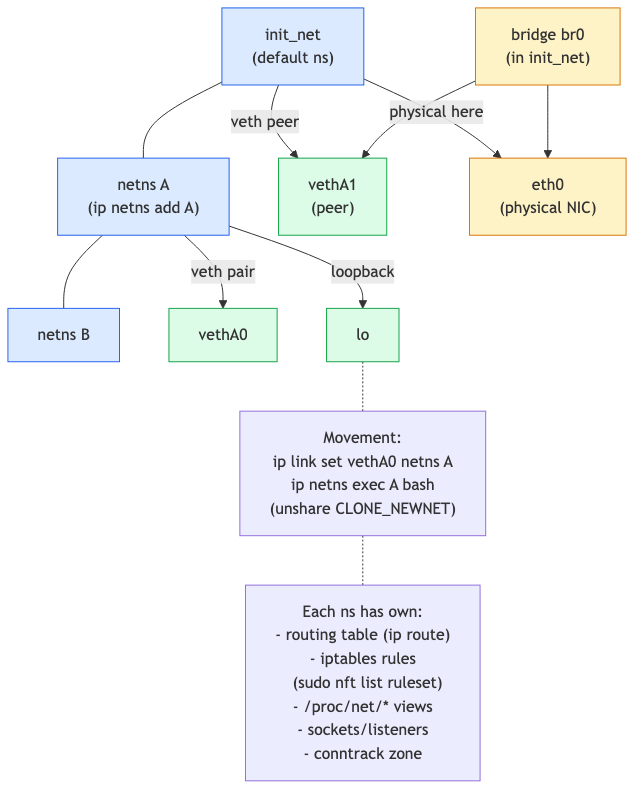
The figure shows the general pattern — substitute red for “netns A” and veth_red/veth_red_peer for vethA0/vethA1.
How struct net is assembled: pernet_operations
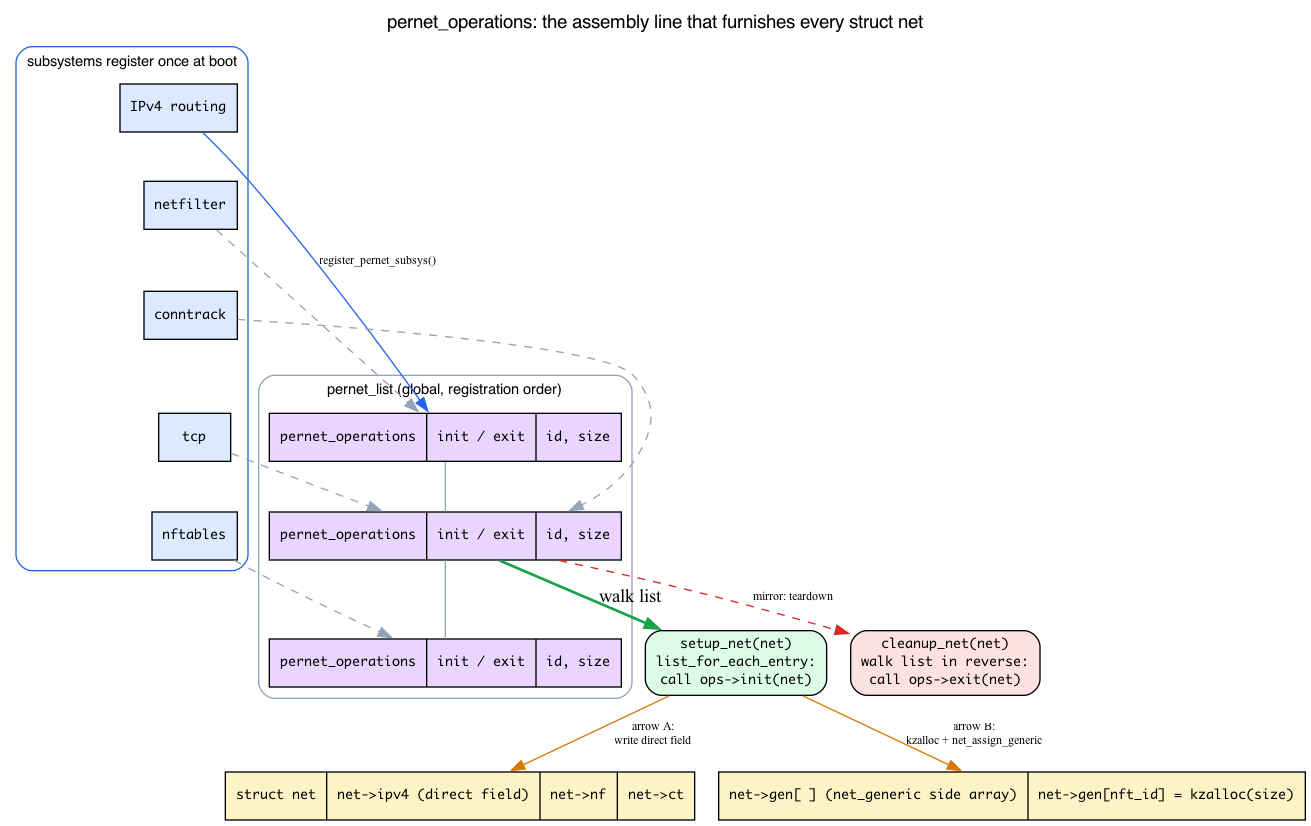
We keep saying struct net “aggregates all per-ns subsystem state.” But who fills it in? When ip netns add red runs, the kernel allocates one bare struct net — how do routing tables, netfilter chains, conntrack counters, and TCP state all appear inside it? And later, who tears them all back down? The answer is one elegant registration mechanism, and once you see it the chapter’s central claim (“most kernel net functions take struct net *net first”) stops being a slogan and becomes obvious.
Intuition: subsystems register init/exit callbacks
Picture every networking subsystem — IPv4 routing, netfilter, conntrack, TCP, nftables — as a tenant that wants a private room in every struct net that will ever exist. At boot, each tenant signs up once by handing the core a pair of callbacks: “when a new netns is born, call my init to furnish my room; when it dies, call my exit to clear it out.” The core keeps these signups in a list and replays them for every namespace.
The signup form is struct pernet_operations:
/* include/net/net_namespace.h:459 */
struct pernet_operations {
	struct list_head list;
	int  (*init)(struct net *net);   /* :483 — furnish my per-ns state   */
	void (*pre_exit)(struct net *net);
	void (*exit)(struct net *net);   /* :485 — tear it down               */
	void (*exit_batch)(struct list_head *net_exit_list);
	void (*exit_rtnl)(struct net *net, struct list_head *dev_kill_list);
	unsigned int * const id;         /* :490 — net_generic slot id        */
	const size_t size;               /* :491 — bytes to allocate for it   */
};
A subsystem registers it with register_pernet_subsys() (include/net/net_namespace.h:513), which just appends the node to a global list called pernet_list. That’s the whole registration. For example, IPv4 routing’s /proc plumbing:
/* net/ipv4/route.c:379 */
static struct pernet_operations ip_rt_proc_ops __net_initdata = { ... };
/* and registered at route.c:386 (plus sysctl_route_ops / ip_rt_ops / rt_genid_ops at :3782+) */
register_pernet_subsys(&ip_rt_proc_ops);
Dispatch: setup_net walks the list
When a namespace is created, setup_net() walks pernet_list front-to-back and calls every registered init:
/* net/core/net_namespace.c:436 */
static __net_init int setup_net(struct net *net)
{
	const struct pernet_operations *ops;
	/* ... */
	list_for_each_entry(ops, &pernet_list, list) {
		error = ops_init(ops, net);          /* :446 */
		if (error < 0)
			goto out_undo;
	}
	/* ... */
}
This loop is the assembly line. Each subsystem’s init fills in its slice of per-ns state, one after another, in registration order. That’s why a fresh namespace already has a working (if empty) routing table, netfilter hooks, and so on the instant ip netns add returns.
Two ways to store per-ns state: direct field vs net_generic
Where does a subsystem put its state? There are two strategies, and the chapter’s “What’s per-ns” list mixes both:
-
A direct field of
struct net— for hot, core subsystems the state is embedded right in the struct:net->ipv4(net_namespace.h:138),net->nf(:149),net->ct(:151),net->nft(:154). Fast to reach, no indirection. -
net_generic— a side array — for everything else, baking a field intostruct netfor every module would bloat it. Instead, if apernet_operationssetsidandsize, the dispatcher allocates the room on demand. Look atops_init:/* net/core/net_namespace.c:120 */ static int ops_init(const struct pernet_operations *ops, struct net *net) { void *data = NULL; if (ops->id) { data = kzalloc(ops->size, GFP_KERNEL); /* allocate the room */ err = net_assign_generic(net, *ops->id, data); /* :131 — stash pointer in net->gen */ } /* ... */ if (ops->init) err = ops->init(net); /* then furnish it */ }The pointer lands in
net->gen(net_namespace.h:163), a resizable array indexed by the subsystem’sid. Code fetches it back withnet_generic(net, id). This is exactly whatnft_pernet(net)does under the hood — which is why the chapter calls nftables state “net_generic-backed”: it isn’t a direct field, it lives innet->gen[nft_id].
Either way, everything reachable from one struct net *. Direct field or net->gen[id], a subsystem starts from that single pointer and finds its per-ns slice. That is the real reason “most kernel net functions take struct net *net as the first parameter” — the pointer is the key to every per-ns room in the building.
Teardown is the mirror image
On destruction, cleanup_net (covered next) walks the same registrations and runs each exit callback — the matching “clear out the room” step. Because every registered subsystem must run its exit (flush conntrack, close sockets, free routing tables) one at a time, deleting a busy namespace is slow: it’s a serial walk over every tenant’s move-out.
What’s per-ns
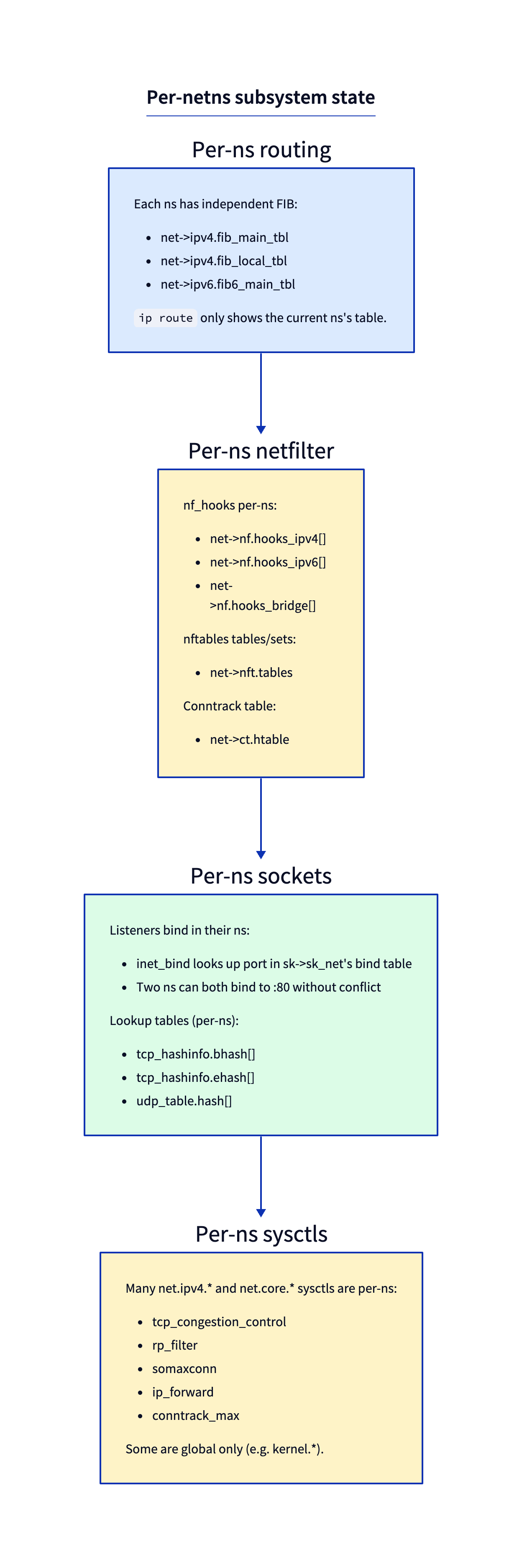
The state per ns includes (the struct net figure above already previewed this inventory; here we mark which are direct fields vs net_generic-backed, now that you know the difference):
- Routing:
net->ipv4.fib_main,ipv4.fib_default,ipv6.fib6_main_tbl— direct fields offnet->ipv4.ip routeonly shows the current ns’s table. - Netfilter:
net->nf.hooks_ipv4[](per-hook arrays, direct field),nft_pernet(net)->tables(net_generic-backed), per-ns conntrack stats innet->ct. nftables and conntrack state are independent. - Sockets: the TCP bind hashtable (
tcp_hashinfo.bhash[]) is itself global/shared, not per-ns — isolation comes from each bind bucket recording its owning netns.struct inet_bind_bucketcarriesib_net, the bucket-match test isnet_eq(ib_net(tb), net) && tb->port == port, and thenetpointer is mixed into the hash viainet_bhashfn(net, port, ...). So two namespaces that bothbind()0.0.0.0:80land in separate buckets keyed by theirstruct netinside the one shared table — same port, no conflict. (Only the ehash can optionally be made per-net viatcp_child_ehash_entries;net->ipv4.tcp_death_row.hashinfois the per-net hashinfo pointer but it still points at the shared bind table by default.) - Sysctls: most
net.ipv4.*are per-ns (tcp_congestion_control,rp_filter,ip_forward). - proc/net: each ns sees its own
/proc/net,/proc/sys/net.
The life and death of a struct net
The chapter’s lifecycle lab traces a namespace being born (copy_net_ns/setup_net) and dying (cleanup_net). To read what you’re seeing — and to understand why deleting a netns sometimes doesn’t actually free it — you need the refcount model. Good news: it’s the same rule you already learned on Day 1.
Recall: the free-at-zero refcount
On Day 1 you saw sk_buff use a refcount_t (skb->users) that’s bumped by skb_get() and dropped by kfree_skb(), freeing only when it hits zero. struct net uses the identical pattern — only the structure being guarded differs. There’s nothing new to learn about how a refcount works; we’re just applying it to namespaces.
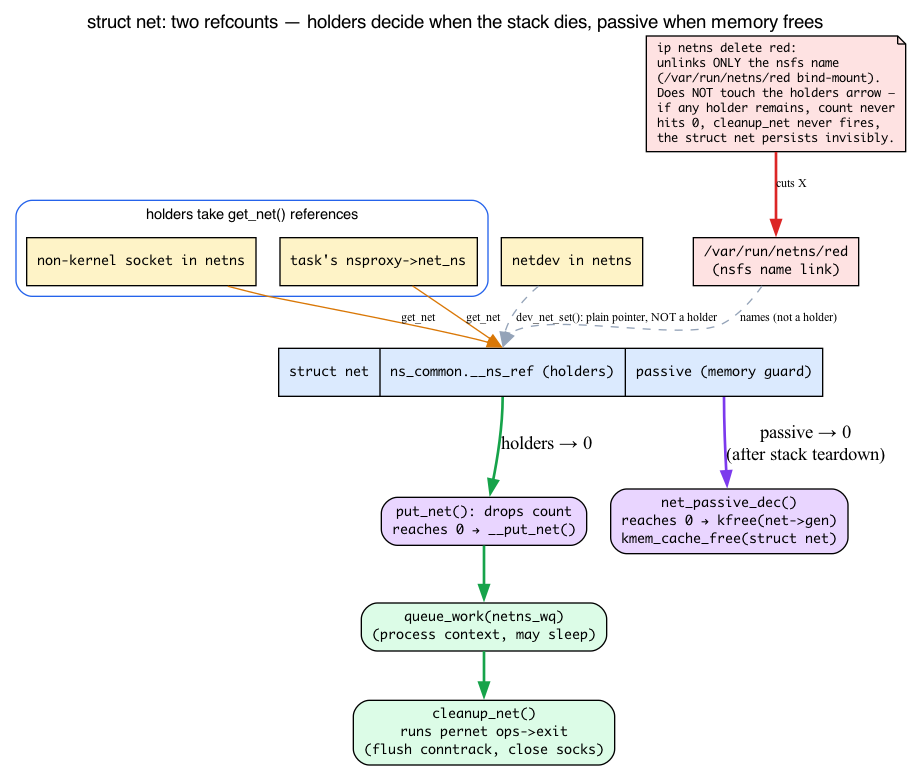
Tier 1: holders (get_net / put_net)
The primary count lives in the embedded ns_common.__ns_ref. Anything that needs the namespace to stay alive takes a reference:
- a non-kernel socket in that netns (
sk_alloc→get_net_track; kernel sockets withsk_net_refcnt == 0take only the passive count, not a holder), - a task’s nsproxy → net_ns pointing at it (
copy_net_nstakes aget_netfor the non-CLONE_NEWNETcase; a freshly created net starts with one__ns_ref), - an open FD or bind-mount of the ns (the nsfs name keeps it pinned).
A netdev does NOT hold a reference to its netns. Its nd_net is a plain pointer: dev_net_set() → write_pnet(&dev->nd_net, net) (netdevice.h:2774) is a bare pointer write with no refcount — grep -cE 'get_net\b|get_net_track' net/core/dev.c returns 0. The only count a netdev ever touches is the separate passive (memory-guard) count, and only transiently inside rtnl_net_dev_lock/unlock. In fact the design is the opposite of “a device pins its netns”: because devices do not hold the namespace alive, the teardown machinery must actively evict them. default_device_ops (registered via register_pernet_device) runs default_device_exit_net at teardown, which moves migratable physical devices back to init_net and deletes virtual ones (veth). That eviction code exists precisely because a netdev cannot keep a netns alive — if it could, any netns containing a device would never be freed.
get_net(net) bumps the count; put_net(net) drops it:
/* include/net/net_namespace.h:276, :295 */
static inline struct net *get_net(struct net *net)
{
	ns_ref_inc(net);          /* bump ns_common.__ns_ref */
	return net;
}
static inline void put_net(struct net *net)
{
	if (ns_ref_put(net))      /* drop; true when it hit zero */
		__put_net(net);
}
There’s also maybe_get_net() (:282), the careful variant that fails (returns NULL) if the count is already zero — used when you have a pointer but aren’t sure the namespace is still alive.
Why the last put_net doesn’t free inline — the workqueue
Here’s the subtle part. When put_net drops the holder count to zero it calls __put_net, which does not free anything immediately:
/* net/core/net_namespace.c:745 */
void __put_net(struct net *net)
{
	ref_tracker_dir_exit(&net->refcnt_tracker);
	/* Cleanup the network namespace in process context */
	if (llist_add(&net->cleanup_list, &cleanup_list))
		queue_work(netns_wq, &net_cleanup_work);   /* :750 — punt to a workqueue */
}
It appends the dead namespace to a cleanup_list and queues work. Destruction is deferred to a workqueue.
A workqueue is the kernel’s mechanism for running deferred functions in a kernel thread — i.e. in process context, where the code is allowed to sleep. That’s distinct from the softirq/NAPI context you met on Day 2, which is atomic and may not sleep. Why does namespace teardown need to sleep? Because tearing down subsystems (synchronize_rcu(), flushing conntrack, closing sockets) blocks — and put_net can be called from anywhere, including atomic contexts where blocking is forbidden. So the rule is: drop the refcount cheaply and atomically, then hand the heavy, sleepy teardown off to a kernel thread.
The work item and its function are wired up statically:
/* net/core/net_namespace.c:743 */
static DECLARE_WORK(net_cleanup_work, cleanup_net);
cleanup_net (net/core/net_namespace.c:662) is the function that eventually runs on that workqueue thread. It walks the pernet_operations registrations in reverse and calls every subsystem’s exit — the teardown half of the assembly line from the previous section.
This is also a handy tracing fact: because cleanup_net is a real, non-inlined function registered via DECLARE_WORK, fentry:cleanup_net attaches reliably. The birth-side setup_net, by contrast, is static __net_init and may be inlined — which is exactly the caveat in the lifecycle lab below.
Tier 2: passive (the memory guard)
There’s a second, separate refcount on struct net:
/* include/net/net_namespace.h:66 */
refcount_t		passive;
Why two? The holders count answers “should this network stack stay operational?” The passive count answers a narrower question: “is anyone still touching this struct net’s memory?” A transient lookup might need to pin the bytes of the struct for a moment without keeping the whole stack alive. passive is initialized to 1 (net/core/net_namespace.c:410: refcount_set(&net->passive, 1)), and net_passive_dec() (:530) does the final teardown — freeing net->gen and ultimately kmem_cache_freeing the struct — when it reaches zero, after the operational teardown has already run. Two tiers: holders decide when the stack dies, passive decides when the memory is freed.
What ip netns delete actually does
Now the chapter’s central puzzle resolves cleanly. ip netns delete red only unlinks the name — the nsfs bind-mount under /var/run/netns/red. It does not force the namespace to die. If any process, socket, or open FD still holds a get_net reference, the holder count stays above zero, __put_net is never called, cleanup_net never runs, and the namespace persists invisibly until the last holder exits. The name is gone from ip netns list, but the struct net lives on. That is precisely the “what if a process is still inside?” problem: Linux holds struct net until the last reference goes away — process exit, FD close, etc.
Today’s experiment
See ns metadata
sudo ip netns add green
ls /var/run/netns/        # one entry per ns

# nsfs link to /proc/<pid>/ns/net:
readlink /proc/$$/ns/net           # current shell's netns (init_net)
sudo ip netns exec green readlink /proc/self/ns/net   # green's netns
net:[4026531833]    # init_net (your number differs)
net:[4026532243]    # green — a different inode
You’re looking at two ns_common.inum values resolved through nsfs — the userspace-visible name for each namespace (the kernel itself keys on the struct net * pointer, but each live net maps 1:1 to an inum, so distinct strings here mean distinct namespaces). Note the use of /proc/self in the second command, not /proc/$$. $$ is expanded by your outer interactive shell (which lives in init_net) before ip netns exec runs, so it would resolve the symlink for a process still in init_net and print the same inode twice. /proc/self is resolved by the readlink process that ip netns exec actually placed inside green, so the two inodes genuinely differ — that’s how the kernel knows which ns a process is in.
Per-ns sysctl
# In init_net — show YOUR actual value (don't assume a specific one):
cat /proc/sys/net/ipv4/tcp_congestion_control
# cubic (whatever your box uses — often cubic)

# What's even compiled in? (reno is always built in)
cat /proc/sys/net/ipv4/tcp_available_congestion_control
# reno cubic dctcp bbr htcp

# In green:
sudo ip netns exec green cat /proc/sys/net/ipv4/tcp_congestion_control
# cubic (a new ns inherits init_net's congestion control)

# Set green to reno — always built in, so guaranteed distinct from a default-cubic box:
sudo ip netns exec green sysctl -w net.ipv4.tcp_congestion_control=reno

# Confirm green changed but init_net did NOT:
sudo ip netns exec green cat /proc/sys/net/ipv4/tcp_congestion_control   # reno
cat /proc/sys/net/ipv4/tcp_congestion_control                            # unchanged (your original value)
Different values per ns — green now reads reno while init_net keeps its original value, proving the tables are independent. The per-ns sysctl table is at net->sysctls. (If your init_net somehow already runs reno, set green to cubic instead — the point is just to pick something different from init_net’s current value.)
Per-ns routing
# In red (with veth set up):
sudo ip netns exec red ip route
# 10.99.99.0/24 dev veth_red_peer scope link

# In init_net:
ip route
# (your normal routes, including 10.99.99.0/24 if the host added one)
Different tables, different views.
Watch ns lifecycle
sudo bpftrace -e '
fentry:setup_net  { printf("setup_net %p\n", (void *)args->net); }
fentry:cleanup_net { printf("cleanup_net work %p\n", (void *)args->work); }
'

# In another terminal:
sudo ip netns add demo
sudo ip netns delete demo
Caveat:
setup_netisstatic __net_init(net/core/net_namespace.c:436), so it may be inlined or freed after boot andfentry:setup_netmay not reliably attach. If it doesn’t fire, trace its callercopy_net_ns(net/core/net_namespace.c:549) instead — but note thatcopy_net_ns’sstruct net *argument (args->old_net) is the OLD/parent namespace, not the new one. The freshly createdstruct netis the function’s RETURN value, so you must usefexitandretval:sudo bpftrace -e 'fexit:copy_net_ns { printf("new net %p\n", retval); }'(
copy_net_nsalso runs forCLONEwithoutCLONE_NEWNET, in which case it just returns the old net pointer; the distinct heap addresses appear exactly whenip netns addruns.)cleanup_netis a work-queue function (registered viaDECLARE_WORKatnet/core/net_namespace.c:743) and attaches reliably — exactly as the lifecycle section explained.
You’ll see the ns being created and torn down. Tie it back to the refcount model: the cleanup_net line only fires once the holder count hit zero and __put_net queued the work — for a freshly created, empty demo with no lingering processes or sockets, that’s immediate.
What happens when you delete a netns
You just watched cleanup_net fire — recall from the refcount section that it only ran because demo had no lingering holders. (If a process, socket, or FD had still held a get_net reference, ip netns delete would have unlinked only the nsfs name and the struct net would have survived invisibly until that last holder went away.)
What to read in the kernel
include/linux/nsproxy.h—struct nsproxy(line 32). See the one-pointer-per-namespace-kind layout;net_nsis the field today is about.include/net/net_namespace.h—struct netdefinition (line 62). Read all fields once. Note the embeddedns_common ns(line 97), thepassiverefcount (line 66), thegenpointer for net_generic (line 163), and the direct fieldsipv4/nf/ct(lines 138/149/151). Alsostruct pernet_operations(line 459) andregister_pernet_subsys(line 513).include/linux/ns/ns_common_types.h—struct ns_common(line 111); theinumfield (line ~118) is the identity nsfs prints.net/core/net_namespace.c— the lifecycle:setup_net(line 436),ops_init/net_assign_generic(lines 120/83),copy_net_ns(line 549),__put_net(line 745),cleanup_net(line 662),net_passive_dec(line 530), andstruct net init_net(line 49).include/linux/netdevice.h— searchdev_net(dev). Most code calls this to get the ns from a netdev.- Any
*_pernet_opsregistration — for examplenet/ipv4/route.cregister_pernet_subsys(&ip_rt_proc_ops)(line 386). Each subsystem registers init/exit callbacks here. Documentation/admin-guide/sysctl/net.rst— which sysctls are per-ns, which are global.
What to break
Try moving a physical NIC to a netns
First find your real interface name — many cloud/test VMs use predictable names like ens5 or enp0s3, not eth0:
ip route get 1.1.1.1 # read the 'dev <name>' field; substitute it for eth0 below
sudo ip link set eth0 netns red # **CAREFUL** — your SSH may go away
If you do this on the real interface you’re using, your SSH session disconnects (init_net no longer has eth0). For real testing, do it with a non-essential interface or via a console. Under the hood, moving the NIC just reassigns its dev->nd_net to red’s struct net — a plain pointer write, not a get_net reference. The device does not pin red: at red’s destruction default_device_exit_net would push eth0 back to init_net automatically.
To recover from console — note the device comes back down with its addresses flushed, so you must bring it up and re-acquire an address:
sudo ip netns exec red ip link set eth0 netns 1   # back to init_net
sudo ip link set eth0 up
sudo dhclient eth0        # if your distro uses DHCP; otherwise re-add the static address you had before
Watch conntrack count per ns
sudo ip netns exec red sysctl net.netfilter.nf_conntrack_count
# 0 (red has no traffic)

sysctl net.netfilter.nf_conntrack_count
# possibly thousands (init_net has all real traffic)
The two views are independent — net->ct is a per-ns slice furnished by conntrack’s own pernet_operations init when red was created.
Cleanup
These experiments leave persistent namespaces and a veth pair behind. Tear them down so you don’t accumulate stale interfaces and ns mounts:
sudo ip link del veth_red 2>/dev/null     # removes both ends of the pair
sudo ip netns delete green 2>/dev/null
sudo ip netns delete red 2>/dev/null      # also reaps the peer living inside it
Remember: each ip netns delete only drops the name. The struct net is actually freed only once its last holder (the veth you just deleted, any ip netns exec shells you left open) is gone and cleanup_net has run.
Bullet Points
- A namespace is a kernel scoping mechanism that turns one global resource into N isolated copies. Kinds:
uts,ipc,mnt,pid,net,time,cgroup. A process points at all of them throughtask_struct → nsproxy;nsproxy->net_nsis the netns. - Network namespace =
struct net(net_namespace.h:62). One per ns; aggregates all per-ns subsystem state. The default ns isinit_net. - A namespace’s userspace identity is
ns_common.inum, an inode number exposed via nsfs as/proc/<pid>/ns/net→net:[<inum>]. The kernel itself compares thestruct net *pointer (net_eqisnet1 == net2); the inum is a 1:1 userspace name for live namespaces (and is recycled after free). init_net’s is the fixedNET_NS_INIT_INO. - Per-ns state is assembled by
pernet_operations: each subsystem registers init/exit callbacks viaregister_pernet_subsys;setup_netwalks the list calling eachinit,cleanup_netcalls eachexit. State lives either in a direct field (net->ipv4/nf/ct) or innet_generic(net->gen[id], e.g. nftables). - That single mechanism is why most kernel net functions take
struct net *netfirst — the pointer reaches every per-ns slice. struct netuses the same free-at-zero refcount rule as Day 1’s sk_buff: holders (get_net/put_netonns_common.__ns_ref) keep the stack alive; a separatepassiverefcount guards the final memory free.- The last
put_netdoesn’t free inline —__put_netqueuescleanup_neton thenetns_wqworkqueue (process context, may sleep), distinct from Day 2’s softirq context. ip netns deleteunlinks only the nsfs name; if any holder remains, the ns persists invisibly until the last one exits.vethpairs are the most common way to connect a ns to the outside world.- Per-ns: routing, netfilter rules, conntrack, sockets, sysctls, /proc/net. NOT per-ns: hardware, slab caches, scheduler.
ip netns add/del/execfor management;unshare(CLONE_NEWNET)to create programmatically.
Check question
Two TCP servers run, one in init_net and one in netns “red”, both bound to 0.0.0.0:80. Both have full read/write to their socket. A client in init_net connects to 127.0.0.1:80. Which server gets the connection?
Click to reveal answer
Answer: The init_net server. Socket bind tables are per-ns: 0.0.0.0:80 in init_net is one entry; 0.0.0.0:80 in red is a separate entry. The kernel routes the SYN by namespace: the client is in init_net, the SYN goes through init_net’s stack, lookup in init_net’s bind table finds the init_net listener. Red’s listener never sees the packet. To reach red’s listener, you’d need a process in red to connect (e.g., ip netns exec red curl 127.0.0.1), or a route + nftables setup that forwards traffic into red.
End of Phase 1
You can now read the kernel network stack from sk_buff up. RX path, TX path, offloads, namespaces. The vocabulary is real — when you see dev_net(skb->dev), napi->poll, __qdisc_run, gso_segs, get_net(sock_net(sk)), you know what they’re doing.
Phase 2 (Days 6–12) walks the L2/L3 layers in detail: Ethernet, ARP, the FIB, IPv6, bridges, tunnels.