Day 6 — Ethernet, VLAN, and the L2 layer
Today’s mission: see what
eth_type_transdoes to every received packet — and learn the four pieces of wire-format background it quietly leans on (the Ethernet header layout, MAC-address bit semantics, network byte order, and the 802.1Q tag internals) so nothing along the way is a magic constant. Then create a VLAN device and watch tags appear and disappear. Total time: ~110 minutes.
Phase 2 starts here. Days 6–12 walk the L2/L3 layers in detail: Ethernet, ARP, IP routing, IPv6, bridges, tunnels.
What L2 means in Linux
The “Layer 2” code in Linux is small but ubiquitous. Every received frame passes through it; every transmitted frame has its Ethernet header built there. The implementation lives mostly in net/ethernet/eth.c (~640 lines).
The single most important function in this layer is eth_type_trans — called by every Ethernet driver on RX, every time. By the end of Day 2 you watched the driver call it in Stage 2 of the RX path: it sets skb->protocol, and that value becomes the demux key the core stack hashes on to pick ip_rcv. Today we open it up.
But eth_type_trans parses raw bytes off the wire, and to read it without hand-waving you need to know what those bytes are. So before we walk the function, three short background sections — intuition first, then the concrete v7.1 struct — on the Ethernet header, MAC-address bits, and byte order. After that the function reads as plain English. The fourth piece of wire-format background — the 802.1Q VLAN tag (Background 4) — comes after the function, in the VLAN section, because that’s where the function hands tagged frames off to the dedicated VLAN subsystem.
One thing from Day 1 is load-bearing today and will not be re-taught:
- The skb’s four pointers (
head ≤ data ≤ tail ≤ end) andskb_pull/skb_push. Recall from Day 1 —skb->datais the first valid byte of the current header view, andskb_pull(skb, n)advancesdatabynbytes (stripping a header you’ve finished with).eth_type_transdoes exactly oneskb_pullof 14 bytes; that’s the whole “advance past the Ethernet header” trick.
Background 1: the 14 bytes of an Ethernet header
Before eth_type_trans can do anything, it has to know what the first bytes of a received frame mean. On Ethernet, every frame starts with a fixed 14-byte header, and it is gloriously simple — just three fields back to back, no options, no variable length.
struct ethhdr is exactly that (include/uapi/linux/if_ether.h:177-181):
struct ethhdr {
    unsigned char   h_dest[ETH_ALEN];   /* destination eth addr  */
    unsigned char   h_source[ETH_ALEN]; /* source ether addr     */
    __be16          h_proto;            /* packet type ID field  */
} __attribute__((packed));
with ETH_ALEN 6 (if_ether.h:32) and ETH_HLEN 14 (if_ether.h:34). Lay it out as a byte ruler:
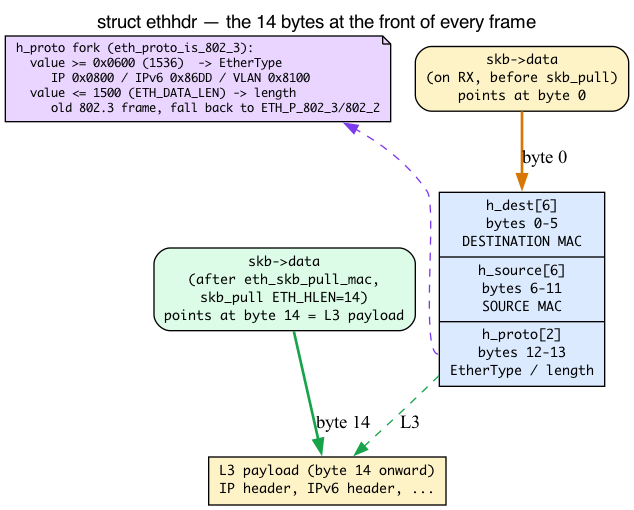
- Bytes 0–5:
h_dest— the destination MAC (who the frame is for). - Bytes 6–11:
h_source— the source MAC (who sent it). - Bytes 12–13:
h_proto— the 2-byte EtherType (what’s inside).
6 + 6 + 2 = 14 = ETH_HLEN. That is the exact number skb_pull advances by. When a frame arrives, the driver has placed skb->data on byte 0 (the start of h_dest). After eth_type_trans does skb_pull(skb, ETH_HLEN), skb->data lands precisely on byte 14 — the first byte of the L3 header (the IP header, usually). No parsing, no length math: the Ethernet header is a fixed size, so one fixed pull strips it. This is why the helper that does it, eth_skb_pull_mac, is so short (etherdevice.h:640-645):
static inline struct ethhdr *eth_skb_pull_mac(struct sk_buff *skb)
{
    struct ethhdr *eth = (struct ethhdr *)skb->data;  /* read the 14 bytes */
    skb_pull_inline(skb, ETH_HLEN);                   /* then step past them */
    return eth;
}
The EtherType is sometimes a length
Here’s the one wrinkle. The 2-byte h_proto field is overloaded, for historical reasons:
- If the value is ≥ 0x0600 (1536), it’s a real protocol type — “Ethernet II” framing. Examples:
ETH_P_IP0x0800 (if_ether.h:52),ETH_P_IPV60x86DD (:74),ETH_P_ARP0x0806 (:54),ETH_P_8021Q0x8100 (:71, VLAN),ETH_P_8021AD0x88A8 (:93, QinQ). - If the value is ≤ 1500, it’s a frame length, not a type — the original IEEE 802.3 framing, where the protocol was identified by an LLC header inside the payload instead.
The boundary between the two interpretations is the constant ETH_P_802_3_MIN 0x0600 (if_ether.h:127), whose comment says it outright: “If the value in the ethernet type is more than this value then the frame is Ethernet II. Else it is 802.3.” The kernel decides which case it’s in with eth_proto_is_802_3() (etherdevice.h:220). That is exactly why, at the very end, eth_type_trans returns eth->h_proto only if (eth_proto_is_802_3(...)) — and otherwise falls back to a dummy “this is really a length” protocol ID. So the “h_proto is a length field (< 1536)” aside later in this chapter is not magic: it’s the < 1536 / ≥ 0x0600 split made concrete.
Background 2: what a MAC address actually encodes
eth_type_trans classifies every frame by looking at the destination MAC (h_dest): is it for us, for everyone, for a group, or for someone else? To follow that — and to understand why the lab later invents the address 02:00:00:00:00:01 — you need to know that a MAC address isn’t just six random bytes. Two bits of the first octet carry meaning.
A MAC address is 48 bits / 6 octets. The two least-significant bits of the first octet are special:
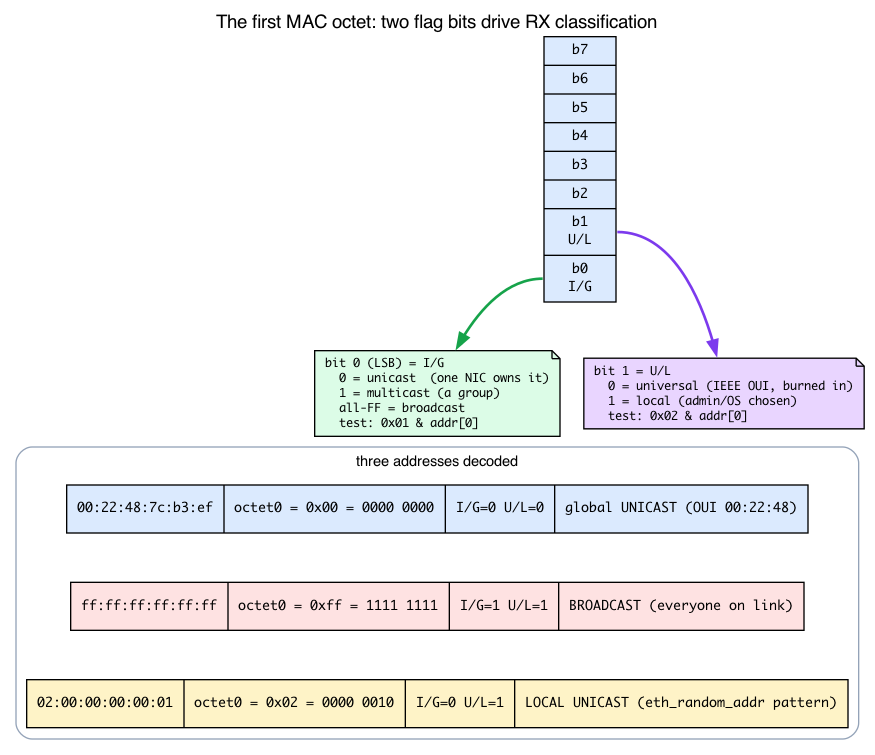
- bit 0 — I/G (Individual/Group):
0= unicast (this frame is addressed to one NIC);1= multicast/group (addressed to a set of NICs). - bit 1 — U/L (Universal/Local):
0= globally unique, burned in by the vendor (the top 3 octets are the vendor’s OUI);1= locally administered, i.e. software-assigned.
The kernel reads “the multicast bit” with the simplest possible test — is_multicast_ether_addr() is literally 0x01 & addr[0] (etherdevice.h:130). That single bit is the multicast bit this chapter keeps mentioning. And is_local_ether_addr() is 0x02 & addr[0] (the U/L bit, etherdevice.h:163).
Broadcast is a special case of multicast. The broadcast address ff:ff:ff:ff:ff:ff has every bit set — including bit 0 — so it is a multicast address, just the all-ones one. is_broadcast_ether_addr() checks all six octets equal 0xff (etherdevice.h:176). This is exactly why the classifier checks multicast first, then asks “is it the broadcast address specifically?” Watch eth_skb_pkt_type() do it (etherdevice.h:623-638):
static inline void eth_skb_pkt_type(struct sk_buff *skb,
                                    const struct net_device *dev)
{
    const struct ethhdr *eth = eth_hdr(skb);

    if (unlikely(!ether_addr_equal_64bits(eth->h_dest, dev->dev_addr))) {  /* not us */
        if (unlikely(is_multicast_ether_addr_64bits(eth->h_dest))) {      /* group bit set? */
            if (ether_addr_equal_64bits(eth->h_dest, dev->broadcast))
                skb->pkt_type = PACKET_BROADCAST;   /* the all-ones one */
            else
                skb->pkt_type = PACKET_MULTICAST;   /* some other group */
        } else {
            skb->pkt_type = PACKET_OTHERHOST;       /* unicast, but not our MAC */
        }
    }
    /* else: leaves the default PACKET_HOST — dst == our dev_addr */
}
The four outcomes are the pkt_type constants (include/uapi/linux/if_packet.h:26-29): PACKET_HOST 0, PACKET_BROADCAST 1, PACKET_MULTICAST 2, PACKET_OTHERHOST 3. Note the function only sets a value when the dst is not our dev_addr; the skb’s default pkt_type is already PACKET_HOST, so “addressed to us” needs no assignment.
Why 02:00:00:00:00:01 is the canonical “safe to invent” MAC
Now the lab’s magic constant decodes itself. Take the first octet 0x02 = binary 0000 0010:
- bit 0 = 0 → unicast. A NIC configured with this address treats frames sent to it as
PACKET_HOST(us). - bit 1 = 1 → locally administered. By definition it can’t collide with any vendor’s globally-unique OUI.
So 02:00:...:01 is guaranteed (a) to be a normal unicast address and (b) never to clash with real hardware. That’s why it’s the textbook address to assign to a throwaway interface — which is exactly what the “Set a non-default MAC” lab does.
Background 3: network byte order and the __be16 type
There’s one more thing you must know before reading eth_type_trans, and it’s the gotcha that makes today’s bpftrace experiment print a “wrong-looking” number. It’s about byte order.
A 2-byte field like h_proto holds a 16-bit number, and there are two ways to lay those two bytes out in memory:
- Big-endian (“network byte order”): most-significant byte first. The value
0x0800is stored as the bytes08 00. - Little-endian: least-significant byte first. The same value
0x0800is stored as00 08.
The wire is always big-endian. Every multi-byte protocol field — EtherType, IP addresses, port numbers — travels most-significant-byte-first. But x86 and ARM hosts are little-endian. So if you grab the two raw wire bytes 08 00 and read them back as a host u16, the CPU interprets them in its order and you get 0x0008, not 0x0800:
| On the wire (big-endian) | Read raw as host u16 (little-endian x86) | After ntohs() |
|---|---|---|
bytes 08 00 | 0x0008 | 0x0800 = ETH_P_IP |
That table is the entire explanation for today’s experiment printing type=0x0008 for an IP frame. The bytes are right; you’re just reading them in the wrong order.
__be16 / __be32 are the kernel’s annotations marking a value as big-endian (they’re checked by the sparse static analyzer). When you see __be16 h_proto, it’s a reminder: don’t do arithmetic or comparisons on this as a native integer until you convert it. The conversion helpers are:
ntohs()/ntohl()— network-to-host, wire → host (16-bit / 32-bit).htons()/htonl()— host-to-network, host → wire.
The subtlety that ties Day 2 together
Here’s the part worth holding onto. eth_type_trans returns h_proto __be16, without swapping it — return eth->h_proto; at net/ethernet/eth.c:177, and the signature returns __be16 (eth.c:155). The driver stores that still-big-endian value straight into skb->protocol. So skb->protocol stays in network byte order end-to-end.
Where does the swap finally happen? At the L3 demux you met in Day 2. Handlers register their EtherType into a bucket with htons(pt->type) (the registration helper ptype_head() at net/core/dev.c:608), and at RX time __netif_receive_skb_core indexes that same hash table with ntohs() — ptype_base[ntohs(type) & PTYPE_HASH_MASK] where type = skb->protocol (net/core/dev.c:6147, with type assigned from skb->protocol at :6142). Registration and demux hash the same way. Recall from Day 2 — that’s how skb->protocol (big-endian) gets matched against the registered handlers to reach ip_rcv. So nothing along the RX path ever byte-swaps skb->protocol itself; the comparison is done in network order. This is precisely why a raw %04x print in bpftrace shows the swapped value: you’re seeing the honest, unswapped wire bytes.
The mental tool: when you print a wire field raw and it looks byte-swapped, read the low two hex digits, or wrap the field in bswap() in bpftrace.
eth_type_trans — the universal RX header parser
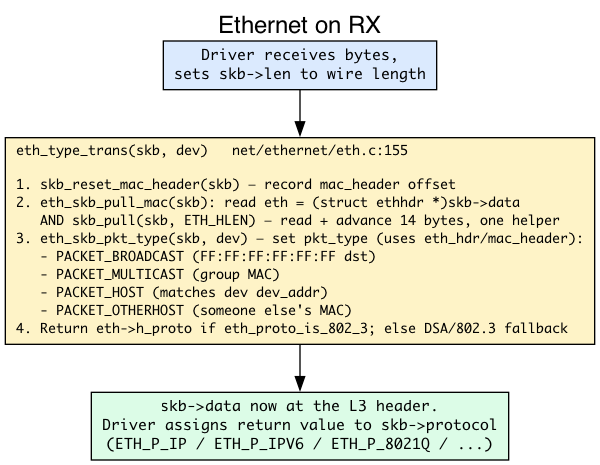
Now the function reads cleanly. eth_type_trans(skb, dev) (net/ethernet/eth.c:155) does four things in tight succession:
skb_reset_mac_header(skb)— record where the Ethernet header is by storing the offset ofskb->datawithin the buffer (skb->data - skb->head); it’s atskb->dataright now (Background 1: byte 0, the start ofh_dest).- Read and pull, in one helper —
eth_skb_pull_mac(skb). This single call both readseth = (struct ethhdr *)skb->data(the three-field header from Background 1) and does theskb_pull(skb, ETH_HLEN)that advancesskb->datapast the 14-byte header. So by the end of this one stepskb->dataalready points at the L3 payload — the read and the pull are not two separate stages. - Set
skb->pkt_type(viaeth_skb_pkt_type, called after the pull) based on destination MAC — exactly the multicast-first / broadcast / otherhost logic from Background 2. This still works even though the header was just pulled:eth_skb_pkt_typefinds the header viaeth_hdr(skb), which uses themac_headeroffset recorded in step 1, notskb->data.PACKET_BROADCASTif dst isff:ff:ff:ff:ff:ff.PACKET_MULTICASTif the multicast bit (addr[0] & 1) is set.PACKET_OTHERHOSTif dst is unicast but doesn’t matchdev->dev_addr(would be dropped on a normal NIC; promiscuous mode keeps these). Otherwise it leaves the defaultPACKET_HOSTwhen dst matchesdev_addr(us).
- Return the protocol ID — typically
eth->h_proto(ETH_P_IP0x0800,ETH_P_IPV60x86DD, orETH_P_8021Q0x8100, VLAN), but onlyif (eth_proto_is_802_3(...))— the ≥ 0x0600 / < 1536 boundary from Background 1. There are two short-circuits before that: if the device uses DSA tagging (Distributed Switch Architecture, where an embedded switch prepends its own tag) it returnsETH_P_XDSA(0x00F8) without looking at the packet, and ifh_protois a length field (< 1536, i.e. belowETH_P_802_3_MIN0x0600) it falls back toETH_P_802_3(IPX magic) orETH_P_802_2(802.2 LLC). The returned value is__be16and is not byte-swapped (Background 3).
The driver assigns the return value to skb->protocol, then passes the skb to GRO / netif_receive_skb (recall the Day 2 RX path). From here the L3 dispatcher uses skb->protocol to find the right handler (ip_rcv for IP) — hashing it via ntohs() as Background 3 described.
Background 4: the 802.1Q VLAN tag
So far every frame has been 14 bytes of header then payload. A VLAN tag inserts 4 extra bytes into that header to label which virtual LAN the frame belongs to. Let’s decompose those 4 bytes — they’re the reason skb->vlan_tci and “VLAN ID 100” exist.
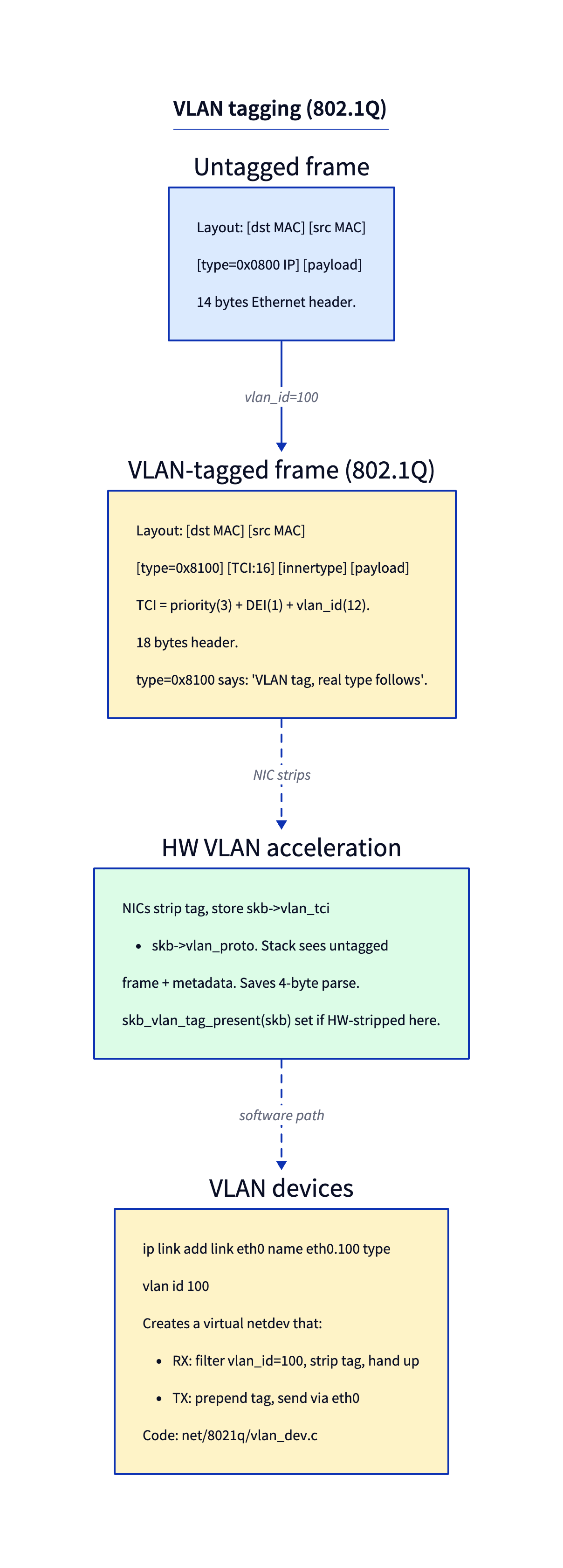
The full 802.1Q tag is 4 bytes (VLAN_HLEN 4, if_vlan.h:16), inserted between the source MAC and the EtherType field. It’s two halves:
- a 2-byte TPID (Tag Protocol IDentifier) —
0x8100for 802.1Q, or0x88A8for the outer tag of stacked 802.1ad/QinQ. The TPID sits where the EtherType normally would, which is how the NIC knows a tag follows. - a 2-byte TCI (Tag Control Information) — the actual label, decomposed below.
The original EtherType (e.g. 0x0800 for IP) moves to after the tag. The concrete struct makes this layout explicit (if_vlan.h:48-55):
struct vlan_ethhdr {
    unsigned char   h_dest[ETH_ALEN];        /* bytes  0–5  */
    unsigned char   h_source[ETH_ALEN];      /* bytes  6–11 */
    __be16          h_vlan_proto;            /* bytes 12–13: TPID, 0x8100   */
    __be16          h_vlan_TCI;              /* bytes 14–15: TCI            */
    __be16          h_vlan_encapsulated_proto; /* bytes 16–17: inner type   */
};
(struct vlan_hdr at if_vlan.h:35-38 is just the TCI plus the inner ethertype — the two __be16s that follow the TPID, not the full 4-byte tag.)
Decomposing the 16-bit TCI
The TCI packs three subfields into 16 bits:
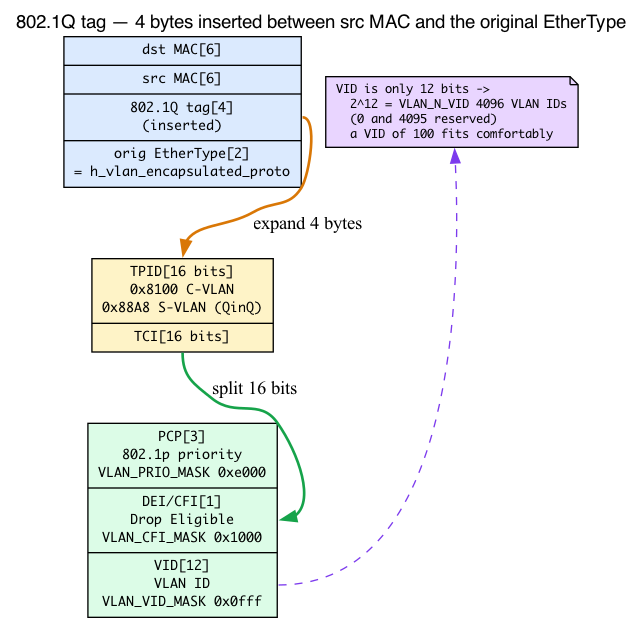
- bits 15–13 (top 3): PCP — Priority Code Point, the 802.1p class of service (0–7). Mask
VLAN_PRIO_MASK 0xe000, shiftVLAN_PRIO_SHIFT 13. - bit 12: DEI/CFI — Drop Eligible Indicator (formerly Canonical Format Indicator). Mask
VLAN_CFI_MASK 0x1000. - bits 11–0 (bottom 12): VID — the VLAN ID. Mask
VLAN_VID_MASK 0x0fff.
(All four constants at if_vlan.h:73-77.) Twelve bits give VLAN_N_VID 4096 possible IDs (0 and 4095 are reserved, leaving 4094 usable — which is why the labs cap out there). The VID is the “VLAN ID 100” the labs use.
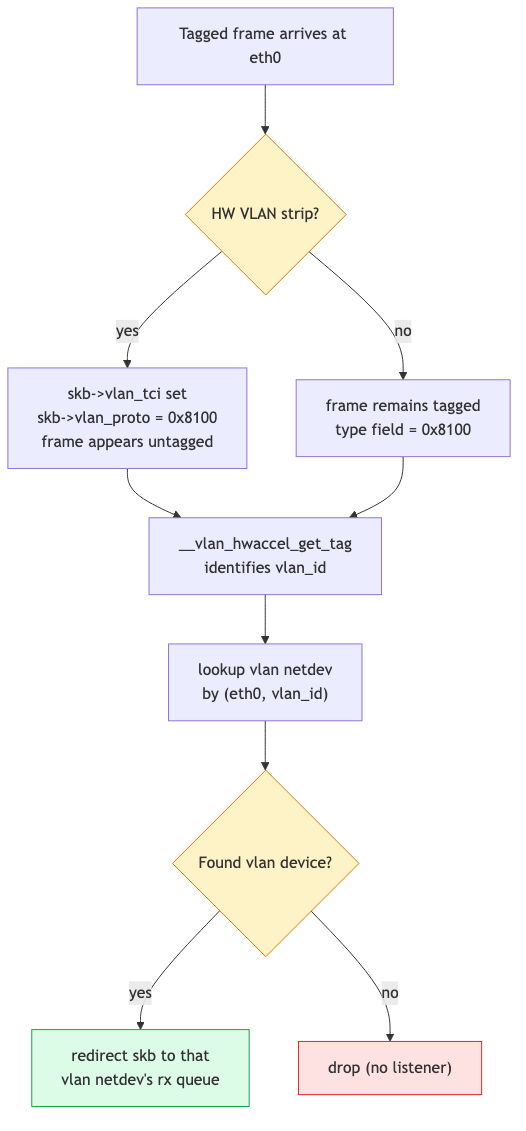
When a modern NIC strips the tag in hardware (HW acceleration), it stashes the TCI in skb->vlan_tci and the TPID in skb->vlan_proto. These overlay a single u32 for cheap presence-testing (include/linux/skbuff.h:1052-1055):
union {
    u32       vlan_all;        /* test this for "any tag present?" */
    struct {
        __be16 vlan_proto;     /* the TPID  */
        __u16  vlan_tci;       /* the TCI   */
    };
};
That’s why skb_vlan_tag_present(skb) is literally !!skb->vlan_all (if_vlan.h:82): if either half is non-zero, a tag is present. And the accessors mask the TCI apart exactly as the bit diagram shows — skb_vlan_tag_get_id(skb) is vlan_tci & VLAN_VID_MASK (if_vlan.h:84), skb_vlan_tag_get_prio shifts out the PCP, skb_vlan_tag_get_cfi tests the DEI bit.
The kernel handles VLANs in two ways:
-
HW acceleration — the
vlan_allunion path described above (NIC strips the tag on RX, stack sees an untagged frame plus metadata, tested withskb_vlan_tag_present). On TX the kernel hands the NIC a possibly-untagged skb and the NIC adds the tag if requested. -
Software path — for NICs without HW VLAN, or for stacked VLANs (QinQ),
vlan_do_receiveinnet/8021q/vlan_core.cparses the tag and dispatches.
A VLAN device (eth0.100) is a virtual netdev that filters frames by VLAN ID:
sudo ip link add link eth0 name eth0.100 type vlan id 100
sudo ip link set eth0.100 up
sudo ip addr add 192.168.100.5/24 dev eth0.100
Now eth0.100 is a fully-featured interface with its own routes, MTU, and IP. Frames with VLAN ID 100 arriving on eth0 get redirected to eth0.100’s RX path; transmits on eth0.100 get tagged and sent through eth0. That redirection is vlan_do_receive() (net/8021q/vlan_core.c:10): it reads the VID with skb_vlan_tag_get_id(skb) (the & VLAN_VID_MASK from the bit diagram) and looks up the matching device with vlan_find_dev(skb->dev, vlan_proto, vlan_id). If a device is registered for that (interface, VID) pair, the frame is steered to it; if not, the lookup returns NULL and vlan_do_receive returns false (the Check question hinges on this).
There are no Dumb Questions
Q: What’s the difference between
skb->protocoland the type field?A: They’re set from the same source (
eth->h_proto), butskb->protocolis what the stack uses for dispatch. For VLAN-tagged frames, the kernel processes the tag, then setsskb->protocolto the inner type (h_vlan_encapsulated_proto). So a TCP-over-VLAN frame ends up withskb->protocol = ETH_P_IPafter VLAN handling. (Both are stored big-endian — Background 3.)Q: Can I have a VLAN inside a VLAN?
A: Yes — and there are two flavors. The simplest is plain 802.1Q-in-802.1Q double tagging, where both the outer and inner tags use TPID 0x8100:
ip link add link eth0.100 name eth0.100.200 type vlan id 200stacks a second default-protocol (0x8100) tag on top of the first. True QinQ (802.1ad) instead uses an 0x88a8 outer S-tag with an 0x8100 inner tag — but you must ask for that protocol explicitly, because the VLAN netlink default is 802.1Q (0x8100). Create the outer device withtype vlan proto 802.1ad id 100, then stack the inner withtype vlan proto 802.1q id 200. The bare command above does not produce an 0x88a8 outer tag.Q: How does the kernel pick the source MAC for outbound frames?
A: From
dev->dev_addrof the egress device. Modern NICs allow random MACs at boot (privacy viaMACAddressPolicy=randomin systemd-networkd) — and a randomly-generated MAC always has the locally-administered bit set (Background 2), so it never collides with a vendor OUI. The Ethernet header build happens indev_hard_header→eth_header(net/ethernet/eth.c).
Today’s experiment
See eth_type_trans in action
sudo bpftrace -e '
fentry:eth_type_trans {
  $eth = (struct ethhdr *)args->skb->data;
  printf("dst=%02x:%02x:%02x:%02x:%02x:%02x type=0x%04x\n",
         $eth->h_dest[0], $eth->h_dest[1], $eth->h_dest[2],
         $eth->h_dest[3], $eth->h_dest[4], $eth->h_dest[5], $eth->h_proto);
}' &
sleep 3                 # let the fentry BTF probe attach before we trigger traffic
ping -c 5 8.8.8.8
sleep 1                 # let the last frames drain through the probe
sudo killall bpftrace
The sleep 3 matters: a BTF fentry probe takes a second or two to attach, and a single ping -c 1 completes in a few hundred milliseconds — without the delay the trigger (and the kill) happen before the probe is live and you see nothing. eth_type_trans fires on every received frame, so with the probe up for a few seconds you’ll get output even apart from the ping:
dst=00:22:48:7c:ffffffb3:ffffffef type=0x0008
dst=00:22:48:7c:ffffffb3:ffffffef type=0x0008
dst=00:22:48:7c:ffffffb3:ffffffef type=0x0008
You’ll see actual MAC addresses and EtherTypes flying through, and both gotchas from the background sections show up at once:
- The MAC octets print as signed bytes, so values ≥ 0x80 show sign-extended as
ffffffb3— read the low two hex digits (b3). (This is a bpftrace printing quirk, not the bit semantics from Background 2.) - The type is byte-swapped.
h_protois__be16(big-endian on the wire, Background 3), so on a little-endian host the raw%04xprint shows IP as0x0008rather than0x0800. Mentally swap the bytes, or wrap the field inbswap().
Create a VLAN and watch traffic
sudo ip link add link eth0 name eth0.100 type vlan id 100
sudo ip link set eth0.100 up
sudo ip addr add 10.100.0.1/24 dev eth0.100

# verify
ip -d link show eth0.100   # see vlan_id 100, vlan_protocol 802.1Q

# capture both:
sudo tcpdump -i eth0 -e -n vlan 100 &
sudo tcpdump -i eth0.100 -n &
sleep 1

# trigger: no peer answers, but the ARP request for 10.100.0.2
# egresses eth0 tagged with VID 100 (and untagged on eth0.100)
ping -c 3 -W1 10.100.0.2
sleep 1
You should see the same frame twice — on eth0 carrying the 802.1Q tag that -e exposes (vlan 100, p 0, ethertype ARP ...) and on eth0.100 already stripped/untagged. The vlan 100, p 0 is the TCI decoded for you: VID 100, PCP 0 (the TCI bitfields from Background 4). That side-by-side is the VLAN device doing tag insertion on egress and removal on ingress. The ping gets no replies (there’s no host at 10.100.0.2) — that’s fine; the tagged ARP requests are the point.
# cleanup
sudo pkill tcpdump            # stop both backgrounded captures (and drop promisc mode)
sudo ip link del eth0.100     # also removes the 10.100.0.1/24 address
See pkt_type stats
sudo bpftrace -e '
fexit:eth_type_trans {
  @pkt_types[args->skb->pkt_type] = count();
}
interval:s:5 { exit(); }'
PACKET_HOST=0, BROADCAST=1, MULTICAST=2, OTHERHOST=3 (the constants from Background 2). We attach at fexit (function return), not fentry: eth_type_trans is the function that sets pkt_type (via eth_skb_pkt_type), so at entry the field still holds its prior value (usually 0). By the time the function returns, the assignment is complete. fexit exposes args-> for the input arguments just like fentry.
What to break
Toggle promiscuous mode
sudo ip link set eth0 promisc on

# re-run the "See pkt_type stats" trace above while generating traffic

sudo ip link set eth0 promisc off   # restore
Now the kernel processes packets that aren’t addressed to your MAC (where pkt_type == PACKET_OTHERHOST — unicast frames whose dst doesn’t match dev_addr, Background 2). tcpdump enables this implicitly.
Caveat: on a mirrored/SPAN port, a hub, or a shared segment you’ll now see
@pkt_types[3](PACKET_OTHERHOST) appear. On an ordinary switched link or a cloud vNIC the switch never delivers other hosts’ unicast to your port, so key 3 may stay 0 even with promisc on — that’s expected, not a bug. Alwayspromisc offafterward so you don’t leave the NIC in promiscuous mode.
Set a non-default MAC
WARNING: do not change the MAC of the interface carrying your SSH session.
eth0is usually the management interface on a cloud/test VM — changing its MAC (or bringing the link down to do so) drops your connection, and many drivers reject an address change while the link is up. Use a throwaway interface instead:
# Option A (safe): a dummy interface, so you never touch the SSH link.
sudo ip link add mac-test type dummy
sudo ip link set mac-test address 02:00:00:00:00:01
ip link show mac-test            # observe the new MAC
sudo ip link delete mac-test     # cleanup

# Option B: a real spare NIC (NOT the one carrying SSH).
IF=eth1                          # NOT your SSH interface; eth1 is illustrative —
                                 # substitute an actual spare NIC present on your box
orig=$(cat /sys/class/net/$IF/address)
sudo ip link set $IF down
sudo ip link set $IF address 02:00:00:00:00:01
sudo ip link set $IF up
ip link show $IF                 # confirm; re-run the eth_type_trans trace
sudo ip link set $IF down
sudo ip link set $IF address "$orig"   # restore the original MAC
sudo ip link set $IF up
We chose 02:00:00:00:00:01 deliberately (Background 2): first octet 0x02 has the unicast bit clear and the locally-administered bit set, so it’s guaranteed to be treated as a normal unicast address and guaranteed not to collide with any vendor’s burned-in OUI. Now eth_type_trans sees 02:00:00:00:00:01 as “us” — frames addressed there are PACKET_HOST. Useful for testing identity rules.
What to read in the kernel
net/ethernet/eth.c—eth_type_trans(line 155),eth_header, header_ops. The whole file is ~640 lines.include/uapi/linux/if_ether.h—struct ethhdr(line 177),ETH_ALEN/ETH_HLEN, theETH_P_*EtherType constants, andETH_P_802_3_MIN(line 127, the type-vs-length boundary).include/linux/etherdevice.h—is_multicast_ether_addr(line 130),is_broadcast_ether_addr(line 176),eth_proto_is_802_3(line 220),eth_skb_pkt_type(line 623),eth_skb_pull_mac(line 640).include/linux/if_vlan.h—struct vlan_ethhdr(line 48), the TCI masks (VLAN_VID_MASKetc., lines 73–77),skb_vlan_tag_present/skb_vlan_tag_get_id(lines 82–84).net/8021q/vlan_core.c— VLAN reception path (vlan_do_receive, line 10).net/8021q/vlan_dev.c— VLAN device implementation.include/linux/skbuff.h— searchvlan_tci,vlan_proto,vlan_all(the union at line 1052).
Bullet Points
- The Ethernet header is 14 bytes (
ETH_HLEN):h_dest[6]+h_source[6]+h_proto[2](struct ethhdr). That fixed size is whyskb_pull(skb, 14)landsskb->dataexactly on the L3 header. - The EtherType
h_protois overloaded: ≥ 0x0600 = real type (IP 0x0800, IPv6 0x86DD, ARP 0x0806, VLAN 0x8100); ≤ 1500 = a frame length (802.3). The boundary isETH_P_802_3_MIN 0x0600, decided byeth_proto_is_802_3(). - A MAC’s first octet carries two flag bits: bit 0 = I/G (0 unicast, 1 multicast); bit 1 = U/L (0 global/vendor, 1 locally-administered). “The multicast bit” is
addr[0] & 1. Broadcastff:ff:ff:ff:ff:ffis just the all-ones multicast.02:00:..:01= safe synthetic unicast (local + not multicast). - Network byte order is big-endian.
__be16/__be32mark wire values; convert withntohs/htons.eth_type_transreturnsh_protounswapped, soskb->protocolstays big-endian end-to-end; the demux does thentohs(). A raw print on little-endian x86 shows IP as0x0008. eth_type_transis the universal RX header parser; called from every Ethernet driver. Setsskb->dev,skb->mac_headerandskb->pkt_type, advancesskb->datapast the L2 header, and returns the L3 protocol id (which the driver assigns toskb->protocol—eth_type_transnever writes that field itself).skb->pkt_type: HOST / BROADCAST / MULTICAST / OTHERHOST.- VLAN = a 4-byte tag (
VLAN_HLEN) between src MAC and EtherType: 2-byte TPID (0x8100, or 0x88a8 for QinQ) + 2-byte TCI. The TCI splits into PCP[15:13] + DEI[12] + VID[11:0]; 12-bit VID → 4094 usable IDs. - HW VLAN acceleration: NIC strips tag, kernel reads
skb->vlan_tci/vlan_proto(thevlan_allunion).skb_vlan_tag_present=!!vlan_all;skb_vlan_tag_get_id=vlan_tci & VLAN_VID_MASK. Otherwise software path innet/8021q/. - VLAN devices are virtual netdevs that filter+strip by VLAN ID;
vlan_do_receivelooks them up withvlan_find_dev. - TX side:
dev_hard_header→eth_headerbuilds the L2 frame, usingdev->dev_addras the source MAC.
Check question
A frame arrives at eth0 with VLAN tag 100, but no eth0.100 device exists. What happens?
Click to reveal answer
Answer: vlan_do_receive() reads the VID with skb_vlan_tag_get_id(skb) (= vlan_tci & VLAN_VID_MASK = 100) and looks up a registered VLAN device for (eth0, 100) via vlan_find_dev, finds none, and returns false (net/8021q/vlan_core.c:10, lookup fails at dev.c:6077). The frame isn’t redirected to a VLAN netdev; __netif_receive_skb_core marks it PACKET_OTHERHOST (net/core/dev.c:6111) and it is delivered to the L3 receive handler ip_rcv via the normal ptype dispatch — but ip_rcv (in ip_rcv_core) drops it immediately because pkt_type == PACKET_OTHERHOST, bumping the rx_otherhost_dropped core stat (via dev_core_stats_rx_otherhost_dropped_inc, net/ipv4/ip_input.c:509). So it reaches L3 ingress but is never routed or processed. To accept untagged “unknown VLAN” traffic, you’d configure a VLAN-aware bridge with the relevant VID on the port.
Tomorrow
Day 7: ARP and the neighbour subsystem. How the kernel learns its peers’ MAC addresses and what happens when neighbour entries go stale.