Day 7 — ARP and the neighbour subsystem
Today’s mission: see how Linux learns its peers’ MAC addresses, the state machine an ARP entry walks through, and what happens at scale — plus the four pieces of background that make the state machine make sense: the kernel’s notion of time, the kernel timer that drives the states, the ARP packet on the wire, and how a flat-looking “table” is really a hashed, garbage-collected cache. Total time: ~110 minutes.
ARP in one paragraph
When Linux wants to send an IP packet to some next-hop IP on a directly connected network, it needs the destination’s MAC. The protocol is ARP (RFC 826): broadcast a query, receive a reply, cache the result. The cache is what ip neigh shows.
But “ARP” in Linux is a specific case of a more general neighbour subsystem at net/core/neighbour.c. The same code handles IPv6 NDP (Neighbour Discovery Protocol) and InfiniBand IPoIB. The L4-protocol-specific bits live in net/ipv4/arp.c.
How does an arriving ARP frame even reach this code? Recall eth_type_trans from Day 6: it reads the Ethernet frame’s EtherType and stores it in skb->protocol, and the core stack uses that value to pick a handler. ARP frames carry ETH_P_ARP = 0x0806 (include/uapi/linux/if_ether.h:54), so they’re dispatched to arp_rcv rather than ip_rcv (0x0800). Same demux you saw on the RX path — just a different EtherType key.
Most of this chapter is about time: “REACHABLE for 30s,” “probe every 1s,” “stale after 60s.” So before anything else, we need to know what the kernel means by a second.
Background: jiffies and HZ — the kernel’s notion of time
The kernel can’t call gettimeofday() on every packet — that’s far too expensive for the hot path. Instead it keeps a single, dirt-cheap counter that a periodic timer interrupt bumps on a fixed schedule:
- A jiffy is one tick of the kernel’s periodic timer interrupt.
- The global counter
jiffiesincrements by one on every tick. Reading it is a single memory load — this is the kernel’s cheap monotonic clock. HZis the tick rate (ticks per second). It’s a compile-time constant —# define HZ CONFIG_HZ(include/asm-generic/param.h:8) — and common values are 100, 250, or 1000. On aHZ=1000kernel, one jiffy is 1 ms; onHZ=250, one jiffy is 4 ms.
The key consequence: a duration in seconds is seconds * HZ jiffies. That’s why the kernel source writes 30 * HZ, 1 * HZ, 5 * HZ instead of literal millisecond counts — the same expression yields the right tick count whatever HZ the kernel was built with. Look at the ARP defaults (net/ipv4/arp.c:152):
struct neigh_table arp_tbl = {
    .parms = {
        .reachable_time = 30 * HZ,          /* REACHABLE lasts ~30s   */
        .data = {
            [NEIGH_VAR_MCAST_PROBES]   = 3,
            [NEIGH_VAR_UCAST_PROBES]   = 3,
            [NEIGH_VAR_RETRANS_TIME]   = 1 * HZ,   /* probe spacing ~1s */
            [NEIGH_VAR_DELAY_PROBE_TIME] = 5 * HZ, /* DELAY window ~5s  */
            [NEIGH_VAR_GC_STALETIME]   = 60 * HZ,  /* GC after ~60s     */
            /* ... */
        },
    },
    .gc_thresh1 = 128, .gc_thresh2 = 512, .gc_thresh3 = 1024,
};
So when this chapter says “REACHABLE for 30s” or “retrans 1s,” the struct literally holds 30 * HZ and 1 * HZ jiffies — not seconds, not milliseconds.
The 30s is a base, not a fixed window.
.reachable_time = 30 * HZis only the seed: each entry’s effectivereachable_timeis randomized byneigh_rand_reach_time(net/core/neighbour.c:130) to a value in(1/2)*base … (3/2)*base— roughly 15–45s — and re-randomized periodically. The point is to avoid a fleet of entries all expiring on the same jiffy. So “~30s” throughout this chapter means “30s base, 15–45s in practice.”
The neighbour’s timestamp fields are jiffies snapshots too. In struct neighbour (include/net/neighbour.h:140):
unsigned long confirmed;   /* neighbour.h:145 — jiffies at last reachability confirmation */
unsigned long updated;     /* neighbour.h:146 — jiffies at last state change            */
“Is this entry stale?” is therefore never wall-clock arithmetic; it’s a jiffy comparison like time_after(now, confirmed + reachable_time), where now = jiffies. You’ll see that exact pattern in the timer handler in a moment.
One footnote so the sysctls make sense. Because the unit is jiffies, the same
.data[]slot is exposed to userspace under two names — a ticks form and a*_MSmilliseconds alias (e.g.NEIGH_VAR_RETRANS_TIMEvsRETRANS_TIME_MS). That’s whyip-sysctl.rstlets you read or writeretrans_time(jiffies) orretrans_time_ms(milliseconds) for the same underlying value.

The ARP wire format
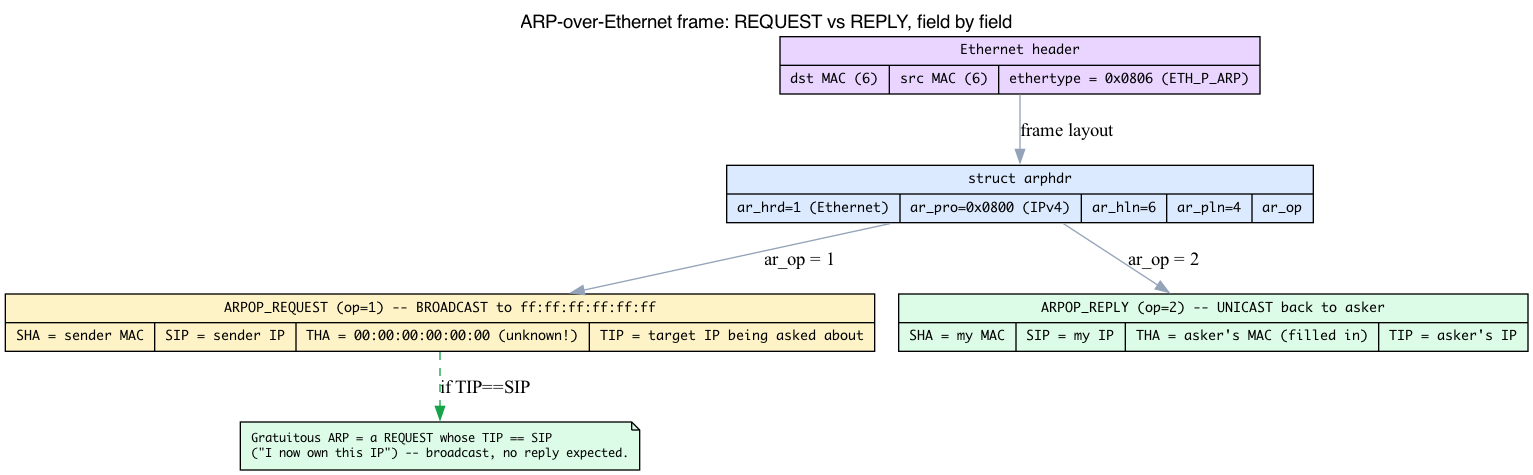
Before we cache MACs, let’s see what’s actually in an ARP packet — otherwise “request is broadcast, reply is unicast” and “gratuitous ARP” are just assertions. An ARP message is a tiny fixed header followed by four variable-length address fields. The fixed header is struct arphdr (include/uapi/linux/if_arp.h:145):
struct arphdr {
    __be16        ar_hrd;   /* hardware type (1 = Ethernet)        */
    __be16        ar_pro;   /* protocol type (0x0800 = IPv4)       */
    unsigned char ar_hln;   /* hardware address length (6 for MAC) */
    unsigned char ar_pln;   /* protocol address length (4 for IPv4)*/
    __be16        ar_op;    /* opcode: request or reply            */
};
/* then, for ARP-over-Ethernet (commented in the header at if_arp.h:156-159): */
/*   ar_sha[6]  sender hardware address (SHA)  */
/*   ar_sip[4]  sender IP address       (SIP)  */
/*   ar_tha[6]  target hardware address (THA)  */
/*   ar_tip[4]  target IP address       (TIP)  */
The opcode (ar_op) is what distinguishes the two messages (include/uapi/linux/if_arp.h:107-108):
ARPOP_REQUEST= 1 — “who has TIP? tell SIP.” Sent to the Ethernet broadcast MACff:ff:ff:ff:ff:ffso every host on the segment sees it. The sender fills in SHA + SIP + TIP and leaves THA = 00:00:00:00:00:00 (it doesn’t know the target’s MAC yet — that’s the whole question).ARPOP_REPLY= 2 — “TIP is at THA.” The host that owns TIP fills in its own MAC as THA and sends it unicast straight back to the asker.
That’s exactly what a tcpdump -e capture shows in the lab below: one broadcast request with an empty target MAC, one unicast reply with it filled in. The parsing happens in arp_process (net/ipv4/arp.c:702), reached from arp_rcv (net/ipv4/arp.c:967); outgoing requests/replies are built and sent by arp_send (net/ipv4/arp.c:323).
Gratuitous ARP falls right out of this layout: it’s just a request whose TIP equals its SIP. Re-read that with the fields in hand — the node is announcing “I (SIP) now own this IP,” and because it’s a broadcast request, everyone updates their cache unsolicited. No reply is expected; the point is the announcement.
The neighbour table
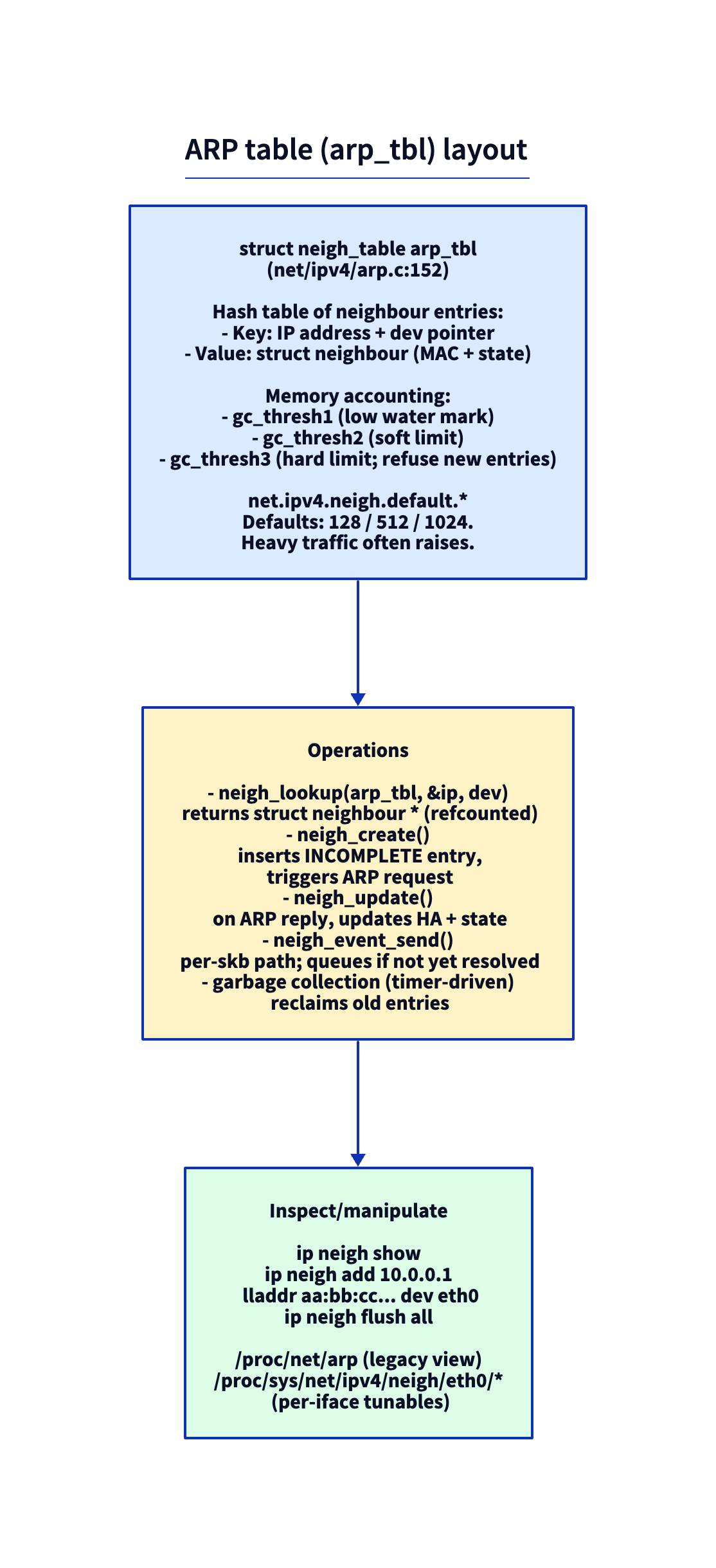
struct neigh_table arp_tbl (net/ipv4/arp.c:152) holds all IPv4 neighbour entries. Each entry is a struct neighbour (include/net/neighbour.h:140) with:
primary_key(neighbour.h:169): the next-hop IP address — the lookup key.ha[MAX_ADDR_LEN]: hardware address (MAC).dev: which netdev this neighbour is reachable through.nud_state: state machine (REACHABLE, STALE, INCOMPLETE, …).confirmed/updated: jiffies snapshots (the timestamps from the jiffies section).arp_queue: skbs waiting for resolution.
It’s a hash table, not a list
We keep saying “the table,” but it isn’t a flat list. arp_tbl.nht (include/net/neighbour.h:244) points at a struct neigh_hash_table (include/net/neighbour.h:201):
struct neigh_hash_table {
    struct hlist_head *hash_heads;   /* array of hash buckets        */
    unsigned int       hash_shift;   /* current size = 1 << shift     */
    __u32              hash_rnd[NEIGH_NUM_HASH_RND]; /* random seeds (=4, anti-collision) */
    struct rcu_head    rcu;
};
An entry lives in the bucket chosen by hashing its key (next-hop IP) plus dev. Each struct neighbour is linked into its bucket through struct hlist_node hash; (neighbour.h:141). A lookup — neigh_lookup (net/core/neighbour.c:625), or the fast inline __neigh_lookup — hashes the key, then walks just that one bucket’s hlist. As the population grows the table is rehashed to a bigger size, keeping chains short. That’s why a gateway with thousands of peers still resolves each next hop in roughly O(1).
Two details make the hot path safe and cheap:
- RCU read side. The bucket walk happens under RCU read-side protection — no lock on the per-packet lookup path. (RCU, in one sentence: readers proceed lock-free, and a removed object isn’t actually freed until all concurrent readers have finished, so a lookup can safely hold a pointer that another CPU is deleting.)
- Refcounts, freed via RCU. Each entry carries
refcount_t refcnt;(neighbour.h:148) and astruct rcu_head rcu;(neighbour.h:166). This is the same free-at-zero refcount discipline you learned forsk_buff->userson Day 1, applied to neighbours: hold a reference while you use the entry, drop it when done, and the object is reclaimed only when the count hits zero and RCU says no reader can still see it.
Background: the timer that drives the state machine
Here’s the thing the state diagram never shows: states don’t change on their own. The engine that advances a neighbour from REACHABLE to STALE, or from INCOMPLETE to FAILED, is a per-entry kernel timer.
Each struct neighbour embeds one (include/net/neighbour.h:151):
struct timer_list timer;
A timer_list is the kernel’s basic one-shot timer: you arm it with a future expiry expressed in jiffies, and when jiffies reaches that value the kernel’s timer machinery calls the callback you registered. The neighbour subsystem wires the callback at construction time (net/core/neighbour.c:534):
timer_setup(&n->timer, neigh_timer_handler, 0);
Day 5 introduced workqueues — deferred work that runs in process context and may sleep — when tearing down a netns. A
timer_listis a different mechanism Day 5 did not cover: its callback runs atomically (softirq context, cannot sleep) and fires at a scheduled jiffy, not “whenever a worker thread gets around to it.” The neighbour subsystem uses a timer for each entry’s per-entry state, and (separately) adelayed_workfor table-wide garbage collection — we’ll meet the GC one later.
When the timer fires, neigh_timer_handler (net/core/neighbour.c:1103) runs. It reads now = jiffies (neighbour.c:1114), looks at nud_state and the timing constants, and either re-arms itself (still probing) or transitions the entry. The real transitions, straight from the source:
- REACHABLE → if
nowis pastconfirmed + reachable_time, demote to STALE (or DELAY if the entry was recently used). (neighbour.c:1120-1139) - DELAY → if confirmation came in, promote back to REACHABLE; otherwise go to PROBE and start actively soliciting. (
neighbour.c:1140-1162) - PROBE / INCOMPLETE → re-arm at
now + retrans_timeto send the next probe — until the probe budget is exhausted.
That budget is the missing piece behind “6 probes / 3 probes.” It’s computed by neigh_max_probes (net/core/neighbour.c:1054):
static __inline__ int neigh_max_probes(struct neighbour *n)
{
    struct neigh_parms *p = n->parms;
    return NEIGH_VAR(p, UCAST_PROBES) + NEIGH_VAR(p, APP_PROBES) +
           (n->nud_state & NUD_PROBE ? NEIGH_VAR(p, MCAST_REPROBES)
                                     : NEIGH_VAR(p, MCAST_PROBES));
}
With ARP defaults (UCAST_PROBES = 3, MCAST_PROBES = 3, MCAST_REPROBES = 0, APP_PROBES = 0):
- INCOMPLETE (not yet in PROBE):
3 + 0 + 3 = 6is the threshold. - PROBE (already had a MAC, re-confirming):
3 + 0 + 0 = 3is the threshold.
But the threshold and the number of packets actually sent differ for INCOMPLETE. When __neigh_event_send first drives an entry into INCOMPLETE it pre-seeds the probe counter to UCAST_PROBES = 3 (neighbour.c:1224, atomic_set(&neigh->probes, UCAST_PROBES)). The timer then increments the counter once per multicast solicitation, climbing 3 → 4 → 5 → 6; at 6 it equals the threshold and the entry fails. So only 3 multicast ARP requests are actually emitted in INCOMPLETE — and they are all multicast, because arp_solicit computes probes -= UCAST_PROBES (arp.c:376) which is always ≥ 0 here, forcing the multicast branch every time. No unicast probe is possible while INCOMPLETE: there is no MAC to unicast to. (Those UCAST_PROBES unicast probes belong to PROBE-state revalidation, where the entry already has a stale MAC.)
Once probes >= neigh_max_probes(neigh) for an INCOMPLETE or PROBE entry, the handler gives up (neighbour.c:1164-1169): INCOMPLETE → NUD_FAILED, PROBE → STALE/FAILED. That is the timer-driven mechanism behind “first ping takes ~1ms longer” (one resolution round-trip before the entry is REACHABLE) and “INCOMPLETE → FAILED after the probes.”

The state machine
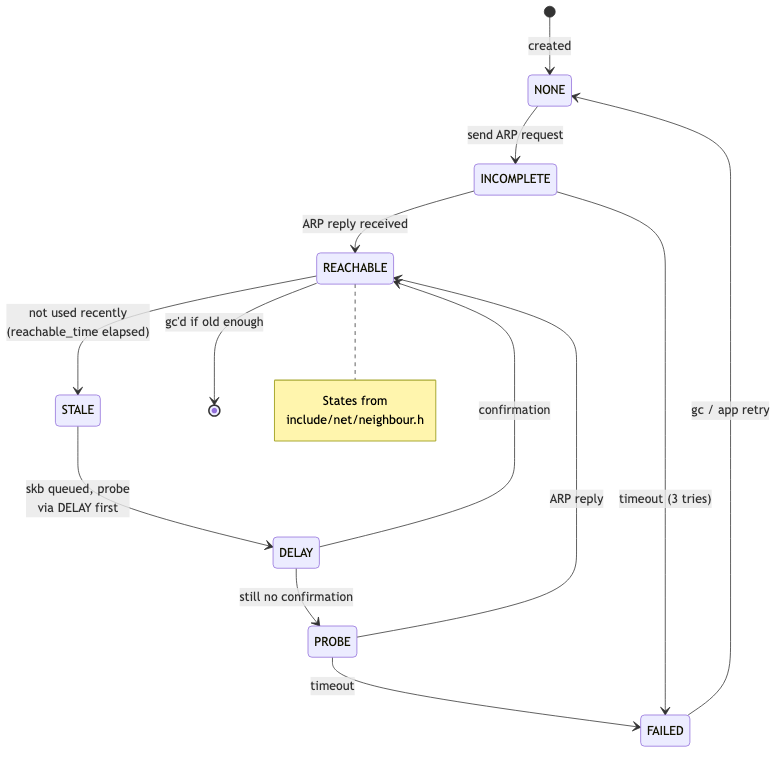
A neighbour entry walks through states — and now you know the timer is what moves it:
- NONE — newly created, no resolution attempted yet.
- INCOMPLETE — ARP request sent, waiting for reply. Skbs going to this neighbour queue here.
- REACHABLE — fresh, recent confirmation (default
reachable_time = 30s, i.e.30 * HZjiffies). - STALE — has MAC but old. Next packet triggers a confirmation probe.
- DELAY — sent a packet expecting the L4 to confirm reachability quickly.
- PROBE — actively probing via ARP.
- FAILED — resolution timed out. INCOMPLETE sends ~3 multicast ARP requests ~1s apart, then fails; PROBE-state revalidation (entry already has a stale MAC) sends up to 3 unicast probes instead. (Full derivation — why the budget is 6 but only 3 are sent — is in the timer-background section above.)
The state machine is the canonical answer to “why does my first ping take 1ms longer than subsequent ones?” — first packet goes through INCOMPLETE → REACHABLE; later packets hit a cached entry directly.
Lookup on TX
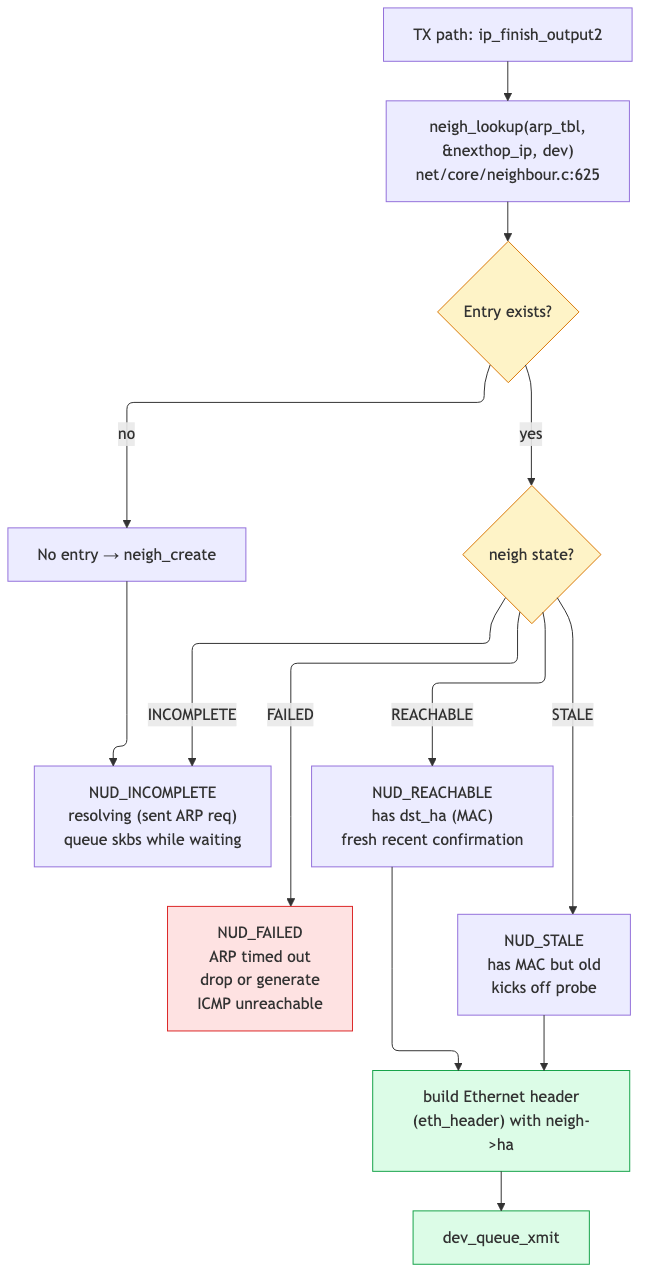
The packet that triggers ARP: async resolution, a bounded queue, and two fast paths
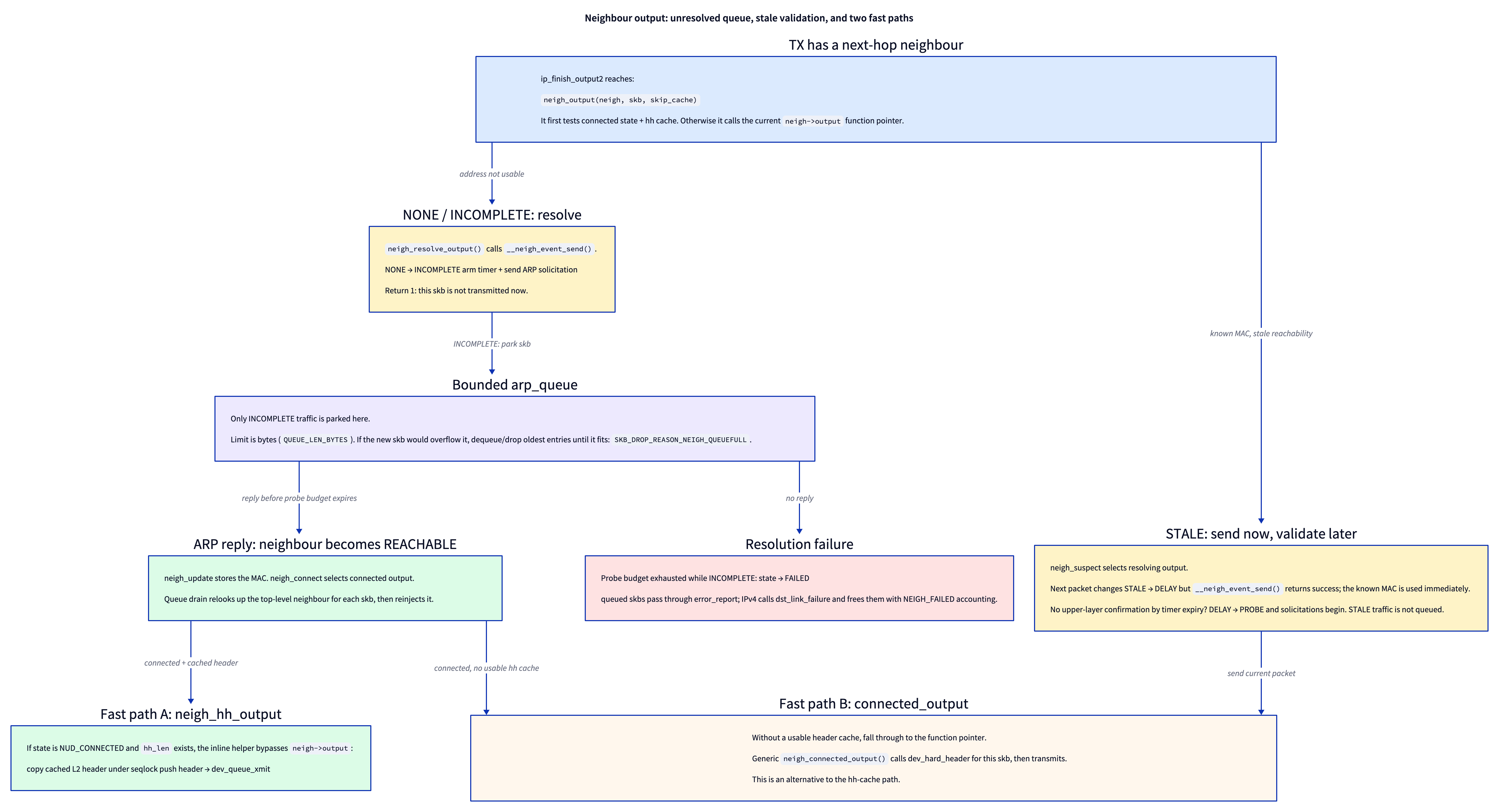
ip_finish_output2 does not call ARP directly. It reaches the inline neigh_output(neigh, skb, skip_cache) helper, which makes two decisions: can it use a cached L2 header immediately, and if not, which function does neigh->output currently name? Follow the states rather than treating the pointer as the whole fast path:
-
First packet, no usable address. A new NUD_NONE entry has
neigh->output = neigh->ops->output, which for ordinary ARP isneigh_resolve_output.neigh_event_send→__neigh_event_sendchanges NONE to INCOMPLETE, arms the timer, sends a solicitation, queues the supplied skb, and returns1.neigh_resolve_outputtherefore does not transmit that skb; TX unwinds instead of blocking for an ARP round-trip. -
Only unresolved packets queue. While the state is INCOMPLETE, skbs are parked on the per-neighbour
arp_queue. Itsarp_queue_len_bytesis bounded byQUEUE_LEN_BYTES; when adding a new skb would exceed the limit, the loop dequeues and drops the oldest entries withSKB_DROP_REASON_NEIGH_QUEUEFULLuntil the new skb fits. One unreachable neighbour therefore has a fixed memory budget. -
The reply lands.
arp_rcv→neigh_updatestores the MAC and changes the state to REACHABLE.neigh_connectwritesneigh->output = neigh->ops->connected_output, andneigh_update_process_arp_queuedrains the unresolved queue. It relooks up the top-level neighbour for each skb before reinjecting it because qdiscs such as shapers can lead to a different neighbour object. -
Connected output has two forms. On the ordinary call path,
neigh_output()first checksNUD_CONNECTEDandhh.hh_len. If both hold,neigh_hh_output()copies the cached L2 header under its sequence lock, pushes it, and callsdev_queue_xmitwithout callingneigh->outputat all. If no header cache is usable, the helper falls through to the function pointer; genericneigh_connected_output()rebuilds the header withdev_hard_headerand transmits it.hh_cacheandneigh_connected_outputare alternatives, not one combined fast path. -
STALE is usable, not unresolved. When reachability ages,
neigh_suspectrestores the resolving output function. The next packet reachesneigh_resolve_output;__neigh_event_sendchanges STALE to DELAY but returns success, so that packet is sent immediately with the known MAC. If upper-layer confirmation does not arrive duringdelay_first_probe_time, the timer advances to PROBE and sends solicitations. A STALE packet does not enterarp_queue.
If INCOMPLETE probing exhausts its budget, neigh_timer_handler sets FAILED and neigh_invalidate removes queued skbs through ops->error_report before purging the remainder. For IPv4, arp_error_report calls dst_link_failure and frees the skb with SKB_DROP_REASON_NEIGH_FAILED; the exact user-visible error depends on the route/socket context.
This connects forward: routing chooses the next hop that the neighbour subsystem resolves, and the bounded oldest-first eviction pattern reappears in the queueing discussion on Day 23.
Which IPs actually get ARP’d? on-link vs via-gateway
The FAILED lab below hinges on a routing fact, so here’s the rule (the full FIB is Day 8). The kernel only ARPs for the next hop, and the next hop depends on routing:
- A destination on a directly-connected subnet (on-link) is its own next hop — the kernel ARPs for it directly.
- A destination outside every local subnet is reached via the gateway — so the kernel ARPs for the gateway, and never for the remote IP at all.
“Directly connected” just means the destination matches one of the interface’s configured subnet prefixes (e.g.
192.168.1.0/24oneth0). This is the same next-hop IP that Day 3 saidip_finish_output2hands to the neighbour subsystem: routing chooses the next-hop IP, neighbour resolves it to a MAC. And it’s confirmed by the table itself —arp_tblhaskey_len = 4and is keyed byprimary_key(neighbour.h:169), i.e. one entry per next-hop IPv4 address.This is why the “Watch FAILED state” lab must target an unused address inside your own subnet: only then is the destination its own next hop, so your packet triggers a real ARP that can time out to FAILED. An off-subnet address like
10.99.99.99would just resolve the gateway (already cached) and never produce a FAILED entry for the address you typed.
There are no Dumb Questions
Q: What is “gratuitous ARP”?
A: A node announcing its MAC unsolicited (e.g., on interface up, or after a failover). Linux sends one as an
arp_send(ARPOP_REQUEST, ETH_P_ARP, ...)with target IP == source IP, frominetdev_send_gratuitous_arpinnet/ipv4/devinet.c. It updates other nodes’ caches without them having to ask. (With the wire format in hand: it’s a request whose TIP == SIP — see the ARP wire-format section.)Q: What’s
arp_announcefor?A: Sysctl that controls which IP the kernel uses as source for ARP requests. Default 0 (any local IP); 1 prefers same-subnet; 2 always uses the primary IP of the egress interface. Important for multi-homed servers.
Q: Why are there gc_thresh1/2/3?
A: gc_thresh3 is a hard cap; new ARP attempts beyond it fail. Heavy-traffic gateways routinely hit the default 1024 — symptom:
neighbor table overflow!in dmesg. Bump via sysctl. (The exact mechanism is the next section.)
How garbage collection enforces gc_thresh1/2/3
The table can’t grow forever, so a per-table atomic counter, gc_entries, is bumped every time an entry is created — and creation consults the three thresholds before allocating. The check, in the create path (net/core/neighbour.c:507):
entries = atomic_inc_return(&tbl->gc_entries) - 1;
gc_thresh3 = READ_ONCE(tbl->gc_thresh3);
if (entries >= gc_thresh3 ||
    (entries >= READ_ONCE(tbl->gc_thresh2) &&
     time_after(now, READ_ONCE(tbl->last_flush) + 5 * HZ))) {
    if (!neigh_forced_gc(tbl) && entries >= gc_thresh3) {
        net_info_ratelimited("%s: neighbor table overflow!\n", tbl->id);
        NEIGH_CACHE_STAT_INC(tbl, table_fulls);
        goto out_entries;          /* returns -ENOBUFS */
    }
}
That’s the whole three-tier behaviour, grounded:
- Below
gc_thresh1(128): the periodic GC doesn’t even bother —neigh_periodic_workskips the bucket scan withif (atomic_read(&tbl->entries) < gc_thresh1) goto out;(net/core/neighbour.c:1000), and theout:path still re-queues the delayed_work, so the worker keeps rescheduling itself. (That periodic GC is adelayed_workrunning in the process context Day 5 introduced for netns teardown — no need to re-teach it.) - At/above
gc_thresh2(512) and more than 5 s (5 * HZ) since the last flush: a forced synchronous GC runs,neigh_forced_gc(net/core/neighbour.c:253), reclaiming stale entries back down towardgc_thresh2. - At/above
gc_thresh3(1024): if even forced GC can’t get back under the cap, creation fails with-ENOBUFSand emits the rate-limited"%s: neighbor table overflow!"— the exact dmesg symptom this chapter and the Check question describe.
Two things to keep straight:
- The data packet isn’t dropped because of this. The kernel just couldn’t create the neighbour entry; that surfaces as a resolution failure / brief hang, not a thrown-away packet at the GC layer. (That’s the grounding for the Check answer’s “it just refuses to create new entries.”)
- Reclamation targets STALE/old entries;
NUD_PERMANENTentries are exempt and never GC’d. That’s why the staticnud permanentpins in the labs survive GC pressure.
Today’s experiment
Before you start: the commands below use
eth0and the gateway192.168.1.1as examples. Replace them with your interface and default gateway — derive both fromip route show default:IFACE=$(ip route show default | awk '{print $5; exit}') GW=$(ip route show default | awk '{print $3; exit}') echo "iface=$IFACE gateway=$GW" # iface=eth0 gateway=10.0.0.1Run verbatim against a machine whose interface is
ens3/enp0s3or whose gateway is different, andip neigh flush dev eth0fails with “Cannot find device” andping 192.168.1.1goes nowhere. Substitute$IFACE/$GW(or your real values) wherever you seeeth0/192.168.1.1below.
See your ARP table
ip neigh show
# 192.168.1.1 dev eth0 lladdr aa:bb:cc:11:22:33 REACHABLE
# 192.168.1.20 dev eth0 lladdr aa:bb:cc:44:55:66 STALE
Force an ARP from scratch
sudo ip neigh flush dev eth0
ping -c 1 192.168.1.1
ip neigh show
# entry now REACHABLE
Watch ARP packets
sudo tcpdump -i eth0 -n arp -e &
sudo ip neigh flush dev eth0
ping -c 1 192.168.1.1
sudo pkill tcpdump   # stop the background capture
You’ll see the ARP request (broadcast) and reply (unicast) — and now you can read them field-by-field: the request goes to ff:ff:ff:ff:ff:ff with ARPOP_REQUEST (op 1) and an empty target MAC; the reply comes back unicast with ARPOP_REPLY (op 2) and the target MAC filled in. The pkill is essential: a backgrounded tcpdump with no count/timeout otherwise runs forever, spamming your terminal with every later ARP on the link.
Trace neighbour state changes
sudo bpftrace -e '
fentry:neigh_update {
  printf("update: state=%d new_state=%d\n",
         args->neigh->nud_state, args->new);
}'
The numbers are NUD bitmask values (include/uapi/linux/neighbour.h): 1=INCOMPLETE, 2=REACHABLE, 4=STALE, 8=DELAY, 16=PROBE, 32=FAILED. In another terminal, flush and re-ping the gateway to drive a resolution. neigh_update() is the packet/netlink-driven path — it’s only ever called with NUD_STALE, NUD_REACHABLE, NUD_FAILED, or a user/ndisc-supplied state, so this hook catches transitions like INCOMPLETE→REACHABLE on an arriving reply:
# update: state=1 new_state=2 (INCOMPLETE -> REACHABLE, ARP reply received)
What this hook will never show is the internal STALE→DELAY, DELAY→PROBE, or timeout-driven INCOMPLETE→FAILED transitions: those are WRITE_ONCE(neigh->nud_state, ...) stores inside __neigh_event_send (neighbour.c:1249) and neigh_timer_handler — they don’t flow through neigh_update() at all. To watch those, attach an fentry on neigh_timer_handler instead, or trace the nud_state field directly.
These tie directly back to the state machine at the top of the chapter. (Swap %d for %x in the printf if you’d rather see the raw hex #define values.)
Probe gc thresholds
sysctl net.ipv4.neigh.default.gc_thresh1   # default 128
sysctl net.ipv4.neigh.default.gc_thresh2   # default 512
sysctl net.ipv4.neigh.default.gc_thresh3   # default 1024

# bump for high-fanout servers:
sudo sysctl -w net.ipv4.neigh.default.gc_thresh3=8192

# restore the default when you're done (this change is non-persistent —
# it's lost on reboot and not written to sysctl.conf):
sudo sysctl -w net.ipv4.neigh.default.gc_thresh3=1024
These are the very gc_thresh1/2/3 fields from arp_tbl (net/ipv4/arp.c:152) whose create-time check produces neighbor table overflow!.
What to break
Statically pin a wrong MAC
Warning: do not pin a wrong MAC for the gateway on the interface you’re SSH-ing in over — it drops your session before you can run the undo, locking you out. Pin a non-gateway LAN peer instead, or run this from the local console.
sudo ip neigh add 192.168.1.1 lladdr aa:bb:cc:00:00:00 dev eth0 nud permanent
ping -c 3 -W 1 192.168.1.1   # no replies — packets sent to a MAC nobody owns

# undo:
sudo ip neigh del 192.168.1.1 dev eth0
This shows the cache is authoritative until the kernel re-resolves. The -c 3 -W 1 is important: a bare ping runs until you Ctrl-C, and until you do, the del line never executes and the entry stays poisoned. (The nud permanent entry is also GC-exempt — it survives table pressure until you delete it.)
Watch FAILED state
To actually watch INCOMPLETE → FAILED you must (a) target an address that is directly connected — pick an unused IP inside your eth0 subnet, not an off-subnet one like 10.99.99.99 (those route via the gateway, so the kernel never ARPs for them — see the on-link vs via-gateway box) — and (b) send real traffic to kick off resolution. Note too that a bare ip neigh add IP dev eth0 with no lladdr/nud is rejected by modern iproute2 (“No link layer address given”) and creates no entry at all.
# pick an unused IP in your eth0 subnet, e.g. 192.168.1.250
sudo ip neigh flush 192.168.1.250 dev eth0 2>/dev/null
ping -c1 -W1 192.168.1.250 || true   # queues a packet -> kernel starts ARPing
sleep 8                              # past the INCOMPLETE probe budget: counter climbs from its UCAST_PROBES seed (3) to neigh_max_probes()=6, sending 3 multicast probes ~1s apart
ip neigh show 192.168.1.250
# 192.168.1.250 dev eth0  FAILED     (briefly INCOMPLETE first)
sudo ip neigh del 192.168.1.250 dev eth0   # cleanup
The 8-second wait is no accident: it’s past the INCOMPLETE probe budget. The counter is seeded at UCAST_PROBES (3) and increments once per multicast solicitation, so it sends 3 multicast probes spaced retrans_time (1 * HZ) apart (~3s of probing) before neigh_max_probes() = 6 trips and the timer flips the entry to FAILED. Eight seconds leaves a comfortable margin.
What to read in the kernel
net/core/neighbour.c— the generic subsystem. Readneigh_lookup(line 625),___neigh_create(line 646),neigh_update,neigh_timer_handler(line 1103 — the state machine engine),neigh_max_probes(line 1054 — the probe budget), and the GC create-time check (lines 507–516).net/ipv4/arp.c— ARP-specific protocol.arp_rcv(line 967),arp_send(line 323),arp_process(line 702),arp_solicit, andarp_tbl(line 152). ~1500 lines.include/net/neighbour.h—struct neighbour(line 140),struct neigh_hash_table(line 201), thenhtfield (line 244), the NUD_* state constants.include/uapi/linux/if_arp.h—struct arphdr(line 145),ARPOP_REQUEST/ARPOP_REPLY(lines 107–108).Documentation/networking/ip-sysctl.rst— theneigh.*sysctls (gc thresholds, probe counts, timers, and the jiffies-vs-*_msaliases); pair it with the source itself.
Bullet Points
- The kernel measures time in jiffies (
jiffiesincrements once per timer tick;HZticks/second). A duration isseconds * HZjiffies — hence30 * HZ,1 * HZin the source.neighbour.confirmed/updatedare jiffies snapshots; staleness is atime_after(now, confirmed + reachable_time)comparison. - An ARP packet is
struct arphdr(hw/proto type, lengths, opcode) + SHA/SIP/THA/TIP.ARPOP_REQUEST(1) is broadcast with an empty THA;ARPOP_REPLY(2) is unicast with THA filled in. Gratuitous ARP = a request with TIP == SIP. - The neighbour subsystem (ARP for IPv4, NDP for IPv6) lives at
net/core/neighbour.c. The “table” is a resizable, RCU-protected hash table (neigh_hash_table) keyed per next-hop IP; lookups walk one bucket lock-free; entries are refcounted and RCU-freed (same free-at-zero model as Day 1’s sk_buff). - A per-entry
timer_listdrives the state machine:neigh_timer_handlerre-arms or transitions entries.neigh_max_probes()= 6 for INCOMPLETE, 3 for PROBE (ARP defaults), but because the counter is pre-seeded toUCAST_PROBES(3), an INCOMPLETE entry actually emits 3 multicast ARP requests before FAILED; the 3 unicast probes belong to PROBE-state revalidation of an entry that already has a (stale) MAC. - Entries cycle through NONE → INCOMPLETE → REACHABLE → STALE → DELAY → PROBE → REACHABLE/FAILED.
- The kernel only ARPs the next hop: on-link destinations are their own next hop; off-subnet ones resolve the gateway (full FIB is Day 8).
- TX-side lookup is a lockless RCU hash lookup —
ip_neigh_for_gw→__ipv4_neigh_lookup_norefinip_finish_output2, falling back to__neigh_createon a miss (the exportedneigh_lookupis for netlink/proc callers, not the per-packet path). Skbs queue onarp_queuewhile a neighbour is INCOMPLETE. - GC thresholds (
gc_thresh1/2/3, default 128/512/1024) cap entry count via agc_entriescounter checked at create time; exceedinggc_thresh3after forced GC returns-ENOBUFSand logsneighbor table overflow!.NUD_PERMANENTentries are GC-exempt. - Inspect:
ip neigh show. Manipulate:ip neigh add/del/replace.
Check question
You set net.ipv4.neigh.default.gc_thresh3=128 on a server with 500 active client peers. What symptoms appear?
Click to reveal answer
Answer: neighbor table overflow! messages in dmesg. New connections to peers whose ARP entries got evicted will hang briefly while ARP re-resolves; if entries are evicted faster than they’re re-resolved, traffic stalls. The fix is to raise gc_thresh3 (and gc_thresh1/2 proportionally — typically 4096/8192/16384 for a busy server). The kernel doesn’t drop packets directly because of this; it just refuses to create new entries, which manifests as resolution failures.
Tomorrow
Day 8: IP routing — the FIB. How the kernel decides where to send a packet (and therefore which next-hop IP the neighbour subsystem resolves), and why route lookups are so cheap on modern hardware.