Day 8 — IP routing: the FIB
Today’s mission: see how Linux decides where to send a packet, learn the data structure that powers route lookups, and understand how the result gets stapled onto the packet — and how
ip routeprograms the table in the first place. We’ll teach four mechanisms the routing path leans on (thedst_entryhandle, longest-prefix-match semantics, the LC-trie, and the rtnetlink config channel) so nothing in the path is a black box. Total time: ~110 minutes.
What “routing” means in Linux
Every packet that needs to go somewhere not-here requires a routing decision: which next-hop, which output interface, which source IP. The decision is fast — sub-microsecond on modern hardware, even against tables with hundreds of thousands of routes.
That speed comes from the FIB (Forwarding Information Base) and the LC-trie (level-compressed trie) data structure backing it. But before we touch the trie, we have to be honest about some things the rest of this chapter quietly assumes you already know: what it means for a route to “match,” what handle the lookup result is delivered through, how the trie itself works, and how a route got into the table at all. Days 1–7 never taught any of these. Two of them we teach up front (what “match” means, and the handle the result rides on); the trie itself and the write-side config channel we build up as we reach them — intuition first, then the concrete v7.1 struct.
Background 1: longest-prefix-match — what “the route matches” actually means
Picture your routing table as a stack of rules, each one saying “addresses that start with these bits go this way.” That “starts with these bits” idea is a prefix, and a route is a prefix plus a prefix length:
10.0.0.0/24means “addresses whose top 24 bits equal10.0.0.0.”10.0.0.0/8means “addresses whose top 8 bits equal10.”0.0.0.0/0— the default route — has prefix length 0, so zero bits have to match. It matches everything.
Here’s the catch that makes routing interesting: a single destination address can match several routes at once. A packet to 10.0.0.5 matches all three of the routes above simultaneously. So which one wins?
The rule: the most specific match wins — the longest prefix length. 10.0.0.0/24 (24 bits) beats 10.0.0.0/8 (8 bits) beats 0.0.0.0/0 (0 bits). This is longest-prefix-match (LPM), and it’s what makes routing deterministic. It’s also why the default route is the last resort: 0.0.0.0/0 only wins when nothing more specific matched. (That’s exactly why the “break a default route” lab later in this chapter works — strip away the specific routes and the /0 catches the packet.)
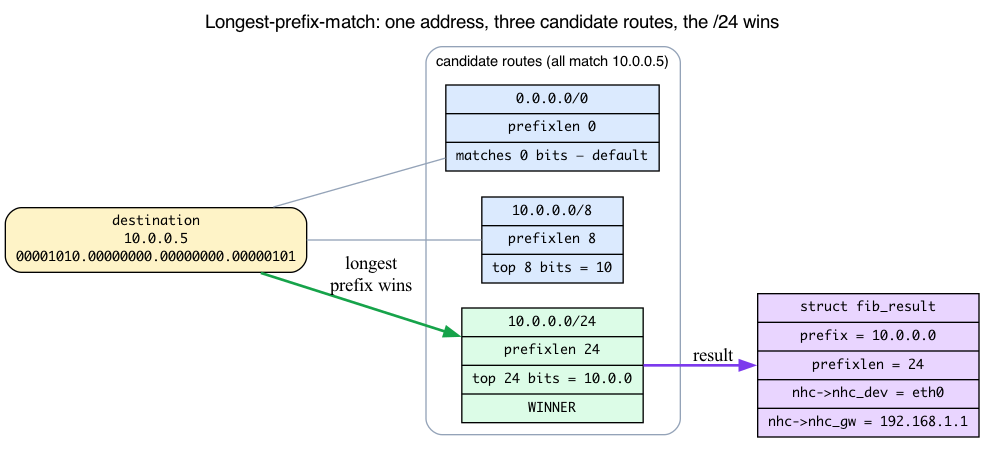
The lookup result records which prefix won. That result is a struct fib_result (include/net/ip_fib.h:173):
struct fib_result {
    __be32          prefix;     /* the matched prefix, e.g. 10.0.0.0 */
    unsigned char   prefixlen;  /* its length, e.g. 24 — how the winner was chosen */
    unsigned char   nh_sel;
    unsigned char   type;       /* RTN_UNICAST, RTN_LOCAL, RTN_BROADCAST, ... */
    unsigned char   scope;
    struct fib_nh_common *nhc;  /* next-hop info */
    struct fib_info *fi;
    struct fib_table *table;
    /* ...tclassid, dscp, fa_head in v7.1... */
};
prefix and prefixlen are the matched prefix and its length — the winner of the LPM contest. The interesting field is nhc, the next-hop, a struct fib_nh_common (include/net/ip_fib.h:83):
struct fib_nh_common {
    struct net_device   *nhc_dev;     /* egress interface */
    int                  nhc_oif;
    u8                   nhc_gw_family;
    union {
        __be32          ipv4;         /* gateway IP, if any */
        struct in6_addr ipv6;
    } nhc_gw;
    /* ... */
};
It tells you the egress device (nhc_dev/nhc_oif) and the gateway IP (if any) (nhc_gw_family + nhc_gw). (The preferred source IP and the route MTU are not in fib_nh_common — they come from the enclosing fib_nh’s nh_saddr and from the route’s metrics on the dst, respectively.)
The type field is why the same machinery answers both “forward this” and “this is for us.” RTN_UNICAST (include/uapi/linux/rtnetlink.h:263) is a gateway or direct route; RTN_LOCAL (:264) means “accept locally”; RTN_BROADCAST (:265). The kernel keeps its own host IPs as RTN_LOCAL entries in a separate table — more on that below.
One more connection: LPM is why the FIB is a trie keyed on address bits and not a hash. A hash gives you exact-match — great for “is this exact key present?” But routing needs “what’s the longest prefix that is a leading substring of this address?” A bitwise trie answers that naturally: descend as far as the address bits keep agreeing, and the deepest matching prefix is the answer. That’s the structure we build up in Background 3.
Background 2: the dst_entry — how a route result rides on the packet
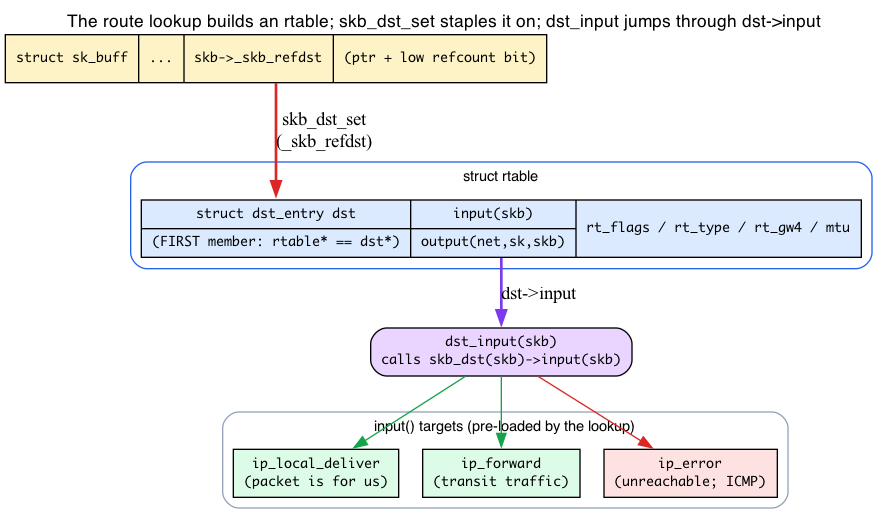
The lookup found a winner. Now what? The kernel doesn’t return a raw “go out eth0 via 192.168.1.1” answer and leave the caller to interpret it. Instead it builds a small object, staples it onto the skb, and lets the packet carry its own “what happens next” instructions. That object is the dst_entry (“destination entry”), and it’s the single most important handle in the forwarding path.
Intuition: a per-packet “next step” with two function pointers
Think of dst_entry as a tiny instruction card pinned to the packet. The card has two slots:
input(skb)— what to do with the packet on the receive/forward side.output(net, sk, skb)— what to do on the transmit side.
This is the same function-pointer-as-vtable idea Day 3 used for proto_ops and Qdisc_ops: instead of a giant if/else over packet types, you store a function pointer and call through it. The dst_entry struct itself is new, but the dispatch pattern is one you already know.
Here’s the struct (include/net/dst.h:26):
struct dst_entry {
    union {
        struct net_device       *dev;
        struct net_device __rcu *dev_rcu;
    };
    struct dst_ops          *ops;                               /* :31 */
    /* ...metrics, expires, xfrm... */
    int  (*input)(struct sk_buff *);                            /* :39 */
    int  (*output)(struct net *net, struct sock *sk, struct sk_buff *skb); /* :40 */
    unsigned short flags;
    /* ... */
};
The route lookup doesn’t return a dst — it returns an rtable that embeds one
When the IPv4 route lookup finishes, it produces a struct rtable (route table entry, include/net/route.h:57):
struct rtable {
    struct dst_entry    dst;     /* <-- the very FIRST member */
    int                 rt_genid;
    unsigned int        rt_flags;
    __u16               rt_type;
    /* ...rt_gw4/rt_gw6, rt_iif, mtu... */
};
Look at the first member: struct dst_entry dst. Because it’s first, an rtable * and a dst_entry * point at the same address — an rtable is a dst with extra fields hanging off the end. To go the other way (recover the full rtable from a bare dst), the kernel uses a container_of helper (include/net/route.h:80):
#define dst_rtable(_ptr) container_of_const(_ptr, struct rtable, dst)
This is the classic Linux “embed the generic struct as the first member, recover the concrete one with container_of” trick. The routing code fills in rt->dst.input and rt->dst.output depending on what the lookup decided (net/ipv4/route.c):
rt->dst.input = ip_local_deliver— packet is for us (:1668).rth->dst.input = ip_forward— transit traffic (:1894).rth->dst.input = ip_error— unreachable; rate-limits and sends ICMP (:2442).rt->dst.output = ip_output— the TX direction (:1666).
(ip_local_deliver lives at net/ipv4/ip_input.c:250; ip_forward at net/ipv4/ip_forward.c:83 — the same two handlers Day 2 mentioned without explaining.)
Stapling it on: skb_dst_set and dst_input
Two skb helpers connect the dst to the packet:
skb_dst_set(skb, &rt->dst)(include/linux/skbuff.h:1217) staples the dst onto the skb. It’s stored inskb->_skb_refdst(skbuff.h:923) — a singleunsigned longthat holds the pointer plus a low “is-it-refcounted?” bit.skb_dst(skb)(skbuff.h:1159) reads it back.
And the entire “dispatch the next step” mechanism is one inline function, dst_input (include/net/dst.h:478):
static inline int dst_input(struct sk_buff *skb)
{
    return INDIRECT_CALL_INET(READ_ONCE(skb_dst(skb)->input),
                              ip6_input, ip_local_deliver, skb);
}
Strip the INDIRECT_CALL_INET wrapper (it’s a retpoline/speculation optimization that hints the two likely targets) and it reads: call skb_dst(skb)->input(skb). That’s it. The whole “the skb’s dst->input dispatches the next step” claim is this single jump through a function pointer that the route lookup pre-loaded.
The fast path: skip the lookup if a dst is already attached
The RX code first checks whether the skb already has a usable dst attached, and if so, skips the whole lookup. That check is skb_valid_dst (include/net/dst_metadata.h:93):
static inline bool skb_valid_dst(const struct sk_buff *skb)
{
    struct dst_entry *dst = skb_dst(skb);
    return dst && !(dst->flags & DST_METADATA);
}
“Has a dst, and it’s a real route (not a metadata placeholder used by tunnels).” If that’s true, the packet already knows where it’s going and the kernel jumps straight to dst_input.
The lookup pipeline
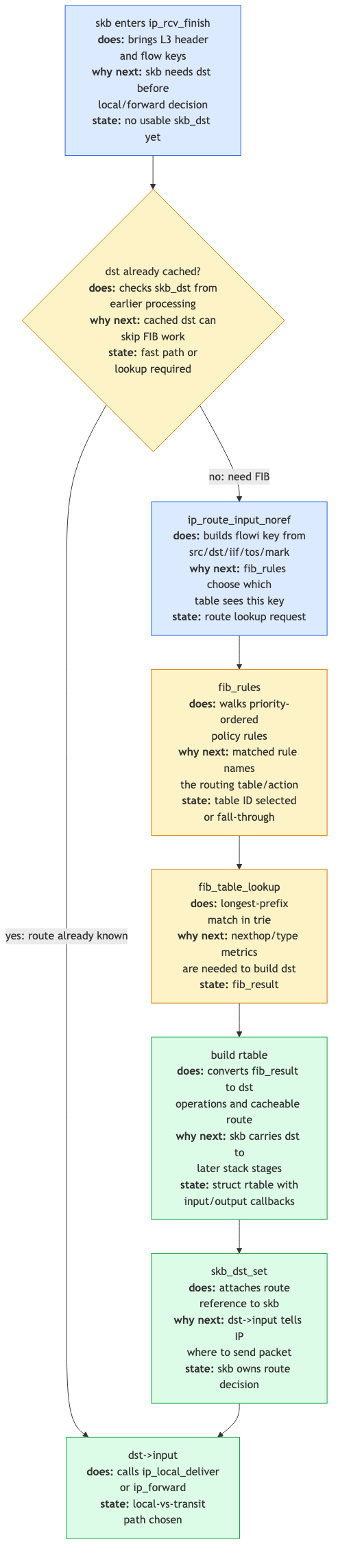
For an incoming packet, ip_rcv_finish (via ip_rcv_finish_core) first checks whether the skb already has a dst attached (skb_valid_dst → fast path, Background 2). If not, it calls ip_route_input_noref (net/ipv4/route.c:2546) which:
- Calls
fib_lookup→ walksfib_rulesto pick a table. - Calls
fib_table_lookup(net/ipv4/fib_trie.c:1420) on that table — the LC-trie walk (Background 3). - Builds an
rtablefrom the result, attaches it to the skb viaskb_dst_set— loadingrt->dst.inputper Background 2.
The skb’s dst->input function pointer then dispatches the next step via dst_input, jumping to whichever handler the lookup loaded (ip_local_deliver / ip_forward / ip_error — Background 2). The one new detail worth pinning down here: ip_error handles route type RTN_UNREACHABLE (it rate-limits and sends ICMP Destination Unreachable), whereas TTL-exceeded is not dispatched here — it is detected inside ip_forward, which then emits ICMP Time Exceeded.
Anatomy of a lookup
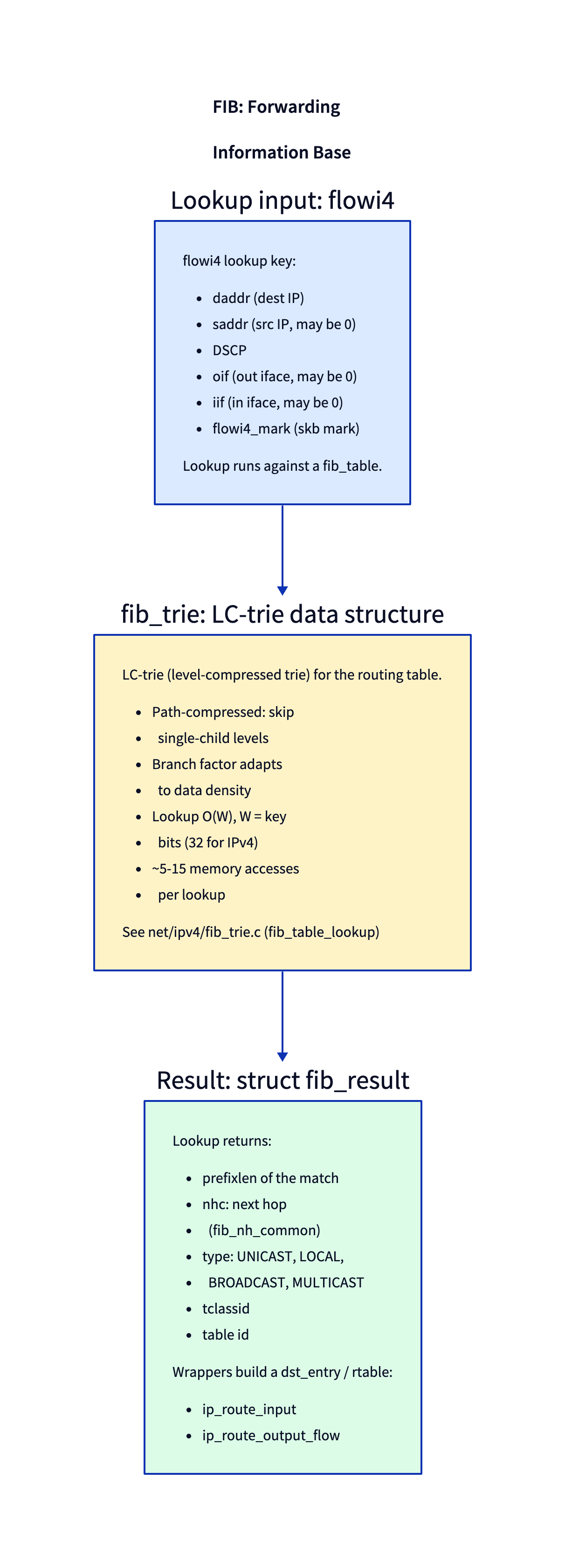
The lookup key is a struct flowi4:
struct flowi4 {
    __be32  saddr;
    __be32  daddr;
    dscp_t  flowi4_dscp;
    __u32   flowi4_mark;
    int     flowi4_oif;
    int     flowi4_iif;
    __u8    flowi4_proto;
    /* ... ports, etc. */
};
(In v7.1 these fields are really #define aliases over an inner struct flowi_common __fl_common — e.g. flowi4_oif is __fl_common.flowic_oif. The flattened view above is a fair simplification; the trace lab below uses the real flp4->__fl_common.flowic_oif form.)
The result is the struct fib_result you met in Background 1 — prefix/prefixlen record which LPM winner was chosen, and nhc carries the egress device (nhc_dev) and the gateway (nhc_gw). (The preferred source IP and MTU live elsewhere — in the enclosing fib_nh’s nh_saddr and the route’s metrics on the dst — not in fib_nh_common.)
Background 3: the LC-trie — what it is and why it’s fast
The internet has ~1M IPv4 routes globally. A linear scan would be hopeless. The FIB uses an LC-trie (“level-compressed trie”) and the chapter keeps calling it “fast” — let’s earn that claim by building it up from scratch.
Start with a trie
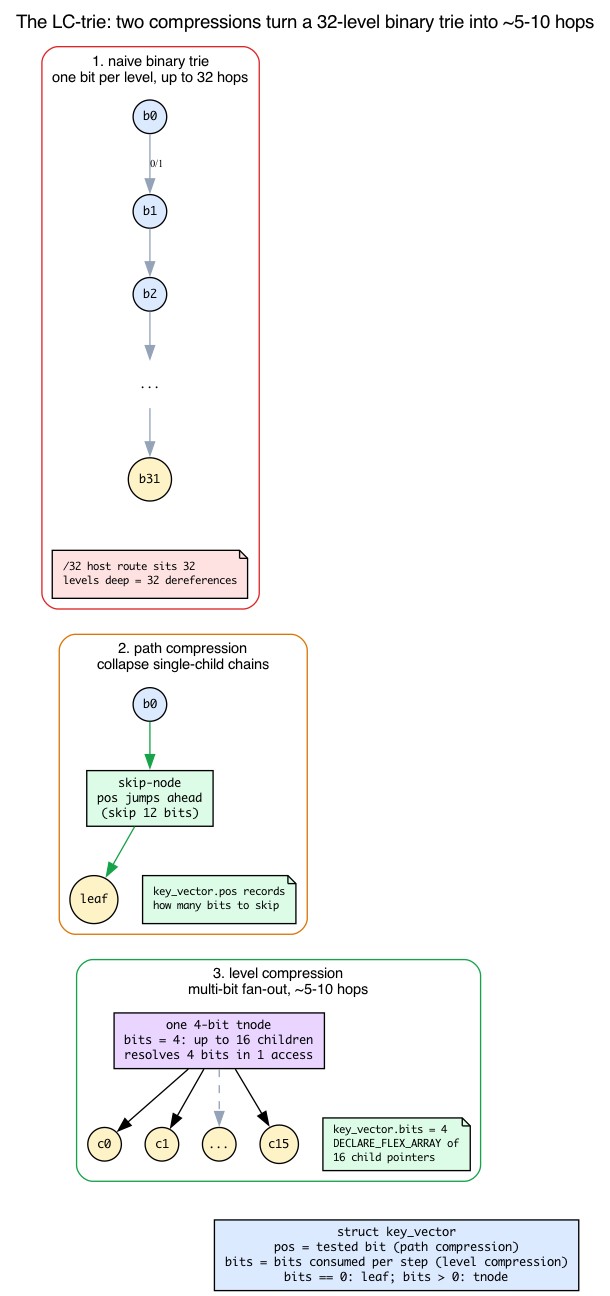
A trie is a tree where you navigate by the digits of the key, not by comparing whole keys. For IP routing the key is the 32 bits of an IPv4 address, so the simplest version is a binary trie: each node looks at one bit of the address and branches left (0) or right (1). A route with prefix length L lives at depth L — you walked L bits to reach it.
The problem is depth. A /32 host route sits 32 levels deep, so a worst-case lookup is 32 memory dereferences — one per bit. On a million-route table that’s far too slow. This naive binary trie is the baseline the LC-trie improves on, with two compressions.
Compression #1: path compression (the first “C”)
Walk down a binary trie and you’ll often hit long runs where every node has exactly one child — a stretch of address space with only a single route underneath it. Spending one node (and one memory access) per bit through that run is pure waste.
Path compression collapses any chain of single-child internal nodes into one node that simply records how many bits to skip. The long single-child chains stop costing a node per bit.
Compression #2: level compression (the second “C”)
In the dense regions of the trie — where almost every branch is populated — you can do the opposite of skipping: fan out wider. Instead of branching on one bit per level, level compression replaces several binary levels with a single node that branches on multiple bits at once: a node consuming k bits has up to 2^k children and resolves k address bits in one memory access.
How v7.1 encodes both in one node
Both compressions live in a single struct, struct key_vector (net/ipv4/fib_trie.c:121):
struct key_vector {
    t_key key;
    unsigned char pos;    /* which bit position this node tests */
    unsigned char bits;   /* how many bits this node consumes */
    unsigned char slen;
    union {
        struct hlist_head leaf;                              /* if IS_LEAF */
        DECLARE_FLEX_ARRAY(struct key_vector __rcu *, tnode); /* if IS_TNODE — :130 */
    };
};
The two fields carry the whole scheme:
posis the bit position this node examines — path compression lives here, becauseposcan jump past skipped bits.bitsis how many bits this node consumes in one step — level compression lives here.bits == 0is a leaf (IS_LEAF,:119);bits > 0is an internal tnode (IS_TNODE,:118). A node withbits = 4has up to 16 children (theDECLARE_FLEX_ARRAYof child pointers is the multi-bit fan-out in memory) and consumes 4 address bits at once.
The key length is fixed by the address width: KEYLENGTH = 8 * sizeof(t_key) (:112) and typedef unsigned int t_key (:115), so KEYLENGTH = 32 for IPv4 — the 32 levels of the naive trie we started from. Internal nodes are wrapped in a struct tnode (:134) carrying child-occupancy bookkeeping (empty_children, full_children) and the parent pointer.
The payoff
On real internet tables, the dense regions get flattened (fewer levels via level compression) and the sparse single-child chains get skipped (path compression), so lookups average ~5–10 node visits regardless of table size — instead of up to 32. That’s the “fast” the chapter promised.
Finally, tie it back to LPM (Background 1): the walk descends to a leaf following the address bits, then checks the leaf’s fib_alias list to find the most specific prefix whose bits actually match the key. The trie narrows the candidates; the leaf check confirms the match length. Read net/ipv4/fib_trie.c (fib_table_lookup, line 1420) and Documentation/networking/fib_trie.rst for the gory details — both are well-commented.
How the walk actually works: each tnode owns a branching window
A plain binary trie examines one address bit per level. An LC-trie compresses both paths and levels: every internal key_vector (tnode) stores pos and bits, selecting a multi-bit window of the 32-bit host-order key and a child array of size 1 << bits.
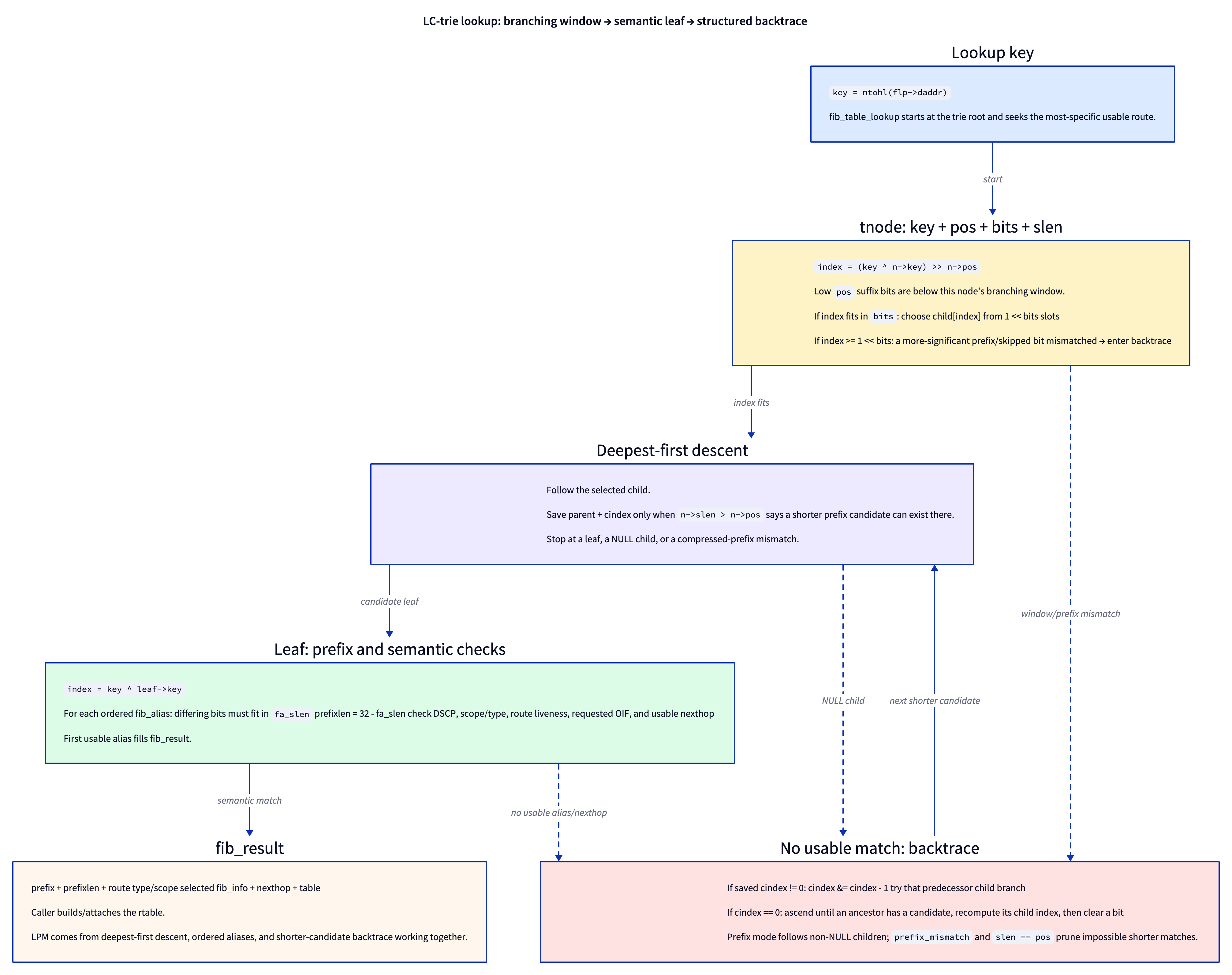
fib_table_lookup begins with key = ntohl(flp->daddr) and uses:
struct key_vector {
    t_key key;
    unsigned char pos;   /* low-order suffix bits below this window */
    unsigned char bits;  /* width of this node's child index        */
    unsigned char slen;  /* longest suffix length below this node   */
    /* leaf hlist, or a (1 << bits)-entry child array                */
};
The hot expression is index = get_cindex(key, n) = (key ^ n->key) >> n->pos. The shift discards the low pos suffix bits, which are below this node’s branching window; it does not discard bits already examined on the way down. If all more-significant prefix and path-compressed bits agree with n->key, the remaining value fits in n->bits and directly indexes one child. A tnode with bits = 4 therefore selects among 16 children in one dereference. If index >= 1 << n->bits, some differing bit lies above the window, so this subtree cannot contain the key and lookup enters prefix backtracking.
The first descent aims at the most specific candidate. When index fits and bits == 0, it has reached a leaf whose key passed that step’s comparison. A leaf holds a sorted hlist of fib_alias routes; fa_slen is the number of low-order suffix bits excluded from that alias’s prefix, so prefixlen = 32 - fa_slen. The semantic scan also checks DSCP, route liveness/type/scope, output-interface constraints, and usable nexthops before filling fib_result.
Backtracking enumerates valid shorter-prefix candidates
If descent finds a missing child, a prefix mismatch, or no usable alias/nexthop, lookup does not restart at the root. It keeps a parent pn and child index cindex only where slen > pos says a shorter prefix may exist below that point.
At backtrace, a nonzero cindex is changed with cindex &= cindex - 1, clearing its least-significant set bit and selecting the next prefix-aligned predecessor branch in that child array. If cindex is already zero, the code ascends until an ancestor has another candidate, recomputes that ancestor’s child index with get_index, and continues. Prefix-matching mode then follows the first non-NULL child of a candidate subtree, while prefix_mismatch(key, n) and n->slen == n->pos prune branches that cannot contain a shorter match.
At a candidate leaf, index = key ^ n->key; an alias is eligible only when every differing bit fits inside its ignored suffix (index < 1 << fa_slen, with the 32-bit guard in the source). Thus longest-prefix behavior comes from the combination of deepest-first descent, aliases ordered by prefix length, and this structured backtrace toward shorter candidates — not from “the first leaf always wins” and not from blindly climbing one trie level per prefix bit.
Route insertion keeps the structure efficient by resizing tnodes: inflate widens dense branching windows and halve narrows sparse ones. Those operations change bits and child placement without changing the lookup contract.
You can see the resulting shape directly:
cat /proc/net/fib_trie
Each +-- line is an internal tnode printed as prefix/len bits full_children empty_children; each |-- line is a leaf with its routes. Watch a bits value of 2 or 3 on a busy line — that’s level compression fanning a node out to 4 or 8 children so the walk skips whole levels.
Read net/ipv4/fib_trie.c if you want the resize math; the lookup loop itself (lines 1420–1545) is the part worth reading top-to-bottom.
Multiple tables
Linux supports multiple routing tables. The defaults:
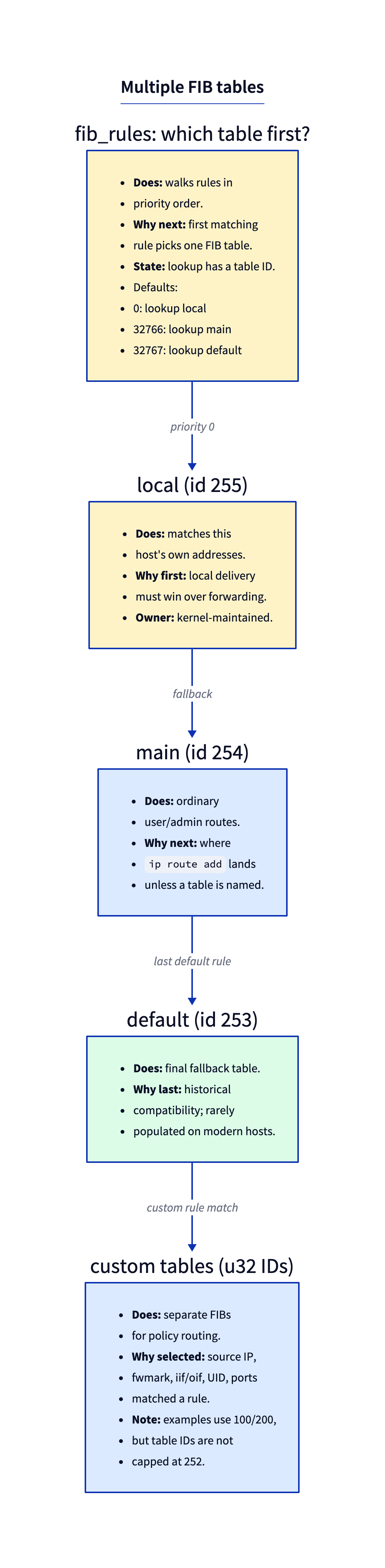
- local (255) — IPs on local interfaces; kernel-maintained.
- main (254) — user-added routes go here by default.
- default (253) — lowest priority; rarely used.
- custom — created with
ip route add ... table N. Small examples often use IDs below 253, but the kernel carries table IDs asu32; larger IDs travel through netlink attributes such asRTA_TABLE(Background 4).
(These match RT_TABLE_LOCAL=255 / RT_TABLE_MAIN=254 / RT_TABLE_DEFAULT=253 in include/uapi/linux/rtnetlink.h:360.)
fib_rules decide which table to consult based on packet attributes: source IP, fwmark, OIF, IIF. Day 9 covers them.
Background 4: how a route gets into the FIB — the rtnetlink path
Every lab in this chapter uses ip route add/del/show, and the lookup side walks a trie those commands populated. But how does ip route add 10.99.0.0/16 dev lo actually become a leaf in the LC-trie? So far we’ve only looked at the read side. Here’s the write side.
ip route is a netlink client
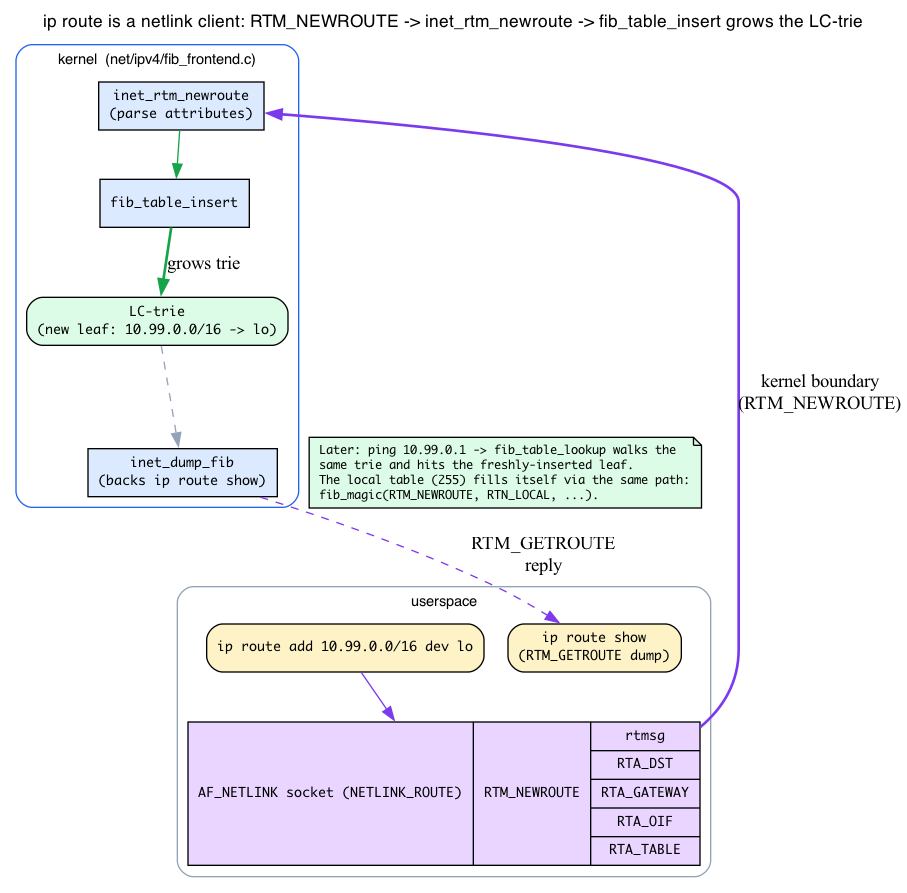
ip route does not poke the kernel via ioctl or /proc. It opens an AF_NETLINK socket in the NETLINK_ROUTE family (“rtnetlink”) and sends a structured message:
- Adding a route → an
RTM_NEWROUTEmessage (include/uapi/linux/rtnetlink.h:44, value 24). - Deleting →
RTM_DELROUTE(:46). ip route show→ anRTM_GETROUTEdump (:48).
The message carries a struct rtmsg plus typed attributes (TLVs — type-length-value records): RTA_DST (the prefix), RTA_GATEWAY, RTA_OIF (egress interface), and RTA_TABLE (:385) — the very attribute the “Multiple tables” section mentioned for large table IDs.
Kernel side: per-message-type handlers that mutate the FIB
Each message type is registered to a handler function (net/ipv4/fib_frontend.c:1694):
static const struct rtnl_msg_handler fib_rtnl_msg_handlers[] __initconst = {
    {.protocol = PF_INET, .msgtype = RTM_NEWROUTE,
     .doit = inet_rtm_newroute, .flags = RTNL_FLAG_DOIT_PERNET},
    {.protocol = PF_INET, .msgtype = RTM_DELROUTE,
     .doit = inet_rtm_delroute, .flags = RTNL_FLAG_DOIT_PERNET},
    {.protocol = PF_INET, .msgtype = RTM_GETROUTE, .dumpit = inet_dump_fib, ...},
};
So RTM_NEWROUTE → inet_rtm_newroute (:910), RTM_DELROUTE → inet_rtm_delroute (:876), RTM_GETROUTE → inet_dump_fib (:1018, the dump that backs ip route show). inet_rtm_newroute parses the attributes and calls fib_table_insert (:930) — the function that actually grows the LC-trie the lookup side walks.
That closes the loop:
ip route add 10.99.0.0/16 dev lo
  → AF_NETLINK socket: RTM_NEWROUTE { rtmsg + RTA_DST/RTA_OIF/RTA_TABLE }
    → inet_rtm_newroute → fib_table_insert → new leaf in the LC-trie
ping 10.99.0.1
  → fib_table_lookup walks the trie → hits that freshly-inserted leaf
Why the local table fills itself
This also explains where the kernel’s own host-IP routes come from. When an interface gets an IP assigned, the kernel issues the same RTM_NEWROUTE internally — with type RTN_LOCAL — via fib_magic (net/ipv4/fib_frontend.c:1156: fib_magic(RTM_NEWROUTE, RTN_LOCAL, addr, 32, ...)). No userspace involved; the local table (255) is populated through the identical insert path your ip route add uses. We don’t need the deeper netlink framing (nlmsghdr, attribute parsing) here — the teaching point is just config arrives as rtnetlink messages dispatched to per-type handlers that mutate the FIB.
There are no Dumb Questions
Q: How does the kernel cache routes?
A: Modern Linux (since ~3.6) does NOT cache per-flow rtables. Instead, route lookups are cheap enough to do per-packet. The exception is per-CPU caches for outbound connect paths and the
dst_cachemechanism that lwtunnels use. The pre-3.6 “rt_cache” was a security risk and is gone.Q: Where does the kernel keep its own host IPs?
A: In the
localFIB table (id 255). Kernel auto-inserts entries when interfaces get IPs assigned — via the internalfib_magic(RTM_NEWROUTE, RTN_LOCAL, ...)path from Background 4.ip route show table locallists them.Q: How fast is a lookup, in practice?
A: ~50ns–150ns on modern x86_64 against a typical Linux server’s small FIB. Internet routers with 1M routes see ~200–500ns per lookup, dominated by memory access patterns and cache effects.
Today’s experiment
Inspect your routes
ip route show table main
ip route show table local
ip rule show
ip rule is the fib_rules list. A vanilla kernel installs three rules (local, main, default); some distros or host services add extra rules (e.g. a 220: from all lookup 220 entry), so you may see more. (Each ip route show you run is an RTM_GETROUTE dump handled by inet_dump_fib — Background 4.)
Watch a route lookup
sudo bpftrace -e '
fentry:fib_table_lookup {
  printf("lookup daddr=%s table_id=%d\n",
         ntop(args->flp->daddr),
         args->tb->tb_id);
}'

# in another terminal:
ping -c 1 8.8.8.8
You’ll see at least one fib_table_lookup per originated packet; exact counts vary with dst caching.
Add a route
sudo ip route add 10.99.0.0/16 dev lo
ip route show

# remove:
sudo ip route del 10.99.0.0/16
The add is silent on success; ip route show confirms it by listing the new prefix:
10.99.0.0/16 dev lo scope link
Under the hood, that ip route add sent an RTM_NEWROUTE message into inet_rtm_newroute → fib_table_insert, which inserted a fresh leaf into the main table’s LC-trie (Background 4). To connect this back to the FIB lookup, leave the fentry:fib_table_lookup trace from the previous section running, then in another terminal:
ping -c 1 10.99.0.1
The trace prints lookup daddr=10.99.0.1 table_id=254 — the LC-trie in the main table (254) now resolves the prefix you just added. Remember to run the ip route del above when you’re done so your host table is left clean.
Trace ip_route_output_flow
sudo bpftrace -e '
fentry:ip_route_output_flow {
  printf("out: daddr=%s oif=%d\n", ntop(args->flp4->daddr), args->flp4->__fl_common.flowic_oif);
}'

# in another terminal:
ping -c 1 8.8.8.8
This is the outbound counterpart to ip_route_input — it fires for every locally-originated packet. You’ll see one line per outbound route lookup:
out: daddr=8.8.8.8 oif=0
oif=0 means the caller did not pin an egress interface, so the lookup is free to choose one. (A box that talks to the network constantly will print background lookups too, e.g. DNS resolvers and the like.) Press Ctrl-C to stop.
What to break
Break a default route safely, inside a namespace
Do not replace your host’s real default route. Put the failure in a disposable namespace:
sudo ip netns add fibbreak
sudo ip -n fibbreak link set lo up
# onlink: tell the kernel to trust this gateway even though it is
# not on any subnet configured on lo (lo carries only 127.0.0.1/8).
sudo ip -n fibbreak route add default via 10.99.99.99 dev lo onlink
sudo ip -n fibbreak route show                  # default via 10.99.99.99 dev lo onlink
sudo ip netns exec fibbreak ping -c 1 8.8.8.8   # 100% packet loss, namespace only

sudo ip netns del fibbreak
With onlink the route installs, so the FIB lookup succeeds and resolves a next-hop — but 10.99.99.99 answers no ARP, so transmission has nowhere to go and the ping reports 100% packet loss. (Without onlink the kernel rejects the off-subnet gateway outright with Error: Nexthop has invalid gateway. and the route is never added at all.) Either way your host routing table never changes, and ip netns del tears down the namespace and its routes completely.
This is also LPM in miniature (Background 1): the only route present is 0.0.0.0/0, so a packet to 8.8.8.8 matches it because there was nothing more specific.
Inspect rt cache stats (legacy)
cat /proc/net/stat/rt_cache
The per-flow cache-hit columns (in_hit/out_hit) are zero because the per-flow rt_cache is gone — that’s the teaching point. The in_slow_tot/out_slow_tot/in_martian_src columns are just cumulative lookup counters, so they will be non-zero. The proc file remains for compatibility.
What to read in the kernel
net/ipv4/route.c—ip_route_input_noref(line 2546),ip_route_output_flow(line 2929). Also thert->dst.input/rt->dst.outputassignments (lines 1666–1668, 1894, 2442).net/ipv4/fib_trie.c—fib_table_lookup(line 1420). The LC-trie implementation;struct key_vector(line 121),IS_TNODE/IS_LEAF(lines 118–119).net/ipv4/fib_frontend.c— netlink interface:inet_rtm_newroute(line 910),inet_rtm_delroute(line 876),inet_dump_fib(line 1018), the handler table (line 1694),fib_magic(definition at line 1099; theRTN_LOCALcall site is line 1156), and thefib_lookupwrapper.net/ipv4/fib_rules.c— fib_rules implementation.include/net/dst.h—struct dst_entry(line 26),dst_input(line 478).include/net/route.h—struct rtable(line 57),dst_rtable(line 80).include/net/flow.h—struct flowi4.include/net/ip_fib.h—struct fib_result(line 173),struct fib_nh_common(line 83).Documentation/networking/fib_trie.rst— LC-trie internals;Documentation/networking/ip-sysctl.rst— routing-related sysctls.
Bullet Points
- A route is a (prefix, prefixlen) pair. Many routes can match one address; the longest prefix wins (LPM).
0.0.0.0/0(the default) matches everything and is the last resort. - The lookup result is a
struct fib_result:prefix/prefixlenrecord the LPM winner;nhc(afib_nh_common) carries the egress dev and gateway IP — the preferred source IP (nh_saddr) and MTU live in the enclosingfib_nh/route metrics, not innhc.type(RTN_UNICAST/RTN_LOCAL/RTN_BROADCAST) is why the same machinery handles “forward” and “for us.” - A
dst_entryis the per-packet “next step” handle, carryinginput(skb)(RX/forward) andoutput(net,sk,skb)(TX) function pointers. The route lookup builds astruct rtablewhose first member is adst_entry(sortable* == dst*; recover withdst_rtable).skb_dst_setstaples it on;dst_inputjust callsskb_dst(skb)->input(skb)— that’s the entire dispatch. rt->dst.inputis set toip_local_deliver/ip_forward/ip_error.skb_valid_dstis the fast-path check that skips the lookup when a real dst is already attached.- FIB is the kernel’s routing table; lookups go through
fib_table_lookupagainst an LC-trie. A naive binary trie is 32 levels deep; path compression skips single-child chains and level compression uses multi-bit (2^bits-way) nodes, so lookups average ~5–10 node visits regardless of table size.struct key_vector{pos,bits}encodes both (bits==0= leaf). - The lookup key is
struct flowi4; the result isstruct fib_result. - Three well-known tables: local (255), main (254), default (253). Custom table IDs are
u32; low IDs are just convenient examples.fib_rulesdecide which table to consult. ip routeis a netlink client. Add/del/show map toRTM_NEWROUTE/RTM_DELROUTE/RTM_GETROUTE→inet_rtm_newroute/inet_rtm_delroute/inet_dump_fib; inserts go throughfib_table_insert. The kernel auto-populates the local table via the same path (fib_magic,RTN_LOCAL).- No more flow-level rt_cache as of ~3.6 — lookups are cheap enough per-packet.
Check question
You add ip route add 10.0.0.0/24 via 192.168.1.1 dev eth0. A packet with daddr 10.0.0.5 enters. Walk the lookup.
Click to reveal answer
Answer: ip_rcv_finish → ip_route_input_noref → fib_lookup walks rules in priority order: the local rule (from all lookup local) is consulted first, but the local table has no entry for 10.0.0.5, so evaluation falls through to the kernel’s default from all lookup main. fib_table_lookup(main, &flowi4) walks the LC-trie. Several prefixes may match 10.0.0.5 (a default 0.0.0.0/0, perhaps a 10.0.0.0/8, and the 10.0.0.0/24 you just added), but longest-prefix-match selects the /24 — the most specific. fib_result has prefix=10.0.0.0, prefixlen=24, nhc->nhc_gw.ipv4=192.168.1.1, nhc->nhc_dev=eth0. The route is the gateway form, so the kernel knows to ARP for 192.168.1.1 (Day 7’s neighbour subsystem) when transmitting. An rtable is built and attached to the skb via skb_dst_set; the lookup loaded rt->dst.input = ip_forward (assuming we’re not 10.0.0.5 ourselves), so dst_input(skb) jumps to ip_forward and forwarding proceeds.
Tomorrow
Day 9: multipath, policy routing, source-based routing. The fib_rules machinery — which decides which table each fib_table_lookup consults — gets serious.