Day 10 — IPv6 specifics: NDP, autoconfig, extension headers
Today’s mission: see what’s genuinely different about IPv6 from the IPv4 you’ve traced for nine days — the 40-byte base header and its
nexthdrchain, the 128-bit address with its prefix/host split, the autoconfig flow, the neighbor discovery protocol that replaces ARP, and the extension-header chain that’s caused real CVEs. Total time: ~110 minutes.
Why IPv6 deserves its own day
Most of the kernel network stack is shared between IPv4 and IPv6: the socket layer, the routing infrastructure, netfilter, the device queue, qdiscs. But IPv6 has structurally different features that can’t be glossed over:
- A different base header and an extensible header chain. Fixed 40 bytes, no options inside it, no checksum — and a
nexthdrbyte that can point at a chain of variable-length extension headers before you ever reach L4. - 128-bit addresses with built-in scope and a prefix/host split. Not “IPv4 with bigger numbers” — the address structure drives autoconfiguration.
- Autoconfiguration. IPv6 hosts self-configure their addresses without DHCP, by listening to Router Advertisements.
- NDP replaces ARP. Same idea (resolve next-hop link-layer address) but built on ICMPv6 with richer semantics, and — crucially — multicast instead of broadcast.
- Extension headers. Variable-length, chained between the base IPv6 header and the L4 protocol. Powerful, fragile, and the source of multiple CVEs over the years.
Everything you learned Days 1–9 was IPv4-only: the sk_buff from Day 1, the RX path and protocol demux from Day 2, the neighbour/ARP subsystem from Day 7. IPv6 reuses an enormous amount of that machinery — so this chapter leans on it hard and only teaches what is genuinely new. We’ll build each new concept intuition-first, then point at the concrete v7.1 struct or function in your ~/code/linux checkout (line numbers from kernel 7.1).
The base header: 40 fixed bytes and a nexthdr byte
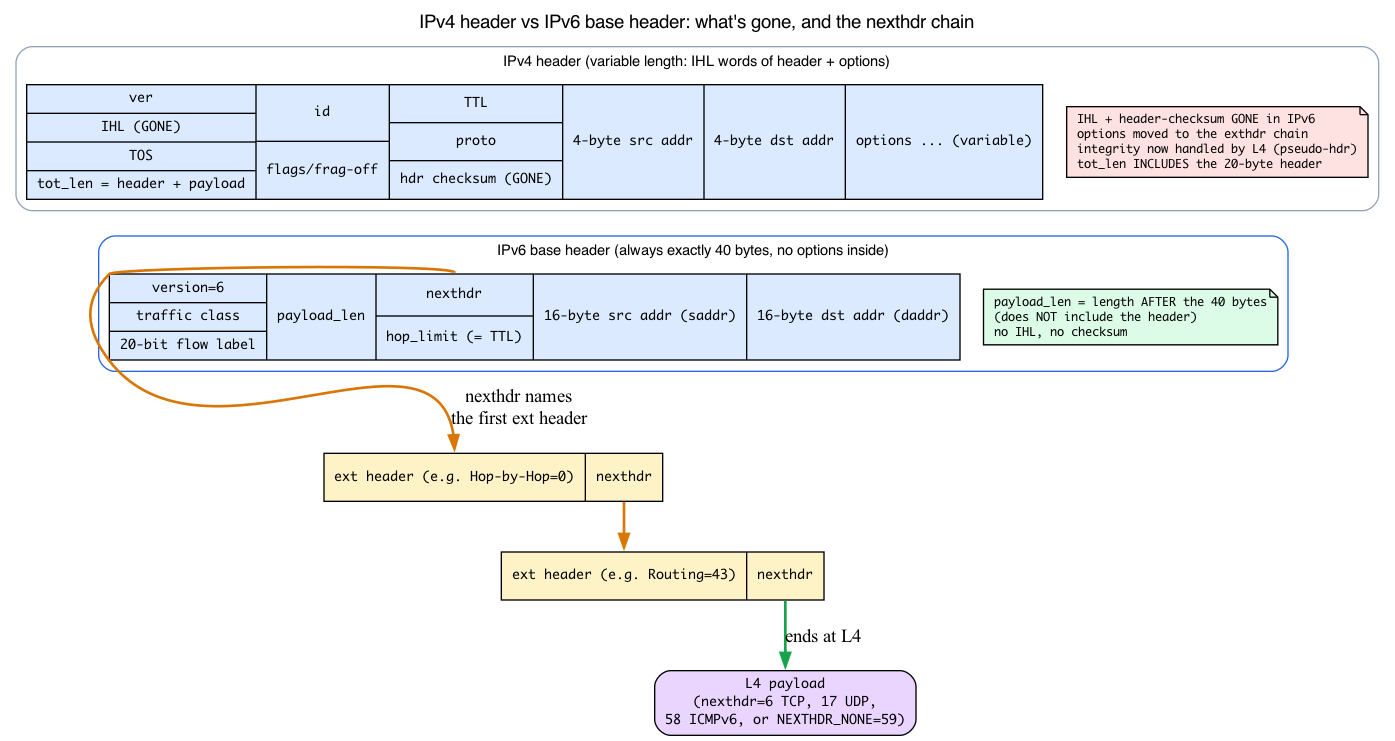
Everything today rests on one structure, so we open the struct before anything else. The natural point of contrast is the IPv4 header (struct iphdr, include/uapi/linux/ip.h:87), whose length varied: its 4-bit ihl field counted 32-bit words of header + options, so it could carry inline options. IPv6 throws that out. The base header is always exactly 40 bytes — no length field, no options inside it:
/* include/uapi/linux/ipv6.h:118 — simplified: real struct uses endian
 * bitfield guards + __struct_group(addrs,...) wrapping saddr/daddr */
struct ipv6hdr {
        __u8    priority:4,
                version:4;          /* version == 6 */
        __u8    flow_lbl[3];        /* 8-bit traffic class is split: priority
                                       nibble + top 4 bits of flow_lbl;
                                       low 20 bits of flow_lbl = flow label */
        __be16  payload_len;        /* length of everything AFTER these 40 bytes */
        __u8    nexthdr;            /* what comes next: an L4 proto OR an ext header */
        __u8    hop_limit;          /* IPv6's name for IPv4's TTL */
        struct in6_addr saddr;      /* 16 bytes */
        struct in6_addr daddr;      /* 16 bytes */
};
Read it field by field:
version= 6, plus a 4-bitprioritynibble (the top half of the 8-bit Traffic Class; its lower half is the top 4 bits offlow_lbl[3]) and a 20-bit flow label that occupies the low 20 bits offlow_lbl[3]. The flow label lets a router hash a flow without parsing L4.payload_len— the single biggest gotcha if you’re coming from IPv4. It is the length of everything after the 40-byte header, not including the header. IPv4’stot_lenincludes the 20-byte header; IPv6’spayload_lendoes not. (This is whyip6_rcv_coretrims the skb to40 + payload_len, not justpayload_len.)nexthdr— the protocol selector. For plain TCP traffic it’s just6. But it can also name an extension header, which carries its ownnexthdr, forming a chain. We’ll build that chain below.hop_limit— exactly TTL, renamed. Decremented per hop; packet dropped at zero.saddr/daddr— two 16-byte addresses (next section).
Three structural differences to burn in
Compared to the IPv4 header (struct iphdr, the one Day 2’s ip_rcv_core parsed), three things are gone or changed, and each one explains a design decision you’ll meet later today:
- The header is fixed-length — there is no IHL field and no options inside the base header. That’s exactly why options had to move out into a separate extension-header chain. A fixed base header is cheap and predictable to parse; variable junk lives elsewhere.
- There is no header checksum field at all. Grep proves it —
include/uapi/linux/ipv6.hcontains zero occurrences of the stringcheck. IPv4 routers recompute the header checksum on every hop (because they decrement TTL); IPv6 routers don’t, because there’s nothing to recompute. Integrity is left to L4 checksums (which cover an IPv6 pseudo-header). The consequence: walking thenexthdrchain is the only per-hop parsing cost — there’s no checksum verify/update on the fast path. hop_limitreplaces TTL. Same mechanic, new name.
The nexthdr number space — the key to the whole chain
Here is the single insight that makes the extension-header “chain” make sense: nexthdr uses one shared one-byte protocol-number space, used identically by the base header and by every extension header. A value of 6 always means “TCP comes next,” whether it’s in the base header or seven extension headers deep. The kernel names them in include/net/ipv6.h:32:
#define NEXTHDR_HOP        0   /* Hop-by-Hop options    */
#define NEXTHDR_TCP        6   /* TCP                   */
#define NEXTHDR_ROUTING    43  /* Routing header (SRv6) */
#define NEXTHDR_FRAGMENT   44  /* Fragment header       */
#define NEXTHDR_ESP        50  /* IPsec ESP             */
#define NEXTHDR_AUTH       51  /* IPsec Authentication  */
#define NEXTHDR_NONE       59  /* nothing follows       */
#define NEXTHDR_DEST       60  /* Destination options   */
#define NEXTHDR_MOBILITY   135 /* Mobile IPv6           */
So parsing IPv6 is a loop: read nexthdr; if it names an extension header, parse that header (which is self-describing in length and carries the next nexthdr), and repeat; if it names an L4 protocol (TCP, UDP, ICMPv6…), stop — you’ve reached the payload. NEXTHDR_NONE (59) means “the chain ends here, no payload follows.”
ip6_rcv_core (net/ipv6/ip6_input.c:188) is the IPv6 twin of Day 2’s ip_rcv_core: it validates version == 6, uses payload_len to trim the skb to the right length, and then leaves nexthdr to be resolved by the extension-header and L4 handlers. ipv6_rcv (net/ipv6/ip6_input.c:344) is the ~10-line wrapper that calls ip6_rcv_core and then runs the netfilter PRE_ROUTING hook — structurally identical to IPv4’s ip_rcv.
IPv6 address anatomy: 128 bits, scopes, and the /64 split
The autoconfig and NDP stories below toss around fe80::/64, ::, ff02::1, “host portion,” “prefix” — none of which mean anything until you know what a 128-bit address actually is. Days 1–9 only ever handled the 32-bit IPv4 dotted-quad (__be32). IPv6 is four times wider and structured.
The struct: 16 bytes
/* include/uapi/linux/in6.h:33 */
struct in6_addr {
        union {
                __u8    u6_addr8[16];   /* 16 bytes  = 128 bits */
                __be16  u6_addr16[8];   /* 8 groups of 16 bits  */
                __be32  u6_addr32[4];   /* 4 words of 32 bits   */
        } in6_u;
};
#define s6_addr   in6_u.u6_addr8        /* the byte view */
Contrast with the bare 4-byte __be32 you’ve used everywhere up to Day 9. The union exists because different code wants different granularities — byte-at-a-time text formatting (s6_addr[16]), or word-at-a-time comparison (s6_addr32[4]); you’ll see both today.
Reading the text notation
Just enough to read the rest of the chapter. An address is eight groups of 16 bits, written in hex, colon-separated: 2001:0db8:0000:0000:0000:0000:0000:0001. Two shorthands:
- Drop leading zeros in each group:
2001:db8:0:0:0:0:0:1. - One
::collapses a single run of all-zero groups — and you may use it only once (otherwise it’d be ambiguous):2001:db8::1.
Now decode the chapter’s own recurring examples:
::— all 128 bits zero. This is the unspecified address, used as the source during Duplicate Address Detection (“I don’t have an address yet”).fe80::/64— the link-local prefix (fe80::followed by a 64-bit host portion).ff02::1,ff02::2— link-local-scope multicast addresses (all-nodes, all-routers). More on multicast in the NDP section.
The /64 split — prefix half + host half
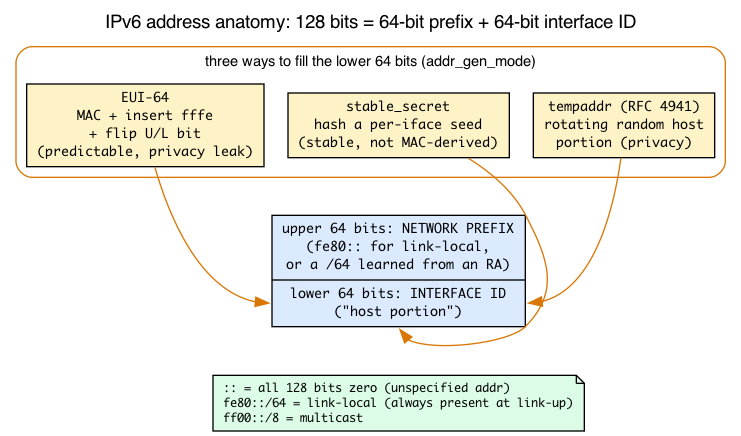
This is the structure the entire SLAAC/EUI-64 story depends on. A normal unicast IPv6 address is conceptually two 64-bit halves:
|<------ 64 bits: network prefix ------>|<------ 64 bits: interface ID ------>|
   fe80::  (link-local)  OR  from an RA       the "host portion" you keep hearing about
- The upper 64 bits are the network prefix —
fe80::for a link-local address, or a globally-routable prefix learned from a Router Advertisement. - The lower 64 bits are the interface identifier, a.k.a. the “host portion.” EUI-64,
stable_secret, andtempaddr(all in the autoconfig section) are simply three different ways to fill in that lower 64 bits.
Scopes are first-class
In IPv4, “scope” was mostly convention. In IPv6 it’s structural, and the chapter relies on it:
- Link-local (
fe80::/10): never routed off the link. Every interface always has one, generated the moment the link comes up — before any router is heard from. This is what makes DAD and NDP possible before you have a global address. - Global (routable): assigned from prefixes a router advertises.
- Multicast (
ff00::/8): one-to-many; the substrate NDP runs on.
Because a link-local address exists immediately, the kernel can do neighbor discovery and address autoconfig over it from the very first millisecond of link-up.
Where the code starts
addrconf_addr_gen (net/ipv6/addrconf.c:3417) is where concept meets code. It seeds the link-local base and then branches on the per-interface generation mode:
/* paraphrased from addrconf_addr_gen() */
ipv6_addr_set(&addr, htonl(0xFE800000), 0, 0, 0);  /* fe80:: ... upper half */
switch (idev->cnf.addr_gen_mode) {                 /* ... then fill lower 64 bits */
case IN6_ADDR_GEN_MODE_EUI64:        /* from the MAC */
case IN6_ADDR_GEN_MODE_STABLE_PRIVACY:
case IN6_ADDR_GEN_MODE_RANDOM:
case IN6_ADDR_GEN_MODE_NONE:
}
The four modes are an enum (include/uapi/linux/if_link.h:459), and their values are exactly the 0/1/2/3 you set via sysctl:
enum in6_addr_gen_mode {
        IN6_ADDR_GEN_MODE_EUI64,            /* 0 */
        IN6_ADDR_GEN_MODE_NONE,             /* 1 */
        IN6_ADDR_GEN_MODE_STABLE_PRIVACY,   /* 2 */
        IN6_ADDR_GEN_MODE_RANDOM,           /* 3 */
};
There are no Dumb Questions
Q: If a link-local address is auto-generated the instant the link comes up — before any router is heard from — why do I still need a Router Advertisement at all?
A: Because link-local is non-routable. fe80::/10 never leaves the link; a router will not forward it. It’s enough to talk to neighbors on the same segment (and to run DAD and NDP), but to reach anything off-link you need a globally-routable prefix, and the only way a host learns one via autoconfig is from an RA. Link-local gets you bootstrapped; the RA gets you on the internet.
Q: Why is the split always /64? Why not some other prefix/host boundary?
A: Because SLAAC and EUI-64 assume a 64-bit interface identifier. The whole “append the host portion to the prefix” trick — EUI-64 stuffing fffe into a 48-bit MAC, stable-privacy hashing into 64 bits — produces a 64-bit lower half by construction. A prefix longer than /64 wouldn’t leave room for it, so SLAAC simply won’t run on non-/64 prefixes. The /64 boundary is baked into the autoconfig machinery, not just a convention.
Autoconfiguration
The first time you bring up an IPv6-enabled interface, the kernel runs through this sequence — most of it before any user-supplied configuration:
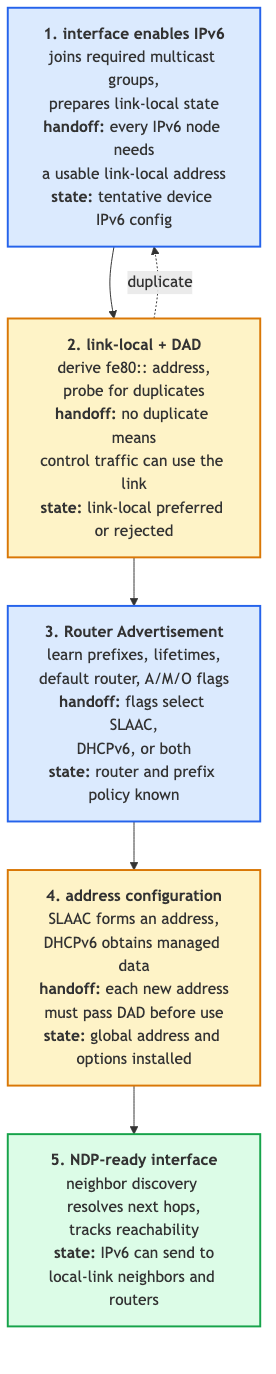
Step 1: assign a link-local address
Every IPv6 interface gets at least a link-local address in fe80::/64. As we just saw, that’s fe80:: (upper 64 bits) plus a host portion (lower 64 bits) derived from one of:
- EUI-64: insert
fffebetween the two halves of the MAC address (and flip the U/L bit). For MACaa:bb:cc:dd:ee:ffyou getfe80::a8bb:ccff:fedd:eeff. Predictable but privacy-leaking — the MAC stays the same across networks. stable_privacy(RFC 7217, configured via thestable_secretsysctl): hash a per-interface seed with a cryptographic RNG. Different every fresh boot or interface reset. This is the same mechanismaddr_gen_mode=2selects below.tempaddr(RFC 4941): privacy extensions; periodically rotate the host portion.
Sysctls that matter:
net.ipv6.conf.<dev>.addr_gen_mode: 0 = EUI-64, 1 = none, 2 = stable_privacy, 3 = random (initializes a random secret, then generates via the stable_privacy algorithm).net.ipv6.conf.<dev>.use_tempaddr: 0 = no privacy addrs, 1 = use them but prefer stable, 2 = prefer privacy.
Implementation: net/ipv6/addrconf.c:3417 addrconf_addr_gen — branches on addr_gen_mode and calls the right generator (the function we read above).
Step 2: Duplicate Address Detection (DAD)
Before committing an address, the host sends an ICMPv6 Neighbor Solicitation for it — with src :: (the unspecified address you now recognize), telling everyone “I’m tentatively claiming this.” If anyone replies, the address is in use; the kernel marks it dadfailed and refuses to use it. If nobody replies after dad_transmits retries (default 1) at intervals of RetransTimer (default 1 s), the address moves from tentative to preferred.
Where does that NS get sent, though? Not to a broadcast — to the target’s solicited-node multicast address (a per-address group derived from the address’s low 24 bits, built in the NDP section below). That’s the mechanism that makes DAD (and ARP-style lookup) cheap. For now:
ip -6 addr show dev eth0 # look for 'tentative' or 'dadfailed' flags
DAD is mandatory by spec; you can disable it with net.ipv6.conf.<dev>.accept_dad=0 for niche cases (link with no neighbors yet) but never on a shared LAN.
Step 3: Listen for Router Advertisements
ICMPv6 type 134 — emitted periodically by routers (the kernel itself doesn’t originate RAs; that’s a userspace daemon like radvd, whose MaxRtrAdvInterval defaults to 600 s — RFC 4861 permits 4 s–1800 s; unsolicited RAs are actually emitted at random intervals between MinRtrAdvInterval (~200 s by default) and MaxRtrAdvInterval (600 s)), or on demand in response to a Router Solicitation (type 133) from hosts that just came up. RAs carry, among other things:
- A list of prefixes with on-link/auto-config flags.
- Default route (the router itself).
- MTU.
- M flag (“Managed” — use DHCPv6 for addresses).
- A flag (“Autonomous” — do SLAAC from this prefix).
- O flag (“Other” — use DHCPv6 for non-address config like DNS).
- RDNSS option — recursive DNS server (RFC 8106).
If A=1 in a prefix, the host runs SLAAC: take the announced 64-bit prefix, append its 64-bit host portion (Step 1’s interface identifier), run DAD on the result, and install the address. If M=1, the kernel kicks off a DHCPv6 client (handled by userspace — dhclient -6, wpa_supplicant, NetworkManager, etc.). Both can be true simultaneously.
Step 4: NDP everywhere else
After address setup, NDP keeps neighbor state fresh. Same plumbing as Day 7’s neighbour subsystem — there’s a struct neigh_table nd_tbl at net/ipv6/ndisc.c:109 that’s structurally identical to arp_tbl. Same NUD states (REACHABLE, STALE, etc.), same gc thresholds, same ip neigh show. We do not re-teach the neighbour subsystem here — flip back to Day 7 for NUD and nd_tbl internals.
NDP — Neighbor Discovery Protocol in detail
NDP runs over ICMPv6. Before the message table, two pieces of new background: how an ICMPv6 packet even reaches the NDP handlers, and why NDP’s multicast is cheaper than ARP’s broadcast.
How an inbound packet reaches ndisc_rcv (ICMPv6 as NDP’s carrier)
NDP messages aren’t a new EtherType the way ARP was (Day 7). They are ICMPv6 messages — IPPROTO_ICMPV6 = 58, which sits at the end of the nexthdr chain like any other L4 protocol. So the extension-header walk from earlier must complete before NDP is even seen.
The dispatch mechanism is the IPv6 twin of Day 2’s registered-handler demux, so we don’t re-teach it: inet6_protos[] is the IPv6 twin of Day 2’s inet_protos[] — an RCU-protected, MAX_INET_PROTOS-sized array of struct inet6_protocol, indexed by protocol number (net/ipv6/protocol.c:25). ICMPv6 registers itself at slot 58 (net/ipv6/icmp.c:96):
static const struct inet6_protocol icmpv6_protocol = {
        .handler = icmpv6_rcv,        /* net/ipv6/icmp.c:1101 */
        ...
};
What is new is the second-level demux inside ICMPv6. Unlike IPv4’s icmp_rcv (which carries only echo/error), ICMPv6 does double duty — it carries echo/error and the entire neighbor-discovery control plane and (separately) MLD. So icmpv6_rcv switches on the ICMPv6 type byte, and for the five NDP types (133–137) hands off to ndisc_rcv (net/ipv6/icmp.c:1188):
/* icmpv6_rcv(), net/ipv6/icmp.c */
case NDISC_ROUTER_SOLICITATION:
case NDISC_ROUTER_ADVERTISEMENT:
case NDISC_NEIGHBOUR_SOLICITATION:
case NDISC_NEIGHBOUR_ADVERTISEMENT:
case NDISC_REDIRECT:
        reason = ndisc_rcv(skb);
ndisc_rcv (net/ipv6/ndisc.c:1805) then switches again on the type to reach the concrete handler — ndisc_recv_ns for a Neighbor Solicitation (net/ipv6/ndisc.c:1831), ndisc_recv_na for an advertisement (net/ipv6/ndisc.c:1836), and so on. That two-step switch is the missing link between “NDP runs over ICMPv6” and the handler names below. In IPv6 there is no ARP EtherType and no separate ARP handler — it all funnels through this one inet6_protos slot.
The five message types
| Type | Name | Purpose |
|---|---|---|
| 133 | Router Solicitation | “Any router on link?” — host on bring-up |
| 134 | Router Advertisement | Router announcing itself + prefixes |
| 135 | Neighbor Solicitation | “Who has this address?” (≈ ARP request); also DAD |
| 136 | Neighbor Advertisement | Reply to NS; also unsolicited (≈ gratuitous ARP) |
| 137 | Redirect | “Send packets for X via Y instead of me” |
(Type constants: include/net/ndisc.h:9 — 133 RS, 134 RA, 135 NS, 136 NA, 137 Redirect.)
Why NS is cheaper than an ARP broadcast: solicited-node multicast
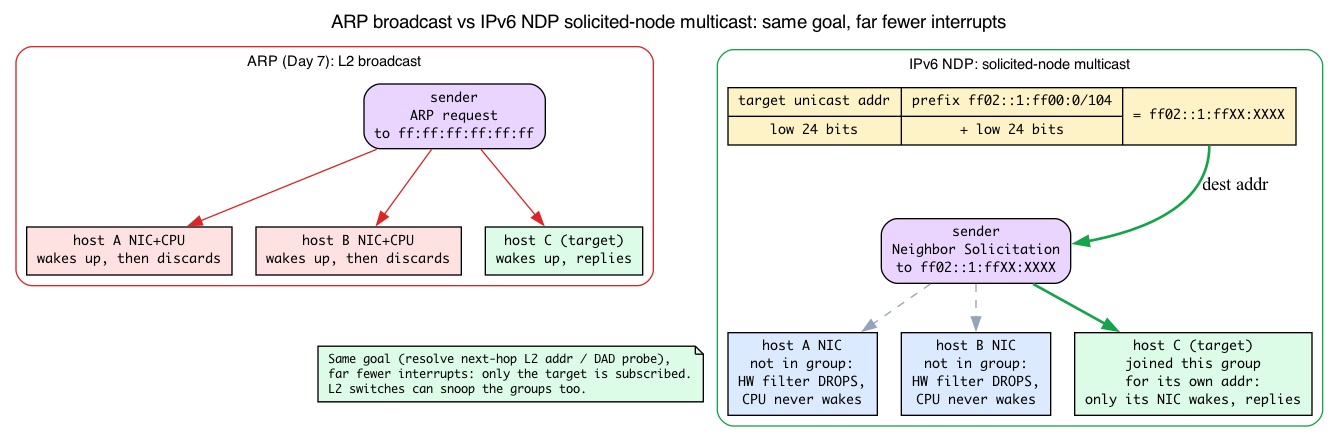
Day 7’s ARP resolves a neighbor by broadcasting at L2 — every NIC on the segment receives the frame, processes it, and (almost all) discard it. NDP does better with multicast, and this is the mechanism the comparison table’s “multicast-based, saves bandwidth” line actually refers to.
Minimal multicast model:
ff00::/8is the entire multicast address space. The second nibble encodes scope —ff02::is link-local scope (the only scope NDP needs).- Two you meet immediately:
ff02::1(all-nodes) andff02::2(all-routers — where Router Solicitations go).
The clever bit is the solicited-node multicast address. For any target unicast address, you take its low 24 bits and append them to the well-known prefix ff02::1:ff00:0/104, producing ff02::1:ffXX:XXXX. A host joins the solicited-node group for each of its own addresses. So when you want to resolve (or DAD-probe) a specific address, you send the NS to that address’s solicited-node group — and (almost always) only the target is subscribed, so only the target’s NIC is interrupted. Every other host’s hardware multicast filter drops the frame without waking the CPU. Same goal as an ARP broadcast, far fewer interrupts, and L2 switches can snoop the groups.
The kernel computes it with one helper (include/net/addrconf.h:484):
static inline void addrconf_addr_solict_mult(const struct in6_addr *addr,
                                             struct in6_addr *solicited)
{
        ipv6_addr_set(solicited,
                      htonl(0xFF020000), 0,         /* ff02::         */
                      htonl(0x1),                   /* ...1:          */
                      htonl(0xFF000000) | addr->s6_addr32[3]); /* ff + low 24 bits */
}
This ties Steps 2 and 3 together mechanically. DAD (Step 2) sends an NS for the tentative address, from src ::, to that address’s own solicited-node multicast group — computed by exactly this helper. The NS senders call it: net/ipv6/ndisc.c:382 and net/ipv6/ndisc.c:395 both use addrconf_addr_solict_mult to pick the destination. And ndisc_send_na (net/ipv6/ndisc.c:524) carries the solicited/override/router flags the table references. The NA installs a neigh entry — same nd_tbl/NUD machinery as Day 7.
Implementation entry points:
ndisc_recv_ns— incoming neighbor solicitation.ndisc_recv_na— incoming advertisement.ndisc_send_na,ndisc_send_ns— outgoing.
net/ipv6/ndisc.c is ~2000 lines but most of it is option parsing.
Compared to ARP, NDP is also richer in other ways:
- Authenticated with SEND (RFC 3971), though deployment is rare.
- Detects unreachability actively (bidirectional reachability checks, not just on-demand).
- Carries options for MTU, source link-layer address, prefix info, route info.
Extension headers — power and pitfall
We met the nexthdr chain at the top of the day. Now we walk it. The base header is 40 bytes; its nexthdr may point at an extension header, which carries its own nexthdr, forming a chain that ends at an L4 protocol (or NEXTHDR_NONE):
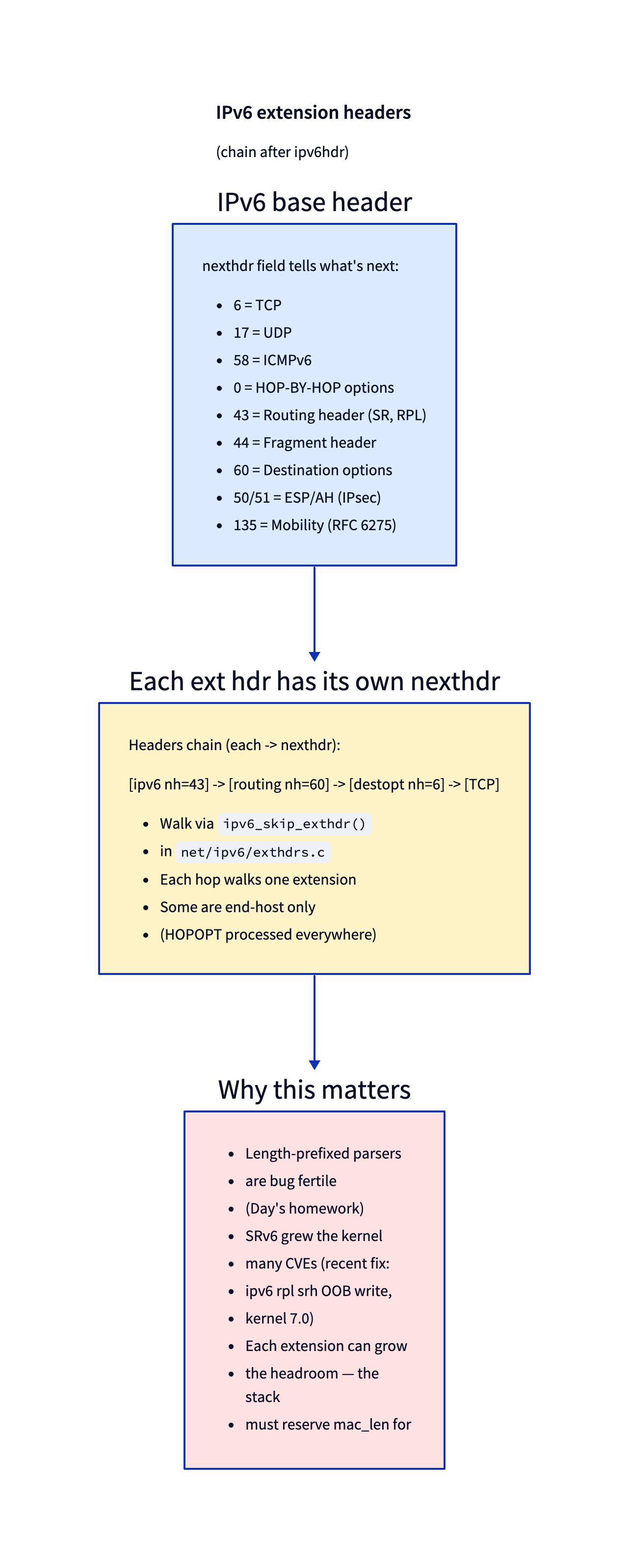
The headers in the chain
- Hop-by-Hop Options (0) — every router on the path must process. Used by Jumbograms (>64KB), MLD, RPL. Must be first if present.
- Routing (43) — Source Routing Header (SRH) for SRv6, RPL.
- Fragment (44) — IPv6 fragmentation (only by source; routers don’t fragment).
- Destination Options (60) — end-host options.
- Authentication Header (51) / ESP (50) — IPsec.
- Mobility (next-header 135 — distinct from the ICMPv6 message type 135, Neighbor Solicitation, above; different namespaces) — Mobile IPv6.
Each extension is parsed by a per-protocol handler registered in inet6_protos[] (the same table ICMPv6 lives in). The Routing handler is ipv6_rthdr_rcv (net/ipv6/exthdrs.c:658), Destination is ipv6_destopt_rcv (net/ipv6/exthdrs.c:299), etc.
How an option is encoded: the TLV format
The Hop-by-Hop and Destination Options headers don’t carry fixed fields — they carry a list of TLV (Type-Length-Value) records, and you need this layout to understand both the Check question and the CVE class below.
Each option is three parts:
+--------+--------+--------------------------+
| Type   | Length | Value (Length bytes)     |
| 1 byte | 1 byte | <-- exactly Length -->   |
+--------+--------+--------------------------+
- Type (1 byte) — which option this is.
- Length (1 byte) — the length of the Value that follows.
- Value (
Lengthbytes) — the option data.
A Hop-by-Hop or Destination Options header is just a chain of these TLVs, padded to 8-byte alignment with two special options: Pad1 (a single zero byte) and PadN (a TLV whose value is N zero bytes). This is the classic “length-prefixed-buffer parser” pattern — and the Length byte is attacker-controlled, which is the seed of the whole CVE story.
The two high bits of the Type byte: unknown-option actions
This is the exact mechanism the Check question hinges on. The top 2 bits of the Type byte tell a node what it must do when it doesn’t recognize the option:
| Top 2 bits | Action on unknown option |
|---|---|
00 | Skip this option and continue parsing |
01 | Discard the packet, silently |
10 | Discard and always send an ICMPv6 Parameter Problem |
11 | Discard, and send a Parameter Problem only if the destination was not multicast |
(A third bit, 0x20, separately flags whether the option may change en route — relevant to the Authentication Header.)
The kernel implements precisely this in ip6_tlvopt_unknown (net/ipv6/exthdrs.c:65), which ip6_parse_tlv (net/ipv6/exthdrs.c:114) calls for each unrecognized option. It dispatches on those two bits (switch at net/ipv6/exthdrs.c:79):
switch ((skb_network_header(skb)[optoff] & 0xC0) >> 6) {
case 0: /* ignore */                 return true;   /* skip, keep parsing */
case 1: /* drop packet */            break;         /* silent drop        */
case 3: /* ICMP unless multicast */  ... fallthrough;
case 2: /* send ICMP, always drop */ icmpv6_param_prob_reason(...); return false;
}
ip6_tlvopt_unknown is invoked from ip6_parse_tlv’s option loop (net/ipv6/exthdrs.c:195 and :211), which handles Destination Options via ipv6_destopt_rcv (net/ipv6/exthdrs.c:329) and Hop-by-Hop at net/ipv6/exthdrs.c:1084; a hopbyhop bool parameter distinguishes the two callers. The Jumbo Payload option’s parser, ipv6_hop_jumbo (net/ipv6/exthdrs.c:996), is dispatched from the Hop-by-Hop option table — a tiny but instructive length-field parser, and historically a buggy one.
Why this is dangerous
Extension-header parsers are length-prefixed-buffer parsers in C, deep in the network stack, fed an attacker-controlled Length byte per TLV. A parser that trusts that Length without bounding it against the header’s own declared length is the recurring bug class. They’ve been a recurring source of CVEs:
- 2026 (kernel 7.1): SRv6 RPL OOB write —
ipv6_rpl_srh_rcv(net/ipv6/exthdrs.c:491) could push a recompressed SRH that exceeded headroom, causingskb_mac_header_rebuild(called atnet/ipv6/exthdrs.c:615) to underflowmac_headerto ~65530 andmemmoveto write 14 bytes ~64KiB pastskb->head. Fix in commit9e6bf146b559. - 2022: SRv6 Segment Routing Header out-of-bounds read when setting HMAC data (CVE-2022-48687, “ipv6: sr: fix out-of-bounds read when setting HMAC data”).
- Various jumbogram bugs in
ipv6_hop_jumbo(net/ipv6/exthdrs.c:996).
The pattern: an attacker controls extension-header lengths, and a parser miscomputes how much memory to allocate or how many bytes are valid. (That 2026 SRv6 bug is a skb-geometry bug — mac_header underflowing, memmove past skb->head. That’s the head/data/tail/end + headroom geometry from Day 1’s sk_buff chapter; refer back there rather than re-deriving it.) If you write an extension header parser, treat it like a fuzzing target from day one.
Skipping the chain
To get to L4, code calls ipv6_skip_exthdr(skb, start, &nexthdr, &frag_off) — walks the chain until reaching a non-extension nexthdr and returns the offset. The signature (net/ipv6/exthdrs_core.c:72):
int ipv6_skip_exthdr(const struct sk_buff *skb, int start,
                     u8 *nexthdrp, __be16 *frag_offp);
Quirks:
- Some L4 lookups need to skip all extension headers; others (like conntrack) want to inspect specific ones.
- A malformed chain (loop, oversized) causes
ipv6_skip_exthdrto return-1, and the kernel drops the packet. - It takes
frag_offbecause a Fragment header tells you the packet is part of a larger original — the caller may need to defer processing.
Today’s experiment
# See your IPv6 addresses and their states
ip -6 addr show
# Look for: 'global', 'mngtmpaddr', 'dynamic', 'tentative', 'deprecated'

# Watch DAD on bring-up
sudo bpftrace -e 'fentry:ndisc_send_ns {
  printf("NS sent target=%s\n", ntop(args->solicit->in6_u.u6_addr8));
}' &
sudo ip link set eth0 down && sleep 1 && sudo ip link set eth0 up

# Watch NDP traffic globally
sudo tcpdump -i eth0 -nn icmp6 and not host ::

# Inspect autoconfiguration sysctls for one interface
sysctl net.ipv6.conf.eth0 | grep -E "addr_gen_mode|accept_ra|use_tempaddr|dad_transmits"

# Trace extension-header parsing
sudo bpftrace -e 'fentry:ipv6_skip_exthdr { printf("skip nexthdr=%d start=%d\n", *args->nexthdrp, args->start); }'
What to read in the kernel
-
net/ipv6/ip6_input.c:188—ip6_rcv_core. The IPv6 receive core logic (~145 lines, ~80 of real logic).ipv6_rcv(line 344) is a ~10-line wrapper that callsip6_rcv_core, then runs the netfilter PRE_ROUTING hook. Notice how it parses the base header, validatesversion=6, trims topayload_len, and dispatches via the registeredinet6_protos[]table — same pattern as IPv4’sip_rcvbut with the extension-header parser as the first handler. -
net/ipv6/addrconf.c— autoconf state machine. ~7600 lines but you only need a few entry points:addrconf_dad_start(search for the function; no fixed line) — kicks off DAD.addrconf_rs_timer— periodic RS solicitation when no router heard from.addrconf_prefix_rcv— handle a prefix from RA: install address, run DAD on it.addrconf_addr_gen(line 3417) — host-portion generation.
Read the top of the file’s comments first; the model is a state machine per
inet6_dev. -
net/ipv6/ndisc.c:109—nd_tbl, the neighbour-table instance. The struct is identical to IPv4’sarp_tbl— confirms how generic the neighbour subsystem is. Around it,ndisc_recv_ns,ndisc_recv_na,ndisc_send_na,ndisc_send_nsare the protocol handlers;ndisc_rcv(line 1805) is the type-switch they hang off. -
net/ipv6/exthdrs.c— extension-header parsers.ipv6_rthdr_rcv(line 658): Routing header. Read this to understand SRv6 — the most actively-developed extension. Also where most CVEs have been.ipv6_destopt_rcv(line 299): Destination Options. Simpler; good warm-up. Callsip6_parse_tlv.ip6_parse_tlv(line 114): the generic TLV walker, with the unknown-option action dispatch at line 79.ipv6_hop_jumbo(line 996): the parser for the Jumbo Payload option in HOPOPT. Tiny but instructive.
-
include/uapi/linux/in6.handinclude/net/ipv6.h— the canonical structs (struct ipv6hdr,struct in6_addr, theNEXTHDR_*constants). -
Documentation/networking/ipv6.rst— overview. Light but has pointers to RFC numbers. -
RFCs to skim: 8200 (IPv6 spec), 4861 (NDP), 4862 (SLAAC), 4941 (privacy extensions), 7136 (modified EUI-64), 8754 (SRv6).
Bullet Points
- The base header is fixed at 40 bytes: version=6, a
prioritynibble plusflow_lbl[3](together holding the 8-bit traffic class — priority + top 4 bits of flow_lbl — and the 20-bit flow label in the low 20 bits of flow_lbl),payload_len(length after the header — unlike IPv4tot_len),nexthdr,hop_limit(TTL renamed), two 16-byte addresses. No IHL, no header checksum — options moved to the extension-header chain. nexthdris one shared protocol-number space (6=TCP, 0=HopByHop, 43=Routing, 44=Fragment, 59=None, 60=DestOpts): parse it as a loop until you hit an L4 protocol.- An IPv6 address is 128 bits (
struct in6_addr, 16 bytes), split into a 64-bit prefix + 64-bit host portion.::= unspecified,fe80::/64= link-local (always present),ff00::/8= multicast. - IPv6 hosts auto-configure: link-local (fe80::/64) immediately, global addresses from RAs.
- Address generation modes (
addr_gen_mode): EUI-64 (0, kernel default), none (1), stable_privacy (2), random (3). - DAD is mandatory: send NS for your tentative address to its solicited-node multicast group (
ff02::1:ffXX:XXXX, low 24 bits of the target), from src::, wait, then commit. - Solicited-node multicast is why NDP beats ARP: only the target host is subscribed, so only its NIC wakes — vs an ARP L2 broadcast every host processes.
- ICMPv6 (proto 58) carries NDP.
inet6_protos[](Day 2’sinet_protos[]twin) →icmpv6_rcv→ (type switch) →ndisc_rcv→ndisc_recv_ns/_na/… - NDP = ICMPv6 messages 133–137: RS, RA, NS, NA, Redirect. Replaces ARP. The
neighboursubsystem (nd_tbl) is structurally identical to IPv4’sarp_tbl(Day 7). - Extension headers chain between base IPv6 header and L4. Walked by
ipv6_skip_exthdr. Important ones: HopByHop (0), Routing (43, SRv6), Fragment (44), DestOpts (60), AH/ESP (51/50). - HopByHop/DestOpts options are TLV-encoded (Type, Length, Value). The top 2 bits of Type select the unknown-option action: skip / drop / drop+ICMP / drop+ICMP-unless-multicast (
ip6_parse_tlv). - Extension-header parsers trust an attacker-controlled Length byte — a recurring CVE source. Treat as a fuzz-prone area.
Check question
A node receives an IPv6 packet whose first extension header is nexthdr=0 (Hop-by-Hop Options). What action is the kernel obligated to take, even if the packet is for a peer (not for us)?
Click to reveal answer
Answer: Process the Hop-by-Hop options. HopByHop is special — every router on the path must inspect it, regardless of whether the packet’s destination is local. (That’s what “hop-by-hop” means.) The kernel parses the Hop-by-Hop options via the same ip6_parse_tlv walker you saw above (its hopbyhop caller), immediately after the base header. If an option is unknown and has the high bits in the option-type byte set to indicate “discard packet on unknown option,” the packet is dropped (and possibly an ICMPv6 Parameter Problem returned). Other extensions like Destination Options are processed only at the destination — the kernel skips them on a forwarding path. The Hop-by-Hop processing requirement is also why this header must be the first extension if present; later positions are spec-illegal.
Tomorrow
Day 11: the bridge subsystem. Linux as a software L2 switch.