Day 11 — The bridge subsystem
Today’s mission: create a software Linux bridge, attach two interfaces to it, and watch the FDB learn MACs as traffic flows. Along the way you’ll learn the four mechanisms the bridge is built on — the
rx_handlerhook that hijacks a NIC’s frames, the RCU-protected hash table that keeps the FDB lock-free for readers, why L2 loops are catastrophic (and what spanning tree does about it), and howbr_netfilterdrags bridged frames through iptables — plus how VLAN-aware bridges deliver real switch behavior. Total time: ~110 minutes.
What a Linux bridge is, and why you have one
A Linux bridge is a software L2 switch. It looks like a netdev (you can give it an IP, ping it, configure routes through it) but its job is to forward Ethernet frames between member ports based on destination MAC. Like any switch, it learns which MAC lives behind which port and stores that mapping in a table called the FDB (forwarding database). The implementation lives in net/bridge/ (~29k lines of top-level .c).
You’re using bridges constantly even if you’ve never explicitly created one:
- Container runtimes. Docker creates
docker0by default; Podman createscni-podman0; CNI plugins createcni0/cbr0. Each one is a Linux bridge that wires container veths to the host network. - VMs. libvirt’s “default” network is a bridge (
virbr0);bridge=br0mode in qemu attaches the VM’s TAP (a software NIC that hands frames to a userspace process like qemu) directly to a host bridge. - Multi-NIC servers acting as switches. A box with multiple Ethernet NICs can bridge them with one
ip link add br0 type bridgeplusip link set <if> master br0per port.
The bridge is the fastest L2-forwarding plane in the kernel — much faster than the IP routing path because, switching purely by destination MAC, it skips everything L3 does: no L3/FIB lookup, no TTL decrement and header-checksum rewrite, and (by default — see br_netfilter) no netfilter traversal or decapsulation.
This chapter leans on four pieces of machinery that no earlier day taught you: the rx_handler hook that diverts a slave NIC’s frames into bridge code; the RCU-protected rhashtable that backs the forwarding database; the broadcast-storm / spanning-tree problem that explains why switches need STP at all; and the netfilter chains that br_netfilter exposes. We’ll teach each one — intuition first, then the concrete v7.1 struct or function — right where the bridge depends on it.
Two things from earlier days are load-bearing today and will not be re-taught:
- The RX path. Recall from Day 2 — the NIC’s NAPI poll builds an skb, then
__netif_receive_skb_corewalks theptype_basehash to find the L3 handler (ip_rcvfor IPv4). Today’s whole story is about a hook that fires before that demux.- The CPU cache line. Recall from Day 1 — the CPU reads memory in 64-byte lines, so write-heavy fields are kept off read-mostly cache lines to avoid false sharing. We’ll meet that idea once more, in the FDB entry.
Anatomy
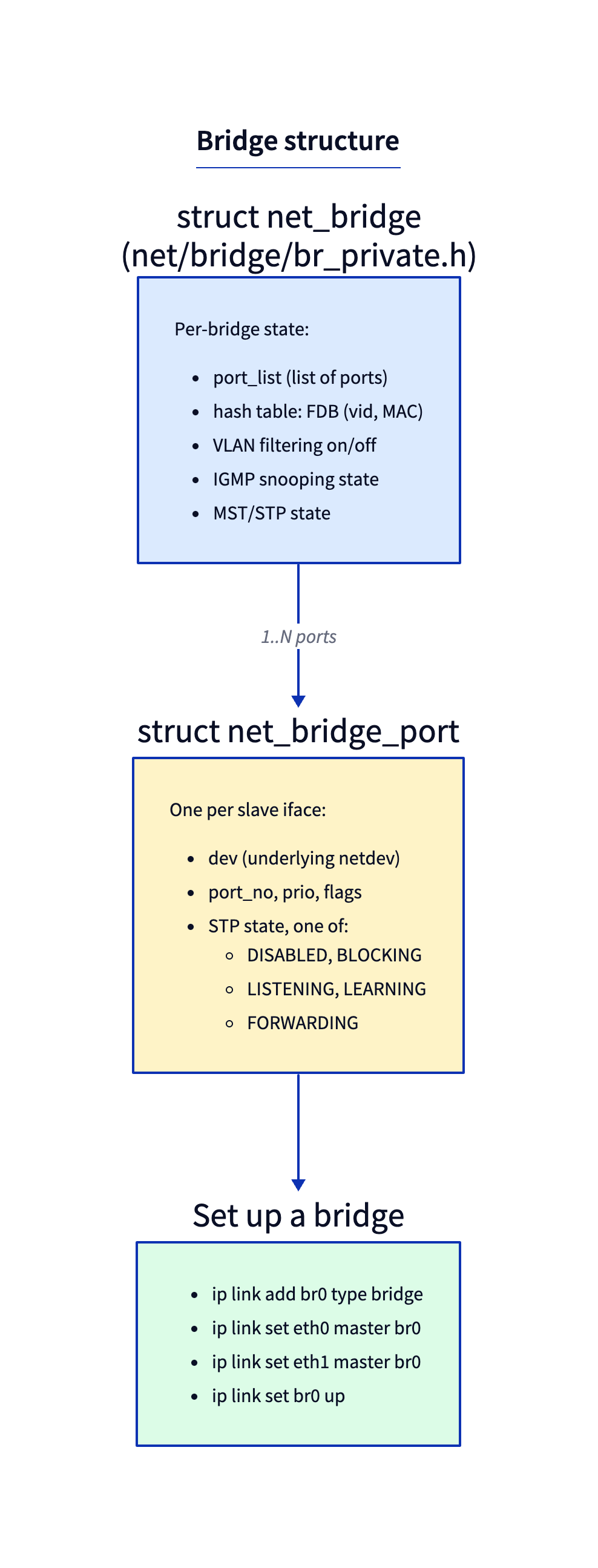
A bridge is two structs working together:
struct net_bridge(net/bridge/br_private.h:495) — the bridge itself. Holds the FDB (forwarding database) — the MAC-address-to-port table that is the heart of any L2 switch — plus the port list, VLAN config, IGMP-snooping state, MST/STP state. One of these perbrNnetdev.struct net_bridge_port(net/bridge/br_private.h:387) — one per slave interface. Holds thedevpointer (the underlying netdev), the port number, STP state (DISABLED, LEARNING, FORWARDING, …), and per-port flags (BPDU guard, root guard, hairpin, etc.).
When you do ip link set eth0 master br0, the kernel attaches a net_bridge_port to eth0, registers br_handle_frame as eth0’s rx_handler, and the slave’s frames now flow into bridge logic instead of the normal stack. That sentence hides the single most important mechanism in the chapter — so let’s open it up.
Background 1: the rx_handler — how a slave NIC’s frames get hijacked
Recall the RX path from Day 2: a frame is DMAed in, NAPI builds an skb, and __netif_receive_skb_core indexes ptype_base by skb->protocol to find the one L3 handler (ip_rcv, the IPv6 handler, ARP, …). That’s the “normal stack.” A bridge has to get its hands on the frame before that L3 demux runs — otherwise a frame destined for some other host would be delivered to this host’s IP stack instead of being switched out another port.
The kernel’s hook for exactly this is the rx_handler.
One function pointer per netdev
Every struct net_device carries a single, optional rx_handler slot (include/linux/netdevice.h:2189):
rx_handler_func_t __rcu  *rx_handler;
void __rcu               *rx_handler_data;
When that pointer is set, __netif_receive_skb_core calls it before the ptype_base packet-type walk that Day 2 traced. So the rx_handler sits at the exact spot in the RX path where the L3 demux would otherwise run, and gets first refusal on the frame. There is only one rx_handler per device — registering a second returns -EBUSY (include/linux/netdevice.h:461-477). The bridge, bonding, macvlan, and OVS all compete for this same plug-in slot; a “join a master” device is one that has installed an rx_handler.
Its return value decides the frame’s fate
The handler tells the receive path what to do with the skb via an enum rx_handler_result (documented at include/linux/netdevice.h:461-477). The two that matter:
RX_HANDLER_CONSUMED— “I took the skb; do not process it further.” The frame never reachesptype_base, never reachesip_rcvon the slave NIC. The bridge returns this for every data frame — including one addressed to the bridge’s own IP. That last case is the subtle one:br_handle_framestill returns CONSUMED, butbr_handle_frame_finishnotices the destination is aBR_FDB_LOCALentry and callsbr_pass_frame_up(), which re-injects the skb onto the bridge netdev (skb->dev = br0) vianetif_receive_skb(net/bridge/br_input.c:218-220). So “pingingbr0” works by re-injection onbr0, not by passing the frame through on the slave port.RX_HANDLER_PASS— “Do nothing; proceed as if no handler ran.” The bridge uses this only for the genuine pass-through cases:PACKET_LOOPBACK, and locally-consumed link-local control frames (STP BPDUs, LLDP) handled via__br_handle_local_finish. It is not how a frame reaches the bridge’s own IP.
(There are two more — RX_HANDLER_ANOTHER, re-loop because skb->dev changed, and RX_HANDLER_EXACT, force exact delivery — that the bridge doesn’t lean on today.)
Where the bridge installs it
Back in br_add_if (the code path behind ip link set eth0 master br0), the bridge registers its handler (net/bridge/br_if.c:613):
err = netdev_rx_handler_register(dev, br_get_rx_handler(dev), p);
Three things happen in that one call:
br_get_rx_handler(dev)(net/bridge/br_input.c:463) returnsbr_handle_framefor an ordinary port (a special dummy is used for DSA switch ports).netdev_rx_handler_registerplantsbr_handle_frameintodev->rx_handler.- The third argument —
p, thenet_bridge_port— is stashed asrx_handler_data, so when a frame later arrives,br_handle_framecan recover which port and which bridge it belongs to.
br_handle_frame itself is at net/bridge/br_input.c:339:
static rx_handler_result_t br_handle_frame(struct sk_buff **pskb)
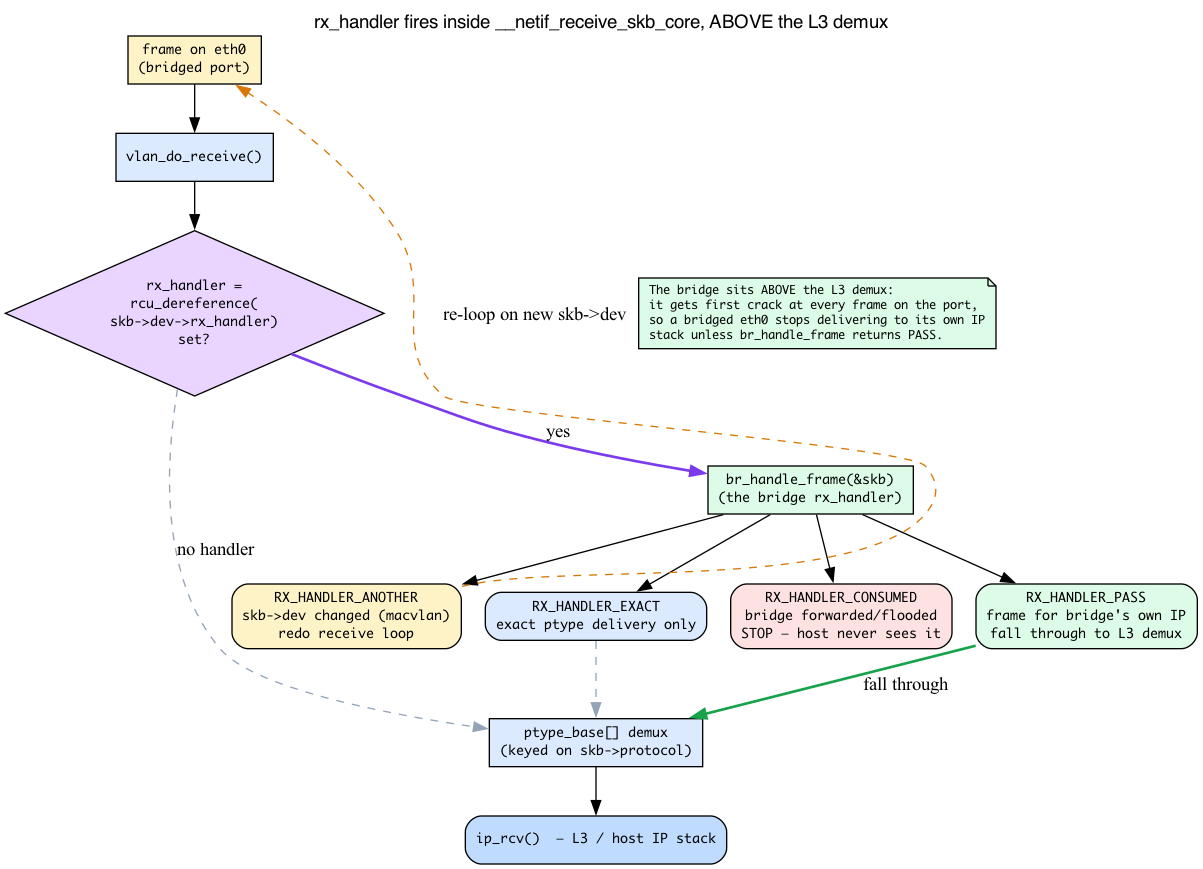
So the picture is: a frame on a slave NIC reaches __netif_receive_skb_core, which checks dev->rx_handler. It’s set, so br_handle_frame runs. For any data frame — switched or destined to the bridge’s own IP — it returns RX_HANDLER_CONSUMED, so the frame is gone from the slave NIC’s perspective. A frame addressed to the bridge’s own IP still reaches ip_rcv, but by re-injection on br0 (via br_pass_frame_up → netif_receive_skb), not by falling through the slave’s ptype_base demux. RX_HANDLER_PASS is reserved for loopback and locally-handled link-local control frames.
The forwarding decision
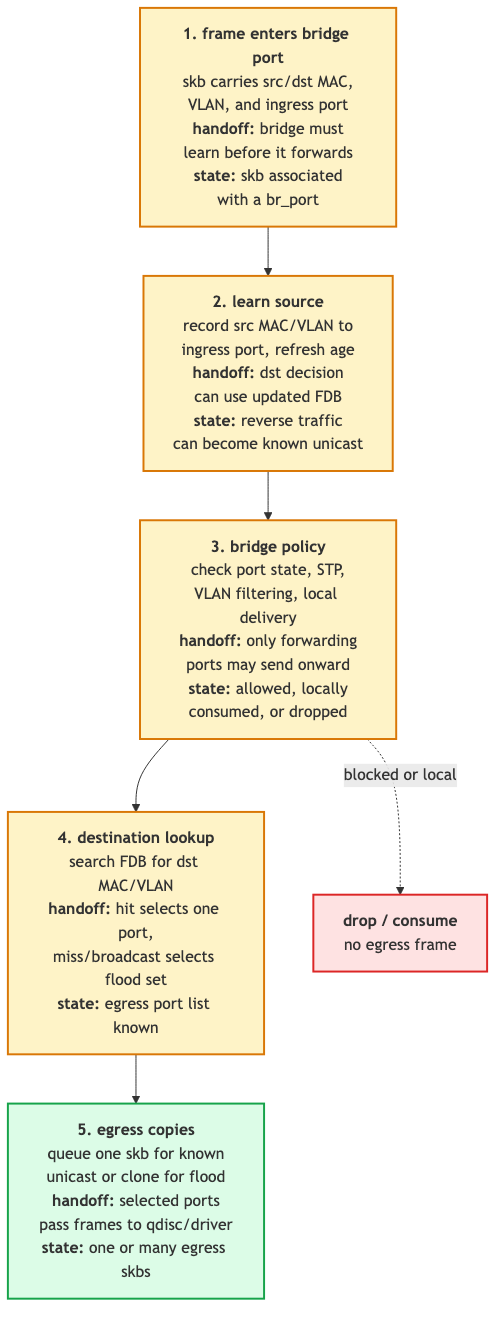
For every frame that lands on a bridge port, the kernel runs the same compact decision tree:
- Drop or forward control frames. STP BPDUs (Bridge Protocol Data Units — Spanning Tree control frames, covered in Background 3; destined to
01:80:c2:00:00:00) get special handling; non-bridge multicast may be flooded or snooped. - Learn the source. Insert/refresh
(src MAC, vid, port)in the FDB — the forwarding database, whose internals are Background 2 just below — viabr_fdb_update(net/bridge/br_fdb.c:972). Aging timers tick. - Look up the destination.
br_fdb_find_rcu(net/bridge/br_fdb.c:263) walks the hash table. - Decide:
- Hit, same port → drop (don’t loop the frame back to where it came from).
- Hit, different port →
br_forward(net/bridge/br_forward.c:144) — send out that one port. - Miss →
br_flood(net/bridge/br_forward.c:201) — send to every port except the input port. - Broadcast/multicast — flood, possibly filtered by IGMP/MLD snooping.
The “miss → flood” rule is what makes bridges self-learning. Initial frames flood; replies teach the FDB the source’s port; subsequent frames are unicast.
The actual entry point is br_handle_frame (net/bridge/br_input.c:339), which is registered as the rx_handler when an interface joins a bridge. Following the path br_handle_frame → br_handle_frame_finish (net/bridge/br_input.c:76) gives you the full L2 forwarding code in ~250 lines.
Background 2: the FDB is an RCU-protected rhashtable
Steps 2 and 3 above both hit the FDB — one write, one read — on every single frame. At line rate that’s millions of lookups per second, so the data structure underneath has to let readers run without ever blocking each other or the writers. Two kernel mechanisms make that possible, and neither was introduced earlier, so let’s build them up.
rhashtable: the kernel’s resizable hash table
rhashtable is the kernel’s generic, automatically-resizing hash table. The FDB configures one with a small parameter block (net/bridge/br_fdb.c:27):
static const struct rhashtable_params br_fdb_rht_params = {
    .head_offset = offsetof(struct net_bridge_fdb_entry, rhnode),
    .key_offset  = offsetof(struct net_bridge_fdb_entry, key),
    .key_len     = sizeof(struct net_bridge_fdb_key),
    .automatic_shrinking = true,
};
The key is not just the MAC — it’s the {MAC, vlan_id} pair (net/bridge/br_private.h:286):
struct net_bridge_fdb_key {
    mac_addr addr;
    u16      vlan_id;
};
That single fact explains a behavior you’ll see in the VLAN lab below: the same MAC address in two different VLANs is two separate FDB entries, because the VID is part of the key. A lookup is rhashtable_lookup(tbl, &key, br_fdb_rht_params) (net/bridge/br_fdb.c:216).
RCU in one paragraph (it’s new here)
RCU (Read-Copy-Update) is a synchronization scheme tuned for read-mostly data. Readers take no lock at all: they call rcu_read_lock(), walk the structure, and call rcu_read_unlock(). A writer that wants to delete an entry first unlinks it so new readers can’t find it, then defers actually freeing the memory until every reader that might still hold a pointer has finished (the “grace period”). The payoff is enormous for the FDB: the per-frame forwarding hot path looks up destinations with zero lock contention, even while another CPU is busy learning new MACs.
This is what the _rcu suffix on br_fdb_find_rcu announces by convention: “you must call me inside an RCU read-side section, and the pointer I return is only valid until rcu_read_unlock().” So:
- Readers — the forwarding path — call
br_fdb_find_rcu(net/bridge/br_fdb.c:263) →rhashtable_lookup, no lock per frame. - Writers — the learning path — call
br_fdb_update(net/bridge/br_fdb.c:972). Crucially, the common per-frame case (an already-known source) refreshes the entry’supdated/dstfields lock-free viaWRITE_ONCE()— no lock at all.br->hash_lock(net/bridge/br_private.h:497) is taken only on the slow path that inserts a brand-new entry (fdb_create) or deletes one.
One callback to Day 1’s cache line
That updated timestamp is touched on every learning frame — it’s write-heavy. The FDB lookup fields (key, dst) are read-mostly. If they shared a 64-byte cache line, every aging-timestamp write would invalidate the line that lookups are reading — false sharing (recall Day 1). So the kernel deliberately puts updated on its own line (net/bridge/br_private.h):
/* write-heavy members should not affect lookups */
unsigned long  updated ____cacheline_aligned_in_smp;
That ____cacheline_aligned_in_smp is the same cache-line lesson from Day 1, applied to keep write-heavy aging off the read-mostly lookup path.
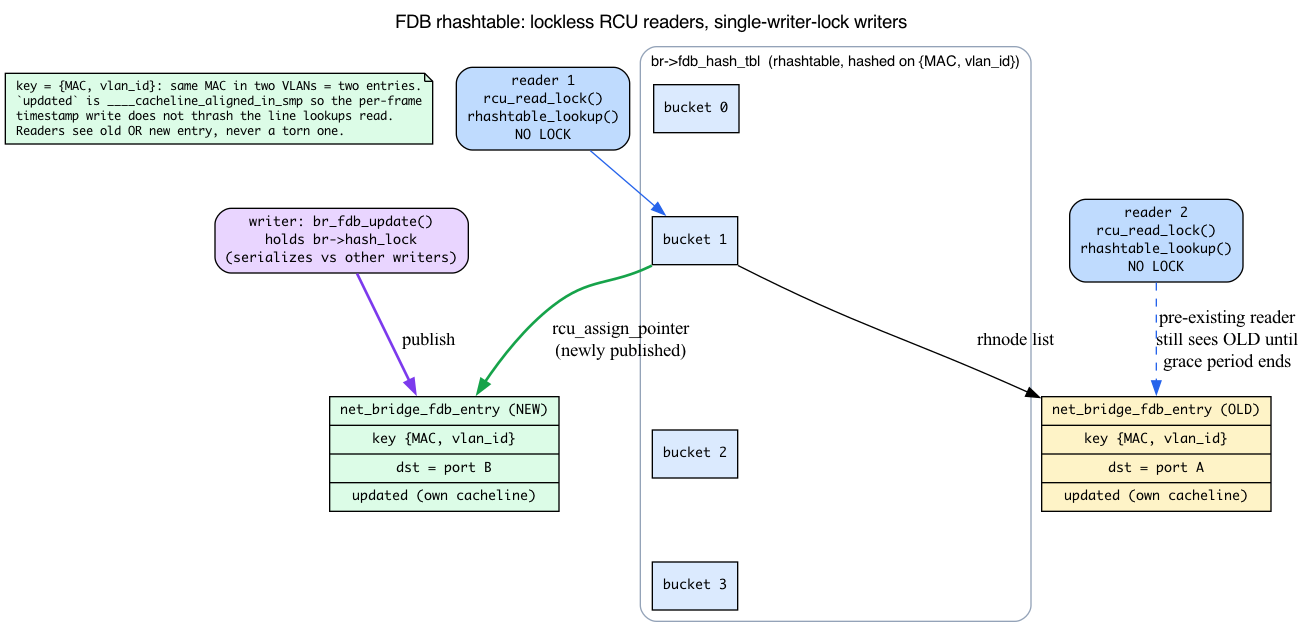
Put together: readers are lockless. A writer makes a new entry visible atomically through the rhashtable insert (hlist_add_head_rcu), and a deleted entry’s memory is reclaimed only after an RCU grace period — so a concurrent reader mid-traversal always sees a consistent, whole entry, never a torn or freed one. The per-frame refresh of an existing source’s updated/dst fields is a lock-free in-place WRITE_ONCE(), taking no lock and forcing no grace period. That’s why FDB lookups scale.
VLAN-aware bridges
By default a bridge ignores VLAN tags — it’s just an L2 switch. Toggle VLAN-awareness:
sudo ip link set br0 type bridge vlan_filtering 1
Now the bridge implements proper 802.1Q switching:
- Each port has a list of allowed VLANs (egress: tagged or untagged) and a PVID (default VLAN for untagged ingress).
- Frames are forwarded only between ports that share a VLAN.
- The FDB is keyed on
(MAC, vid)not just MAC — same MAC in different VLANs is two separate entries (that’s thenet_bridge_fdb_keyfrom Background 2).
# Allow VLAN 100 on two ports, untagged on port A, tagged on port B:
sudo bridge vlan add dev v1p vid 100 pvid untagged
sudo bridge vlan add dev v2p vid 100 tagged
Now untagged frames from v1p are tagged with VID 100 internally, can be forwarded to v2p (which expects them tagged), and on egress the bridge tags them out.
This is the foundation of VLAN-aware bridges used in network namespaces (the netns you built in Day 5) and in VLAN-segmented host setups — libvirt/KVM VM hosting and VLAN-partitioned container/namespace networks (bridge vlan_filtering).

On ingress, an untagged frame is stamped with the port’s PVID (br_allowed_ingress); the FDB lookup is keyed on {MAC, vid}; on egress each port applies its own tag/untag policy (br_handle_vlan). Forwarding is gated by shared membership — a frame moves between two ports only if both are members of its VID. That’s why moving v2p to VID 200 breaks connectivity at the egress membership check, not at a FDB miss.
There are no Dumb Questions
Q: Why doesn’t the bridge just run netfilter (iptables) by default?
A: Because the bridge operates below IP — it switches frames by MAC and returns
RX_HANDLER_CONSUMEDlong before any L3 routing decision, so iptables rules on the IP path never see bridged traffic. Subjecting every L2 frame to netfilter would also cost performance on the hot path. You opt in by loadingbr_netfilter(Background 4), which then drags bridged frames through the IP chains — at the price of a packet sometimes traversing iptables twice.Q: Why is the input port excluded from flooding?
A: Split-horizon. The frame already arrived on that port, so resending it there is at best wasted and at worst loops on a shared medium. The exclusion is structural:
should_deliver()returns false whenskb->dev == p->dev(unlessBR_HAIRPIN_MODE), independent of what the FDB has learned.Q: Why are there two FDB entries for the same MAC under VLAN filtering?
A: The FDB key is
{MAC, vlan_id}, not just the MAC (struct net_bridge_fdb_key). The same MAC seen in VLAN 100 and VLAN 200 hashes to two distinct keys, so it occupies two separate entries — which is exactly what keeps the VLANs isolated.
Background 3: why L2 loops are catastrophic, and what STP does about it
The chapter is about to tell you to “enable STP and watch the port walk LISTENING → LEARNING → FORWARDING.” But STP solves a problem you’ve never been shown, so it would be enabling a cure for an unnamed disease. Here is the disease.
The broadcast storm
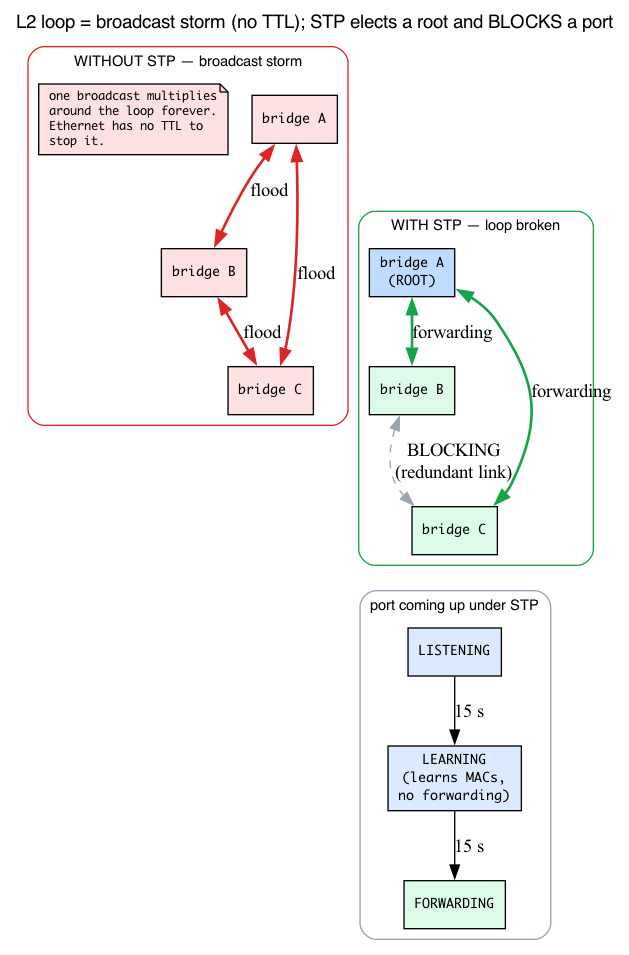
The bridge’s own rule — miss → flood, broadcast → flood — sends a frame out every port except the one it came in on. That’s perfectly safe in a tree-shaped topology. But suppose two bridges are wired together with two links (for redundancy), forming a physical loop. Now a single broadcast frame:
- arrives at bridge A, which floods it out both links to bridge B;
- bridge B floods each copy out its other ports — including back toward A on the other link;
- A floods those again…
The frame circulates forever and multiplies at every hop. Within milliseconds the links are saturated with billions of copies of one frame — a broadcast storm that takes the segment down completely. And here’s the killer detail: an Ethernet frame has no TTL field. Unlike an IP packet, which a router decrements and eventually drops, nothing in the frame itself ever stops the loop. The topology must be loop-free, or the network dies.
STP: prune the graph to a tree
STP (Spanning Tree Protocol, IEEE 802.1D) is the fix. The bridges talk to each other, elect a single root bridge, and compute a loop-free spanning tree over the physical graph. Redundant links that would close a loop are put into a BLOCKING state — they carry no data frames, so exactly one active path exists between any two ports. If an active link fails, a blocked link is brought back up to restore connectivity. You get redundancy without the storm.
The port states, grounded
The transitional states the lab makes you watch are a real kernel enum (include/uapi/linux/if_bridge.h:49-53):
#define BR_STATE_DISABLED   0
#define BR_STATE_LISTENING  1
#define BR_STATE_LEARNING   2
#define BR_STATE_FORWARDING 3
#define BR_STATE_BLOCKING   4
A newly-up port under STP doesn’t start forwarding immediately — it could create a transient loop before the tree has converged. So it walks LISTENING → LEARNING → FORWARDING, pausing one forward delay at each transitional stage to let the topology settle. The default forward delay is 15 * HZ (15 seconds), set in br_dev_setup (net/bridge/br_device.c:528):
br->bridge_forward_delay = br->forward_delay = 15 * HZ;
Two stages × 15 s ≈ the ~30 seconds of startup latency the experiment observes — and exactly why containers and VMs, where you control the topology and know there’s no loop, leave STP off. When STP is disabled (or forward delay is 0), the kernel skips the LISTENING/LEARNING walk entirely and jumps a port straight to FORWARDING (net/bridge/br_stp.c:454):
if (br->stp_enabled == BR_NO_STP || br->forward_delay == 0) {
    br_set_state(p, BR_STATE_FORWARDING);
    ...
}
BPDUs: the control frames STP exchanges
STP bridges talk via BPDUs (Bridge Protocol Data Units), destined to the reserved group MAC 01:80:c2:00:00:00. These must never be forwarded like ordinary data — they’re consumed and processed locally. br_handle_frame special-cases the whole link-local 01:80:c2:00:00:0X range before data-frame forwarding by switching on the low byte of the destination (net/bridge/br_input.c:382-408):
switch (dest[5]) {
case 0x00:  /* Bridge Group Address — STP BPDUs */
    ...
case 0x01:  /* IEEE MAC (Pause) */
    ...
case 0x0E:  /* 802.1AB LLDP */
    ...
}
So control frames branch off here; everything else continues into the learn/lookup/forward tree.
Background 4: the bridge and netfilter (a forward reference)
The next section, and one of the “What to break” labs, talk about pushing bridged frames through “iptables”, the “FORWARD chain”, and “PREROUTING”. You’ve only glimpsed netfilter once — nf_hook_slow flashing past in a Day-2 trace. Full coverage is a Phase 4 topic (Days 20–22). Here’s just enough to follow today’s bridge-specific twist, and no more.
netfilter is the kernel’s packet-filtering framework. Tools like iptables and nftables install rules into named chains that are attached at fixed hook points along the IP path — PREROUTING, FORWARD, POSTROUTING, and others. A packet normally encounters these chains only when it is routed at L3.
Now the bridge-specific point this section is really about: by default, bridged frames do not enter the IP (iptables) netfilter chains at all. The bridge operates below IP — it switches frames by MAC and returns RX_HANDLER_CONSUMED long before any L3 routing decision. So an iptables rule in the FORWARD chain simply doesn’t see bridged traffic. (Bridge-family netfilter — ebtables/nft bridge — is a separate matter and is always available; see below.)
Loading the optional br_netfilter module changes that. It sets net.bridge.bridge-nf-call-iptables=1, which pushes bridged frames through the IP netfilter chains anyway — which is exactly why, in the lab, a FORWARD -j DROP rule suddenly kills a ping that never left L2. The mechanics: for every forwarded frame, br_handle_frame’s finish path runs through nf_hook_bridge_pre() (net/bridge/br_input.c:267), which dispatches any registered NFPROTO_BRIDGE PRE_ROUTING hooks (used by ebtables/nft bridge family) and otherwise falls straight through to br_handle_frame_finish (if (!e) goto frame_finish;, br_input.c:282-284). That dispatch is not what br_netfilter adds. What br_netfilter (net/bridge/br_netfilter_hooks.c) does is register a hook at NF_BR_PRE_ROUTING which redirects bridged frames into the IP (iptables) chains — and it’s that registration, not the dispatch loop, that makes a FORWARD -j DROP rule bite.
Forward pointer: netfilter, chains, conntrack, and hooks are covered in full on Days 20–22. For today you only need two facts: iptables rules live on the IP path, and
br_netfilteris the switch that subjects bridged frames to them. We deliberately stop here — no pre-teaching the rest of Phase 4.
STP and netfilter knobs (the operator’s view)
With the why in hand, the operator-facing toggles are short.
Enable STP:
sudo ip link set br0 type bridge stp_state 1
When STP is on, the bridge sends/processes BPDUs, computes a loop-free topology, and puts redundant ports in BLOCKING. For container/VM scenarios where you control the topology, leave STP off — it adds the ~30 s startup latency from Background 3.
Enable br_netfilter:
sudo modprobe br_netfilter
Useful for: applying iptables to traffic between VMs that share a bridge, transparent proxying, host-as-firewall scenarios.
Gotcha: br_netfilter costs performance (every bridged frame now traverses netfilter); it’s also semantically tricky (a single packet may traverse iptables chains twice — once as bridge ingress, once as IP forward). For pure L2 forwarding without IP-level filtering, leave br_netfilter off.
Today’s experiment
Build a two-namespace bridged network (the veth pairs and network namespaces are from Day 5):
sudo ip link add br0 type bridge
sudo ip link set br0 up

sudo ip link add v1 type veth peer name v1p
sudo ip link add v2 type veth peer name v2p
sudo ip link set v1p master br0
sudo ip link set v2p master br0
sudo ip link set v1p up
sudo ip link set v2p up

sudo ip netns add ns1
sudo ip netns add ns2
sudo ip link set v1 netns ns1
sudo ip link set v2 netns ns2

sudo ip netns exec ns1 ip addr add 10.0.0.1/24 dev v1
sudo ip netns exec ns1 ip link set v1 up
sudo ip netns exec ns2 ip addr add 10.0.0.2/24 dev v2
sudo ip netns exec ns2 ip link set v2 up

# Test
sudo ip netns exec ns1 ping -c 2 10.0.0.2
Inspect the FDB:
bridge fdb show dev v1p     # learned MAC of v1
bridge fdb show dev v2p     # learned MAC of v2
bridge fdb show prints several lines per port — don’t expect just one:
92:56:a0:eb:25:81 master br0                 # <- the learned entry (v1's MAC)
ee:72:dd:99:36:fa vlan 1 master br0 permanent
ee:72:dd:99:36:fa master br0 permanent
33:33:00:00:00:01 self permanent
01:00:5e:00:00:01 self permanent
The learned entry is the single line shown as <mac> master br0 without a permanent flag — that is v1’s MAC, learned from ns1’s traffic, and it ages out after 300 s (the default ageing_time). The ... permanent line is the port’s own MAC; the 33:33:.../01:00:5e:... self permanent lines are multicast-group memberships — none of those are learned traffic.
Trace the learning path. br_fdb_update (the FDB writer from Background 2) runs on the per-frame learning path, so bound the probe with an interval exit and provoke traffic while it runs:
sudo bpftrace -e 'fentry:br_fdb_update {
  printf("learn vid=%d port=%s\n", args->vid, args->source->dev->name);
} interval:s:10 { exit(); }'
(If you try to list the probe first with bpftrace -l "fentry:br_fdb_update" it comes back empty — br_fdb_update is a local symbol in the loadable bridge module, and listing module fentry probes needs the module qualifier: fentry:bridge:br_fdb_update. The unqualified run form above still attaches fine; you don’t need the qualifier to probe it.)
While that runs, in another terminal flush the FDB (so re-learning fires the probe) and ping:
sudo bridge fdb flush dev v1p master
sudo ip netns exec ns1 ping -c 5 10.0.0.2
br_fdb_update fires on every received frame on a learning port, so you’ll see one learn line per packet per source port (a 5-packet ping prints ~5 lines for v1p) — not once per MAC. For an already-known source each call refreshes the entry’s updated timestamp (Background 2) lock-free via WRITE_ONCE() — which is how an active entry avoids aging out. (vid=0 appears here because vlan_filtering is still off; it becomes 100 only after you enable filtering below.) The probe auto-exits after 10 s.
Then turn on VLAN filtering:
sudo ip link set br0 type bridge vlan_filtering 1
sudo bridge vlan add dev v1p vid 100 pvid untagged
sudo bridge vlan add dev v2p vid 100 pvid untagged
sudo bridge vlan show

# After flushing FDB, traffic should still pass (both ports in VLAN 100).
# The `master` scope flushes the entries the bridge LEARNED on each port.
# Without it, iproute2 defaults to `self`, and a veth has no self-FDB delete
# handler, so the kernel returns "Operation not supported" and nothing flushes:
sudo bridge fdb flush dev v1p master
sudo bridge fdb flush dev v2p master
sudo ip netns exec ns1 ping -c 2 10.0.0.2

# Now move v2p to a different VLAN:
sudo bridge vlan del dev v2p vid 100
sudo bridge vlan add dev v2p vid 200 pvid untagged
# ping should now fail — v1p in VLAN 100, v2p in VLAN 200, frame dropped at egress:
sudo ip netns exec ns1 ping -c 2 -W 1 10.0.0.2   # 100% packet loss, exit code 1
What to break
- Set
stp_state 1on a bridge with no loops. To actually watch the state machine run, enable STP and then bounce a port — just settingstp_state 1on a bridge whose ports are already forwarding leaves them forwarding, because thelistening → learningwalk only happens when a port comes up under STP:
You’ll seesudo ip link set br0 type bridge stp_state 1 sudo ip link set v1p down; sudo ip link set v1p up watch -n1 bridge link show dev v1pstate listening→learning→forwardingover ~30 s (default forward delay is 15 s, applied once per stage — see Background 3). Containers usually don’t tolerate this delay; leave STP off. - Enable
br_netfilterand add an iptables DROP rule on the bridge. Loading the module defaultsnet.bridge.bridge-nf-call-iptables=1, which is what routes bridged frames through iptables (Background 4):
Clean up by deleting the exact rule. Note thatsudo modprobe br_netfilter sudo iptables -A FORWARD -j DROP sudo ip netns exec ns1 ping -c2 -W1 10.0.0.2 # now fails — iptables sees bridged framesiptables -P FORWARD ACCEPTonly resets the chain policy — it will NOT remove an appended-Arule, so it leaves connectivity broken:sudo iptables -D FORWARD -j DROP sudo modprobe -r br_netfilter - Mix VLANs: put
v1pandv2pin different VLANs. FDB miss → flood, but flood respects VLAN membership, so frame is dropped.bridge -s vlan showreveals the rules.
What to read in the kernel
-
net/bridge/br_input.c:339—br_handle_frame. This is the rx_handler installed bybr_add_if. Read top to bottom (~110 lines including the no-port early returns). Notice it dispatches BPDUs separately from data frames (theswitch (dest[5])at line 382), applies VLAN filtering, and then either invokes the netfilter PREROUTING hook (ifbr_netfilteris loaded) or jumps directly tobr_handle_frame_finish. -
net/bridge/br_input.c:76—br_handle_frame_finish. The actual switch logic. Walk through it: FDB lookup, multicast handling, forward vs flood decision. This is the function whose performance limits how fast a Linux bridge can switch — every cycle here is on the per-frame hot path. -
net/bridge/br_fdb.c:263—br_fdb_find_rcu. Hash lookup. Note the RCU-protected design — readers don’t lock, writers update an existing entry’s fields lock-free and takebr->hash_lockonly to insert/delete. The FDB is the kernel’srhashtable(br_fdb_rht_params, line 27), keyed on{MAC, vlan_id}(struct net_bridge_fdb_key,br_private.h:286) and looked up viarhashtable_lookup(line 216). -
net/bridge/br_fdb.c:972—br_fdb_update. The learning path — the FDB writer. For a known source it refreshes the entry’sdstand the cache-line-isolatedupdatedfield in place viaWRITE_ONCE()(no lock); it takesbr->hash_lockonly tofdb_createa new entry. Notice theBR_FDB_ADDED_BY_EXT_LEARNflag (br_private.h:278, tested viatest_bitonfdb->flags;NTF_EXT_LEARNEDon the netlink path) — this is how SDN controllers push entries from userspace. -
net/bridge/br_forward.c:144—br_forward. Egress on a single port. Updates stats, appliesBR_HAIRPIN_MODE(loops the frame back out the input port — used for some virtual networking patterns), then callsbr_forward_finishwhich hands off todev_queue_xmit. -
net/bridge/br_forward.c:201—br_flood. Iterate ports, skip the input port and any withBR_FLOODcleared, send to each via__br_forward. Notice the optimization: the original skb is consumed by the last egress port; every earlier port receives askb_clone()(deliver_clone()). The deferral carries the previously-matched port inprevand only clones to it once a subsequent deliverable port appears, so exactly one clone is saved (the last port reuses the original). -
include/linux/netdevice.h:2189— therx_handlerfield onstruct net_device, and theenum rx_handler_resultdoc at:461-477(CONSUMED vs PASS, the single-handler /-EBUSYrule).net/bridge/br_if.c:613shows thenetdev_rx_handler_registercall that wiresbr_handle_framein. -
net/bridge/br_vlan.c— VLAN-aware bridge logic. ~2350 lines. The two main functions arebr_allowed_ingress(ingress filtering) andbr_handle_vlan(egress tagging). -
net/bridge/br_stp_*.c— STP/RSTP implementation. Skimbr_stp_set_bridge_priorityandbr_become_root_bridgefor the high-level state machine;br_stp.c:454is the no-STP fast path that skips the listening/learning walk. -
net/bridge/br_netfilter_hooks.c— bridge ↔ netfilter glue. Thebr_nf_*functions hook into PRE_ROUTING and POST_ROUTING for bridged traffic. Read this if you ever need to debug “iptables sees bridged frames” issues. (Full netfilter coverage: Days 20–22.) -
Documentation/networking/bridge.rst— official guide. Brief but pointed.
Bullet Points
- A Linux bridge = software L2 switch.
ip link add br0 type bridgecreates one. - Three operations per frame: learn (FDB update with src), look up (dst), forward or flood.
rx_handleris the per-netdev hook (netdevice.h:2189) that fires inside__netif_receive_skb_corebefore the Day-2ptype_basedemux. The bridge installsbr_handle_framethere; it returnsRX_HANDLER_CONSUMEDfor every data frame — even one addressed to the bridge’s own IP, which reachesip_rcvby re-injection onbr0(br_pass_frame_up), not by passing through.RX_HANDLER_PASSis reserved for loopback and link-local control frames (STP/LLDP). One handler per device — a second register returns-EBUSY.- FDB is an RCU-protected
rhashtablekeyed on{MAC, vlan_id}. Readers (br_fdb_find_rcu) take no lock; writers (br_fdb_update) refresh a known source’s fields lock-free viaWRITE_ONCE()and takebr->hash_lockonly to insert/delete an entry. The write-heavyupdatedfield is____cacheline_aligned_in_smpto avoid false sharing (recall Day 1). Default 300 s aging;bridge fdbto inspect. vlan_filtering 1turns the bridge into a real 802.1Q switch with per-port VLAN config; the{MAC, vid}key means the same MAC in two VLANs is two entries.- L2 loops are catastrophic — Ethernet has no TTL, so a flooded frame multiplies around a loop forever (broadcast storm). STP elects a root bridge and BLOCKs redundant links to break the loop; a port walks LISTENING → LEARNING → FORWARDING at 15 s/stage (~30 s), which is why container/VM setups leave it off.
br_netfiltermodule makes iptables apply to bridged frames (setsbridge-nf-call-iptables=1) — useful but slows the data path. (netfilter itself: Days 20–22.)- Hairpin mode loops a frame back out its input port; used in some SDN patterns.
Check question
A bridge has 4 ports. A frame with destination MAC aa:bb:cc:dd:ee:ff arrives on port 1. The FDB has no entry for that MAC. What ports does the frame go out on, and why is it implemented as “everything except input”?
Click to reveal answer
Answer: Ports 2, 3, and 4 — the bridge floods to all forwarding ports except the input port (this is “split-horizon”). The input port is excluded structurally: sending the frame back out the same port would either be wasted (the source already has it) or, on a shared/hub-like medium, create a loop. Once a reply comes back from one of the flood-targets carrying aa:bb:cc:dd:ee:ff as its source MAC, the FDB learns and subsequent unicast frames go directly. Implementation: br_flood() iterates the port list and calls should_deliver() for each port, which returns false when skb->dev == p->dev (unless BR_HAIRPIN_MODE), so the ingress port is skipped structurally — not via FDB learning.
Tomorrow
Day 12: tunnels — VXLAN, GRE, IPIP, WireGuard. End of Phase 2.