Day 13 — The socket layer: struct sock
Today’s mission: understand the kernel side of
socket(),bind(),listen(),connect(),accept(). See howstruct socksits underneath every networking syscall — and learn the machinery the socket layer is built on (the FD→socket bridge,sock_common, the two dispatch tables, the socket lock and receive-wakeup model, and the slab cache), taught as Backgrounds 1–5, so nothing in the lifecycle is hand-waved. Total time: ~120 minutes.
Phase 3 starts here. Days 13–19 cover L4: sockets, UDP, TCP state machine, congestion control, retransmission, sockopts, epoll/io_uring.
Phase 1 (Days 1–5) walked a packet from the wire to ip_rcv. Phase 2 routed it. Now we arrive at the layer the application actually talks to: the socket. Every socket(), bind(), connect(), send(), recv() your program calls lands here. Today’s job is to make struct sock — the kernel’s per-connection state object — completely concrete, and to teach the five mechanisms that every remaining Phase-3 chapter leans on.
We anchor everything to a specific file/function in your ~/code/linux checkout (line numbers from kernel 7.1).
Two structs you must keep straight: struct socket and struct sock
The kernel has two “socket” structures, with confusingly similar names:
struct socket(include/linux/net.h) — the BSD-API-level handle. One per file descriptor. Owns the protocol-independent stuff: the file pointer, the type (SOCK_STREAM/SOCK_DGRAM/…), the wait queue, a pointer to theproto_opstable.struct sock(include/net/sock.h:365) — the protocol-level state. Owns receive/send queues, the protocol’s send/recv functions, the routing-table reference (sk_dst_cache), the socket option storage, etc.
Each struct socket has a struct sock *sk pointing at its protocol state. They’re separate because:
- The same
struct socketAPI works for AF_INET, AF_UNIX, AF_NETLINK, AF_PACKET, etc. — wildly different protocol stacks. - Some sockets are kernel-internal and don’t have a userspace FD (e.g., the netlink socket the kernel uses for routing notifications).
When kernel code says “the socket” it usually means struct sock, not struct socket. The userspace API talks about FDs; the kernel networking code talks about sk pointers.
Background 1: how a file descriptor becomes a struct socket
Every lifecycle step below begins with the same sentence: “looks up struct socket from the FD.” But how does a small integer — fd = 5 — reach a C structure in the kernel? This is the very first thing every socket syscall does, so let’s make it real before we walk the lifecycle.
A socket FD is just a VFS file descriptor
When you call socket(AF_INET, SOCK_STREAM, 0), the kernel returns an int. That integer is the same kind of FD you get from open("/etc/passwd"). It indexes into your process’s file-descriptor table, where each slot points at a struct file. The reason read(), write(), close(), and poll() all work on a socket FD is precisely that a socket is a file as far as the VFS (Virtual File System) layer is concerned.
The trick is that a socket has no path on any real disk. So socket() creates an anonymous inode on a special, internal-only filesystem called sockfs — a filesystem that exists purely to give sockets a VFS identity. It then builds a struct file whose f_op points at socket_file_ops (the file-operations table that routes read/write/poll into the network stack) and whose private_data points at the struct socket.
Recovering the socket from the file
So the chain to get from an FD back to protocol state is fixed and short. The kernel uses two helpers:
/* net/socket.c:590 — given the struct file, return its socket */
struct socket *sock_from_file(struct file *file)
{
        if (likely(file->f_op == &socket_file_ops))
                return file->private_data;     /* set in sock_alloc_file */
        return NULL;
}

/* net/socket.c:612 — given the FD, fget() the file, then sock_from_file() */
struct socket *sockfd_lookup(int fd, int *err);
sock_from_file first checks file->f_op == &socket_file_ops — that’s how it rejects a regular-file FD passed where a socket was expected (you get -ENOTSOCK). Once it knows the file is a socket, the struct socket is simply file->private_data. And struct socket carries both a back-pointer to the file and the sk (include/linux/net.h:137):
struct socket {
        socket_state            state;
        short                   type;
        unsigned long           flags;
        struct file             *file;   /* back-pointer to the VFS file  */
        struct sock             *sk;     /* the protocol-level state      */
        const struct proto_ops  *ops;    /* the BSD-API vtable (Background 3) */
        struct socket_wq        wq;      /* wait queue (Background 4)      */
};
So the full descent is: fd → struct file (via the fd table) → file->private_data = struct socket → socket->sk = struct sock → sk->sk_prot = the protocol vtable. The first two hops are the VFS / file layer; the last two are the protocol layer. Calling read() on a TCP FD enters at struct file (through socket_file_ops), is routed to the socket, and ultimately lands in sk->sk_prot->recvmsg.

Sockets with no FD
This two-layer split is also why kernel-internal sockets work. The netlink socket the kernel uses for routing notifications (mentioned above) has a struct socket and a struct sock but no struct file and no FD — it’s created with sock_create_kern (net/socket.c:1739), which builds the protocol state but skips the sockfs file entirely. There’s nothing for userspace to read(); the kernel just holds the sk pointer directly. The FD bridge is a separable layer that internal sockets simply don’t bother with.
struct sock: the polymorphic descriptor
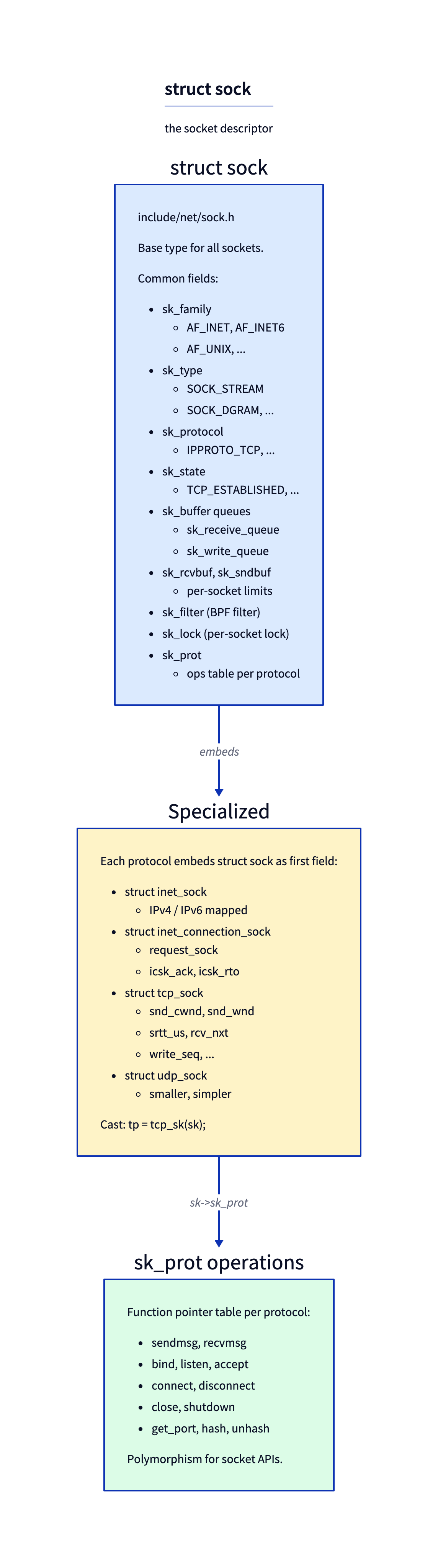
struct sock is huge (config-dependent, ~800 bytes on x86_64 — 808 in this build) and most of its fields are protocol-specific shadow state. Two structural tricks make it manageable: a shared first member (sock_common, below) and embedding for the protocol-specific layers.
Background 2: struct sock_common, the shared first member
Open struct sock and the first thing you see is not a normal field (include/net/sock.h:365):
struct sock {
        /*
         * Now struct inet_timewait_sock also uses sock_common, so please
         * just don't add nothing before this first member (__sk_common) --acme
         */
        struct sock_common      __sk_common;
#define sk_family       __sk_common.skc_family
#define sk_state        __sk_common.skc_state
#define sk_daddr        __sk_common.skc_daddr
#define sk_rcv_saddr    __sk_common.skc_rcv_saddr
#define sk_dport        __sk_common.skc_dport
#define sk_prot         __sk_common.skc_prot
#define sk_net          __sk_common.skc_net
        /* ... ~30 more #defines, then the real fields ... */
};
Here’s the part that trips people up: every “field” you’ll see written as sk->sk_state, sk->sk_family, sk->sk_daddr, sk->sk_dport, sk->sk_prot is a #define alias onto __sk_common.skc_*. They are not direct members of struct sock at all — they live inside the embedded sock_common at offset 0. The aliases exist so the code reads naturally; the storage is shared.
Why does this matter? Because sock_common is deliberately the first member of three different structs:
- full sockets —
struct sock(__sk_common,include/net/sock.h:365); - TIME_WAIT minisockets —
struct inet_timewait_sock(__tw_common,include/net/inet_timewait_sock.h:38); - the request-sock / half-open path —
struct request_sock(__req_common,include/net/request_sock.h:51), theTCP_NEW_SYN_RECVstate.
Because all three begin with an identical sock_common block, the established hash (ehash, below) can store and compare any of them uniformly by the 4-tuple (saddr, sport, daddr, dport) — those fields live in sock_common, so the lookup never has to know whether a given hash entry is a full multi-kilobyte socket, a tiny TIME_WAIT stub, or a half-open request. One bucket, three shapes, one comparison. That’s the entire reason a ~230-byte TIME_WAIT/request minisocket (sock_common itself is 136 bytes; inet_timewait_sock and request_sock are each 232) and a ~2.4 KB tcp_sock can sit side by side in the same hash chain.

Embedding: the protocol-specific layers
The same first-field trick is applied one level up to build the protocol hierarchy. Each richer socket type embeds the simpler one as its first member:
struct sock { struct sock_common __sk_common; /* + queues, locks, callbacks */ ... };

struct inet_sock { struct sock sk; /* IPv4/IPv6-common stuff */ ... };
struct inet_connection_sock { struct inet_sock icsk_inet; /* + retransmit/RTO */ ... };
struct tcp_sock { struct inet_connection_sock inet_conn; /* + cwnd/snd_wnd/srtt/... */ ... };
struct udp_sock { struct inet_sock inet; /* + udp-specific */ ... };
A pointer to a tcp_sock is also a valid pointer to an inet_connection_sock, also a valid pointer to an inet_sock, also a valid sock — they all start at the same address. C’s structural inheritance via “first field” embedding. Helper macros do the cast:
struct tcp_sock *tp = tcp_sk(sk);     // container_of: compile-time cast to tcp_sock
struct udp_sock *up = udp_sk(sk);
struct inet_sock *inet = inet_sk(sk);
These are container_of (tcp_sk is container_of_const(ptr, struct tcp_sock, inet_conn.icsk_inet.sk), include/linux/tcp.h:561). For a first member, container_of computes “pointer minus offsetof(member)” where the offset is 0, so it’s a free, no-op pointer cast. (tcp_sk’s member chain inet_conn.icsk_inet.sk happens to be all first members — inet_conn at offset 0 of tcp_sock, icsk_inet at 0 of inet_connection_sock, sk at 0 of inet_sock — so its cumulative offset is still 0, a no-op. The same macro also works for genuinely non-first members, where it subtracts a non-zero offset.)
Background 3: the two dispatch tables — proto_ops vs proto
The polymorphism — “the same syscall does different things for TCP vs UDP” — lives in function-pointer tables (vtables). But there are two of them, at two different layers, and confusing them is the single most common way to get lost in this code. Let’s name both.
The BSD layer: struct socket->ops (a proto_ops)
struct socket->ops points at a struct proto_ops (include/linux/net.h:181) — the BSD-API layer. It is shared by all AF_INET stream sockets (the instance is inet_stream_ops, net/ipv4/af_inet.c:1062). Its job is protocol-independent glue: argument validation, then dispatch downward.
struct proto_ops {
        int  family;
        int  (*release)(struct socket *sock);
        int  (*bind)   (struct socket *sock, struct sockaddr_unsized *, int);
        int  (*connect)(struct socket *sock, struct sockaddr_unsized *, int, int);
        int  (*accept) (struct socket *sock, struct socket *newsock, ...);
        __poll_t (*poll)(struct file *, struct socket *sock, ...);
        int  (*listen) (struct socket *sock, int len);
        int  (*sendmsg)(struct socket *sock, struct msghdr *, size_t);
        /* ... */
};
Note the signatures: everything takes a struct socket *. This is the table the VFS layer reaches through. inet_stream_ops wires .listen = inet_listen, .bind = inet_bind, .sendmsg = inet_sendmsg, etc. (net/ipv4/af_inet.c:1062).
The protocol layer: struct sock->sk_prot (a proto)
struct sock->sk_prot points at a struct proto (include/net/sock.h:1291) — the protocol layer. The instance for TCP is tcp_prot; for UDP, udp_prot. Its job is the actual protocol logic.
struct proto {
        void (*close)     (struct sock *sk, long timeout);
        int  (*connect)   (struct sock *sk, struct sockaddr_unsized *, int);
        struct sock *(*accept)(struct sock *sk, struct proto_accept_arg *arg);
        int  (*init)      (struct sock *sk);
        int  (*sendmsg)   (struct sock *sk, struct msghdr *, size_t);
        int  (*recvmsg)   (struct sock *sk, struct msghdr *, size_t, ...);
        int  (*bind)      (struct sock *sk, struct sockaddr_unsized *, int);
        int  (*hash)      (struct sock *sk);
        int  (*get_port)  (struct sock *sk, unsigned short snum);
        /* ... ~40 more callbacks ... */
        struct kmem_cache *slab;        /* per-protocol object cache (Background 5) */
        unsigned int       obj_size;
};
Note these signatures take a struct sock *. Same verb names sometimes appear in both tables (connect, sendmsg, bind) — that’s exactly why they’re easy to confuse.
One syscall crosses both tables
The two layers are stacked: the BSD layer validates and dispatches down to the protocol layer. The cleanest example is bind(). The BSD-level inet_bind (net/ipv4/af_inet.c:472, a proto_ops .bind) does protocol-independent validation — address length, SO_REUSEADDR/REUSEPORT checks — and then calls down:
/* inside __inet_bind, net/ipv4/af_inet.c:543 */
err = sk->sk_prot->get_port(sk, snum);   /* a *proto* op: TCP's inet_csk_get_port */
So a single bind(2) syscall touches both vtables: socket->ops->bind (the proto_ops inet_bind) → sk->sk_prot->get_port (the proto op inet_csk_get_port). Likewise send() crosses both: socket->ops->sendmsg (inet_sendmsg) → sk->sk_prot->sendmsg (tcp_sendmsg).
Some operations live mostly in one table. listen() has no proto->listen slot, so it dispatches only through proto_ops (inet_listen) — but inet_listen still reaches into proto ops (get_port, hash) and allocates the accept queue. connect(), get_port, and the real TCP logic are proto ops. And RAW sockets are the rare case that define sk_prot->bind directly (most protocols leave it NULL and rely on inet_bind → get_port).
The mental model: proto_ops sits on struct socket and faces userspace; proto sits on struct sock and faces the wire. So when the lifecycle below says a syscall “dispatches through sk->sk_prot,” that’s only the bottom half of the story — the top half went through socket->ops first.

There are no Dumb Questions
Q: Why two structs —
struct socketandstruct sock— instead of one?A: Because they serve two different audiences.
struct socketis the BSD-API handle: one per FD, protocol-independent, the thing the VFS layer reaches throughproto_ops.struct sockis the protocol state: queues, theprotovtable, the route cache — the thing the wire side touches. The split lets the samestruct socketAPI drive AF_INET, AF_UNIX, AF_NETLINK, etc., and lets kernel-internal sockets exist with asockbut no FD-bearingsocket/fileat all (Background 1).Q: Then why does
bind()have to touch two vtables?A: Because the work splits cleanly across the two layers. The protocol-independent half — validating the address length, honoring
SO_REUSEADDR/REUSEPORT— lives in the BSD layer (proto_ops->bind=inet_bind). The protocol-specific half — actually reserving the port in TCP’s bind hash — lives in the protocol layer (proto->get_port=inet_csk_get_port). One syscall, one descent through both tables.
Key fields you’ll see everywhere
sk_family            // AF_INET, AF_INET6, AF_UNIX, AF_NETLINK, ...  (alias into sock_common)
sk_type              // SOCK_STREAM, SOCK_DGRAM, SOCK_RAW, ...
sk_protocol          // IPPROTO_TCP, IPPROTO_UDP, ...
sk_state             // TCP_ESTABLISHED, TCP_LISTEN, ... (alias into sock_common;
                     //   TCP-specific but reused by UDP for connected sockets)
sk_receive_queue     // skb_queue: incoming packets waiting to be read
sk_write_queue       // skb_queue: outgoing skbs not yet ACKed (TCP)
sk_backlog           // packets parked here while the socket lock is held (Background 4)
sk_rcvbuf, sk_sndbuf // per-socket buffer limits
sk_filter            // BPF socket filter (sk_attach_filter)
sk_lock              // the special socket lock (lock_sock / release_sock — Background 4)
sk_data_ready        // callback fired when data arrives (Background 4)
sk_prot              // the proto vtable (alias into sock_common)
sk_dst_cache         // refcounted route entry — see Day 8
sk_net               // pointer back to the netns (alias into sock_common)
Background 4: the socket lock and the receive-wakeup model
The field list above mentions sk_lock, sk_backlog, sk_receive_queue, and sk_data_ready, and the lifecycle below will say connect()/accept() “sleep until something arrives.” All of that is hand-waving until you understand three things: the special socket lock, the backlog queue, and how an arriving packet wakes a sleeping reader. These are load-bearing for every remaining Phase-3 chapter (UDP/TCP receive, and epoll on Day 19).
sk_lock is not a plain spinlock
A socket is touched from two completely different contexts at once:
- process context — your
recv()/send()syscall, running in a schedulable task that is allowed to sleep; - softirq context — the NET_RX path from Day 2, delivering an arriving packet, which must not sleep.
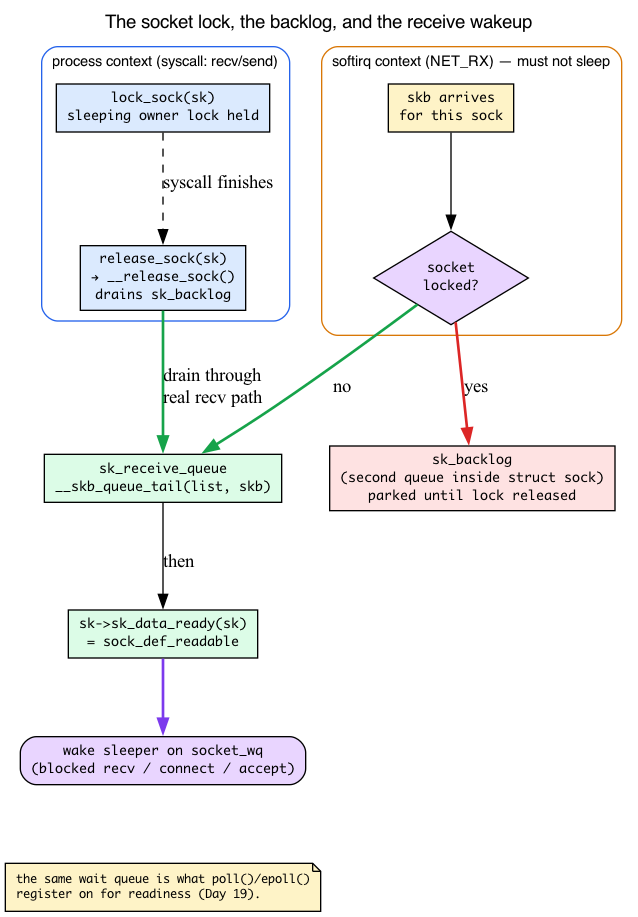
A plain spinlock can’t bridge those: process context may need to hold the socket across a sleep (e.g. waiting for buffer space), but you can’t hold a spinlock across a sleep. So sk_lock is a hybrid owner lock. lock_sock() (include/net/sock.h:1711, which calls lock_sock_nested at :1709) takes a sleeping owner lock used by process context. While a syscall holds it, softirq-context delivery is not allowed to touch the socket’s receive queue.
The backlog: where packets wait out the lock
But packets keep arriving while your syscall holds the lock. They can’t be dropped, and they can’t go into sk_receive_queue (the lock owner might be mid-traversal). So they’re parked on the backlog — a tiny second queue inside struct sock (include/net/sock.h:420):
struct {
        atomic_t        rmem_alloc;
        int             len;
        struct sk_buff  *head;
        struct sk_buff  *tail;
} sk_backlog;
#define sk_rmem_alloc sk_backlog.rmem_alloc
This is why struct sock carries both sk_receive_queue and the sk_backlog sub-struct. The decision is: if the socket is locked, push the skb onto sk_backlog; otherwise queue it normally. When the syscall finishes, release_sock() (net/core/sock.c:3819) calls __release_sock() (net/core/sock.c:3208), which drains the backlog through the real receive path before dropping the lock. Nothing is lost; it’s just deferred past the critical section.
The wakeup: sk_data_ready and the wait queue
Now the other half — how does a blocked recv() wake up? When the stack queues a packet onto the receive queue, it calls the socket’s data-ready callback (net/core/sock.c:514–518):
        __skb_queue_tail(list, skb);
        ...
        sk->sk_data_ready(sk);
sk_data_ready (include/net/sock.h:453) is a function pointer. The default, wired up by sock_init_data (net/core/sock.c:3779, which sets sk->sk_data_ready = sock_def_readable at :3734), is sock_def_readable (net/core/sock.c:3614). It wakes any process sleeping on the socket’s wait queue.
Where’s the wait queue? It lives in struct socket->wq (a socket_wq), reached from the sock side via sk->sk_wq / sk_sleep(sk). A blocking accept()/recvmsg() adds itself to that queue and schedules away; when data (or a completed connection) arrives, sk_data_ready (default sock_def_readable, net/core/sock.c:3614) runs and its wakeup callback pulls the sleeper back to runnable. A blocking connect() parks on the same queue but is woken differently: handshake completion (tcp_finish_connect) flips the state to ESTABLISHED and fires sk->sk_state_change(sk) (default sock_def_wakeup, net/core/sock.c:3591, wired at :3733), not sk_data_ready. Both callbacks wake the same sk_wq->wait queue, so “sleeps until the SYN-ACK arrives” resolves either way — but for connect the named mechanism is the state-change/sock_def_wakeup path, while recvmsg/accept ride sk_data_ready/sock_def_readable.
This same wait queue is what poll()/epoll() register on for readiness notifications — which is exactly how Day 19 builds epoll on top of it. And the limits that decide when these queues count as “full” are sk_rcvbuf / sk_sndbuf (in the field list) — the very numbers today’s experiment inspects with ss -tim.
Lifecycle
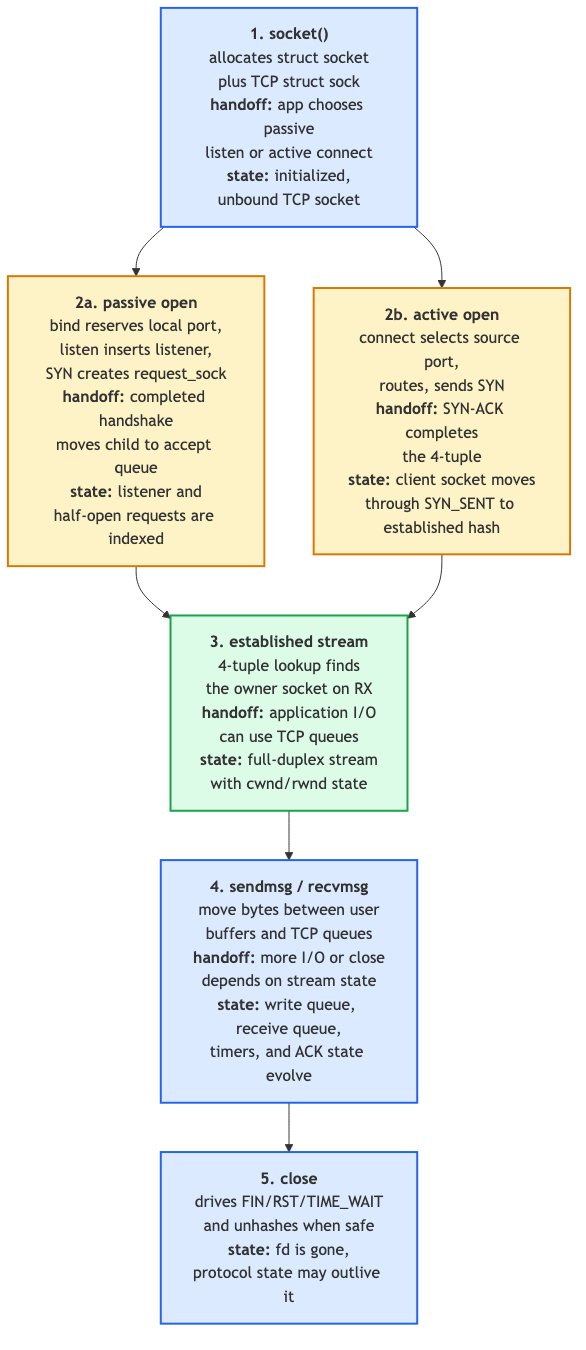
Now walk a TCP server’s lifecycle, kernel-side, with every “looks up the socket from the FD” backed by Background 1 and every “dispatches” backed by Background 3.
socket(AF_INET, SOCK_STREAM, 0)
- Userspace calls the syscall — handled at
net/socket.c:1819SYSCALL_DEFINE3(socket, ...). __sock_create(net/socket.c:1594) allocates thestruct socketviasock_alloc(), then walksnet_families[AF_INET]to find the protocol family’screatecallback and invokes it with that already-allocated socket.- For AF_INET that callback is
inet_create(net/ipv4/af_inet.c:259). It:- Allocates the
struct sockviask_alloc(net/ipv4/af_inet.c:333), drawing a wholetcp_sock(orudp_socketc.) from the protocol’sprot->slabcache (Background 5). It does not allocate thestruct socket(already done above) or thestruct file(created later). - Calls
sock_init_data(net/ipv4/af_inet.c:362) to wire the generic defaults — includingsk_data_ready = sock_def_readablefrom Background 4 — before the protocol’sprot->initruns. - Then calls the protocol’s
prot->init(net/ipv4/af_inet.c:390) — for TCP,tcp_init_sock(net/ipv4/tcp.c:421) — for TCP-specific initialization: snd_cwnd, ssthresh, smoothed RTT/RTO, the retransmit (write) queue, sndbuf/rcvbuf. (No accept queue here — that’s alisten()-time allocation; see below.) - Returns. Back in
__sys_socket,sock_map_fd→sock_alloc_file(net/socket.c:1780) now creates the sockfsstruct fileand installs the FD: the FD points at the file, the file’sprivate_datapoints at the socket, the socket’sskpoints at the sock.
- Allocates the
Background 5: where the sock object comes from (slab — recall Day 1)
The allocation in step 3 is worth one line. Recall the slab allocator from Day 1: fixed-size object caches that make allocation an O(1) “pop a free slot.” Each struct proto owns its own dedicated slab cache (prot->slab, with prot->obj_size, include/net/sock.h:1382), so allocating a tcp_sock is a fast fixed-size slab alloc, not a general kmalloc. The object size is the full derived struct — a whole tcp_sock (~2 KB), not just struct sock — which is exactly why obj_size is set per protocol. inet_create (net/ipv4/af_inet.c:259) allocates through this per-protocol cache.
bind(fd, ...)
- Looks up
struct socketfrom the FD (Background 1:fd→file→private_data). - Calls
sock->ops->bind— for AF_INET TCP that’sinet_bind(net/ipv4/af_inet.c:472), aproto_opsop (Background 3). __inet_bindvalidates, then callssk->sk_prot->get_port(sk, snum)(net/ipv4/af_inet.c:543) — aprotoop, crossing from the BSD table to the protocol table. For TCP that’sinet_csk_get_port(net/ipv4/inet_connection_sock.c:500), which reserves the port in the per-netns bind hash table (tcp_hashinfo.bhash). (A separatesk_prot->bindhook exists too, but only RAW sockets define it.)- The bind table is keyed by
(netns, port)— that’s why two netns can both bind:80.
listen(fd, backlog)
A pure proto_ops op (inet_listen, net/ipv4/af_inet.c:237). Marks the sock as TCP_LISTEN. Allocates the accept queue: a FIFO list of completed connections waiting for accept() (request_sock_queue.rskq_accept_head). Half-open handshakes (SYN_RECV) don’t live here — they sit in the established hash as TCP_NEW_SYN_RECV request socks (those sock_common-fronted minisockets from Background 2) until the handshake finishes.
connect(fd, ...) — client side
- Looks up the sock from the FD.
- Calls
sk->sk_prot->connect— for TCPtcp_v4_connect(net/ipv4/tcp_ipv4.c:221), aprotoop. - Sets sock state to
TCP_SYN_SENT, then callsinet_hash_connectto pick a source port (ephemeral range) and insert into the established hash (tcp_hashinfo.ehash) keyed by 4-tuple. - Calls
tcp_connectto build and send the SYN. - Returns
EINPROGRESS(non-blocking) or sleeps until the SYN-ACK arrives (blocking) — that sleep is exactly Background 4: the task parks on the socket’s wait queue, and handshake completion wakes it via the state transition toESTABLISHED(sk_state_change/sock_def_wakeup), notsk_data_ready.
accept(fd, ...) — server side
- Pops a completed connection from the accept queue (blocking via the same wait-queue mechanism if the queue is empty).
- Allocates a new FD wrapping the new
sock(a fresh sockfs file, Background 1). - Returns the FD.
The original listening socket stays — accept just hands you a new socket for the connection.
The two hash tables: bhash and ehash
struct inet_hashinfo (used by TCP — UDP has its own struct udp_table, see Day 14) holds two key data structures:
bhash— the bind hash. Keyed by port number; each bucket holds a list of bound sockets (multiple ifSO_REUSEPORT). Lookup onbind()and on incoming SYN to find listener.ehash— the established hash. Keyed by the 4-tuple(saddr, sport, daddr, dport). Lookup on every incoming TCP packet to find the existing connection. This is the hash that holds full socks, TIME_WAIT minisocks, andTCP_NEW_SYN_RECVrequest socks side by side — possible only because all three sharesock_commonas their first member (Background 2).
Per-netns. Alongside bhash/ehash, struct inet_hashinfo carries a separate listener table, lhash2, hashed by (local port, local address). It’s a sibling of the bind and established tables, not part of bhash, and it speeds up finding the listening socket on an incoming SYN (it also carries the SO_REUSEPORT groups that listener lookup then selects from — Day 24).
How an arriving segment finds its socket: the two-tier lookup
Here’s the part the static field list above skips, and it’s the whole reason these two tables exist. Every TCP segment that arrives off the wire is just bytes with a 4-tuple in its headers — (saddr, sport, daddr, dport). Somewhere in the kernel there may be a struct sock that owns this conversation, or a listener willing to start one, or nobody at all. Demultiplexing is the act of turning that 4-tuple into the right sk pointer, and it happens on every single inbound packet. Get the mental model for this and the rest of L4 falls into place, because every later day (TCP state machine, congestion control, retransmission) assumes the segment has already been routed to its sock.
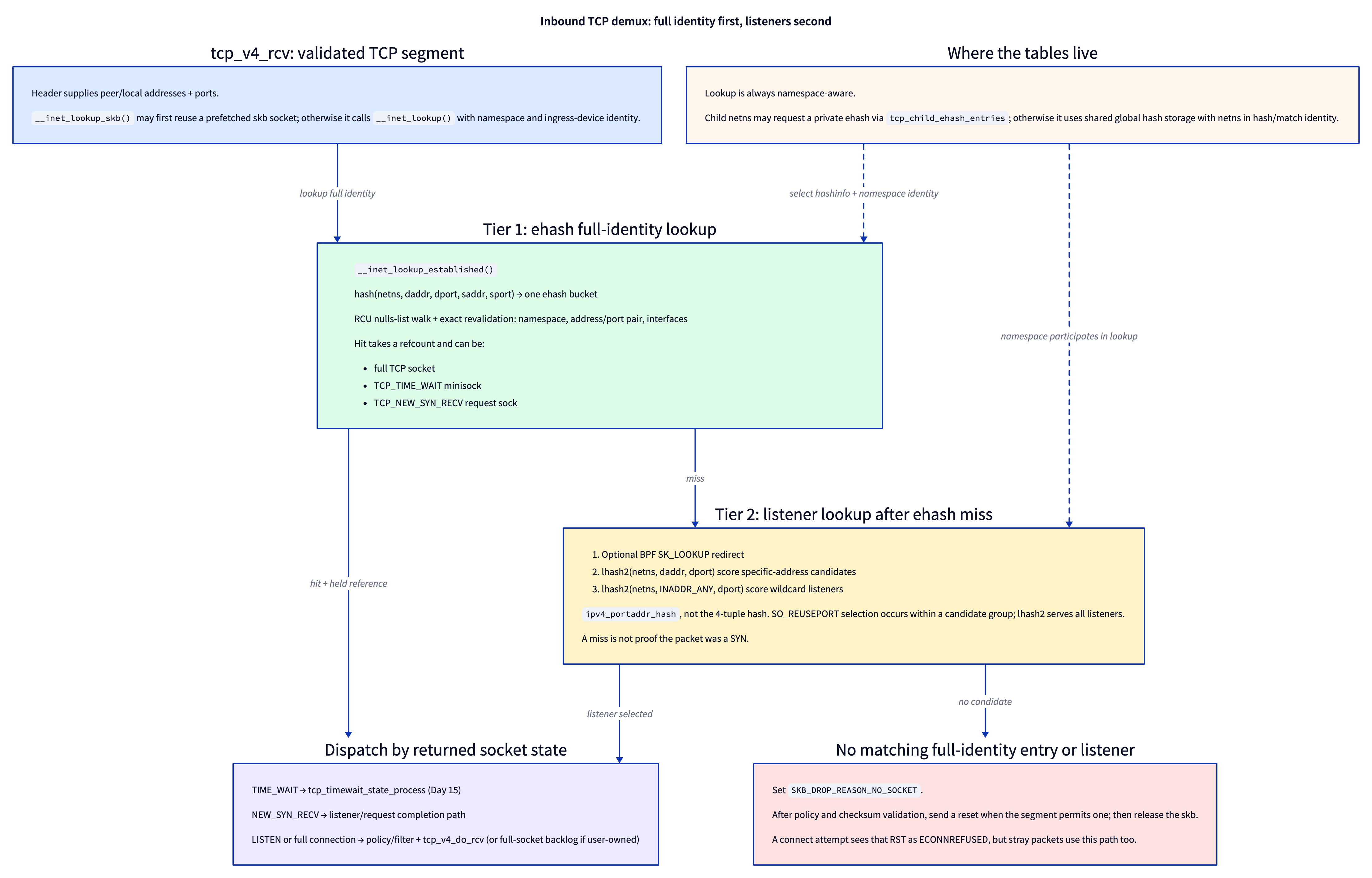
The entry point is tcp_v4_rcv, which calls __inet_lookup_skb → __inet_lookup. That helper searches in two tiers, in a deliberate order:
- Try the ehash first — entries with full identity.
__inet_lookup_establishedcomputesinet_ehashfn(net, daddr, dport, saddr, sport), selects one bucket, and walks its nulls list under RCU.inet_matchverifies namespace, exact address/port pair, and interface constraints. A hit can be a full connection, a TIME_WAIT minisock, or aTCP_NEW_SYN_RECVrequest sock;tcp_v4_rcvbranches on those special states before normal full-socket processing. Day 15 follows the TIME_WAIT branch through the full-socket-to-minisock hand-off and eventual timer expiry. - Only if ehash misses, try listener lookup.
__inet_lookup_listenerfirst offers the segment to the BPFSK_LOOKUPhook when enabled. It then hashes(netns, daddr, dport)withipv4_portaddr_hashand searches thatlhash2bucket; if no specific-address listener wins, it repeats withINADDR_ANY. Candidate scoring accounts for namespace, address, and bound-device specificity. A reuseport candidate invokesreuseport_select_sock, but lhash2 is the normal listener table, not a reuseport-only structure.
An ehash miss is not proof that the segment is a SYN — stray ACKs and other unmatched segments take the same fallback. TCP state processing decides what a listener accepts. The ordering still optimizes the common data path: established traffic performs one full-identity bucket lookup, while wildcard/scored listener selection runs only after that misses.
Two consequences fall out of this:
- An ehash hit takes a refcount.
__inet_lookup_establishedusesrefcount_inc_not_zeroand revalidates the match before returning, so an established/request/TIME_WAIT entry cannot vanish mid-RX. The listener path is RCU-protected and reportsrefcounted = false; its caller follows the appropriate listener lifetime rules. - Both tiers missing is the “no socket” path.
tcp_v4_rcvassignsSKB_DROP_REASON_NO_SOCKETand, after policy/checksum checks, sends a reset for a segment that permits one. A connect attempt observes that reset asECONNREFUSED; not every no-socket packet corresponds to a userspace connect.
Today’s experiment
# Inspect socket state
ss -tan       # TCP all numeric
ss -ti        # TCP with internal info: rtt, cwnd, retrans

# Trace lifecycle of one connection
sudo bpftrace -e '
fentry:tcp_init_sock { printf("init %p\n", args->sk); }
fentry:inet_csk_get_port { printf("get_port port=%d\n", args->snum); }
fentry:tcp_v4_connect { printf("connect %p\n", args->sk); }
fentry:tcp_set_state { printf("set_state %p -> %d\n", args->sk, args->state); }
'

# In another terminal:
nc -l 9999 &
echo hi | nc -q 1 localhost 9999

# Stop tracer (Ctrl-C in the bpftrace shell)
You’ll see init → get_port (server) → init (client) → connect → set_state through SYN_SENT → ESTABLISHED → CLOSE_WAIT → LAST_ACK → CLOSE.
tcp_set_state prints the new state as a raw integer, not a name — so a line like set_state 0xffff... -> 2 means “this sock moved to SYN_SENT.” The mapping (from include/net/tcp_states.h) is: 1=ESTABLISHED, 2=SYN_SENT, 3=SYN_RECV, 4=FIN_WAIT1, 5=FIN_WAIT2, 6=TIME_WAIT, 7=CLOSE, 8=CLOSE_WAIT, 9=LAST_ACK, 10=LISTEN, 11=CLOSING. (There’s also TCP_NEW_SYN_RECV in that enum — the half-open minisocket state from Background 2 — but tcp_set_state isn’t the path that sets it.) The two distinct %p sock pointers tell the server listener apart from the client connection — each transitions through its own sequence. To read the states as names directly, decode them in a BEGIN block (so the map is populated once, not re-assigned on every hit):
sudo bpftrace -e '
BEGIN { @sn[1]="ESTABLISHED";@sn[2]="SYN_SENT";@sn[3]="SYN_RECV";@sn[4]="FIN_WAIT1";@sn[5]="FIN_WAIT2";@sn[6]="TIME_WAIT";@sn[7]="CLOSE";@sn[8]="CLOSE_WAIT";@sn[9]="LAST_ACK";@sn[10]="LISTEN";@sn[11]="CLOSING"; }
fentry:tcp_set_state { printf("set_state %p -> %s\n", args->sk, @sn[args->state]); }
END { clear(@sn); }
'
See the bind/established hashes
# Bound listening sockets:
sudo ss -tlnp

# Only the established (ehash) entries, with owning process:
sudo ss -tnp state established

# (ss -tap would also include LISTEN sockets from the bhash above —
#  the `state established` filter isolates the ehash side of the contrast.)

# Memory accounting:
ss -tim
ss reads from /proc/net/tcp (and the netlink-based INET_DIAG). The numbers come straight from the per-sock state — including the sk_rcvbuf/sk_sndbuf limits and the receive-queue occupancy that Background 4 explained govern wakeups and “queue full” decisions.
What to read in the kernel
-
net/socket.c:590—sock_from_file. Three lines: thef_op == &socket_file_opscheck, thenreturn file->private_data. This is the FD→socket bridge. -
net/socket.c:612—sockfd_lookup.fget(fd)→sock_from_file. The whole “look up the socket from the FD” step every syscall starts with. -
include/linux/net.h:137—struct socket. Notefile,sk,ops,wqliving side by side. -
include/linux/net.h:181—struct proto_ops. The BSD/socket-level vtable (every callback takesstruct socket *). -
include/net/sock.h:365—struct sock. Read all fields (~150 lines of struct). First notestruct sock_common __sk_commonat offset 0 and the long#define sk_* __sk_common.skc_*block right after it — those aliases are whysk->sk_stateworks. Then the__cacheline_group_begin/__cacheline_group_endmacros grouping fields into hot/cold cache lines (sock_write_rx,sock_read_rx, etc.). This struct is one of the most cache-line-tuned in the kernel; respect the layout. -
include/net/sock.h:420— thesk_backlogsub-struct (with#define sk_rmem_alloc). The second receive queue used while the socket lock is held. -
include/net/sock.h:453—sk_data_ready(and the nearby callback pointers). The receive-wakeup hook. -
include/net/sock.h:1291—struct proto. The protocol/sock-level vtable (every callback takesstruct sock *); notehash/get_portat:1339/:1342andslab/obj_sizeat:1382. -
include/net/sock.h:1711—lock_sock(andlock_sock_nestedat:1709,release_sockdeclared at:1717). The special sleeping owner lock. -
net/core/sock.c:3208—__release_sock. Drainssk_backloginto the real receive path.net/core/sock.c:3614—sock_def_readable, the defaultsk_data_readythat wakessk_sleep(sk).net/core/sock.c:3779—sock_init_data, where the defaults get wired. -
include/net/inet_sock.h:218—struct inet_sock. Adds IPv4/IPv6 common fields: addresses, ports, ttl, mc_addr, sk_dst_cache. Quick read. -
include/net/inet_connection_sock.h:81—struct inet_connection_sock. Adds retransmit timer, accept queue, ack delay timer. The “connection-oriented” base for TCP and DCCP. -
include/linux/tcp.h:197—struct tcp_sock. The full TCP state. ~150 fields covering snd_wnd, snd_cwnd, srtt_us, rcv_nxt, write_seq, sack info, RACK, retrans queue. Don’t try to memorize; just know it’s there and grep when you need a specific field. (tcp_skis#defined atinclude/linux/tcp.h:561.) -
net/socket.c:1819—SYSCALL_DEFINE3(socket, ...). The userspace entry. ~50 lines. Walk through to see how a syscall becomes astruct socket. -
net/socket.c:1594—__sock_create. The protocol-family dispatch. Readsnet_families[family]and calls the registered create callback. (sock_create_kernatnet/socket.c:1739is the no-FD variant for kernel-internal sockets.) -
net/ipv4/af_inet.c:259—inet_create. AF_INET’s create. Allocates the sock from the protocol’s slab cache, sets up inet_sk fields, calls protocol-specific init. -
net/ipv4/af_inet.c:472—inet_bind. The bind path (aproto_ops .bind). Validates addr_len, checks SO_REUSEADDR/REUSEPORT, then atnet/ipv4/af_inet.c:543dispatches tosk->sk_prot->get_port. Useful to understand whybind(0.0.0.0, port)andbind(127.0.0.1, port)behave differently. -
net/ipv4/inet_connection_sock.c:500—inet_csk_get_port. Port reservation. Read this to understand SO_REUSEPORT (Day 24): the function walks bind hash buckets and decides whether collision is allowed based on thereuseflag and UID match. -
net/ipv4/tcp.c:421—tcp_init_sock. TCP per-socket init. Sets up cwnd, ssthresh, RTT estimators, the retransmit (write) queue, sndbuf/rcvbuf. (Not the accept queue — that’s allocated atlisten()time byinet_csk_listen_start.) Read this once to see what state a fresh TCP socket starts with. -
net/ipv4/tcp_ipv4.c:221—tcp_v4_connect. The client connect path. Walk through: route lookup, source-port allocation, ehash insertion, SYN build/send. -
Documentation/networking/kapi.rst— the networking kernel API reference, including the socket/struct sockinterfaces. Brief.
Bullet Points
- An FD reaches the kernel socket through the VFS layer:
fd→struct file→file->private_data=struct socket→socket->sk=struct sock.sock_from_file/sockfd_lookup(net/socket.c:590/:612) do the recovery; kernel-internal sockets (sock_create_kern) skip the FD entirely. struct socketis the BSD-level descriptor (one per FD);struct sockis the protocol-level state. They’re linked viasock->sk.- The first member of
struct sockisstruct sock_common __sk_common, and fields likesk_state/sk_daddr/sk_protare#definealiases into it.sock_commonis also the first member ofinet_timewait_sockandrequest_sock, which is what lets the ehash compare full socks, TIME_WAIT minisocks, andTCP_NEW_SYN_RECVrequest socks uniformly by 4-tuple. - Polymorphism via embedding:
tcp_sockembedsinet_connection_sockembedsinet_sockembedssock. Thetcp_sk()/udp_sk()/inet_sk()helpers arecontainer_of(offset-0 no-op casts here). - Two dispatch tables:
struct socket->opsis aproto_ops(BSD layer —inet_stream_ops: bind/listen/poll/sendmsg, all takingstruct socket *);struct sock->sk_protis aproto(protocol layer —tcp_prot: get_port/connect/sendmsg, all takingstruct sock *). One syscall crosses both:bind()=inet_bind(proto_ops) →get_port(proto). - The socket lock (
lock_sock/release_sock) is a sleeping owner lock. While process context holds it, arriving packets are parked onsk_backloginstead ofsk_receive_queue;release_sockdrains the backlog. Arriving data callssk_data_ready(defaultsock_def_readable), which wakes any task sleeping on the socket’s wait queue — the mechanism behind blockingrecv()and behind epoll (Day 19). - Each
struct protoowns a dedicated slab cache (prot->slab,obj_size= the full derived struct liketcp_sock) — the same slab allocator from Day 1. - Bind tables (
tcp_hashinfo.bhash) and established tables (ehash) are per-netns. accept()returns a newsocktaken from the listener’s accept queue — the listener stays.- Inspect with
ss, especiallyss -tipsmfor full per-socket metadata.
Check question
Why do struct tcp_sock and struct udp_sock both embed struct inet_sock as their first field, rather than struct sock directly?
Click to reveal answer
Answer: inet_sock adds IPv4/IPv6-common fields (rcv_saddr, daddr, sport, dport, ttl, etc.) that any IP-based protocol needs. By inheriting from inet_sock, TCP and UDP share these fields without duplication, and the helper inet_sk(sk) returns a meaningful pointer for both. Non-IP protocols like UNIX sockets (struct unix_sock) skip inet_sock and embed sock directly because they don’t have IP semantics — there’s no source/dest IP address. The hierarchy is essentially “protocol-family base classes”: sock for everything, inet_sock for IP-based, inet_connection_sock for connection-oriented IP-based. (And one level deeper, sock itself starts with sock_common, the base shared even by minisockets.)
Tomorrow
Day 14: UDP — the simpler protocol. From sendmsg to wire and back, with the per-port lookup that makes UDP receive cheap — and the receive queue plus sk_data_ready wakeup you just learned put to work for real.