Day 14 — UDP: the simple protocol
Today’s mission: trace a UDP packet end to end. See why “connectionless” simplifies the kernel-side code dramatically — and learn the four mechanisms the path leans on (the 8-byte wire header and its checksum, the sleep/wake rendezvous behind
recvmsg, the receive-memory budget that decides who gets dropped, and the UDP hash table that finds your socket) so nothing along the way is a black box. Total time: ~130 minutes.
UDP looks trivial from userspace: sendto, recvfrom, done. But that simplicity rests on four pieces of kernel machinery this chapter repeatedly leans on. We teach each one intuition-first, then the concrete v7.1 struct or function, and only then walk the path, with every stage resting on something you already understand.
Several things from earlier days are load-bearing today and will not be re-taught in full:
struct sock,sk_receive_queue,sk_protvtable dispatch — Day 13. When userspace callssendto, the kernel dispatchessk->sk_prot->sendmsg, which for UDP isudp_sendmsg.bhash(port-keyed) vsehash(4-tuple-keyed) — Day 13 taught TCP’s two-table split instruct inet_hashinfo. UDP has the analogous split but in its ownstruct udp_table; Day 13 deferred the details to today, and we teach them below.- The pseudo-header and the
CHECKSUM_PARTIALoffload contract — Day 4. The L4 checksum covers a pseudo-header built from the IP addresses; withCHECKSUM_PARTIALthe kernel fills in the pseudo-header sum and the NIC finishes the fold over the payload (skbuff.h:248-251). Today we apply that to UDP specifically.skb->truesize— Day 3 introduced it on the TCP send side (sk_wmem_queued): an skb’s true memory cost is payload plus headers plus per-skb struct overhead and page-fragment slack, not its on-wire length. Today we meet the same number on the receive side.sk->sk_wq, the socket wait queue — Day 13 named it as a field ofstruct socket. Today we teach the wake path that actually uses it.- The TX/IP output path — Day 3. Once
udp_sendmsghands the datagram toip_send_skb, it follows the sameip_local_out → ip_outputroad you already traced.
Why UDP first
UDP has no state machine, no retransmissions, no congestion control. One sendmsg produces one wire packet (or one fragmented packet, if size > path MTU). One recvmsg returns one datagram. Everything else — packet loss recovery, in-order delivery, flow control — is the application’s problem.
Understanding UDP gives you the baseline L4 path. TCP (Days 15–17) is “UDP plus a state machine plus retransmission plus congestion control” — knowing where the simple version ends helps you see where TCP’s complexity goes.
Background 1: the UDP wire header and what the checksum protects
Before we trace a sendmsg, look at what actually goes on the wire. The chapter later discusses UDP-Lite’s “partial checksum,” the InCsumErrors counter, and keeps saying “one sendmsg produces one wire packet” — none of which you can reason about without seeing the 8-byte header udp_sendmsg builds.
The whole protocol is 8 bytes
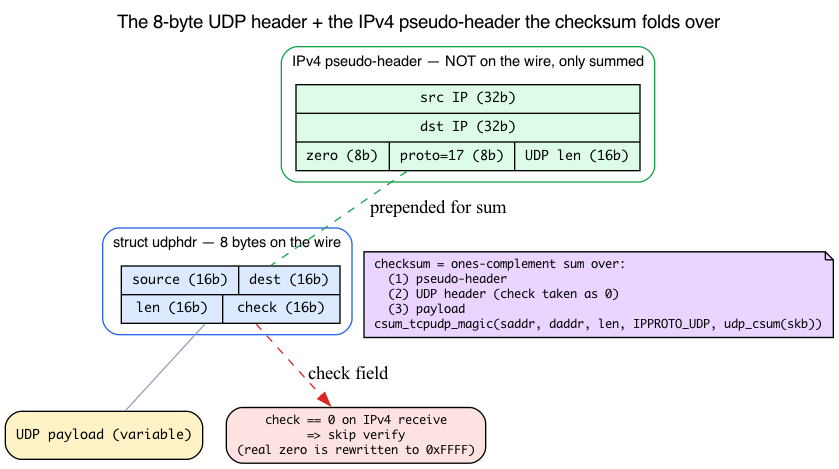
The entire UDP wire header is four 16-bit big-endian fields (include/uapi/linux/udp.h:23):
struct udphdr {
    __be16  source;   /* source port      */
    __be16  dest;     /* destination port */
    __be16  len;      /* UDP header + payload length, in bytes */
    __sum16 check;    /* checksum (see below) */
};
That is the whole protocol on the wire — 8 bytes. Contrast TCP’s 20+ byte header carrying sequence numbers, acknowledgments, a window, and flags. There is no sequence number because UDP never reorders or retransmits; no window because it never flow-controls; no flags because there are no connection states to signal. This minimal header is “why UDP is simple.” udp_send_skb (net/ipv4/udp.c:1092) fills these four fields in just before handing the skb to IP:
uh = udp_hdr(skb);
uh->source = inet_sk(sk)->inet_sport;
uh->dest   = fl4->fl4_dport;
uh->len    = htons(len);
uh->check  = 0;                 /* finalised below */
What the checksum folds over
UDP’s check field is a ones-complement sum over three things, in order:
- The pseudo-header — source IP, destination IP, a zero byte, the protocol number (
IPPROTO_UDP= 17), and the UDP length. (Recall the pseudo-header from Day 4 — the same construction TCP uses.) Folding the IP addresses into an L4 checksum ties the datagram to its endpoints, so a packet misdelivered to the wrong host or protocol is caught even though L4 alone couldn’t tell. - The UDP header (the 8 bytes above, with
checktaken as zero during computation). - The payload.
In v7.1 this is exactly the csum_tcpudp_magic call at the end of udp_send_skb:
uh->check = csum_tcpudp_magic(fl4->saddr, fl4->daddr, len,
                              IPPROTO_UDP, udp_csum(skb));
if (uh->check == 0)
    uh->check = CSUM_MANGLED_0;
csum_tcpudp_magic adds the pseudo-header to udp_csum(skb) (the sum over header+payload). The CHECKSUM_PARTIAL offload branch (Day 4’s contract) takes a different road — udp4_hwcsum seeds the pseudo-header sum and lets the NIC finish the fold over the payload — but the coverage is identical.
Why a zero checksum means “skip” on IPv4
Notice the if (uh->check == 0) uh->check = CSUM_MANGLED_0; above. On IPv4 the UDP checksum is optional: a received datagram whose check field is literally zero means “the sender did not compute a checksum; do not verify.” Because a genuinely-computed checksum can legitimately fold to zero, the sender rewrites that one value to the equivalent 0xFFFF (CSUM_MANGLED_0) so that an on-the-wire zero unambiguously means “absent.” The receive side honours this in udp4_csum_init (net/ipv4/udp.c:2536) via skb_checksum_init_zero_check — uh->check == 0 short-circuits verification entirely.
Why is this allowed? Because IPv4 has its own header checksum, so a corrupted address is caught at L3 even if L4 skips. IPv6 has no header checksum, so there is nothing to fall back on, and the UDP checksum is therefore mandatory there — a zero check on IPv6 receive is an error.
This optional-but-rewritable rule is exactly what UDP-Lite tweaks. UDP-Lite keeps the checksum mandatory but lets the application shrink the covered byte-range (the UDPLITE_SEND_CSCOV/UDPLITE_RECV_CSCOV sockopts): cover only the first N bytes — typically the media frame header — so a partly-corrupt video payload still gets delivered instead of dropped. Same udphdr on the wire; only the meaning of len/coverage changes.
Where a failed checksum shows up
When a received datagram’s checksum does not fold to zero, the kernel increments Udp: InCsumErrors. The MIB enum order (include/uapi/linux/snmp.h:158-162) is the same order the columns appear in /proc/net/snmp:
UDP_MIB_INDATAGRAMS,    /* InDatagrams  */
UDP_MIB_NOPORTS,        /* NoPorts      */
UDP_MIB_INERRORS,       /* InErrors     */
UDP_MIB_OUTDATAGRAMS,   /* OutDatagrams */
UDP_MIB_RCVBUFERRORS,   /* RcvbufErrors */
/* ... SndbufErrors, InCsumErrors, IgnoredMulti, MemErrors */
So InCsumErrors means “a datagram arrived but its checksum did not verify” — a corruption failure, distinct from NoPorts (a datagram arrived for a port with no listener) and RcvbufErrors (a datagram arrived but the receive queue had no room). The drops lab at the end of the chapter watches all three; now you know what each one means.
The TX side
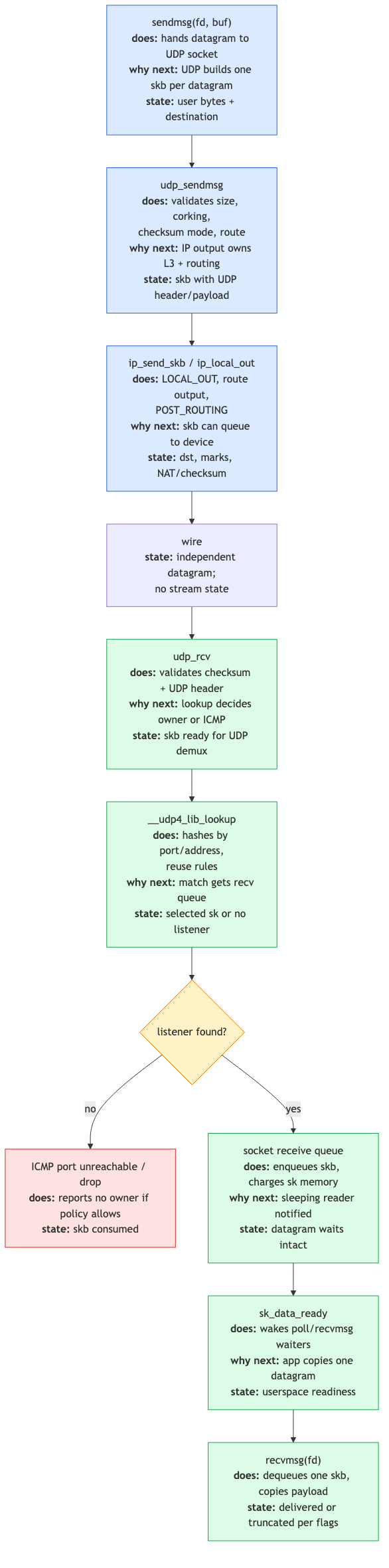
sendmsg(fd, msg, flags)
  → sock_sendmsg
    → udp_sendmsg                       // net/ipv4/udp.c:1233
      → ip_make_skb / ip_append_data    // net/ipv4/ip_output.c:1553, 1359
      → udp_send_skb                     // net/ipv4/udp.c:1092 (builds the 8-byte header above)
        → ip_send_skb                    // net/ipv4/ip_output.c:1506
          → ip_local_out → ip_output → ... (Day 3's TX path)
udp_sendmsg is roughly 274 lines of code — most of it option handling (MSG_CONFIRM, MSG_MORE, GSO_BY_FRAGS, control-message processing) and the route lookup for the destination. The actual datagram construction is a single call to ip_make_skb or, for cork mode, ip_append_data. The four-field header you just learned is stamped in by udp_send_skb right before ip_send_skb.
Why two paths (ip_make_skb and ip_append_data)?
ip_make_skb: build one skb directly from one userspace buffer. Fast path; one syscall, one packet.ip_append_data(corked): used whenMSG_MOREorUDP_CORKis set. The kernel accumulates writes into a partial skb; the nextsendmsg(orUDP_CORK off) finalizes it as one datagram. Useful when an application has multiple sources of data for one packet (header + payload built separately).
No socket-level send queue
Unlike TCP, UDP doesn’t keep an sk_write_queue of unsent skbs. As soon as udp_sendmsg builds the datagram, it’s handed to IP and gone. Why? Because UDP has no notion of retransmission — there’s no reason to keep the bytes around. The socket buffer (sk_sndbuf) only matters for back-pressure on sendmsg itself: if the IP stack can’t accept the packet right now (e.g., qdisc is full), sendmsg blocks or returns EAGAIN.
Background 2: the blocking/wake rendezvous behind recvmsg
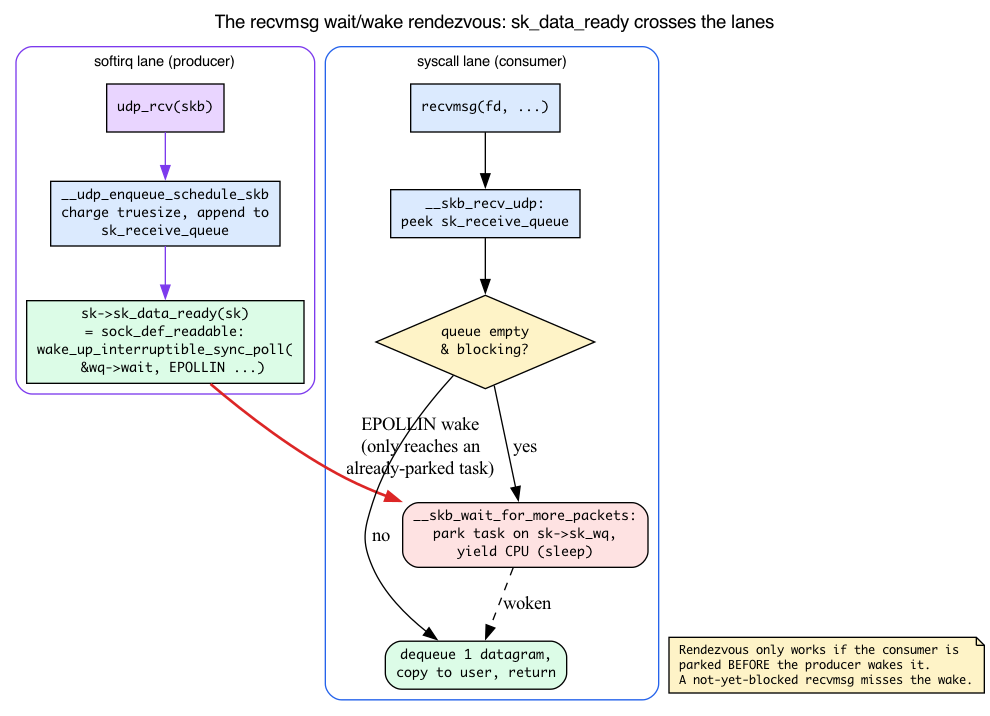
A receive queue only earns its keep because two parties meet at it: the softirq producer drops a datagram in, and the syscall consumer picks it up. The whole point is the rendezvous when the consumer arrives before the producer — a blocking recvmsg on an empty queue must somehow wait and then wake the instant a packet lands. That machinery is invisible in the call chains, so let’s teach it before tracing them.
The problem: don’t spin
A blocking recvmsg on an empty queue must not busy-loop burning a CPU. Instead it parks the calling task on the socket’s wait queue and yields the CPU. Every struct sock has exactly such a wait queue, reached via sk->sk_wq (Day 13 named this field; here is where it earns its keep). A parked task sleeps until something explicitly wakes it.
The wake: sk_data_ready
The single hook that turns “a packet landed in the queue” into “the application’s recvmsg returns” is sk->sk_data_ready. Its default, installed for every socket in sock_init_data (net/core/sock.c:3734):
sk->sk_data_ready = sock_def_readable;
sock_def_readable (net/core/sock.c:3614) is short and is the entire wake path:
void sock_def_readable(struct sock *sk)
{
    struct socket_wq *wq;
    trace_sk_data_ready(sk);
    rcu_read_lock();
    wq = rcu_dereference(sk->sk_wq);
    if (skwq_has_sleeper(wq))
        wake_up_interruptible_sync_poll(&wq->wait, EPOLLIN | EPOLLPRI |
                                        EPOLLRDNORM | EPOLLRDBAND);
    sk_wake_async_rcu(sk, SOCK_WAKE_WAITD, POLL_IN);
    rcu_read_unlock();
}
Two things happen: any sleeper parked on sk_wq is woken with an EPOLLIN poll-mask wake (that is what unblocks a sleeping recvmsg), and sk_wake_async_rcu fires the async/SIGIO and epoll/io_uring notifications. So sk_data_ready is the one call that services every waiter style — blocking recvmsg, select/poll/epoll, and SIGIO — from a single producer-side hook.
Wiring it together
The producer side calls this hook right after charging the datagram to the queue. In __udp_enqueue_schedule_skb (net/ipv4/udp.c:1745):
INDIRECT_CALL_1(READ_ONCE(sk->sk_data_ready),
                sock_def_readable, sk);
INDIRECT_CALL_1 is just the kernel’s indirect-call wrapper — it calls sk->sk_data_ready (the function pointer) while hinting the compiler that the target is almost always sock_def_readable, so the common case avoids a retpoline. The effect is simply sk->sk_data_ready(sk).
The consumer side loops in the dequeue path. __skb_recv_udp (net/ipv4/udp.c:1923) is the UDP dequeue entry the recvmsg path drives; it peeks/dequeues from sk_receive_queue (via its reader_queue), and if the queue is empty and the socket is blocking, its own dequeue loop calls __skb_wait_for_more_packets (net/core/datagram.c:89, invoked from net/ipv4/udp.c:1984) to sleep until sk_data_ready wakes it — or a timeout or signal fires. (UDP does not go through the generic __skb_recv_datagram loop at net/core/datagram.c:305; that path serves other datagram protocols. UDP carries its own loop so it can splice the producer-side queue and do its own memory accounting.)
This is also exactly why the experiment later insists you attach probes before sending: a wake only reaches a waiter that is already parked. The same reason a late-attached probe sees nothing, a not-yet-blocked recvmsg misses the wake — the rendezvous only works if the consumer is waiting when the producer arrives.
Background 3: the receive-memory budget (sk_rmem_alloc vs sk_rcvbuf)
The drops story below rests entirely on “if the queue is full, the packet is dropped.” But full of what? Not a count of datagrams, and not payload bytes — the answer is a memory budget, and getting it exactly right is what lets you predict when drops happen.
The budget and the meter
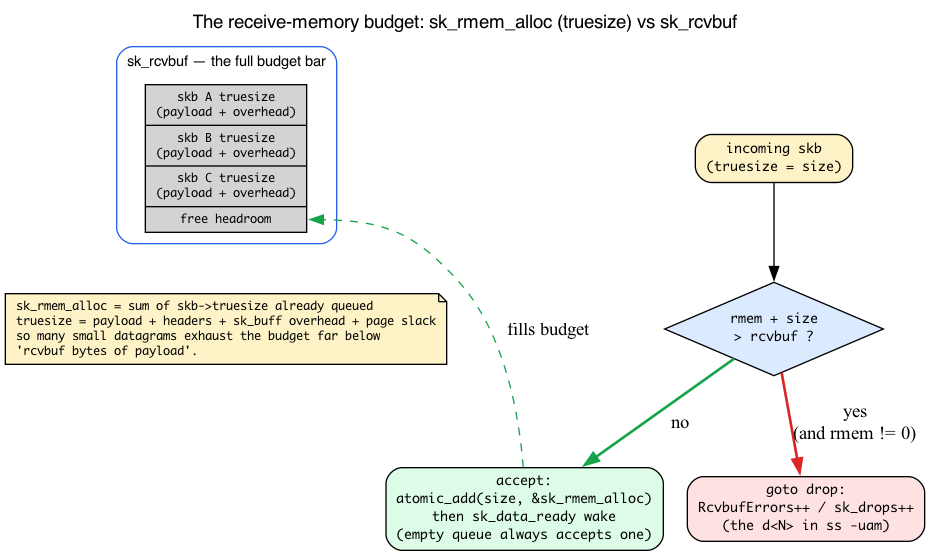
Each socket’s receive queue has a memory budget: sk_rcvbuf, initialised from net.core.rmem_default and raisable via SO_RCVBUF up to net.core.rmem_max. The running charge against it is sk_rmem_alloc, an atomic counter.
What gets charged is skb->truesize — recall from Day 3 (the send-side sk_wmem_queued accounting) that truesize is payload plus headers plus the sk_buff struct overhead plus page-fragment slack, not the on-wire length. The receive side uses the very same number. The consequence is sharp: many small datagrams, each in its own small skb, each carrying fixed per-skb overhead, can exhaust the budget far below “rcvbuf bytes of payload.” A 20-byte datagram can easily cost several hundred bytes of truesize.
The enqueue gate
__udp_enqueue_schedule_skb (net/ipv4/udp.c:1655) reads the meter and the budget, then applies the gate (net/ipv4/udp.c:1679):
rmem   = atomic_read(&sk->sk_rmem_alloc);
rcvbuf = READ_ONCE(sk->sk_rcvbuf);
size   = skb->truesize;
/* ... */
if (rmem + size > rcvbuf) {
    if (rcvbuf > INT_MAX >> 1)
        goto drop;
    /* Accept the packet if queue is empty. */
    if (rmem)
        goto drop;
}
Read it literally: if rmem + truesize > rcvbuf, drop — with one humane nuance. If the queue is currently empty (rmem is zero), the packet is accepted anyway, so a single jumbo datagram larger than the whole budget is never starved to death. The INT_MAX >> 1 guard handles the unsigned-cast boundary check. An over-budget drop is counted as RcvbufErrors / sk_drops — the d<N> token you’ll read in ss -uam and the RcvbufErrors column the lab watches.
Just past the gate (net/ipv4/udp.c:1695), when the queue is more than half full (rmem > rcvbuf >> 1), the kernel calls skb_condense(skb) to shrink the skb’s truesize — squeezing a linear copy to reclaim page-fragment slack — and stretch the budget. The charge is committed with atomic_add(q_size, &sk->sk_rmem_alloc) (net/ipv4/udp.c:1736) before the sk_data_ready wake, so a waking recvmsg always sees a consistent meter.
This is exactly why “tune rmem_max + SO_RCVBUF” is the fix for a flooded slow receiver: you are raising the truesize budget so transient bursts fit instead of being dropped before recvmsg can drain them.
The RX side
ip_rcv → ip_local_deliver → ip_local_deliver_finish
  → udp_rcv(skb)                         // net/ipv4/udp.c:2588
    → __udp4_lib_lookup                   // net/ipv4/udp.c:667 — find sock by 4-tuple
    → udp_queue_rcv_skb                  // net/ipv4/udp.c:2422
      → __udp_queue_rcv_skb               // net/ipv4/udp.c:2307
        → __udp_enqueue_schedule_skb      // the truesize gate from Background 3
        → sk->sk_data_ready(sk)           // the wake from Background 2
Background 4: the UDP hash table and the most-specific-first lookup
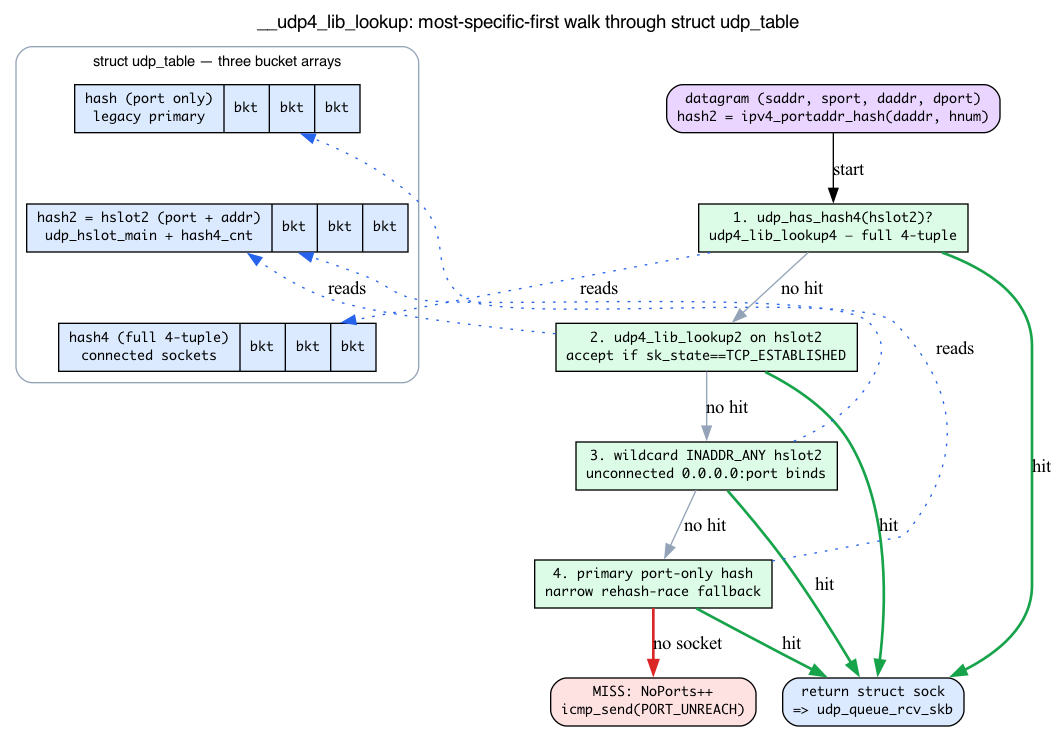
Day 13 taught TCP’s bhash/ehash split and said “UDP has its own struct udp_table, see Day 14.” This is that section. When a datagram arrives with (saddr, sport, daddr, dport), the kernel must turn it into a struct sock, and the table it walks is not TCP’s inet_hashinfo.
Two kinds of bind drive the design:
- Unconnected (default): bound to
(local_addr, local_port). Receives datagrams to that port regardless of source. - Connected (after
connect()on aSOCK_DGRAM): bound to a specific 4-tuple. Receives only from the matching peer — and is markedTCP_ESTABLISHED(UDP reuses the TCP state constant).
Three hash arrays. struct udp_table (include/net/udp.h:94, per-netns via net->ipv4.udp_table) holds three, ordered most-general to most-specific:
struct udp_table {
    struct udp_hslot      *hash;    /* keyed by local port only — legacy primary */
    struct udp_hslot_main *hash2;   /* keyed by (local port, local address) — the hslot2 */
    struct udp_hslot      *hash4;   /* keyed by full 4-tuple — connected (out under CONFIG_BASE_SMALL) */
    unsigned int mask;
    unsigned int log;
};
A bucket is a struct udp_hslot (include/net/udp.h:57) — a socket-list head + count + spinlock, cache-aligned (__aligned(2 * sizeof(long))):
struct udp_hslot {
    union { struct hlist_head head; struct hlist_nulls_head nulls_head; };
    int       count;
    spinlock_t lock;
} __aligned(2 * sizeof(long));
The hash2 buckets are a richer struct udp_hslot_main (include/net/udp.h:76) that embeds an hslot plus a hash4_cnt — the count of connected (hash4) sockets sharing that (port, addr). That counter is what the udp_has_hash4(hslot2) fast-path test reads: it tells the lookup whether bothering with the connected 4-tuple table is worthwhile at all.
The lookup is most-specific-first. __udp4_lib_lookup (net/ipv4/udp.c:667) walks four steps:
hash2  = ipv4_portaddr_hash(net, daddr, hnum);
hslot2 = udp_hashslot2(udptable, hash2);

if (udp_has_hash4(hslot2)) {                 /* 1. connected 4-tuple table first */
    result = udp4_lib_lookup4(net, saddr, sport, daddr, hnum, dif, sdif, udptable);
    if (result) return result;
}
/* 2. non-wildcard (daddr,dport) hslot2 — accept if it's a connected socket */
result = udp4_lib_lookup2(net, saddr, sport, daddr, hnum, dif, sdif, hslot2, skb);
if (!IS_ERR_OR_NULL(result) && result->sk_state == TCP_ESTABLISHED)
    goto done;
/* ... (BPF sk_lookup redirect omitted) ... */
if (result) goto done;
/* 3. wildcard INADDR_ANY hslot2 — unconnected binds to 0.0.0.0:port */
hash2  = ipv4_portaddr_hash(net, htonl(INADDR_ANY), hnum);
hslot2 = udp_hashslot2(udptable, hash2);
result = udp4_lib_lookup2(net, saddr, sport, htonl(INADDR_ANY), hnum, dif, sdif, hslot2, skb);
if (!IS_ERR_OR_NULL(result)) goto done;
/* 4. primary port-only hash as a race fallback */
result = udp4_lib_lookup1(net, saddr, sport, daddr, hnum, dif, sdif, udptable);
Read the ordering: (1) if any connected sockets exist for this (port, addr), try the full 4-tuple table; (2) else look up the non-wildcard hslot2 for (daddr, dport) and accept it only if it is TCP_ESTABLISHED (i.e. a connected socket); (3) fall back to the wildcard INADDR_ANY hslot2 that holds unconnected 0.0.0.0:port binds; (4) the primary port-only hash covers a narrow rehash race. This is precisely why connected UDP wins over an unconnected bind to the same port — and, as you’ll see in the experiment, why a second nc with a fresh source port fails the connected 4-tuple match and is silently not delivered.
With SO_REUSEPORT, a group of sockets share a hash2 slot and the kernel hashes the 4-tuple to pick one of the group (deferred to Day 24); that is the “multiple sockets share the bind slot” line, now grounded in which array holds them.
On a miss, the lookup returns no socket, and udp_rcv takes the no-listener path (net/ipv4/udp.c:2662):
__UDP_INC_STATS(net, UDP_MIB_NOPORTS);
icmp_send(skb, ICMP_DEST_UNREACH, ICMP_PORT_UNREACH, 0);
That UDP_MIB_NOPORTS bump plus the ICMP port-unreachable is the exact path the drops lab triggers by spraying datagrams at a closed port.
There are no Dumb Questions
Q: If UDP is connectionless, what does
connect()on aSOCK_DGRAMeven do?A: It pins the socket to one 4-tuple and marks it
TCP_ESTABLISHED, so the most-specific-first lookup above delivers only datagrams from that one peer — and lets the kernel skip the per-sendmsgroute lookup, caching the destination instead. No packets are exchanged; it is a purely local binding.Q: Why is the checksum mandatory on IPv6 but optional on IPv4?
A: IPv4 has its own L3 header checksum, so a corrupted address is caught at L3 even when L4 skips (Background 1). IPv6 dropped the header checksum to save per-hop work, so the UDP checksum is the only integrity check left — it cannot be optional.
Queueing
udp_queue_rcv_skb appends the skb to the socket’s sk_receive_queue — a doubly-linked list of skbs — via the __udp_enqueue_schedule_skb gate you met in Background 3. If that gate passes, the charge is committed and sk_data_ready fires the wake from Background 2; if the budget is exceeded, the datagram is dropped and RcvbufErrors climbs. UDP doesn’t push back on the sender (no ACK mechanism), so an over-budget burst is simply lost.
The recvmsg path
recvmsg(fd, msg, flags)
  → sock_recvmsg
    → udp_recvmsg                         // net/ipv4/udp.c:2031
      → __skb_recv_udp                    // net/ipv4/udp.c:1923 — dequeue (or park on sk_wq if empty+blocking)
      → skb_copy_datagram_msg              // copy into user buffer
      → skb_consume_udp                    // free the skb (UDP-specific wrapper)
Each recvmsg returns exactly one datagram. If the user buffer is smaller than the datagram, the rest is silently truncated and MSG_TRUNC is set in msg->msg_flags. (TCP doesn’t do this — TCP gives you bytes, UDP gives you packets.)
MSG_PEEK returns the data without dequeueing — useful for fixed-header protocols where you peek to learn the length, then read for real. Costs more CPU because the skb stays in the queue.
When the queue is empty and the socket is blocking, __skb_recv_udp is where the consumer parks on sk_wq (Background 2) until a producer’s sk_data_ready wakes it.
UDP-Lite, GSO, and other variations
- UDP-Lite (RFC 3828): the optional-checksum tweak from Background 1 — mandatory checksum, but coverage shrunk to the first N bytes via
CSCOV. Linux exposes it asIPPROTO_UDPLITE; the code path is the sameudp_sendmsg/recv logic with a coverage flag. - UDP GSO (
UDP_SEGMENTsockopt): the application sends one large buffer, kernel fragments it into MTU-sized datagrams in software. This is how QUIC/HTTP3 implementations achieve high throughput from userspace — one syscall delivers many packets. (udp_send_skbalso has a GSO path, guarded bycork->gso_size, that setsSKB_GSO_UDP_L4so the segmentation happens later inudp_offload.c— see the reading list.) - UDP-encap (IPsec, VXLAN, GENEVE, FoU): UDP socket on a special port; instead of queueing on
sk_receive_queue, calls a registeredencap_rcvhandler. Day 12 covered VXLAN’s use of this.
Today’s experiment
Order matters: the probes must be attached before any datagram is sent, or the trace shows nothing. (This is Background 2 in action — a wake only reaches an already-parked waiter, and a probe only sees calls made after it attaches.) Use two terminals.
Terminal 1 — start a UDP listener, then attach the trace and wait for Attached 3 probes:
nc -ul 9999 &

sudo bpftrace -e '
fentry:udp_sendmsg           { printf("send %d bytes from sk=%p\n", args->len, args->sk); }
fentry:udp_rcv               { printf("recv at sk-lookup\n"); }
fentry:udp_queue_rcv_one_skb { printf("queue to sk=%p\n", args->sk); }
'
Terminal 2 — only once the trace prints Attached 3 probes, send two datagrams from a single client process so they share one source port:
{ echo hello; sleep 1; echo world; } | nc -u -q1 127.0.0.1 9999
-q1 makes the client exit 1 s after EOF instead of hanging on the open UDP socket. Watch Terminal 1; you’ll see one send → one rcv → one queue per datagram, then Ctrl-C the trace:
Attached 3 probes
send 6 bytes from sk=0xffff8bf601ed5400
recv at sk-lookup
queue to sk=0xffff8bf61237f380
send 6 bytes from sk=0xffff8bf601ed5400
recv at sk-lookup
queue to sk=0xffff8bf61237f380
No state-machine churn — every datagram takes the identical, stateless three-step path.
When done, stop the listener: kill %1 # (or: pkill nc)
Two pitfalls this layout avoids:
- Why one client process, not two
echo | nc? With the OpenBSDncused here, an unconnectednc -ul 9999connect()s to the first sender’s address after the first datagram. A second, separateecho | ncis a new process with a fresh ephemeral source port, so it fails the connected-socket 4-tuple match in__udp4_lib_lookupand is not delivered to the listener — you’d see itsrecvbut noqueueline. That is exactly the most-specific-first lookup from Background 4: once the listener is connected, step 1/2 demand the full 4-tuple, and a new source port no longer matches. Driving both writes from one process keeps the source port stable so both datagrams match. (Don’t collapse them intoprintf 'hello\nworld\n' | nc— a single pipe read becomes onesendto, i.e. one datagram.) - Why
udp_queue_rcv_one_skband not__udp_queue_rcv_skb? The static__udp_queue_rcv_skb(the symbol named in the RX diagram above) is inlined intoudp_queue_rcv_one_skbon most builds —grep __udp_queue_rcv_skb /proc/kallsymsreturns nothing, andfentry:__udp_queue_rcv_skbfails to attach, which makes bpftrace abort the whole program (you’d get zero output). The non-inlined wrapperudp_queue_rcv_one_skbis reliably attachable and carries the sameargs->sk. Verify withbpftrace -l 'fentry:vmlinux:udp_queue_rcv_one_skb'before running.
Watch UDP drops
On an idle box every drop counter reads 0, so first provoke a drop to have something to watch. Sending to a closed UDP port bumps the NoPorts (NO_SOCKET) counter — the simplest reliably-demonstrable UDP delivery failure, and the exact __udp4_lib_lookup miss → UDP_MIB_NOPORTS + icmp_send path from Background 4:
# Baseline:
grep -E '^Udp:' /proc/net/snmp

# Trigger: 50 datagrams to a closed port (each is dropped with NO_SOCKET):
for i in $(seq 1 50); do echo x | nc -u -w0 127.0.0.1 1; done

# Read again — NoPorts climbs by ~50:
grep -E '^Udp:' /proc/net/snmp
nstat -az | grep -i '^Udp'

# Per-socket drops:
ss -uam   # u=UDP, a=all, m=memory
Expected — the NoPorts column (2nd value) jumps by exactly the 50 datagrams sent:
Udp: InDatagrams NoPorts InErrors OutDatagrams RcvbufErrors SndbufErrors InCsumErrors IgnoredMulti MemErrors
Udp: 1547 88 0 1636 0 0 0 1 0      # before
Udp: 1547 138 0 1686 0 0 0 1 0     # after (NoPorts 88 → 138)
Reading the output:
grep -E '^Udp:' /proc/net/snmpprints two rows: the first lists counter names, the second lists values; the Nth value belongs to the Nth name (this is theUDP_MIB_*enum order from Background 1). The:in^Udp:excludes the separateUdpLite:block. WatchNoPorts(no socket at the destination port — the case triggered above),InErrors(general receive errors),InCsumErrors(a datagram arrived but its checksum didn’t verify — Background 1), andRcvbufErrors(sk_rcvbufbudget exceeded — Background 3).nstat -azshows the same counters by name (UdpNoPorts,UdpInErrors,UdpRcvbufErrors). Use-az—-agives absolute (cumulative-since-boot) values and-zincludes zero-valued counters; barenstatprints only counters that changed since its last run and rewrites its history file, so a second run shows nothing.ss -uamreports per-socket drops as thed<N>token at the end of eachskmem:(...)line; on an idle socket it readsd0(andrb<bytes>is that socket’ssk_rcvbuf— the budget bar from Background 3), which is why the trigger matters.
NoPorts is a delivery failure (no listener) rather than a queue overflow; the RcvbufErrors case needs a slow receiver with a small SO_RCVBUF being flooded to provoke — i.e. driving sk_rmem_alloc past sk_rcvbuf faster than recvmsg drains it.
A common cause of UDP drops on busy servers: too small sk_rcvbuf. The default is net.core.rmem_default (often 212KB). For a high-throughput UDP receiver:
sudo sysctl -w net.core.rmem_max=33554432
# Then in app: setsockopt(fd, SOL_SOCKET, SO_RCVBUF, ..., 16MB)
Remember from Background 3 that you’re raising the truesize budget, not a byte-count of payload — so size for the per-skb overhead, not just the data rate.
What to read in the kernel
-
net/ipv4/udp.c:1233—udp_sendmsg. The TX side. Read top to bottom (~274 lines). Notice three sections: control-message parsing (cmsg loop), route lookup, and skb construction (theip_make_skbvsip_append_databranch). If you ever wonder “what does MSG_CONFIRM do?” — search this file. -
net/ipv4/udp.c:1092—udp_send_skb. Where the 8-byte header from Background 1 is stamped and the checksum mode (CHECKSUM_NONE/CHECKSUM_PARTIAL/ fullcsum_tcpudp_magic) is finalised beforeip_send_skb. -
net/ipv4/udp.c:2588—udp_rcv. The RX entry. Short (~107 lines). Performs the basic checks (length, checksum viaudp4_csum_init), looks up the destination socket via__udp4_lib_lookup, dispatches to multicast/unicast paths, and on a miss bumpsNoPorts+ sends ICMP port-unreach. -
net/ipv4/udp.c:667—__udp4_lib_lookup. The 4-tuple → socket lookup. Walk the most-specific-first ordering from Background 4: connectedhash4, non-wildcardhslot2(accept ifTCP_ESTABLISHED), wildcardINADDR_ANYhslot2, primary port-onlyhash. Reading this clarifies what “connected UDP” actually means kernel-side. -
include/net/udp.h:57,76,94—struct udp_hslot,struct udp_hslot_main,struct udp_table. The three-array structure (hash/hash2/hash4) and thehash4_cntfield that powers theudp_has_hash4fast path. -
net/ipv4/udp.c:1655—__udp_enqueue_schedule_skb. The receive-memory gate from Background 3:rmem + truesize > rcvbuf⇒ drop (with the empty-queue acceptance),skb_condenseunder pressure, then theatomic_addcharge and thesk_data_readywake. -
net/ipv4/udp.c:2422—udp_queue_rcv_skb. The queueing path. It’s a thin (~21-line) wrapper; the work — the SO_FILTER / sk_filter check (BPF socket filters), the multicast membership check, and the back-pressure handling — lives in the call chain it heads (udp_queue_rcv_one_skb→__udp_queue_rcv_skb→__udp_enqueue_schedule_skb), which runs ~200 lines total including that slow path. -
net/ipv4/udp.c:2031—udp_recvmsg. The dequeue side. Read the MSG_PEEK handling — it’s surprisingly subtle (locks the socket, walks the queue without removing). -
net/core/sock.c:3614—sock_def_readable. The defaultsk_data_readyfrom Background 2: thesk_wqsleeper wake plus the async/epoll notification. Installed atnet/core/sock.c:3734. -
net/core/datagram.c:89—__skb_wait_for_more_packets. How a blockingrecvmsgactually sleeps; for UDP it is called from__skb_recv_udp’s own dequeue loop atnet/ipv4/udp.c:1984(not the generic__skb_recv_datagramloop atnet/core/datagram.c:305, which serves other datagram protocols). -
net/ipv4/ip_output.c:1553—ip_make_skb. How a single-shot UDP packet is built. Compare against the corkedip_append_datato understand the trade-off. -
net/ipv4/udp_offload.c— UDP GSO/GRO. Searchudp4_ufo_fragmentfor the segmentation function andudp_gro_receivefor the receive-side coalescing. Read this if you’re pushing high-rate UDP (QUIC) and want to understand why GSO matters. -
net/ipv4/udp.cUDP_GRO / UDP_SEGMENT sockopt handlers — there is no dedicatedudp.rst; UDP GSO/GRO and error queues are documented mainly in the code and the original commit logs. (Documentation/networking/udplite.rstcovers the UDP-Lite variant.)
Bullet Points
- The entire UDP wire header is 8 bytes —
source, dest, len, check(udp.h:23). No sequence/ack/window/flags; that minimal header is “why UDP is simple.” - The checksum covers pseudo-header (src/dst IP, proto=17, UDP len) + UDP header + payload. On IPv4 it’s optional (
check==0⇒ skip verify; a real zero is rewritten to0xFFFF); on IPv6 it’s mandatory. UDP-Lite keeps it mandatory but shrinks the covered byte-range. A verify failure bumpsInCsumErrors. - TX:
udp_sendmsg → ip_make_skb → udp_send_skb → ip_send_skb → .... No send queue — datagrams hand off to IP immediately (UDP never retransmits). - RX:
udp_rcv → __udp4_lib_lookup → udp_queue_rcv_skb → enqueue + wake. - Lookup walks
struct udp_table’s three arrays most-specific-first: connectedhash4(4-tuple) → non-wildcardhash2/hslot2(accept ifTCP_ESTABLISHED) → wildcardINADDR_ANYhash2→ primary port-onlyhash. A miss bumpsNoPortsand sends ICMP port-unreach. - Blocking
recvmsgparks the task onsk->sk_wq; the softirq’ssk->sk_data_ready(sock_def_readable) issues anEPOLLINwake.__skb_wait_for_more_packetsis the sleep. - Drops happen when
sk_rmem_alloc + skb->truesize > sk_rcvbuf— a truesize budget (payload + overhead), not a payload-byte count. Empty queue always accepts one; over-budget bumpsRcvbufErrors/sk_drops. Fix withnet.core.rmem_max+SO_RCVBUF. - MSG_PEEK reads without dequeueing; MSG_TRUNC flags truncated reads.
- UDP GSO (
UDP_SEGMENTsockopt) gives one syscall → many MTU-sized datagrams. Used by QUIC.
Check question
Why does UDP have a per-socket receive queue (sk_receive_queue) but no send queue?
Click to reveal answer
Answer: UDP doesn’t retransmit — there are no ACKs, no reason to remember a sent datagram once it’s handed to IP. The send path builds an skb in udp_sendmsg and immediately enters the IP output path; nothing is held back. TCP, by contrast, must keep sent skbs in sk_write_queue because it may need to retransmit them when ACKs don’t arrive (Day 17). The receive queue is needed because the kernel arrives with a datagram before the application has called recvmsg to consume it; the queue holds it until the app shows up. Both protocols have receive queues; only TCP needs a send queue.
Tomorrow
Day 15: TCP state machine — eleven states, ~7,700 lines of state-handling code in tcp_input.c.