Day 15 — TCP state machine
Today’s mission: trace a TCP connection through every state. First learn the bytes that drive the transitions — the TCP header and its control flags — then the three- and four-packet choreography that moves the states, then the TIME_WAIT minisock that explains the chapter’s best puzzle. Understand why TIME_WAIT exists, why FIN_WAIT_2 sometimes hangs, and how the kernel implements every transition. Total time: ~110 minutes.
What “state machine” really means here
TCP is a connection-oriented protocol — every connection has state that both ends maintain through its lifetime. The states encode “what’s the next legal thing this connection can do?” The state transitions happen in response to:
- Application calls (
connect,listen,accept,close). - Received segments (SYN, SYN-ACK, ACK, FIN, RST).
- Timer events (RTO firing, 2MSL elapsed).
The whole apparatus is in tcp_rcv_state_process (net/ipv4/tcp_input.c:7119) for incoming-segment-driven transitions, and in tcp_set_state (net/ipv4/tcp.c:2961) for explicit state changes from anywhere. Reading those two functions teaches you 80% of TCP control flow.
But there’s a gap in that bullet list that almost every TCP tutorial leaves open. The middle item — “received segments (SYN, SYN-ACK, ACK, FIN, RST)” — names five events, and the whole rest of this chapter is a machine driven by them. Yet what is a SYN? Where does it live? Is “SYN-ACK” one packet or two? Before we can talk about states, we have to talk about the bytes that trip the transitions. That’s where we start.
Background 1: The TCP segment and its control flags
Day 3 taught the socket side of TX — sendmsg, the write queue, snd_nxt. Today we look at what actually goes on the wire and, crucially, at the handful of bits in it that the state machine reacts to.
Intuition first: flags are bits, not packet types
A TCP segment is just a TCP header followed by optional options and then payload bytes. The header is a fixed 20 bytes (more if options are present). Buried in it is a set of single-bit control flags. The state machine doesn’t react to “a SYN packet” the way you’d react to a differently-shaped envelope in the mail — it reacts to which bits are set in the one and only kind of TCP header.
This is the single most important thing to internalize today: SYN, ACK, FIN, RST, PSH are independent bits. They are not mutually-exclusive packet types. One segment can set several at once:
- SYN-ACK is not two packets — it’s one segment with both the SYN bit and the ACK bit set.
- The final packet of the handshake is a bare ACK (only the ACK bit set).
- A FIN almost never travels alone — it rides with ACK, so on the wire you see FIN+ACK. (Every segment after the handshake sets ACK, because TCP piggybacks acknowledgements on everything.)
What each bit means to the state machine:
- SYN — “open.” Synchronise sequence numbers; only seen during connection setup.
- ACK — “this segment acknowledges data I’ve received.” Set on essentially everything after the first SYN.
- FIN — “I’m done sending; graceful close of my half.”
- RST — “abort, immediately.” No graceful dance, no acknowledgement expected.
- PSH — “push this to the application now”; doesn’t drive states.
- URG / ECE / CWR / AE — urgent pointer and ECN/AccECN signalling; not relevant to the state machine.
The concrete struct: struct tcphdr
Here is the actual on-the-wire header in v7.1 (include/uapi/linux/tcp.h:25, little-endian layout shown):
struct tcphdr {
    __be16  source;
    __be16  dest;
    __be32  seq;        /* sequence number of the first payload byte    */
    __be32  ack_seq;    /* next byte I expect from you (set when ack=1)  */
    __u16   ae:1,
            res1:3,
            doff:4,     /* data offset: header length in 32-bit words    */
            fin:1,
            syn:1,
            rst:1,
            psh:1,
            ack:1,
            urg:1,
            ece:1,
            cwr:1;
    __be16  window;
    __sum16 check;
    __be16  urg_ptr;
};
The flags are literally those :1 bitfields — fin:1, syn:1, rst:1, psh:1, ack:1. The two __be32 fields above them, seq and ack_seq, are the heart of the protocol: seq numbers the bytes I’m sending, ack_seq tells you the next byte I expect from you.
![The 20-byte TCP header and its flags field (tcp[12-13])](diagrams/day15_tcp_header.png)
Two ways the kernel reads the flags
The kernel touches these flags in two different ways, and you’ll see both when you read the code:
-
Straight off the wire bitfield. Code with a
struct tcphdr *thin hand readsth->syn,th->fin,th->rst, etc. directly. There’s also a helper,tcp_flags_ntohs(th)(include/net/tcp.h:1062), that pulls all the flag bits out as one host-order value. -
Pre-extracted into the skb control block. Recall the
cb[48]scratchpad from Day 1 — the per-packet area each layer stashes state in. TCP overlays it withstruct tcp_skb_cb, reached via theTCP_SKB_CB(skb)macro (include/net/tcp.h:1149). Early on the input path the flags byte is copied intoTCP_SKB_CB(skb)->tcp_flags— a__u16commented “TCP header flags (tcp[12-13])” (include/net/tcp.h:1115) — so the rest of the input path canswitchon flags cheaply without re-parsing the header.
Each named bit has a BIT() constant for masking (include/net/tcp.h:1050-1054):
#define TCPHDR_FIN  BIT(0)
#define TCPHDR_SYN  BIT(1)
#define TCPHDR_RST  BIT(2)
#define TCPHDR_PSH  BIT(3)
#define TCPHDR_ACK  BIT(4)
The fact the whole chapter silently leans on: SYN and FIN consume a sequence number
A pure ACK carries no payload and occupies no place in the byte stream — it just reports a number. But SYN and FIN each consume one sequence number, exactly as if they were a single phantom byte of data. This is not a quirk; it’s the mechanism that makes graceful close reliable:
- Because a FIN sits at a real sequence slot, the peer can acknowledge it specifically (its ACK names the byte after the FIN).
- Because it’s acknowledged, it can be retransmitted if the ACK is lost, just like any other byte (recall
snd_nxtfrom Day 3 — the FIN advances it by one).
Hold onto this. It’s the reason TIME_WAIT’s “stay alive to ACK a retransmitted FIN” guarantee works later in the chapter.
RST is the exception to all of it
RST is special: it carries no payload, occupies no sequence slot, and is not acknowledged. It doesn’t participate in the graceful FIN dance at all — it tears the connection down on the spot. That’s exactly why, when an application calls close() with unread data still in the receive queue, __tcp_close sends an RST instead of a FIN (you’ll see this in “What to read”): there’s no point gracefully draining a connection nobody is listening to.
The eleven states
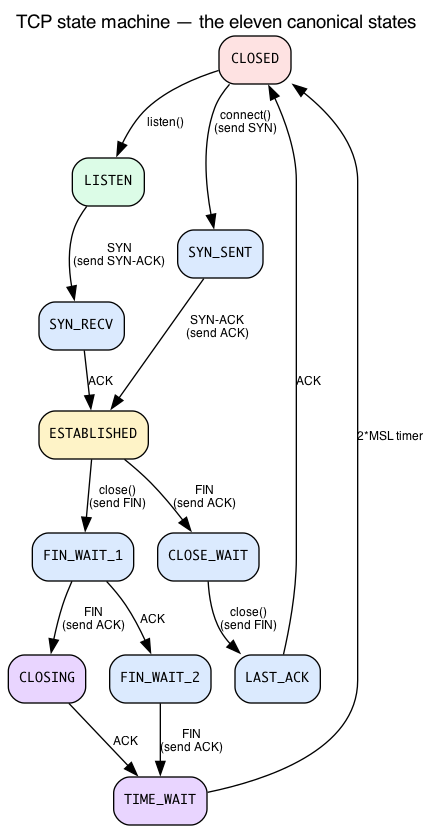
Defined in include/net/tcp_states.h:13:
enum {
    TCP_ESTABLISHED = 1,
    TCP_SYN_SENT,
    TCP_SYN_RECV,
    TCP_FIN_WAIT1,
    TCP_FIN_WAIT2,
    TCP_TIME_WAIT,
    TCP_CLOSE,
    TCP_CLOSE_WAIT,
    TCP_LAST_ACK,
    TCP_LISTEN,
    TCP_CLOSING,
    TCP_NEW_SYN_RECV,
    TCP_BOUND_INACTIVE,
};
(The last two are internal sub-states — NEW_SYN_RECV is a half-open SYN entry on the listener; BOUND_INACTIVE is a recently-bound socket with no listen yet.)
The order of this enum is not cosmetic — it’s the integer wire the bpftrace experiment decodes later: TCP_ESTABLISHED=1, TCP_SYN_SENT=2, TCP_SYN_RECV=3, and so on. Keep the numbers in view; you’ll be reading them raw off a probe in a few sections.
The connection-establishment states
- CLOSED — no connection. Initial and final state.
- LISTEN — passive open: the server’s listening socket. Waits for incoming SYNs.
- SYN_SENT — active open: client sent SYN, waiting for SYN-ACK.
- SYN_RECV — server received SYN, sent SYN-ACK, waiting for the ACK that completes the 3-way handshake.
- ESTABLISHED — handshake complete, data flowing.
Background 2: the three-way handshake, packet by packet
The chapter’s state diagram drops you straight into CLOSED → SYN_SENT → ESTABLISHED and the server’s LISTEN → SYN_RECV → ESTABLISHED, as if the open exchange were already obvious. It isn’t — so here are the three packets that actually move those edges.
Day 13 already taught the socket-side plumbing: connect() sends the SYN and puts the client in SYN_SENT; listen() builds the accept queue; the half-open handshake lives in the ehash as a TCP_NEW_SYN_RECV request sock; and accept() pops a completed connection. That’s the machinery — recall it from Day 13. What’s new today is the on-the-wire choreography.
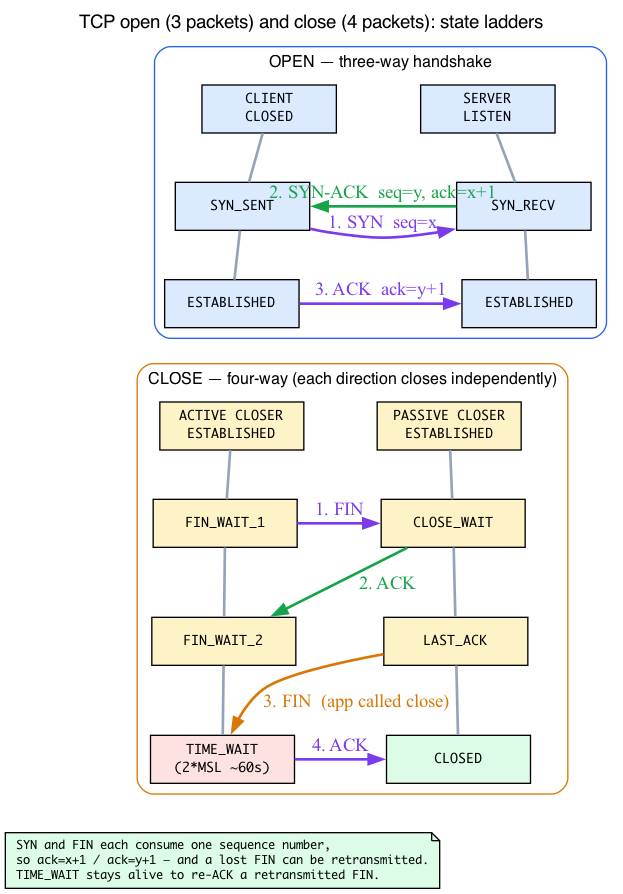
Open is three packets:
- Client → server: SYN,
seq=x. (Client enters SYN_SENT.) - Server → client: SYN-ACK,
seq=y, ack=x+1. (Server creates the half-open entry and sends this; noteack=x+1because the SYN consumed sequence numberx.) - Client → server: ACK,
ack=y+1. (Server moves to ESTABLISHED on receiving it; client moved to ESTABLISHED the moment the SYN-ACK arrived.)
The real purpose of this dance is not politeness — it’s that each side learns the other’s initial sequence number (x and y). Without that exchange neither end knows where the other’s byte stream begins.
Map each packet to a state edge:
| Packet | Who moves | Edge |
|---|---|---|
| SYN sent | client | CLOSED → SYN_SENT |
| SYN received | server | LISTEN → (half-open) → sends SYN-ACK |
| SYN-ACK received | client | SYN_SENT → ESTABLISHED |
| final ACK received | server | SYN_RECV → ESTABLISHED |
That is the left half of the state diagram made concrete. The close mirrors it, but with FINs, and it takes four packets (FIN, ACK, FIN, ACK) rather than three — because each direction closes independently. That asymmetry is the whole reason the close half of the diagram is a messy diamond of states rather than a single edge; we get to it next.
In the kernel, tcp_rcv_state_process (net/ipv4/tcp_input.c:7119) dispatches on the connection’s current state and only then inspects the flags. The TCP_SYN_SENT and TCP_SYN_RECV cases (the switch is at tcp_input.c:7128, with case TCP_LISTEN at :7133) are the bulk of the function precisely because handshake completion is the most intricate part of TCP control flow.
The graceful-close states
TCP’s connection close is bidirectional: each direction can shut down independently (a “half-close”). This produces the messy diamond of close states. It’s a four-packet exchange — each side sends its own FIN and acknowledges the other’s.
The side that calls close() first goes:
- FIN_WAIT_1 — sent FIN, waiting for ACK or peer’s FIN.
- FIN_WAIT_2 — peer ACKed our FIN; waiting for peer’s FIN.
- TIME_WAIT — peer’s FIN received; ACKed; we wait 2*MSL (twice the Maximum Segment Lifetime) before fully closing.
The side that receives the close goes:
- CLOSE_WAIT — received FIN; app hasn’t called
close()yet. - LAST_ACK — app called
close(); we sent our FIN; waiting for ACK.
If both sides close simultaneously, you can hit:
- CLOSING — sent FIN, peer’s FIN arrived before our ACK; both sides are now closing.
Drivers of state changes
Application-initiated
| Call | Effect |
|---|---|
socket() + listen() | CLOSED → LISTEN |
connect() | CLOSED → SYN_SENT (sends SYN) |
close() from ESTABLISHED | ESTABLISHED → FIN_WAIT_1 (sends FIN) |
close() from CLOSE_WAIT | CLOSE_WAIT → LAST_ACK (sends FIN) |
shutdown(SHUT_WR) | half-close: same as close but socket stays open for reads |
Segment-driven
The big function is tcp_rcv_state_process (net/ipv4/tcp_input.c:7119). It dispatches by current state, then handles flags (the very th->syn/th->fin/TCP_SKB_CB(skb)->tcp_flags bits from Background 1). Pseudocode:
switch (sk->sk_state) {
case TCP_LISTEN:    handle SYN -> create child sock in NEW_SYN_RECV
case TCP_SYN_SENT:  handle SYN-ACK -> ESTABLISHED, send ACK
case TCP_SYN_RECV:  handle ACK -> ESTABLISHED
default:            handle FIN, RST, ACKs that drive close states
}
For non-trivial states (ESTABLISHED, FIN_WAIT_*) it falls through to tcp_data_queue for normal data delivery and runs the close-state transitions when a FIN arrives.
Timer-driven
- SYN-ACK retransmit timer: in SYN_SENT and SYN_RECV, the SYN/SYN-ACK is retransmitted with exponential backoff if no progress.
- Retransmit timer (RTO): in ESTABLISHED, fires when an ACK is overdue (Day 17).
- TIME_WAIT timer (2*MSL): ~60s on Linux, hardcoded to
TCP_TIMEWAIT_LEN(60*HZ,include/net/tcp.h:140) and not configurable. This is separate fromnet.ipv4.tcp_fin_timeout, which (despite its name) controls the FIN_WAIT_2 timeout, not TIME_WAIT. - Keepalive timer (if
SO_KEEPALIVE): probes idle connections.
Why TIME_WAIT exists
TIME_WAIT is the most-asked-about TCP state. Two reasons:
- Make sure our last ACK reaches the peer. If our final ACK is lost, the peer’s
LAST_ACKretransmits its FIN. We need to be in TIME_WAIT — still able to send an ACK — to handle that retransmit. If we’d already moved to CLOSED, we’d reply with RST, which the peer would interpret as an error. (This is exactly where Background 1’s “a FIN consumes a sequence number, so it can be individually acknowledged and retransmitted” pays off — the retransmitted FIN is a real, ACK-able segment.) - Prevent old packets from a previous incarnation of the 4-tuple from being delivered to a new connection. Without TIME_WAIT, a freshly-opened connection on the same 4-tuple might receive late-arriving packets from the old connection. MSL (Maximum Segment Lifetime, ~30s) is the maximum lifetime of a single in-flight packet, bounded by IP TTL and router queueing. TIME_WAIT holds for 2*MSL (~60s on Linux) to cover a full round trip — the active closer’s final ACK can take up to one MSL to reach the peer, and if it is lost the peer’s retransmitted FIN takes up to another MSL to come back. After 2*MSL, every old duplicate in both directions has certainly drained.
There are no Dumb Questions
Q: Is SYN-ACK one packet or two?
A: One. It’s a single TCP segment with two control bits set — the SYN bit and the ACK bit — in the one flags field every header carries (Background 1). “SYN-ACK” names a bit combination, not a packet type; there is no separate ACK packet in the handshake’s middle step.
Q:
tcp_fin_timeoutsounds like it controls TIME_WAIT — why doesn’t it?A: The name is misleading.
net.ipv4.tcp_fin_timeoutbounds how long we sit in FIN_WAIT_2 waiting for the peer’s FIN. TIME_WAIT’s duration is the hardcodedTCP_TIMEWAIT_LEN(60*HZ), not a sysctl — you cannot tune it without recompiling.Q: Why 2*MSL and not 1*MSL?
A: Because the worst case is a full round trip, not a one-way trip. Our final ACK may take up to one MSL to reach the peer; if it’s lost, the peer’s retransmitted FIN takes up to another MSL to come back. Waiting 2*MSL guarantees we’re still around to re-ACK that FIN, and that every stray duplicate in both directions has expired.
Background 3: the TIME_WAIT minisock
Here’s a subtlety that the chapter’s headline experiment hinges on, and it’s worth its own section: the socket that enters TIME_WAIT is not the socket you started with.
When a connection enters TIME_WAIT, the kernel does not keep the full struct sock — with its send/receive queues, congestion state, and the rest — pinned in memory for 60 seconds. That would be enormously wasteful on a busy server. Instead it allocates a tiny, stripped-down object: a struct inet_timewait_sock (include/net/inet_timewait_sock.h:33), commonly called a minisock.
The minisock holds only what’s needed to recognise and correctly ACK a retransmitted FIN:
- the connection’s 4-tuple (so the ehash lookup still finds it),
- the last sequence/ack numbers (
tw_rcv_nxt,tw_snd_nxt), - timestamps (for PAWS /
tcp_tw_reuse), - the death-row timer hook that fires after
TCP_TIMEWAIT_LEN.
The exact hand-off: replace the full socket without a lookup gap
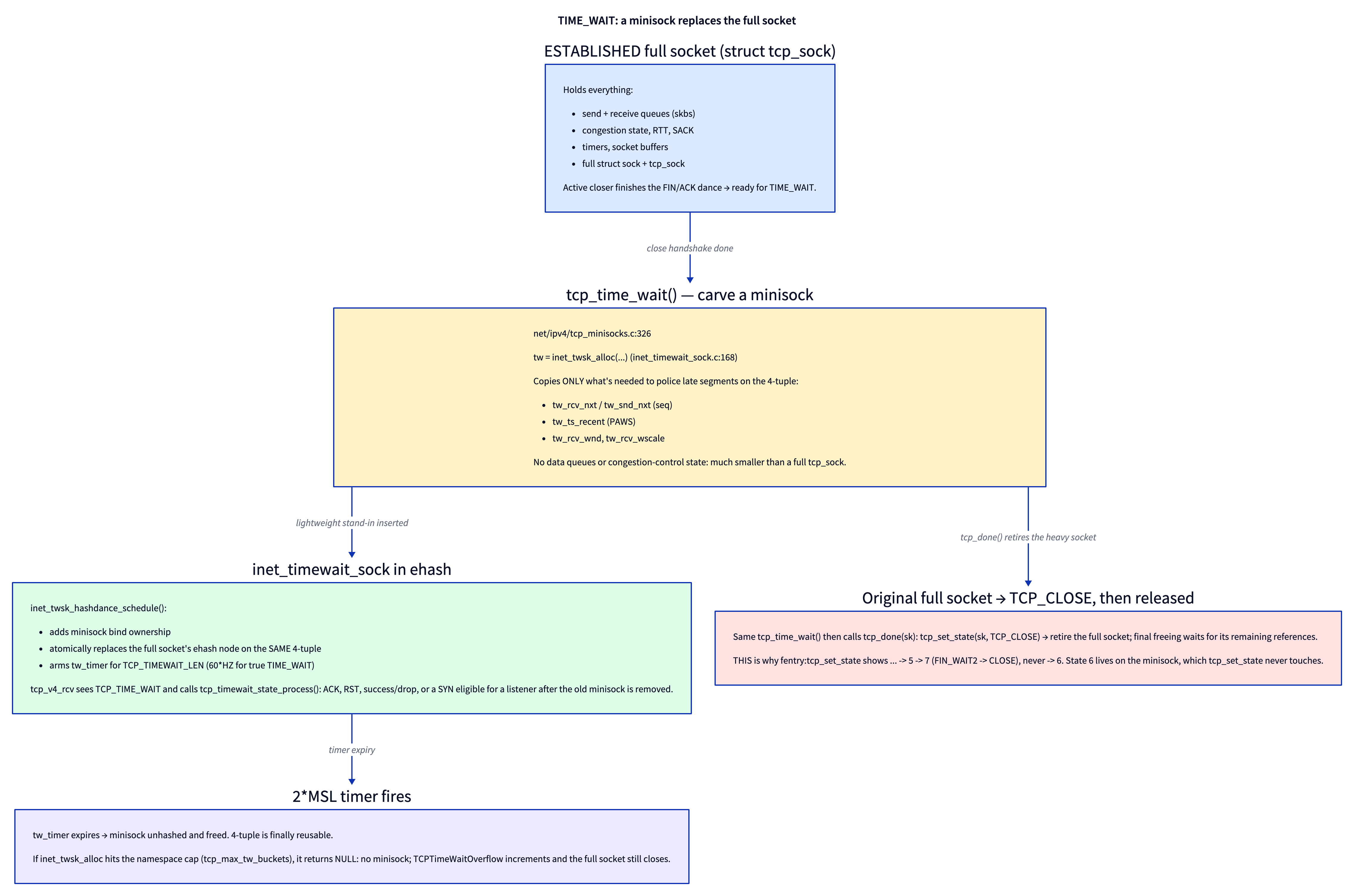
tcp_time_wait() performs a controlled replacement:
inet_twsk_alloc()allocates aninet_timewait_sock/tcp_timewait_sockand copies the connection identity plus the limited sequence, receive-window, timestamp, mark, and queue-mapping state needed to classify late segments. It has no TCP data queues or congestion-control state.inet_twsk_hashdance_schedule()adds the minisock to bind ownership, then under the ehash lock atomically replaces the full socket’s ehash node with the minisock’s node. Lookups for the same namespace and 4-tuple therefore continue to find an object without a gap. The minisock receives references for its bind link, ehash link, and timer, and the timer is armed forTCP_TIMEWAIT_LENwhen this is true TIME_WAIT.- Back in
tcp_time_wait(),tcp_done(sk)moves the original full socket to TCP_CLOSE. Its memory is released only after its remaining references drain. This is whyfentry:tcp_set_stateon the full socket shows… → 5 → 7, never→ 6; the minisock was initialized directly withTCP_TIME_WAITand does not pass throughtcp_set_state. - A later segment still hits ehash first (Day 13).
tcp_v4_rcvsees the returned object’sTCP_TIME_WAITstate and callstcp_timewait_state_process, which may request an ACK, request a reset, consume the segment, or allow an eligible SYN to be retried against a listener after removing the old minisock. Timer expiry eventually unhashes and frees it.
This also gives the cost of TIME_WAIT a concrete shape: each TIME_WAIT consumes one small minisock plus one ehash slot. That’s why a busy short-connection server (HTTP, microservices) accumulates tens of thousands of them, and why there’s a cap — tcp_max_tw_buckets — on the total.
And there’s a failure mode worth knowing: if inet_twsk_alloc fails (out of memory, or the bucket cap is hit), there is no minisock to retransmit-ACK with. The else branch in tcp_time_wait simply bumps NET_INC_STATS(net, LINUX_MIB_TCPTIMEWAITOVERFLOW) and falls through to tcp_done(sk) — the connection skips TIME_WAIT entirely and closes immediately, sending no RST. That counter is exactly what you’ll hammer in the “What to break” lab.
TIME_WAIT cost
Recall from Background 3 that each TIME_WAIT costs one small minisock plus one ehash slot — so a busy short-connection server (HTTP, microservices) can accumulate tens of thousands of them. The mitigations:
SO_REUSEADDRlets a new socket bind even if a recent connection’s TIME_WAIT entry occupies the 4-tuple.net.ipv4.tcp_max_tw_bucketscaps the global TIME_WAIT count. Overflow follows the exact skip-TIME_WAIT path from Background 3 (no minisock, no RST;TCPTimeWaitOverflowincrements). The default isehash_entries / 2, so it scales with system memory (often tens to hundreds of thousands).net.ipv4.tcp_tw_reuse=1lets the kernel reuse TIME_WAIT sockets for new outgoing connections (uses TCP timestamps to ensure no overlap). Safe for client-side; doesn’t affect listening sockets.- (
tcp_tw_recycle
FIN_WAIT_2 and the 60-second timeout
If a peer ACKs our FIN but never sends its own FIN (perhaps the application is hung), we sit in FIN_WAIT_2. To avoid leaking, the kernel times out after net.ipv4.tcp_fin_timeout seconds (default 60) and force-closes. This is why “broken peers” don’t break us forever.
Today’s experiment
# Watch state in real time
watch -n 0.5 'ss -tan'

# In another terminal
nc -l 9999 &
sleep 0.5
nc localhost 9999      # both ends in ESTAB
# In each: Ctrl-D to close

# You'll see:
# initial:   LISTEN (server)
# connect:   ESTAB (both)
# nc client closes:  FIN_WAIT_2 (client) / CLOSE_WAIT (server) briefly
# nc server closes:  TIME_WAIT (client) / CLOSED (server)
# 60s later: TIME_WAIT entry expires
Trace state transitions. This probe fires for every socket system-wide but nothing drives it on an idle box, so leave it running and, in another terminal, re-run the nc -l 9999 & / echo q | nc -q 0 localhost 9999 listener+client pair from the force-close block below to provoke transitions. The interval:s:10 bound makes it exit cleanly after 10s:
sudo bpftrace -e '
fentry:tcp_set_state {
  printf("sk=%p state=%d -> %d\n", args->sk, args->sk->__sk_common.skc_state, args->state);
}
interval:s:10 { exit(); }'
The integers are the tcp_states.h enum values from above: 1=ESTABLISHED, 2=SYN_SENT, 3=SYN_RECV, 4=FIN_WAIT1, 5=FIN_WAIT2, 6=TIME_WAIT, 7=CLOSE, 8=CLOSE_WAIT, 9=LAST_ACK. Because the probe is system-wide you’ll see the client’s and the server’s transitions interleaved, each tagged with the kernel’s sk pointer. A client connect/close prints roughly:
sk=0xffff…  state=7 -> 2    # CLOSE -> SYN_SENT       (client connect)
sk=0xffff…  state=2 -> 1    # SYN_SENT -> ESTABLISHED
sk=0xffff…  state=1 -> 4    # ESTABLISHED -> FIN_WAIT1  (active closer)
sk=0xffff…  state=4 -> 5    # FIN_WAIT1 -> FIN_WAIT2
sk=0xffff…  state=5 -> 7    # FIN_WAIT2 -> CLOSE
Note you will not see a transition into TIME_WAIT (state 6) here — the chapter’s headline state. This is Background 3 made visible: entering TIME_WAIT spins up a separate minisock and calls tcp_done(), which sets the original socket to TCP_CLOSE (7). So tcp_set_state on the full socket goes … -> 5 -> 7, never -> 6 — state 6 lives on the minisock, a different object the probe isn’t attached to. To watch TIME_WAIT itself, use ss -tan as below.
Force-close to see TIME_WAIT
# Server accepts one connection then exits; client (nc -q 0) closes first -> client TIME_WAIT
nc -l 9999 &
sleep 0.1
echo q | nc -q 0 localhost 9999

# Immediately:
ss -tan | grep 9999
# tcp  TIME-WAIT  0  0  127.0.0.1:NNNN  127.0.0.1:9999   # Local = ephemeral client port, Peer = :9999
Observe: the client is the active closer (nc -q 0 closes as soon as stdin hits EOF), so its ephemeral port sits in TIME_WAIT for ~60s — note ss prints Local Address:Port first, then Peer Address:Port, so the ephemeral port is Local and :9999 is Peer. Plain nc -l accepts a single connection and exits when it closes, so only the client’s TIME-WAIT remains (no LISTEN row). The server side returns to CLOSED immediately.
What to break
-
Set
tcp_fin_timeout=5, then drive a connection into FIN_WAIT_2 — a state you reach only when the peer ACKs your FIN but never sends its own. A plainncclose won’t do it (the peer reciprocates with its own FIN), so use a listener that accepts but never closes:sudo sysctl -w net.ipv4.tcp_fin_timeout=5 # Listener that accepts but never closes (its kernel ACKs the FIN; the app sends none back): python3 -c 'import socket,time; s=socket.socket(); s.setsockopt(socket.SOL_SOCKET,socket.SO_REUSEADDR,1); s.bind(("127.0.0.1",9999)); s.listen(); c,_=s.accept(); time.sleep(600)' & sleep 0.3 # Client connects then closes its write side -> FIN_WAIT_1, then FIN_WAIT_2 after the server's ACK: exec 3<>/dev/tcp/127.0.0.1/9999; exec 3>&- watch -n0.5 'ss -tan state fin-wait-2' # the FIN_WAIT_2 row appears, then vanishes after ~5s sudo sysctl -w net.ipv4.tcp_fin_timeout=60 # restore the defaultUseful for diagnosing connection leaks.
-
Hammer
tcp_max_tw_buckets: cap the global TIME_WAIT count and watch the overflow counter climb. This is theLINUX_MIB_TCPTIMEWAITOVERFLOWpath from Background 3 — once the cap is hit,inet_twsk_allocis refused, no minisock is built, and the close skips TIME_WAIT. Capture the default first so you can restore it:orig=$(cat /proc/sys/net/ipv4/tcp_max_tw_buckets) sudo sysctl -w net.ipv4.tcp_max_tw_buckets=100 nc -l -k 9999 & # persistent listener (OpenBSD nc -k) nstat -az TcpExtTCPTimeWaitOverflow # baseline (-z shows zero-valued counters) for i in $(seq 1 500); do echo q | nc -q 0 localhost 9999; done nstat -az TcpExtTCPTimeWaitOverflow # the count has risen (e.g. ~400) sudo sysctl -w net.ipv4.tcp_max_tw_buckets=$orig # restore kill %1 # stop the listenerOnce the cap is hit, new closes skip TIME_WAIT and close immediately (no RST is sent), so
ss -tan | grep TIME-WAIT | wc -lstays low — the risingTCPTimeWaitOverflowcounter, not the visible TIME_WAIT count, is the reliable signal. -
Try
tcp_tw_reuse=1for outgoing-only workloads: it lets the kernel reuse local TIME_WAIT slots for new outgoing connections (requires TCP timestamps), relieving bucket pressure for clients that connect frequently to the same server (test clients, benchmarking tools). Make it observable:sudo sysctl -w net.ipv4.tcp_tw_reuse=1 nc -l -k 9999 & watch -n0.5 'ss -tan state time-wait | wc -l' # in one terminal # in another, open many short outgoing connections to the same server: for i in $(seq 1 2000); do echo q | nc -q 0 localhost 9999; done # the TIME_WAIT count stays bounded as the kernel reuses slots for new connects sudo sysctl -w net.ipv4.tcp_tw_reuse=2 # restore the default
What to read in the kernel
-
include/uapi/linux/tcp.h:25—struct tcphdr. The on-the-wire header. See thefin:1, syn:1, rst:1, psh:1, ack:1bitfields and theseq/ack_seq__be32s above them. This is where the state machine’s events physically live. -
include/net/tcp.h:1050— theTCPHDR_*BIT()flag constants,tcp_flags_ntohs(:1062), andstruct tcp_skb_cb’stcp_flagsfield (:1115) reached viaTCP_SKB_CB(skb)(:1149). This is the pre-extracted-flags path the input code switches on. -
include/net/tcp_states.h:13— the state enum. Tiny file (~50 lines). Read it to know the canonical names and the integer order the bpftrace decode relies on. -
net/ipv4/tcp_input.c:7119—tcp_rcv_state_process. The big state-machine function (~300 lines including all branches). Read it once with the diagram open. Notice: it dispatches by current state (switch (sk->sk_state)) and handles each state’s possible incoming events. The bulk is the SYN_SENT and SYN_RECV cases (handshake completion); the other states share a fall-through to data processing plus close-flag handling. -
net/ipv4/tcp.c:2961—tcp_set_state. The explicit state change function. Note the per-state SNMP counter increments (TCP_INC_STATS); this is hownstatreportsTcp.CurrEstab, etc. Also note the ehash insert/remove on transitions to/from ESTABLISHED. -
net/ipv4/tcp.c:3310—tcp_close. What happens when the application callsclose(). This is a thin wrapper; read the substantive ~170-line implementation in__tcp_close(net/ipv4/tcp.c:3138) end-to-end. Notice the LINGER handling, the multi-step state transitions (ESTABLISHED → FIN_WAIT_1, etc.), and the inline receive-queue flush: it walksskb_peek(&sk->sk_receive_queue)freeing any unread skbs, and if data was still unread it sends an RST instead of a graceful FIN (data_was_unread→tcp_send_active_reset) — the RST-vs-FIN choice from Background 1. -
net/ipv4/tcp_ipv4.c:2068—tcp_v4_rcv. The IP-layer entry. Looks up the sock via the ehash (4-tuple match) and dispatches into the state machine. Read this to see how a packet arrives, gets associated with a sock, and proceeds. -
net/ipv4/tcp_minisocks.c:326—tcp_time_wait, the minisock conversion from Background 3. TIME_WAIT sockets are reduced sock objects (struct inet_timewait_sock,include/net/inet_timewait_sock.h:33) holding just enough to ACK retransmitted FINs. Watch it copytw_rcv_nxt/tw_snd_nxt, hashdance the minisock into the ehash, bumpLINUX_MIB_TCPTIMEWAITOVERFLOWon alloc failure, and finish the original sock withtcp_done(sk). -
net/ipv4/tcp_timer.c— all TCP timers.tcp_keepalive_timer,tcp_compressed_ack_kick, etc. Useful when a state is stuck and you wonder which timer should be advancing it. -
Documentation/networking/ip-sysctl.rst(TCP section) andDocumentation/networking/proc_net_tcp.rst— sysctl reference and the/proc/net/tcpformat. Brief.
Bullet Points
- A TCP segment is a 20-byte
struct tcphdr(include/uapi/linux/tcp.h:25) + options + data. The state machine reacts to independent single-bit flags in it —syn,ack,fin,rst,psh— so SYN-ACK is one segment with two bits set, the final handshake packet is a bare ACK, and FIN rides as FIN+ACK. - The kernel reads flags two ways: off the wire (
th->syn,tcp_flags_ntohs) and pre-extracted inTCP_SKB_CB(skb)->tcp_flags. TheTCPHDR_*BIT()constants name each bit (include/net/tcp.h:1050). - SYN and FIN each consume one sequence number — that’s what lets a FIN be individually ACKed and retransmitted, which underpins TIME_WAIT. RST consumes none, isn’t ACKed, and aborts immediately.
- Open = 3 packets (SYN → SYN-ACK → ACK); close = 4 packets (FIN, ACK, FIN, ACK), because each direction closes independently — hence the diamond of close states.
- 11 TCP states in
include/net/tcp_states.h. ESTABLISHED is the steady state; rest are open or close transitions. tcp_rcv_state_processdrives segment-driven transitions;tcp_set_statedoes explicit changes.- TIME_WAIT runs on a minisock (
inet_timewait_sock), not the originalstruct sock; the original is set toTCP_CLOSEviatcp_done(). Holds for2*MSL(~60 s,TCP_TIMEWAIT_LEN). Two purposes: (1) ACK retransmitted FIN, (2) prevent reincarnation overlap. tcp_fin_timeoutcontrols FIN_WAIT_2 timeout (default 60), not TIME_WAIT.tcp_max_tw_bucketscaps global TIME_WAIT count; overflow bumpsTCPTimeWaitOverflowand skips TIME_WAIT (no minisock, no RST).tcp_tw_reuse=1lets clients reuse TIME_WAIT slots for new connects (safe).- Inspect with
ss -tan. Trace transitions withbpftrace fentry:tcp_set_state(remember: you won’t see state 6 on the original sock).
Check question
Why does TIME_WAIT exist? What problem does it solve, and why specifically 2*MSL seconds?
Click to reveal answer
Answer: Two distinct problems. (1) Final-ACK reliability. When we close, our final ACK might be lost; the peer (in LAST_ACK) will retransmit its FIN. To respond with another ACK we must still exist as a TCP entity — TIME_WAIT keeps us responsive. If we’d already moved to CLOSED, we’d send RST, which the peer would interpret as an error. (This works because a FIN consumes a sequence number, so it’s a real, acknowledge-able, retransmittable segment.) (2) Reincarnation safety. A new connection on the same 4-tuple could be created shortly after the old one closes. If old packets are still in flight in the network, they could be misdelivered to the new connection. Here MSL (“Maximum Segment Lifetime”, ~30s) is the worst-case time a single segment can survive in the network (bounded by IP TTL and router queueing). TIME_WAIT waits 2*MSL (~60s on Linux) — one full round trip — because the active closer’s final ACK can take up to one MSL to arrive, and if it is lost the peer’s retransmitted FIN takes up to another MSL to come back. After 2*MSL, every old duplicate in both directions has certainly been discarded; the 4-tuple is safe to reuse.
Tomorrow
Day 16: TCP congestion control. CUBIC, BBR, and the framework that lets you swap algorithms.