Day 18 — Socket options: per-socket tuning
Today’s mission: know what each sockopt actually changes about a socket’s behavior, when you’d reach for each, and where in the kernel the change takes effect. Along the way we’ll fill in the four pieces of background the knobs lean on but the book never taught: the capability privilege gate, the
sockptr_tunified-pointer ABI, receive/send buffer auto-tuning and the bandwidth-delay product, and the delayed-ACK timer thatTCP_QUICKACKoverrides. Total time: ~110 minutes.
How sockopts work
A socket option is a per-socket knob set via:
setsockopt(fd, level, optname, value, valuelen);
getsockopt(fd, level, optname, value, &valuelen);
The four parts of that call are a contract, and it’s worth saying each one out loud because the rest of the day is just variations on it:
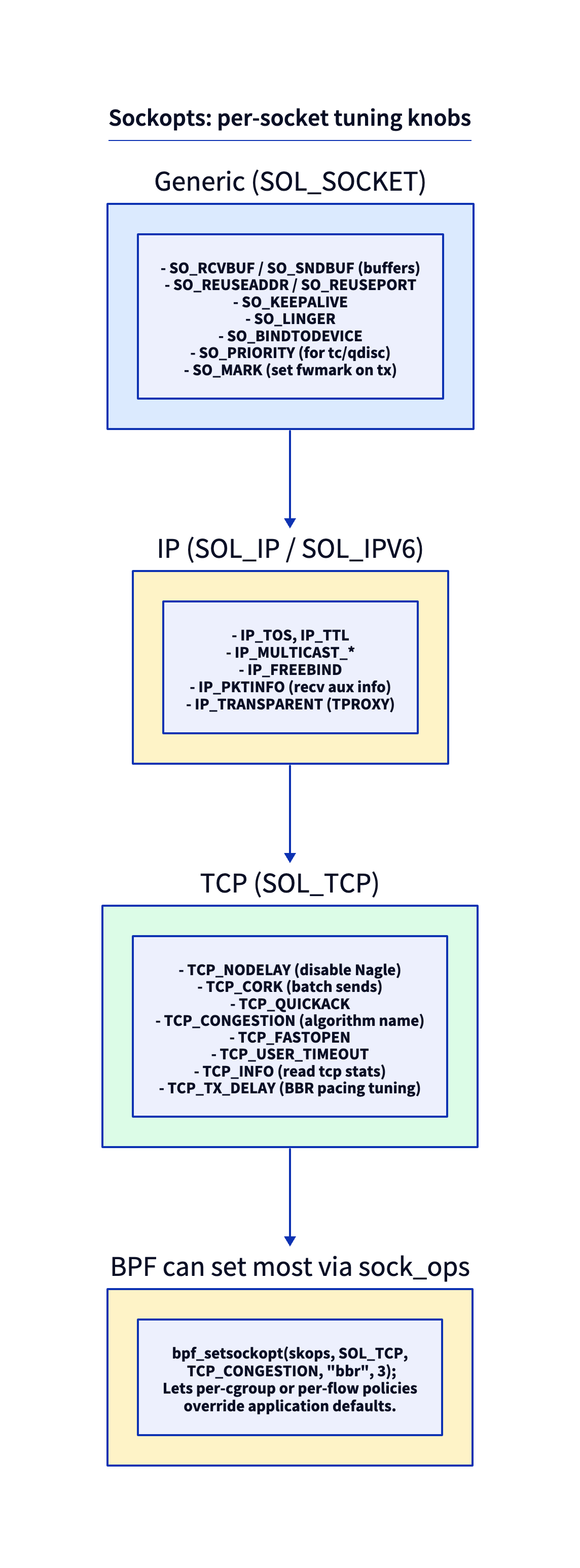
levelselects a namespace of options:SOL_SOCKET(generic, works on any socket),SOL_IP/SOL_IPV6(IP-layer),SOL_TCP,SOL_UDP(per-protocol). The sameoptnameinteger means different things under different levels, so the level disambiguates.optnamepicks the specific knob inside that namespace (SO_RCVBUF,TCP_NODELAY, …).optvalis a pointer to a typed value — sometimes anint, sometimes astruct linger, sometimes a string like"bbr". The kernel reinterprets the bytes according tooptname.optlenis the size of that value.
For getsockopt there’s one subtlety that trips up everyone the first time: optlen is value-result. You pass in the size of the buffer you’re offering, and the kernel writes back how many bytes it actually filled. That’s why today’s experiment always passes &gl / &cl (the length) by address — the kernel needs to be able to update it. Forget the & and you either truncate the answer or get EFAULT.
The kernel’s dispatch path
When the syscall enters the kernel, the option has to find its way to the one case that implements it. The dispatch is mechanical:
- The syscall lands in
do_sock_setsockopt(net/socket.c:2349). - For
level == SOL_SOCKET(generic), the kernel callssock_setsockopt(net/core/sock.c:1685) — a thin wrapper that immediately callssk_setsockopt(net/core/sock.c:1195), where the actual ~600-line option switch lives. - For other levels, it goes through
sk->sk_prot->setsockopt(or, for AF_INET,sock->ops->setsockopt), which dispatches to per-protocol code:tcp_setsockopt(net/ipv4/tcp.c:4175),udp_setsockopt,ip_setsockopt(net/ipv4/ip_sockglue.c:1409), etc.
That sk->sk_prot->setsockopt in step 3 is the sk_prot vtable from Day 13 — the per-protocol function table hanging off every struct sock. The same indirection that routes sendmsg to tcp_sendmsg vs udp_sendmsg routes setsockopt to the right protocol handler. (Recall the whole struct sock, its sk_prot dispatch, and its sk_lock from Day 13; we lean on all three today.)
Each option is a case in a giant switch statement. When you read tcp_setsockopt, you’re reading the canonical “what does this knob change?” reference.
One function body, two callers: sockptr_t
Look closely at do_sock_setsockopt’s signature in v7.1 and one parameter stands out:
int do_sock_setsockopt(struct socket *sock, bool compat, int level,
		       int optname, sockptr_t optval, int optlen)   /* net/socket.c:2349 */
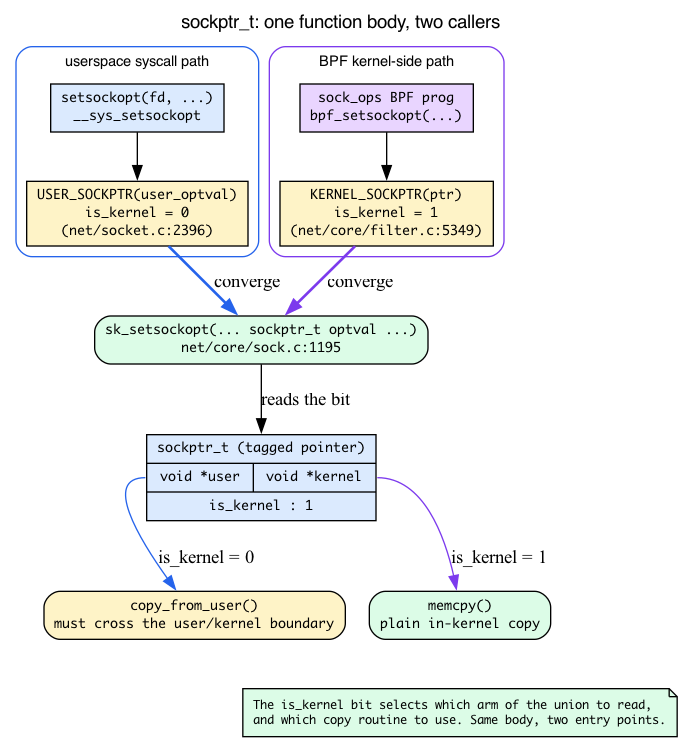
optval is not a void * and not a void __user * — it’s a sockptr_t. This is the abstraction the “What to read” list tells you to notice, so let’s actually explain it. A sockptr_t is a tagged pointer: a union of a kernel pointer and a userspace pointer plus a one-bit is_kernel flag (include/linux/sockptr.h:14):
typedef struct {
	union {
		void		*kernel;
		void __user	*user;
	};
	bool		is_kernel : 1;
} sockptr_t;
Why bother? Because the same option-setting code has two completely different callers:
- The syscall path.
__sys_setsockoptwraps the userspace buffer withUSER_SOCKPTR(user_optval)(net/socket.c:2396), sois_kernel = 0and the kernel knows it mustcopy_from_userbefore touching the bytes. - The BPF path. A
sock_opsBPF program (the “BPF can override most of these” paragraph below) callsbpf_setsockopt, which reuses the very samesk_setsockoptby wrapping its argument withKERNEL_SOCKPTR(net/core/filter.c:5349), sois_kernel = 1and the bytes are copied as a plain in-kernelmemcpy.
One function body, two entry points, the is_kernel bit selecting which arm of the union to read. That’s the entire reason sockptr_t exists — and it’s also why the capability-check helpers carry a sockopt_ prefix (next section): a kernel-side BPF caller must be able to skip the privilege check that a userspace caller is held to.
Who’s allowed: the capability privilege gate
Four of today’s options are gated behind a capability — you’ll see “requires CAP_NET_RAW” or “requires CAP_NET_ADMIN” repeated below — so before the catalog, here’s what a capability is.
Historically, a process was either root (uid 0, allowed to do anything) or not. That’s too coarse: a packet-capture tool needs to open raw sockets but has no business rebooting the machine. POSIX capabilities slice root’s omnipotence into ~40 independent privileges, each grantable on its own. A process can hold just one slice without being full root. Networking sockopts gate on two of these slices:
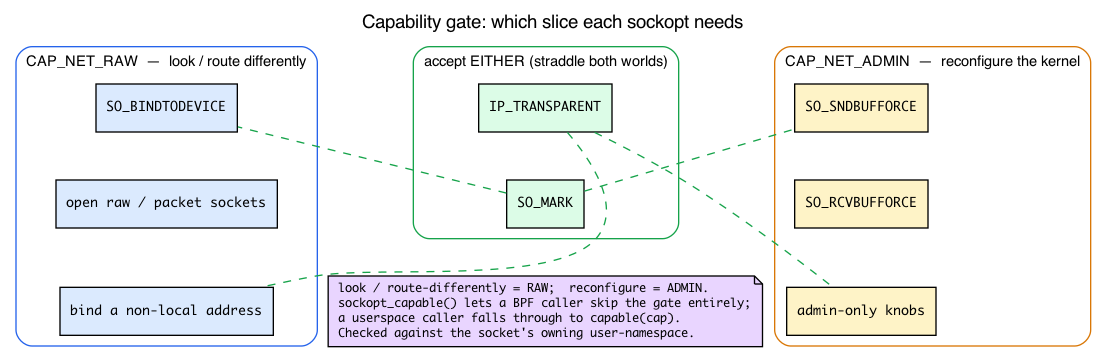
CAP_NET_RAW— “look, or route differently”: open raw/packet sockets, re-bind an already device-bound socket to a different device (binding an unbound socket to a device needs no capability), bind a non-local address.CAP_NET_ADMIN— “reconfigure kernel networking behavior”: force buffer sizes past the sysctl ceiling, change admin-only knobs, set up transparent proxying.
The rule of thumb the chapter relies on: raw access / “look but route my own way” = CAP_NET_RAW; “reconfigure the kernel” = CAP_NET_ADMIN. So SO_*BUFFORCE (override the max) needs ADMIN; SO_BINDTODEVICE needs RAW; IP_TRANSPARENT and SO_MARK accept either (they straddle both worlds — a mark is “route differently,” but it’s also “reconfigure”).
In the source the check is a one-liner. sockopt_capable(CAP_NET_ADMIN) returns -EPERM to the caller if the slice is missing — e.g. the SO_SNDBUFFORCE gate if (!sockopt_capable(CAP_NET_ADMIN)) at net/core/sock.c:1357, and the matching SO_RCVBUFFORCE gate at net/core/sock.c:1379. The helper itself is tiny (net/core/sock.c:1173, declared at include/net/sock.h:1780):
bool sockopt_capable(int cap)
{
	return has_current_bpf_ctx() || capable(cap);
}
There’s the sockopt_ prefix paying off: a BPF caller (has_current_bpf_ctx()) skips the check entirely — the kernel trusts its own programs. A userspace caller falls through to the real capable(cap).
One more wrinkle that explains a real-world surprise: the mark check uses sockopt_ns_capable(sock_net(sk)->user_ns, CAP_NET_X), and the device-bound check uses plain ns_capable(net->user_ns, CAP_NET_RAW) — both tested against the socket’s owning user-namespace, not the global one. That’s why an unprivileged container with its own user namespace can sometimes set a SO_MARK or re-bind to a device that looks like it should require root: inside its own userns it legitimately holds the slice. (The SO_BINDTODEVICE early branch is if (sk->sk_bound_dev_if && !ns_capable(net->user_ns, CAP_NET_RAW)) at net/core/sock.c:642 — note the leading sk->sk_bound_dev_if &&: the capability is only required to change the device once a socket is already bound; binding an unbound socket needs none. The SO_MARK gate accepts RAW-or-ADMIN at net/core/sock.c:1527.)
The shape every case shares
You’re about to read a catalog of options, but they all have the same skeleton — the one the “What to read” list calls out. Each case in sk_setsockopt (and its per-protocol cousins):
- copies
optvalin, validatingoptlen(this is thesockptr_tcopy from above); - takes the socket lock —
lock_sockfrom Day 13, which serializes against the data path so a knob change can’t race a concurrentsendmsg; - mutates a field of
struct sock(orstruct tcp_sock) — the same already-known struct from Day 13; - releases the lock.
So a sockopt is, mechanically, “lock the socket, write one field, unlock.” Keep that in mind and the catalog reads as a tour of which field each knob writes.
SOL_SOCKET — generic options
These work on any socket regardless of protocol family. Implementation: sk_setsockopt (net/core/sock.c:1195), reached via the thin sock_setsockopt wrapper (net/core/sock.c:1685).
SO_RCVBUF / SO_SNDBUF — buffer sizes
- What: maximum bytes queued in the socket’s receive (
sk_rcvbuf) or send (sk_sndbuf) queue — the twostruct sockfields you met on Day 13. - Why: larger buffers absorb more burst traffic without dropping or back-pressuring. For high-BDP paths the default may be too small to keep the pipe full — see the BDP box below.
- When: any high-throughput TCP server. Default
tcp_rmem/tcp_wmemtriplets give a baseline;SO_RCVBUF/SO_SNDBUFoverride per-socket. - Gotcha: the kernel doubles the value you set (one half is for kernel data structures); reads return the doubled value. This is in
sock_setsockopt— the SO_SNDBUF case doubles at theset_sndbuflabel (~line 1351). Also: setting these disables the kernel’s automatic buffer auto-tuning (the BDP box explains exactly how). - Where:
net/core/sock.c:1337(SO_SNDBUF case) andnet/core/sock.c:1369(SO_RCVBUF case).
Background: BDP and buffer auto-tuning
Two phrases in the section above — “high-BDP” and “auto-tuning” — are load-bearing and have never been defined. Here they are.
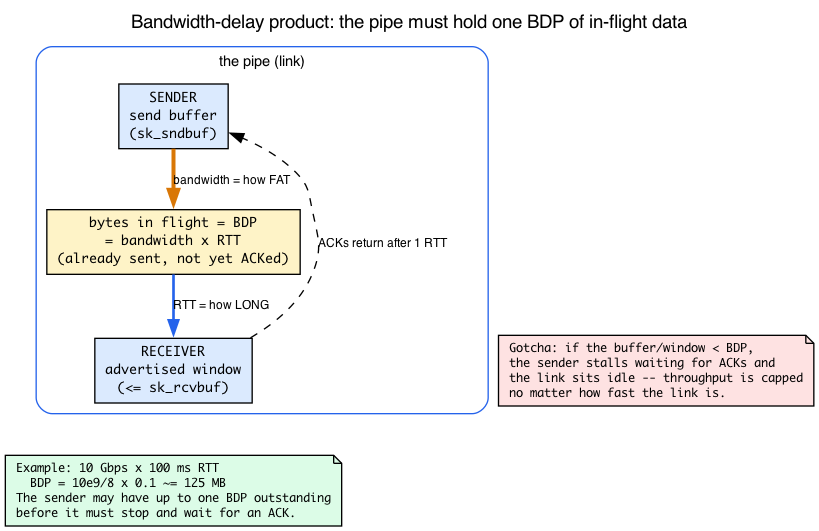
Bandwidth-delay product (BDP) = bandwidth × round-trip time. It is the number of bytes that are “in flight” — already sent but not yet acknowledged — when a pipe is running full. Picture a hose: bandwidth is how fat the hose is, RTT is how long it is; BDP is how much water the hose holds. To keep a link busy, the sender must be allowed to have at least one BDP of unacknowledged data outstanding, which means the send buffer (and the peer’s advertised receive window) must each be at least one BDP. A 10 Gbps link at 100 ms RTT has a BDP of
10e9/8 × 0.1 ≈ 125 MB— vastly larger than any default buffer. That is why the “high-bandwidth × high-latency” phrasing matters: on a fat, long path a too-small buffer caps throughput no matter how fast the link is.Auto-tuning is how Linux copes without making you guess. By default (
tcp_moderate_rcvbuf = 1) the kernel growssk_rcvbufon its own as it measures the connection’s BDP rising, staying within thetcp_rmem[min, default, max]triplet.tcp_wmemis the send-side equivalent triplet. Left alone, a busy long-fat connection’s buffers swell to fit the pipe automatically.The gotcha mechanism, in three beats:
- The userlock opts you out of auto-tuning. Calling
setsockopt(SO_RCVBUF)orSO_SNDBUFsets a “userlock” bit —SOCK_RCVBUF_LOCK/SOCK_SNDBUF_LOCK. You can see it in__sock_set_rcvbuf(net/core/sock.c:967):sk->sk_userlocks |= SOCK_RCVBUF_LOCK;at:975. After that the kernel never grows the buffer for you again.- The arithmetic: clamp first, then double. The value you ask for is first clamped to
sysctl_wmem_max/sysctl_rmem_max(net/core/sock.c:1343clamps SO_SNDBUF; SO_RCVBUF clamps at:1375), and then doubled for kernel-data overhead —sk_rcvbuf = max_t(int, val * 2, SOCK_MIN_RCVBUF)(:987), with the comment spelling out why. So the stored buffer can be up to twice the sysctl ceiling (2 * wmem_max/2 * rmem_max). The SO_SNDBUF path is the mirror image atnet/core/sock.c:1343-1351.- The consequence — an explicit small value can hurt. Because you turned off the autopilot, a value that’s too small throttles throughput worse than the default would have: you set a low ceiling and then forbade the kernel from raising it. On a long-fat path, either don’t set these at all, or set them generously.
SO_REUSEADDR — bind on TIME_WAIT
- What: allow bind() to succeed even when a recent socket on the same port is in TIME_WAIT.
- Why: server restart shouldn’t have to wait for TIME_WAITs to clear. (Recall TIME_WAIT from Day 15: the ~60 s wait the active closer sits in so late duplicate segments can’t be mistaken for a new connection. Without
SO_REUSEADDR, a restarting server’sbind()fails withEADDRINUSEwhile old connections linger there.) - When: every server. Set immediately after
socket(). - Gotcha: does not allow two sockets to bind the same port simultaneously — that’s
SO_REUSEPORT. The names are similar; the semantics are distinct. - Where:
net/core/sock.c:1321.
SO_REUSEPORT — multiple sockets sharing one port
- What: lets N sockets (in the same UID and netns) bind the same
(addr, port). Kernel hashes incoming connections to spread across them. - Why: scale a multi-process/multi-thread server across cores. Each worker has its own listening socket; no contention on the accept queue.
- When: any high-fanout server (nginx, envoy, custom Go/Rust servers). Day 24 covers it in detail.
- Gotcha: all sockets must set this before bind. UID match required (security: don’t let user A snipe user B’s port). The hash is per-flow, so a single client always lands on the same worker.
- Where:
net/core/sock.c:1324. The dispatch logic is ininet_csk_get_portand__inet_lookup_listener.
SO_KEEPALIVE — periodic liveness probes
- What: kernel sends periodic empty TCP segments to keep idle connections alive (and detect when the peer is gone).
- Why: detect dead peers (NAT box rebooted, peer crashed) without application-level heartbeats.
- When: long-lived connections behind NAT or load balancers (whose state may time out). Default off; specific applications turn it on.
- Gotcha: the keepalive intervals are system-wide sysctls (
net.ipv4.tcp_keepalive_time= 7200s,tcp_keepalive_intvl= 75s,tcp_keepalive_probes= 9). For per-socket overrides, useTCP_KEEPIDLE,TCP_KEEPINTVL,TCP_KEEPCNT— see SOL_TCP. - Where:
net/core/sock.c:1390.
SO_LINGER — block close() until data flushed (or RST)
- What: struct linger { l_onoff, l_linger }. If on,
close()blocks until either pending data is sent orl_lingerseconds elapse; in the latter case, RST is sent. - Why: ensure the peer either gets the data or knows the connection abruptly ended.
- When: rare. Useful for testing (RST to force immediate close) or high-stakes data delivery (transactional protocols).
- Gotcha: with
l_onoff=1, l_linger=0,close()immediately sends RST instead of FIN — useful for forced shutdowns but breaks graceful close. Withl_linger>0,close()may block for up tol_lingerseconds. - Where:
net/core/sock.c:1404.
SO_BINDTODEVICE — restrict to one interface
- What: bind socket to a specific net_device (by name). Outbound packets go through that device only; inbound only matches if arrived on it.
- Why: multi-homed hosts where you want a daemon to use a specific path (e.g., always send through the management NIC).
- When: management daemons, VPN clients, custom multipath logic.
- Gotcha: binding an unbound socket to a device needs no capability at all (deliberately enabled for non-root users so unprivileged processes can use VRFs);
CAP_NET_RAWis only required to change the device once a socket is already bound — thesk->sk_bound_dev_if &&guard atnet/core/sock.c:642. Bypasses normal routing — be aware that you’re disabling the kernel’s path selection. The check is tested against the socket’s user-namespace, so a container with its own userns may hold it. - Where:
net/core/sock.c:1210(a special early branch) andnet/core/sock.c:2045.
SO_MARK — set fwmark on outbound packets
- What: sets
skb->markfor every packet sent on this socket. Pairs withip rule fwmark X lookup TABLEfor socket-driven policy routing. - Why: route this app’s traffic differently (VPN, custom gateway) without iptables tagging. (Recall Day 9:
skb->markis theu32scratch field on the sk_buff, andip rule fwmark … lookup TABLEselects a non-default FIB table based on it — that’s the policy-routing machinery this option feeds. We’re just stamping the mark at the socket instead of in iptables.) - When: VPN clients, multi-homed daemons, traffic-engineering tools.
- Gotcha: requires
CAP_NET_RAWorCAP_NET_ADMIN(either suffices in v7.1 — a mark both “routes differently” and “reconfigures”). The mark is applied at socket level — packets generated by this socket carry it; received packets do not get it from this option. - Where:
net/core/sock.c:1527.
SO_PRIORITY — qdisc priority class
- What: sets
skb->priorityfor outbound packets. Used by qdiscs (notablypfifo_fast’s priority bands) for scheduling. - Why: mark interactive traffic as higher priority.
- When: if you control the egress qdisc and want app-controlled scheduling. With modern
fq_codel(default), this matters less. - Where:
net/core/sock.c:1223(SO_PRIORITY case insk_setsockopt).
SOL_IP / SOL_IPV6 — IP-layer options
Implementation: do_ip_setsockopt (net/ipv4/ip_sockglue.c:892).
IP_TOS — set DSCP/ECN bits
- What: sets the IP header’s TOS byte for outbound packets. The byte splits 6 + 2: the top 6 bits are the DSCP field, the low 2 bits are ECN.
- Why: mark traffic for QoS classification (DSCP) or ECN-capable signaling. (Recall DSCP from Day 9’s routing-selector boxes, and ECN from Day 16’s DCTCP, which consumes ECN-CE marks. This option is just the userspace handle that writes those bits into the header.)
- When: QoS-aware applications. Check egress qdisc respects DSCP.
- Gotcha: the value you set must match what your qdisc expects — many networks rewrite or strip DSCP.
- Where:
net/ipv4/ip_sockglue.c:1057(the case comment notes it “sets both TOS and Precedence”).
IP_TTL — outbound TTL
- What: override default TTL (usually 64) for outbound packets.
- When: traceroute (TTL=1), packet experiments. Most apps leave default.
- Where:
net/ipv4/ip_sockglue.c:1026.
IP_PKTINFO — receive auxiliary info per packet
- What: with
IP_PKTINFO=1,recvmsgaux data includes the destination address the packet was sent to and the interface it arrived on. - Why: UDP servers bound to
0.0.0.0need to know which local IP a request was destined to (so the reply uses the same source). WithoutIP_PKTINFO, you’d have to bind one socket per IP. - When: DHCP, DNS, SIP servers — any UDP service on a multi-homed host.
- Where:
net/ipv4/ip_sockglue.c:952.
IP_TRANSPARENT — bind to non-local addresses
- What: allows
bind()to a non-local IP. Combined with iptablesTPROXY, lets you intercept traffic destined elsewhere. - Why: transparent proxies (squid, HAProxy with
transparent, Envoy in some modes). - When: L7 transparent proxies, packet capture tools that re-inject.
- Gotcha: requires
CAP_NET_RAWorCAP_NET_ADMIN(either suffices — see the capability gate: binding a non-local address is “look/route differently,” reconfiguring interception is “admin,” so it straddles both), plus a corresponding TPROXY iptables rule + policy routing. - Where:
net/ipv4/ip_sockglue.c:1010.
IP_FREEBIND — bind before address is configured
- What: allow
bind()to an IP that doesn’t currently exist on any local interface. - Why: services that come up before networking is fully configured (failover daemons, daemons binding to floating IPs).
- Where:
net/ipv4/ip_sockglue.c:988.
SOL_TCP — TCP-specific options
Implementation: do_tcp_setsockopt (net/ipv4/tcp.c:3840).
TCP_NODELAY — disable Nagle
- What: Nagle’s algorithm batches small writes (waits for ACK or full segment before sending).
TCP_NODELAY=1disables this — every write goes immediately. - Why: latency-critical apps (interactive: SSH, X, gaming, real-time messaging) where waiting for a batch is unacceptable. (Recall Nagle from Day 3, the third gate in the TX path: don’t send a new small segment while a previous small one is still unacked — coalesce instead, recorded in
tp->nonagle.TCP_NODELAYflipstp->nonagleso the gate stops holding small writes.) - When: request-response protocols where each request fits in <1 segment and latency matters. Most modern servers.
- Gotcha: if both NODELAY and CORK are off, default Nagle applies. NODELAY beats CORK for any individual
write. - Where:
net/ipv4/tcp.c:3970.
TCP_CORK — buffer until full or uncorked
- What: opposite of NODELAY. Hold writes until either an MSS-sized segment fills up or
TCP_CORK=0. (It’s a stronger, deliberate version of the Nagle batching from Day 3 — instead of “coalesce only while a small segment is unacked,” it says “coalesce everything until I say go.”) - Why: an application building a multi-piece response (header + body) wants to ensure they go in one segment.
- When: static-file servers (
sendfile()followed by uncork), HTTP servers building structured responses. - Gotcha: corked sockets will eventually send (after ~200 ms) even without uncorking. But don’t rely on that — explicitly uncork.
- Where:
net/ipv4/tcp.c:4043.
TCP_QUICKACK — disable delayed ACKs (one-shot)
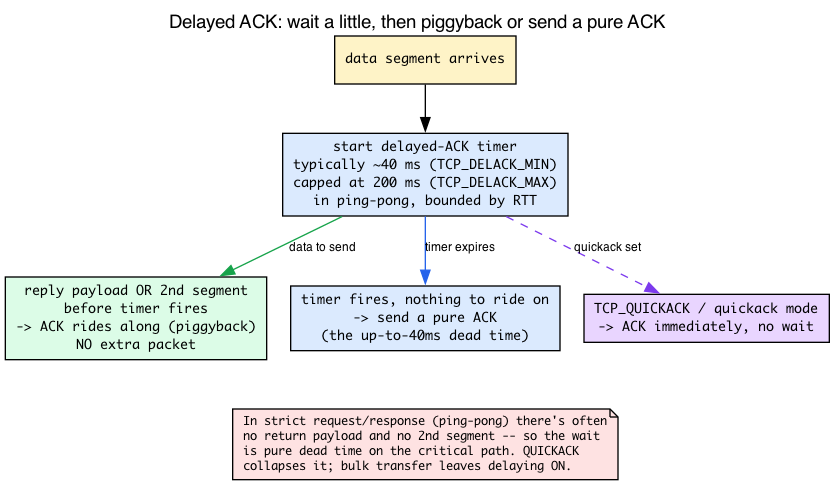
- What: TCP normally delays ACKs by a short bounded time — typically ~40 ms (
TCP_DELACK_MIN), capped at 200 ms (TCP_DELACK_MAX) in ping-pong mode — hoping to piggyback on outgoing data.TCP_QUICKACK=1forces an immediate ACK on the next received segment, then reverts to normal. - Why: request-response patterns where you’ve just sent a request and the next segment is the response — you want to ACK fast so the server’s CC algorithm sees it.
- When: rarely useful at the application level. The kernel already enters “quickack mode” automatically in some scenarios.
- Gotcha: it’s a one-shot, not a persistent setting.
- Where:
net/ipv4/tcp.c:4062(TCP_QUICKACK case indo_tcp_setsockopt).
Background: what “delayed ACK” actually is
TCP_QUICKACKoverrides a mechanism the book hasn’t introduced (Day 17 covered loss and retransmission, not this timer). Delayed ACK: after receiving data, TCP doesn’t ACK immediately — it waits a short, bounded time (typically ~40 ms —TCP_DELACK_MIN= HZ/25,include/net/tcp.h:154— and capped at 200 ms —TCP_DELACK_MAX= HZ/5,:150— in ping-pong mode, further bounded by the connection’s measured RTT) hoping that either a reply payload comes along so the ACK can ride on it (piggybacking), or a second data segment arrives so one ACK covers both. It trades a little latency for far fewer pure-ACK packets. The timer lives in the TCP output path —tcp_send_delayed_ack(net/ipv4/tcp_output.c:4408) uses the RTT estimate to bound the delay (“use it to bound delayed ack”,net/ipv4/tcp_output.c:4424), and sending real data clears any pending delayed ACK (“Send it off, this clears delayed acks for us”,net/ipv4/tcp_output.c:4499).Why it matters for the request/response case: in strict ping-pong traffic there’s often no return payload to piggyback on and no second segment coming, so the wait (typically ~40 ms, up to 200 ms) is pure dead time on the critical path.
TCP_QUICKACK(or the kernel’s own quickack heuristics) cuts that delay. It reverts afterward because in steady bulk transfer delaying ACKs is the right default.
TCP_CONGESTION — choose CC algorithm
- What: name string of CC algorithm (e.g., “cubic”, “bbr”). Replaces the default for this socket.
- Why: different connections want different algorithms; per-socket override is the cleanest way. (Recall Day 16: the pluggable congestion-control framework and the per-socket
tcp_set_congestion_control. This swaps the CC module for one socket — the congestion windowsnd_cwndand the rest of thestruct tcp_sockstate from Day 13 are then driven by the new algorithm.) - When: specialized workloads (intra-datacenter wants DCTCP; cross-WAN wants BBR).
- Gotcha: the algorithm must be loaded (
modprobe tcp_bbr). Checktcp_available_congestion_control. Switching to some non-default algorithms requiresCAP_NET_ADMIN. - Where:
net/ipv4/tcp.c:3851.
TCP_USER_TIMEOUT — give up after milliseconds
- What: abort the connection if data has been unacked for the given time, regardless of RTO retries.
- Why: keep-alive isn’t enough — you want hard “give up after 30 seconds” semantics.
- When: any application where stale connections are worse than aggressive aborts (RPC clients, request/response protocols with deadlines).
- Gotcha: in milliseconds (other timeouts are seconds — check the docs). 0 = use system default (which is roughly 15 min via RTO retry).
- Where:
net/ipv4/tcp.c:3922.
TCP_FASTOPEN — TCP Fast Open (TFO)
- What: server-side: queue up to N early-data connections (data carried in the SYN). Client-side: cookie-based optimistic data send.
- Why: save one RTT on connection establishment for repeated connections.
- When: services with frequent reconnects (CDN edges, mobile clients).
- Gotcha: middleboxes often strip the TFO cookie. Sysctl
tcp_fastopenconfigures support; bit 1 enables client, bit 2 enables server. - Where:
net/ipv4/tcp.c:4101(TCP_FASTOPEN case indo_tcp_setsockopt). The state machine is more complex than this option suggests.
TCP_INFO — read tcp_info struct
- What: getsockopt-only. Returns
struct tcp_infowith rtt, cwnd, retrans count, state, etc. - Why: observability without parsing
/proc/net/tcp. (Recall Day 16:tcp_get_infofills this struct from the livestruct tcp_sock—snd_cwnd,srtt_us,ca_state. This is the userspace handle on that state.) - When: monitoring agents, performance debugging.
- Where:
net/ipv4/tcp.c— searchtcp_get_info(line 4213). Read this function: it’s the source of truth for whatss -tinshows.
TCP_TX_DELAY — artificial outbound delay (test/emulation only)
- What: delay outgoing packets by a fixed number of microseconds (optname 37). The kernel adds the delay to
skb->skb_mstamp_nsand inflates the connection’ssrtt_us/icsk_rtoso the rest of the stack behaves as if the path RTT were that much larger. - Why: network emulation for testing — let a test on localhost (or a short path) behave like a high-latency WAN link without real distance or
tc netem. Added in commit a842fe1425cb. - When: test harnesses and benchmarks only. Not a production tuning knob.
- Gotcha: this has nothing to do with BBR or pacing. BBR paces via
sk_pacing_rate+ thefqqdisc, not this option;TCP_TX_DELAYonly adds artificial latency. - Where:
net/ipv4/tcp.c:4157(TCP_TX_DELAY case indo_tcp_setsockopt).
BPF can override most of these
A sock_ops BPF program (eBPF Day 19) can call bpf_setsockopt() to set sockopts kernel-side. The genuinely new capability this unlocks is policy by cgroup or flow rather than by application: a single BPF program can stamp a fleet-wide rule the apps never opted into — e.g. “every socket from the high-priority cgroup uses BBR” — overriding whatever each process set itself. (Mechanically it’s exactly the second caller from the sockptr_t section: KERNEL_SOCKPTR into the same sk_setsockopt, has_current_bpf_ctx() sailing past the capability gate.) Day 19 builds one.
There are no Dumb Questions
Q: Why does
getsockopttakeoptlenby pointer whensetsockopttakes it by value?A: Because
getsockopt’soptlenis value-result. On the way in it tells the kernel how big your buffer is (so the kernel won’t overflow it); on the way out the kernel overwrites it with how many bytes it actually wrote.setsockoptonly ever reads, so a plain value is enough. This is exactly why today’s experiment passes&gland&clby address and re-initializescl = sizeof ccbefore the secondTCP_CONGESTIONread — the first call shrank it to the length of"cubic".
Q: I set
SO_RCVBUFto a big number and throughput got worse. How?A: You opted out of auto-tuning (the
SOCK_RCVBUF_LOCKuserlock) and, depending on the value, may have set a ceiling below what the kernel would have grown to on its own for your BDP. The autopilot was doing a better job. Either don’t set it at all on a long-fat path, or set it generously (and remember the kernel doubles it, then clamps atsysctl_rmem_max).
Q: My container sets
SO_MARKwithout being root. Is that a bug?A: No. The check is
sockopt_ns_capable(sock_net(sk)->user_ns, …)— it’s against the socket’s user namespace, not the global one. A container with its own user namespace can legitimately holdCAP_NET_RAW/CAP_NET_ADMINinside that namespace, so marks that look privileged from the host’s view are allowed from inside.
Q: How can one C function (
sk_setsockopt) safely take a pointer that’s sometimes userspace and sometimes kernel?A: That’s the whole job of
sockptr_t— a union plus anis_kernelbit. Userspace callers wrap withUSER_SOCKPTR(copy_from_user), BPF callers wrap withKERNEL_SOCKPTR(plain memcpy). The function reads the bit, not your intentions.
Today’s experiment
# See sockopts on live sockets
ss -tipsm | head -20    # m=memory accounting

# SET options and READ them back via getsockopt — exercises the day's core verb
cat << 'EOF' > /tmp/tcpinfo.c
#include <stdio.h>
#include <stdlib.h>
#include <sys/socket.h>
#include <netinet/in.h>
#include <netinet/tcp.h>
#include <arpa/inet.h>
#include <unistd.h>

int main(int argc, char **argv) {
  int s = socket(AF_INET, SOCK_STREAM, 0);

  /* (1) SET a buffer size and watch the kernel double it — no connection needed */
  int v = 65536, g; socklen_t gl = sizeof g;
  setsockopt(s, SOL_SOCKET, SO_RCVBUF, &v, sizeof v);
  getsockopt(s, SOL_SOCKET, SO_RCVBUF, &g, &gl);
  printf("SO_RCVBUF: set %d, got %d (kernel doubled it)\n", v, g);

  /* (2) SET congestion control for THIS socket only (no global sysctl) */
  char cc[32]; socklen_t cl = sizeof cc;
  getsockopt(s, IPPROTO_TCP, TCP_CONGESTION, cc, &cl);
  printf("cc before: %s\n", cc);
  setsockopt(s, IPPROTO_TCP, TCP_CONGESTION, "bbr", 3);

  /* (3) connect, then READ tcp_info + the now-active CC name */
  struct sockaddr_in a = { AF_INET, htons(argc > 2 ? atoi(argv[2]) : 80) };
  inet_aton(argc > 1 ? argv[1] : "8.8.8.8", &a.sin_addr);
  if (connect(s, (struct sockaddr*)&a, sizeof a) < 0) { perror("connect"); return 1; }

  struct tcp_info ti;
  socklen_t l = sizeof ti;
  getsockopt(s, IPPROTO_TCP, TCP_INFO, &ti, &l);
  cl = sizeof cc;
  getsockopt(s, IPPROTO_TCP, TCP_CONGESTION, cc, &cl);
  printf("rtt %u us, cwnd %u, rwnd %u, retrans %u, ca_state %u, cc %s\n",
         ti.tcpi_rtt, ti.tcpi_snd_cwnd, ti.tcpi_snd_wnd,
         ti.tcpi_total_retrans, ti.tcpi_ca_state, cc);
  return 0;
}
EOF
cc /tmp/tcpinfo.c -o /tmp/tcpinfo && /tmp/tcpinfo
The default target is 8.8.8.8:80, so this needs outbound TCP/80 reachability. On an offline or egress-firewalled box, start a local listener and point the program at it instead (the program takes host port as args):
nc -l 127.0.0.1 18080 &     # any high port avoids needing root to bind :80
/tmp/tcpinfo 127.0.0.1 18080
kill %1                      # stop the listener
Expected output (numbers vary; loopback gives a tiny rtt):
SO_RCVBUF: set 65536, got 131072 (kernel doubled it)
cc before: cubic
rtt 37 us, cwnd 10, rwnd 65483, retrans 0, ca_state 0, cc bbr
What each line proves:
set 65536, got 131072— the chapter’s headline gotcha (the__sock_set_rcvbufdoubling). The kernel stored twice what you asked; the extra half is bookkeeping overhead. (The doubled value is clamped at2 * net.core.rmem_max, so very large sets get capped.) Thissetsockoptalso silently set theSOCK_RCVBUF_LOCKuserlock — this socket is now opted out of auto-tuning.cc before: cubic→cc bbr— the per-socketsetsockopt(TCP_CONGESTION)took effect, andgetsockoptreads it back.cubicis the typical kernel default, but if your box already defaults tobbr(checksysctl net.ipv4.tcp_congestion_control),cc beforewill readbbrand the override is a visual no-op — set the default tocubicfirst, or read the source line to confirm the per-socket write still happened. This changes only this socket — the system-wide default (net.ipv4.tcp_congestion_control) is never touched, so there is no global state to restore.bbrmust be available (modprobe tcp_bbr; checksysctl net.ipv4.tcp_available_congestion_control). Note the program resetscl = sizeof ccbefore this second read — because the firstgetsockoptshrankclto the value-result length of"cubic".rttistcpi_rtt=srtt_us >> 3in microseconds;cwnd 10is the initial congestion window;ca_state 0isTCP_CA_Open(the normal, no-loss state).
What to read in the kernel
-
net/socket.c:2349—do_sock_setsockopt. The dispatcher. Read it to see how(level, optname, value)flows to the right protocol code. Notice thesockptr_tabstraction that lets BPF (kernel-space caller) and userspace use the same setsockopt path —USER_SOCKPTRwraps the syscall buffer at:2396. -
include/linux/sockptr.h:14— thesockptr_tunion +is_kernelbit itself. Five lines; read them once and the BPF-vs-syscall convergence clicks. -
net/core/sock.c:1685—sock_setsockopt. The SOL_SOCKET entry — but it’s just a thin wrapper. The real work is insk_setsockopt(net/core/sock.c:1195): a long switch (~600 lines). Read the cases for the options you care about — each is its own micro-routine. Notice the consistent pattern: copy from user, validate, take socket lock (lock_sock, Day 13), update field, release lock. The capability one-linersockopt_capableis at:1173. -
net/core/sock.c:967—__sock_set_rcvbuf. TheSOCK_RCVBUF_LOCKuserlock and the “double it for overhead” comment in one place — the mechanism behind both buffer gotchas. -
net/ipv4/tcp.c:4175—tcp_setsockopt. The TCP-specific dispatcher; passes through todo_tcp_setsockopt(line 3840). Readdo_tcp_setsockoptend-to-end if you ever wonder “what does TCP_FOO actually do?” — every option has its case here. -
net/ipv4/tcp.c:3970— TCP_NODELAY case. ~10 lines. The simplest TCP option; useful as a starting reference. -
net/ipv4/tcp.c:4043— TCP_CORK case. Note the interaction with TCP_NODELAY (mutually exclusive in spirit but both can be set). -
net/ipv4/tcp.c:3851— TCP_CONGESTION case. Callstcp_set_congestion_control(Day 16). Notice thecap_net_adminrequirement for some non-default algorithms. -
net/ipv4/tcp.c:4213—tcp_get_info. Fillsstruct tcp_infoforTCP_INFOgetsockopt. Read this to know what fields are intcp_infoand where each comes from (rtt →tp->srtt_us >> 3at:4300, cwnd →tcp_snd_cwnd(tp)at:4241, etc.). -
net/ipv4/ip_sockglue.c:892—do_ip_setsockopt. The IP-level dispatcher. Read the cases forIP_PKTINFO(line 952),IP_FREEBIND(line 988),IP_TRANSPARENT(line 1010) — they’re each illuminating examples of how a single line of userspace code unlocks a whole behavior. -
include/uapi/linux/tcp.h— TCP option constants. Skim to see the full list. There are ~50; you’ll meet most over a career. -
include/uapi/asm-generic/socket.h— generic SO_* constants. -
Documentation/networking/ip-sysctl.rst— sysctls related to TCP/IP behavior (much of which interacts with sockopts).
Bullet Points
- A sockopt is
(level, optname, optval, optlen).levelnames the namespace,optnamethe knob,optvala typed value,optlenits size — and ongetsockopt,optlenis value-result (pass the buffer size in, get the filled size back). - Dispatch:
do_sock_setsockopt(socket.c:2349) → SOL_SOCKET viasock_setsockopt→sk_setsockopt(sock.c:1195); other levels via thesk_protvtable (Day 13). Each case: copy in,lock_sock, write astruct sockfield, unlock. sockptr_tis a union (kernel ptr / user ptr) +is_kernelbit, so onesk_setsockoptserves both the syscall path (USER_SOCKPTR) and BPF (KERNEL_SOCKPTR). Thesockopt_prefix lets BPF skip the privilege check.- Capabilities slice root’s power:
CAP_NET_RAW= raw/packet sockets, re-bind an already device-bound socket, non-local bind;CAP_NET_ADMIN= force buffers, admin knobs, transparent proxy.SO_BINDTODEVICE→nothing to bind an unbound socket, RAW only to change device;SO_*BUFFORCE→ADMIN,SO_MARK/IP_TRANSPARENT→either. Checked against the socket’s user-namespace. SO_RCVBUF/SO_SNDBUF— buffers. The value is clamped tormem_max/wmem_maxfirst, then doubled (so the stored buffer can reach2*rmem_max/2*wmem_max); an explicit set trips the userlock and disables auto-tuning. BDP = bandwidth × RTT = bytes in flight; a too-small buffer caps throughput on high-bandwidth × high-latency paths.SO_REUSEADDR— bind over a port stuck in TIME_WAIT (Day 15).SO_REUSEPORT— multiple sockets, one port (Day 24).TCP_NODELAY— disable Nagle (Day 3; flipstp->nonagle).TCP_CORK— its opposite; batch until uncork.TCP_QUICKACK— one-shot override of delayed ACK (typically a ~40 ms wait to piggyback an ACK on return data, capped at 200 ms in ping-pong mode).TCP_CONGESTION— pick CC algorithm per-socket (Day 16).TCP_USER_TIMEOUT— hard deadline (ms) for unacked data.TCP_INFO(getsockopt) — full TCP stats fromtcp_get_info; equivalent toss -tin.IP_TOS— TOS byte = 6-bit DSCP (Day 9) + 2-bit ECN (Day 16).IP_PKTINFO— UDP servers learn which local IP a packet was sent to.IP_TRANSPARENT— bind to non-local IP for transparent proxies.- BPF (
cgroup_sockops) can override all of these from kernel-side via the samesk_setsockopt.
Check question
Why might TCP_NODELAY and TCP_CORK look like opposites yet sometimes both be useful on the same socket at different times?
Click to reveal answer
Answer: They serve different needs at different points in the connection’s lifecycle. A request/response server might CORK while building a multi-piece response (header + body — the application calls write() multiple times to compose), then uncork — the kernel sends one efficient large segment. Right after the response, the app might set NODELAY so any tail data (a small “200 OK” follow-up, a heartbeat) doesn’t sit waiting for Nagle. Real apps mix both: cork for batching prepared output, nodelay for ad-hoc small writes between batches. The point: the application knows when batching helps (assembling a large response) and when latency matters more (everything else). Sockopts let it switch dynamically. (The kernel even confirms they coexist: net/ipv4/tcp.c:3640 notes “TCP_CORK can be set together with TCP_NODELAY and it is stronger than TCP_NODELAY.”)
Tomorrow
Day 19: epoll and io_uring for sockets. The two ways modern userspace waits on many sockets efficiently.