Day 19 — epoll and io_uring for sockets
Today’s mission: understand how userspace efficiently waits on many sockets, and why io_uring is taking over from epoll for the highest-throughput servers. We’ll first build the two pieces of machinery the whole chapter rests on — blocking vs. non-blocking sockets and the kernel wait queue a socket sleeps on — and only then open epoll, which is nothing more than a clever hook into that wait queue. Total time: ~110 minutes.
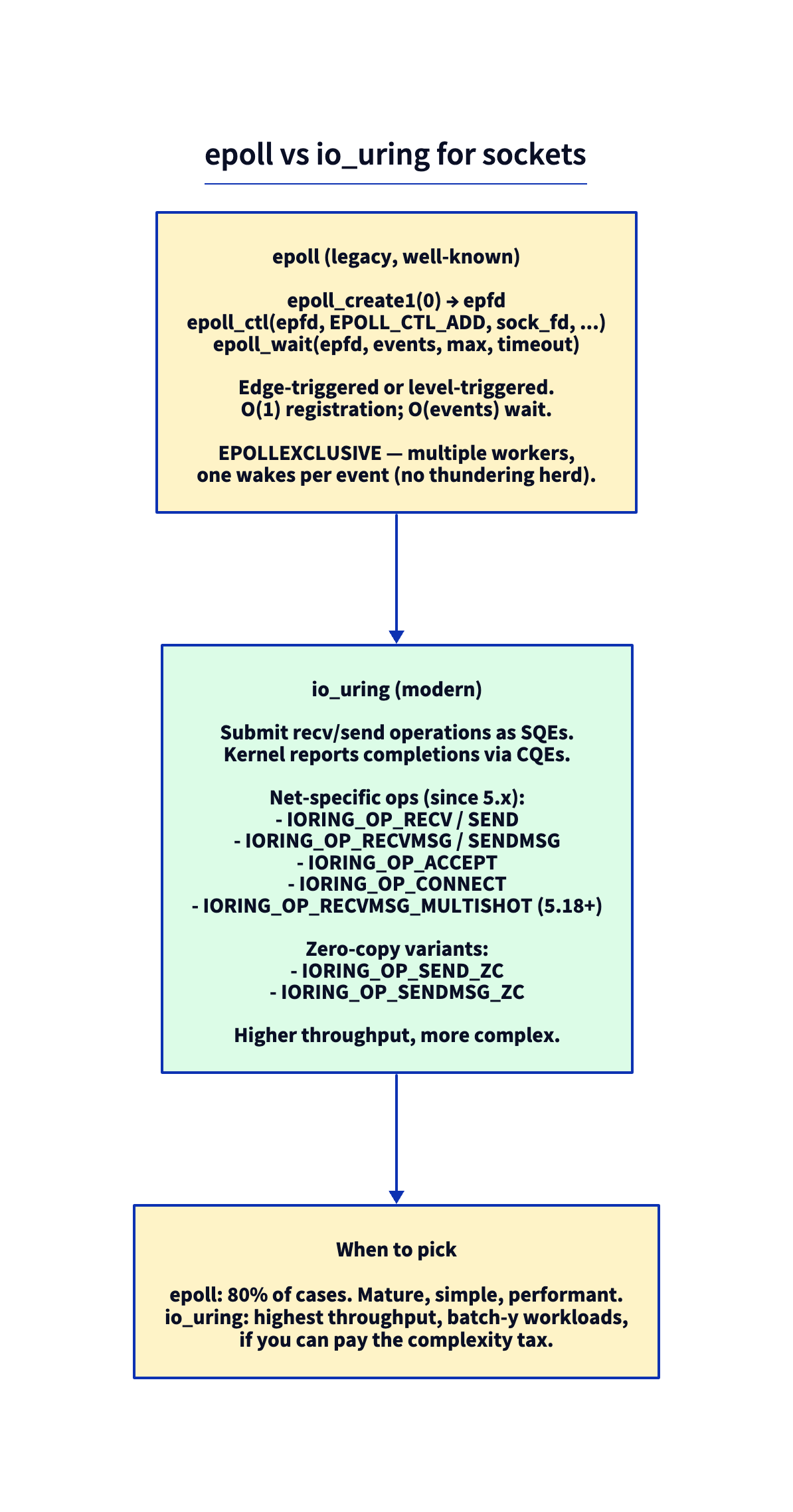
The problem they solve
A naive blocking server handles one client at a time. To handle many, you can:
- Fork a process per client (Apache prefork, ~early-2000s style). Heavy.
- Spawn a thread per client (1:1 threading). Lighter than processes but still ~MB per client and lots of context switches.
- Use one thread for many clients with non-blocking I/O. Read/write only when ready; never block on individual sockets. Now you need to know which socket is ready.
That last bullet is what epoll and io_uring solve — but with totally different mechanics.
But before any of that makes sense, we have to be precise about two words in bullet 3 that the rest of the chapter leans on constantly: “block” and “ready.” What does it mean for recv() to block? What machine puts the thread to sleep, and what wakes it? And what does “ready” actually test? Those two questions are the same question, and answering it is the key that unlocks epoll’s internals. So we’ll teach that machinery first — intuition, then the v7.1 structs — and only then walk the epoll API.
Background 1: blocking, non-blocking, and the EAGAIN contract
A blocking recv() puts your thread to sleep
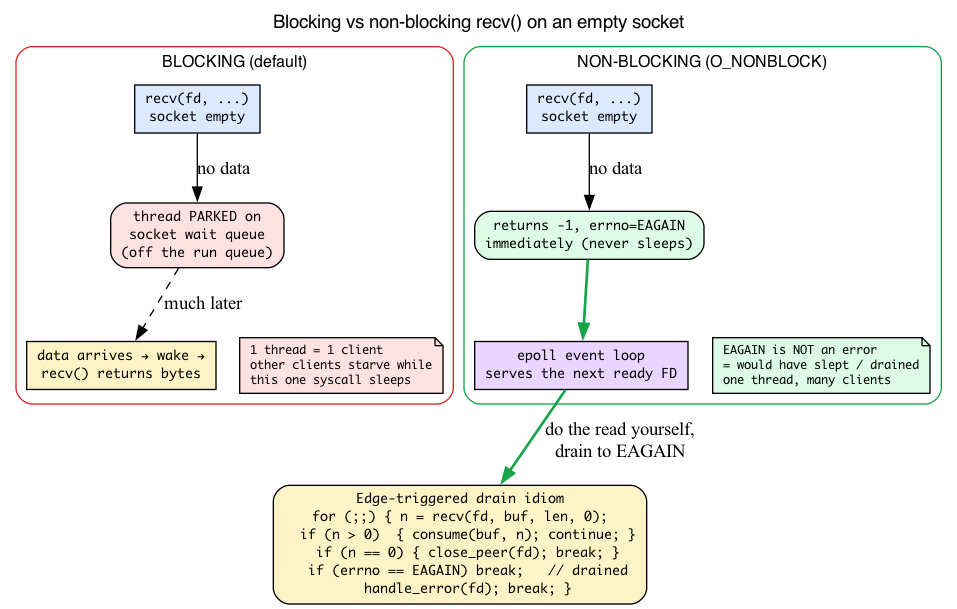
By default, a socket is blocking. Call recv() on a TCP socket that has no data waiting, and your thread does not spin, poll, or return an error — it goes to sleep. The kernel parks the task, schedules something else onto the CPU, and only wakes your task when data arrives. From userspace it looks like one long syscall that “took a while”; underneath, the thread was off the run queue entirely.
That is exactly why bullet 3’s “many clients in one thread” is hard. If your one thread calls recv() on client A and A is quiet, the thread sleeps inside that syscall — and clients B, C, D get no service, even if they have data ready right now. One blocking thread serves one slow client. The whole readiness model only works if syscalls never sleep.
O_NONBLOCK flips the switch: return instead of sleep
Setting O_NONBLOCK on a socket changes the contract. You set it with fcntl(fd, F_SETFL, O_NONBLOCK), or get it atomically at creation with SOCK_NONBLOCK passed to socket() / accept4(). Now recv, accept, and send return immediately:
- If there’s data (or a pending connection, or send-buffer room), they do the work and return normally.
- If there’s nothing to do, instead of sleeping they return
-1witherrno == EAGAIN.
EAGAIN (spelled EWOULDBLOCK on Linux — same value) is not an error. It is the kernel saying “not ready right now; there’s nothing here for you, try again later.” It’s the non-blocking world’s version of “would have slept.”
Why epoll and non-blocking I/O are a matched pair
This is the missing half of the readiness model. epoll_wait (we meet it below) tells you which FDs are ready. You then do the syscall yourself — and EAGAIN is the signal that you’ve drained this FD for now, so you stop and move to the next ready FD.
Without O_NONBLOCK, the design breaks: even after epoll_wait says “FD is readable,” a blocking recv() could still sleep — for instance if a checksum-failed segment got dropped between the readiness notification and your read, leaving the socket empty again. One stalled recv() and your whole event loop freezes. Non-blocking mode is what guarantees the loop keeps spinning. epoll without O_NONBLOCK is a loaded footgun.
Edge-triggered mode makes EAGAIN mandatory
There are two ways epoll can report readiness (we’ll formalize them later):
- Level-triggered (default): epoll re-reports an FD for as long as it still has data. If you read only half the bytes, the next
epoll_waithappily tells you again. Forgiving. - Edge-triggered (
EPOLLET): epoll notifies you on each new data arrival (a fresh wake of the socket’s wait queue), not continuously while data sits unread. It will not re-report unread bytes on its own — only a new wake fires it again.
So under edge-triggered mode you must loop:
/* Edge-triggered drain: read until the kernel says EAGAIN */
for (;;) {
    ssize_t n = recv(fd, buf, sizeof buf, 0);
    if (n > 0)        { consume(buf, n); continue; }   /* more queued — keep going */
    if (n == 0)       { close_peer(fd);  break;    }   /* orderly shutdown */
    /* n < 0 */
    if (errno == EAGAIN) break;     /* drained: nothing left until next arrival */
    handle_error(fd); break;
}
If you stop early — say you read one buffer’s worth and trust epoll to remind you — the leftover bytes just sit there. Edge-triggered already fired its one notification for that transition; the next epoll_wait stays silent until brand-new data triggers another edge. Your reader is wedged with data it never picked up. Draining to EAGAIN is the only correct edge-triggered idiom. Level-triggered forgives a partial read precisely because it re-reports while data remains.
The same loop shape shows up for accepting connections under EPOLLEXCLUSIVE (later in the chapter): a woken worker calls accept4() in a loop until EAGAIN to drain the listen backlog, then goes back to sleep.
Background 2: wait queues — the sleep/wake machine under every socket
We just said a blocking recv() “goes to sleep” and “gets woken when data arrives.” Time to make that literal, because this exact mechanism is what epoll hooks into. Get this and epoll’s internals stop being magic.
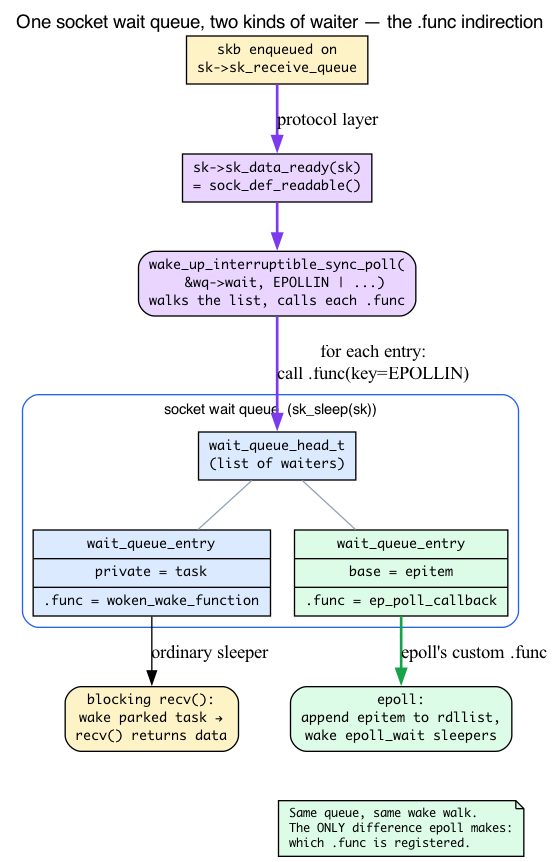
A wait queue is a list of sleepers plus a wake function
When a thread must wait for an event (“data on this socket”), the kernel needs somewhere to record “this task is sleeping, and here’s how to wake it.” That record-keeper is a wait queue: a wait_queue_head_t is just a list of waiters, and each waiter is a struct wait_queue_entry that points at a sleeping task plus a wake callback function to run when the event fires.
/* include/linux/wait.h:15 */
typedef int (*wait_queue_func_t)(struct wait_queue_entry *wq_entry,
                                 unsigned mode, int flags, void *key);

/* include/linux/wait.h:28 */
struct wait_queue_entry {
    unsigned int            flags;
    void                    *private;     /* usually the task to wake */
    wait_queue_func_t       func;         /* the callback — remember this field */
    struct list_head        entry;
};
That .func field is the whole story of today’s chapter. For an ordinary sleeper it’s a generic “wake this task” routine. epoll, as we’ll see, swaps in its own function — and that swap is the entire trick.
Every socket carries a wait queue; recv() sleeps on it
A blocking recv() that finds the socket empty adds itself to the socket’s wait queue and sleeps. You can see it plainly in sk_wait_data (net/core/sock.c:3269):
int sk_wait_data(struct sock *sk, long *timeo, const struct sk_buff *skb)
{
    DEFINE_WAIT_FUNC(wait, woken_wake_function);
    int rc;

    add_wait_queue(sk_sleep(sk), &wait);                 /* park on the socket's queue */
    sk_set_bit(SOCKWQ_ASYNC_WAITDATA, sk);
    rc = sk_wait_event(sk, timeo,
                       skb_peek_tail(&sk->sk_receive_queue) != skb, &wait);
    /* ... woken: remove and return ... */
    remove_wait_queue(sk_sleep(sk), &wait);
    return rc;
}
sk_sleep(sk) is the socket’s wait queue head. The thread links a wait_queue_entry onto it and blocks. Hold onto that queue — when the chapter later says epoll registers on “the same wait queue recvmsg would block on,” this sk_sleep(sk) queue is the one it means.
The wake comes from sk_data_ready → sock_def_readable
So who wakes the sleeper? On the receive side, every socket has a callback pointer sk->sk_data_ready, fired whenever the protocol layer has just enqueued a packet for the socket. (Day 14 showed __udp_enqueue_schedule_skb calling sk->sk_data_ready(sk) (net/ipv4/udp.c:1745) to “wake any recvmsg waiters” — that one line is the wake. Here we explain the queue it kicks.)
The default sk_data_ready is sock_def_readable, installed at socket creation (net/core/sock.c:3734). Day 14 showed its full body; the one line that matters here is the wake itself (net/core/sock.c:3614):
wake_up_interruptible_sync_poll(&wq->wait, EPOLLIN | EPOLLPRI |
                                EPOLLRDNORM | EPOLLRDBAND);
This walks the socket’s wait queue and, for each waiter, calls that waiter’s .func, passing EPOLLIN (and friends) as the key argument. For a blocking recv(), .func wakes the parked task and recv() returns with data. Notice the kernel passes EPOLLIN — the very same bit you’ll put in your epoll_event. That’s not a coincidence; it’s the next idea.
->poll(): one call that both registers and reports readiness
Every pollable file (sockets, pipes, eventfds, even other epoll FDs) exports a ->poll() file operation. The kernel calls it through vfs_poll(file, pt) with a small helper called a poll_table, and ->poll() does two jobs in one shot:
- Register the caller on the file’s wait queue (using the
poll_table), so the caller will be woken on future readiness. - Return a readiness bitmask right now —
EPOLLINif there’s data to read,EPOLLOUTif there’s send-buffer room, etc.
This is the deep reason the EPOLLIN in your epoll_event is the same bit the kernel uses internally: readiness is one bitmask shared by ->poll(), by sock_def_readable’s wake key, and by your userspace event struct. They are literally the same flags.
So an ordinary blocking wait threads through exactly this chain — recv() parks on sk_sleep(sk), a packet’s sk_data_ready walks the queue, your entry’s .func wakes the task, recv() returns (the numbered flow below spells out each hop). epoll changes exactly one thing in that chain: which .func gets registered. That’s the next section.
epoll — the readiness model
The mental model: “Tell me when this FD is ready for I/O. I’ll do the syscall myself.”
int epfd = epoll_create1(0);

struct epoll_event ev = { .events = EPOLLIN | EPOLLET, .data.fd = sock };
epoll_ctl(epfd, EPOLL_CTL_ADD, sock, &ev);

struct epoll_event events[64];
int n = epoll_wait(epfd, events, 64, 100);
for (int i = 0; i < n; i++) {
    /* events[i].data.fd is ready — go read/write it (non-blocking, drain to EAGAIN) */
}
Three syscalls:
epoll_create1(fs/eventpoll.c:2200): create an epoll instance (a kernel object referenced by the returned FD).epoll_ctl(fs/eventpoll.c:2385): ADD, MOD, or DEL an FD from the instance.epoll_wait(fs/eventpoll.c:2467): block until one or more registered FDs become ready, or until the timeout.
And note EPOLLIN | EPOLLET and the “drain to EAGAIN” comment in the loop — that’s Background 1 and Background 2 cashing out in the actual API.
Internals
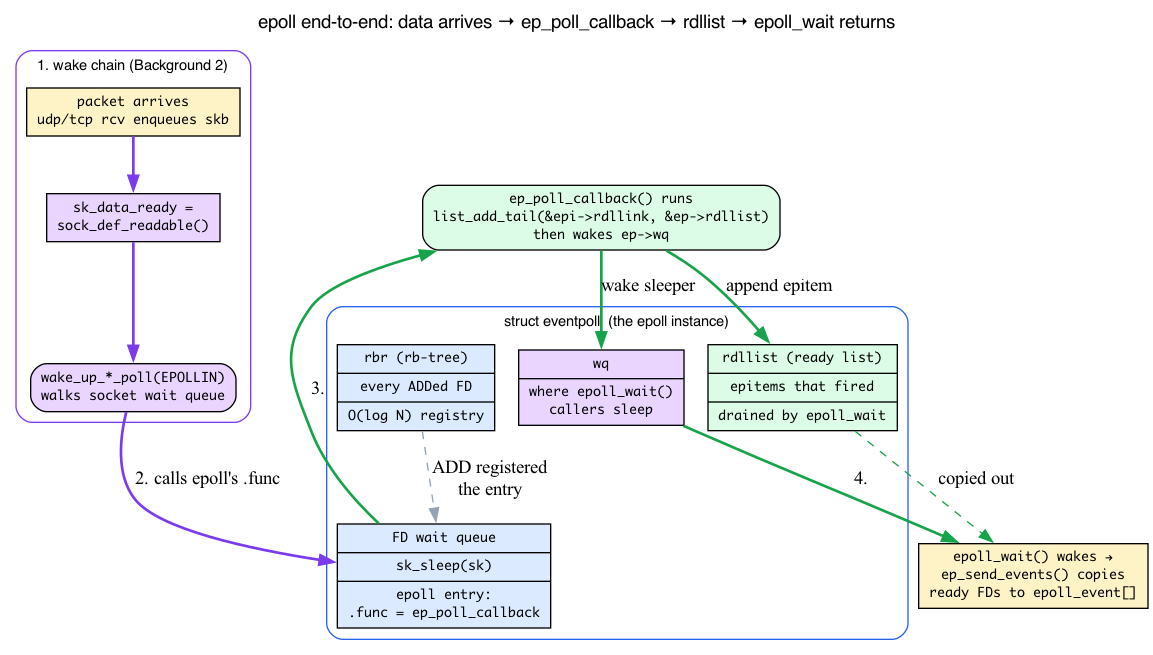
With wait queues in hand, the internals are short. The epoll instance is a struct eventpoll (fs/eventpoll.c:172), and four of its fields carry the whole design:
struct eventpoll {
    /* ... mutex ... */
    wait_queue_head_t wq;          /* where epoll_wait() callers sleep         */
    wait_queue_head_t poll_wait;   /* for an epoll fd nested inside another epoll */
    struct list_head  rdllist;     /* the READY list: FDs that fired            */
    struct rb_root_cached rbr;     /* the registered FDs, an rb-tree            */
    /* ... */
};
Three lists/queues, and they map one-to-one to what epoll does:
rbr— a red-black tree of every FD you’ve ADDed, keyed for O(log N) ADD/DEL/lookup. This is the registry. Each ADDed FD becomes astruct epitem— the per-FD record — stored inrbr; that epitem is what gets linked ontordllistwhen the FD fires.rdllist— the ready list: FDs that have become ready and are waiting to be reported byepoll_wait.wq— the wait queue yourepoll_waitcall sleeps on when nothing is ready yet (the same wait-queue machinery from Background 2, but now it belongs to the epoll object, not a socket).
Now the wiring. When you ADD an FD, ep_insert (fs/eventpoll.c:1566) calls the FD’s ->poll() and hands it a special poll_table whose “register me” callback is ep_ptable_queue_proc (fs/eventpoll.c:1360). Here’s the twist that makes epoll fast — instead of registering a generic “wake me” entry on the socket’s wait queue, it installs a wait-queue entry whose .func is epoll’s own ep_poll_callback:
/* fs/eventpoll.c:1360, ep_ptable_queue_proc */
init_waitqueue_func_entry(&pwq->wait, ep_poll_callback);   /* custom .func! */
pwq->whead = whead;
pwq->base  = epi;
if (epi->event.events & EPOLLEXCLUSIVE)
    add_wait_queue_exclusive(whead, &pwq->wait);           /* see EPOLLEXCLUSIVE below */
/* else add_wait_queue(whead, &pwq->wait); */
That whead is exactly sk_sleep(sk) — the same socket wait queue a blocking recv() would park on (Background 2). epoll just hangs a different kind of waiter on it.
So follow the flow when data arrives, and every step is something you already know:
- A packet lands; the protocol layer enqueues it on the socket and calls
sk->sk_data_ready→sock_def_readable→wake_up_interruptible_sync_poll(&wq->wait, EPOLLIN|...)(Background 2). - That walks the socket’s wait queue and calls each entry’s
.func. For epoll’s entry,.funcisep_poll_callback(fs/eventpoll.c:1249). ep_poll_callbackruns, links this FD’sepitemonto the eventpoll’srdllist(list_add_tail(&epi->rdllink, &ep->rdllist),fs/eventpoll.c:1294), and wakes anyone sleeping onep->wq— i.e. yourepoll_wait.epoll_waitwakes,ep_send_events(fs/eventpoll.c:1765) copies the ready FDs into yourepoll_event[]array, and you get yourn.
That callback-instead-of-plain-wakeup indirection is the entire “magic” — and it’s nothing more than swapping the .func you learned about in Background 2. The same ->poll() that registers the callback also returns the current readiness bitmask (via ep_item_poll → vfs_poll(file, pt), fs/eventpoll.c:1057), which is how an FD that’s already ready at ADD time lands on rdllist immediately.
Level-triggered vs edge-triggered
We met these in Background 1; here’s where they live in the code.
- Level-triggered (LT, default): epoll_wait reports the FD as long as it’s ready. Read what you can, leave the rest; epoll_wait will report it again next time.
- Edge-triggered (ET,
EPOLLETflag): epoll_wait reports the FD only when its readiness changes (e.g., went from “no data” to “data arrived”). You must drain the FD until you getEAGAIN, or you’ll miss subsequent data.
ET is faster (fewer wake-ups) but more error-prone. LT is what you want unless you know exactly why ET helps.
The LT/ET difference is implemented in one branch of ep_send_events. EPOLLET is stored per-epitem (it’s one of the private epoll bits: EP_PRIVATE_BITS = (EPOLLWAKEUP | EPOLLONESHOT | EPOLLET | EPOLLEXCLUSIVE), fs/eventpoll.c:86) — it’s never passed down to the FD’s ->poll(), which is why re-arming is purely an epoll-side decision. After copying an FD’s events to userspace, ep_send_events does (fs/eventpoll.c:1835):
} else if (!(epi->event.events & EPOLLET)) {
    /*
     * If this file has been added with Level Trigger mode, we need to
     * insert back inside the ready list, so that the next call to
     * epoll_wait() will check again the events availability.
     */
    list_add_tail(&epi->rdllink, &ep->rdllist);   /* fs/eventpoll.c:1847 */
    ep_pm_stay_awake(epi);
}
For level-triggered, the FD is re-added to rdllist so the next epoll_wait re-checks it — that’s “LT re-reports while data remains.” For edge-triggered, that branch is skipped: the FD leaves rdllist and won’t come back until ep_poll_callback fires again on a fresh readiness transition. That single if is the entire LT-vs-ET behavior, and it’s the source-level reason a partial read under ET strands your data.
EPOLLEXCLUSIVE — solving thundering herd
Default semantics: when an event fires on an FD that has multiple epoll_wait waiters, all of them wake. For an accept socket shared by N workers, this means a newly completed connection (the final ACK lands, the connection joins the accept queue, and tcp_child_process calls the listener’s sk_data_ready, net/ipv4/tcp_minisocks.c:1005) wakes all N — N-1 immediately call accept, get EAGAIN (Background 1 — non-blocking accept on an empty backlog), go back to sleep. Wasted wake-ups. (Note it’s connection completion, not the SYN, that wakes the listener: the SYN path only queues the request and sends SYN-ACK.)
EPOLLEXCLUSIVE (added 4.5) tells epoll: wake only one waiter per event. The implementation is the add_wait_queue_exclusive branch we saw in ep_ptable_queue_proc (fs/eventpoll.c:1360) — an exclusive waiter tells the wait-queue walker to stop after waking the first responsive thread instead of waking the whole list. Modern multi-process servers should use it.
(Aside: SO_REUSEPORT — Day 24 — is a more powerful alternative. Each worker has its own listening socket; the kernel hashes incoming SYNs across them, so each worker’s epoll only ever sees SYNs that were destined for it.)
io_uring — the completion model (preview)
epoll’s model is readiness: “tell me when this FD is ready; I’ll do the syscall myself.” io_uring inverts it to completion: “do this network operation for me — tell me when it’s done.” Instead of learning which FD is ready and then issuing recv/send yourself, you hand the kernel the whole operation through two memory-mapped ring buffers:
- Submission Queue (SQ): userspace pushes Submission Queue Entries (SQEs) describing work to do.
- Completion Queue (CQ): the kernel pushes Completion Queue Entries (CQEs) when the work finishes.
The practical contrast that matters today:
- epoll: 2 syscalls per I/O —
epoll_waitto learn readiness, thenrecv/send. - io_uring: ~1 syscall per batch (
io_uring_entercarrying many SQEs at once), or zero in steady state withIORING_SETUP_SQPOLL(a kernel thread polls the SQ).
For sustained request rates above ~100k/sec per thread that saving is real; below that it’s invisible, and epoll’s smaller, battle-tested API is the right default (nginx, redis, node.js via libuv, and most Python/Go/Rust async runtimes all ride epoll). Hold onto the one distinction — epoll signals readiness; io_uring signals completion — and pick it up in depth on Day 28, which covers the full network op set, multishot recv, provided buffers, and zero-copy send.
There are no Dumb Questions
Q: Is
EAGAINan error I should log and bail on?A: No — it’s the opposite.
EAGAIN(==EWOULDBLOCKon Linux) on a non-blocking socket means “nothing here right now.” On a freshly-reported FD it means “you’ve drained everything queued; stop reading and go handle the next ready FD.” Logging it as an error would flood your logs on every event loop tick. The onlyrecvreturns that are real errors aren < 0with some other errno (e.g.ECONNRESET).
Q: If a blocking
recv()sleeps on the socket’s wait queue, and epoll also registers on that same queue, do they fight?A: They don’t, because they’re different kinds of waiter on the same list. A blocking
recv()adds an entry whose.funcwakes the parked task; epoll adds an entry whose.funcisep_poll_callback. As the 4-step flow showed, whensock_def_readablewalks the queue it calls each entry’s.funcin turn. You normally wouldn’t do both on one FD, but structurally the wait queue happily holds both — that’s the point of the.funcindirection (Background 2).
Q: Why does
EPOLLETrequire non-blocking sockets butEPOLLIN(level-triggered) seems to tolerate blocking ones?A: Neither is truly safe with a blocking socket, but ET makes the bug unavoidable. ET fires one notification per readiness transition, so you must loop
recvuntilEAGAINto consume everything — and that loop requiresEAGAIN, which only a non-blocking socket produces. A blocking socket’s finalrecvin that loop would sleep forever instead of returningEAGAIN, freezing the thread. LT seems to tolerate blocking because it re-reports, so a one-read-per-event style mostly works — until the one read it permits blocks (e.g. data vanished after the notification), and the whole loop stalls. Always useO_NONBLOCKwith epoll.
Q: Where does the
EPOLLINbit I pass actually go?A: It’s one shared bitmask across three places: your
epoll_event.events, the FD’s->poll()return value, and thekeyargumentsock_def_readablepasses towake_up_interruptible_sync_poll(&wq->wait, EPOLLIN|...). epoll stores your interest mask per-epitem, the wake passes the fired bits as the key, andep_poll_callbackchecks the overlap before linking the epitem ontordllist. Same flags, end to end.
Today’s experiment
epoll wakeup tracking
Setup. We need an epoll-based server and a load generator. nginx fits (it uses the readiness model on every connection), and ab (ApacheBench) drives it. Install both, then start nginx — binding port 80 needs root, and nginx daemonizes itself, so no &:
sudo apt-get install -y nginx apache2-utils
sudo nginx
(Any already-running epoll-based server works too — the probe below is system-wide, so it captures every epoll_wait on the box, not just nginx’s.)
Terminal 1 — start the trace. This runs in the foreground and blocks the terminal, so the load must come from a second terminal:
sudo bpftrace -e '
tracepoint:syscalls:sys_enter_epoll_wait,
tracepoint:syscalls:sys_enter_epoll_pwait,
tracepoint:syscalls:sys_enter_epoll_pwait2 { @waits = count(); }
tracepoint:syscalls:sys_exit_epoll_wait,
tracepoint:syscalls:sys_exit_epoll_pwait,
tracepoint:syscalls:sys_exit_epoll_pwait2 /args->ret >= 0/ { @returns = hist(args->ret); }
interval:s:5 { print(@waits); print(@returns); clear(@waits); clear(@returns) }'
Why all three syscalls? nginx on x86_64 issues the bare epoll_wait, but Go and Node/libuv use epoll_pwait, and on arm64/riscv glibc routes epoll_wait() through epoll_pwait — so a single-syscall probe leaves @waits empty and looks broken. epoll_pwait2 exists on 5.11+. The /args->ret >= 0/ filter drops the -1 (EINTR) returns, which hist() would otherwise bin into a confusing negative bucket.
Terminal 2 — generate load:
ab -n 100000 -c 100 http://127.0.0.1/
What you’ll see. Idle (nginx running but no traffic), @returns is dominated by the [0] bucket — every epoll_wait timed out with no FD ready, and @waits is small:
@waits: 8
@returns:
[0]    7 |@@@@@@@@@@@@@@@@@@@@@@@@@@@@@@@@@@@@@@@@@@@@@@@@@@@@|
Once ab runs, @waits climbs into the thousands per interval and the histogram fills the low positive buckets — each epoll_wait now returns one or more ready sockets:
@waits: 438
@returns:
[0]     176 |@@@@@@@@@@@@@@@@@@@@@@@@@@@@@@@@@@@@                |
[1]     252 |@@@@@@@@@@@@@@@@@@@@@@@@@@@@@@@@@@@@@@@@@@@@@@@@@@@@|
[2, 4)    8 |@                                                 |
That batching of several ready FDs into one return is exactly the readiness-model payoff: one epoll_wait syscall amortized over N sockets. A [1]-heavy histogram is the low-concurrency case; the buckets shift right as more sockets become ready between calls. And each of those returns is the tail end of the Background-2 chain firing: a completed connection or a data segment arrived, sk_data_ready walked the socket’s wait queue, ep_poll_callback appended the FD to rdllist and woke ep->wq, and this is the epoll_wait waking up.
Cleanup. When you’re done, stop the server:
sudo nginx -s stop
(For the io_uring side — an async accept loop plus tracing the kernel-side net ops — see Day 28’s experiment.)
Optional: watch the wakeup callback itself
To see the wait-queue callback from Background 2 / the internals section fire in real time, trace ep_poll_callback while load runs:
sudo bpftrace -e 'kprobe:ep_poll_callback { @[comm] = count(); } interval:s:5 { print(@); clear(@); }'
Each count is one FD-readiness transition that moved an epitem onto an rdllist. Under ab load you’ll see it climb in lockstep with @waits above — that’s the sk_data_ready → ep_poll_callback → rdllist → wake path you read in the code, made visible.
What to read in the kernel
-
fs/eventpoll.c:2200—epoll_create1. Tiny wrapper that allocates aneventpollstruct, gets an FD. Read the struct definition above this; that’s the per-instance state (thewq,rdllist,rbryou just learned). -
fs/eventpoll.c:2385—epoll_ctl. The ADD/MOD/DEL dispatcher. Notice howEPOLL_CTL_ADDcallsep_insertwhich registers the wait-queue callback on the target FD. That’s where the magic happens — once the callback is registered, the FD reports readiness to epoll automatically. -
fs/eventpoll.c:1360—ep_ptable_queue_proc. Thepoll_tablecallback that->poll()invokes to register the waiter. This is the exact line (init_waitqueue_func_entry(&pwq->wait, ep_poll_callback)) where epoll hooks its custom.funconto the socket’s wait queue instead of a plain wakeup. -
fs/eventpoll.c:1938—ep_poll. The wait path. Read end to end (~120 lines). Notice how it handles spurious wakes, the busy-loop fast path for low-latency cases, and how it dequeues from the rdllist. -
fs/eventpoll.c:1765—ep_send_events. Copies the ready list to the user’sepoll_eventarray. For LT, re-arms the FD if still ready (list_add_tail(&epi->rdllink, &ep->rdllist)at line 1847). For ET, doesn’t. -
fs/eventpoll.c:1249—ep_poll_callback. The wait-queue callback that gets called when a registered FD becomes ready. Short (~100 lines). This is where readiness gets translated into an epoll event and the epitem is linked ontordllist. -
net/core/sock.c:3614—sock_def_readable, the defaultsk_data_ready(installed at line 3734). Thewake_up_interruptible_sync_poll(&wq->wait, EPOLLIN|...)here is what firesep_poll_callback. Read it alongsidesk_wait_data(line 3269) to see the blockingrecv()side of the same queue. -
io_uring — for the
io_uring/net.candio_uring/io_uring.centry points, the liburing examples, and the man pages, see Day 28’s “What to read.” Today, focus on the epoll path above.
Bullet Points
- Blocking
recv()sleeps by parking await_queue_entryon the socket’s wait queue (sk_sleep(sk), viask_wait_data,net/core/sock.c:3269). One blocking thread serves one slow client — which is why the readiness model needs non-blocking I/O. O_NONBLOCKmakesrecv/accept/sendreturn immediately; “nothing ready” comes back as-1/EAGAIN(==EWOULDBLOCK).EAGAINis not an error — it’s “not ready / drained for now.” epoll + non-blocking sockets are a matched pair;EPOLLETmakes draining toEAGAINmandatory.- Wait queue = a list of sleepers, each a
wait_queue_entrywith a.funccallback (include/linux/wait.h:28). The wake on RX issk_data_ready→sock_def_readable→wake_up_interruptible_sync_poll(&wq->wait, EPOLLIN|...)(net/core/sock.c:3614), which calls each waiter’s.func. ->poll()does two jobs at once: register the caller on the file’s wait queue and return a readiness bitmask. TheEPOLLINin yourepoll_event, in->poll()’s return, and in the wake key are the same flags.- epoll = readiness model. “Tell me when ready, I’ll syscall.” It hooks a custom
.func(ep_poll_callback) onto the socket’s wait queue viaep_ptable_queue_proc(fs/eventpoll.c:1360); when it fires, the epitem is appended tordllistandepoll_wait(sleeping onep->wq) wakes. Three structures:rbr(registered FDs),rdllist(ready FDs),wq(epoll_wait sleepers). - Three syscalls:
epoll_create1,epoll_ctl,epoll_wait. - Level-triggered (default) re-adds the epitem to
rdllistinep_send_events(fs/eventpoll.c:1847); edge-triggered (EPOLLET) skips that branch — ET requires draining toEAGAIN. EPOLLEXCLUSIVE— wake only one waiter per event (add_wait_queue_exclusive). Solves thundering herd.- io_uring = completion model: submit ops, collect completions; ~1 syscall per batch (zero with
SQPOLL). Covered in depth on Day 28. - For most servers, epoll. For sustained > 100k ops/sec per thread or batched workloads, io_uring.
Check question
Why is EPOLLEXCLUSIVE important for accepting connections in a multi-worker server, and what’s a more powerful alternative?
Click to reveal answer
Answer: Without EPOLLEXCLUSIVE, when a connection completes its handshake and lands on the accept queue of a listening socket shared by N workers, all of them get woken from epoll_wait. (The wake fires on connection completion — tcp_child_process calling the listener’s sk_data_ready after the final ACK — not on the SYN.) The first to call accept() succeeds; the rest immediately call accept(), get EAGAIN (non-blocking accept on a now-empty backlog), and go back to sleep. That’s “thundering herd” — wasted CPU, wasted scheduler decisions, lost cache locality. EPOLLEXCLUSIVE (added 4.5) tells the kernel “wake only one waiter per event” — implemented as add_wait_queue_exclusive in ep_ptable_queue_proc, so the wait-queue walker stops after the first responsive thread — eliminating the wasted wake-ups.
The more powerful alternative is SO_REUSEPORT (Day 24). Instead of N workers sharing one listening socket, each worker creates its own listening socket bound to the same (addr, port). The kernel hashes the incoming connection’s 4-tuple and dispatches to one specific socket. Each worker’s epoll only ever sees connections that belong to it — there’s no shared FD, so no thundering herd is even possible. As a bonus, the kernel’s 4-tuple hash spreads connections deterministically across workers (each connection’s packets always reach the same worker — that’s connection affinity, not per-client affinity, since the ephemeral source port is part of the hash), with SO_ATTACH_REUSEPORT_[CE]BPF available to customize the selection.
End of Phase 3
You can now read the L4 layer: socket lifecycles, UDP, TCP states + congestion control + retransmission, sockopts, the modern wait APIs.
Phase 4 (Days 20–26) goes into the kernel’s network subsystems: netfilter, nftables, conntrack, traffic control, SO_REUSEPORT, kTLS, MPTCP.
Next, Day 20 opens the packet-mangling machinery: netfilter’s five hook points and how a packet traverses them.