Day 27 — XDP and the rest of the stack
Today’s mission: see exactly where the XDP hook sits in the receive path, why it can do things faster than tc-bpf, and how XDP cooperates with (rather than replacing) the regular Linux network stack. Along the way we’ll fill in the four pieces of background the rest of the book never taught: what a BPF map actually is, what
struct xdp_mdlooks like to your program, howXDP_REDIRECTreally fires, and what an AF_XDP socket is. Total time: ~110 minutes.
Phase 5 starts here. The last four days cover the modern hooks layered on top of everything you’ve learned, plus a capstone day where you trace one real packet end-to-end.
What XDP is, kernel-side
You already met XDP on Day 2, so we won’t re-derive it from scratch. The one-line refresher:
Recall from Day 2: native XDP is an eBPF program the driver runs on the raw RX frame before any
sk_buffexists — the earliest software hook in the kernel. It looks at anxdp_buff(four stack pointers over the DMA page, no slab allocation, nousers/datarefrefcounts) and returns one of five action codes.XDP_PASSis the only one that proceeds to build an skb; the other four consume the frame in the driver. Generic XDP (do_xdp_generic→netif_receive_generic_xdp,net/core/dev.c:5656/:5576) is the slower fallback that runs later, after an skb already exists.
So the five actions, in the order the kernel defines them (enum xdp_action, include/uapi/linux/bpf.h:6548 — note XDP_ABORTED is 0, not last):
XDP_ABORTED(0) — same effect as DROP plus a tracepoint fires (debugging signal).XDP_DROP— packet freed in-driver, no kernel work done.XDP_PASS— kernel allocates skb and continues with normal RX (Day 2).XDP_TX— sends it back out the same NIC, reflecting the packet without ever touching skb.XDP_REDIRECT— sends it to a different netdev, a CPU map (cpumap), or an AF_XDP socket.
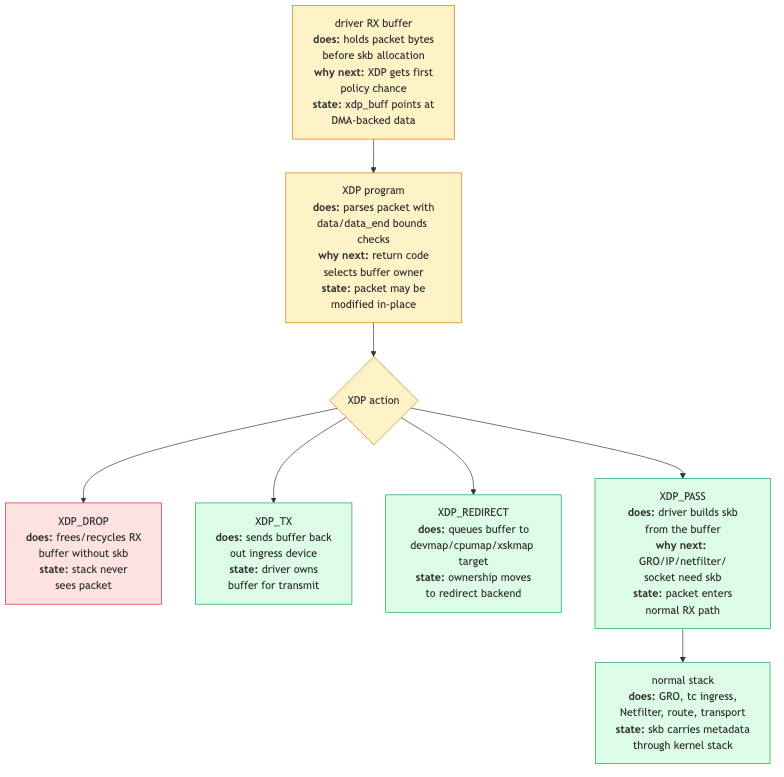
This is the earliest hook in the kernel for incoming packets. There’s nothing before XDP except the NIC and the driver code that just received the frame.
Why this matters
Recall from Day 1: allocating an
sk_buffis not free — it’s a slab allocation of the descriptor plus a separate data-buffer allocation, refcount setup, and cache-line dirtying (~500 ns of fixed cost). Routing, conntrack (Days 20–22), and netfilter each add more on top.
For high-rate packet filtering or load balancing, you don’t want to pay any of that for packets you’ll just drop or redirect. XDP runs at ~10 ns of fixed overhead plus your program’s logic. A drop in XDP is the cheapest packet operation Linux can do. Cilium’s load balancer, Cloudflare’s DDoS scrubbing, Facebook’s Katran — all use XDP to decide “drop / pass / redirect / mangle” in the few hundred nanoseconds before the kernel commits to processing the packet.
Three modes
XDP has three execution modes, picked at attach time:
Native XDP (default, fastest)
The driver implements XDP support: it calls bpf_prog_run_xdp directly from its NAPI poll, before allocating skb. The packet is in the driver’s RX buffer; XDP gets a pointer to it and the data length. ~10 ns overhead for an empty program.
Major drivers with native XDP: ixgbe, i40e, mlx5, mlx4, virtio_net, veth (yes, veth supports XDP — useful for testing).
Generic XDP (XDP_FLAGS_SKB_MODE)
Works on any driver. The kernel implements XDP as a hook after the driver has done some skb-related setup. Slower than native (~half the speed) because it duplicates work.
Use generic when your NIC doesn’t support native XDP. Or for development on virtio in older VM setups.
Hardware-offloaded XDP (XDP_FLAGS_HW_MODE)
The BPF program is JITed to NIC firmware (Netronome NFP, some Mellanox SKUs). Runs on the NIC, not on the host CPU. Insanely fast for simple programs but very limited — the offload target supports only a subset of maps and helpers (the NFP, for example, offloads array/hash maps plus map_lookup/update/delete_elem and xdp_adjust_head/tail, but rejects anything outside that subset). Exactly what works depends on the NIC.
Practically rare; most production XDP runs in native mode.
Background 1: what a BPF map actually is
Everything interesting XDP does — redirect to a device, steer to a CPU, hand off to a userspace socket, export a drop counter — leans on a thing this book has been quietly assuming: a BPF map. The whole “XDP_REDIRECT — where it shines” section below is built on three map types, and the tc-bpf cooperation note says XDP and tc “communicate via shared maps.” Time to make a map real.
The problem a map solves: a BPF program is stateless and forgets everything
An XDP program runs, returns an action code, and is done — there is no skb to stash state in (it runs before the skb exists), no socket to hang data off. Each invocation starts with a blank slate. So how does a load balancer remember its backend list across millions of packets? How does a DDoS filter export “I dropped 4 billion packets” to a dashboard? How does the program even know which device to redirect a frame to?
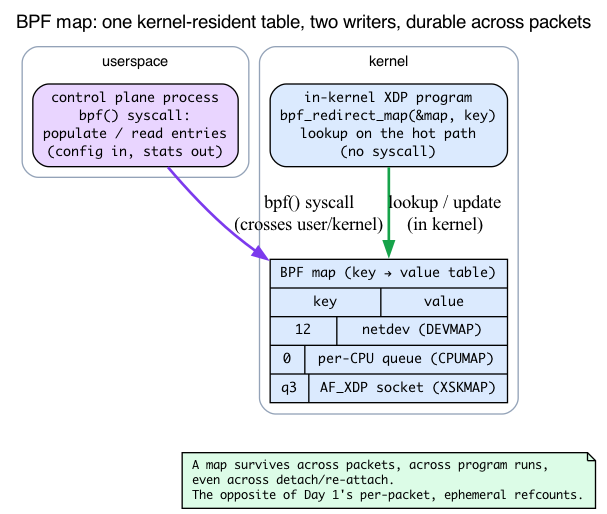
The answer is the BPF map: a typed key→value table that lives in the kernel, outside any single program invocation. It is the durable state that an otherwise stateless per-packet program reads and writes.
- A map is created from userspace via the
bpf()syscall, which returns a file descriptor. The map persists as long as someone holds a reference to it (an fd, or a pin in the bpffs filesystem) — it survives across packets, across program invocations, even across the program being detached and re-attached. - A BPF program references a map by fd/id and does lookups/updates inside the kernel with no syscall.
- Both sides touch the same table. A userspace “control plane” process populates and reads entries (config in, stats out); the in-kernel program reads them on the hot path. For XDP — which has no skb and no socket — this shared map is the only way to keep configuration and export statistics. It is also exactly how XDP and tc-bpf “communicate”: they each hold an fd to the same map.
Contrast with what you already know. Day 1’s two
sk_buffrefcounts and Day 2’s thrown-awayxdp_buffare the opposite of a map: they are per-packet, ephemeral, gone the moment the packet leaves. A map is the durable counterpart — the state that survives between packets.
Redirect maps: the value is a forwarding target, not plain data
Maps come in many types — the v7.1 enum bpf_map_type (include/uapi/linux/bpf.h) lists dozens. The three this chapter uses are redirect maps, where each value is not a number or a struct you read, but a place to send the packet:
Map type (enum at include/uapi/linux/bpf.h) | Key | Value is… |
|---|---|---|
BPF_MAP_TYPE_DEVMAP (line 1014) | array slot (0..max_entries-1) | a netdev (the real ifindex lives in the value, + optional egress XDP program) |
BPF_MAP_TYPE_CPUMAP (line 1016) | CPU id | a per-CPU queue |
BPF_MAP_TYPE_XSKMAP (line 1017) | queue id | an AF_XDP socket |
The DEVMAP value layout is worth seeing, because it proves a map value can be “a device plus an optional program” (struct bpf_devmap_val, include/uapi/linux/bpf.h:6575, just after struct xdp_md):
struct bpf_devmap_val {
    __u32 ifindex;             /* device index */
    union {
        int   fd;             /* prog fd on map write */
        __u32 id;             /* prog id on map read  */
    } bpf_prog;               /* optional egress XDP program */
};
The in-kernel entry that this becomes is struct bpf_dtab_netdev (kernel/bpf/devmap.c:67); the CPUMAP equivalent is struct bpf_cpu_map_entry (kernel/bpf/cpumap.c:60). Userspace writes a bpf_devmap_val into the map; the kernel turns it into a bpf_dtab_netdev holding a real net_device *.
The program stages a redirect with a single helper:
long bpf_redirect_map(struct bpf_map *map, __u64 key, __u64 flags);
It looks up map[key] and stages the redirect (we’ll see exactly what “stages” means in Background 3). The helper is allowed for XDP programs via BPF_FUNC_redirect_map (net/core/filter.c:8528), backed by bpf_xdp_redirect_map_proto (net/core/filter.c:4674).
Background 2: struct xdp_md and mandatory bounds checking
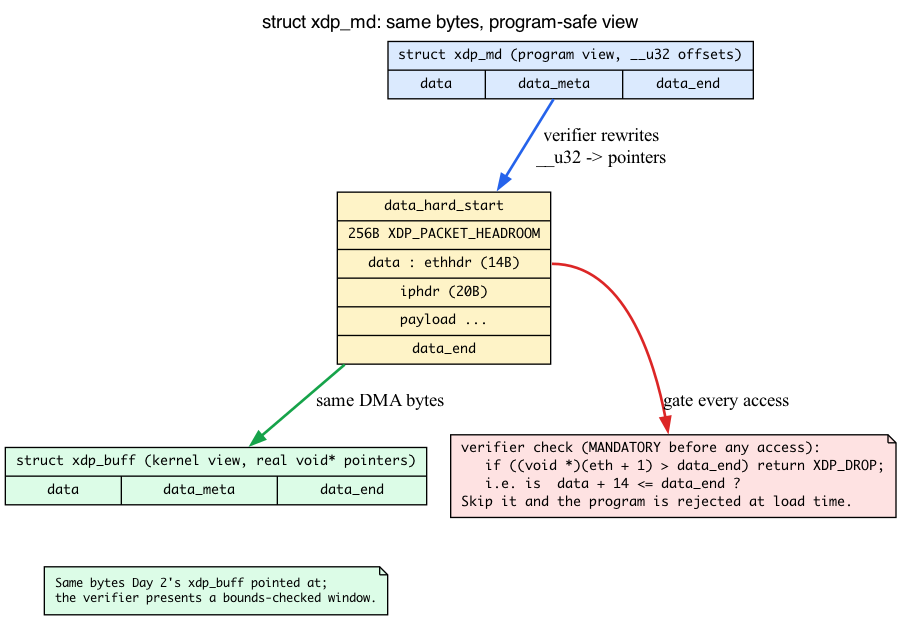
Today’s experiment hands you int xdp_drop(struct xdp_md *ctx). Day 2 taught the kernel-side struct xdp_buff (four pointers into the DMA page) — but a BPF program never sees an xdp_buff. It sees struct xdp_md, the verifier-exposed context. You cannot write any non-trivial XDP program — parse Ethernet, look at an IP header, the whole point of XDP filtering — without understanding it.
What the program sees
struct xdp_md is the context the verifier presents to an XDP program (include/uapi/linux/bpf.h:6559):
struct xdp_md {
    __u32 data;            /* start of packet bytes      */
    __u32 data_end;        /* one past the last byte      */
    __u32 data_meta;       /* custom metadata region      */
    /* Below access go through struct xdp_rxq_info */
    __u32 ingress_ifindex; /* rxq->dev->ifindex           */
    __u32 rx_queue_index;  /* rxq->queue_index            */
    __u32 egress_ifindex;  /* txq->dev->ifindex           */
};
The trick: data and data_end are declared __u32, but the verifier rewrites them into real pointers at load time. After the rewrite, the packet bytes live in [data, data_end). Same DMA bytes Day 2’s xdp_buff pointed at — the verifier just presents them as a bounds-checked, program-safe window.
Relate to Day 2: the kernel builds an
xdp_buffover the DMA page; for your program the verifier presents that same window asxdp_mdwith boundeddata/data_end. Same bytes, program-safe view.
The other fields tell a redirect program where the frame came from: ingress_ifindex (= rxq->dev->ifindex) and rx_queue_index (= rxq->queue_index) are how a steering program decides what to do; egress_ifindex is set for devmap egress programs. data_meta is a scratch region for XDP→XDP or XDP→tc handoff.
The cardinal rule: prove every access in-bounds, or the verifier rejects you
This is the #1 thing that trips up a first XDP program. Before you dereference any header at data, you must prove to the verifier that the bytes are actually there:
SEC("xdp")
int xdp_parse(struct xdp_md *ctx)
{
    void *data     = (void *)(long)ctx->data;
    void *data_end = (void *)(long)ctx->data_end;
    struct ethhdr *eth = data;

    if ((void *)(eth + 1) > data_end)   /* MANDATORY: data + 14 <= data_end? */
        return XDP_DROP;                /* not enough bytes — bail */

    if (eth->h_proto == bpf_htons(ETH_P_IP))
        return XDP_PASS;
    return XDP_DROP;
}
Skip that if and the verifier rejects the program at load time — it cannot prove the access is safe, so it refuses to load it. This is the concrete meaning of the “limited mutation / can’t reach inside arbitrarily” limitation noted below: every packet access is gated on a bounds check against data_end.
There’s headroom in front of data to make pushes cheap: XDP_PACKET_HEADROOM is 256 bytes (include/uapi/linux/bpf.h:6541), reserved so bpf_xdp_adjust_head (prepend/strip bytes at the front) rarely has to do anything expensive.
XDP and the rest of the stack
XDP doesn’t replace the network stack — it sits in front of it. For traffic that returns XDP_PASS:
- XDP returns PASS.
- Driver allocates skb (
build_skb/napi_build_skb— recall the zero-copy wrap from Day 1). - Normal RX path (Day 2): GRO,
__netif_receive_skb_core, tc-bpf ingress, IP, conntrack, sockets.
XDP is “the fast path for the easy cases.” Everything else still flows through the regular stack.
Cooperating with tc-bpf
Many production setups use both. XDP for high-rate fast-path drops/redirects, tc-bpf for everything skb-aware. Cilium, for example:
- XDP for L3 service load balancing (a few hot services with millions of pps).
- tc-bpf for L4 connection tracking, NetworkPolicy enforcement, encryption negotiation.
- The two work in sequence: XDP runs first, returns PASS for traffic tc-bpf needs to see.
You can attach both to the same interface. They don’t interfere — XDP runs at packet boundary; tc-bpf runs at skb boundary; the only shared resource is the BPF map ecosystem from Background 1, where they can communicate via shared maps (each side holds an fd to the same key→value table).
XDP_REDIRECT — where it shines
bpf_redirect_map() is the highest-throughput mechanism XDP exposes. Three target map types (the redirect maps from Background 1):
BPF_MAP_TYPE_DEVMAP
{ array slot → netdev *, optional egress XDP program } — the key is just the slot index you chose at map-update time; the target netdev’s real ifindex is stored in the value (bpf_devmap_val.ifindex). XDP_REDIRECT to this map sends the packet to the named netdev. Used for L3 forwarding, container networking (redirect from physical NIC into a veth), gateway boxes.
BPF_MAP_TYPE_CPUMAP
{ cpu_id → cpu queue }. Redirects the packet to a different CPU’s per-CPU queue, which then runs the kernel RX path on that CPU. Useful for steering: “RSS landed this on CPU 0 but the destination socket is pinned to CPU 4 — redirect.”
BPF_MAP_TYPE_XSKMAP
{ queue_id → AF_XDP socket }. Sends the packet directly to userspace via AF_XDP — zero-copy if the NIC supports it. The basis of high-throughput userspace packet processing (DPDK-on-Linux-without-DPDK). Background 4 explains what’s on the other end.
Background 3: how XDP_REDIRECT actually fires
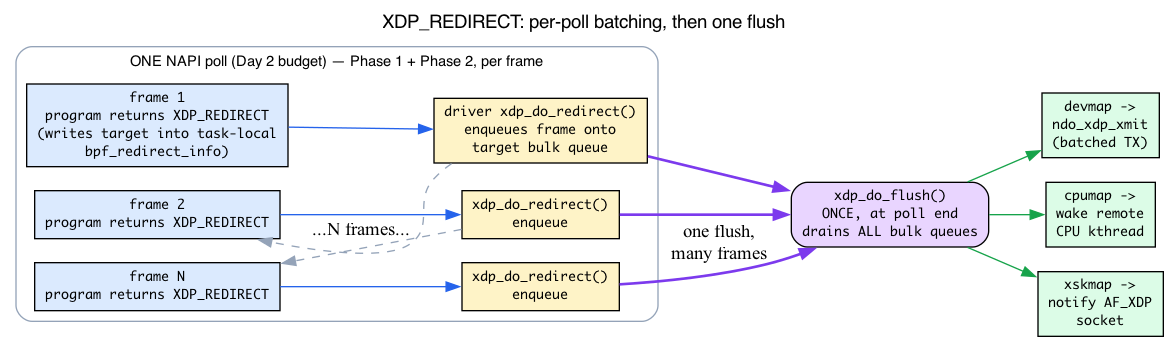
Here’s the part that’s usually just asserted: redirect is “the highest-throughput path.” Why? The mechanism is a two-phase, batched model — and the batching is the whole reason it’s fast. bpf_redirect_map() does not transmit the packet.
Phase 1 — the helper records intent, the program just returns a code
When your program calls bpf_redirect_map(&map, key, flags), the helper looks up the target and stashes it into a struct bpf_redirect_info (include/linux/filter.h:774). In v7.1 this lives inside a struct bpf_net_context hung off current->bpf_net_context — task-local scratch on the softirq stack, fetched via bpf_net_ctx_get_ri() (include/linux/filter.h:815). (It used to be a literal per-CPU variable; it’s still effectively one-per-CPU because NAPI runs in BH-disabled softirq context that can’t migrate, but the data structure itself is no longer a DEFINE_PER_CPU.) Then it returns XDP_REDIRECT. Your program does nothing else — it just returns that action code. No packet has moved.
Phase 2 — the driver enqueues, then flushes once per poll
Seeing XDP_REDIRECT, the driver calls xdp_do_redirect() (net/core/filter.c:4519). That reads the bpf_redirect_info and enqueues the frame onto the target’s bulk queue — dispatching to __xdp_do_redirect_xsk (:4424) for an AF_XDP socket, or __xdp_do_redirect_frame (:4449) for a devmap/cpumap target. Still no transmit: the frame is sitting on a bulk queue (devmap bulk queue / cpumap ptr_ring / xsk ring).
Then, once per NAPI poll — at the end of the driver’s ->poll() call, after that call has drained up to its per-poll weight (Day 2’s inner budget, default 64; not the outer netdev_budget of 300, which is spread across all NAPI instances in the softirq) — the driver calls xdp_do_flush() (net/core/filter.c:4358), which flushes all the bulk queues at once:
- devmap →
ndo_xdp_xmit(batched TX of many frames), - cpumap → wake the remote CPU’s kthread,
- xskmap → notify the AF_XDP socket.
Batching across the whole poll is the throughput win. N frames redirected during the poll cost one flush, not N transmits. This is exactly why XDP_REDIRECT beats XDP_TX for forwarding to other devices, and why it rides the same per-CPU, per-poll batching that makes NAPI efficient (Day 2). The kernel even guards against a driver forgetting to flush: WARN_ONCE(missed, "Missing xdp_do_flush() invocation after NAPI by %ps\n", ...) at net/core/filter.c:4392.
The driver call site that proves the whole pattern is the ixgbe one you’ll read below: ixgbe_run_xdp’s case XDP_REDIRECT: calls xdp_do_redirect(adapter->netdev, xdp, xdp_prog) (drivers/net/ethernet/intel/ixgbe/ixgbe_main.c:2435, inside the function at line 2400).
Background 4: AF_XDP sockets and the UMEM
The XSKMAP bullet promised “zero-copy … the basis of DPDK-on-Linux-without-DPDK.” Nothing earlier in this book teaches AF_XDP (Day 25’s “zero-copy” was kTLS sendfile; Day 28 is io_uring) — so here’s the model behind what XSKMAP delivers to.
A socket whose buffer is shared memory
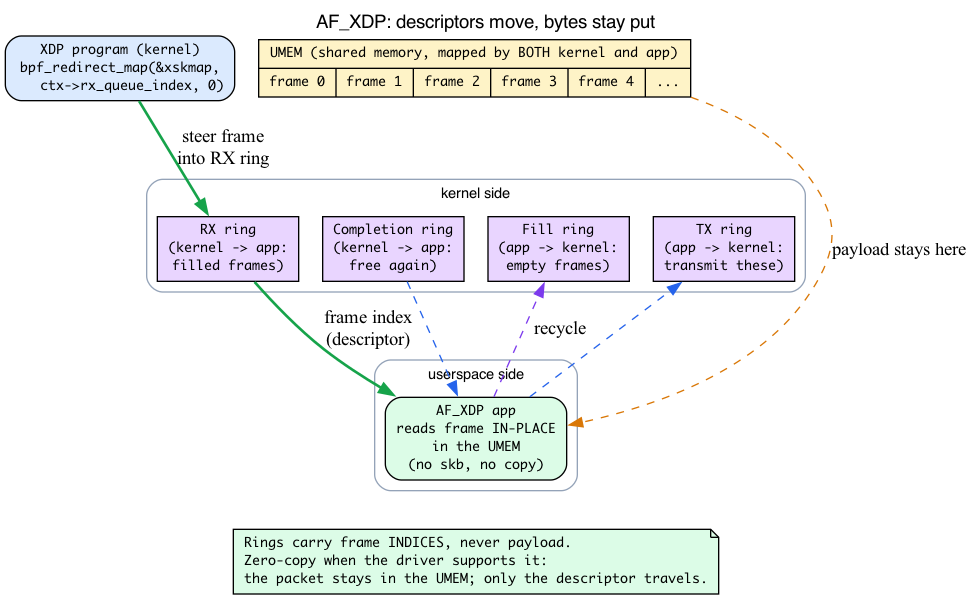
AF_XDP is a socket family: socket(AF_XDP, SOCK_RAW, 0). Its receive endpoint is not a kernel skb queue — it’s a UMEM: a userspace-allocated array of equal-size frames that both the kernel and the app map into their address spaces. The packet bytes land directly in this shared region.
Four rings move descriptors, not bytes
Around the UMEM sit four single-producer/single-consumer rings that carry frame descriptors (essentially UMEM frame indices), never payload:
| Direction | Rings |
|---|---|
| Receive | Fill (app → kernel: “here are empty frames to fill”) and RX (kernel → app: “these frames now hold packets”) |
| Send | TX (app → kernel: “transmit these frames”) and Completion (kernel → app: “these are free again”) |
Because what moves between kernel and app is a frame index, the bytes never get copied when the driver supports zero-copy. The packet stays put in the UMEM; only the descriptor travels.
Where XSKMAP fits
An XSKMAP value is an AF_XDP socket bound to a specific (netdev, queue_id). In XDP you write:
return bpf_redirect_map(&xskmap, ctx->rx_queue_index, 0);
That steers the frame into that socket’s RX ring (__xdp_do_redirect_xsk, the Background-3 dispatch). Userspace then reads the packet straight out of the UMEM in place. This is the DPDK-class userspace fast path — while staying entirely inside the kernel’s normal driver model.
Contrast with Day 1’s sk_buff path: AF_XDP bypasses skb allocation and the socket-buffer copy entirely. It’s the same “don’t build an skb” motivation that justifies XDP itself, extended all the way out to a userspace application.
The official model lives in Documentation/networking/af_xdp.rst (UMEM + four rings); the ring implementation is in net/xdp/ (xsk.c, xsk_queue.h).
Limitations
- No fragmentation handling. XDP sees the raw frame as the NIC delivered it; it can’t reassemble IP fragments (would require buffering).
- No GRO. GRO happens after XDP (Day 2). If you want coalesced superpackets, see them in tc-bpf, not XDP.
- Limited mutation. You can
bpf_xdp_adjust_headto add/remove bytes at the front (that’s what the 256-byteXDP_PACKET_HEADROOMis for),bpf_xdp_adjust_tailfor the back. But you can’t reach inside arbitrarily without thedata_endbounds checking from Background 2. - No skb metadata. No conntrack info, no netfilter mark, no socket lookup (until kernel 5.0 added
bpf_sk_lookup_tcp/udpto the XDP hook).
Today’s experiment
# See if your driver supports native XDP. Find your NIC first — on most modern
# distros and cloud VMs the primary NIC is enp0s3/ens5/eno1, not eth0.
ip -br link                       # list interfaces, pick your NIC
ethtool -i <iface> | grep driver  # e.g. virtio_net, mlx5_core, ixgbe
# virtio_net and veth support native XDP; many cloud NICs only do generic mode.

# Quick test on veth (always supports XDP). Put the peer in its OWN netns so the
# frame is forced across the wire and is actually *received* on veth0's RX path.
# If both ends share the root namespace, the kernel short-circuits via the
# loopback fast-path, the frame never crosses the link, and the XDP program on
# veth0 never runs (the ping would simply succeed and teach you nothing).
sudo ip link add veth0 type veth peer name veth1
sudo ip netns add ns1
sudo ip link set veth1 netns ns1
sudo ip addr add 10.99.0.1/24 dev veth0
sudo ip link set veth0 up
sudo ip netns exec ns1 ip addr add 10.99.0.2/24 dev veth1
sudo ip netns exec ns1 ip link set veth1 up
sudo ip netns exec ns1 ip link set lo up

# Tiny XDP program: drop everything
cat << 'EOF' > /tmp/xdp_drop.bpf.c
#include <linux/bpf.h>
#include <bpf/bpf_helpers.h>
SEC("xdp")
int xdp_drop(struct xdp_md *ctx) { return XDP_DROP; }
char _license[] SEC("license") = "GPL";
EOF
clang -O2 -target bpf -c /tmp/xdp_drop.bpf.c -o /tmp/xdp_drop.o
# If clang errors with "'asm/types.h' file not found", add your arch include
# path, e.g.: clang -O2 -target bpf -I/usr/include/x86_64-linux-gnu -c ...

# Attach to veth0
sudo ip link set veth0 xdp obj /tmp/xdp_drop.o sec xdp

# Send traffic FROM ns1 so it is received on veth0's RX/XDP path. XDP_DROP kills
# every frame — even the ARP request — so the echo requests never reach the
# stack and get no replies. Expect 100% packet loss. Without -W 1, ping would
# hang ~10 s on each unanswered probe before reporting the loss.
sudo ip netns exec ns1 ping -c 3 -W 1 10.99.0.1
#   3 packets transmitted, 0 received, 100% packet loss

# Inspect while the program is STILL attached — before the detach/cleanup below.
# Once you detach and delete veth0 there is nothing left for bpftool to show.
sudo bpftool net show
sudo bpftool prog show

# Detach and ping again to confirm the contrast: now it succeeds.
sudo ip link set veth0 xdp off
sudo ip netns exec ns1 ping -c 3 -W 1 10.99.0.1
#   3 packets transmitted, 3 received, 0% packet loss

# Cleanup
sudo ip link del veth0
sudo ip netns del ns1
That xdp_drop program is the minimal struct xdp_md consumer from Background 2 — it never touches ctx->data, so it needs no bounds check; it unconditionally returns XDP_DROP. The moment you want it to parse anything, the Background-2 data + sizeof(hdr) <= data_end check becomes mandatory.
The two bpftool commands (run above, while the program is still attached) confirm the attachment. bpftool net show lists per-interface BPF attachments — look for an xdp entry under veth0, which confirms the program is bound at the driver RX hook (not tc/ingress):
xdp:
veth0(N) driver id M
bpftool prog show lists every loaded program; find the one of type xdp named xdp_drop whose id matches the M shown by net show:
M: xdp  name xdp_drop  tag <hex>  gpl
	loaded_at ...  uid 0
	xlated ...B  jited ...B  memlock 4096B
Your N and M will differ — the point is that the same id appears in both outputs, proving the loaded program is the one bound to veth0’s RX path. Run these before the xdp off / ip link del step: once veth0 is gone, net show lists no XDP attachment for it.
There are no Dumb Questions
Q: A BPF program forgets everything between packets — so where does a load balancer keep its backend list?
A: In a BPF map (Background 1). The map lives in the kernel, outside any single program run, and survives across packets and even across detach/re-attach. A userspace control plane populates it (backend IPs, weights); the XDP program looks entries up on the hot path. The map is also how the program exports stats out and how XDP and tc-bpf share state — both hold an fd to the same table.
Q: I see
struct xdp_mdin my program but Day 2 talked aboutstruct xdp_buff. Which is it?A: Both, at different altitudes. The kernel builds an
xdp_buff(real pointers into the DMA page). The verifier exposes that same window to your program asstruct xdp_md, whosedata/data_endare declared__u32but rewritten into pointers at load time. Same bytes;xdp_mdis the bounds-checked, program-safe view.
Q: Does
bpf_redirect_map()send the packet?A: No. It only records the target in a
bpf_redirect_info(task-local scratch offcurrent->bpf_net_contextin v7.1) and returnsXDP_REDIRECT(Background 3). The driver then callsxdp_do_redirect()to enqueue the frame on a bulk queue, and onexdp_do_flush()per NAPI poll actually fans everything out. The batching is why redirect is the highest-throughput path.
Q: What’s actually on the other end of an XSKMAP redirect?
A: An AF_XDP socket bound to one
(netdev, queue_id), backed by a shared-memory UMEM and four descriptor rings (Background 4). The frame lands in the UMEM and userspace reads it in place — no skb, no copy. That’s the “DPDK without DPDK” claim made concrete.
What to read in the kernel
-
net/core/dev.c— searchbpf_prog_run_xdp(the generic-XDP dispatch from driver to BPF). For theXDP_REDIRECTimplementation (xdp_do_redirect), seenet/core/filter.c. -
include/net/xdp.h—struct xdp_buff(line 86), the kernel-side view. The program-sidestruct xdp_mdand the action constants live ininclude/uapi/linux/bpf.h(xdp_mdat line 6559,enum xdp_actionat line 6548). Quick read. -
include/uapi/linux/bpf.h—enum bpf_map_type(DEVMAP at line 1014, CPUMAP 1016, XSKMAP 1017),struct bpf_devmap_val(line 6575). The map-value layout that proves a value can be “a device plus an egress program.” -
net/core/filter.c—xdp_do_redirect(line 4519),xdp_do_flush(line 4358), the missed-flushWARN_ONCE(line 4392),bpf_xdp_redirect_map_proto(line 4674), theBPF_FUNC_redirect_mapallowance (line 8528). Also searchxdp_func_protofor the full helper-allowance table for XDP programs. -
include/linux/filter.h—struct bpf_redirect_info(line 774), held instruct bpf_net_contextand fetched viabpf_net_ctx_get_ri()(line 815) offcurrent->bpf_net_context. The task-local scratch that Phase 1 of redirect writes. -
kernel/bpf/devmap.c—BPF_MAP_TYPE_DEVMAPimplementation; the in-kernel entrystruct bpf_dtab_netdev(line 67). How abpf_redirect_mapto a devmap entry results in xmit to that netdev. -
kernel/bpf/cpumap.c—BPF_MAP_TYPE_CPUMAP; the entrystruct bpf_cpu_map_entry(line 60). How packet → CPU queue → kernel RX on that CPU. -
drivers/net/ethernet/intel/ixgbe/ixgbe_main.c— concrete native-XDP implementation. Look atixgbe_run_xdp(line 2400) to see how a driver calls into BPF in its NAPI poll, and itsXDP_REDIRECTcase callingxdp_do_redirect(line 2435). -
drivers/net/veth.c— searchveth_xdp. veth’s XDP support; useful because it’s simpler than NIC drivers. -
Documentation/networking/af_xdp.rst— the official UMEM + four-ring description (Background 4). The ring structs live innet/xdp/(xsk.c,xsk_queue.h). -
tools/testing/selftests/bpf/progs/test_xdp_*.c— example programs.
Bullet Points
- XDP runs in the NIC driver’s NAPI poll, before skb allocation. Earliest hook in the kernel for RX. Five actions: ABORTED (0), DROP, PASS, TX, REDIRECT — only
XDP_PASSbuilds an skb (recall Day 2). - A BPF map is a kernel-resident key→value table, created from userspace via
bpf(), that outlives any single program run. It’s the durable state a stateless per-packet program reads, the way it exports stats, and how XDP and tc-bpf “communicate” (shared fd to one table). - A program sees
struct xdp_md, notxdp_buff:data/data_endare__u32rewritten into pointers by the verifier. You must provedata + sizeof(hdr) <= data_endbefore every access or the program won’t load. - Three modes: native (driver-supported, fastest), generic (any driver, slower), HW-offloaded (NIC firmware, rarest).
XDP_REDIRECTis a two-phase, batched model:bpf_redirect_map()only records the target in abpf_redirect_info(task-local scratch offcurrent->bpf_net_context) and returns the code; the driver’sxdp_do_redirect()enqueues onto a bulk queue; onexdp_do_flush()per NAPI poll fans out (devmap xmit / cpumap kthread wake / xsk notify). The per-poll batching is the throughput win.- Three redirect maps: DEVMAP (→ netdev), CPUMAP (→ per-CPU queue), XSKMAP (→ AF_XDP socket).
- AF_XDP = a socket family whose buffer is a shared-memory UMEM with four SPSC rings (Fill/RX, TX/Completion). Descriptors (frame indices) move; bytes stay put. XSKMAP steers a frame into a socket’s RX ring for zero-copy userspace processing.
- Cooperates with the rest of the stack: PASS routes through normal RX. XDP doesn’t replace anything. Cilium / Katran / Cloudflare use XDP for the hot path; tc-bpf for skb-aware logic.
- Limitations: no IP fragment reassembly, no GRO, limited mutation (bounds-checked).
Check question
You attach an XDP program that returns XDP_DROP for some packets and XDP_PASS for others. Does iptables/nftables ever see the dropped packets?
Click to reveal answer
Answer: No. XDP runs before skb allocation; the dropped packets never reach netfilter — they don’t even reach __netif_receive_skb_core. iptables/nftables only see what XDP passed through. This is why XDP is preferred for high-rate DDoS mitigation: drops at this layer never pay the cost of skb alloc + netfilter rule walk + conntrack lookup. For 10M-pps DDoS traffic, that cost difference is the difference between staying online and falling over.
If you want both XDP filtering and netfilter visibility on dropped packets (e.g., for forensics), you need to log/sample at XDP and emit metadata to userspace via a perf or ringbuf map — and notice that this is exactly Background 1’s point: the only way an skb-less XDP program can tell userspace anything is through a BPF map. Netfilter cannot see what XDP dropped because the packet never existed as an skb.
Tomorrow
Day 28: io_uring networking. The completion-based I/O model applied to sockets, with zero-copy send.