Day 28 — io_uring networking: zero-copy send/recv
Today’s mission: see how io_uring fundamentally inverts the syscall model for sockets — and understand the machinery that makes that inversion work: a lock-free shared-memory ring, a three-tier async execution ladder, and a refcounted page-pin that tells you exactly when a zero-copy buffer is free again. Then see why zero-copy send is a big deal for high-throughput servers, and how multishot recv lets you submit once and receive many. Total time: ~120 minutes.
The two I/O paradigms
Day 19 introduced epoll (readiness model) and io_uring (completion model). Today we go deep into io_uring’s networking-specific abilities.
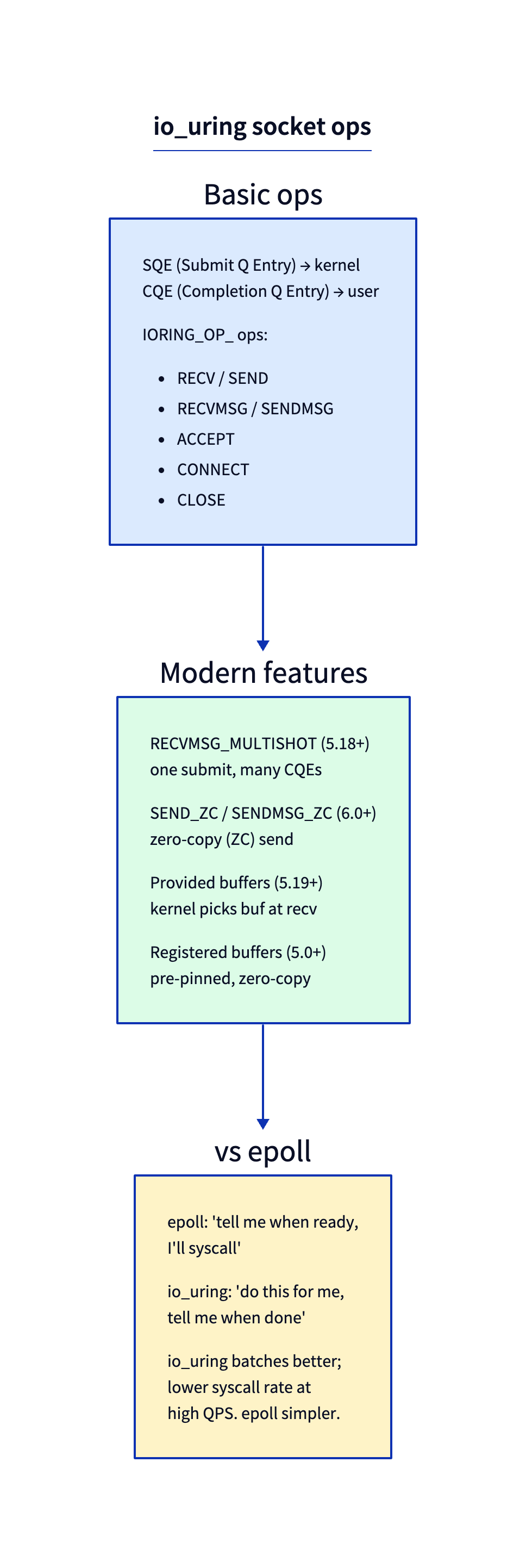
Recall:
- epoll: “tell me when this FD is ready; I’ll syscall myself.” Each I/O =
epoll_wait(1 syscall) +recv/send(1 syscall). Two syscalls per I/O. - io_uring: “do this for me; tell me when done.” Each batch of I/Os = 1 syscall (
io_uring_enter) covering many ops. Or zero in steady state withIORING_SETUP_SQPOLL(kernel-thread polling).
For workloads doing > 100k ops/sec per thread, the syscall savings alone are significant. For zero-copy send, the gains scale with payload size.
But that whole pitch — “one syscall per batch,” “zero in steady state” — rests on a mechanism the marketing slides never show: how do userspace and the kernel agree on a queue of work without a syscall per item? That is the first thing we have to teach, because everything else today is built on it.
How the ring actually works: a lock-free shared-memory queue
Here’s the puzzle. A syscall is the normal way userspace asks the kernel to do something — and a syscall is exactly what we’re trying to avoid. So how can userspace “submit” an operation without calling into the kernel at all? The answer is shared memory: userspace and the kernel literally read and write the same physical pages, so handing over a piece of work is just a memory store, not a mode switch.
The setup: one fd, three mmap’d regions
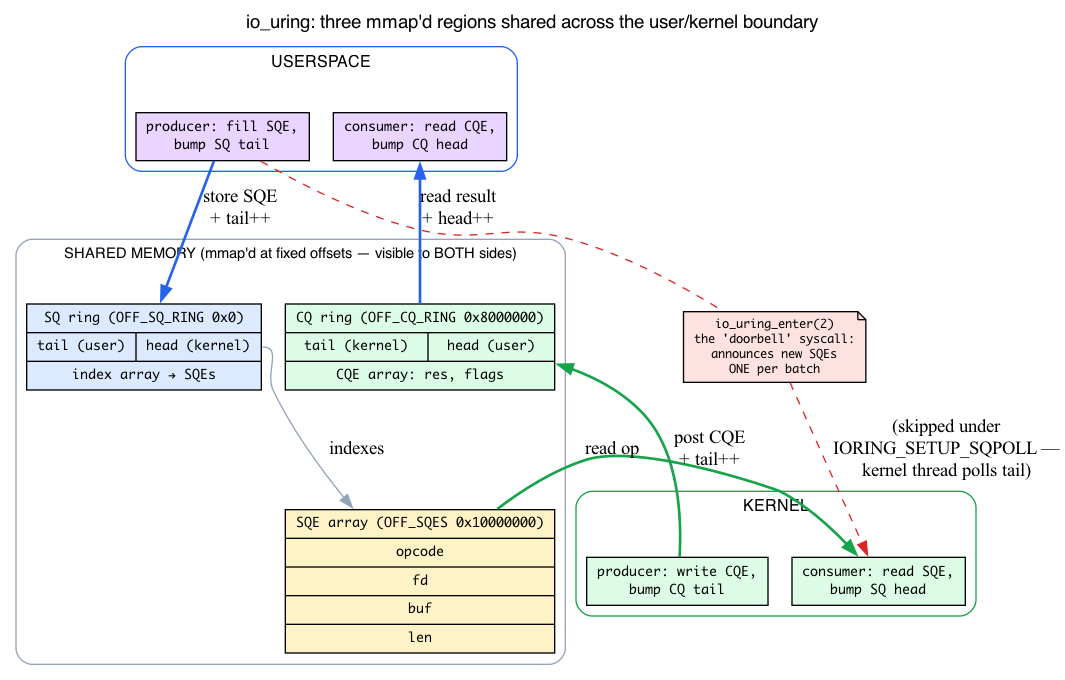
io_uring_setup(2) is the one syscall that bootstraps everything. It returns a file descriptor, and then userspace mmaps that fd at a few fixed magic offsets to map the shared regions into its own address space (include/uapi/linux/io_uring.h):
#define IORING_OFF_SQ_RING   0ULL          /* :551 — the SQ ring header + index array */
#define IORING_OFF_CQ_RING   0x8000000ULL  /* :552 — the CQ ring + CQE array          */
#define IORING_OFF_SQES      0x10000000ULL /* :553 — the SQE array itself              */
Three regions, one shared mapping each:
- The SQ ring — a small header plus an array of indices into the SQE array.
- The CQE array — where completions land (the CQ ring).
- The SQE array — the actual Submission Queue Entries (the op descriptions: opcode, fd, buffer, length, …).
After the mmap, those pages are visible to both sides. When userspace fills in an SQE, the kernel sees the bytes with no copy. When the kernel writes a CQE, userspace sees it with no copy. liburing’s io_uring_queue_init does the io_uring_setup + three mmaps for you, which is why the basic API below looks so innocent.
How does userspace know where the head/tail fields live inside those mapped pages? io_uring_setup fills in a struct io_uring_params (:614) and copies it back. Two sub-structs carry the byte offsets of every field within the rings:
struct io_sqring_offsets {   /* :561 — head, tail, ring_mask, ring_entries, ... */ };
struct io_cqring_offsets {   /* :580 — head, tail, ring_mask, ring_entries, ... */ };
/* and inside io_uring_params: */
struct io_sqring_offsets sq_off;   /* :623 */
struct io_cqring_offsets cq_off;   /* :624 */
So userspace maps the regions, then uses sq_off.head, sq_off.tail, etc. to find the indices inside the shared pages. The kernel side of all this is io_uring_setup (io_uring/io_uring.c:3111) and its syscall entry SYSCALL_DEFINE2(io_uring_setup) (:3150), which allocate the rings and populate those offsets.
The circular buffer: head, tail, and why no lock is needed
Each ring is a single-producer / single-consumer (SPSC) circular buffer, governed by two free-running 32-bit counters:
- a tail, advanced by the producer when it adds an entry, and
- a head, advanced by the consumer when it removes one.
Index into the array with counter & ring_mask (the mask is ring_entries - 1, so the size is always a power of two and the wrap is a cheap AND). The gap between head and tail is the pending work. Empty when head == tail; full when the gap equals the ring size.
The crucial property: only one side ever writes each counter. For the SQ, userspace owns the tail and the kernel owns the head. For the CQ, the kernel owns the tail and userspace owns the head. Because no counter has two writers, you never need a lock — only a memory barrier so the other side sees your index update after it sees the entry you wrote. That barrier is the only subtlety, and liburing hides it inside io_uring_get_sqe / io_uring_cqe_seen. The magic is the shared SPSC ring; the library is a thin, correct wrapper around it.
Put the two rings together and you get the full producer/consumer picture:
| Ring | Producer (writes entries, bumps tail) | Consumer (reads entries, bumps head) |
|---|---|---|
| SQ (submissions) | userspace — fills SQE, bumps SQ tail | kernel — reads SQE, bumps SQ head |
| CQ (completions) | kernel — writes CQE, bumps CQ tail | userspace — reads CQE, bumps CQ head |
That last cell is what io_uring_cqe_seen() does: it bumps the CQ head to tell the kernel “I’ve consumed this completion; the slot is free again.”
Where the syscall went
Now the thesis makes mechanical sense. When you “submit,” you have already written the SQE into shared memory and bumped the SQ tail — no syscall happened. The only thing the kernel still needs is a notification that new SQEs are present so it goes and drains them. That notification is the single io_uring_enter syscall (SYSCALL_DEFINE6(io_uring_enter), io_uring/io_uring.c:2600), whose submission path calls io_submit_sqes(ctx, to_submit) (:2651, defined at :2026) to walk the SQ and run each op. One io_uring_enter can announce hundreds of SQEs at once — that’s the “one syscall per batch.”
And IORING_SETUP_SQPOLL (include/uapi/linux/io_uring.h:175) removes even that. With SQPOLL the kernel spawns a poll thread that watches the SQ tail itself; when it sees the tail move, it drains the queue without anyone calling io_uring_enter. That is the literal source of “zero syscalls in steady state” — the doorbell rings itself.
So when the rest of today says an op is “submitted,” hold this picture: a store into a shared page and a tail bump. The expensive part — the mode switch — happens at most once per batch, and with SQPOLL not at all.
The basic API
#include <liburing.h>

struct io_uring ring;
io_uring_queue_init(256, &ring, 0);

/* Submit a recv */
struct io_uring_sqe *sqe = io_uring_get_sqe(&ring);
io_uring_prep_recv(sqe, sock_fd, buf, sizeof(buf), 0);
io_uring_sqe_set_data(sqe, /* user pointer */);
io_uring_submit(&ring);

/* Wait for completion */
struct io_uring_cqe *cqe;
io_uring_wait_cqe(&ring, &cqe);
/* cqe->res = number of bytes received (or -errno) */
io_uring_cqe_seen(&ring, cqe);
Read this with the ring picture in mind:
io_uring_get_sqehands you the next free slot in the shared SQE array (it bumps an internal “sqe tail” liburing tracks for you).io_uring_prep_recvfills that SQE: opcodeIORING_OP_RECV, the fd, the buffer, the length.io_uring_submit()publishes the SQE (bumps the SQ tail) and rings the doorbell — oneio_uring_enter, not one syscall per op. It is not copying the SQE into the kernel; the SQE was already in shared memory.io_uring_wait_cqewaits for the kernel to push a CQE onto the CQ ring.io_uring_cqe_seenbumps the CQ head so the kernel can reuse that completion slot.
Remember: io_uring_submit() publishes SQEs and rings the doorbell (one io_uring_enter for the whole batch, or none under SQPOLL) — it does not syscall per op.
What “async” actually means: the three-tier execution ladder
Every op table row below says “Each is async: submit → kernel does the work in the background → CQE posted when done.” That’s true, but “in the background” hides a graceful three-step ladder that’s worth understanding, because it explains why io_uring is cheap when data is ready and only expensive when it isn’t — and it reuses machinery you already met on Day 19.
Think about what “do this recv for me” really involves. The data might already be sitting in the socket buffer, or it might not have arrived yet. A naive design would spin up a thread for every op and let it block — but threads are expensive, and most of the time the data is right there. So io_uring tries the cheapest thing first and only escalates when forced.
Tier 1 — inline, non-blocking try. When io_uring issues a network op, it ORs in MSG_DONTWAIT (the per-call “do not block” flag) if it’s allowed to not block. You can see it in io_send (io_uring/net.c:667) and in the sendmsg path (:568):
if (issue_flags & IO_URING_F_NONBLOCK)
    flags |= MSG_DONTWAIT;
If the data is already available, the op completes immediately, inline, and the CQE is posted right there — no background work at all. This is the common case for a busy server, and it costs essentially nothing.
Tier 2 — arm a poll waiter. If the non-blocking try returns -EAGAIN (socket not ready), io_uring does not immediately burn a thread. The send path bails with:
if (ret == -EAGAIN && (issue_flags & IO_URING_F_NONBLOCK))
    return -EAGAIN;   /* io_uring/net.c:578 */
and the core then calls io_arm_poll_handler(req, issue_flags) (io_uring/poll.c:705). This registers an internal poll waiter on the socket — on the exact same sk_sleep(sk) wait queue that Day 19 showed blocking recv() and epoll hanging waiters on. When the socket becomes readable, the poll callback re-issues the op via task work and posts the CQE. The decision lives in the issue path:
if (io_arm_poll_handler(req, issue_flags) == IO_APOLL_OK) /* io_uring/io_uring.c:1563 */
This is why io_uring didn’t have to invent a new wakeup path: it leans on the kernel’s existing ->poll() + wait-queue infrastructure. The recv that “would block” just becomes a waiter on the socket, costing one small registration instead of a thread.
Tier 3 — punt to an io-wq worker. Only if poll-arming is impossible (the file type doesn’t support ->poll(), reported as IO_APOLL_ABORTED) does io_uring fall back to the heavyweight path: hand the request to a kernel worker-thread pool that’s allowed to block. The fallback is in io_queue_async (io_uring/io_uring.c:1621):
switch (io_arm_poll_handler(req, 0)) {   /* :1634 */
...
case IO_APOLL_ABORTED:                    /* :1638 */
    ...                                   /* punt: */
}
io_wq_enqueue(tctx->io_wq, &req->work);   /* :432 */
io_wq (io_uring/io-wq.c:116) is the bounded/unbounded worker pool that runs ops in a context where blocking is fine. This is the expensive tier — a real thread blocks on your behalf — and it’s why io_uring degrades gracefully rather than falling off a cliff: you only pay for a thread when the op genuinely can’t be done any cheaper.
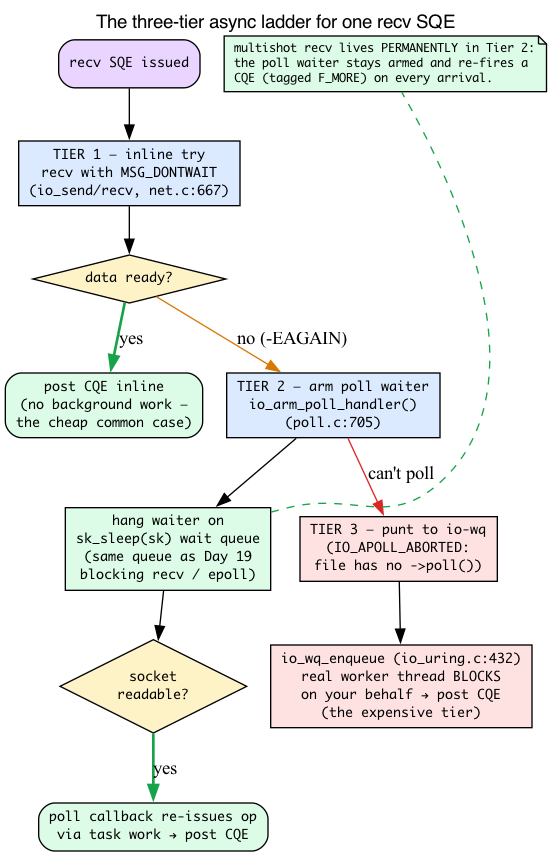
Keep this ladder in mind for two things below: multishot recv is just tier 2 made permanent (the poll waiter stays armed and re-fires), and the Check question at the end asks you to compare this path against a plain blocking recv().
Network-specific ops
In io_uring/net.c, where the actual io_send, io_recv, etc. functions live.
Basic ops
| Op | Userspace prep | Equivalent syscall |
|---|---|---|
IORING_OP_RECV | io_uring_prep_recv | recv() |
IORING_OP_SEND | io_uring_prep_send | send() |
IORING_OP_RECVMSG | io_uring_prep_recvmsg | recvmsg() (msghdr — supports cmsg, scatter-gather) |
IORING_OP_SENDMSG | io_uring_prep_sendmsg | sendmsg() |
IORING_OP_ACCEPT | io_uring_prep_accept | accept4() |
IORING_OP_CONNECT | io_uring_prep_connect | connect() |
IORING_OP_CLOSE | io_uring_prep_close | close() |
IORING_OP_SHUTDOWN | io_uring_prep_shutdown | shutdown() |
Each is async: submit → kernel does the work in the background (via the three-tier ladder above) → CQE posted when done.
Multishot recv (6.0+)
IORING_RECV_MULTISHOT flag on io_uring_prep_recv: one submission, many CQEs. The kernel keeps the recv “armed” — every time data arrives, a CQE is posted. The recv stays in flight until the socket closes or you cancel it.
io_uring_prep_recv(sqe, sock, buf, sizeof(buf), 0);
sqe->ioprio |= IORING_RECV_MULTISHOT;
io_uring_submit(&ring);

/* Now process CQEs as they come — no more submit per recv */
for (;;) {
    struct io_uring_cqe *cqe;
    io_uring_wait_cqe(&ring, &cqe);
    /* cqe->res = bytes received this time */
    io_uring_cqe_seen(&ring, cqe);
}
Mechanically, multishot is tier 2 of the async ladder made permanent. A normal recv disarms its poll waiter after one completion; a multishot recv leaves the request registered on the socket’s sk_sleep(sk) wait queue and re-fires a CQE — tagged IORING_CQE_F_MORE — every time data arrives, until you cancel it or the socket closes. (IORING_CQE_F_MORE is the kernel saying “this SQE will produce more completions; don’t retire it yet.”)
For high-rate receivers, this eliminates the per-recv submission cost entirely: one armed recv, a stream of CQEs.
Provided buffers (5.19+)
There’s a subtle waste in multishot recv as described so far: each recv still needs a buffer to land data in. If you hand the kernel a fixed buffer per recv, you’re back to per-recv bookkeeping. Provided buffer rings fix this by handing the kernel a whole pool of buffers up front and letting it pick one only when data actually arrives.
What gets registered
A provided buffer ring is a second shared-memory ring, entirely separate from the SQ/CQ. Userspace fills it with descriptors, each naming a buffer’s address, length, and a buffer id (bid) (include/uapi/linux/io_uring.h:857):
struct io_uring_buf {
    __u64 addr;   /* where the buffer is */
    __u32 len;    /* how big                 */
    __u16 bid;    /* :860 — the buffer id you'll get back */
    __u16 resv;
};

struct io_uring_buf_ring { /* :864 — the ring of the above */ };
You register this ring with the IORING_REGISTER_PBUF_RING opcode (:685, value 22) — that’s what liburing’s io_uring_register_buf_ring wraps:
io_uring_register_buf_ring(&ring, ®, 0); /* IORING_REGISTER_PBUF_RING */
You’ve handed the kernel a pool, not a per-op pointer.
How the kernel tells you which buffer it used
When you submit a recv with the IOSQE_BUFFER_SELECT flag (:167, bit at :149), the kernel defers the buffer choice until data is ready, then consumes one descriptor from the pool ring. The recv path imports that selected buffer into the message iterator — iov_iter_ubuf(&kmsg->msg.msg_iter, ITER_DEST, sel.addr, len) (io_uring/net.c:1061), with the longer mapping path at :1158/:1170. The chosen bid is stashed in the request’s buf_index slot (include/linux/io_uring_types.h:726, whose comment literally says “it points to the selected buffer ID”).
But the part that makes the API usable is how you learn which buffer was used. The completion encodes the bid in the upper bits of cqe->flags, shifted by IORING_CQE_BUFFER_SHIFT (:546, value 16), and sets the IORING_CQE_F_BUFFER flag so you know it’s there. Userspace decodes it:
if (cqe->flags & IORING_CQE_F_BUFFER) {
    unsigned bid = cqe->flags >> IORING_CQE_BUFFER_SHIFT;
    /* the bytes landed in the buffer you registered with this bid */
    /* ...process them, then re-publish that descriptor to the ring */
}
Process the bytes, then re-publish that descriptor so the kernel can reuse it. Without decoding the bid, you’d have data but no idea where it landed — which is why this detail is the whole point of the section.
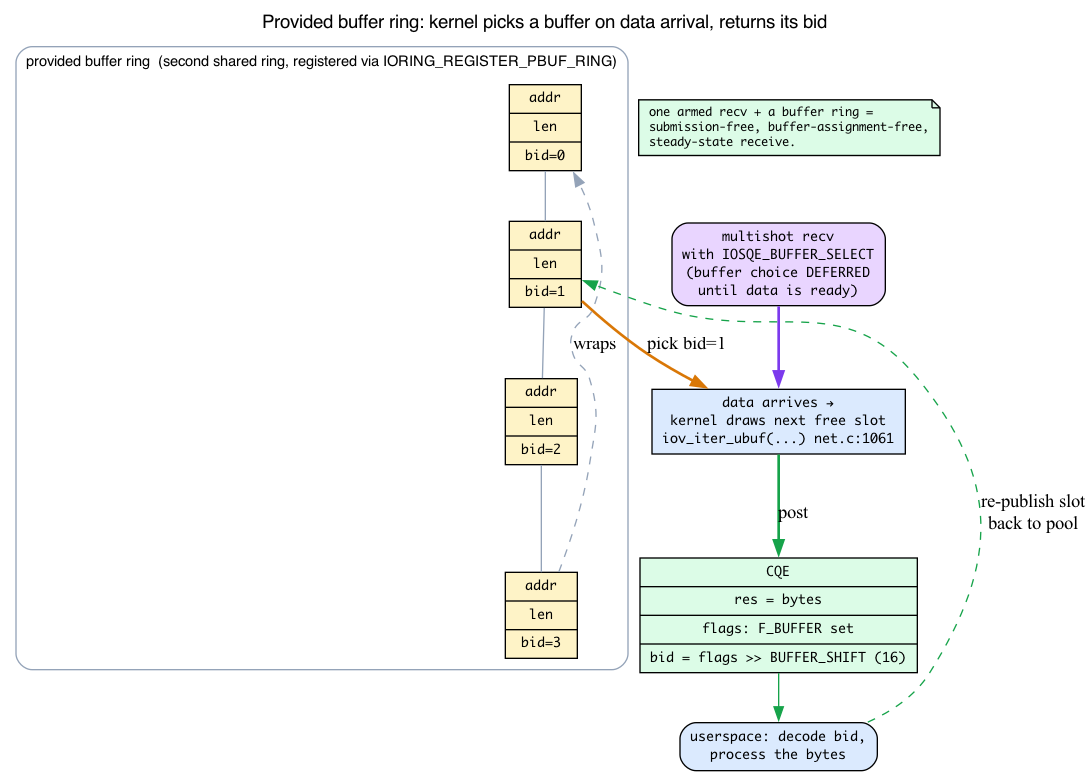
This pairs naturally with multishot recv: one armed recv + a buffer ring means every arriving datagram lands in the next free pool buffer and the CQE carries its bid — a fully submission-free, buffer-assignment-free, steady-state receive.
Zero-copy send (6.0+)
IORING_OP_SEND_ZC / IORING_OP_SENDMSG_ZC. This is the day’s headline op, so it deserves the full mechanism, not a hand-wave.
Why there’s a buffer-lifetime problem at all
A normal send() copies your bytes out of userspace into kernel skb memory. That copy is the reason send() can return immediately and you can scribble over your buffer the next instant — the kernel already has its own copy. Zero-copy send skips that copy: the outgoing skb’s page fragments point directly at your userspace pages (recall the linear-head + page-frags split from Day 1). The kernel pins those pages — locks them in memory so they can’t be swapped or moved — and the NIC DMAs straight out of them.
That’s faster, but it creates a new obligation: your pages must stay valid and unchanged until the NIC has finished DMAing them. If you reused the buffer too early, you’d transmit garbage. So zero-copy send needs a way to tell you “the hardware is done; your pages are free again” — and that is the entire reason for the deferred second CQE.
How the kernel knows the pages are free: ubuf_info and its refcount
The skb carries a shared-info flag, SKBFL_ZEROCOPY_ENABLE (include/linux/skbuff.h:505), and a pointer to a tiny refcounted kernel object, struct ubuf_info (:546):
struct ubuf_info {
    const struct ubuf_info_ops *ops;
    refcount_t refcnt;   /* the page-pin reference count */
    u8 flags;
};
struct ubuf_info_msgzc { struct ubuf_info ubuf; ... };   /* :552 */
Every skb that references the pinned pages holds one reference on this ubuf_info. That matters because the TCP stack clones skbs constantly — a retransmit keeps a copy, segmentation splits one skb into many — and each clone that still points at your pages bumps the refcount. (Some of these paths use SKBFL_MANAGED_FRAG_REFS, :524, tested by skb_zcopy_managed() at :1804.)
io_uring wires this up by allocating a notification request whose embedded ubuf_info is the skb’s uarg. The io_uring side is struct io_notif_data { struct file *file; struct ubuf_info uarg; ... } (io_uring/notif.h:13), reached via io_notif_to_data (:30). At prep time it allocates the notif — notif = zc->notif = io_alloc_notif(ctx) inside io_send_zc_prep (io_uring/net.c:1353, prep at :1336) — and the send path hands that uarg to the skb:
kmsg->msg.msg_ubuf = &io_notif_to_data(sr->notif)->uarg; /* io_uring/net.c:1518 */
Now follow the refcount. As the stack finishes with each skb fragment, it drops a reference on the ubuf_info. When the last reference goes away, the completion callback fires (io_uring/notif.c:43):
void io_tx_ubuf_complete(struct sk_buff *skb, struct ubuf_info *uarg, ...)
{
    ...
    if (!refcount_dec_and_test(&uarg->refcnt))   /* :57 */
        return;
    /* refcount hit zero → post the F_NOTIF CQE */
}
So the IORING_CQE_F_NOTIF CQE is not a timer and not a guess. It is, precisely, “the last skb referencing your pages was freed.” This is the same ubuf_info machinery the TCP stack already uses for plain SO_ZEROCOPY sockets (the SO_ZEROCOPY/MSG_ZEROCOPY path) — io_uring just routes the completion to a CQE instead of the socket error queue. And it’s a third lifetime layer stacked on what Day 1 taught: skb->users counts descriptor references, dataref counts data-buffer references, and now ubuf_info.refcnt counts page-pin references.
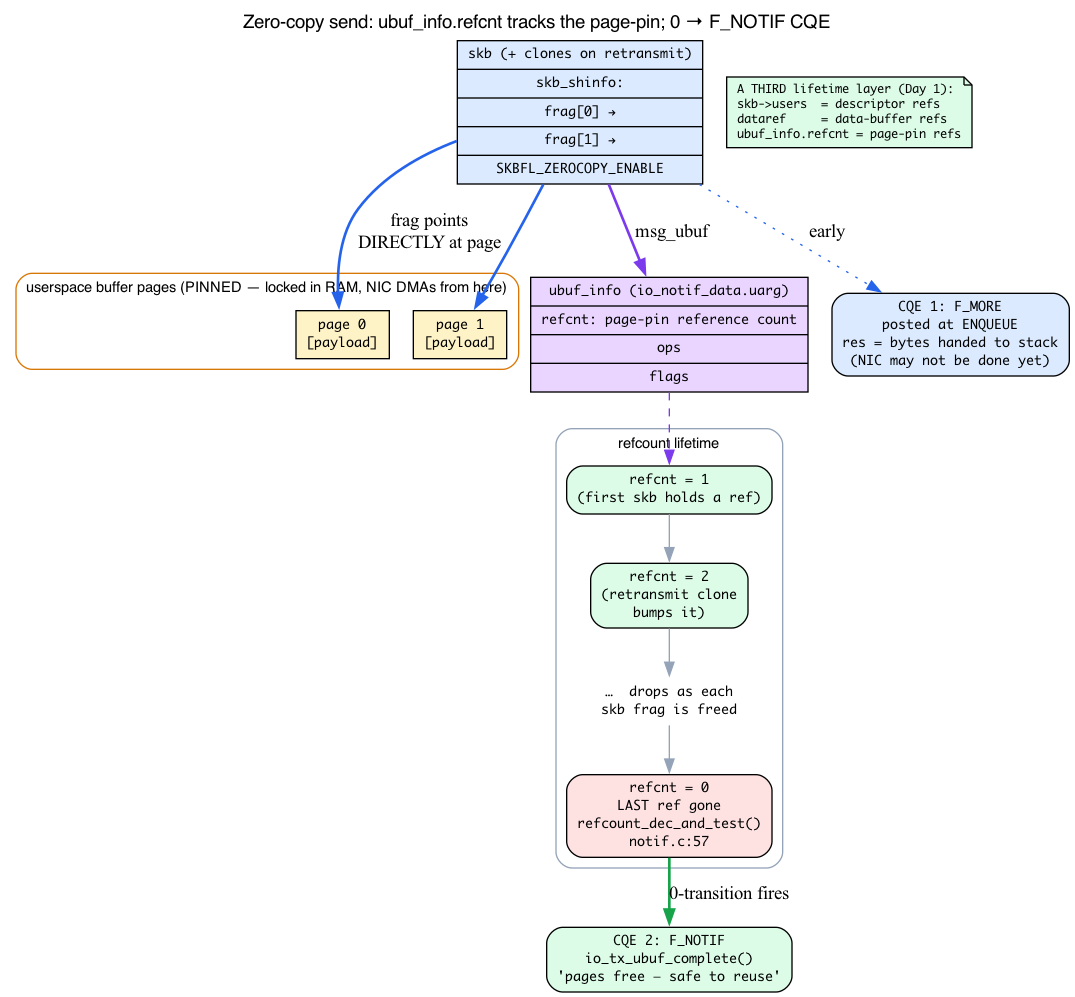
The two CQEs
Two CQEs per send:
- Send result (
IORING_CQE_F_MORE): carries the actual send outcome — bytes sent (cqe->res). The data has been handed to the stack, but the NIC may not have DMAed it yet. This is the request’s own final completion:io_sendmsg_zcends withio_req_set_res(req, ret, IORING_CQE_F_MORE); return IOU_COMPLETE;(io_uring/net.c:1556), so the core posts it withres= bytes sent and theF_MOREflag set (defined atinclude/uapi/linux/io_uring.h:539). It is not anio_req_post_cqe()aux CQE. - Notification of completion (
IORING_CQE_F_NOTIF,:541): user pages are no longer in use; the buffer is safe to free or reuse. This is the refcount-hit-zero moment above.
sqe = io_uring_get_sqe(&ring);
io_uring_prep_send_zc(sqe, sock, buf, len, 0, 0);
io_uring_submit(&ring);

/* CQE 1: send started */
io_uring_wait_cqe(&ring, &cqe);

/* CQE 2: buffer no longer in use (e.g., NIC DMA done) */
io_uring_wait_cqe(&ring, &cqe);
Why split them? Because the two facts become true at very different times. The byte count / errno is known as soon as the data is queued to the stack — you want that promptly. But reuse-safety must wait for DMA completion, which can be much later. Decoupling the CQEs lets you learn the result immediately while still being told precisely when the pages are free. Reusing the buffer between CQE 1 and CQE 2 would corrupt the in-flight transmit.
There are no Dumb Questions
Q: Why not just post one CQE after the DMA completes?
A: Because the two facts you care about become known at very different times. The byte count (or errno) is settled the instant the data is queued to the stack — you want to act on it right away. But the DMA-done moment, when your pages are finally free, can be much later. Folding them into one CQE would force you to wait for the slow fact before learning the fast one. Splitting lets you handle the result immediately while still being told precisely when the buffer is safe to reuse.
For large transfers (> ~4 KB), zero-copy send approaches the limits of what the NIC and PCIe bus allow. Userspace processes (databases, HTTP servers serving large files) see significant throughput improvement.
Zero-copy receive (experimental 6.x)
Day 29 mentions net_iov and page pool memory provider — the infrastructure to extend zero-copy semantics to RX. Not as mature as ZC send; check kernel notes.
When to choose which
For most servers, epoll is enough. Battle-tested, simple API, performs well into the millions of QPS for typical web workloads.
io_uring shines when:
- Sustained > 100k ops/sec per thread and you can pay the development complexity.
- You’re already doing batched I/O across multiple kinds (file I/O alongside network).
- You want zero-copy send for large transfers (CDN edges, large file serving).
- You want to use
IORING_SETUP_SQPOLLto skip the syscall path entirely (reduces context switches under heavy load).
io_uring’s complexity tax:
- Bigger API surface (~50 ops, lots of flags).
- Subtle ordering rules (when the SQE order matters; when CQE delivery is guaranteed).
- More failure modes (incorrect ring sizing → drops; misuse of ZC buffers → crashes).
Adoption is real but slower than the engineering benefits suggest. Notable users: ScyllaDB, parts of QEMU for storage I/O, experimental nginx branches, some Kubernetes runtimes for high-volume pod ingest.
Today’s experiment
# Verify io_uring support (grep the file directly — /proc/kallsyms is a
# regular file, so `ls | grep` would only ever match the path string).
# The syscall wrappers show up as __x64_sys_io_uring_enter / __do_sys_io_uring_enter.
grep -q io_uring_enter /proc/kallsyms && echo "io_uring: supported" || cat /proc/version

# Install liburing if not present
sudo apt install liburing-dev liburing2

# Look at the examples (the -dev package installs them under liburing-dev/)
ls /usr/share/doc/liburing-dev/examples/

# A trivial async-accept loop
cat << 'EOF' > /tmp/iour_accept.c
#include <stdio.h>
#include <string.h>
#include <unistd.h>
#include <netinet/in.h>
#include <sys/socket.h>
#include <liburing.h>

int main() {
    int s = socket(AF_INET, SOCK_STREAM, 0);
    int one = 1;
    setsockopt(s, SOL_SOCKET, SO_REUSEADDR, &one, sizeof one);
    struct sockaddr_in a = { AF_INET, htons(7777) };
    bind(s, (struct sockaddr*)&a, sizeof a);
    listen(s, 64);

    struct io_uring ring;
    io_uring_queue_init(8, &ring, 0);

    struct io_uring_sqe *sqe = io_uring_get_sqe(&ring);
    io_uring_prep_accept(sqe, s, NULL, NULL, 0);
    io_uring_submit(&ring);

    struct io_uring_cqe *cqe;
    io_uring_wait_cqe(&ring, &cqe);   /* CQE for the accept */
    int conn = cqe->res;
    io_uring_cqe_seen(&ring, cqe);

    if (conn >= 0) {
        /* Reply through io_uring with a ZERO-COPY send so this experiment
         * actually exercises the day's headline op (IORING_OP_SEND_ZC).
         * io_uring_prep_send_zc(sqe, sockfd, buf, len, msg_flags, zc_flags). */
        const char msg[] = "hi via io_uring\n";
        sqe = io_uring_get_sqe(&ring);
        io_uring_prep_send_zc(sqe, conn, msg, sizeof msg - 1, 0, 0);
        io_uring_submit(&ring);

        /* CQE 1: send result, carries IORING_CQE_F_MORE (more to come) */
        io_uring_wait_cqe(&ring, &cqe);
        printf("send  res=%d more=%d\n", cqe->res,
               !!(cqe->flags & IORING_CQE_F_MORE));
        io_uring_cqe_seen(&ring, cqe);

        /* CQE 2: notification, carries IORING_CQE_F_NOTIF — buffer is now
         * free to reuse (the NIC is done with the pinned pages). */
        io_uring_wait_cqe(&ring, &cqe);
        printf("notif flag=%d\n", !!(cqe->flags & IORING_CQE_F_NOTIF));
        io_uring_cqe_seen(&ring, cqe);

        close(conn);
    }

    io_uring_queue_exit(&ring);
    close(s);
    return 0;
}
EOF
cc /tmp/iour_accept.c -o /tmp/iour_accept -luring && /tmp/iour_accept &

# Connect:
nc localhost 7777
The server handles exactly one accept (one io_uring_prep_accept + one CQE) and then exits. You should see the single greeting line, after which nc exits because the server closes the connection:
hi via io_uring
If nothing prints, the accept op never completed. The server’s own stdout shows the two-CQE zero-copy pattern from the prose — the send result (with F_MORE) followed by the buffer-free notification (with F_NOTIF, i.e. the moment ubuf_info.refcnt hit zero):
send  res=16 more=1
notif flag=1
Cleanup: the server self-exits after one connection. If you start the bpftrace watch first and skip (or fail) the nc step, the backgrounded server stays blocked in io_uring_wait_cqe holding port 7777 — stop it with pkill -f iour_accept.
Watch the kernel side. Trace the ops this program actually submits — the async accept and the zero-copy send — and bound it with an exit() so it does not run forever (the original probes traced io_send/io_recvmsg, ops this workload never issues, so they would stay permanently blank):
sudo bpftrace -e 'fentry:io_accept  { @accept = count(); }
fentry:io_sendmsg_zc { @zc = count(); }
interval:s:5 { print(@accept); print(@zc); exit(); }'
After running /tmp/iour_accept and connecting once with nc localhost 7777, expect one of each (connect again for higher counts):
@accept: 1
@zc: 1
Probe names must match the submitted op: a plain recv goes through io_recv, recvmsg through io_recvmsg, send through io_send, and ZC send through io_sendmsg_zc (both IORING_OP_SEND_ZC and SENDMSG_ZC issue through the same function).
What to read in the kernel
-
io_uring/net.c— networking ops. ~1900 lines. Key entries:io_send_setup(line 350),io_sendand friends — the send paths.io_sendmsg_setup(line 396),io_recvmsg.io_send_zc_prep/io_sendmsg_zc— zero-copy paths (bothIORING_OP_SEND_ZCandSENDMSG_ZCissue throughio_sendmsg_zc).- The
io_kiocbstruct holds per-op state — including thebuf_indexslot that carries the selected provided-bufferbid.
-
io_uring/io_uring.c— main entry points:io_uring_setup(line 3111),io_uring_register,io_uring_enter(line 2600). Readio_submit_sqes(line 2026) for the submission walk andio_iopoll_checkfor the polled-IO completion path (the general completion wait isio_cqring_wait, now inio_uring/wait.c). The async ladder lives here too:io_arm_poll_handlerdecision (line 1563),io_queue_async(line 1621), and the io-wq puntio_wq_enqueue(line 432). -
io_uring/poll.c— multishot infrastructure.io_arm_poll_handler(line 705) registers the internal poll waiter on the socket’s wait queue; multishot recv keeps requests in a “ready” state and re-fires CQEs. -
io_uring/notif.c/io_uring/notif.h— the zero-copy notification object.struct io_notif_data(notif.h line 13) embeds theubuf_info uarg;io_tx_ubuf_complete(notif.c line 43) is where the page-pin refcount hits zero and theF_NOTIFCQE is born. -
include/uapi/linux/io_uring.h— UAPI. Operation IDs (IORING_OP_*), flags (IOSQE_*), the mmap offsets (line 551),io_uring_params+ ring offsets (line 614), provided-buffer structs (io_uring_bufline 857), and the CQE flags (F_MOREline 539,F_NOTIFline 541,IORING_CQE_BUFFER_SHIFTline 546). -
include/linux/skbuff.h—struct ubuf_info(line 546) and theSKBFL_*zero-copy flags (line 505) that connect the io_uring notif to the skb page-pin lifetime. -
liburing repo (https://github.com/axboe/liburing) — userspace API. The
examples/directory has annotated code for every common pattern. -
io_uring man pages (
io_uring_setup(2),io_uring_enter(2), and the liburingman/pages) — the primary reference docs; the kernel tree has no networking io_uring.rst. -
External: Jens Axboe’s “io_uring: efficient io” papers/talks; the libuv issue tracker for nuanced behavior comparisons.
Bullet Points
- The ring is shared memory, not a syscall queue.
io_uring_setupreturns an fd; userspacemmaps three regions (SQ ring, SQE array, CQ ring) at fixed offsets. Submitting = writing an SQE into shared pages + bumping a tail index. No copy, no per-op syscall. - Each ring is a lock-free SPSC circular buffer. Producer bumps the tail, consumer bumps the head; only one writer per index ⇒ no lock. SQ: userspace produces, kernel consumes. CQ: kernel produces, userspace consumes (
io_uring_cqe_seenbumps the CQ head). - One syscall per batch (
io_uring_enter) is just a doorbell announcing new SQEs. Zero syscalls in steady state withIORING_SETUP_SQPOLL(a kernel thread watches the SQ tail itself). - Async = a three-tier ladder: (1) inline
MSG_DONTWAITtry — data ready ⇒ instant CQE; (2)-EAGAIN⇒io_arm_poll_handlerhangs a waiter on the samesk_sleep(sk)queue Day 19 uses; (3) can’t poll ⇒ punt to an io-wq worker that’s allowed to block. - Multishot recv (6.0+): tier 2 made permanent — one submission, many CQEs (each tagged
F_MORE) as data arrives. - Provided buffers (5.19+): register a pool ring of
{addr,len,bid}; withIOSQE_BUFFER_SELECTthe kernel picks a buffer on data arrival and returns thebidpacked intocqe->flags >> IORING_CQE_BUFFER_SHIFT. Pairs with multishot for fully submission-free receive. - Zero-copy send (6.0+):
IORING_OP_SEND_ZC. Pins your pages so the NIC DMAs them directly. Two CQEs:F_MORE(send result, posted at enqueue) andF_NOTIF(pages free — fired exactly when the skb’subuf_info.refcnthits zero inio_tx_ubuf_complete). - For most servers, epoll is fine. io_uring is for sustained > 100k ops/sec or batched workloads.
- The complexity tax is real; adoption is slow but growing.
Check question
If you submit IORING_OP_RECV and immediately io_uring_wait_cqe, what’s the difference compared to a blocking recv()?
Click to reveal answer
Answer: Functionally similar — both block until data arrives. The mechanism is different.
For blocking recv(): the syscall enters the kernel and blocks on the socket’s sk_sleep(sk) wait queue; when data arrives, sk->sk_data_ready() (sock_def_readable) is invoked and wakes that queue, and recv returns with the data copied to user.
For IORING_OP_RECV + immediate wait: the op runs the three-tier ladder. The kernel first tries the recv inline with MSG_DONTWAIT; if data is already there, the CQE is posted immediately. If not (-EAGAIN), io_arm_poll_handler registers a poll waiter on the same socket wait queue blocking recv() would have used, and you wait at io_uring_wait_cqe. When data arrives, the poll callback re-issues the recv and posts a CQE, waking you.
For a single recv this is more overhead than blocking recv — you pay the io_uring framework cost (the ring, the poll-arm) without getting the batching benefit. The win is when you have hundreds of operations in flight: one io_uring_enter syscall to submit them all, one to wait for any to complete. epoll would need one syscall per recv() plus one per epoll_wait(). At scale, io_uring’s amortized syscall cost is much lower.
For a server doing 1 op/sec, blocking recv beats io_uring. For one doing 100k ops/sec, io_uring wins. The crossover depends on workload.
Tomorrow
Day 29: recent additions — PSP encryption, drop_monitor improvements, devlink, NETLINK YAML.