Day 13 — Ringbuf at scale: drops, back-pressure, dynptr
Today’s mission: instrument a high-rate tracer to see when it’s losing events, then fix the loss with sizing, filtering, and
bpf_dynptr. Along the way you’ll finally see whybpf_ringbuf_reservereturns NULL, how a sleeping consumer gets woken, and what abpf_dynptractually is. End of Phase 2. Total time: ~110 minutes.
When ringbuf isn’t free
Day 1 you wrote a low-rate tracer and ringbuf “just worked.” You called bpf_ringbuf_reserve to grab a slot, filled it, and bpf_ringbuf_submit’d it; userspace polled with ring_buffer__poll. That’s the whole MPSC (multi-producer, single-consumer) contract, and at a few hundred events per second you never saw it strain.
Today you’ll trace something high-rate — every vfs_read on a busy server — and watch ringbuf push back.
Ringbuf has no infinite queue. By default (the lab’s configuration, with no BPF_F_RB_OVERWRITE flag), when producers outpace the consumer bpf_ringbuf_reserve returns NULL and your event is dropped silently — unless you instrument for it. That sentence is the whole chapter, but it hides a mechanism nobody showed you on Day 1: what does “outpace” mean, concretely, and why does a fixed buffer have no choice but to fail the reservation? That’s the first thing we’ll fix.
The circular buffer: two positions chasing each other
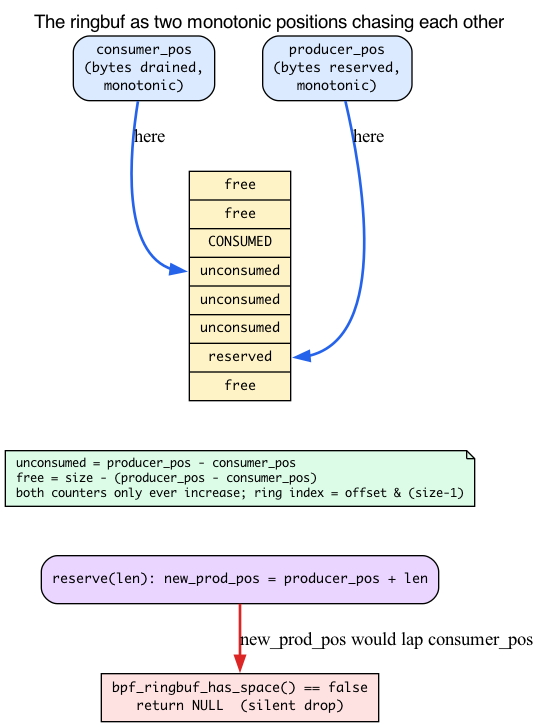
Here’s the model Day 1 let you skip. A BPF ringbuf is one fixed, power-of-two-sized region of bytes — you pick the size at map creation (max_entries, which for ringbuf means bytes, not entries). It never grows. The kernel tracks exactly two numbers about it, and both only ever increase:
producer_pos— a running byte count of everything that has ever been reserved. The next record starts here.consumer_pos— a running byte count of everything userspace has finished draining.
Both live in struct bpf_ringbuf (kernel/bpf/ringbuf.c:28). They’re monotonic — they never wrap back to zero — and the kernel maps a byte offset into the physical ring with a single mask: offset & rb->mask, where mask = size - 1 (that’s why the size must be a power of two). So the two counters race forward forever, and the gap between them is what matters:
Unconsumed bytes =
producer_pos − consumer_pos. Free space = ring size − (producer_pos − consumer_pos).
When the consumer keeps up, consumer_pos chases producer_pos closely and there’s lots of free space. When the consumer falls behind, the gap widens until it equals the whole ring — and now there is nowhere to put the next record.
What reserve actually does
Open __bpf_ringbuf_reserve (kernel/bpf/ringbuf.c:463). Several checks can hand you back NULL; here they are in the order the kernel runs them:
1. Reject an absurd record size. The very first line rejects anything past an outer sanity ceiling:
/* kernel/bpf/ringbuf.c:469 */
if (unlikely(size > RINGBUF_MAX_RECORD_SZ))
    return NULL;
RINGBUF_MAX_RECORD_SZ is UINT_MAX/4 (ringbuf.c:26) — about 1 GiB. You’ll never hit this with a sane event; it’s just an outer bound.
2. Round the request up, then reject anything bigger than the ring. Your event isn’t stored bare — each record carries an 8-byte header (BPF_RINGBUF_HDR_SZ = 8, include/uapi/linux/bpf.h:6275), and the total is rounded to 8. The rounded length is then checked against the ring’s own size:
/* kernel/bpf/ringbuf.c:472 */
len = round_up(size + BPF_RINGBUF_HDR_SZ, 8);
if (len > ringbuf_total_data_sz(rb))   /* :473 — the realistic oversize path */
    return NULL;
So a tidy 32-byte struct event doesn’t cost 32 bytes — it costs round_up(32 + 8, 8) = 40 bytes of ring. (The struct is { __u32 pid; __u64 dur; char comm[16]; }; the __u64 forces 8-byte alignment, so sizeof is 32, not the 28-byte field sum.) This matters more than it looks: our demo ring is a deliberately tiny 64 KiB, so it holds only ~1,600 of these records before it’s full. At hundreds of thousands of reads per second, that’s a few milliseconds of slack. And note the :473 check: a single record larger than the whole ring is rejected right here — that’s the realistic oversize path, long before the 1 GiB ceiling.
3. Take the ring’s lock. raw_res_spin_lock_irqsave can itself fail and return NULL (ringbuf.c:478) — a rare path, but a NULL exit nonetheless.
4. Check for space — and this is your drop. The kernel computes new_prod_pos = prod_pos + len and asks whether that would collide with the not-yet-consumed region:
/* kernel/bpf/ringbuf.c:494 */
if (!bpf_ringbuf_has_space(rb, new_prod_pos, cons_pos, pend_pos)) {
    raw_res_spin_unlock_irqrestore(&rb->spinlock, flags);
    return NULL;
}
That return NULL is the silent drop. By default — no BPF_F_RB_OVERWRITE flag, which is what our lab uses — there is no eviction, no blocking, no “make room”: if advancing producer_pos by len would overrun where the consumer still has unread data, reserve simply fails. (v7.1 does add an opt-in overwrite mode that evicts the oldest records instead — we’ll come back to it in the Dumb Questions box; the lab never sets the flag.) On success it stamps the record’s header length with the BUSY bit (hdr->len = size | BPF_RINGBUF_BUSY_BIT, ringbuf.c:529) — the per-record “reserved but not yet submitted” marker you met on Day 1 — and hands you the slot.
Why a bigger ring doesn’t save you
Now you can answer the question we raised earlier: if drops happen, why isn’t the fix just “bigger ring”?
Because the ring size only sets the maximum gap the producer can open before reserve starts failing. A bigger ring buys more slack — more milliseconds the consumer can lag before the gap saturates. But if the producer is permanently faster than the consumer, the gap grows until it pins at “full” and stays there, no matter how big the ring is. Size buys you a longer runway for bursts; it buys you nothing against a sustained rate mismatch. The real fix for sustained pressure is to produce fewer events (filter in BPF) or smaller summaries (aggregate in BPF) — which is exactly the lab below.
Drop visibility
Default behavior: drops are silent. Your tracer just emits fewer events than it observed. Production tracers always count drops.
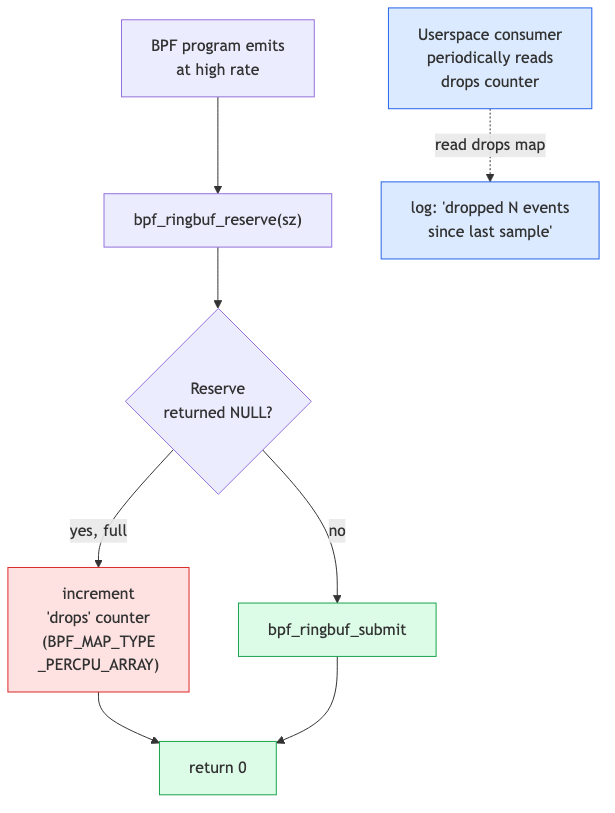
The pattern: a separate per-CPU array map for drop counts. Increment it whenever bpf_ringbuf_reserve returns NULL. Userspace samples the map periodically and logs. The drops map below is a BPF_MAP_TYPE_PERCPU_ARRAY — recall from Day 2 why per-CPU memory means inc_drops() needs no atomic (each CPU bumps its own private copy) and why sample_drops() must read an array of one __u64 per CPU and sum vals[i] across every CPU to get the real total.
How userspace sleeps, and how a producer wakes it
It’s tempting to assume the kernel wakes the consumer whenever the ring crosses some fill threshold. The real rule is simpler — and it’s the reason high-rate tracing stays cheap. Let’s build it from the bottom.
The consumer is asleep in epoll_wait
ring_buffer__poll(rb, timeout) — the loop you’ve used since Day 1 — is epoll_wait under the hood. The ringbuf file descriptor implements the kernel’s .map_poll operation (ringbuf_map_poll_kern, wired in at kernel/bpf/ringbuf.c:383). When your consumer thread polls, that function registers the thread on the ring’s wait queue and reports whether there’s data:
/* kernel/bpf/ringbuf.c:342 */
poll_wait(filp, &rb_map->rb->waitq, pts);

if (ringbuf_avail_data_sz(rb_map->rb))
    return EPOLLIN | EPOLLRDNORM;   /* :345 — only if unconsumed data exists */
return 0;
So with no unconsumed data, epoll_wait returns nothing to do and blocks the consumer thread on rb->waitq — zero CPU burned until something wakes it. That waitq is a wait_queue_head_t right at the top of struct bpf_ringbuf (ringbuf.c:28).
The producer wakes it through irq_work
When a producer submits a record, the kernel may need to wake that sleeping thread. It does not call the scheduler directly from submit — because submit can run in NMI or hard-IRQ context (a kprobe on a function called from an interrupt handler, say), where touching the scheduler is illegal. Instead it queues an irq_work: a tiny deferred callback that runs in a safe context. That callback is bpf_ringbuf_notify:
/* kernel/bpf/ringbuf.c:154 */
static void bpf_ringbuf_notify(struct irq_work *work)
{
    struct bpf_ringbuf *rb = container_of(work, struct bpf_ringbuf, work);
    wake_up_all(&rb->waitq);   /* unblocks epoll_wait */
}
It’s hooked up once at ring creation (init_irq_work(&rb->work, bpf_ringbuf_notify), ringbuf.c:183). wake_up_all is what makes the consumer’s epoll_wait return.
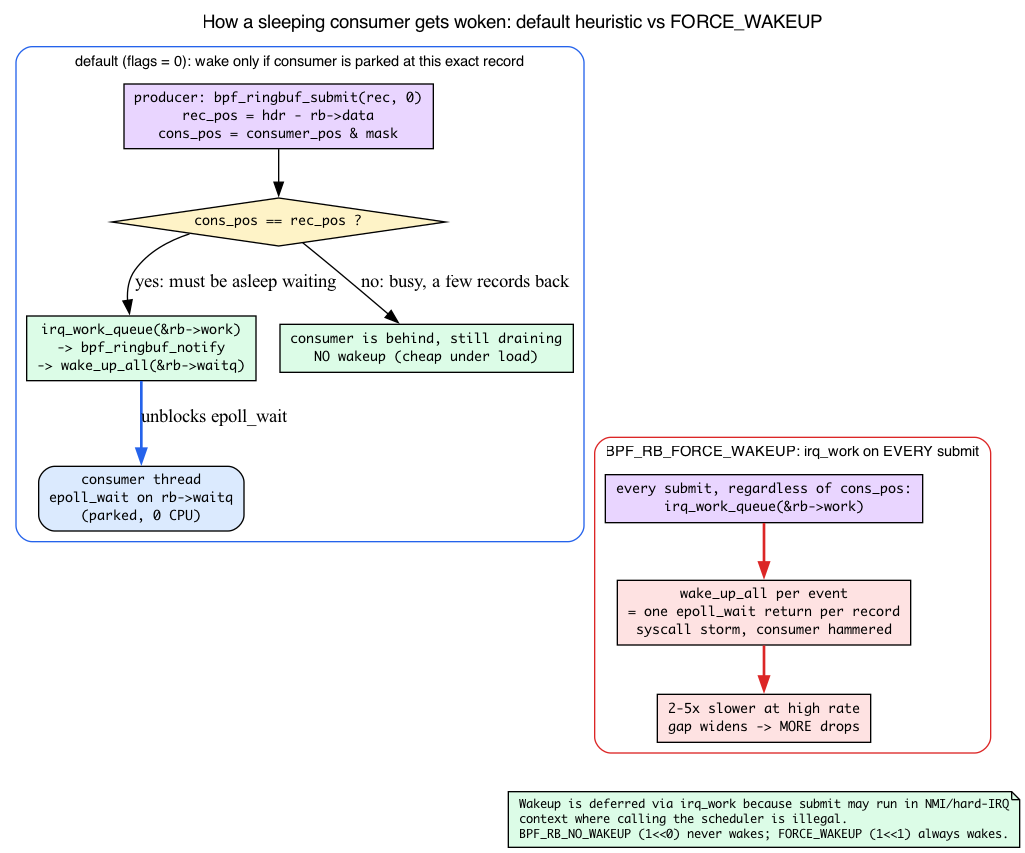
The real default heuristic: “did the consumer catch all the way up to me?”
Here’s the actual decision, in bpf_ringbuf_commit (the shared body of submit/discard):
/* kernel/bpf/ringbuf.c:578 */
rec_pos = (void *)hdr - (void *)rb->data;
cons_pos = smp_load_acquire(&rb->consumer_pos) & rb->mask;

if (flags & BPF_RB_FORCE_WAKEUP)
    irq_work_queue(&rb->work);                                  /* :581 */
else if (cons_pos == rec_pos && !(flags & BPF_RB_NO_WAKEUP))
    irq_work_queue(&rb->work);                                  /* :583 */
Read the else if carefully. The default wakes only when cons_pos == rec_pos — i.e. the consumer has drained all the way up to the exact record we just wrote. The intuition: if the consumer is sitting precisely at this record, it must be asleep waiting for it, so wake it. But if cons_pos is behind rec_pos — meaning there’s already unconsumed data ahead of the consumer — then the consumer is still busy draining and will reach this record on its own next pass. No wakeup needed.
This is the whole reason the default is cheap under load: a busy consumer is almost never parked at exactly the newest record. Under high rate it’s always a few records behind, so almost every submit skips the irq_work entirely. The wakeups happen only when the ring drains to empty and the consumer truly goes to sleep — which is exactly when you want a wakeup.
The two flags, and what they cost
bpf_ringbuf_submit(rec, flags) takes one of:
0(default) — thecons_pos == rec_posheuristic above. Right for almost everything.BPF_RB_NO_WAKEUP(= 1ULL << 0,include/uapi/linux/bpf.h:6258) — never queue a wakeup, even if the consumer is asleep at this record. Only safe when you know another event (or a later forced one) will follow soon to wake the consumer — otherwise it sleeps until your poll timeout fires. Use it to batch a known burst and wake once at the end.BPF_RB_FORCE_WAKEUP(= 1ULL << 1,:6259) — unconditionally queue theirq_workon every submit. Under high rate that’s a wakeup — and effectively a consumer-side syscall return — per event. That’s the 2–5× degradation Break 4 demonstrates.
Pass any other bit and the call is rejected — bpf_ringbuf_output checks if (flags & ~(BPF_RB_NO_WAKEUP | BPF_RB_FORCE_WAKEUP)) return -EINVAL; (ringbuf.c:619). Override the default only with cause.
bpf_dynptr: variable-size events
A subtle constraint of bpf_ringbuf_reserve(rb, sz, 0) is that sz must be constant at compile time. That isn’t a stylistic rule — it’s baked into the helper’s prototype. The size argument is typed ARG_CONST_ALLOC_SIZE_OR_ZERO (kernel/bpf/ringbuf.c:555), which tells the Verifier “this must be a compile-time constant.” The Verifier needs that constant to prove every write you do lands inside the reserved slot. A runtime-computed size gives it nothing to bound against, so it refuses the program.
So if your event size depends on, say, the bytes actually read, you have three legacy options:
- Reserve the worst-case max size; waste tail bytes when the event is smaller.
- Use
bpf_ringbuf_output(always copies bytes; skip the reserve/submit pattern). - Cap your max event size small.
In 2022 the kernel added bpf_dynptr (ring-buffer dynptr support landed in 5.19) — a runtime-sized buffer the Verifier tracks via a special pointer type with bounds. To use it correctly you need to know what it actually is.
A dynptr is a (pointer, size) capability the Verifier tracks for you
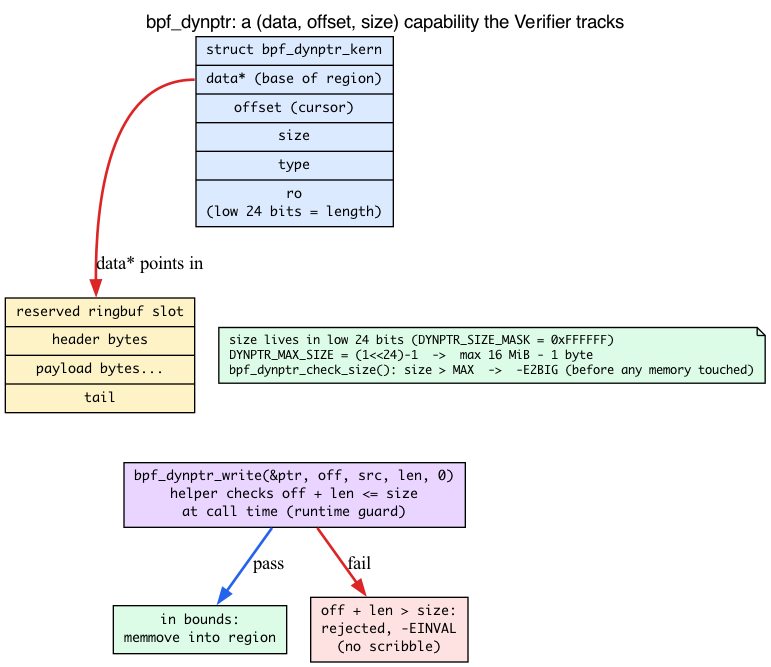
A bpf_dynptr is not a raw pointer. On the kernel side it’s a small descriptor, struct bpf_dynptr_kern (include/linux/bpf.h:1406):
struct bpf_dynptr_kern {
    void *data;     /* base of the region */
    u32   size;     /* low 24 bits = length; bits 28-30 = type (DYNPTR_TYPE_SHIFT=28); bits 24-27 reserved; bit 31 = read-only */
    u32   offset;   /* current offset within the region */
} __aligned(8);
The Verifier treats this as a single opaque object you may only touch through helpers — you never dereference it directly. That indirection is the whole trick: because every access goes through a helper, a runtime-chosen size can be made safe at call time. When you call bpf_dynptr_write(&ptr, off, src, len, 0), the helper checks off + len against the tracked size right then — so the Verifier doesn’t need the compile-time constant that plain reserve demands. The bounds check moved from load time to a runtime guard the helper performs on every write.
It is not a blank check: the 16 MiB ceiling
Because the length lives in only the low 24 bits of that size word (DYNPTR_SIZE_MASK = 0xFFFFFF, kernel/bpf/helpers.c:1765; extracted by __bpf_dynptr_size, :1788/:1796), the largest region a dynptr can describe is (1 << 24) − 1 = 16 MiB minus one byte (DYNPTR_MAX_SIZE = (1UL << 24) - 1, helpers.c:1763). Ask for more and the reservation fails before any memory is touched:
/* kernel/bpf/helpers.c:1823 */
int bpf_dynptr_check_size(u64 size)
{
    return size > DYNPTR_MAX_SIZE ? -E2BIG : 0;
}
So a dynptr is a bounded capability, not an unlimited one.
Lifecycle: same reserve/release discipline as plain reserve
struct bpf_dynptr ptr;
bpf_ringbuf_reserve_dynptr(&rb, sz, 0, &ptr);
bpf_dynptr_write(&ptr, 0, &header, sizeof(header), 0);
bpf_dynptr_write(&ptr, sizeof(header), payload, payload_len, 0);
bpf_ringbuf_submit_dynptr(&ptr, 0);
bpf_ringbuf_reserve_dynptr (kernel/bpf/ringbuf.c:670) reserves a slot the same way plain reserve does, then on success calls bpf_dynptr_init(ptr, sample, BPF_DYNPTR_TYPE_RINGBUF, 0, size) (ringbuf.c:696; the init helper is helpers.c:1847) so the dynptr now is a typed handle over the reserved ring slot. From there the discipline is identical to Day 1’s reserve/submit: you must follow with exactly one bpf_ringbuf_submit_dynptr or bpf_ringbuf_discard_dynptr. A reserved-but-never-released slot is poison — its header still carries the BUSY bit, which (recall the pending-position scan in reserve) wedges the ring’s ability to reclaim space.
One detail that makes the failure path read correctly: when reserve fails, the helper returns a negative error and nulls the dynptr — bpf_dynptr_set_null(ptr) (ringbuf.c:678/:684/:692), which memsets the whole descriptor to zero (helpers.c:1856). A nulled dynptr has data == NULL, so any subsequent bpf_dynptr_write through it is rejected too. That’s why Break 3 can safely call discard on the failure path without checking — and why a write through a failed reservation can never scribble somewhere bad.
bpf_dynptr_write itself is a plain in-kernel memmove into the tracked region (__bpf_dynptr_write, helpers.c:1952; the helper entry is :1994). It does not read user memory — that’s the Day 12 distinction Break 3 leans on. The Verifier statically tracks the dynptr’s bounds and the helper enforces them per call, so out-of-bounds writes are rejected. Performance is identical to direct reserve.
There are no Dumb Questions
Q: Does ringbuf drop the new event or the oldest event when full?
A: With the default ringbuf (no
BPF_F_RB_OVERWRITE) — which is what our lab uses — it drops the new one:bpf_ringbuf_reservesimply fails,bpf_ringbuf_has_space()says no, and__bpf_ringbuf_reservereturns NULL. The unconsumed span is never overwritten. v7.1 adds an opt-in overwrite mode (BPF_F_RB_OVERWRITE,1U<<19): therebpf_ringbuf_has_space()returns true even when full and__bpf_ringbuf_reservewalksoverwrite_pospast the oldest records to make room — i.e. it evicts the oldest unconsumed data instead. Our demo never sets the flag, so it gets the default drop-the-new behavior.Q: Should I size ringbuf to the worst-case rate?
A: No. Worst-case is unbounded. Size it to handle a few seconds of typical-rate burst (256 KiB — 4 MiB is common). Under sustained high rate, you’ll drop. The fix at that point isn’t a bigger ringbuf (see “Why a bigger ring doesn’t save you” above) — it’s filtering more aggressively in BPF, or aggregating in BPF and emitting summaries.
Q: Why is event size limited to constant in plain reserve?
A: Because the Verifier needs to bound the access pattern statically —
reserve’s size argument is literally typedARG_CONST_ALLOC_SIZE_OR_ZERO. Without a known size, it can’t prove your writes stay within the reserved slot.bpf_dynptris the new mechanism specifically designed to track runtime size at the type level and check each write against it at call time.
The lab
dropviz.bpf.c
The program is the Day 6 entry/exit latency pattern — a starts hash keyed by TID, written at fentry and read at fexit to compute a duration — reused here only as a convenient way to generate a high event rate. (Recall from Day 6 the TID-keyed start-timestamp map and its recursion/collision caveats; we don’t need them today.)
The producer and consumer share the event layout through one header:
#ifndef PRACTICAL_EBPF_DROPVIZ_H #define PRACTICAL_EBPF_DROPVIZ_H
struct event { unsigned int pid; unsigned long long dur; char comm[16]; };
#endif
and the program is included from the compiled source:
#include “vmlinux.h” #include <bpf/bpf_helpers.h> #include <bpf/bpf_tracing.h>
#include “dropviz.h”
char LICENSE[] SEC(“license”) = “GPL”;
struct { __uint(type, BPF_MAP_TYPE_RINGBUF); __uint(max_entries, 64 * 1024); /* deliberately small to demo drops */ } rb SEC(“.maps”);
struct { __uint(type, BPF_MAP_TYPE_PERCPU_ARRAY); __uint(max_entries, 1); __type(key, __u32); __type(value, __u64); } drops SEC(“.maps”);
struct { __uint(type, BPF_MAP_TYPE_HASH); __uint(max_entries, 4096); __type(key, __u64); __type(value, __u64); } starts SEC(“.maps”);
static __always_inline void inc_drops(void) { __u32 z = 0; __u64 *c = bpf_map_lookup_elem(&drops, &z); if (c) (*c)++; }
SEC(“fentry/vfs_read”) int BPF_PROG(on_in, struct file *f, char *buf, size_t n, loff_t *pos) { __u64 tid = bpf_get_current_pid_tgid() & 0xffffffff; __u64 ts = bpf_ktime_get_ns();
(void)f;
(void)buf;
(void)n;
(void)pos;
bpf_map_update_elem(&starts, &tid, &ts, BPF_ANY);
return 0;
}
SEC(“fexit/vfs_read”) int BPF_PROG(on_out, struct file *f, char *buf, size_t n, loff_t *pos, ssize_t ret) { __u64 id = bpf_get_current_pid_tgid(); __u64 tid = id & 0xffffffff; __u64 *ts = bpf_map_lookup_elem(&starts, &tid); __u64 dur; struct event *e;
(void)f;
(void)buf;
(void)n;
(void)pos;
(void)ret;

if (!ts)
    return 0;
dur = bpf_ktime_get_ns() - *ts;
bpf_map_delete_elem(&starts, &tid);

/* Filter to keep rate sane (comment out to demonstrate drops). */
if (dur < 5000)
    return 0;     /* skip < 5µs */

e = bpf_ringbuf_reserve(&rb, sizeof(*e), 0);
if (!e) {
    inc_drops();
    return 0;
}
e->pid = id >> 32;
e->dur = dur;
bpf_get_current_comm(&e->comm, sizeof(e->comm));
bpf_ringbuf_submit(e, 0);
return 0;
}
Notice inc_drops() increments without any atomic — that’s the per-CPU array doing its Day 2 job: each CPU touches its own copy, so there’s nothing to race over.
dropviz.c — userspace + drop monitor
The loader lives in the repository’s ebpf/labs/day13 directory; the build
generates dropviz.skel.h (the typed accessors for skel->maps.rb,
skel->maps.drops, etc.) from dropviz.bpf.o. The listing below is included
from the source compiled by make dropviz and CI:
#include <errno.h> #include <signal.h> #include <stdio.h> #include <string.h> #include <time.h>
#include <bpf/bpf.h> #include <bpf/libbpf.h>
#include “dropviz.h” #include “dropviz.skel.h”
static volatile sig_atomic_t exiting;
static void handle_signal(int signal_number) { (void)signal_number; exiting = 1; }
static int install_signal_handlers(void) { const struct sigaction action = { .sa_handler = handle_signal, };
if (sigaction(SIGINT, &action, NULL) != 0 ||
    sigaction(SIGTERM, &action, NULL) != 0) {
    fprintf(stderr, "failed to install signal handlers: %s\n",
            strerror(errno));
    return -errno;
}

return 0;
}
static int handle_event(void *ctx, void *data, size_t size) { const struct event *e = data;
(void)ctx;
if (size != sizeof(*e)) {
    fprintf(stderr, "unexpected ringbuf record size: %zu\n", size);
    return 0;
}

printf("%-16.*s pid=%-7u dur=%llu ns\n", (int)sizeof(e->comm), e->comm,
       e->pid, e->dur);
return 0;
}
/* Sample the per-CPU drops counter and sum across CPUs. */ static void sample_drops(int fd) { int ncpu = libbpf_num_possible_cpus(); __u64 total = 0; __u32 key = 0;
if (ncpu <= 0)
    return;

__u64 vals[ncpu];
if (bpf_map_lookup_elem(fd, &key, vals) != 0)
    return;
for (int i = 0; i < ncpu; i++)
    total += vals[i];
fprintf(stderr, "[total drops: %llu]\n", total);
}
int main(void) { struct dropviz_bpf *skel = NULL; struct ring_buffer *ringbuf = NULL; struct timespec last, now; int drops_fd; int err;
setvbuf(stdout, NULL, _IOLBF, 0);

err = install_signal_handlers();
if (err)
    return 1;

skel = dropviz_bpf__open_and_load();
if (!skel) {
    fprintf(stderr, "failed to open and load dropviz BPF skeleton\n");
    return 1;
}

err = dropviz_bpf__attach(skel);
if (err) {
    fprintf(stderr, "failed to attach dropviz BPF programs: %s\n",
            strerror(-err));
    goto cleanup;
}

ringbuf = ring_buffer__new(bpf_map__fd(skel->maps.rb), handle_event,
                           NULL, NULL);
err = libbpf_get_error(ringbuf);
if (err) {
    ringbuf = NULL;
    fprintf(stderr, "failed to create ringbuf consumer: %s\n",
            strerror(-err));
    goto cleanup;
}

drops_fd = bpf_map__fd(skel->maps.drops);

puts("Tracing vfs_read latency; sampling drops every ~1s. "
     "press Ctrl-C to stop.");
clock_gettime(CLOCK_MONOTONIC, &last);
while (!exiting) {
    err = ring_buffer__poll(ringbuf, 100);   /* 100 ms timeout */
    if (err == -EINTR) {
        err = 0;
        continue;
    }
    if (err < 0) {
        fprintf(stderr, "ringbuf poll failed: %s\n", strerror(-err));
        goto cleanup;
    }

    clock_gettime(CLOCK_MONOTONIC, &now);
    if (now.tv_sec - last.tv_sec >= 1) {   /* ~1s tick */
        sample_drops(drops_fd);
        last = now;
    }
}

err = 0;
cleanup: ring_buffer__free(ringbuf); dropviz_bpf__destroy(skel); return err != 0; }
The sample_drops reader is the per-CPU read-out from Day 2 in the flesh: bpf_map_lookup_elem on a per-CPU map copies out one __u64 per CPU into vals[], and the loop sums them into the logical total. ring_buffer__poll is the epoll_wait we dissected above — when the ring is empty this thread sleeps on the ring’s waitq for up to 100 ms, burning no CPU, until a submit’s irq_work wakes it.
Run with deliberate pressure
First, disable the 5µs filter for this demo only: the dur in on_out is wall time across vfs_read, and /dev/zero reads with bs=512 complete in well under 1µs, so the if (dur < 5000) return 0; line filters out ~99.9% of events before they ever reach bpf_ringbuf_reserve — leaving the drop counter stuck at [total drops: 0]. To make the flood reach the ringbuf, comment out the if (dur < 5000) return 0; line (or simply drop the threshold to 0) and rebuild. Avoid rewriting it as if (dur < 0): dur is __u64, so an unsigned < 0 compare is always false — the optimizer deletes it and the compiler may warn -Wtype-limits, which only confuses the point. (We put the filter back as a fix below.)
make
sudo ./dropviz &

# Generate massive read pressure: ~500k reads/sec straight through vfs_read
dd if=/dev/zero of=/dev/null bs=512 count=10000000 &
Watch (representative — exact numbers vary with CPU and consumer speed):
[total drops: 0]
[total drops: 0]
[total drops: 1452]
[total drops: 4031]
[total drops: 7821]
If you see [total drops: 0] forever, the filter is eating everything — confirm you actually lowered the threshold and rebuilt. Drops appear because hundreds of thousands of fast reads/sec push producer_pos forward far faster than the single-threaded poll loop can advance consumer_pos, so the gap pins at the full 64 KiB and bpf_ringbuf_has_space() starts returning false.
Let it run ~10s to watch drops accumulate, then stop both background jobs:
kill %2 2>/dev/null   # the dd job
sudo pkill dropviz    # the tracer — it polls forever, so Ctrl-C won't reach a backgrounded job
The dd job reads ~5 GB and would eventually exit on its own, but dropviz runs an indefinite poll loop and must be killed explicitly. Now fix:
- Increase ringbuf size to 4 MiB (
64 * 1024 * 64). Drops should stop or shrink. (This widens the gap the producer can open before saturation — good against bursts, not against a permanent rate mismatch.) - Raise the filter threshold — change the 5µs cutoff (
dur < 5000) to 100µs (dur < 100000) so more events are filtered out in BPF before they ever reach the ringbuf. (This lowers the production rate — the real fix.) - Slow down the consumer’s per-event work in your handler. (Print less, so
consumer_posadvances faster.)
Each adjustment you can verify by re-running the workload and watching the drops counter.
What to break, in order
Break 1 — Don’t increment the drop counter
Comment out inc_drops(). Run heavy. You’ll see fewer events than expected — but no signal indicating events are missing. This is how production tracers go silently wrong. Always count drops.
Break 2 — Use bpf_ringbuf_output instead
struct event ev = { ... fill in ... };
long ret = bpf_ringbuf_output(&rb, &ev, sizeof(ev), 0);
if (ret < 0) inc_drops();
Functionally similar; uses copy semantics instead of reserve/submit. About 10% slower per event (it does the reserve, then a memcpy of your stack struct into the slot, then the commit — versus you filling the slot in place). Useful when the event lives on the BPF stack and you don’t want to keep two pointers (the local + the reserved one).
Break 3 — Variable-size with dynptr
Two things make the naive version wrong, and both matter:
- Capture at
fexit, notfentry. At entry the read hasn’t happened yet, so the user bufferbufis not populated — there is nothing to copy. (This is why the lab’s hooks are split the Day 6 way.) bpf_dynptr_writedoes a plain kernelmemmove; it does not read user memory. Passing thechar __user *bufdirectly assrccopies garbage, and the Verifier rejects a raw user pointer where it expects kernel-residentARG_PTR_TO_MEM. You must first stage the user bytes into a bounded kernel stack temp withbpf_probe_read_user— recall from Day 12 why a__userpointer can’t be dereferenced directly and must be copied in (it lives in another address space and may fault).
SEC("fexit/vfs_read")
int BPF_PROG(on_out_dyn, struct file *f, char *buf, size_t n, loff_t *pos, ssize_t ret)
{
    if (ret <= 0) return 0;
    /* cap to a compile-time constant so the Verifier can bound the copy */
    __u32 to_emit = ret > 64 ? 64 : ret;
    char tmp[64];
    if (bpf_probe_read_user(tmp, to_emit, buf) < 0)
        return 0;

    struct bpf_dynptr ptr;
    if (bpf_ringbuf_reserve_dynptr(&rb, sizeof(struct event) + to_emit, 0, &ptr) < 0) {
        inc_drops();
        bpf_ringbuf_discard_dynptr(&ptr, 0);   /* every reserve needs a submit OR discard */
        return 0;
    }
    struct event hdr = {};
    hdr.pid = bpf_get_current_pid_tgid() >> 32;
    bpf_get_current_comm(&hdr.comm, sizeof(hdr.comm));
    bpf_dynptr_write(&ptr, 0, &hdr, sizeof(hdr), 0);
    bpf_dynptr_write(&ptr, sizeof(hdr), tmp, to_emit, 0);   /* kernel src, in-bounds */
    bpf_ringbuf_submit_dynptr(&ptr, 0);
    return 0;
}
The to_emit = ret > 64 ? 64 : ret cap is what lets the Verifier prove the bpf_probe_read_user and the second bpf_dynptr_write stay within tmp[64]. The discard on the failure path is safe even though the reservation failed — recall that a failed bpf_ringbuf_reserve_dynptr nulls the dynptr (bpf_dynptr_set_null), so there’s nothing live to corrupt. Now event size depends on the actual bytes read. Try replacing your reserve-and-submit pattern with this for a tracer that captures variable-length data.
Break 4 — Force-wakeup spam
bpf_ringbuf_submit(e, BPF_RB_FORCE_WAKEUP);
On every event, regardless of what’s pending. Rebuild, run heavy. Watch CPU usage of the userspace process — every forced submit queues the irq_work that calls wake_up_all, returning the consumer’s epoll_wait once per event. With the default cons_pos == rec_pos heuristic disabled, a busy consumer that would normally never be woken under load is now woken on every single record — performance degrades 2–5× for high-rate workloads. Reset to 0.
What to read in the kernel
kernel/bpf/ringbuf.c— the whole file is ~700 lines. Read top to bottom. Notestruct bpf_ringbuf(:28) with itsproducer_pos/consumer_pos/pending_pos,__bpf_ringbuf_reserve(:463) and thebpf_ringbuf_has_spaceNULL path (:494),bpf_ringbuf_commitand the wakeup logic aroundBPF_RB_FORCE_WAKEUP(:578–:583), andbpf_ringbuf_notify→wake_up_all(:158).include/uapi/linux/bpf.h— searchBPF_RB_FORCE_WAKEUP/BPF_RB_NO_WAKEUP(:6258–:6259) and theBPF_RINGBUF_*flags (:6273–:6275).kernel/bpf/helpers.c— the dynamic-pointer bounds-tracking implementation. Readbpf_dynptr_init(:1847),bpf_dynptr_check_size(:1823), and the_write/_readhelpers (__bpf_dynptr_writeat:1952).struct bpf_dynptr_kernis ininclude/linux/bpf.h:1406.tools/testing/selftests/bpf/progs/test_ringbuf.candtest_ringbuf_multi.c— examples of the patterns we covered.
Bullet Points
- A ringbuf is a fixed power-of-two byte ring with two monotonic counters:
producer_pos(reserved) andconsumer_pos(drained). Free space = size − (producer_pos − consumer_pos). - Each record costs
round_up(size + 8, 8)bytes (8-byte header). Reserve returns NULL when the size exceeds ~1 GiB (RINGBUF_MAX_RECORD_SZ) or, the common case, whenbpf_ringbuf_has_space()says the new record would overrun the unconsumed span. That NULL is the silent drop. - By default ringbuf drops the new event when full (no eviction); v7.1’s opt-in
BPF_F_RB_OVERWRITEmode instead evicts the oldest records. Either way, a bigger ring only widens the burst the gap can absorb — it does nothing against a sustained producer/consumer rate mismatch. Filter or aggregate in BPF instead. - Always count drops in a per-CPU array (Day 2: no atomic needed; sum across CPUs in userspace).
- The consumer sleeps in
epoll_waiton the ring’swaitq(.map_poll), burning zero CPU. A producer wakes it via anirq_workrunningwake_up_all(deferred because submit can run in IRQ/NMI context). - The default wakeup heuristic is
cons_pos == rec_pos— wake only when the consumer has caught all the way up to this record (so it must be asleep waiting). A busy consumer is rarely there, which is why the default is cheap under load. BPF_RB_FORCE_WAKEUP(1<<1) wakes on every event — a syscall storm under load (2–5× slower).BPF_RB_NO_WAKEUP(1<<0) never wakes. Any other flag bit →-EINVAL.bpf_dynptrfor variable-size events; same throughput as direct reserve. Plain reserve’s size isARG_CONST_ALLOC_SIZE_OR_ZERO(must be constant); a dynptr moves the bounds check to a per-write runtime guard.- A dynptr is a
(data, offset, size)capability (struct bpf_dynptr_kern); the Verifier tracks it as opaque and the helpers checkoffset+lenagainstsizeon every access. Size lives in the low 24 bits → max 16 MiB − 1 (-E2BIGabove that). A failed reserve nulls the dynptr, so its failure path is safe.
Check question
Your tracer is dropping events under load. You bump the ringbuf from 64 KiB to 16 MiB and the drops briefly go away, then come right back at the same sustained rate. Separately, a teammate suggests adding BPF_RB_FORCE_WAKEUP to “make sure userspace keeps up.” Explain, in terms of producer_pos/consumer_pos and the wakeup heuristic, why the bigger ring didn’t fix the sustained drops and why FORCE_WAKEUP would make things worse, not better.
Click to reveal answer
Answer: The ring size only sets the maximum gap producer_pos − consumer_pos before bpf_ringbuf_has_space() starts failing reservations. A bigger ring buys a longer runway, so a burst drains its backlog and drops stop for a moment — but if the producer is permanently faster than the consumer, the gap grows back until it pins at the full ring size and reserve fails again. Free space is size − (producer_pos − consumer_pos); when the rate mismatch is sustained, that term goes to zero regardless of size. The real fix is to lower the production rate (filter/aggregate in BPF) or speed up the consumer.
BPF_RB_FORCE_WAKEUP makes it worse because the default heuristic only queues a wakeup when cons_pos == rec_pos — i.e. when the consumer is actually asleep waiting for this exact record. Under sustained load the consumer is never there (it’s always behind), so the default issues almost no wakeups and lets the consumer drain in bulk. FORCE_WAKEUP queues the irq_work → wake_up_all on every submit, returning the consumer’s epoll_wait once per event. That’s a syscall-per-event storm that slows the consumer down, widening the gap and causing more drops, not fewer.
End of Phase 2
You now have:
- Latency tracing with fentry/fexit and the entry/exit map pattern (Day 6).
- Argument access for every program type — fentry, kprobe, raw tracepoint, tp_btf (Day 7).
- Tracepoint discovery and the tp_btf vs raw decision (Day 8).
- Stack traces and the path to flame graphs (Day 9).
- Userspace tracing via uprobes and USDT (Day 10).
- Multi-probe attach for tracing many functions at once (Day 11).
- Sleepable BPF for helpers that fault (Day 12).
- Ringbuf scaling, the producer/consumer position model, drop visibility, the wakeup path, and dynptr (Day 13).
That’s enough to write production observability tools competitive with bpftrace’s tracers. Phase 3 (Days 14–19) shifts to networking: XDP, tc, tcx, AF_XDP, and cgroup/sockops.
When ready, signal me to continue.