Day 14 — XDP: count every packet on an interface
Today’s mission: count packets per protocol on a network interface, faster than the kernel can allocate sk_buffs. Along the way, learn the four things 13 days of tracing never taught you: what a packet actually looks like as bytes, why a 2-byte field needs
bpf_htonsand a 1-byte field doesn’t, howdata/data_endand a bounds compare make a packet read legal, and what avethpair plus a network namespace really are. Total time: ~110 minutes.
Phase 3 starts here. Days 14–19 are about networking BPF. You’ll see XDP, tc, tcx, AF_XDP, cgroup, sockops. By Day 19 you’ll be able to write the kind of packet-path BPF that powers Cilium and similar projects.
XDP, the earliest hook in the kernel
Yesterday’s tracing programs ran when something interesting happened to a function that already existed. XDP is different: XDP runs the moment a packet arrives at the NIC, before the kernel allocates an sk_buff, before any iptables, routing, or socket lookup happens.

Where exactly is “the moment a packet arrives”?
You’ve spent 13 days hooking functions. XDP isn’t a function you hook — it’s a callout the driver makes, at a very specific point, and that point is the whole reason XDP is fast. Here’s the one-paragraph refresher (the companion linux-net book, Day 1, teaches all of this in full — NIC RX descriptor rings, DMA, and the cost of an sk_buff — so we won’t re-derive it here):
When a NIC has received frames, it raises an interrupt; the driver then polls a batch of frames off its RX descriptor ring in softirq context — this batched-poll mechanism is called NAPI. By the time the driver’s poll routine runs, the NIC’s DMA engine has already written the frame bytes into a page in RAM. XDP runs inside that poll, handed a pointer to that raw DMA’d frame buffer, before an sk_buff is ever allocated. That’s the entire value proposition: you get to look at (and drop, or redirect) the packet while it’s still just bytes in a page, skipping the cost of building the kernel’s heavyweight packet container.
That allocation is not free. Building an sk_buff runs on the order of a few hundred nanoseconds on a modern x86 (the descriptor alone is ~230 bytes from a dedicated slab cache, plus a separate data-buffer allocation); routing/lookup/etc. add hundreds more. XDP runs before all of it. (Recall the two-allocation sk_buff model — descriptor cache plus data buffer — from linux-net Day 1; here we only care that XDP skips that cost.) XDP runs in the driver’s NAPI poll, called with a pointer to the raw frame, returns an action constant, and that’s it.
You can see the exact callout the driver makes: it’s the inline bpf_prog_run_xdp at include/net/xdp.h:689. Today we’ll attach to a veth device, and veth invokes XDP through that same inline (drivers/net/veth.c:657 and :819) that a physical NIC driver uses — which is precisely why veth is a faithful XDP test bed.
Throughput numbers in the literature: 10 Mpps per core trivially, 100+ Mpps with hardware offload (offloaded XDP on supporting NICs) — both workload- and NIC-dependent. Your single-core software cap is around the line rate of a 10 Gbps link with small packets.
A packet is just bytes: the Ethernet and IPv4 layout
Before we touch struct xdp_md, stop and look at what the driver actually handed us: a flat buffer of bytes. No structs, no fields — just byte 0, byte 1, byte 2, and so on. ctx->data points at byte 0. Everything the program does today is interpreting those bytes by laying header structs over them.
For an ordinary IPv4 packet the first bytes look like this:
[ Ethernet header : 14 bytes ][ IP header : ≥20 bytes ][ L4 (TCP/UDP/ICMP) ... ]
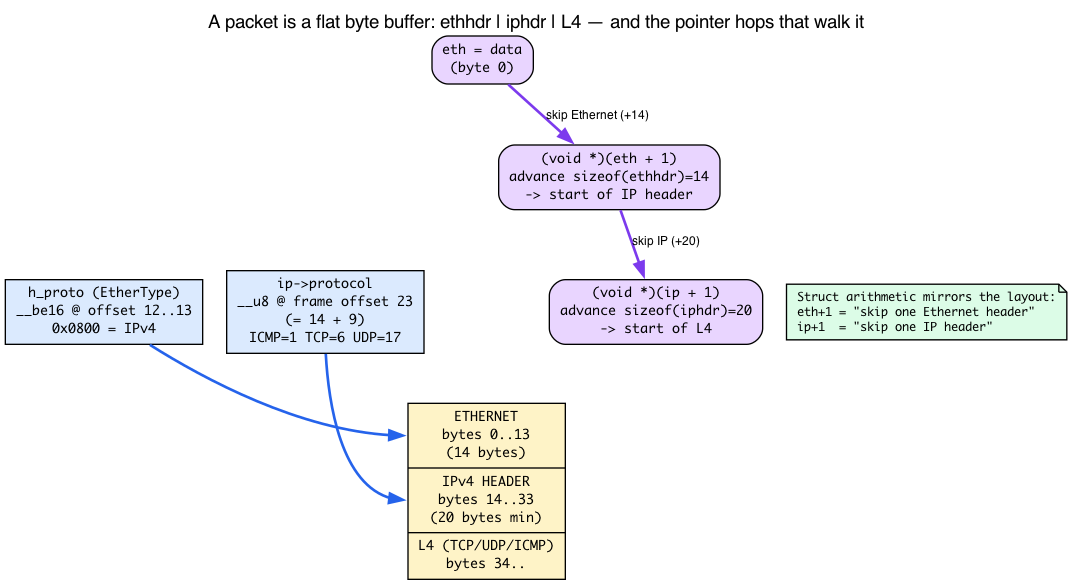
The Ethernet header — exactly 14 bytes
The frame starts with struct ethhdr, and it is one of the simplest structs in the kernel — three fields, and __packed so the compiler inserts no padding (include/uapi/linux/if_ether.h:177):
/* include/uapi/linux/if_ether.h:177 */
struct ethhdr {
    unsigned char h_dest[ETH_ALEN];   /* destination MAC — 6 bytes, offset 0  */
    unsigned char h_source[ETH_ALEN]; /* source MAC      — 6 bytes, offset 6  */
    __be16        h_proto;            /* EtherType       — 2 bytes, offset 12 */
} __attribute__((packed));
ETH_ALEN is 6, so 6 + 6 + 2 = 14 bytes — which is exactly the named constant ETH_HLEN == 14 (if_ether.h:34). The last field, h_proto, is the EtherType: it tells you what header comes next. The value we care about is ETH_P_IP == 0x0800 (if_ether.h:52), meaning “an IPv4 packet follows.” That’s the check the program makes first: is this even an IP packet?
The IPv4 header — and where protocol lives
If the EtherType says IP, the bytes at offset 14 are struct iphdr (include/uapi/linux/ip.h:87):
/* include/uapi/linux/ip.h:87 */
struct iphdr {
    __u8    ihl:4,        /* header length in 32-bit words — first byte... */
            version:4;    /* ...packed with version (little-endian layout) */
    __u8    tos;          /* offset 1 */
    __be16  tot_len;      /* offset 2 */
    __be16  id;           /* offset 4 */
    __be16  frag_off;     /* offset 6 */
    __u8    ttl;          /* offset 8 */
    __u8    protocol;     /* offset 9  ← the field we read (ip.h:102) */
    __sum16 check;
    /* ... saddr, daddr ... */
};
Two things to notice. First, the very first byte packs version:4 and ihl:4 together — which means the IP header length is variable: ihl counts 32-bit words, so the header is ihl * 4 bytes, minimum 20. (For our counting program we don’t need to parse options, so we treat it as the fixed 20-byte minimum.)
Second, and this is the number the whole lab hinges on: protocol is a single __u8 at byte offset 9 of the IP header (ip.h:102). Walk it: version/ihl (1) + tos (1) + tot_len (2) + id (2) + frag_off (2) + ttl (1) = 9 bytes before it. This one byte is the key the map is indexed by: ICMP = 1, TCP = 6, UDP = 17.
Pointer arithmetic mirrors the layout
The code never computes these offsets by hand — it lets C pointer arithmetic do it. Watch how the casts walk the buffer:
struct ethhdr *eth = data;—ethpoints at byte 0.(void *)(eth + 1)— advancing astruct ethhdr *by one whole struct moves the pointersizeof(struct ethhdr) == 14bytes forward. That lands exactly on the start of the IP header.(void *)(ip + 1)— advancing astruct iphdr *by one moves past the (fixed-size) IP header to the start of L4.
So eth + 1 is “skip the Ethernet header” and ip + 1 is “skip the IP header,” expressed as struct arithmetic. This is also the secret decoder ring for Break 1’s off=23: the IP header’s protocol sits at frame offset 14 (one Ethernet header) + 9 (offset inside the IP header) = 23.
That’s all the wire format we need today — just byte offsets. The full kernel RX/stack treatment lives in the companion linux-net book; here we only borrow the layout.
Network byte order: why bpf_htons wraps some values and not others
There’s a trap hiding in h_proto. Look at the struct ethhdr again: h_proto is typed __be16, not __u16. The __be prefix is the kernel’s machine-checkable way of saying “this field is big-endian” — and it is not decoration. Every multi-byte protocol field on the wire is big-endian (most-significant byte first): EtherTypes, IP tot_len, TCP/UDP ports, IP id. You can read it straight off the struct types — __be16 h_proto, __be16 tot_len, __be32 saddr — every __be* is the kernel telling you “big-endian.”
x86 is little-endian. So when you write the constant ETH_P_IP (0x0800) in your C program, the compiler stores it in memory the x86 way — low byte first, as 00 08. But the wire delivered those two bytes as 08 00. If you compared the raw 16-bit field against the raw constant, you’d be comparing 08 00 against 00 08 — they’d never match, silently, and your program would think no packet is ever IP.
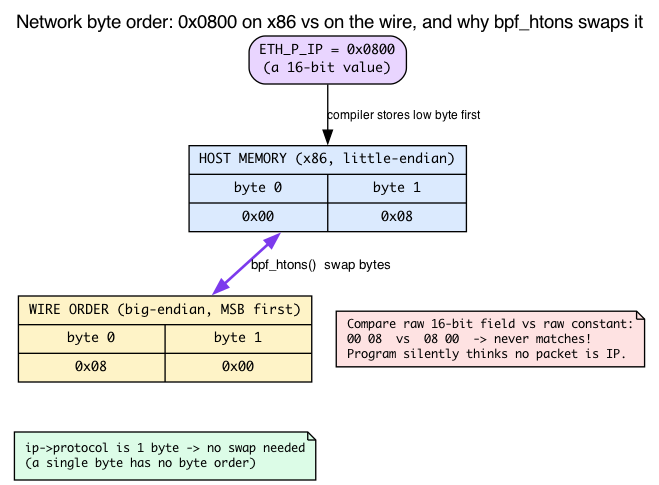
bpf_htons() (“host to network, short”) performs that byte swap, converting your host-order constant into wire order so the comparison is correct. That’s why the program reads:
if (eth->h_proto != bpf_htons(ETH_P_IP))   /* swap the constant to wire order */
    return XDP_PASS;
The portable versions live in #include <bpf/bpf_endian.h>, which is why the program pulls that header in.
The rule of thumb: convert whenever the field is 2 or more bytes — h_proto, tcp->dest, ip->tot_len. A single byte has no byte order at all (there’s nothing to swap), so ip->protocol is read raw. That is exactly why the program wraps ETH_P_IP but reads ip->protocol directly — and why Break 4’s tcp->dest (a __be16 port) would need bpf_ntohs if you wanted to print it as a host number. The direction is symmetric: bpf_htons (host→wire) for constants you compare against, bpf_ntohs (wire→host) when you pull a wire value out to use as a number.
The XDP context: struct xdp_md
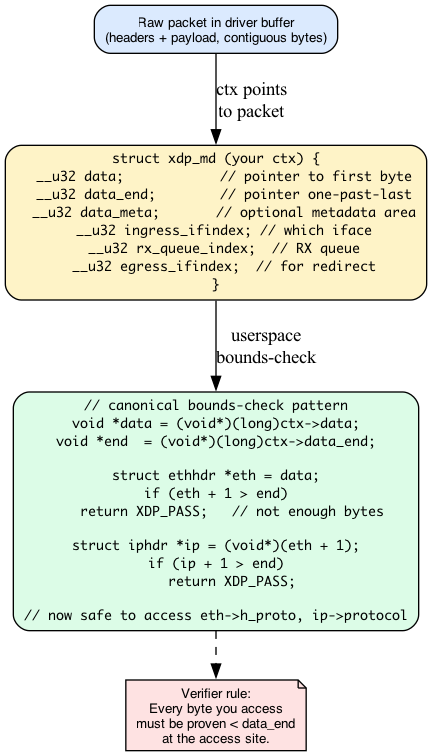
You receive struct xdp_md *ctx. The two fields you’ll touch on every program (include/uapi/linux/bpf.h:6560-6561):
ctx->data— pointer (cast from u32) to the first packet byte.ctx->data_end— pointer one-past-the-last byte.
Other fields:
ingress_ifindex— which interface the packet arrived on.rx_queue_index— which NIC RX queue.data_meta— optional metadata area (Day 18, AF_XDP).egress_ifindex— only readable in devmap-egress XDP programs (expected_attach_type == BPF_XDP_DEVMAP); the Verifier rejects access from a plainSEC("xdp")program (seexdp_is_valid_accessinnet/core/filter.c).
data / data_end: the packet-pointer model
Here is the part that 13 days of tracing never prepared you for. ctx->data and ctx->data_end are a matched pair of packet pointers:
datais aPTR_TO_PACKET— the start of the readable window.data_endis aPTR_TO_PACKET_END— one byte past the last readable byte.
They are runtime values. The verifier does not know the packet’s length when it checks your program at load time — a 64-byte ARP and a 1500-byte TCP segment both arrive through the same code. So the verifier can’t just trust you to read 34 bytes; it has no idea whether 34 bytes are even present.
What the verifier does do is track a proven-safe range on the packet pointer. Initially that range is zero bytes — the verifier will reject any dereference of data, because nothing has proven a single byte is in-bounds. You enlarge the range with a comparison against data_end:
struct ethhdr *eth = data;
if (eth + 1 > end)            /* "are the 14 bytes of an ethhdr present?" */
    return XDP_PASS;          /* not enough bytes — bail out */
/* fall-through branch: verifier now KNOWS 14 bytes from data are safe */
Writing if (eth + 1 > end) return XDP_PASS; and continuing on the false branch teaches the verifier “sizeof(ethhdr) bytes from data are in-bounds.” Only then may you read eth->h_proto. This is the mechanism Day 4 named in one line (find_good_pkt_pointers, the range-narrowing routine at kernel/bpf/verifier.c:15422, triggered by exactly this x + 1 > end compare). Today you use it for real.
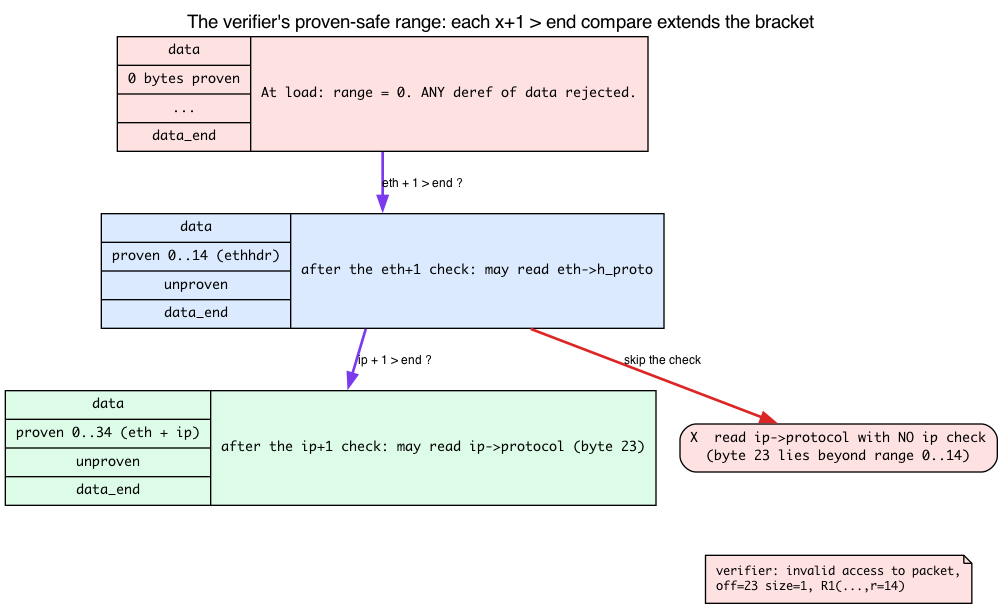
Each layer needs its own check. A compare only extends the proven range up to the pointer being tested. After the eth check, the IP bytes are still unproven — you must re-test ip + 1 > end before touching ip->protocol:
void *data = (void *)(long)ctx->data;
void *end  = (void *)(long)ctx->data_end;
struct ethhdr *eth = data;
if (eth + 1 > end)
    return XDP_PASS;        /* skip — not enough bytes for an Ethernet header */
The pattern repeats for each header layer. ip + 1 > end for IP, tcp + 1 > end for TCP, etc. Skip a layer’s check and the verifier prints invalid access to packet (the verbose() call at kernel/bpf/verifier.c:4433) — which is exactly what Break 1 and Break 4 produce. Bounds checking is not optional, and now you know precisely why: without the compare, the proven range never grows past the last pointer you tested, and the access falls outside it.
XDP actions

Five constants you can return:
XDP_PASS— continue to the kernel stack (allocate skb, hand off).XDP_DROP— free the packet now. Doesn’t touch skb path.XDP_TX— send the (possibly modified) packet back out the same interface. DDoS-mitigation classic.XDP_REDIRECT— paired withbpf_redirect_map(...), send to a different interface, a different CPU (cpumap), or an AF_XDP socket.XDP_ABORTED— error path. Equivalent to DROP plus a tracepoint fires (so you can find bugs).
There are no Dumb Questions
Q: Why isn’t every packet path written as XDP?
A: Because XDP runs before the kernel knows much. There’s no socket lookup, no routing decision, no connection state. For most stacks you want skb-level processing (or higher) to use the kernel’s accumulated knowledge. XDP is for cases where speed beats sophistication: DDoS drop, load balancing, L2/L3 forwarding for known patterns.
Q: Are there modes of XDP?
A: Yes. Native XDP runs in the driver as described — fastest. Generic XDP (
XDP_FLAGS_SKB_MODE) runs much later — up in the stack’s receive path (do_xdp_genericfrom__netif_receive_skb_core), after a fullsk_buffhas already been allocated, wrapping anxdp_buffaround that existing skb. Works on any driver but is slower precisely because you have already paid the skb-allocation cost XDP is meant to skip (roughly half the speed of native). Offloaded XDP runs on the NIC itself for hardware that supports it — in mainline v7.1 that is essentially only the Netronome NFP (Agilio) SmartNIC, the lone non-test driver implementingXDP_SETUP_PROG_HW; the program is JITed to NIC firmware. Mellanox/mlx5 NICs run native driver-mode XDP, not firmware offload. Native is the default and what we’ll use.Q: How do I attach safely without crashing my SSH session?
A: Test on a
vethpair, not your real NIC. We’ll do that in the lab.
Sharpen your pencil
You write an XDP program that counts packets and returns
XDP_PASS. Compared to the same logic written as a tc-bpf ingress program, which is faster?.
.
.Answer: XDP, by roughly the skb-build cost (hundreds of ns) per packet. The tc-bpf path runs after skb allocation; XDP runs before. For pure observability that doesn’t modify the packet, XDP wins. For complex forwarding decisions that benefit from skb metadata, tc may be the right choice — Day 17.
The lab
Setup: a veth pair to play with — and why the namespace matters
Before the script, two concepts you’ve never met (13 days of tracing never ran ip netns):
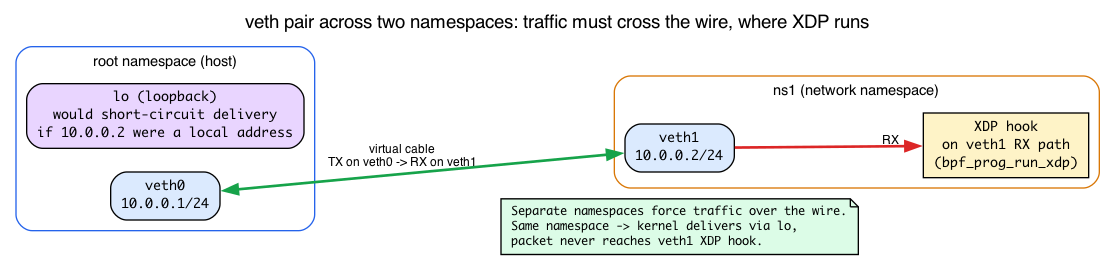
A veth (virtual Ethernet) device is always created as a connected pair. Think of it as a patch cable: a frame transmitted on veth0 appears on the RX path of veth1, and vice-versa. That RX path is what runs the XDP hook — which is the whole reason veth is the safe place to test XDP. (On v7.1 the veth driver runs XDP through the standard bpf_prog_run_xdp entry at drivers/net/veth.c:657/:819 — the same inline a physical NIC uses, so what you test here behaves like the real thing.)
A network namespace is an isolated copy of the kernel’s entire network stack — its own interfaces, routing table, and addresses. Moving veth1 into ns1 puts the two ends of the cable in different stacks. ip netns exec ns1 <cmd> runs a command inside that namespace, which is why we’ll launch the loader with ip netns exec ns1 ./xdp_count veth1. veth is a faithful test bed for XDP program semantics (identical data/data_end, actions, and verifier behavior) — though note that on veth the peer already received an sk_buff, which veth_convert_skb_to_xdp_buff wraps into an xdp_buff before XDP runs, so the veth lab is not where you measure the native-NIC skb-allocation savings.
sudo ip netns add ns1
sudo ip link add veth0 type veth peer name veth1
sudo ip link set veth1 netns ns1
sudo ip addr add 10.0.0.1/24 dev veth0
sudo ip link set veth0 up
sudo ip netns exec ns1 ip addr add 10.0.0.2/24 dev veth1
sudo ip netns exec ns1 ip link set veth1 up
veth1 lives in its own namespace, ns1, and this matters: if both ends shared the root namespace, 10.0.0.2 would be a local address, and the kernel would short-circuit ping 10.0.0.2 through lo — the packet would never leave veth0, and XDP on veth1 would never fire. Putting veth1 in ns1 forces traffic to cross the wire. We attach our program to veth1 inside ns1; pinging 10.0.0.2 from the host sends echo requests out veth0, across the link into veth1’s RX path, where XDP runs.
xdp_count.bpf.c
Included from the source the lab build and CI compile:
#include “vmlinux.h” #include <bpf/bpf_helpers.h> #include <bpf/bpf_endian.h>
/* vmlinux.h carries kernel types and enums but not UAPI #define macros like
- ETH_P_IP, and <linux/if_ether.h> can’t be mixed with vmlinux.h (it
- redefines struct ethhdr). So define the one EtherType we compare against
- locally, the way the kernel’s own BPF selftests do. */ #define ETH_P_IP 0x0800
char LICENSE[] SEC(“license”) = “GPL”;
struct { __uint(type, BPF_MAP_TYPE_PERCPU_ARRAY); __uint(max_entries, 256); /* indexed by IP protocol number */ __type(key, __u32); __type(value, __u64); } counts SEC(“.maps”);
SEC(“xdp”) int xdp_count(struct xdp_md *ctx) { void *data = (void *)(long)ctx->data; void *end = (void *)(long)ctx->data_end;
struct ethhdr *eth = data;
if (eth + 1 > end)
    return XDP_PASS;

if (eth->h_proto != bpf_htons(ETH_P_IP))
    return XDP_PASS;

struct iphdr *ip = (void *)(eth + 1);
if (ip + 1 > end)
    return XDP_PASS;

__u32 key = ip->protocol;          /* TCP=6, UDP=17, ICMP=1 */
__u64 *c = bpf_map_lookup_elem(&counts, &key);
if (c)
    (*c)++;                        /* per-CPU; no atomic needed */

return XDP_PASS;
}
What’s new — and you now have the background for every line:
SEC("xdp")— XDP attach. Userspace specifies the interface.#include <bpf/bpf_endian.h>— forbpf_htons. Theh_protocompare swaps the host constantETH_P_IPto wire order;ip->protocolis one byte, so it’s read raw. (See “Network byte order” above.)- The two
eth + 1 > end/ip + 1 > endlines are the proven-range idiom from thedata/data_endsection — each extends the verified window by one header so the next field read is legal. - The casts
(void *)(eth + 1)/ pastipwalk the byte layout: 14 bytes to the IP header, then into L4. (See “A packet is just bytes” above.) BPF_MAP_TYPE_PERCPU_ARRAY— each CPU gets its own value slot (recall the per-CPU map from Day 2). No atomic needed for increment because no two CPUs share a slot. Userspace must sum across CPUs to get a total.- The bounds check pattern is the XDP idiom. Everyone writes it.
xdp_count.c — userspace
Included from the loader the lab build and CI compile:
#include <errno.h> #include <net/if.h> #include <signal.h> #include <stdio.h> #include <string.h> #include <unistd.h>
#include <bpf/bpf.h> #include <bpf/libbpf.h>
#include “xdp_count.skel.h”
static volatile sig_atomic_t exiting;
static void handle_signal(int signal_number) { (void)signal_number; exiting = 1; }
static int install_signal_handlers(void) { const struct sigaction action = { .sa_handler = handle_signal, };
if (sigaction(SIGINT, &action, NULL) != 0 ||
    sigaction(SIGTERM, &action, NULL) != 0) {
    fprintf(stderr, "failed to install signal handlers: %s\n",
            strerror(errno));
    return -errno;
}

return 0;
}
int main(int argc, char **argv) { struct xdp_count_bpf *skel = NULL; struct bpf_link *link = NULL; unsigned int ifindex; int ncpu; int err;
setvbuf(stdout, NULL, _IOLBF, 0);

if (argc < 2) {
    fprintf(stderr, "usage: %s <iface>\n", argv[0]);
    return 1;
}
ifindex = if_nametoindex(argv[1]);
if (!ifindex) {
    fprintf(stderr, "if_nametoindex(%s): %s\n", argv[1], strerror(errno));
    return 1;
}

err = install_signal_handlers();
if (err)
    return 1;

skel = xdp_count_bpf__open_and_load();
if (!skel) {
    fprintf(stderr, "failed to open and load xdp_count BPF skeleton\n");
    return 1;
}

link = bpf_program__attach_xdp(skel->progs.xdp_count, ifindex);
if (!link) {
    err = -errno;
    fprintf(stderr, "failed to attach XDP program to ifindex %u: %s\n",
            ifindex, strerror(errno));
    goto cleanup;
}

ncpu = libbpf_num_possible_cpus();
if (ncpu <= 0) {
    fprintf(stderr, "libbpf_num_possible_cpus failed\n");
    err = 1;
    goto cleanup;
}

printf("Counting packets per IP protocol on %s; press Ctrl-C to stop.\n",
       argv[1]);
while (!exiting) {
    int fd;

    if (sleep(2) != 0)
        continue;

    fd = bpf_map__fd(skel->maps.counts);
    for (__u32 k = 0; k < 256; k++) {
        __u64 vals[ncpu];

        if (bpf_map_lookup_elem(fd, &k, vals) == 0) {
            __u64 sum = 0;

            for (int i = 0; i < ncpu; i++)
                sum += vals[i];
            if (sum)
                printf("proto %3u: %llu\n", k, sum);
        }
    }
    printf("---\n");
}

err = 0;
cleanup: bpf_link__destroy(link); xdp_count_bpf__destroy(skel); return err != 0; }
Run
make
sudo ip netns exec ns1 ./xdp_count veth1 &
# From the host (root namespace):
ping -c 5 10.0.0.2
nc -u 10.0.0.2 9999 <<< "hello"
Expected output every 2 seconds:
proto   1: 5      # ICMP
proto  17: 1      # UDP
---
You’re now counting every packet that hits veth1. Now redirect this same program at a real NIC (eno1 or whatever) and you’ve got line-rate counters with effectively zero overhead.
Cleanup
sudo kill %1                 # stop the loader; closing its bpf_link fd auto-detaches the XDP program
sudo ip link del veth0       # deletes the pair (veth1 goes with it)
sudo ip netns del ns1        # remove the namespace
The XDP program stays attached only as long as the loader runs — the link is never pinned, so bpf_link__destroy (or simply the process exiting) detaches it. If you stopped the loader some other way and the program is still attached, detach it explicitly with sudo ip netns exec ns1 ip link set dev veth1 xdp off.
What to break, in order
Break 1 — Drop the bounds check
struct iphdr *ip = (void *)(eth + 1);
__u32 key = ip->protocol;     /* no bounds check */
Verifier rejects at load time. libbpf prints the log to stderr when xdp_count_bpf__open_and_load() fails (the if (!skel) return 1; path — the userspace program prints nothing of its own):
invalid access to packet, off=23 size=1, R1(id=N,off=23,r=14)
off=23 because protocol sits 9 bytes into the IP header and the IP header starts 14 bytes (one Ethernet header) into the frame; only those first 14 bytes were bounds-checked (r=14). The Verifier’s per-byte tracking doesn’t know the byte at eth+1+offsetof(protocol) is reachable. The exact wording and offsets are kernel- and clang-version dependent.
(This is the data/data_end proven-range model made concrete: the eth + 1 > end check extended the range to 14, you then deleted the ip + 1 > end check, so the range never reached byte 23 — and the access falls outside the bracket.)
Break 2 — Pre-bound the index, then atomic
Switch from per-CPU to a regular hash:
__uint(type, BPF_MAP_TYPE_HASH);
A PERCPU_ARRAY pre-allocates all 256 indices, so bpf_map_lookup_elem(&counts, &key) always returns a (zeroed) slot. A HASH map starts empty — the lookup returns NULL for every protocol it hasn’t seen yet, so if (c) ... never fires and the counter stays at zero. You have to create the entry on first sight, and because a shared (not per-CPU) map can be touched by several CPUs at once, the increment now needs an atomic:
__u64 *c = bpf_map_lookup_elem(&counts, &key);
if (c) {
    __sync_fetch_and_add(c, 1);          /* shared map: atomic now required */
} else {
    __u64 one = 1;
    bpf_map_update_elem(&counts, &key, &one, BPF_NOEXIST);  /* create on first sight */
}
(The first concurrent update for a brand-new key can still race on a non-preallocated hash; BPF_NOEXIST plus the atomic add on the existing-entry path is the standard mitigation.)
The throughput lesson — a shared hash contends on a per-bucket lock where the per-CPU array does not — is not observable on this veth: a 5-packet ping over a single-queue virtual link generates no contention. To see it you need a real multi-queue NIC and parallel load that spreads RX across CPUs (e.g. iperf3 -u -P 16 to a peer, or pktgen across queues), then sudo perf top -e cycles -g. With the hash you’ll see time in queued_spin_lock_slowpath/_raw_spin_lock under htab_map_update_elem/bpf_map_lookup_elem; with the per-CPU array those frames are absent. (Note: the hardware cycles event needs a real PMU — bare metal or a PMU-enabled host. Many cloud VMs expose no hardware PMU and -e cycles errors out; fall back to the software event sudo perf top -e task-clock -g, and expect the lock-contention frames to be clearest on physical hardware.)
Break 3 — Return XDP_DROP instead of XDP_PASS
Change the return to XDP_DROP, then rebuild and re-attach — editing the program does nothing until you reload it:
make
sudo ip netns exec ns1 ./xdp_count veth1 &
ping -c 5 10.0.0.2
The ping now reports 100% packet loss (0 received): the echo requests cross the wire, hit veth1’s RX inside ns1, and XDP drops them before they reach the IP stack, so no replies come back. SSH into your box still works (it’s on a different interface). Lesson: XDP is the literal first hop. Be careful which iface you attach to. (This break is invisible without the namespace separation from the setup above — a same-namespace 10.0.0.2 is delivered locally over lo and never reaches veth1’s XDP hook.)
Break 4 — Forget a per-layer bounds check
struct iphdr *ip = (void *)(eth + 1);
if (ip + 1 > end) return XDP_PASS;
struct tcphdr *tcp = (void *)(ip + 1);
if (tcp + 1 > end) return XDP_PASS;
__u16 dport = tcp->dest;
As written this compiles and loads — every layer is bounds-checked. Now delete the if (tcp + 1 > end) return XDP_PASS; line and rebuild. The Verifier rejects the load with the same invalid access to packet error, this time pointing at the tcp->dest read: each header layer needs its own check, and Break 1’s lesson generalizes from one header to a multi-layer chain. (And note tcp->dest is a __be16 port — if you wanted to print it you’d wrap it in bpf_ntohs, just like the h_proto compare wrapped ETH_P_IP.)
What to read in the kernel
include/net/xdp.h—bpf_prog_run_xdp, the inline that drivers call to run an XDP program.include/uapi/linux/bpf.h—struct xdp_mdandenum xdp_action(the action constants).net/core/dev.c— searchxdp_buff; the driver-side dispatch path.net/core/filter.c— XDP helpers (xdp_func_prototable). Note which helpers are XDP-only.tools/testing/selftests/bpf/progs/test_xdp_*— many examples of common patterns.Documentation/networking/af_xdp.rst— the AF_XDP socket family (Day 18). Upstream has no top-levelxdp.rstat v7.1; for general XDP background lean on theDocumentation/bpf/BPF docs.Documentation/networking/xdp-rx-metadata.rst— XDP RX metadata (hints the driver can hand to your program).
Bullet Points
- XDP runs in the driver’s NAPI poll, before skb allocation. Fastest place to drop, redirect, or count. (Skips the
sk_buffbuild cost — the two-allocation descriptor+data model from linux-net Day 1.) - A packet is a flat byte buffer:
[ethhdr 14B][iphdr ≥20B][L4].eth->h_proto == ETH_P_IP(0x0800) selects IPv4;ip->protocol(byte 9 of the IP header, frame offset 23) is ICMP=1/TCP=6/UDP=17.(eth+1)/(ip+1)step exactly one header. - Network byte order is big-endian. Wrap multi-byte constants in
bpf_htons(and read wire values withbpf_ntohs); a 1-byte field likeip->protocolneeds no swap. struct xdp_md:data,data_end,ingress_ifindex,rx_queue_index,data_meta,egress_ifindex.- Bounds checks are mandatory:
data/data_endare runtime packet pointers; ax + 1 > endcompare extends the verifier’s proven-safe range. Each header layer needs its own check before you read its fields. - Actions: PASS, DROP, TX, REDIRECT, ABORTED.
BPF_MAP_TYPE_PERCPU_ARRAYfor hot-path counters — no contention, sum in userspace.- A
vethpair is a virtual cable (TX on one end → RX on the other, where XDP runs); a network namespace is an isolated stack. Both ends in separate namespaces forces traffic across the wire instead of short-circuiting throughlo. - Test with
vethpairs before attaching to real interfaces.
Check question
You attach an XDP program that always returns XDP_PASS. Why might it still affect performance compared to no program at all?
Click to reveal answer
Answer: Two reasons. (1) Native XDP requires the driver to call into the BPF program for every packet — that’s a function call (~10-30 ns) plus your logic. Even an empty program has measurable cost at line rate. (2) Some drivers disable certain optimizations (large receive offload, GRO) when XDP is attached, because XDP needs to see one packet at a time, not coalesced bursts. So even a passthrough XDP can reduce throughput by ~10% on workloads dependent on those features. For tracing/observability, this is fine; just be aware before deploying on a production load-balancer NIC.
Tomorrow
Day 15: turn the counter into a denylist with BPF_MAP_TYPE_LPM_TRIE and userspace-controlled rules. Drop traffic from specific CIDRs at line rate.