Day 15 — XDP firewall: drop CIDRs at line rate
Today’s mission: turn yesterday’s counter into a userspace-controlled denylist that drops traffic from configurable IPv4 prefixes. Along the way, learn three things the lab quietly depends on: how a BPF map can outlive and be shared beyond the process that created it (pinning + bpffs), the exact byte layout the kernel demands of an LPM key and why, and what the trie actually allocates under the hood so the per-entry memory cost (a leaf node plus manufactured branch nodes) stops being a hand-wave. Total time: ~110 minutes.
The wrong way and the right way
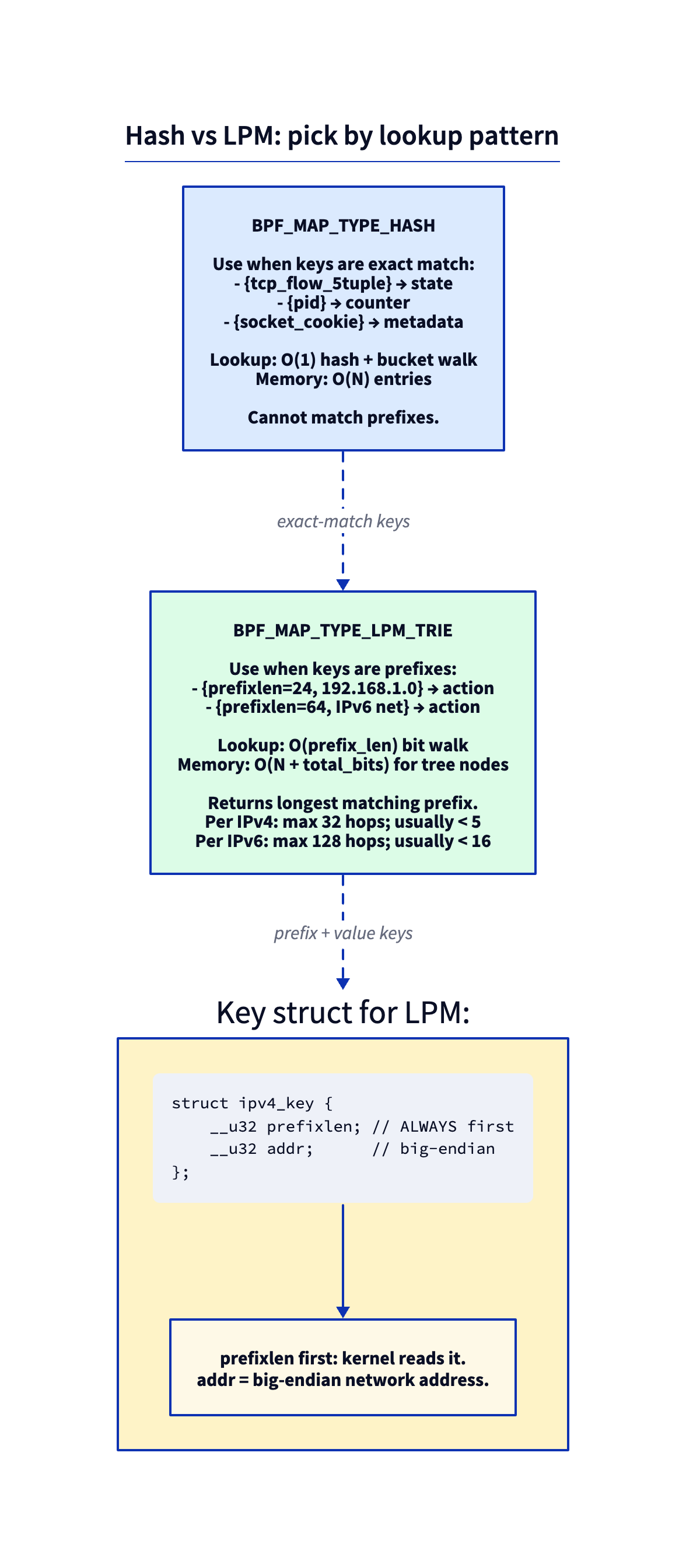
To drop traffic from 10.1.2.0/24, you could shove all 256 IPs into a hash map (the BPF_MAP_TYPE_HASH from Day 2). That works but doesn’t scale to 10.0.0.0/8 (16 million entries) and definitely doesn’t scale to IPv6 (…you’re not enumerating /64 prefixes).
You want prefix matching. The map type for that is BPF_MAP_TYPE_LPM_TRIE.
The LPM trie
A bit-by-bit prefix tree. Insert 10.0.0.0/8, then 10.1.0.0/16, then 10.1.2.0/24, and the trie holds them at the right depths.
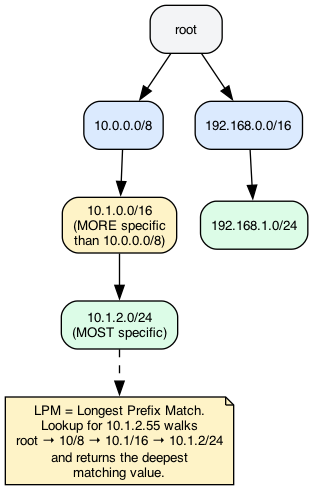
A lookup with key 10.1.2.55 walks:
- Root.
- Match the first 8 bits (10.x.x.x) →
10.0.0.0/8node. - Match next 8 bits (10.1.x.x) →
10.1.0.0/16node. - Match next 8 bits (10.1.2.x) →
10.1.2.0/24node. - No deeper match → return value at
10.1.2.0/24.
That’s Longest Prefix Match (LPM) — the same algorithm IP routing uses. Lookup cost is O(prefix length): max 32 hops for IPv4, ~128 for IPv6, but in practice much less.
What’s actually in the tree: intermediate nodes
That clean root→/8→/16→/24 walk is a simplification, and the simplification is exactly what hides the trie’s real memory cost. Here is the part no tutorial shows you.
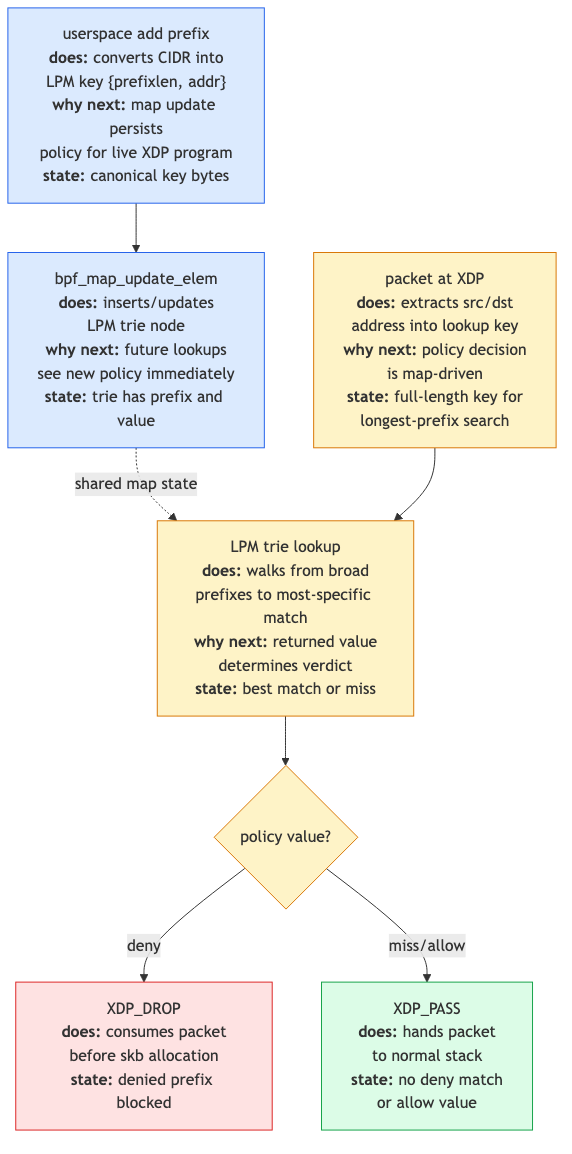
Suppose you store two prefixes that diverge mid-byte — say 10.1.0.0/16 and 10.2.0.0/16. In binary, 10.1 and 10.2 agree for the first 14 bits and split at bit 14. There is no stored prefix at that 14-bit branch point, but the tree still needs a fork there. So the kernel manufactures one: an intermediate (IM) node at the divergence point, with the two real /16 leaves as its children.
/* kernel/bpf/lpm_trie.c:22 */
#define LPM_TREE_NODE_FLAG_IM BIT(0)
The IM node is a genuine allocation — it occupies kernel memory — but it holds no user value. It exists purely to give the two real prefixes a common parent. That is the “multiple internal nodes per leaf” the Dumb-Question answer cites, and it’s why each stored prefix costs more than just sizeof(value): the kernel allocates every node — leaf or branch — at leaf_size = sizeof(struct lpm_trie_node) + data_size + value_size (kernel/bpf/lpm_trie.c:601-602). The header (struct lpm_trie_node) is child[2] (16 bytes) + prefixlen (4) + flags (4) = 24 bytes, so for this lab’s IPv4 map (data_size=4, value_size=4) a node is 24+4+4 = 32 bytes. You pay for the leaf and each branch node that routes to it — tens of bytes per stored prefix, not hundreds. trie_update_elem allocates the IM node at the split point:
/* kernel/bpf/lpm_trie.c:423-444 — insert a branch node at the divergence point */
im_node = lpm_trie_node_alloc(trie, NULL);
...
im_node->prefixlen = matchlen;
im_node->flags |= LPM_TREE_NODE_FLAG_IM;     /* no value; pure branch */
...
rcu_assign_pointer(*slot, im_node);
Two consequences make this worth knowing:
-
Lookup skips IM nodes as match candidates. The walk descends through an IM node but only “remembers” it as a result if it is a real node. The source records the found node only when the IM flag is clear:
/* kernel/bpf/lpm_trie.c:271-275, inside trie_lookup_elem */
/* Consider this node as return candidate unless it is an
 * artificially added intermediate one. */
if (!(node->flags & LPM_TREE_NODE_FLAG_IM))
    found = node;
So “longest prefix match” is literally “the last non-intermediate node the walk passed through.” That’s the mechanism behind the hand-wavy walk above.
-
IM nodes get promoted, not leaked. If you later insert a prefix exactly at an IM node’s branch point, that branch position becomes a real node instead of leaking. The mechanics are copy-and-replace, not in-place flag-clearing:
trie_update_elemalways allocates a freshnew_nodeup front (lpm_trie.c:341), and when the update lands on an existing IM node (node->prefixlen == matchlenwith the IM flag still set), the new real node inherits the IM node’s two children, is swapped into the slot viarcu_assign_pointer, and the old IM node is then freed (lpm_trie.c:387-406). So the kernel doesn’t keep the same node object and clear its flag — it replaces the node while reusing its place in the tree. The source comment uses a192.168.0.0/23example and calls this “turned into a ‘real’ node on demand” / the IM node being “re-used” (lpm_trie.c:142), where “re-used” means the branch point, not the allocation.
The lookup also has two early exits worth one sentence, because they’re what make the O(prefix_len) cost concrete. If a node matches the full key width it returns immediately (exact match), and if fewer bits match than the node’s own prefix length, it stops and returns the last real node seen:
/* kernel/bpf/lpm_trie.c:259-262 — exact match: stop now */
if (matchlen == trie->max_prefixlen) {
    found = node;
    break;
}
/* ... matchlen < node->prefixlen ⇒ bail, return last seen */
One last detail that ties back to byte order: the walk reads the key MSB-first — bit 0 is the top bit of byte 0.
/* kernel/bpf/lpm_trie.c:154 */
static inline int extract_bit(const u8 *data, size_t index)
{
    return !!(data[index / 8] & (1 << (7 - (index % 8))));
}
That is why the address must be stored in network (big-endian) byte order: the trie walks bits from the wire’s most-significant end, so the bytes have to be in wire order for “the first 8 bits” to actually mean “the first octet.”
The key struct: what the kernel really demands, and why
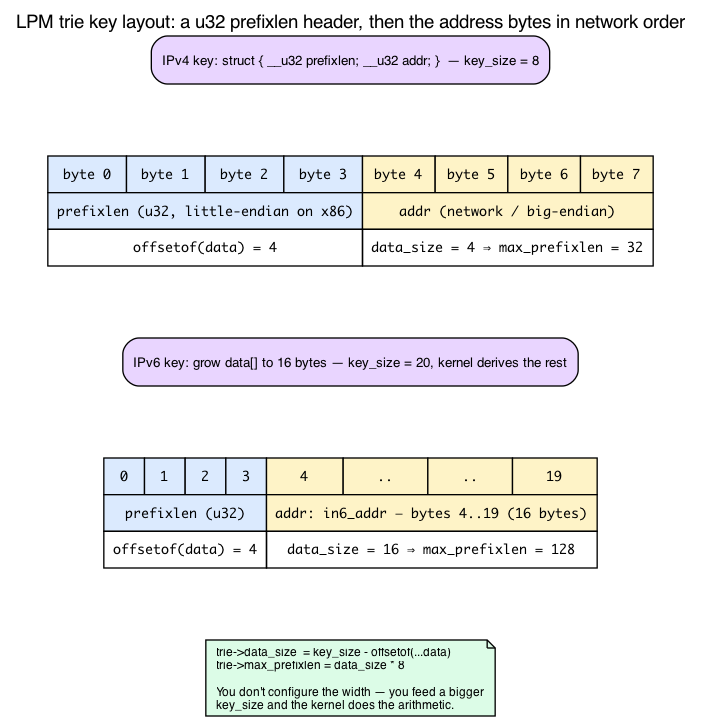
LPM trie keys must start with a prefixlen field, then the address bytes:
struct ipv4_lpm_key {
    __u32 prefixlen;   /* always first */
    __u32 addr;        /* network byte order */
};
That’s the convention every example repeats. But it’s not arbitrary — your hand-rolled struct is mirroring a real UAPI type, and the kernel enforces the layout with a compile-time assertion. The canonical key is:
/* include/uapi/linux/bpf.h:103-109 */
struct bpf_lpm_trie_key_u8 {
    union {
        struct bpf_lpm_trie_key_hdr hdr;
        __u32                       prefixlen;
    };
    __u8 data[];     /* Arbitrary size */
};
(data[] is the address bytes.) A 4-byte prefixlen header followed by a flexible array of address bytes. Your { prefixlen; addr; } is exactly that header plus a 4-byte data[] payload. Three facts fall out of this struct, and each grounds a rule the chapter otherwise asks you to memorize:
-
prefixlenmust be first, and the address must be u32-aligned. The kernel doesn’t trust you — itBUILD_BUG_ONs the offset of the data array:/* kernel/bpf/lpm_trie.c:176 */ BUILD_BUG_ON(offsetof(struct bpf_lpm_trie_key_u8, data) % sizeof(u32));The address bytes therefore land at offset 4. That’s not a coincidence you have to remember; it’s a build-time invariant of the layout.
-
The address width is derived, not hard-coded. The kernel computes how many address bytes there are by subtracting the header size from your declared
key_size, then sets the max prefix length to that many bits:/* kernel/bpf/lpm_trie.c:594-596, in trie_alloc */ trie->data_size = attr->key_size - offsetof(struct bpf_lpm_trie_key_u8, data); trie->max_prefixlen = trie->data_size * 8;A 4-byte
addr⇒data_size = 4⇒max_prefixlen = 32. Enlarge the struct to hold a 16-bytein6_addr⇒data_size = 16⇒max_prefixlen = 128. This is the whole reason the IPv6 variant in Break 4 “just works” by growing the struct — you’re not configuring anything, you’re feeding the kernel a biggerkey_sizeand it does the arithmetic. -
The lookup key uses
prefixlen = 32— “this is an exact host address; match it against any stored prefix.” The kernel rejects a key whoseprefixlenexceeds the trie’s max up front:/* kernel/bpf/lpm_trie.c:244-245, in trie_lookup_elem */ if (key->prefixlen > trie->max_prefixlen) return NULL;
So { .prefixlen = 16, .addr = 0x0a010000 } means “10.1.0.0/16” — only the top 16 bits of addr matter — and { .prefixlen = 32, .addr = <packet saddr> } means “look up this exact source IP and give me the longest stored prefix that covers it.”
Sharing one trie between two processes: pinning and bpffs
Here is something genuinely new today. Every chapter so far (Days 1–14) loaded a skeleton, kept the map’s file descriptor inside one process, and let everything vanish when that process exited. Day 14’s counter disappears the moment the loader dies. Today’s lab has two separate programs — a loader that attaches the XDP program, and a CLI that mutates the denylist — and they must operate on the same trie. That requires a mechanism we haven’t needed until now: pinning.
A map is a kernel object behind a file descriptor
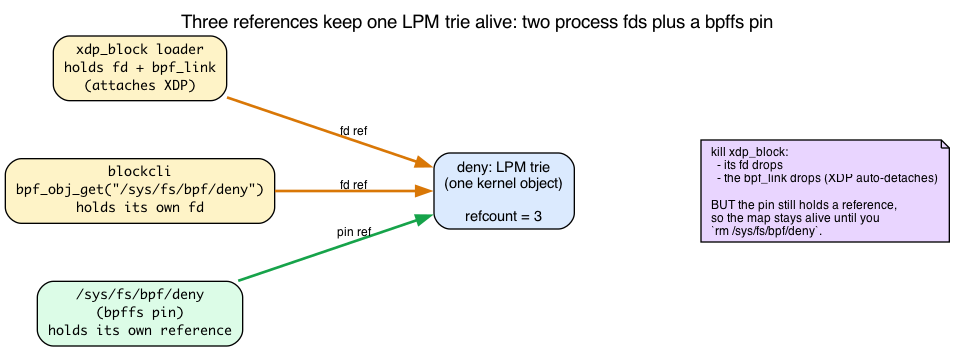
Recall from Day 2 that userspace never holds a kernel pointer to a map — it holds an integer file descriptor, a handle to a kernel object. The same is true of programs and links. And like any fd-referenced kernel object, a BPF map is reference-counted: the kernel keeps it alive as long as at least one fd refers to it, and frees it when the last fd closes. The UAPI header says so directly:
/* include/uapi/linux/bpf.h:951 */
* An eBPF object is deallocated only after all file descriptors referring
* to the object have been closed and no references remain pinned to the
* filesystem or attached ...
That single sentence explains Day 14: the loader held the only fd, the loader exited, the refcount hit zero, the map was freed. Fine when one process owns everything. Useless when a second, unrelated process needs to reach the same map — two processes cannot hand each other a raw fd.
bpffs: a filesystem where kernel objects get names
The rendezvous mechanism is a special pseudo-filesystem of type bpf, mounted by convention at /sys/fs/bpf (it’s called bpffs). It holds no real files on disk; each directory entry is a name bound to a kernel BPF object. Creating such an entry is called pinning, and the pin holds its own reference to the object — exactly the “no references remain pinned to the filesystem” clause above. So a pinned map survives even when no process has it open. The header spells out the contract:
/* include/uapi/linux/bpf.h:945-949 (paraphrased) */
* File descriptors referring to eBPF objects can be pinned to the
* filesystem using the BPF_OBJ_PIN command of bpf(2).
The flow for two processes is then:
- Process A (the loader) pins the map by path: this creates
$PIN/denyinside a directory the run owns and adds a reference. - Process B (the CLI) calls
bpf_obj_get("$PIN/deny")to obtain its own fd to the same underlying map.
Now both processes — plus the pin itself — hold references. The trie is shared, and it stays alive as long as any of those three references exists.
The libbpf entry points
Two layers do the same job:
- High-level, from the skeleton:
bpf_map__pin(map, path)— what the loader calls (tools/lib/bpf/libbpf.c:9150). - Low-level, by fd/path:
bpf_obj_pin(fd, path)(tools/lib/bpf/bpf.c:604) andbpf_obj_get(path)(tools/lib/bpf/bpf.c:609).
Both wrap the same two bpf() syscall commands, BPF_OBJ_PIN and BPF_OBJ_GET (include/uapi/linux/bpf.h:962-963). The CLI never opens a skeleton and never attaches anything — it just calls bpf_obj_get to grab an fd and then issues the ordinary bpf_map_update_elem / bpf_map_delete_elem syscalls from Day 2.
Pin the map, not the program — and the cleanup gotcha
Notice the loader pins the map, not the program. The XDP program stays attached because the loader holds its bpf_link open (via pause() — that’s the whole reason the loader parks). Only the trie needs to be shared, so only the trie is pinned.
The consequence is a cleanup gotcha. Killing the loader drops its bpf_link, which auto-detaches the XDP program — good, the firewall stops filtering. But the pinned map node in bpffs is a separate reference; it lingers until you explicitly rm it:
sudo rm "$PIN/deny" "$PIN/stats" && sudo rmdir "$PIN"
Forget that, and a stale deny trie sits in bpffs holding kernel memory, and the next bpf_map__pin to the same path fails with EEXIST.
There are no Dumb Questions
Q: Can I update the LPM trie while the XDP program is running?
A: Yes. Recall from Day 2 that map reads are RCU-protected — lookups take no lock and elements are RCU-freed, so a returned pointer can’t be freed under you. The LPM trie walks its nodes under
rcu_dereference_check(...)withrcu_read_lock_bh_held()(kernel/bpf/lpm_trie.c:249, :282), so an XDP lookup sees a consistent tree even whileblockcliis mutating it. Updates are atomic at the per-key level. Hot-path-friendly.Q: What’s the lookup cost vs hash?
A: For exact-match keys, hash is faster (O(1)). For prefixes, hash can’t do the job. LPM trie lookup is O(prefix_len) but the per-bit cost is low; on a 5-level trie a lookup is ~30 ns vs ~10 ns for a hash hit. In a wire-rate context that’s noticeable but not crippling.
Q: How many entries can the trie hold?
A: Capped by
max_entries. Each entry costs ~32 bytes for an IPv4 leaf (24-byte node header + 4-byte addr + 4-byte value,lpm_trie.c:601-602) plus ~32 bytes for each intermediate branch node the kernel had to manufacture to route to it (the IM nodes from “What’s actually in the tree”) — and now you know why. So 1M IPv4 entries is tens of MB; 10M is only a few hundred MB. (IPv6 with a large value is bigger per node, but still tens of bytes, not hundreds.)Q: IPv6?
A: Same map type, key struct grows:
{ prefixlen, struct in6_addr addr; }. You don’t configure anything — the kernel derives the address width fromkey_size(see “The key struct”). Treat each 32-bit chunk in network byte order.
End-to-end flow
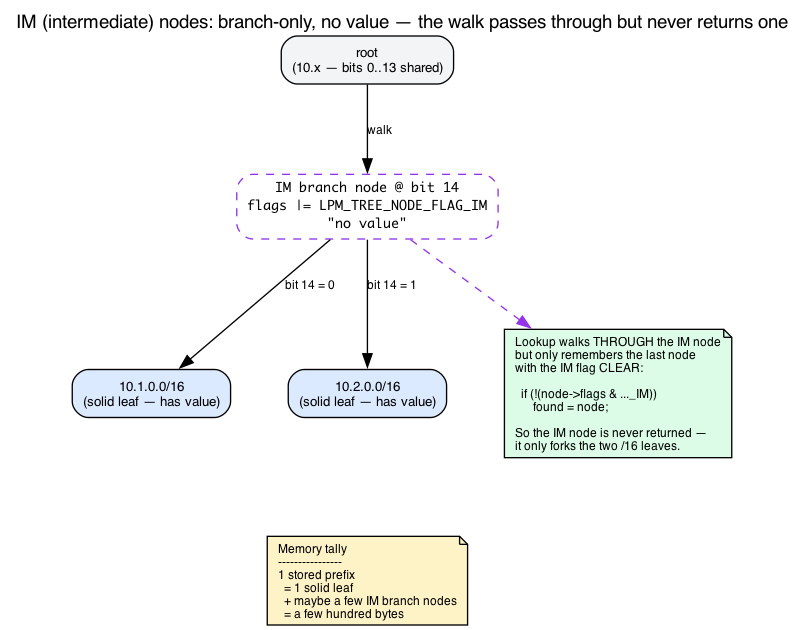
You manage the denylist from userspace via bpf_map_update_elem calls (the Day 2 userspace function — fills a union bpf_attr, issues a bpf() syscall). The XDP program does a single LPM lookup per packet and drops on match.
The lab
block.bpf.c
The BPF program and the blockcli CLI share the LPM key layout through one
header:
#ifndef PRACTICAL_EBPF_BLOCK_H #define PRACTICAL_EBPF_BLOCK_H
/* Shared between the BPF program (block.bpf.c) and the CLI (blockcli.c) so
- both sides agree on the LPM key layout: prefixlen first, then the address
- bytes in network byte order. */ struct ipv4_lpm_key { unsigned int prefixlen; unsigned int addr; };
#endif
and the program is included from the compiled source:
#include “vmlinux.h” #include <bpf/bpf_helpers.h> #include <bpf/bpf_endian.h>
#include “block.h”
/* ETH_P_IP is a UAPI #define, not a BTF enum, so it is absent from vmlinux.h
- and <linux/if_ether.h> cannot be mixed with vmlinux.h. Define it locally. */ #define ETH_P_IP 0x0800
char LICENSE[] SEC(“license”) = “GPL”;
struct { __uint(type, BPF_MAP_TYPE_LPM_TRIE); __uint(max_entries, 1024); __type(key, struct ipv4_lpm_key); __type(value, __u32); /* arbitrary value; we just check existence / __uint(map_flags, BPF_F_NO_PREALLOC); / required for LPM */ } deny SEC(“.maps”);
struct { __uint(type, BPF_MAP_TYPE_PERCPU_ARRAY); __uint(max_entries, 2); /* [0] = pass, [1] = drop */ __type(key, __u32); __type(value, __u64); } stats SEC(“.maps”);
static __always_inline void bump(__u32 idx) { __u64 *c = bpf_map_lookup_elem(&stats, &idx); if (c) (*c)++; }
SEC(“xdp”) int xdp_block(struct xdp_md *ctx) { void *data = (void *)(long)ctx->data; void *end = (void *)(long)ctx->data_end;
struct ethhdr *eth = data;
if (eth + 1 > end)
    goto pass;
if (eth->h_proto != bpf_htons(ETH_P_IP))
    goto pass;

struct iphdr *ip = (void *)(eth + 1);
if (ip + 1 > end)
    goto pass;

struct ipv4_lpm_key k = { .prefixlen = 32, .addr = ip->saddr };
if (bpf_map_lookup_elem(&deny, &k)) {
    bump(1);
    return XDP_DROP;
}
pass: bump(0); return XDP_PASS; }
What’s new (and where it’s grounded):
BPF_F_NO_PREALLOCis required for LPM. Hash maps preallocate by default for fast updates; the trie is a dynamic tree and the kernel rejects its absence at create time. The flag is value(1U << 0)(include/uapi/linux/bpf.h:1402), andtrie_allocreturns-EINVALunless it’s set —!(attr->map_flags & BPF_F_NO_PREALLOC)is right there in the sanity check (kernel/bpf/lpm_trie.c:579). Try removing the flag (Break 1) and you’ll hit that exact line.- The key passed to lookup uses
prefixlen=32— you’re asking “match this exact IP against any prefix in the trie.” The address comes straight fromip->saddr, which is already in network byte order on the wire — exactly the order the MSB-firstextract_bitwalk needs (see “What’s actually in the tree”). - Two-stage drop accounting: indices 0 and 1 in a percpu array hold pass/drop counters — the
PERCPU_ARRAY+ sum-across-CPUs pattern from Day 14 / Day 2.
blockcli.c — userspace CLI
/* Day 15 — CLI for maps owned by a running block loader. *
- blockcli PIN_DIRECTORY add 10.1.0.0/16
- blockcli PIN_DIRECTORY del 10.1.0.0/16
- blockcli PIN_DIRECTORY stats */ #include <arpa/inet.h> #include <errno.h> #include <limits.h> #include <stdio.h> #include <stdlib.h> #include <string.h> #include <unistd.h>
#include <bpf/bpf.h> #include <bpf/libbpf.h>
#include “block.h”
static char deny_pin[PATH_MAX]; static char stats_pin[PATH_MAX];
static int set_pin_paths(const char *directory) { if (snprintf(deny_pin, sizeof(deny_pin), “%s/deny”, directory) >= (int)sizeof(deny_pin) || snprintf(stats_pin, sizeof(stats_pin), “%s/stats”, directory) >= (int)sizeof(stats_pin)) return -1; return 0; }
static int parse_cidr(const char *text, struct ipv4_lpm_key *out) { char buffer[64]; char *slash; char *end; struct in_addr address; long prefixlen;
if (snprintf(buffer, sizeof(buffer), "%s", text) >= (int)sizeof(buffer))
    return -1;
slash = strchr(buffer, '/');
if (!slash)
    return -1;
*slash = '\0';

errno = 0;
prefixlen = strtol(slash + 1, &end, 10);
if (errno || *end != '\0' || prefixlen < 0 || prefixlen > 32)
    return -1;
if (inet_pton(AF_INET, buffer, &address) != 1)
    return -1;

out->prefixlen = (__u32)prefixlen;
out->addr = address.s_addr;
return 0;
}
static int do_add(const char *cidr) { struct ipv4_lpm_key key = {}; __u32 value = 1; int fd; int err = 0;
if (parse_cidr(cidr, &key)) {
    fprintf(stderr, "bad CIDR: %s\n", cidr);
    return 1;
}
fd = bpf_obj_get(deny_pin);
if (fd < 0) {
    fprintf(stderr, "open %s: %s (is block running?)\n", deny_pin,
            strerror(errno));
    return 1;
}
if (bpf_map_update_elem(fd, &key, &value, BPF_ANY)) {
    fprintf(stderr, "update failed: %s\n", strerror(errno));
    err = 1;
} else {
    printf("blocked %s\n", cidr);
}
close(fd);
return err;
}
static int do_del(const char *cidr) { struct ipv4_lpm_key key = {}; int fd; int err = 0;
if (parse_cidr(cidr, &key)) {
    fprintf(stderr, "bad CIDR: %s\n", cidr);
    return 1;
}
fd = bpf_obj_get(deny_pin);
if (fd < 0) {
    fprintf(stderr, "open %s: %s\n", deny_pin, strerror(errno));
    return 1;
}
if (bpf_map_delete_elem(fd, &key)) {
    fprintf(stderr, "delete failed: %s\n", strerror(errno));
    err = 1;
} else {
    printf("unblocked %s\n", cidr);
}
close(fd);
return err;
}
static int sum_slot(int fd, __u32 key, int cpu_count, __u64 *out) { __u64 *values; __u64 total = 0; int err = -1;
values = calloc((size_t)cpu_count, sizeof(*values));
if (!values)
    return -1;
if (bpf_map_lookup_elem(fd, &key, values) == 0) {
    for (int index = 0; index < cpu_count; index++)
        total += values[index];
    *out = total;
    err = 0;
}
free(values);
return err;
}
static int do_stats(void) { int fd = bpf_obj_get(stats_pin); int cpu_count = libbpf_num_possible_cpus(); __u64 pass = 0; __u64 drop = 0; int err = 0;
if (fd < 0) {
    fprintf(stderr, "open %s: %s\n", stats_pin, strerror(errno));
    return 1;
}
if (cpu_count <= 0 || sum_slot(fd, 0, cpu_count, &pass) ||
    sum_slot(fd, 1, cpu_count, &drop)) {
    fprintf(stderr, "failed to read per-CPU statistics\n");
    err = 1;
} else {
    printf("pass=%llu drop=%llu\n", (unsigned long long)pass,
           (unsigned long long)drop);
}
close(fd);
return err;
}
int main(int argc, char **argv) { if (argc < 3 || set_pin_paths(argv[1])) { fprintf(stderr, “usage: %s PIN_DIRECTORY add|del CIDR | stats\n”, argv[0]); return 1; } if (!strcmp(argv[2], “add”) && argc == 4) return do_add(argv[3]); if (!strcmp(argv[2], “del”) && argc == 4) return do_del(argv[3]); if (!strcmp(argv[2], “stats”) && argc == 3) return do_stats();
fprintf(stderr, "usage: %s PIN_DIRECTORY add|del CIDR | stats\n",
        argv[0]);
return 1;
}
The key line is bpf_obj_get("$PIN_DIR/deny") — no skeleton, no attach. This process gets its own fd to the same kernel trie the loader pinned, exactly the rendezvous from the pinning section. Everything after is the ordinary Day 2 userspace map API.
block.c — loader
Neither artifact above attaches the program. The complete loader loads the object, creates one pin directory that did not previously exist, pins both maps for the separate CLI, attaches the XDP program, and owns every resource until Ctrl-C:
/* Day 15 — loader for the XDP LPM-trie firewall. *
- Usage: sudo ./block IFACE [OWNED_PIN_DIRECTORY]
- The optional directory must not already exist. The loader creates it, pins
- both maps for blockcli, and removes the pins and directory on every exit. */ #include <errno.h> #include <limits.h> #include <net/if.h> #include <signal.h> #include <stdio.h> #include <string.h> #include <sys/stat.h> #include <unistd.h>
#include <bpf/libbpf.h>
#include “block.skel.h”
static volatile sig_atomic_t exiting;
static void handle_signal(int signal_number) { (void)signal_number; exiting = 1; }
static int install_signal_handlers(void) { const struct sigaction action = { .sa_handler = handle_signal, };
if (sigaction(SIGINT, &action, NULL) != 0 ||
    sigaction(SIGTERM, &action, NULL) != 0) {
    fprintf(stderr, "failed to install signal handlers: %s\n",
            strerror(errno));
    return -errno;
}
return 0;
}
int main(int argc, char **argv) { struct block_bpf *skel = NULL; struct bpf_link *link = NULL; char default_dir[PATH_MAX]; char deny_pin[PATH_MAX]; char stats_pin[PATH_MAX]; const char *pin_dir; unsigned int ifindex; int dir_created = 0; int deny_pinned = 0; int stats_pinned = 0; int err;
setvbuf(stdout, NULL, _IOLBF, 0);

if (argc < 2 || argc > 3) {
    fprintf(stderr, "usage: %s IFACE [OWNED_PIN_DIRECTORY]\n", argv[0]);
    return 1;
}
ifindex = if_nametoindex(argv[1]);
if (!ifindex) {
    fprintf(stderr, "if_nametoindex(%s): %s\n", argv[1], strerror(errno));
    return 1;
}

if (argc == 3) {
    pin_dir = argv[2];
} else {
    snprintf(default_dir, sizeof(default_dir),
             "/sys/fs/bpf/practical-ebpf-day15-%ld", (long)getpid());
    pin_dir = default_dir;
}
if (snprintf(deny_pin, sizeof(deny_pin), "%s/deny", pin_dir) >=
        (int)sizeof(deny_pin) ||
    snprintf(stats_pin, sizeof(stats_pin), "%s/stats", pin_dir) >=
        (int)sizeof(stats_pin)) {
    fprintf(stderr, "pin directory path is too long\n");
    return 1;
}

err = install_signal_handlers();
if (err)
    return 1;

if (mkdir(pin_dir, 0700) != 0) {
    fprintf(stderr, "refusing pin directory %s: %s\n", pin_dir,
            strerror(errno));
    return 1;
}
dir_created = 1;

skel = block_bpf__open_and_load();
if (!skel) {
    fprintf(stderr, "failed to open and load block BPF skeleton\n");
    err = -errno;
    goto cleanup;
}

err = bpf_map__pin(skel->maps.deny, deny_pin);
if (err) {
    fprintf(stderr, "failed to pin %s: %s\n", deny_pin, strerror(-err));
    goto cleanup;
}
deny_pinned = 1;

err = bpf_map__pin(skel->maps.stats, stats_pin);
if (err) {
    fprintf(stderr, "failed to pin %s: %s\n", stats_pin, strerror(-err));
    goto cleanup;
}
stats_pinned = 1;

link = bpf_program__attach_xdp(skel->progs.xdp_block, ifindex);
if (!link) {
    err = -errno;
    fprintf(stderr, "failed to attach XDP program to %s: %s\n",
            argv[1], strerror(errno));
    goto cleanup;
}

printf("Firewall attached to %s. Manage it with:\n"
       "  blockcli %s add|del <CIDR>\n"
       "  blockcli %s stats\n"
       "Press Ctrl-C to detach and remove the owned pins.\n",
       argv[1], pin_dir, pin_dir);
while (!exiting)
    pause();
err = 0;
cleanup: bpf_link__destroy(link); if (stats_pinned) unlink(stats_pin); if (deny_pinned) unlink(deny_pin); block_bpf__destroy(skel); if (dir_created && rmdir(pin_dir) != 0 && errno != ENOENT) { fprintf(stderr, “failed to remove owned pin directory %s: %s\n”, pin_dir, strerror(errno)); if (!err) err = -errno; } return err != 0; }
The pin is what lets two processes share one trie: block owns the skeleton and attachment; blockcli opens $PIN_DIR/deny and $PIN_DIR/stats with bpf_obj_get. bpf_map__pin (tools/lib/bpf/libbpf.c:9150) issues BPF_OBJ_PIN; bpf_obj_get (tools/lib/bpf/bpf.c:609) issues BPF_OBJ_GET. The loader removes both pins and its directory on every exit path, so the rendezvous lasts exactly as long as this lab run.
Run
First stand up an isolated peer at 10.0.0.2 so there is actually something to ping — otherwise ping times out whether or not XDP is dropping, and the experiment proves nothing. A veth pair is a virtual cable: two linked interfaces, here with one end (veth1) moved into a separate network namespace (an isolated network stack) so it acts like a remote peer.
sudo ip netns add peer
sudo ip link add veth0 type veth peer name veth1
sudo ip link set veth1 netns peer
sudo ip addr add 10.0.0.1/24 dev veth0 && sudo ip link set veth0 up
sudo ip -n peer addr add 10.0.0.2/24 dev veth1 && sudo ip -n peer link set veth1 up
XDP runs on RX (ingress), so the drop must happen on the echo reply — whose source address is 10.0.0.2. Attach the program on veth0, the host side that receives those replies:
make -C ebpf/labs day15
PIN=/sys/fs/bpf/practical-ebpf-day15-$$
sudo ebpf/labs/.output/day15/block veth0 "$PIN" &  # host RX side
LOADER=$!
trap 'sudo kill -INT "$LOADER" 2>/dev/null || true; wait "$LOADER" 2>/dev/null || true; sudo ip link del veth0 2>/dev/null || true; sudo ip netns del peer 2>/dev/null || true' EXIT
sleep 0.5

ping -c 3 10.0.0.2              # replies arrive on veth0 ingress -> PASS
sudo ebpf/labs/.output/day15/blockcli "$PIN" add 10.0.0.0/8
ping -c 3 10.0.0.2              # matching replies -> XDP_DROP -> 100% loss
sudo ebpf/labs/.output/day15/blockcli "$PIN" stats

sudo ebpf/labs/.output/day15/blockcli "$PIN" del 10.0.0.0/8
ping -c 3 10.0.0.2              # works again
The observation is the before/after contrast: the first ping gets replies (0% loss), and after add 10.0.0.0/8 the replies are dropped on veth0 ingress so ping reports 100% loss. blockcli stats confirms it with a non-zero drop count:
pass=<some number> drop=3
(drop should be 3 — one per dropped echo reply. Attaching to the in-netns veth1 instead would not drop the replies, because they leave that side on TX, not RX.)
Clean up by leaving the shell or running the trap body. It signals the exact loader PID (never a broad pkill), waits for the loader to auto-detach XDP and remove its owned pins/directory, then removes only this lab’s veth pair and namespace. If the loader is killed with SIGKILL, its pins demonstrate the persistence rule; remove only the unique $PIN directory before rerunning.
Now you have a userspace-controlled, line-rate firewall. Every API call updates the trie atomically; no XDP restart needed.
What to break, in order
Break 1 — Forget BPF_F_NO_PREALLOC
Remove the flag. Map creation fails:
libbpf: map 'deny': failed to create: EINVAL
That EINVAL is not libbpf being fussy — it comes straight from the kernel’s trie_alloc, which lists !(attr->map_flags & BPF_F_NO_PREALLOC) among the conditions that return ERR_PTR(-EINVAL) (kernel/bpf/lpm_trie.c:579). Most map types preallocate hashtable buckets at create time for stability. The LPM trie is a dynamic tree that allocates nodes on demand, so the kernel insists you acknowledge that with the flag.
Break 2 — Wrong byte order on insert
out->addr = htonl(a.s_addr); /* WRONG — already big-endian */
inet_aton returns network byte order already. Double-converting flips the bits. You’ll insert “wrong” CIDRs that never match. Verify with:
sudo bpftool map dump name deny
bpftool dumps a non-BTF LPM map as raw little-endian hex byte arrays — not as a decoded prefixlen N key 0xN string. For 10.1.0.0/16 you’ll see:
key: 10 00 00 00 0a 01 00 00 value: 01 00 00 00
The first u32 is prefixlen in little-endian (10 00 00 00 = 16); the next 4 bytes are the address in network order — 0a 01 00 00 = 10.1.0.0 (correct). This is the byte layout from “The key struct” made visible: prefixlen at offset 0, address bytes at offset 4. If you double-swapped, the address bytes come out reversed: 00 00 01 0a. (Add -j for the same bytes as a JSON hex array.)
Break 3 — Block your own SSH
If you’re attached to the real NIC and add 0.0.0.0/0 to the denylist, you’ve cut your own session. (Don’t actually do this.) XDP_DROP is below the kernel’s “let SSH through” logic.
To detach without console access: panic + reboot. Or better: never test on a real NIC without an out-of-band escape route.
Break 4 — Add IPv6
struct ipv6_lpm_key {
    __u32 prefixlen;
    struct in6_addr addr;
};
Update the map definition’s value type, parse CIDR with inet_pton(AF_INET6, ...), branch in BPF on ETH_P_IPV6. Same shape, different sizes — and now you know why it just works: enlarging the struct grows key_size, and the kernel derives the address width from it (see “The key struct”). You never tell the kernel “this is IPv6”; the arithmetic on key_size does it for you.
What to read in the kernel
kernel/bpf/lpm_trie.c— the implementation. Readtrie_lookup_elem(the IM-skipping walk at:271-275, the exact-match early exit at:259-262) andtrie_update_elem(the IM-node insert at:423-444). ~800 lines, accessible.include/uapi/linux/bpf.h—struct bpf_lpm_trie_key_u8(:103-109), theBPF_OBJ_PIN/BPF_OBJ_GETcommands (:962-963), andBPF_F_NO_PREALLOC(:1402).tools/lib/bpf/libbpf.c/tools/lib/bpf/bpf.c—bpf_map__pin(:9150),bpf_obj_pin(:604),bpf_obj_get(:609): the pinning entry points.tools/testing/selftests/bpf/map_tests/lpm_trie_map_basic_ops.c— the canonical test, including edge cases.
Bullet Points
BPF_MAP_TYPE_LPM_TRIEis for prefix lookups (CIDRs, IPv6 prefixes, MAC OUIs).- Key struct must start with
prefixlen, followed by address bytes — it mirrorsstruct bpf_lpm_trie_key_u8, and the kernelBUILD_BUG_ONs the address landing at a u32-aligned offset (lpm_trie.c:176). The address width (and thusmax_prefixlen) is derived fromkey_size, which is why IPv6 “just works” by growing the struct. - Always set
BPF_F_NO_PREALLOC— the kernel returns-EINVALat create time without it (lpm_trie.c:579). - The trie stores intermediate (IM) branch nodes with no value to fork diverging prefixes; that’s the real per-entry memory cost, and lookup skips them as match candidates (
lpm_trie.c:271-275), returning the last non-IM node — that’s longest-prefix-match. - Lookup is O(prefix_len) — fast enough for line-rate; reads are RCU-protected (Day 2), safe to update while XDP is running.
- Pinning + bpffs is how two processes share one map: a BPF object is fd-refcounted and freed when the last fd closes (that’s why Day 14’s map vanished); a pin in
/sys/fs/bpfadds a filesystem reference that survives the creator’s death. The loaderbpf_map__pins; the CLIbpf_obj_gets its own fd to the same trie. This lab uses a unique owned directory and removes its pins on normal exit; a forcedSIGKILLstill demonstrates why stale pins must be removed explicitly. - Userspace CIDR parsing:
inet_atonreturns network byte order (don’t double-convert) — required because the trie walks bits MSB-first. - Test on
vethpairs before deploying on real interfaces.
Check question
You add 10.0.0.0/8 and 10.1.0.0/16 to the denylist. A packet from 10.1.5.20 arrives. Which entry matches, and what’s the lookup cost?
Click to reveal answer
Answer: Both prefixes match, but LPM returns the longest — 10.1.0.0/16. Cost is O(prefix length matched) — about 16 bit comparisons, plus tree-walking overhead. The trie nodes are visited in the order: root → /8 → /16, and the walk “remembers” the last non-intermediate node it passed (lpm_trie.c:271-275), returning the value at /16. ~30 ns total on modern hardware.
Tomorrow
Day 16: tc-bpf — the legacy way to attach BPF to the network stack at L2/L3. We’ll see why it predates XDP, what it can do that XDP can’t, and the pain of tc qdisc lifecycle that motivated tcx.