Day 16 — tc-bpf: BPF in the kernel network stack
Today’s mission: attach BPF to a network interface’s ingress and egress with classic tc, learn the traffic-control machinery (qdisc / classifier / filter / clsact) that every
tccommand leans on, see why XDP can’t do everything, and feel the pain oftc qdisclifecycle that motivated tcx (tomorrow). Total time: ~110 minutes.
Why tc, when XDP exists
Days 14–15 put your BPF program in the NIC driver with XDP, before the kernel built anything. That’s the fastest place — and also its limit: there’s no skb yet. No connection-tracking metadata, no socket lookup, no routing decision, no skb control block. For programs that need that information (e.g., “tag packets belonging to flows my conntrack already saw”), XDP isn’t enough.
tc-bpf runs after skb allocation. You see struct __sk_buff — a typed view of the kernel’s struct sk_buff (the universal packet container you dissected on Day 1 of the companion networking book: the descriptor with head/data/tail/end pointers and page-fragment payload). All the metadata that XDP couldn’t show you is now populated.
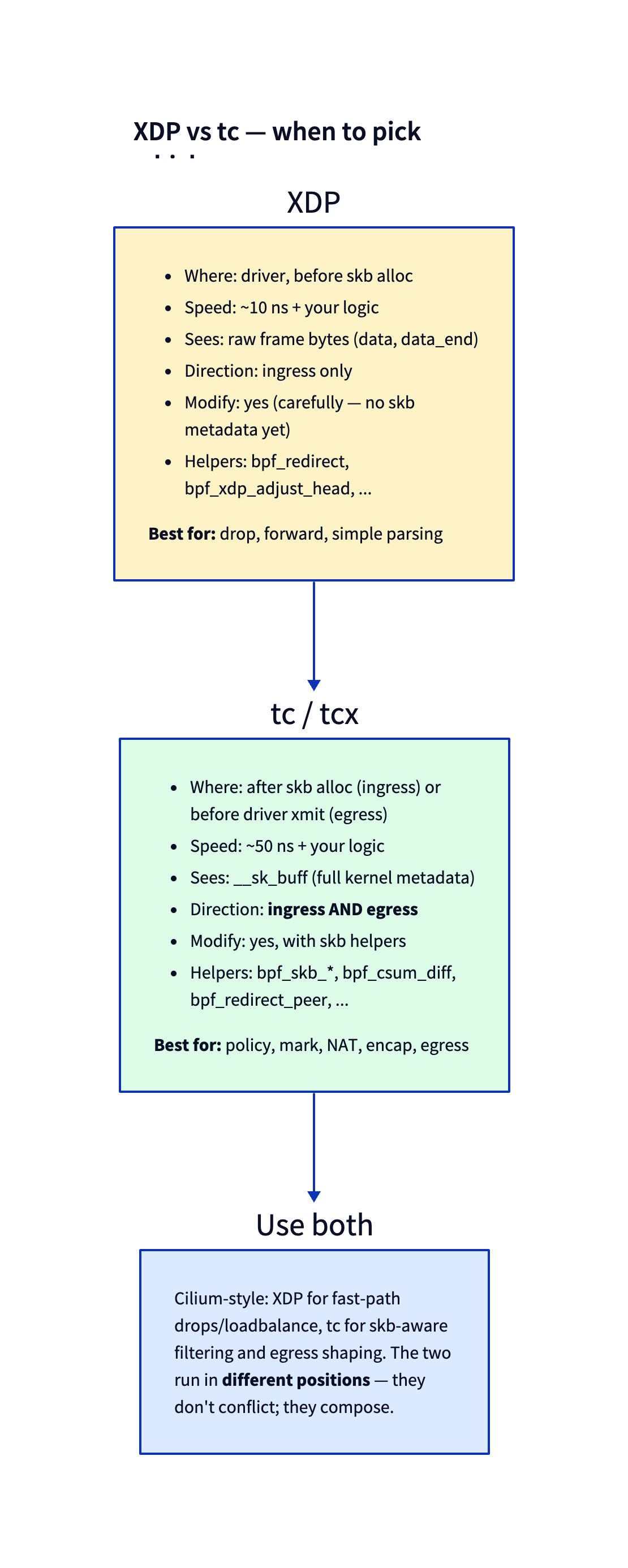
The other big difference: tc has both ingress and egress hooks. XDP is ingress-only. If you want to drop or modify packets on their way out (e.g., adding tunnel encapsulation, marking based on cgroup), you need tc.
But before we write a line of BPF, we have to confront a wall of unfamiliar vocabulary. Every command in today’s lab — tc qdisc add dev veth1 clsact, tc filter add ... bpf da obj, tc filter show — comes from a subsystem that predates BPF by a decade and was built for something else entirely. If you’ve only done XDP, you have never met a qdisc, a classifier, a filter, or a thing called clsact. Let’s fix that first, so none of the lab is cargo-cult.
The tc traffic-control model: qdisc, classifier, filter
tc is short for traffic control. Long before BPF existed, Linux needed a way to do QoS — shape, prioritize, and rate-limit outgoing traffic so that, say, your VoIP packets jump ahead of a bulk file upload. That subsystem is what tc configures, and its central object is the qdisc.
What a qdisc is
A qdisc (queueing discipline) is an object attached to a net_device that decides how packets are queued and scheduled on their way out. When the stack wants to transmit a packet, it doesn’t hand it straight to the driver — it enqueues it on the device’s qdisc, and the qdisc later dequeues packets in whatever order its algorithm dictates. Historically this only existed on the egress (TX) path, because that’s the side you control: you can’t make a remote sender slow down, but you can choose the order in which your packets leave.
The default qdisc on most interfaces is pfifo_fast — a simple three-band priority FIFO. It really does queue: packets go in, packets come out, possibly reordered by priority. That is the normal job of a qdisc — actual buffering and scheduling of bytes.
The classifier → filter → action pipeline
A pure FIFO is dumb; for real QoS you need to classify traffic (“this is VoIP, that is bulk”) and treat classes differently. So tc grew a three-stage pipeline that hangs off a qdisc:
- A filter inspects a packet and decides whether it matches.
tcships many filter types —u32(match raw header bytes),flower(match parsed fields), and the one we care about,bpf(run a BPF program). The filter is the classifier: its job is to say “this packet belongs to class X.” - An action then decides the packet’s fate — drop it, redirect it, re-mark it, pass it along.
So the conceptual flow is classifier → filter → action. BPF was bolted onto this old machinery as just another filter type (cls_bpf). That is the single most important thing to understand today, because it explains why attaching a tc-bpf program needs two commands: one to install a qdisc that provides the hook, and one to add your BPF program as a filter on that qdisc.
You can see the classic classifier entry point in the kernel. When a packet reaches a bpf filter, the kernel calls:
/* net/sched/cls_bpf.c:81 */
TC_INDIRECT_SCOPE int cls_bpf_classify(struct sk_buff *skb,
                                       const struct tcf_proto *tp,
                                       struct tcf_result *res)
registered as the .classify handler of the bpf filter ops:
/* net/sched/cls_bpf.c:685 */
.classify = cls_bpf_classify,
This function — over ten years old — is the legacy path your tc filter add ... bpf command lights up.
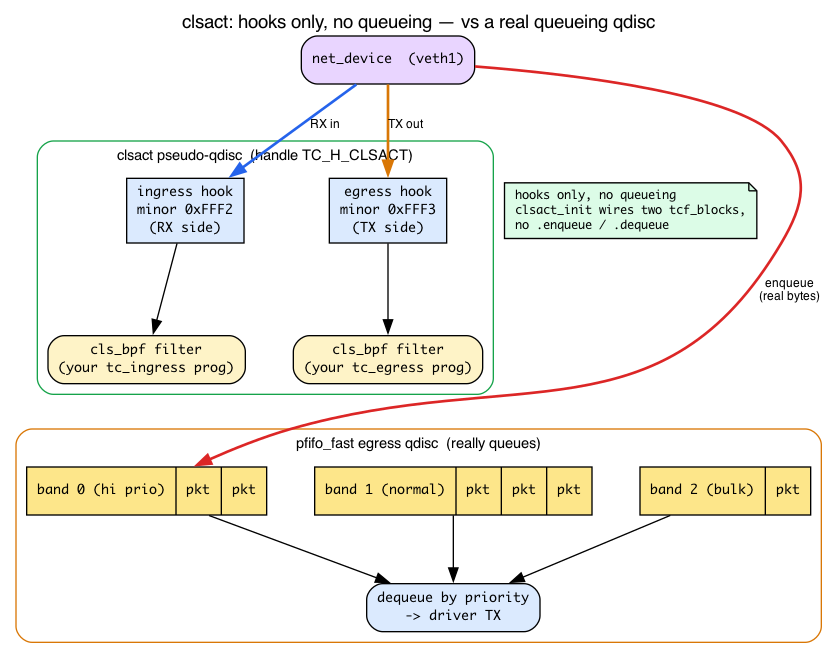
clsact: a qdisc that queues nothing
Here is the twist. To attach BPF you need a qdisc to provide a hook point — but you do not want any of the queueing/shaping behavior a real qdisc brings. You just want a place to hang a classifier on both ingress and egress.
That is exactly what clsact is: a special pseudo-qdisc that does not queue or schedule a single byte. It exists solely to expose two classification hook points — one for ingress, one for egress — so that tc-bpf has somewhere to attach. This is why this chapter (and the kernel community) call it a scaffold: hooks only, no queueing.
You can ground that claim in the source. clsact is registered as a qdisc whose .init is clsact_init:
/* net/sched/sch_ingress.c:341 */
.init = clsact_init,
/* net/sched/sch_ingress.c:337 */
.cl_ops = &clsact_class_ops,
and clsact_init (net/sched/sch_ingress.c:243) does nothing but wire up two blocks — an ingress block and an egress block — that will hold the filters. A “block” (tcf_block) is just the kernel’s container for the chain of filters attached at a hook. The egress side is plumbed by clsact_egress_block_set (sch_ingress.c:222) / clsact_egress_block_get (sch_ingress.c:236); the ingress side reuses the plain-ingress plumbing ingress_ingress_block_set (sch_ingress.c:63). No .enqueue/.dequeue that actually moves packets — contrast that with pfifo_fast, which is all enqueue/dequeue.
The ingress/egress choice is encoded in a handle. A qdisc handle is a 32-bit number written major:minor. clsact claims a fixed reserved handle, and the minor number selects which hook your filter lands on:
/* include/uapi/linux/pkt_sched.h */
#define TC_H_CLSACT       TC_H_INGRESS   /* :77  the clsact qdisc handle itself */
#define TC_H_MIN_INGRESS  0xFFF2U        /* :80  the ingress hook */
#define TC_H_MIN_EGRESS   0xFFF3U        /* :81  the egress hook */
This is the secret behind the words ingress and egress you’ll type in tc filter add dev veth1 ingress .... They are not device names or free-form keywords — they are shorthand for these reserved minor handles that pick the direction. ingress → 0xFFF2, egress → 0xFFF3.
And it explains Break 1 below in advance: without clsact installed, there is no tcf_block to hold your filter, so tc filter add fails with Parent Qdisc doesn't exists. The qdisc is the parent; the filter is the child; no parent, no child.
Where the two hooks actually fire in the datapath
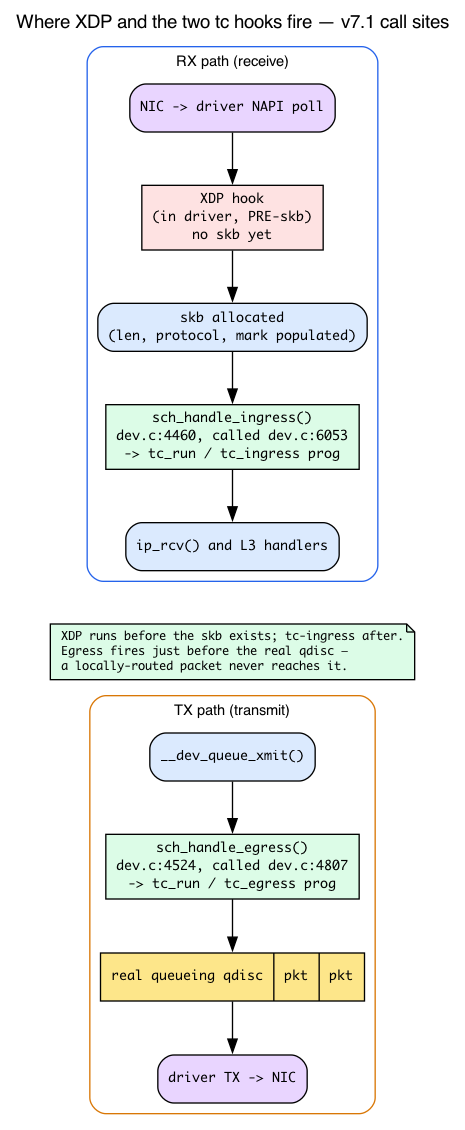
You now know tc-bpf “runs after skb allocation” and that there are two hooks — but where in the receive and transmit paths do they execute? That placement is what lets you reason about ordering (the Check question) and about why a locally-routed packet skips egress (the namespace trick in the lab).
The RX path skeleton (driver → NAPI poll → __netif_receive_skb_core → L3 handlers) and the TX path (__dev_queue_xmit → qdisc → driver) are taught in full in the companion networking book (Days 2–3). Here we only need the two hook placements:
- Ingress tc runs from inside the RX software path, after the driver/NAPI has built the skb but before the packet is handed to L3 protocol handlers (
ip_rcvand friends). That’s the concrete meaning of “after skb allocation”: by the time your program runs,__sk_buffalready carrieslen,protocol,mark, and the rest. - Egress tc runs from inside the transmit path, just before the packet is enqueued to the real (queueing) qdisc and driver. A packet that is locally delivered — e.g. routed over loopback to an address on the same host — never enters this transmit path on
veth1, which is precisely why today’s lab forces traffic into a separate namespace so the UDP datagram actually traversesveth1’s egress hook.
In v7.1 the two hooks are reached through sch_handle_ingress and sch_handle_egress:
/* net/core/dev.c:4460 — reads skb->dev->tcx_ingress; called at dev.c:6053 in the RX path */
static __always_inline struct sk_buff *
sch_handle_ingress(struct sk_buff *skb, struct packet_type **pt_prev, int *ret, ...)

/* net/core/dev.c:4524 — reads dev->tcx_egress; called at dev.c:4807 in __dev_queue_xmit */
static __always_inline struct sk_buff *
sch_handle_egress(struct sk_buff *skb, int *ret, struct net_device *dev)
Both first try tcx_run (the modern Day-17 path) and fall back to the classic tc_run(tcx_entry(entry), skb, ...) — the same hook point is shared by classic tc-bpf and tcx:
/* net/core/dev.c:4485 (ingress) and dev.c:4544 (egress) */
sch_ret = tc_run(tcx_entry(entry), skb, &drop_reason);
tcx_run itself (net/core/dev.c:4439) just walks its program list and runs each with bpf_prog_run. The takeaway: because ingress tc sits at a fixed point in the RX path after the skb exists, and XDP sits before the skb exists in the driver, the XDP → tc-ingress order is deterministic and sequential — which is exactly what today’s Check question is about.
The tc context: struct __sk_buff
A read-mostly typed view of struct sk_buff (abridged — the real definition in include/uapi/linux/bpf.h continues with socket and timestamp fields):
struct __sk_buff {
    __u32 len;
    __u32 pkt_type;        /* PACKET_HOST, PACKET_BROADCAST, ... */
    __u32 mark;            /* socket/skb mark */
    __u32 queue_mapping;
    __u32 protocol;        /* L3 protocol */
    __u32 vlan_present;
    __u32 vlan_tci;
    __u32 vlan_proto;
    __u32 priority;
    __u32 ingress_ifindex;
    __u32 ifindex;
    __u32 tc_index;        /* tc classification slot */
    __u32 cb[5];           /* skb control block — pass data between progs */
    __u32 hash;            /* skb hash */
    __u32 tc_classid;
    __u32 data;            /* same idea as xdp_md */
    __u32 data_end;
    __u32 napi_id;
    /* and more — family/remote_ip4/...; data_meta, tstamp, sk, etc. */
};
Use data and data_end for direct packet access (same bounds-checking discipline as XDP). Use mark, cb, etc. to coordinate with kernel state.
mark: a scratch tag the whole stack shares
Today’s lab writes skb->mark = 0xCAFE in the ingress program and later matches it from iptables. For that to make sense you need to know what mark is and why a value a BPF program writes is visible to a completely different subsystem.
markis a 32-bit scratch field on the skb (kernelstruct sk_buff.mark, surfaced here as__sk_buff.mark). It is not part of the packet on the wire — nothing in the Ethernet/IP/TCP bytes changes. It is metadata that travels with the skb through the stack, like a sticky note on the descriptor.- It is the same field that netfilter calls the packet mark (a.k.a. fwmark / nfmark) and that policy routing matches on. That shared identity is exactly why a tc-bpf write is later matchable by
iptables -m mark: both are reading the oneskb->markslot. (The iptables/netfilter side — theLOGtarget, theINPUTchain,-m mark— is companion-book netfilter material; see the linux-net netfilter chapter for the matching machinery.) markis one of the few__sk_bufffields a tc program is allowed to write (see Break 3’s writable-field list), which is what makes this coordination pattern legal in the first place. We can confirm it directly: intc_cls_act_is_valid_access(net/core/filter.c:9186), theBPF_WRITEallow-list opens withcase bpf_ctx_range(struct __sk_buff, mark):(filter.c:9193).- Because the mark is per-skb and is not reset between hooks, it is the canonical way BPF coordinates with kernel state — which is the chapter’s whole motivation: tag a packet in BPF, act on the tag later in conntrack / routing / iptables.
Action constants for tc
#define TC_ACT_OK         0   /* let the packet through */
#define TC_ACT_RECLASSIFY 1   /* reclassify */
#define TC_ACT_SHOT       2   /* drop */
#define TC_ACT_PIPE       3   /* pass to next filter */
#define TC_ACT_STOLEN     4   /* steal: don't free, prog took it */
#define TC_ACT_QUEUED     5
#define TC_ACT_REPEAT     6
#define TC_ACT_REDIRECT   7   /* paired with bpf_redirect() */
Most programs return TC_ACT_OK (allow), TC_ACT_SHOT (drop), or TC_ACT_REDIRECT.
da = direct-action: your return value is the verdict
Every attach command below uses bpf da obj tc.bpf.o, and tc -s filter show literally prints direct-action. What is da?
Recall the classic pipeline: a classifier returns a classid, and a separate tc action object actually drops or redirects. That indirection — classifier here, action there — is the historical default, and it’s clumsy: you’d have to create an action object and wire it to the classifier.
da = direct-action collapses that. It tells cls_bpf that the BPF program’s return value itself is the TC_ACT_* verdict — no separate action object needed. That is why the lab’s program can simply return TC_ACT_SHOT / TC_ACT_OK and have it take effect.
Internally this is the TCA_BPF_FLAG_ACT_DIRECT flag. The parse path validates and records it:
/* net/sched/cls_bpf.c:473 */
if (bpf_flags & ~TCA_BPF_FLAG_ACT_DIRECT) { ret = -EINVAL; ... }
/* net/sched/cls_bpf.c:478 */
have_exts = bpf_flags & TCA_BPF_FLAG_ACT_DIRECT;
and tc filter show reports it back (cls_bpf.c:611: bpf_flags |= TCA_BPF_FLAG_ACT_DIRECT;), which is the direct-action string you see. The return value is consumed as the verdict inside cls_bpf_classify (cls_bpf.c:81). Without da you’d be hand-wiring classifier-plus-action plumbing; effectively all modern tc-bpf uses direct-action, and it’s conceptually what tcx inherits tomorrow.
There are no Dumb Questions
Q: Does tc see GRO-coalesced packets or individual packets?
A: tc on ingress sees what NAPI/GRO produced. Recall NAPI receive polling from the companion networking book (Days 1–2: the driver drains the RX descriptor ring in softirq). GRO (Generic Receive Offload) is a software step layered on top of that: during NAPI receive, the kernel merges consecutive same-flow segments into one larger skb before delivering it up the stack. So tc-ingress — which sits after that merge in the RX path — may see a single coalesced “superpacket” rather than the individual frames that arrived on the wire. GRO improves throughput but hides per-frame structure, which is why tools that need exact per-packet semantics (Cilium, for instance) disable GRO. On egress the concern doesn’t disappear — it just changes offload. The egress hook (
sch_handle_egress) fires inside__dev_queue_xmitbefore the real qdisc and well before segmentation:skb_gso_segmentruns later, invalidate_xmit_skbon the way todev_hard_start_xmit(and is skipped entirely when the NIC does TSO in hardware). So a TCP sender’s large GSO/TSO buffer reaches the egress hook as a single super-skb (gso_segs > 1, spanning many MTU-worth of data) — the egress analog of a GRO superpacket, not a per-frame view. tc-egress sees skbs pre-segmentation, so the same coalescing caveat applies outbound that GRO creates inbound.Q: Why is the attach mechanism so awkward (
tc qdisc add+tc filter add)?A: As the model section explained, tc predates BPF. It was originally a packet-classifier system for QoS (queueing disciplines), and BPF programs got bolted on as a filter type. The qdisc gives you a hook point; the filter is your BPF. Hence two commands. tcx (tomorrow) ditches this entirely.
The lab: tc on ingress and egress
tc.bpf.c
Included from the source the lab build and CI compile (there is no userspace
loader today — the object is attached with the tc command below):
#include “vmlinux.h” #include <bpf/bpf_helpers.h> #include <bpf/bpf_endian.h>
/* vmlinux.h does not export these UAPI macros, and <linux/pkt_cls.h> can’t be mixed with vmlinux.h (it redefines struct tc_stats etc.). So we define the handful we need locally, the same way the kernel’s own BPF selftests do (tools/testing/selftests/bpf/progs/bpf_tracing_net.h). IPPROTO_UDP already comes from vmlinux.h. */ #define TC_ACT_OK 0 #define TC_ACT_SHOT 2 #define ETH_P_IP 0x0800
char LICENSE[] SEC(“license”) = “GPL”;
/* The ELF section name (SEC) is what tc filter add ... sec tc_ingress selects;
the C function symbol must differ from it, or clang errors with
“symbol ‘tc_ingress’ is already defined”. */
SEC(“tc_ingress”)
int mark_ingress(struct __sk_buff *skb)
{
void *data = (void *)(long)skb->data;
void *end = (void *)(long)skb->data_end;
struct ethhdr *eth = data;
if (eth + 1 > end) return TC_ACT_OK;
if (eth->h_proto != bpf_htons(ETH_P_IP)) return TC_ACT_OK;
struct iphdr *ip = (void )(eth + 1);
if (ip + 1 > end) return TC_ACT_OK;
/ Mark packets so userspace iptables can pick them up */
skb->mark = 0xCAFE;
return TC_ACT_OK;
}
SEC(“tc_egress”) int drop_udp_egress(struct __sk_buff skb) { / Drop every UDP packet outbound to demonstrate egress */ void *data = (void *)(long)skb->data; void *end = (void *)(long)skb->data_end; struct ethhdr *eth = data; if (eth + 1 > end) return TC_ACT_OK; if (eth->h_proto != bpf_htons(ETH_P_IP)) return TC_ACT_OK; struct iphdr *ip = (void *)(eth + 1); if (ip + 1 > end) return TC_ACT_OK; if (ip->protocol == IPPROTO_UDP) return TC_ACT_SHOT; return TC_ACT_OK; }
Setup: build the object and a namespaced veth pair
First build the object (Days 14–15 drove this with make; here is the explicit compile):
clang -O2 -g -target bpf -c tc.bpf.c -o tc.bpf.o # or: make
Now the topology. Unlike Day 14 we put one end of the veth pair in its own network namespace. This matters for the egress demo: as the datapath section explained, the egress hook only fires from inside the transmit path. If both ends live in the root namespace, a packet sent to veth1’s own address (10.0.0.2) is routed over loopback and never traverses veth1’s egress hook — so the egress drop below would silently never fire. A namespace forces the packet out through veth1.
sudo ip netns add ns1
sudo ip link add veth0 type veth peer name veth1
sudo ip link set veth1 netns ns1
sudo ip addr add 10.0.0.1/24 dev veth0
sudo ip link set veth0 up
sudo ip netns exec ns1 ip addr add 10.0.0.2/24 dev veth1
sudo ip netns exec ns1 ip link set veth1 up
sudo ip netns exec ns1 ip link set lo up
(If a veth0/ns1 from a previous run is lying around, run the Detach/cleanup at the bottom first.)
Attach the classic way
veth1 lives in ns1, so every tc command runs inside that namespace with ip netns exec ns1:
sudo ip netns exec ns1 tc qdisc add dev veth1 clsact

sudo ip netns exec ns1 tc filter add dev veth1 ingress \
     bpf da obj tc.bpf.o sec tc_ingress

sudo ip netns exec ns1 tc filter add dev veth1 egress \
     bpf da obj tc.bpf.o sec tc_egress

# verify:
sudo ip netns exec ns1 tc filter show dev veth1 ingress
sudo ip netns exec ns1 tc filter show dev veth1 egress
Read those three commands with the model section in mind: the first installs the clsact pseudo-qdisc (the scaffold — clsact_init wires up the ingress and egress blocks, but queues nothing). The next two add your BPF as a filter on each block; ingress/egress select the 0xFFF2/0xFFF3 minor handles, and da makes the program’s return value the verdict.
Run
Generate traffic from inside ns1 so it egresses veth1:
# ICMP passes — the egress program only drops UDP:
sudo ip netns exec ns1 ping -c 3 10.0.0.1

# UDP is dropped on veth1's egress. A `nc -u` send never reports an
# application error even when the datagram is silently dropped, so don't
# wait for nc to "fail" — instead watch the *peer* veth0 in the root ns:
# UDP never arrives, ICMP does. Start the sniffer first, then send.
sudo timeout 4 tcpdump -i veth0 -nn 'udp port 9999 or icmp' &
sudo ip netns exec ns1 ping -c 1 10.0.0.1
sudo ip netns exec ns1 nc -u -w1 10.0.0.1 9999 <<< "hi"
wait
You’ll see the ICMP echo request reach veth0 but no UDP packet to port 9999 — the egress program shot it on veth1 before it ever left:
IP 10.0.0.2 > 10.0.0.1: ICMP echo request, ...
IP 10.0.0.1 > 10.0.0.2: ICMP echo reply, ...
Why not
tc -s filter show ... egress? Withbpf da(direct-action) there is no separate tc action object to accumulate stats, so on this kernel (iproute2 6.19.0, v7.1.0)tc -s filter showprints only the filter line — noSent ... (dropped N ...)counter. The drop is real (tcpdump proves it); the classic per-action stats line just isn’t emitted for direct-action filters. If you want a counter, add aBPF_MAP_TYPE_ARRAYto the egress program, bump it beforereturn TC_ACT_SHOT, and read it withbpftool map dump.
Verify the mark in iptables
The ingress program stamps skb->mark = 0xCAFE on incoming IP packets — that shared fwmark slot we covered above. To observe it from userspace, add an iptables rule inside ns1 that matches that mark and watch its packet counter climb:
sudo ip netns exec ns1 iptables -A INPUT -m mark --mark 0xCAFE -j ACCEPT
sudo ip netns exec ns1 ping -c 3 10.0.0.1
sudo ip netns exec ns1 iptables -L INPUT -v -n
The rule’s own pkts counter ticks up for every inbound packet carrying the mark — proof the BPF ingress program set it and that netfilter reads the same skb->mark slot (note the kernel prints the mark lowercase):
Chain INPUT (policy ACCEPT ...)
 pkts bytes target  prot opt in   out  source     destination
    3   252 ACCEPT  all  --  *    *    0.0.0.0/0  0.0.0.0/0   mark match 0xcafe
Why not
-j LOG+dmesg? A netfilterLOGtarget firing inside a non-init network namespace does not reach the kernel ring buffer unlessnet.netfilter.nf_log_all_netns=1(it defaults to0), sosudo dmesg | tailwould show nothing here. The-vpacket counter above is non-mutating and works inside the netns, keeping the lab self-contained. (If you must useLOG, runsudo sysctl -w net.netfilter.nf_log_all_netns=1first and reset it to0afterward.)
Detach and clean up
sudo ip netns exec ns1 tc filter del dev veth1 ingress
sudo ip netns exec ns1 tc filter del dev veth1 egress
sudo ip netns exec ns1 tc qdisc del dev veth1 clsact
# remove the mark-match rule we added above:
sudo ip netns exec ns1 iptables -D INPUT -m mark --mark 0xCAFE -j ACCEPT
# tear down the topology (deleting the namespace also removes veth1, and
# that removes its peer veth0):
sudo ip netns del ns1
Three commands to undo. If your test process crashes mid-test, you have to remember to clean up. No FD-based ownership. This is the pain point tcx fixes.
What to break, in order
Break 1 — Forget clsact
# Skip `tc qdisc add ... clsact` and jump straight to the filter:
sudo ip netns exec ns1 tc filter add dev veth1 ingress bpf da obj tc.bpf.o sec tc_ingress
# Error: Parent Qdisc doesn't exists.
This is the failure the model section predicted: without clsact, clsact_init never ran, so there is no tcf_block to hold the filter — there are no ingress/egress slots at all. Note also that ingress here is the parent-direction keyword (the 0xFFF2 minor handle), not a device name — so the kernel reports a missing parent qdisc, not a missing device. (The exact text is iproute2-version-specific: 6.x prints Error: Parent Qdisc doesn't exists.; older iproute2 prints RTNETLINK answers: No such file or directory.) Add clsact first.
Break 2 — Try a BPF helper that doesn’t work in tc
Add an XDP-only helper inside tc_ingress, rebuild, and re-attach:
/* inside tc_ingress() — bpf_xdp_adjust_head's real signature is
   (struct xdp_md *, int), so this is the wrong program type for it */
bpf_xdp_adjust_head(skb, 0);
clang -O2 -g -target bpf -c tc.bpf.c -o tc.bpf.o
sudo ip netns exec ns1 tc filter add dev veth1 ingress bpf da obj tc.bpf.o sec tc_ingress 2>&1 | tail
# program of this type cannot use helper bpf_xdp_adjust_head#44
Note this is a disallowed-helper rejection, not an “unknown func” — the helper exists (it’s helper number 44; you can confirm with FN(xdp_adjust_head, 44, ...) at include/uapi/linux/bpf.h:5949), but each program type has its own helper allowance table, and bpf_xdp_adjust_head is XDP-only.
Break 3 — Set skb->len
skb->len = 100;
Verifier rejects — __sk_buff is read-only for most fields. For tc programs the writable ones are listed explicitly in tc_cls_act_is_valid_access (net/core/filter.c): mark, tc_index, priority, tc_classid, cb[0..4], tstamp, and queue_mapping. len is not among them. (This is the same allow-list that permits the skb->mark = 0xCAFE write in our ingress program — mark is on it, len is not.)
Break 4 — Multiple programs at one priority
sudo ip netns exec ns1 tc filter add dev veth1 ingress pref 100 handle 1 bpf da obj tc.bpf.o sec tc_ingress
sudo ip netns exec ns1 tc filter add dev veth1 ingress pref 100 handle 1 bpf da obj tc.bpf.o sec tc_ingress
# Error: Filter already exists.
The collision is on the priority + handle pair, not the priority alone. A second pref 100 add with no explicit handle does not fail — it gets auto-handle 0x2 and both filters chain, running in handle order. Only reusing the same pref+handle errors. To run programs in a controlled order you use distinct prefs (pref 100, pref 200); replacing an existing filter requires del+add (or tc filter replace). Inspect with sudo ip netns exec ns1 tc -s filter show dev veth1 ingress. This clumsiness is exactly what tcx’s mprog API fixes.
What to read in the kernel
net/sched/cls_bpf.c— the classic tc-bpf classifier (cls_bpf_classifyat:81). Ages ~10 years old. SearchTCA_BPF_FLAG_ACT_DIRECT(:478,:611) to see direct-action parsed and reported.net/sched/sch_ingress.c—clsact_init(:243) and the ingress/egress block plumbing (clsact_egress_block_setat:222). This is the whole “scaffold” qdisc.net/core/dev.c—sch_handle_ingress(:4460) andsch_handle_egress(:4524); the call sites in the RX path (:6053) and__dev_queue_xmit(:4807) show exactly where the hooks fire.tools/lib/bpf/netlink.c— searchbpf_tc_attach. The libbpf wrapper for the legacy interface.
Bullet Points
- A qdisc is a per-device object that queues/schedules egress traffic for QoS; the default
pfifo_fastactually queues. tc’s pipeline is classifier → filter → action, and BPF is just a filter type (cls_bpf). clsactis a pseudo-qdisc that queues nothing — it only exposes ingress (0xFFF2) and egress (0xFFF3) hook points so tc-bpf has somewhere to attach. No clsact ⇒ notcf_block⇒Parent Qdisc doesn't exists.- The two hooks fire at fixed datapath points: ingress after the skb is built but before L3 (
sch_handle_ingress), egress just before the real qdisc in__dev_queue_xmit(sch_handle_egress). Locally-routed packets skip egress onveth1— hence the namespace. da(direct-action) makes the program’s return value be theTC_ACT_*verdict (TCA_BPF_FLAG_ACT_DIRECT), so no separate action object is needed.- tc-bpf runs after skb allocation; sees
__sk_buffwith full kernel metadata. Has both ingress and egress hooks (XDP is ingress only). skb->markis a 32-bit per-skb scratch tag (fwmark/nfmark) that is not on the wire and is writable by tc — the canonical way BPF coordinates with netfilter/routing.- Action constants:
TC_ACT_OK,TC_ACT_SHOT,TC_ACT_REDIRECT. - Classic attach:
tc qdisc add ... clsact+tc filter add ... bpf. Three commands to set up, three to tear down. No FD-based ownership; cleanup on crash is fragile. - Use tcx (Day 17) for new code. tc-bpf classic is legacy.
Check question
You attach the same BPF program to both XDP and tc-ingress on the same interface. Both run on every incoming packet. Will you see them invoked in a deterministic order?
Click to reveal answer
Answer: Yes. XDP runs first (in the driver, before skb alloc). If XDP returns XDP_PASS, the packet flows on; the kernel allocates skb and calls tc-ingress (via sch_handle_ingress). If XDP returns XDP_DROP, tc-ingress never sees the packet. They’re sequential, not concurrent — XDP’s decision gates whether tc even runs.
Tomorrow
Day 17: tcx — same hook position as tc-bpf (the very sch_handle_ingress/sch_handle_egress call sites we read today, taking the tcx_run branch instead of tc_run) but with bpf_link lifecycle, multi-program ordering via mprog, and zero tc qdisc ceremony.