Day 17 — tcx: link-based multi-program networking
Today’s mission: rewrite yesterday’s program with tcx, attach two programs to the same hook in a defined order, and feel why this replaces classic tc-bpf for new code. Along the way we’ll pin down the one thing every tcx tutorial gets backwards — the chain-advance return code — and learn how mprog names the program you want to insert next to. Total time: ~110 minutes.
What tcx fixes
Yesterday’s tc-bpf had three friction points:
- Three commands to attach (qdisc, filter, program) and three to detach.
- No
bpf_linkownership — if your loader process crashes, the BPF stays attached, and you have to manually clean up. - Multiple programs at one hook is awkward — you juggle filter priorities by hand.
tcx (Linux 6.6+, commit e420bed02507) addresses all three.
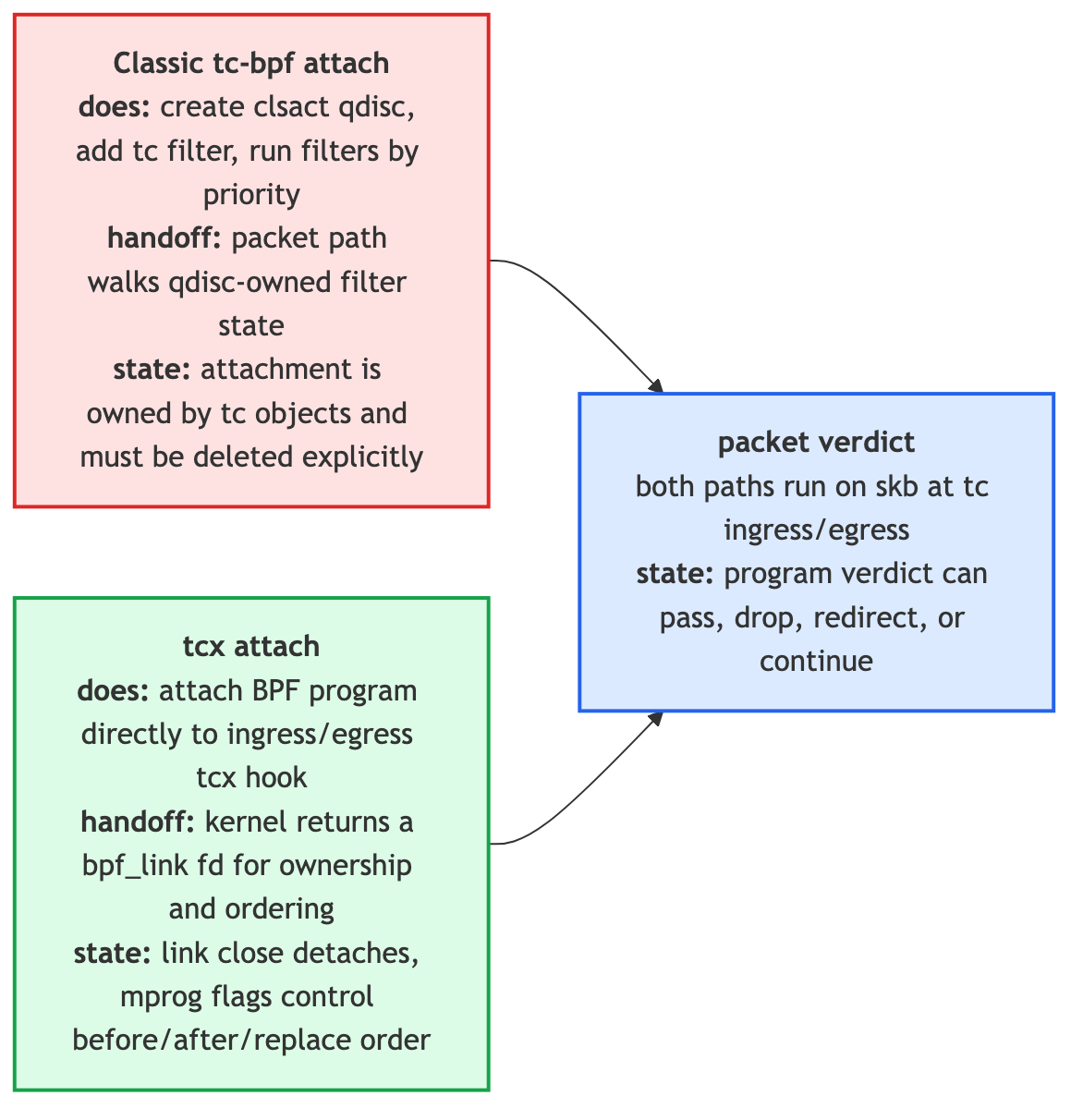
One syscall to attach. Returns a bpf_link FD. Closing the FD detaches. And ordering between multiple programs uses mprog, the same multi-program abstraction that backs tcx and netkit.
Refresher: what a bpf_link is (Day 14, Day 16)
You met bpf_link on Day 14 with XDP: bpf_program__attach_xdp returned a struct bpf_link, and closing its FD auto-detached the program (day14.md:166,185,213). Day 16 contrasted that with classic tc-bpf, which has no FD ownership at all (day16.md:210,278). One line to carry forward:
A
bpf_linkis a kernel object representing one attachment and holding one reference to the program. The userspace FD owns that link — close the FD (or exit the process) and the ref drops, detaching the program. The program itself is unloaded only when its last reference (link, pinned fd, or open program fd) goes away.
In v7.1, libbpf names this link type "tcx" (tools/lib/bpf/libbpf.c:153, BPF_LINK_TYPE_TCX), and the per-device chain it plugs into is struct bpf_mprog_entry __rcu *tcx_ingress; on the net device (include/linux/netdevice.h:2196).
mprog: ordered chains of BPF programs
Multiple BPF programs can attach to the same hook (one tcx-ingress on eth0 can have N programs). mprog defines deterministic ordering with attach-time flags:
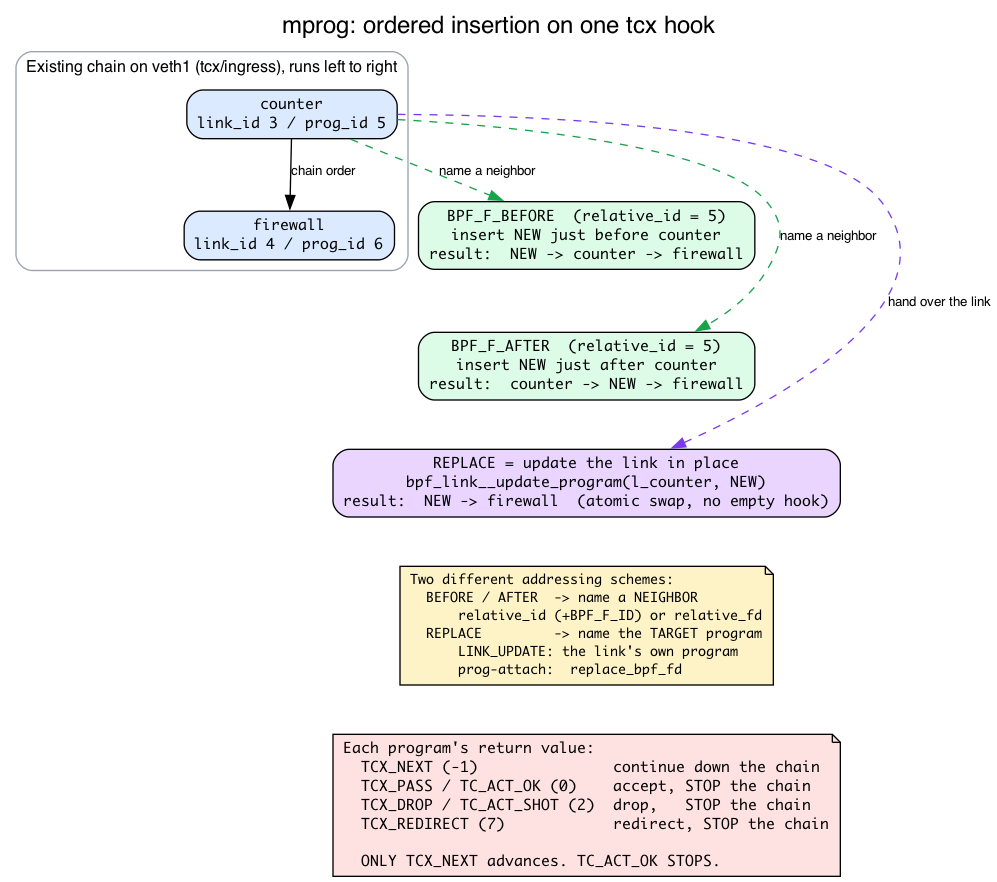
BPF_F_BEFORE— attach before the named program.BPF_F_AFTER— attach after the named program.BPF_F_REPLACE— replace a specific program in place.BPF_F_LINK— interpret the relative target as a link ID/fd rather than a program ID/fd.BPF_F_ID— interpret the relative target as an ID rather than an fd (used withrelative_id).
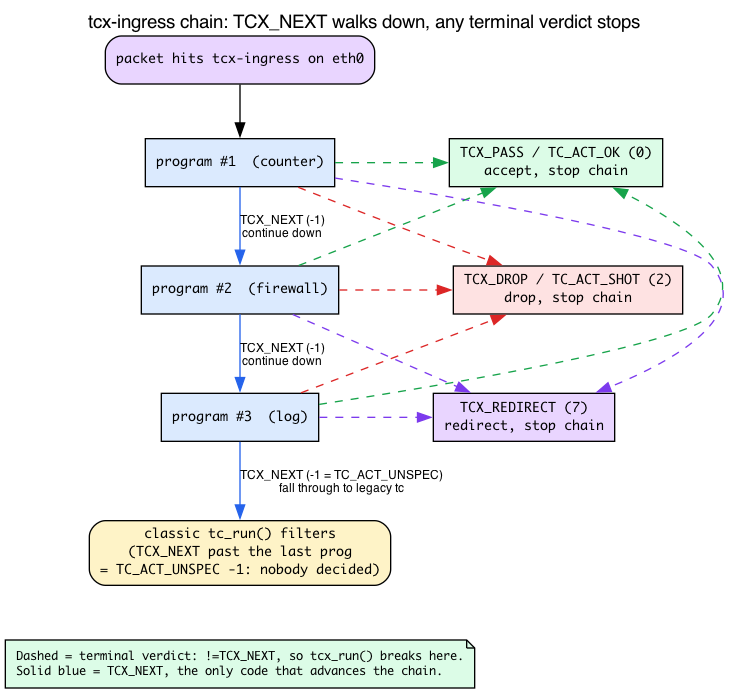
The chain runs each program in order — but how a program says “keep going” is the one thing you must get right, and it is not what classic tc-bpf taught you.
The verdict that advances the chain: TCX_NEXT, not TC_ACT_OK
Here is the kernel’s per-hook chain runner, tcx_run() in net/core/dev.c (line 4439). Read it slowly — it is short, and every line matters:
/* net/core/dev.c:4439 */
static __always_inline enum tcx_action_base
tcx_run(const struct bpf_mprog_entry *entry, struct sk_buff *skb,
        const bool needs_mac)
{
    const struct bpf_mprog_fp *fp;
    const struct bpf_prog *prog;
    int ret = TCX_NEXT;                 /* :4444 — seed: "no decision yet" */

    if (needs_mac)
        __skb_push(skb, skb->mac_len);
    bpf_mprog_foreach_prog(entry, fp, prog) {   /* :4448 */
        bpf_compute_data_pointers(skb);
        ret = bpf_prog_run(prog, skb);          /* :4450 */
        if (ret != TCX_NEXT)                     /* :4451 */
            break;                               /*  ← ANY other value stops the chain */
    }
    if (needs_mac)
        __skb_pull(skb, skb->mac_len);
    return tcx_action_code(skb, ret);
}
Stare at if (ret != TCX_NEXT) break;. A program continues the chain only by returning TCX_NEXT. Any other return value — including the familiar TC_ACT_OK — terminates the chain right there.
That is the trap. On Day 16 you learned the classic tc-bpf verdicts: TC_ACT_OK (“accept, let it proceed”), TC_ACT_SHOT (“drop”), TC_ACT_REDIRECT (“redirect”). It is very tempting to assume TC_ACT_OK is how one tcx program lets the next one run. It is not. Look at the numbers, side by side:
/* include/uapi/linux/bpf.h:6530 — the NEW tcx contract */
enum tcx_action_base {
    TCX_NEXT     = -1,
    TCX_PASS     = 0,
    TCX_DROP     = 2,
    TCX_REDIRECT = 7,
};

/* include/uapi/linux/pkt_cls.h:63 — the legacy tc-classic codes */
#define TC_ACT_UNSPEC   (-1)
#define TC_ACT_OK        0
#define TC_ACT_SHOT      2
#define TC_ACT_REDIRECT  7
The terminal numbers line up on purpose (the uapi comment says tcx codes “must remain compatible with their TC_ACT_* counter-parts”): TCX_PASS == TC_ACT_OK == 0, TCX_DROP == TC_ACT_SHOT == 2, TCX_REDIRECT == TC_ACT_REDIRECT == 7. The genuinely new value is TCX_NEXT = -1, which has no tc-classic verdict equivalent — its numeric twin is TC_ACT_UNSPEC (“nobody decided”).
So return TC_ACT_OK; returns 0, which equals TCX_PASS, which is != TCX_NEXT, so the chain stops with an accept verdict. It does the opposite of “let the next program run.”
Where -1 goes after the chain: tcx_action_code() and the tc fall-through
What does tcx_run() do with that seeded-or-returned ret? It funnels it through tcx_action_code() (include/net/tcx.h:145):
/* include/net/tcx.h:145 */
static inline enum tcx_action_base tcx_action_code(struct sk_buff *skb, int code)
{
    switch (code) {
    case TCX_PASS:
        skb->tc_index = qdisc_skb_cb(skb)->tc_classid;
        fallthrough;
    case TCX_DROP:
    case TCX_REDIRECT:
        return code;            /* a real verdict — pass it straight through */
    case TCX_NEXT:
    default:
        return TCX_NEXT;        /* TCX_NEXT or anything unrecognized -> TCX_NEXT (-1) */
    }
}
TCX_PASS/TCX_DROP/TCX_REDIRECT come back as themselves — a final verdict. But TCX_NEXT (and any unknown code) maps to TCX_NEXT == -1. And -1 is exactly TC_ACT_UNSPEC, which the ingress dispatcher reads as “no tcx program decided — fall through to classic tc”:
/* net/core/dev.c:4481 */
sch_ret = tcx_run(entry, skb, true);
if (sch_ret != TC_ACT_UNSPEC)        /* :4482 */
    goto ingress_verdict;            /* a real verdict — act on it */
sch_ret = tc_run(tcx_entry(entry), skb, &drop_reason);   /* :4485 — else legacy tc filters */
So if the last program in the chain returns TCX_NEXT, control falls through to legacy tc_run() filters — not “accept.” TCX_NEXT means “I defer,” all the way down to the classic tc layer.
The mental model to keep
A tcx program has two jobs it can do per packet:
- Defer — “let the next link decide” — by returning
TCX_NEXT. Counters, tracers, observability programs that don’t make policy returnTCX_NEXT. - Decide — make the final call and short-circuit the rest of the chain — by returning a terminal verdict:
TCX_PASS/TC_ACT_OK(accept),TCX_DROP/TC_ACT_SHOT(drop), orTCX_REDIRECT(redirect). Firewalls and policy programs return a terminal verdict.
This is composable: a counter, a firewall, a tracer can each be installed independently and their ordering controlled at attach time — as long as the observability links return TCX_NEXT so the policy links downstream actually run.
There are no Dumb Questions
Q: If I close the link FD, does the BPF object get unloaded?
A: Only if there are no other references. The link is one ref to the program; closing it drops that ref. If userspace still holds a
bpf_program__fdor the program is pinned in/sys/fs/bpf, it stays loaded but unattached.Q: Does
tcxwork alongside legacytc filter add ... bpf?A: Yes. They share the same hook point; multiple attach mechanisms can coexist. In fact you just saw the coexistence in the source: a tcx chain that ends in
TCX_NEXTfalls through totc_run()’s classic filters. But you generally don’t want to mix — pick one for a given system.Q: Does mprog also exist for XDP?
A: There’s
xdp_multi-attach but the abstraction is slightly different (XDP doesn’t use mprog the same way). For XDP, multi-program is typically done with a “dispatcher” program in front andBPF_PROG_RUNtail calls. We won’t cover that today.
The lab
Refresher: __sk_buff direct packet access and PERCPU_ARRAY (Day 14, Day 16)
The firewall below reads packet bytes and the counter uses a per-CPU map. Both are concepts earlier days own — one line each:
struct __sk_buff+data/data_end(Day 16,day16.md:15-58,83-109):__sk_buffis the typed BPF view of the kernel’ssk_buff;data/data_endbound the packet window, and every pointer step must be re-bounds-checked before you dereference it — the same discipline as XDP. The terminal verdictsTC_ACT_OK/TC_ACT_SHOT/TC_ACT_REDIRECTcarry over from tc-bpf unchanged; only the chain-advance codeTCX_NEXTis new (above).BPF_MAP_TYPE_PERCPU_ARRAY(Day 14,day14.md:108,133,142,174-179): each CPU gets its own value slot, so the in-kernel increment needs no atomic; userspace must sum across all CPUs (libbpf_num_possible_cpus()) to get the true total.
tcx.bpf.c
Included from the source the lab build and CI compile. (TCX_NEXT is a BTF
enum from vmlinux.h; the terminal TC_ACT_* codes are defined locally
because <linux/pkt_cls.h> cannot be mixed with vmlinux.h.)
#include “vmlinux.h” #include <bpf/bpf_helpers.h> #include <bpf/bpf_endian.h>
/* TCX_NEXT (enum tcx_action_base) is a BTF enum, so it comes from vmlinux.h.
- The terminal TC_ACT_* verdicts are UAPI #defines that vmlinux.h does not
- carry, and <linux/pkt_cls.h> can’t be mixed with vmlinux.h (it redefines
- struct tc_stats etc.). Define the two we return locally. ETH_P_IP is a UAPI
- #define too; IPPROTO_UDP already comes from vmlinux.h. */ #define TC_ACT_OK 0 #define TC_ACT_SHOT 2 #define ETH_P_IP 0x0800
char LICENSE[] SEC(“license”) = “GPL”;
struct { __uint(type, BPF_MAP_TYPE_PERCPU_ARRAY); __uint(max_entries, 2); __type(key, __u32); __type(value, __u64); } stats SEC(“.maps”);
static __always_inline void bump(__u32 idx) { __u64 *c = bpf_map_lookup_elem(&stats, &idx); if (c) (*c)++; }
SEC(“tcx/ingress”) int counter(struct __sk_buff skb) { (void)skb; bump(0); / count all / return TCX_NEXT; / DEFER: let the next link (firewall) decide */ }
SEC(“tcx/ingress”) int firewall(struct __sk_buff *skb) { void *data = (void *)(long)skb->data; void *end = (void *)(long)skb->data_end; struct ethhdr *eth = data; if (eth + 1 > end) return TCX_NEXT; if (eth->h_proto != bpf_htons(ETH_P_IP)) return TCX_NEXT; struct iphdr *ip = (void )(eth + 1); if (ip + 1 > end) return TCX_NEXT; if (ip->protocol == IPPROTO_UDP) { bump(1); return TC_ACT_SHOT; / DECIDE: drop the UDP datagram, stop the chain / } return TCX_NEXT; / DEFER on everything else */ }
Two design points, both consequences of tcx_run():
counterreturnsTCX_NEXT, notTC_ACT_OK. This is the correction that makes the lab work. IfcounterreturnedTC_ACT_OK(=0=TCX_PASS),tcx_run()would seeret != TCX_NEXT,breakafter the first program, andfirewallwould never run —udp_dropwould stay0forever. ReturningTCX_NEXTis what lets the chain advance tofirewall.firewallreturnsTCX_NEXTfor traffic it doesn’t care about (non-IP, non-UDP) and the terminalTC_ACT_SHOTonly for the UDP it actually drops. Sincefirewallis last in the chain, itsTCX_NEXTfalls through to classictc(here: nothing), which accepts the packet — exactly what we want for the ICMP we’re letting through.
Attach via tcx, ordered
The loader is built as ./tcx; the listing is included from the source
the lab build and CI compile:
#include <errno.h> #include <net/if.h> #include <signal.h> #include <stdio.h> #include <string.h> #include <unistd.h>
#include <bpf/bpf.h> #include <bpf/libbpf.h>
#include “tcx.skel.h” /* generated from tcx.bpf.o */
static volatile sig_atomic_t exiting;
static void handle_signal(int signal_number) { (void)signal_number; exiting = 1; }
static int install_signal_handlers(void) { const struct sigaction action = { .sa_handler = handle_signal, };
if (sigaction(SIGINT, &action, NULL) != 0 ||
    sigaction(SIGTERM, &action, NULL) != 0) {
    fprintf(stderr, "failed to install signal handlers: %s\n",
            strerror(errno));
    return -errno;
}

return 0;
}
static int sum_slot(int fd, __u32 key, int ncpu, __u64 *out) { __u64 vals[ncpu]; __u64 total = 0;
if (bpf_map_lookup_elem(fd, &key, vals) != 0)
    return -1;
for (int i = 0; i < ncpu; i++)
    total += vals[i];
*out = total;
return 0;
}
int main(int argc, char **argv) { struct tcx_bpf *skel = NULL; struct bpf_link l1 = NULL; / counter */ struct bpf_link l2 = NULL; / firewall */ unsigned int ifindex; int fd, ncpu; int err;
setvbuf(stdout, NULL, _IOLBF, 0);

if (argc < 2) {
    fprintf(stderr, "usage: %s <iface>\n", argv[0]);
    return 1;
}
ifindex = if_nametoindex(argv[1]);
if (!ifindex) {
    fprintf(stderr, "if_nametoindex(%s): %s\n", argv[1], strerror(errno));
    return 1;
}

err = install_signal_handlers();
if (err)
    return 1;

skel = tcx_bpf__open_and_load();
if (!skel) {
    fprintf(stderr, "failed to open and load tcx BPF skeleton\n");
    return 1;
}

/* counter goes first */
LIBBPF_OPTS(bpf_tcx_opts, opts1);
l1 = bpf_program__attach_tcx(skel->progs.counter, ifindex, &opts1);
if (!l1) {
    err = -errno;
    fprintf(stderr, "attach counter failed: %s\n", strerror(errno));
    goto cleanup;
}

/* firewall goes after counter */
LIBBPF_OPTS(bpf_tcx_opts, opts2, .flags = BPF_F_AFTER);
l2 = bpf_program__attach_tcx(skel->progs.firewall, ifindex, &opts2);
if (!l2) {
    err = -errno;
    fprintf(stderr, "attach firewall failed: %s\n", strerror(errno));
    goto cleanup;
}

ncpu = libbpf_num_possible_cpus();
if (ncpu <= 0) {
    fprintf(stderr, "libbpf_num_possible_cpus failed\n");
    err = 1;
    goto cleanup;
}

fd = bpf_map__fd(skel->maps.stats);
printf("tcx counter+firewall attached to %s; press Ctrl-C to stop.\n",
       argv[1]);
while (!exiting) {
    __u64 total = 0, udp_drop = 0;

    sum_slot(fd, 0, ncpu, &total);      /* key 0: all packets */
    sum_slot(fd, 1, ncpu, &udp_drop);   /* key 1: dropped UDP */
    printf("total: %llu  udp_drop: %llu\n", total, udp_drop);

    if (sleep(2) != 0)
        break;
}

err = 0;
cleanup: bpf_link__destroy(l2); /* detaches; FD-based */ bpf_link__destroy(l1); tcx_bpf__destroy(skel); return err != 0; }
Two programs, both at tcx-ingress. The counter runs first; because it returns TCX_NEXT, the chain advances and firewall runs after. (If counter had returned a terminal code such as TC_ACT_SHOT, the chain would stop and firewall would never see the packet — that’s the whole point of the verdict section above.)
Set up the topology
The lab needs an interface to attach to and real traffic crossing it. Build a veth pair with the far end in its own namespace — exactly as on Day 14:
sudo ip netns add ns1
sudo ip link add veth0 type veth peer name veth1
sudo ip link set veth1 netns ns1
sudo ip addr add 10.0.0.1/24 dev veth0
sudo ip link set veth0 up
sudo ip netns exec ns1 ip addr add 10.0.0.2/24 dev veth1
sudo ip netns exec ns1 ip link set veth1 up
Why the namespace? If both ends shared the root namespace, 10.0.0.2 would be a local address and the kernel would short-circuit ping 10.0.0.2 through lo — the packet would never cross the wire into veth1’s ingress, and neither counter nor firewall would ever run. Putting veth1 in ns1 forces traffic across the link. We attach inside ns1; pinging from the host sends packets out veth0, into veth1’s ingress where the tcx chain fires.
Inspect the chain
The attachments live on veth1, which is inside ns1, so query bpftool in that namespace:
sudo ip netns exec ns1 bpftool net show
You’ll see:
xdp:
tc:
   veth1(3) tcx/ingress counter prog_id 5 link_id 3
   veth1(3) tcx/ingress firewall prog_id 6 link_id 4
Note the prog_id and link_id columns — these are the mprog IDs. A link_id is the handle you reach for when you want to replace a program (Break 4 updates the link); a prog_id/link_id is what you pass as relative_id to position a new program BEFORE/AFTER an existing one. Keep this output in mind.
Run
make
sudo ip netns exec ns1 ./tcx veth1 &
# From the host (root namespace):
ping -c 3 10.0.0.2                     # works (counter defers, firewall passes ICMP)
echo ping | nc -u -w1 10.0.0.2 9999    # blocked (firewall drops the UDP datagram)
The loader prints the summed per-CPU counters every 2 seconds. After the ping and the single UDP send:
total: 4 udp_drop: 1
The 3 ICMP packets arriving on veth1’s ingress plus the 1 UDP datagram make total: 4; the firewall drops that one UDP datagram, so udp_drop: 1. (The dropped datagram gets no reply, so there is nothing else to count.) This total: 4 udp_drop: 1 is exactly what proves the chain advanced past counter: if counter had ended the chain, firewall could never have incremented udp_drop.
The loader runs backgrounded under sudo, so Ctrl-C (delivered to the foreground process group) won’t reach it. Signal it directly:
sudo pkill -INT tcx                         # closing its bpf_link FDs auto-detaches both programs
sudo ip netns exec ns1 bpftool net show     # the tcx entries on veth1 are now gone
Then tear down the topology:
sudo ip link del veth0    # deletes the pair (veth1 goes with it)
sudo ip netns del ns1     # remove the namespace
What to break, in order
Break 1 — Forget BPF_F_AFTER
Both programs use default flags. With no BPF_F_BEFORE/BPF_F_AFTER and no relative target, mprog defaults to appending after existing programs (bpf_mprog_attach sets idx = bpf_mprog_total(entry) and flags = BPF_F_AFTER, kernel/bpf/mprog.c). So the order ends up counter → firewall here by default — but don’t rely on it implicitly; pass BPF_F_BEFORE/BPF_F_AFTER to make ordering explicit. Inspect with bpftool net show to verify.
Break 2 — Pin the link
bpf_link__pin(l1, "/sys/fs/bpf/counter_link");
This is the bpffs pinning you met on Day 15 (sharing/keeping BPF objects alive across process lifetime, day15.md:193,197,234) and Day 03 (the /sys/fs/bpf pin/rm mechanics, day03.md:373). One line to carry forward:
Pinning creates a bpffs reference that keeps the link — and therefore the attachment — alive after the loader process exits; removing the pin drops that reference and detaches.
Now even if your loader exits, the link persists (the bpffs pin holds a reference). Useful for daemons that load BPF then exit. Watch it survive: with the loader still running, the counter shows up attached and as a pinned link object —
sudo ip netns exec ns1 bpftool net show              # counter listed on veth1
sudo bpftool link show pinned /sys/fs/bpf/counter_link
Now stop the loader (sudo pkill -INT tcx). The unpinned firewall link detaches, but the pinned counter link survives — re-run both commands and the counter is still attached and still pinned, even though no process holds it. (bpffs must be mounted at /sys/fs/bpf, which is why these need sudo.) Detach it for real by removing the pin:
sudo rm /sys/fs/bpf/counter_link
sudo ip netns exec ns1 bpftool net show              # counter now gone — hook empty
That before/after contrast is the whole point of pinning.
Break 3 — Mix XDP and tcx
Attach an XDP counter and a tcx counter to the same interface. Both run, in order: XDP first (no skb), tcx after (with skb). Useful pattern: XDP for raw drops, tcx for skb-aware logic.
Break 4 — Replace a link
To swap the program behind an existing tcx bpf_link, you update the link in place — you do hand over the link handle:
/* l1 is the bpf_link returned by bpf_program__attach_tcx for `counter`.
   Swap its program for new_prog atomically, with no empty-hook window. */
int err = bpf_link__update_program(l1, skel->progs.new_prog);   /* LINK_UPDATE */
This issues BPF_LINK_UPDATE. Inside the kernel, tcx_link_update() builds the mprog call for you — it does not ask you to name a neighbor. It targets the link’s current program explicitly (kernel/bpf/tcx.c:232):
/* kernel/bpf/tcx.c:232 — inside tcx_link_update() */
ret = bpf_mprog_attach(entry, &entry_new, nprog, link, oprog,
                       BPF_F_REPLACE | BPF_F_ID,
                       link->prog->aux->id, 0);   /* old prog named by the link itself */
if (!ret)
    oprog = xchg(&link->prog, nprog);             /* :237 — atomic swap */
The kernel synthesizes BPF_F_REPLACE | BPF_F_ID against link->prog->aux->id internally and swaps via bpf_mprog_replace — there is no window where the hook is empty. The v7.1 selftest proves this is the only way: tc_links.c:718-759 asserts that a fresh attach carrying BPF_F_REPLACE fails (link_attach_should_fail), then performs the replace via bpf_link__update_program() (tc_links.c:759).
Why can’t a fresh bpf_program__attach_tcx replace a link’s program? Look at struct bpf_tcx_opts (tools/lib/bpf/libbpf.h:900) — its entire surface:
struct bpf_tcx_opts {
    size_t sz;
    __u32  flags;
    __u32  relative_fd;
    __u32  relative_id;
    __u64  expected_revision;
};
#define bpf_tcx_opts__last_field expected_revision
There is no replace-target field. A fresh attach issues LINK_CREATE, whose uapi only carries relative_fd / relative_id / expected_revision (include/uapi/linux/bpf.h:1836-1839) — there is nowhere to name the program being replaced. On the link-create path the kernel passes prog_old = NULL into bpf_mprog_attach (kernel/bpf/mprog.c:225), so bpf_mprog_pos_exact() looks up a NULL program, returns -ENOENT, and the attach fails. That absent field is precisely why link replacement must go through bpf_link__update_program.
The two roles, untangled. relative_id / relative_fd (with BPF_F_ID / BPF_F_LINK) name a neighbor — and they are consumed only for BPF_F_BEFORE / BPF_F_AFTER. BPF_F_REPLACE names the target program, not via the relative tuple at all:
- In the non-link prog-attach API, the target is
attr->replace_bpf_fd(kernel/bpf/tcx.c:25-26). - In
LINK_UPDATE, the target is the link’s own current program (kernel/bpf/tcx.c:232, shown above).
The kernel resolves a relative neighbor through bpf_mprog_tuple_relative() (kernel/bpf/mprog.c:53):
/* kernel/bpf/mprog.c */
bool id = flags & BPF_F_ID;          /* BPF_F_ID set? -> the u32 is an ID, not an fd */
...
if (!id && !id_or_fd)                 /* neither flag nor value -> "first/last position" */
    return 0;
So the single u32 is interpreted as a program/link ID when BPF_F_ID is set (use relative_id), or as a file descriptor when it isn’t (use relative_fd) — but this addressing applies to the BEFORE/AFTER neighbor, never to the replace target.
What the flags do at attach time (kernel/bpf/mprog.c, inside bpf_mprog_attach; line numbers are the call sites in bpf_mprog_attach, with each helper’s definition in parentheses):
| Flag | Position helper | Effect |
|---|---|---|
BPF_F_BEFORE | bpf_mprog_pos_before (call :261, def :193) | insert before the named neighbor |
BPF_F_AFTER | bpf_mprog_pos_after (call :269, def :209) | insert after the named neighbor |
BPF_F_REPLACE | bpf_mprog_pos_exact (call :250, def :178) | swap out the exact named program |
| (none, no target) | default | idx = bpf_mprog_total(entry); flags = BPF_F_AFTER; (:281) — append at the end |
That last row is exactly the default Break 1 relies on.
expected_revision: optimistic concurrency. Each mprog entry carries a revision counter. If you pass a non-zero expected_revision that doesn’t match the live one, the attach fails:
/* kernel/bpf/mprog.c:240 */
if (revision && revision != bpf_mprog_revision(entry))
    return -ESTALE;
This lets a chain manager notice that someone else changed the chain since it last looked, instead of blindly clobbering it. You can leave it 0 to opt out (as our lab does); pass the value you read to get a compare-and-swap. expected_revision rides along on a fresh LINK_CREATE attach — it is the one optimistic-concurrency knob bpf_tcx_opts exposes.
So Break 4 splits cleanly in two: to insert a program next to a neighbor you use BPF_F_BEFORE/BPF_F_AFTER with relative_id/relative_fd; to replace the program behind a link you call bpf_link__update_program(link, new_prog) and let the kernel swap link->prog atomically — no window where the hook is empty.
What to read in the kernel
kernel/bpf/tcx.c— the whole file is ~350 lines (346 in v7.1). Read it.kernel/bpf/mprog.c— the multi-program ordering machinery. Used by tcx, netkit, and others. Readbpf_mprog_attach(:225) andbpf_mprog_tuple_relative(:53) to see the BEFORE/AFTER/REPLACE and ID-vs-fd logic from Break 4.net/core/dev.c—tcx_run(:4439) andsch_handle_ingress(:4459). This is where theTCX_NEXT-vs-terminal split and the fall-through totc_run()actually live.tools/lib/bpf/libbpf.c— searchbpf_program__attach_tcx. The userspace wrapper.tools/testing/selftests/bpf/prog_tests/tc_opts.c— extensive tcx tests.
Bullet Points
- tcx is the modern attach for tc-position BPF programs. Same hook position as tc-bpf classic, better lifecycle.
- Returns a
bpf_linkFD; closing it detaches (Day 14/16 ownership model). Pin into bpffs (Day 15/03) to survive loader exit. - The chain advances only on
TCX_NEXT(-1).tcx_run()doesif (ret != TCX_NEXT) break;— any other value, includingTC_ACT_OK(0), terminates the chain. Observability programs returnTCX_NEXTto defer; policy programs return a terminal verdict (TCX_PASS/TC_ACT_OK=0,TCX_DROP/TC_ACT_SHOT=2,TCX_REDIRECT=7) to decide and stop. - A trailing
TCX_NEXT(=TC_ACT_UNSPEC= -1) falls through to classictc_run()filters, not “accept.” - mprog orders multiple programs via attach-time flags:
BPF_F_BEFORE/BPF_F_AFTERposition a new program relative to a neighbor named byrelative_id(+BPF_F_ID) orrelative_fd.BPF_F_REPLACEis different — it names the target program directly (viareplace_bpf_fdin prog-attach, or the link itself inLINK_UPDATE/bpf_link__update_program), not via the relative tuple.expected_revisionis an-ESTALE-guarded compare-and-swap. Default with no target: append (BPF_F_AFTER). BPF_MAP_TYPE_PERCPU_ARRAY(Day 14): per-CPU slots, no atomic in kernel, sum across CPUs in userspace.- No
tc qdisc add clsactceremony — kernel installs the hook implicitly. - Inspect with
bpftool net show(it prints theprog_id/link_idyou feed to mprog). - For new code, always tcx, never classic tc-bpf.
Check question
You attach three programs to tcx-ingress on eth0, in order: count, firewall, log. You want every packet counted and logged, with firewall dropping UDP in between. What must count return so that firewall and log run at all — and what happens to a UDP packet versus a TCP packet as it walks the chain?
Click to reveal answer
Answer: count must return TCX_NEXT (-1). tcx_run() continues the chain only while each program returns TCX_NEXT; if count returned TC_ACT_OK (0 = TCX_PASS), the runner’s if (ret != TCX_NEXT) break; would fire and the chain would stop after count — firewall and log would never run. This is the opposite of the classic tc-bpf intuition where TC_ACT_OK means “proceed.”
For a TCP packet: count returns TCX_NEXT → firewall sees TCP, returns TCX_NEXT → log runs, returns TCX_NEXT → chain falls through to classic tc (and is accepted). All three programs ran.
For a UDP packet: count returns TCX_NEXT → firewall returns the terminal TC_ACT_SHOT (2 = TCX_DROP), which is != TCX_NEXT, so the chain stops there. log never runs for that packet, and the packet is dropped.
Lesson, corrected for tcx: order observability before policy, and make observability programs return TCX_NEXT (defer) — only the program that makes the final decision returns a terminal verdict, and that verdict short-circuits everything after it. If you put log after firewall, dropped UDP is never logged.
Tomorrow
Day 18: AF_XDP — bypass the kernel network stack entirely. Get raw packets to a userspace ring at 30+ Mpps per core.