Day 19 — cgroup BPF and sockops: policy at the socket layer
Today’s mission: filter network access per cgroup, then tune TCP behavior per cgroup. Learn what a cgroup v2 actually is, how a socket carries its cgroup with it, how the kernel turns your program’s return value into a packet verdict, and how one
sock_opsprogram gets re-entered at every step of a TCP handshake. End of Phase 3. Total time: ~110 minutes.
Above the packet, below the socket
Days 14–18 worked at the packet layer. Today goes higher: the socket and cgroup layers. Two related families:
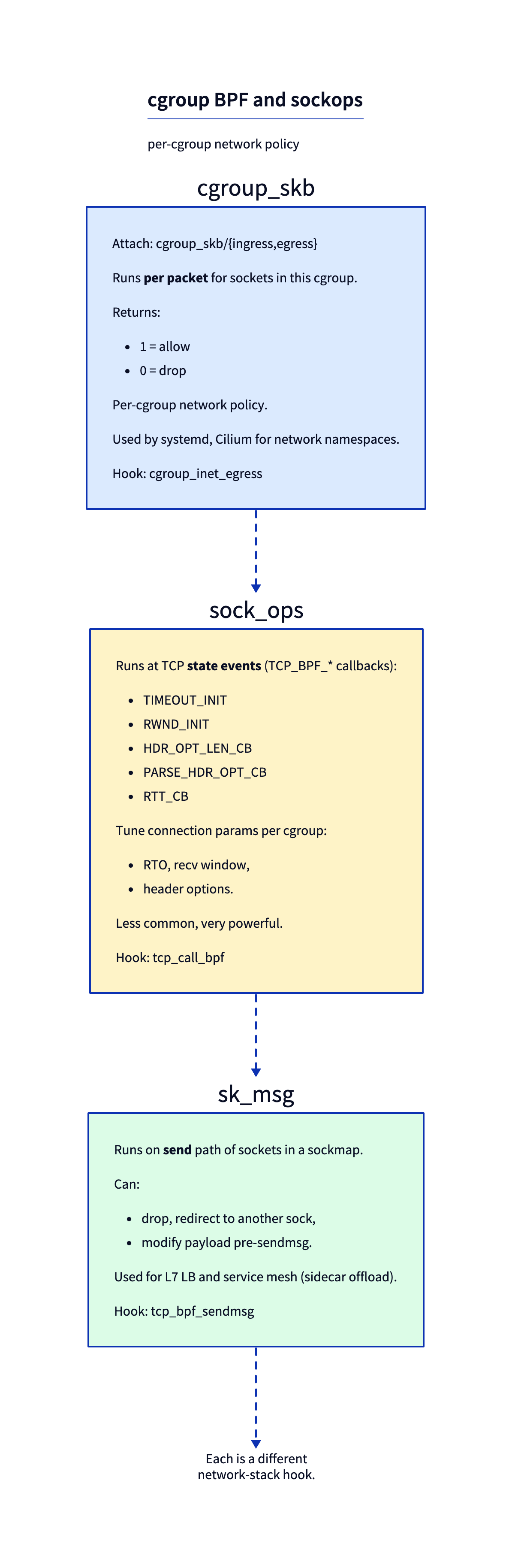
cgroup_skb— fires per-packet for sockets in a cgroup. Returns 0 (drop) or 1 (allow). Used for namespaced firewalls.sock_ops— fires at TCP state-machine events (connect, ESTABLISHED, RTT updates, header option negotiation). Tune connection params per cgroup.sk_msg— fires onsendmsgfor sockets in a sockmap; used for L7 load balancing (Cilium service mesh).cgroup_sock_addr— fires onconnect(),bind(),sendmsg()to UDP, etc. Modify sockaddr (do socket-level NAT).
These programs run in process context with the full non-sleepable helper set, so they can call helpers like bpf_setsockopt. (They are not sleepable — see can_be_sleepable() in the verifier if you ever need the exact list of program types that are.)
But every one of those program types rests on a single idea this chapter has to make solid first: a cgroup. Everything else today — why a packet’s egress program knows which policy applies to it, why a process that joins a directory is instantly subject to a firewall, why you can pick BBR for one set of connections and CUBIC for another — falls out of one fact about how Linux ties a socket to a cgroup. So we start there.
What a cgroup v2 actually is
You have heard “cgroups partition resources (CPU, memory, IO, network)” a hundred times. That sentence is true and useless. Here is the part that matters for BPF.
A cgroup v2 hierarchy is a single tree of directories, mounted once at /sys/fs/cgroup with filesystem type cgroup2. That word single is the whole point. Old cgroup v1 had a separate tree per controller — one mount for cpu, another for memory, another for net_cls — and a process could sit in different places in each tree at once. v2 collapsed all of that into one unified hierarchy: every process lives at exactly one node in one tree, and all controllers (cpu, memory, io, …) are just knobs enabled on the nodes of that one tree. When you mount | grep cgroup2 and see cgroup2 on /sys/fs/cgroup type cgroup2, you are looking at the root of that single tree.
Each directory is a cgroup. Membership is a file. Make a directory under /sys/fs/cgroup and you have created a child cgroup. Inside it the kernel materializes control files — cgroup.procs, cgroup.controllers, and so on. The one that matters today is cgroup.procs: writing a PID into a cgroup’s cgroup.procs file moves that task (and all its threads) into that cgroup. That is literally all membership is — a number written into a file. When a controlled child runs echo $$ > "$CG/cgroup.procs", $$ is that child shell’s PID and the write relocates only that child into the owned cgroup. Membership can be changed again with another cgroup.procs write, but this lab deliberately leaves your interactive shell untouched.
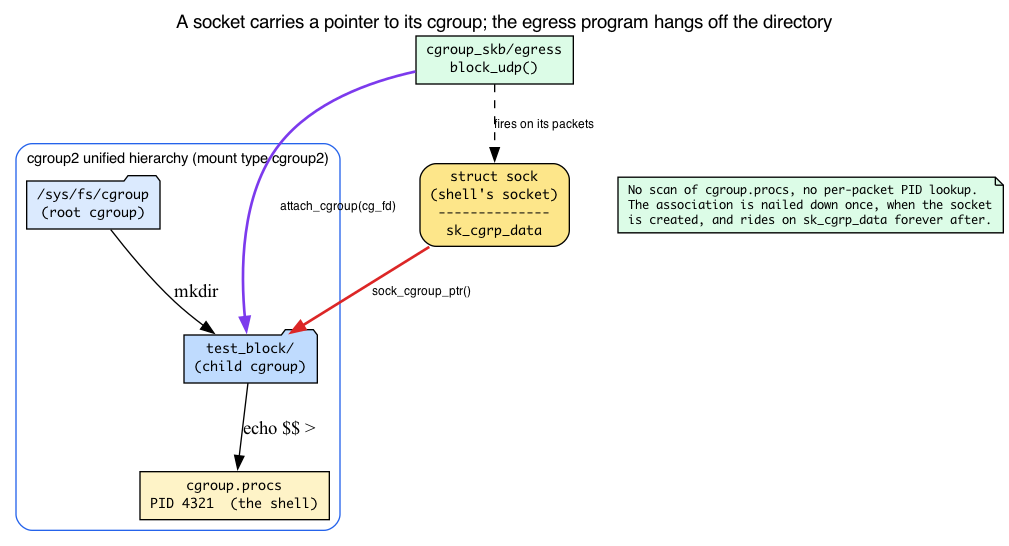
How a packet’s program knows which cgroup it belongs to
Here is the question the old version of this chapter waved away. The “Dumb Questions” answer below asserts “the kernel knows which cgroup the destination socket belongs to.” How? It is not magic, and it is not a lookup. It is a pointer stored on the socket.
Every socket records the cgroup of the task that created it. The kernel embeds a small struct directly inside struct sock:
/* include/linux/cgroup-defs.h:920 */
/* sock_cgroup_data is embedded at sock->sk_cgrp_data and contains
 * per-socket cgroup information except for memcg association. */
So struct sock carries a struct sock_cgroup_data sk_cgrp_data field, and the helper sock_cgroup_ptr() resolves it to the owning struct cgroup *. When a packet leaves a socket, the cgroup BPF dispatch path does exactly this:
/* kernel/bpf/cgroup.c:1574, inside __cgroup_bpf_run_filter_skb() */
cgrp = sock_cgroup_ptr(&sk->sk_cgrp_data);
That single line is “the kernel knows which cgroup the socket belongs to.” It dereferences a pointer the socket has been carrying since birth, gets the cgroup, and runs that cgroup’s attached programs. There is no scan of cgroup.procs, no per-packet PID lookup — the association was nailed down once, when the socket was created, and rides along on the socket forever after.
One guard sits right above that line: cgroup_skb only applies to IP sockets.
/* kernel/bpf/cgroup.c:1571 */
if (sk->sk_family != AF_INET && sk->sk_family != AF_INET6)
    return 0;
A Unix-domain socket or a netlink socket sails straight through your egress firewall untouched — the hook returns 0 (allow) before your program ever runs. Good to know before you wonder why your “block everything” program let the X server talk to its clients.
How you attach, and what “hierarchical” means
A cgroup BPF program does not attach to an interface or a PID. It attaches to a cgroup directory’s file descriptor. That is why the loader does open(cg_path, O_RDONLY | O_DIRECTORY) — it is opening the explicitly supplied directory to get an fd, and bpf_program__attach_cgroup hands that fd to the kernel. From then on the program fires for every socket whose sk_cgrp_data points at that cgroup (or a descendant of it). This is why a process that joins the cgroup after you attach is immediately covered: it inherits the cgroup, its new sockets get sk_cgrp_data pointing there, and the dispatch path finds your program. Nothing has to be re-attached.
Attachment is hierarchical: a program on a parent cgroup also covers its children. When more than one level wants a program, v7.1 gives you attach flags to choose how they combine:
/* include/uapi/linux/bpf.h:1200-1219 */
/* BPF_F_ALLOW_OVERRIDE: a child's program yields to / replaces the parent's. */
/* BPF_F_ALLOW_MULTI:    programs from multiple levels all run, in FIFO order
 *                       (child programs first, then this cgroup, then parent). */
You will not need either today — libbpf’s attach_cgroup uses the default single-program semantics (one program per cgroup, NONE flags). But know multi-attach exists: it is how a node-level agent and a pod-level policy can coexist on the same socket.
Why cgroups, for BPF specifically
Now the one-liner finally lands. BPF cgroup hooks let you attach policy to a cgroup directory that runs only for the sockets of processes in that cgroup — because those sockets carry a pointer back to the cgroup. This is how systemd, Cilium, and Kubernetes sidecars implement per-pod or per-service network rules without iptables overhead: a pod is a cgroup, so “this pod’s traffic” is just “sockets whose sk_cgrp_data points here.”
sockops example: per-cgroup TCP tuning
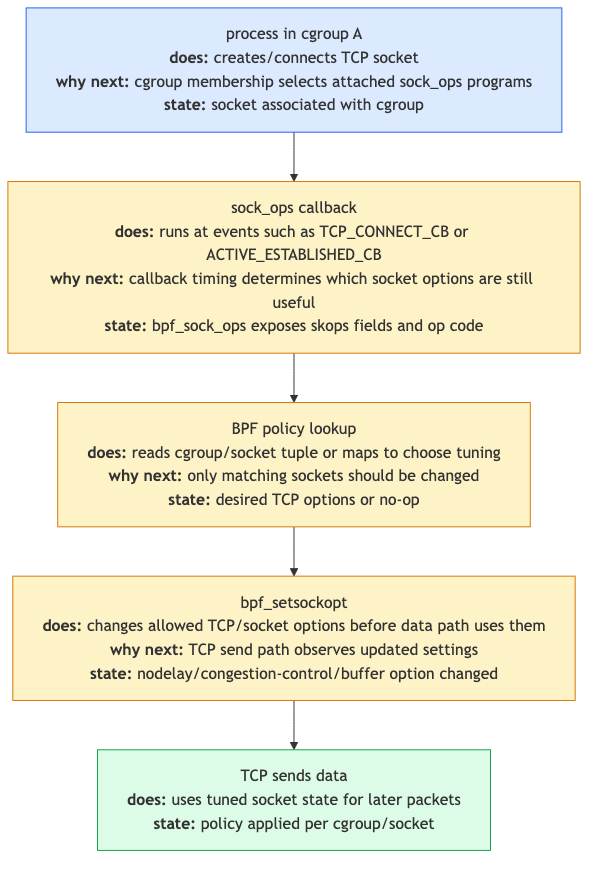
When a TCP connection event fires (e.g., BPF_SOCK_OPS_TCP_CONNECT_CB), your BPF program can call bpf_setsockopt(skops, ..., TCP_CONGESTION, "bbr", 3) to set BBR for this socket. Combined with cgroup attachment, you’ve got “all sockets from cgroup X use BBR; all sockets from cgroup Y use CUBIC.” We’ll unpack what bpf_setsockopt and TCP_CONGESTION actually are below, right before Part B uses them.
There are no Dumb Questions
Q: When does
cgroup_skbrun vstc?A:
cgroup_skb/ingressruns after IP routing decided this packet is for a local socket; the kernel knows which cgroup the destination socket belongs to.cgroup_skb/egressruns after the socket sent — kernel knows the source socket’s cgroup. tc runs at L2/L3, before/after socket layer. Use cgroup_skb when policy is “this cgroup’s traffic” rather than “this interface’s traffic.”Q: How is sock_ops different from setting sysctls?
A: Sysctls are global; sock_ops is per-socket and conditional. You can set RTO_MIN to 500ms for cgroup A and 5ms for cgroup B without touching sysctls. The conditional check happens in BPF, evaluated per connection.
Q: Are these used much in practice?
A: Yes — Cilium uses cgroup_sock_addr extensively for socket-level service translation (kube-proxy replacement). Service meshes use sk_msg for L7 routing. Most users don’t touch them directly because tools abstract them.
The lab — two parts
Part A: cgroup_skb firewall
Create a test cgroup and block egress UDP for any process in it.
Prerequisite: cgroup v2 (unified hierarchy) mounted at
/sys/fs/cgroup— verify withmount | grep cgroup2(expectcgroup2 on /sys/fs/cgroup type cgroup2 ...) — and a kernel built withCONFIG_CGROUP_BPF=y(checkzgrep CGROUP_BPF /proc/config.gzor/boot/config-$(uname -r)). On cgroup v1 / hybrid hosts the path and attach semantics differ.
CG=/sys/fs/cgroup/practical-ebpf-day19-$$
sudo mkdir "$CG"
Do not move your interactive shell. Each trigger below starts a short-lived child shell, writes only that child’s PID to $CG/cgroup.procs, and then execs the test command. Every socket that controlled child opens has sk_cgrp_data pointing at the owned cgroup; your terminal and SSH connection stay in the root cgroup.
fw.bpf.c:
#include "vmlinux.h"
#include <bpf/bpf_helpers.h>
#include <bpf/bpf_endian.h>

char LICENSE[] SEC("license") = "GPL";

SEC("cgroup_skb/egress")
int block_udp(struct __sk_buff *skb)
{
    void *data = (void *)(long)skb->data;
    void *end  = (void *)(long)skb->data_end;
    struct iphdr *ip = data;
    if (ip + 1 > end) return 1;       /* allow if can't parse */
    if (ip->protocol == IPPROTO_UDP) return 0;  /* drop UDP */
    return 1;
}
Wait — why does data point straight at the IP header here? Recall from Day 16 that __sk_buff exposes data/data_end for bounds-checked direct packet access: every read you make must be proven in-range before the verifier accepts it (that’s why the if (ip + 1 > end) check is mandatory before touching ip->protocol). Same discipline applies here. But there’s a difference Day 16 didn’t prepare you for, and it would trip you up if nobody flagged it.
On Day 16 the tc program saw the Ethernet header first — data pointed at an ethhdr, and you had to parse past it before reaching the IP header. Here there is no ethhdr parse step at all: fw.bpf.c casts data straight to struct iphdr *. That is not a bug. For cgroup_skb, the data pointer starts at the network (IP) header, because the hook runs at the socket layer, not the L2 framing layer. The kernel arranges this explicitly before invoking your program:
/* kernel/bpf/cgroup.c:1561-1577, __cgroup_bpf_run_filter_skb() */
unsigned int offset = -skb_network_offset(skb);
...
__skb_push(skb, offset);                       /* move data back to the IP header */
bpf_compute_and_save_data_end(skb, &saved_data_end);
__skb_push rewinds skb->data to the network header, then bpf_compute_and_save_data_end sets the data/data_end window your program sees. So for cgroup_skb, [data, data_end) spans from the IP header onward — cast and go. (Contrast Day 16’s tc code, which had to parse ethhdr first because tc runs below the socket, where L2 framing is still present.)
Note: cgroup_skb/ingress returns 1 = allow, 0 = drop. cgroup_skb/egress is wider — the verifier enforces a return range of 0-3: 0=drop, 1=keep, 2=drop and notify TCP of congestion (cn), 3=keep and cn. Returning anything outside that range is rejected at load time. (We dissect exactly where that range is enforced and how it becomes a packet verdict in Break 1 — it is the chapter’s headline mechanism, and worth understanding before you trust it.)
Userspace attach. Compile this loader with the day’s Makefile (same skeleton-driven pattern as earlier days) and keep it running while you test — bpf_program__attach_cgroup returns a struct bpf_link * whose lifetime is tied to the process. When the loader exits, the link is freed and UDP egress is allowed again:
int cg_fd = open(cg_path, O_RDONLY | O_DIRECTORY);   /* explicit DIRECTORY fd */
struct fw_bpf *skel = fw_bpf__open_and_load();
struct bpf_link *l = bpf_program__attach_cgroup(skel->progs.block_udp, cg_fd);
printf("attached, Ctrl-C to detach\n");
pause();   /* keep the process (and the link) alive */
Notice the attach target is cg_fd, the cgroup directory fd — not an interface, not a PID. That is the attachment model from the cgroup section made concrete: the program now fires for every socket whose sk_cgrp_data points at $CG.
A production policy can pin the link to a uniquely owned bpffs path, but this lab intentionally keeps it process-owned: stopping the exact loader PID is guaranteed to detach it. The trigger itself is a controlled child placed in $CG.
The complete loader (fw.c) wraps that sketch with signal handling and safe cgroup-argument handling: it requires an explicit cgroup-v2 directory path and opens it with O_DIRECTORY, so it cannot silently attach to a fixed or unexpected cgroup. Build it with make -C ebpf/labs fw:
#include <errno.h>
#include <fcntl.h>
#include <signal.h>
#include <stdio.h>
#include <string.h>
#include <unistd.h>

#include <bpf/libbpf.h>

#include "fw.skel.h"

static volatile sig_atomic_t exiting;

static void handle_signal(int signal_number)
{
    (void)signal_number;
    exiting = 1;
}

static int install_signal_handlers(void)
{
    const struct sigaction action = {
        .sa_handler = handle_signal,
    };

    if (sigaction(SIGINT, &action, NULL) != 0 ||
        sigaction(SIGTERM, &action, NULL) != 0) {
        fprintf(stderr, "failed to install signal handlers: %s\n",
                strerror(errno));
        return -errno;
    }

    return 0;
}

/* Open the cgroup v2 directory whose fd is the cgroup-BPF attach target.
 * O_DIRECTORY makes a non-directory (or missing) path fail cleanly instead
 * of attaching to something unexpected. Empty arguments are rejected. */
static int open_cgroup_dir(const char *path)
{
    int fd;

    if (path == NULL || path[0] == '\0') {
        fprintf(stderr, "cgroup path must be a non-empty directory\n");
        return -1;
    }

    fd = open(path, O_RDONLY | O_DIRECTORY | O_CLOEXEC);
    if (fd < 0) {
        fprintf(stderr, "failed to open cgroup dir '%s': %s\n", path,
                strerror(errno));
        return -1;
    }

    return fd;
}

int main(int argc, char **argv)
{
    const char *cg_path;
    struct fw_bpf *skel = NULL;
    struct bpf_link *link = NULL;
    int cg_fd = -1;
    int err;

    setvbuf(stdout, NULL, _IOLBF, 0);

    if (argc != 2) {
        fprintf(stderr, "usage: %s <owned-cgroup-v2-directory>\n", argv[0]);
        return 2;
    }
    cg_path = argv[1];

    err = install_signal_handlers();
    if (err)
        return 1;

    cg_fd = open_cgroup_dir(cg_path);
    if (cg_fd < 0)
        return 1;

    skel = fw_bpf__open_and_load();
    if (!skel) {
        fprintf(stderr, "failed to open/load fw BPF skeleton\n");
        err = 1;
        goto cleanup;
    }

    link = bpf_program__attach_cgroup(skel->progs.block_udp, cg_fd);
    if (!link) {
        err = -errno;
        fprintf(stderr, "failed to attach cgroup_skb/egress to '%s': %s\n",
                cg_path, strerror(errno));
        goto cleanup;
    }

    printf("attached cgroup_skb/egress UDP filter to %s; Ctrl-C to detach\n",
           cg_path);
    while (!exiting)
        pause();

    err = 0;

cleanup:
    bpf_link__destroy(link);
    fw_bpf__destroy(skel);
    if (cg_fd >= 0)
        close(cg_fd);
    return err != 0;
}
Test. Use a UDP probe whose success/failure is visible — dig defaults to UDP/53, exactly the protocol/port the filter drops, so the timeout-vs-answer contrast is unambiguous (raw nc -u would hang identically in both cases and reveal nothing):
make -C ebpf/labs day19
sudo ebpf/labs/.output/day19/fw "$CG" &
FW_PID=$!
trap 'sudo kill -INT "$FW_PID" 2>/dev/null || true; wait "$FW_PID" 2>/dev/null || true; sudo rmdir "$CG" 2>/dev/null || true' EXIT
sleep 0.5

# only this controlled child enters the cgroup (UDP/53 is dropped):
sudo sh -c 'echo $$ > "$1/cgroup.procs"; exec dig +tries=1 +timeout=2 @1.1.1.1 example.com' _ "$CG"
#   -> communications error / no servers could be reached
sudo sh -c 'echo $$ > "$1/cgroup.procs"; exec ping -c 3 1.1.1.1' _ "$CG"
#   -> works: ICMP is not UDP

# this ordinary process remains outside the cgroup and receives an answer:
dig +tries=1 +timeout=2 @1.1.1.1 example.com
The ordinary process sees its packets sail through because its sockets’ sk_cgrp_data points at the root cgroup, not $CG — the program is simply not in their dispatch path. This ties back to the chapter’s own check question: DNS over UDP/53 is exactly what a cgroup_skb/egress UDP drop kills.
Teardown is the trap installed above: it signals the exact loader PID, waits for skeleton destruction to detach the link, and removes only $CG. The trigger commands exec, so their temporary cgroup is already empty when they exit. Your interactive shell never moved and needs no recovery step.
Part B: sock_ops TCP tuning
Part A fired your program once per packet. sock_ops is a different animal: one program, invoked many times over the life of a single connection, once at each interesting TCP event. To read the example you need two pieces of background the old chapter skipped — what the bpf_sock_ops context is, and what bpf_setsockopt/TCP_CONGESTION actually do.
The bpf_sock_ops context and the op state-machine
A sock_ops program is handed a struct bpf_sock_ops *, and its very first field tells you why you were called:
/* include/uapi/linux/bpf.h:6900 */
struct bpf_sock_ops {
    __u32 op;                 /* WHICH event fired — your switch key   */
    union { __u32 args[4]; __u32 reply; ... };  /* per-op in/out values */
    __u32 family;
    __u32 remote_ip4, local_ip4;
    __u32 remote_port, local_port;
    __u32 is_fullsock;
    __u32 snd_cwnd;
    __u32 srtt_us;            /* smoothed RTT << 3, microseconds        */
    __u32 state;             /* a TCP_* state (TCP_ESTABLISHED = 1, …) */
    ...
    __u64 bytes_acked;
    ...
};
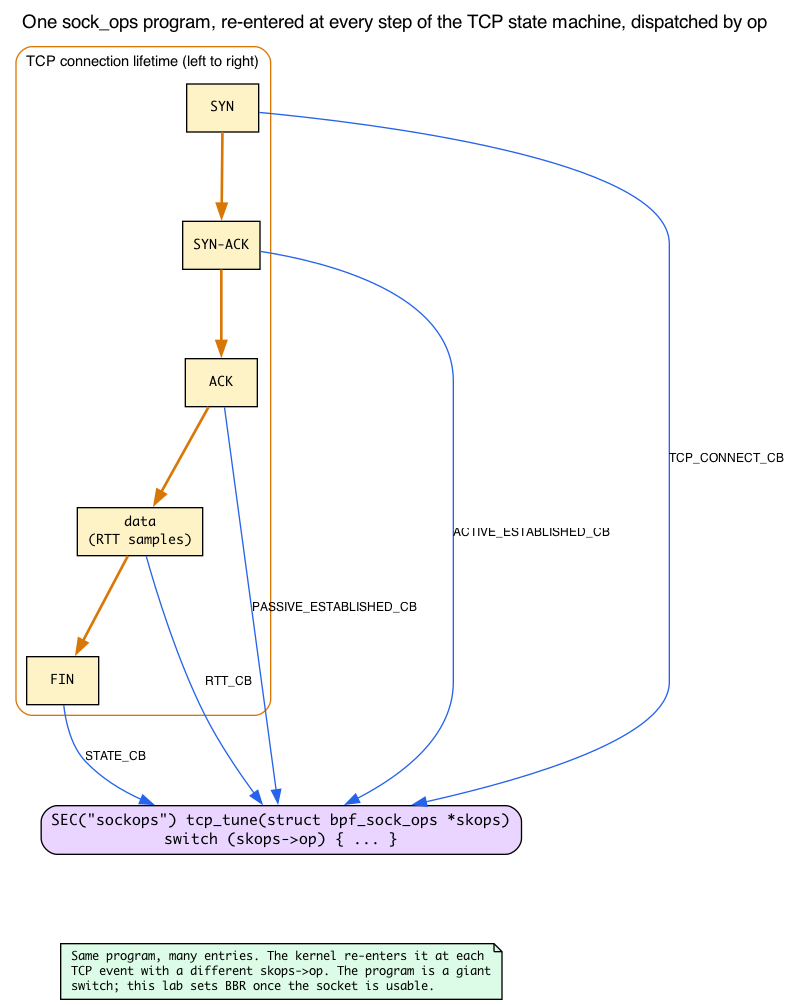
The program is a giant switch on op. The kernel re-enters the same program at each step of the TCP state machine — active connect, passive/active establishment, RTT sample, retransmit, state change, header-option parse/write — each time with a different op. The op values are a UAPI enum; the three this lab cares about:
/* include/uapi/linux/bpf.h:7048 */ BPF_SOCK_OPS_TCP_CONNECT_CB        /* right before an active connect    */
/* include/uapi/linux/bpf.h:7051 */ BPF_SOCK_OPS_ACTIVE_ESTABLISHED_CB /* SYN-ACK finished an outbound 3WHS */
/* include/uapi/linux/bpf.h:7055 */ BPF_SOCK_OPS_PASSIVE_ESTABLISHED_CB/* ACK finished an inbound 3WHS      */
tune.bpf.c below checks all three because it wants to set the congestion control once the socket is usable, no matter how the connection came to be — whether this host dialed out (active) or accepted a connection (passive).
Beyond op, the context exposes live TCP state you may read: family, remote/local ip+port, state (a TCP_* value — TCP_ESTABLISHED = 1 per include/net/tcp_states.h:13), srtt_us, snd_cwnd, bytes_acked, and more. So a real policy can be conditional on connection properties — “use BBR only for long-haul connections with srtt > 20ms” — not just “always set BBR.” The args[4]/reply union lets some op callbacks pass arguments in and return a value out (RTO/RWND-init ops return a value that way); for our setsockopt use-case the program just returns 0.
What bpf_setsockopt and TCP_CONGESTION do
bpf_setsockopt(ctx, level, optname, optval, optlen) is the kernel-internal twin of the userspace setsockopt(2) syscall. Same level/optname constants (SOL_TCP, TCP_CONGESTION), same effect — but called from inside a BPF program, on the very socket the hook is firing for, with no syscall boundary to cross. It is offered only to socket-context program types (sock_ops, cgroup_sock_addr, …), which is exactly why this hook family can tune connections at all. The kernel wires it into the sock_ops helper set explicitly:
/* net/core/filter.c:8597, in sock_ops_func_proto() */
case BPF_FUNC_setsockopt: return &bpf_sock_ops_setsockopt_proto;
and the implementation behind it is __bpf_setsockopt(struct sock *sk, int level, int optname, ...) at net/core/filter.c:5598 — it operates directly on the struct sock, no copy from userspace.
TCP_CONGESTION (#define TCP_CONGESTION 13, include/uapi/linux/tcp.h:107) takes a string naming a registered congestion-control module — "bbr", "cubic", "reno", "dctcp". The kernel looks the name up in its CC registry, so "bbr" only resolves if tcp_bbr is built in or modprobe’d (the prerequisite below). The modules really are separate files: net/ipv4/tcp_bbr.c, net/ipv4/tcp_cubic.c. An unknown name returns -ENOENT (the CC registry lookup misses) — and a BPF helper reports that as a return value, not an exception, which is why Break 3’s failure is silent.
Brief framing only — we do not teach the algorithm here (that’s Days 22–23, struct_ops congestion control): congestion control is the pluggable kernel logic that decides how big the send window may grow. CUBIC is the default; BBR is rate/RTT-based. The point for Day 19 is that you can pick a different one per socket / per cgroup without touching the global net.ipv4.tcp_congestion_control sysctl. That per-socket selectability is the entire value proposition of this hook.
tune.bpf.c (the full file adds the usual vmlinux.h/bpf_helpers.h includes, the GPL LICENSE, and fallback SOL_TCP/TCP_CONGESTION defines — those UAPI constants are #defines, not BTF types, so vmlinux.h does not supply them):
SEC("sockops")
int tcp_tune(struct bpf_sock_ops *skops)
{
    if (skops->op == BPF_SOCK_OPS_TCP_CONNECT_CB ||
        skops->op == BPF_SOCK_OPS_PASSIVE_ESTABLISHED_CB ||
        skops->op == BPF_SOCK_OPS_ACTIVE_ESTABLISHED_CB) {
        /* Set BBR for connections in this cgroup */
        char cc[] = "bbr";
        bpf_setsockopt(skops, SOL_TCP, TCP_CONGESTION, cc, sizeof(cc));
    }
    return 0;
}
Attach to a cgroup:
struct bpf_link *l = bpf_program__attach_cgroup(skel->progs.tcp_tune, cg_fd);
The complete loader (tune.c) shares fw.c’s safe cgroup-argument handling — required explicit cgroup path plus O_DIRECTORY — and attaches tcp_tune instead. Build it with make -C ebpf/labs tune:
#include <errno.h>
#include <fcntl.h>
#include <signal.h>
#include <stdio.h>
#include <string.h>
#include <unistd.h>

#include <bpf/libbpf.h>

#include "tune.skel.h"

static volatile sig_atomic_t exiting;

static void handle_signal(int signal_number)
{
    (void)signal_number;
    exiting = 1;
}

static int install_signal_handlers(void)
{
    const struct sigaction action = {
        .sa_handler = handle_signal,
    };

    if (sigaction(SIGINT, &action, NULL) != 0 ||
        sigaction(SIGTERM, &action, NULL) != 0) {
        fprintf(stderr, "failed to install signal handlers: %s\n",
                strerror(errno));
        return -errno;
    }

    return 0;
}

/* Open the cgroup v2 directory whose fd is the cgroup-BPF attach target.
 * O_DIRECTORY makes a non-directory (or missing) path fail cleanly instead
 * of attaching to something unexpected. Empty arguments are rejected. */
static int open_cgroup_dir(const char *path)
{
    int fd;

    if (path == NULL || path[0] == '\0') {
        fprintf(stderr, "cgroup path must be a non-empty directory\n");
        return -1;
    }

    fd = open(path, O_RDONLY | O_DIRECTORY | O_CLOEXEC);
    if (fd < 0) {
        fprintf(stderr, "failed to open cgroup dir '%s': %s\n", path,
                strerror(errno));
        return -1;
    }

    return fd;
}

int main(int argc, char **argv)
{
    const char *cg_path;
    struct tune_bpf *skel = NULL;
    struct bpf_link *link = NULL;
    int cg_fd = -1;
    int err;

    setvbuf(stdout, NULL, _IOLBF, 0);

    if (argc != 2) {
        fprintf(stderr, "usage: %s <owned-cgroup-v2-directory>\n", argv[0]);
        return 2;
    }
    cg_path = argv[1];

    err = install_signal_handlers();
    if (err)
        return 1;

    cg_fd = open_cgroup_dir(cg_path);
    if (cg_fd < 0)
        return 1;

    skel = tune_bpf__open_and_load();
    if (!skel) {
        fprintf(stderr, "failed to open/load tune BPF skeleton\n");
        err = 1;
        goto cleanup;
    }

    link = bpf_program__attach_cgroup(skel->progs.tcp_tune, cg_fd);
    if (!link) {
        err = -errno;
        fprintf(stderr, "failed to attach sockops to '%s': %s\n",
                cg_path, strerror(errno));
        goto cleanup;
    }

    printf("attached sockops TCP tuner to %s; Ctrl-C to detach\n", cg_path);
    while (!exiting)
        pause();

    err = 0;

cleanup:
    bpf_link__destroy(link);
    tune_bpf__destroy(skel);
    if (cg_fd >= 0)
        close(cg_fd);
    return err != 0;
}
Verify. There’s nothing to observe until a fresh TCP connection fires sockops from inside the cgroup, and BBR must actually be available — otherwise bpf_setsockopt(...,"bbr",...) fails silently (that’s Break 3). Also scope ss to the target so you don’t match unrelated sockets (e.g. your SSH session, which may itself be on BBR):
# prerequisite: BBR must be available
sudo modprobe tcp_bbr 2>/dev/null   # no-op if built in
sysctl net.ipv4.tcp_available_congestion_control

# stop Part A's exact loader, then attach sockops to the same owned cgroup:
sudo kill -INT "$FW_PID"; wait "$FW_PID" || true
sudo ebpf/labs/.output/day19/tune "$CG" &
TUNE_PID=$!
trap 'sudo kill -INT "$TUNE_PID" 2>/dev/null || true; wait "$TUNE_PID" 2>/dev/null || true; sudo rmdir "$CG" 2>/dev/null || true' EXIT
sleep 0.5

# only this short-lived child enters the cgroup and opens the fresh TCP socket:
sudo sh -c 'echo $$ > "$1/cgroup.procs"; exec curl -s https://speed.cloudflare.com/__up -T /dev/zero --max-time 4' _ "$CG" >/dev/null &
CLIENT_PID=$!
sleep 1
ss -ti dst :443 | grep bbr
wait "$CLIENT_PID" || true
Expected: the in-cgroup connection’s ss -i info line contains bbr. A socket opened from a shell not in the cgroup shows the host default CC instead — which differs from your per-cgroup choice as long as the default isn’t already bbr (on this devbox the default happens to be bbr, so to see the contrast pick a non-default name like "cubic" in tune.bpf.c). Same reason as Part A: a non-cgroup socket’s cgroup pointer doesn’t name $CG, so tcp_tune never runs for it. If ss is empty, either no fresh connection was made from the cgroup, or BBR is not loaded (the bpf_setsockopt failed silently — Break 3).
What to break, in order
Break 1 — Out-of-range return
Return 5 (or any value > 3) from a cgroup_skb/egress program. The verifier rejects it at load: egress return values must fall in retval_range(0, 3) (kernel/bpf/verifier.c). The defined values are 0=drop, 1=keep, 2=drop+cn, 3=keep+cn — so returning TC_ACT_SHOT (which is 2) actually loads and runs, but it means “drop and signal congestion,” not “allow.” It’s a defined egress value, not a coincidental pass. On ingress the range is just 0/1. Don’t borrow tc’s TC_ACT_* constants here — the conventions only overlap by accident.
This is the chapter’s headline mechanism, so let’s ground every word of it in the source. Two stages enforce the contract.
Stage 1 — the verifier clamps the range at load time, per program type. The default exit range for any program is 0-1; the CGROUP_SKB egress attach type widens it to 0-3:
/* kernel/bpf/verifier.c:16747 — default */
*range = retval_range(0, 1);
...
/* kernel/bpf/verifier.c:16772-16773 — CGROUP_SKB egress only */
if (env->prog->expected_attach_type == BPF_CGROUP_INET_EGRESS)
    *range = retval_range(0, 3);
So return 5 is rejected before the program ever runs — that is exactly Break 1. Ingress never hits that if, so it keeps the default 0-1: drop/allow, no widening. The asymmetry is deliberate, not an oversight.
Stage 2 — at runtime the kernel maps your 0-3 to a NET_XMIT_* code. Before the egress branch even sees a value, the run-array loop splits your 0-3 return bit-by-bit:
/* kernel/bpf/cgroup.c:81-87, in bpf_prog_run_array_cg() */
func_ret = run_prog(prog, ctx);
if (ret_flags) {
    *(ret_flags) |= (func_ret >> 1);   /* bit 1 -> the cn flag   */
    func_ret &= 1;                     /* bit 0 -> keep(1)/drop(0) */
}
if (!func_ret && !IS_ERR_VALUE((long)run_ctx.retval))
    run_ctx.retval = -EPERM;           /* drop becomes a negative err */
This is where your 0-3 is split: bit 0 is the keep/drop decision, bit 1 is the cn flag. A drop (bit 0 = 0) sets retval to -EPERM — that is the negative value the egress branch below then maps. So the ret and flags the next snippet reads are not your raw return value; they are already this post-split pair.
The egress branch of __cgroup_bpf_run_filter_skb() then does the final translation into a NET_XMIT_* code. Heads up — the integers in this kernel comment are the post-conversion NET_XMIT_* result codes, a different namespace from your program’s 0-3 return values. Your return 1 (keep) converts to NET_XMIT_SUCCESS=0; your return 2 (drop+cn) becomes NET_XMIT_DROP=1; return 3 (keep+cn) becomes NET_XMIT_CN=2; return 0 (drop) becomes a negative -err:
/* kernel/bpf/cgroup.c:1589-1610 (egress branch) */
/* left column = the post-conversion NET_XMIT result, NOT your return value:
 *   0: NET_XMIT_SUCCESS  skb should be transmitted
 *   1: NET_XMIT_DROP     skb should be dropped and cn
 *   2: NET_XMIT_CN       skb should be transmitted and cn
 *   3: -err              skb should be dropped              */
cn = flags & BPF_RET_SET_CN;
if (ret && !IS_ERR_VALUE((long)ret))
    ret = -EFAULT;
if (!ret)  ret = (cn ? NET_XMIT_CN : NET_XMIT_SUCCESS);
else       ret = (cn ? NET_XMIT_DROP : ret);
with the codes themselves defined at include/linux/netdevice.h:119-121:
#define NET_XMIT_SUCCESS  0x00   /* transmit            */
#define NET_XMIT_DROP     0x01   /* drop + congestion-notify */
#define NET_XMIT_CN       0x02   /* transmit + congestion-notify */
The “cn” bit is a separate channel (BPF_RET_SET_CN), which is the source of truth behind “2 = drop+cn, 3 = keep+cn.” Mind the namespace trap in the box above, though: that left column (0..3) is the resulting NET_XMIT_* code, not the value your program returned. The two spaces do not line up one-to-one. bpf_prog_run_array_cg() (cgroup.c:81-87, the Stage-2 snippet above) splits your return value bit-by-bit before this branch ever runs — the low bit is keep(1)/drop(0), the high bit becomes the cn flag — so program-return 2 (drop+cn) converts to NET_XMIT_DROP, and the NET_XMIT_CN result is instead produced by program-return 3 (keep+cn). That still confirms the subtle point: TC_ACT_SHOT == 2 “works” on egress only because 2 is a defined program-return value there (drop+cn), not because tc and cgroup share a convention — and emphatically not because it equals NET_XMIT_CN. They overlap by accident. Ingress, by contrast, is the simple branch — range 0/1, no cn channel — matching the note on the egress code box and the Bullet Points below.

Break 2 — Forget the IPPROTO check
Drop all packets in cgroup_skb/egress (return 0 always). The controlled child in $CG loses network access; your terminal does not. Recover by signaling the exact loader PID, which destroys the link, or simply let the child exit and the trap remove the now-empty owned cgroup. This is why the lab never moves your interactive shell into a policy it is deliberately breaking.
Break 3 — TCP CC not loaded
bpf_setsockopt(..., "bbr_invalid", ...). The kernel looks "bbr_invalid" up in its CC registry, finds nothing, and returns -ENOENT (tcp_set_congestion_control() in net/ipv4/tcp_cong.c sets err = -ENOENT when tcp_ca_find* returns NULL) — but bpf_setsockopt surfaces that as a return value, not a fault, so nothing crashes and nothing logs. The connection still succeeds with the system default. Symptom: your sockops “doesn’t work” — it’s running, but the helper failed silently. Always check return values: if (bpf_setsockopt(...) < 0) { /* handle */ }.
Break 4 — Use cgroup_sock_addr for socket-level NAT
SEC("cgroup/connect4")
int rewrite_connect(struct bpf_sock_addr *ctx)
{
    if (ctx->user_port == bpf_htons(8080)) {
        ctx->user_port = bpf_htons(80);
        return 1;
    }
    return 1;
}
This attaches as BPF_CGROUP_INET4_CONNECT (include/uapi/linux/bpf.h:1108) and rewrites the destination port inside the connect() syscall, before the SYN is built. Now connections from this cgroup to port 8080 are silently redirected to port 80. The bpf_sock_addr context fields (user_port, user_ip4, …) are real (include/uapi/linux/bpf.h:6871). This is how Cilium’s “socket-level service translation” works — kube-proxy without iptables, done one cgroup at a time using the same socket-carries-its-cgroup mechanism you learned this chapter.
What to read in the kernel
kernel/bpf/cgroup.c— the cgroup BPF infrastructure. ~2750 lines. Read the dispatch path__cgroup_bpf_run_filter_skb(thesock_cgroup_ptr→ run-array →NET_XMIT_*mapping you just dissected).include/linux/bpf-cgroup.h— interface and program types.net/core/filter.c— searchsock_ops_func_proto(:8588). Helpers available to sockops, includingbpf_setsockopt.tools/testing/selftests/bpf/progs/sockopt_*.c— sockops examples.Documentation/bpf/prog_cgroup_sockopt.rst— official docs.
Bullet Points
- A cgroup v2 is one unified tree mounted at
/sys/fs/cgroup(typecgroup2); each directory is a cgroup and writing a PID into itscgroup.procsfile moves that task in. v1 had a separate tree per controller; v2 has exactly one. - A socket carries its cgroup.
struct sockembedssk_cgrp_data;sock_cgroup_ptr(&sk->sk_cgrp_data)(cgroup.c:1574) resolves it to the owning cgroup. That pointer — set when the socket was created — is how the kernel “knows” which cgroup a packet’s program belongs to. No scan, no lookup. - Cgroup programs attach to a cgroup directory fd, fire for every socket whose
sk_cgrp_datanames that cgroup (or a descendant), and are hierarchical (BPF_F_ALLOW_OVERRIDE/MULTIfor multi-level). cgroup_skb only applies toAF_INET/AF_INET6(cgroup.c:1571). cgroup_skbruns per-packet for sockets in a cgroup. Ingress returns 1=allow/0=drop; egress allows 0-3 (0=drop, 1=keep, 2=drop+cn, 3=keep+cn), verifier-enforced. The verifier widens the range to 0-3 only forBPF_CGROUP_INET_EGRESS(verifier.c:16772); the kernel maps it toNET_XMIT_*atcgroup.c:1588.- For cgroup_skb,
skb->datastarts at the IP header (kernel does__skb_push(skb, -skb_network_offset(skb))), not the Ethernet header — unlike tc on Day 16. Same Day 16 bounds-check discipline still applies. sock_opsis one program re-entered at each TCP event;skops->opselects which (TCP_CONNECT_CB,ACTIVE/PASSIVE_ESTABLISHED_CB, …). The context also exposes live state (state,srtt_us,snd_cwnd,bytes_acked) for conditional policy.bpf_setsockoptis the in-kernel twin ofsetsockopt(2), available to socket-context programs (filter.c:8597).TCP_CONGESTION(tcp.h:107) takes a CC name string resolved against the kernel’s CC registry — so per-socket/per-cgroup CC without touching the global sysctl. Unknown name → silent-ENOENT.cgroup_sock_addrlets you rewrite sockaddrs atconnect/bind— socket-level NAT (BPF_CGROUP_INET4_CONNECT).- These hooks run in process context — full non-sleepable helper set, can call
bpf_setsockopt. - Used heavily in production: Cilium, systemd, Kubernetes service meshes.
Check question
You attach a cgroup_skb/egress program that returns 0 (drop) for every packet. A process in the cgroup runs wget google.com. Does the DNS lookup happen?
Click to reveal answer
Answer: No. DNS uses UDP/53; both UDP and TCP egress are filtered by cgroup_skb. The lookup socket(), connect(), and sendmsg() all succeed (cgroup_skb fires later, on packet send), but the actual UDP packet leaving the cgroup is dropped by your program. wget times out. To allow DNS specifically, gate by destination port in BPF.
End of Phase 3
You can now write BPF programs at every layer of the network stack: XDP at the driver, tc/tcx at the skb layer, AF_XDP for kernel bypass, cgroup_skb for per-cgroup filtering, sock_ops for TCP tuning, sk_msg for L7. That’s the full surface — and you now know the one fact that ties the cgroup hooks together: a socket carries a pointer to its cgroup, and every policy decision hangs off that pointer.
Phase 4 (Days 20–24) shifts to modern primitives: kfuncs, kptrs, struct_ops, BTF spelunking. The infrastructure that makes 2024–2026 BPF feel different from 2019 BPF. (Days 22–23 in particular pick up the congestion-control thread we deliberately left dangling here — you’ll write a CC algorithm as a struct_ops, not just select one by name.)