Day 20 — kfuncs: the modern kernel-extension mechanism
Today’s mission: call a kfunc from BPF, understand the acquire/release reference-counting semantics that the verifier enforces, learn what a kernel refcount actually is and why a task carries two of them, and know why new BPF features ship as kfuncs rather than helpers. Total time: ~100 minutes.
Phase 4 starts here. Days 20–24 cover the modern primitives that distinguish 2024+ BPF from the older days: kfuncs, kptrs, struct_ops, and BTF spelunking.
What a kfunc is
You met the helper-vs-kfunc split on Day 7: helpers are frozen UAPI (a fixed number and signature in enum bpf_func_id, a forever commitment), while kfuncs are ordinary in-tree kernel functions matched by name against kernel BTF and explicitly allowed to evolve. That’s why the kernel community stopped adding helpers around 2022 and ships new capabilities as kfuncs. Today we actually call one and learn the reference-counting semantics the verifier enforces around it.
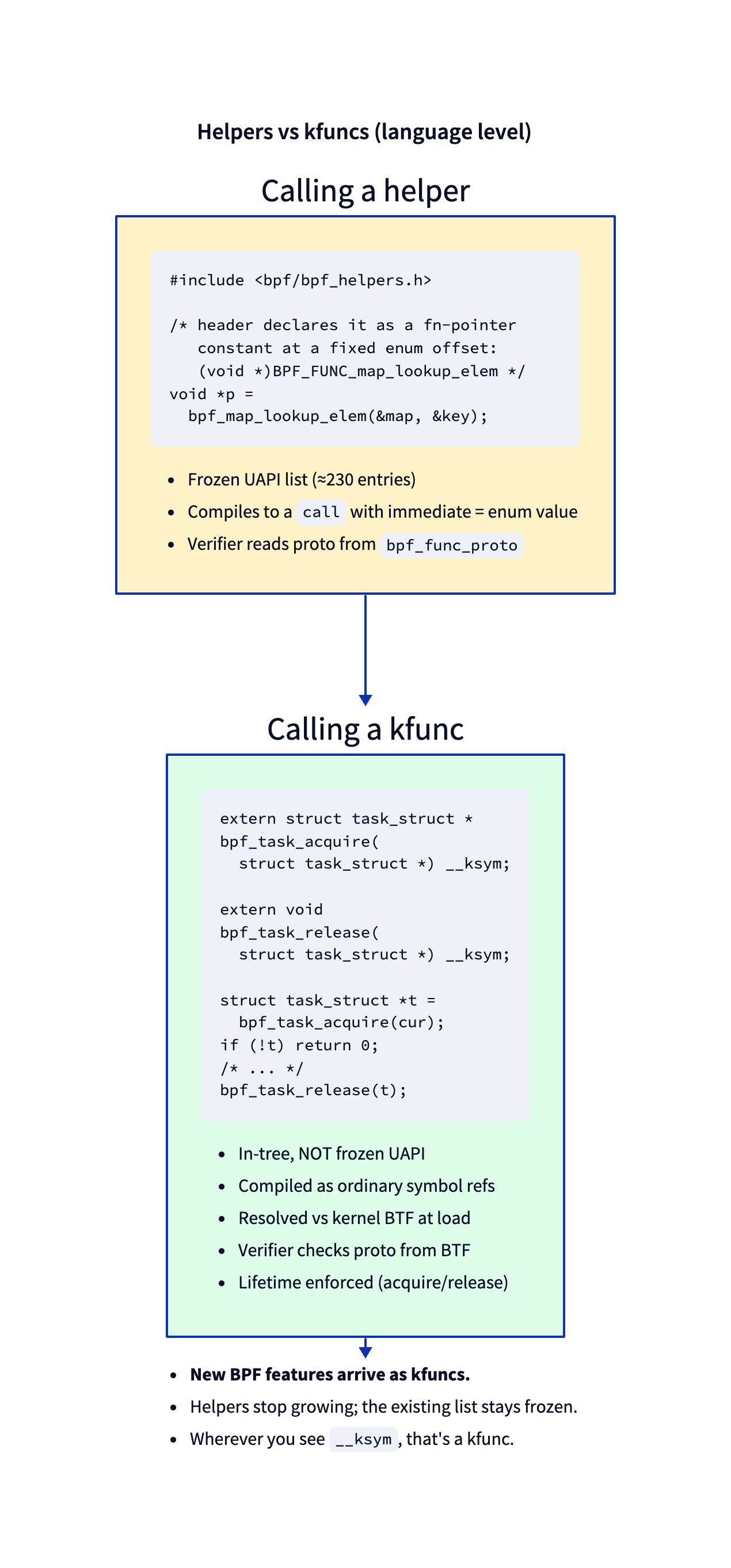
Concretely, a kfunc is a regular C function in the kernel, marked with __bpf_kfunc, registered against a BTF_KFUNCS_START/BTF_KFUNCS_END block, and resolved by name (against kernel BTF) at BPF program load time.
/* In kernel/bpf/helpers.c — line 2733 */
__bpf_kfunc struct task_struct *bpf_task_acquire(struct task_struct *p)
{
    /* take a refcount on p */
    if (refcount_inc_not_zero(&p->rcu_users))
        return p;
    return NULL;
}

/* line 2744 */
__bpf_kfunc void bpf_task_release(struct task_struct *p)
{
    put_task_struct_rcu_user(p);
}

/* And later, registered: */
BTF_KFUNCS_START(generic_btf_ids)
BTF_ID_FLAGS(func, bpf_task_acquire, KF_ACQUIRE | KF_RCU | KF_RET_NULL)
BTF_ID_FLAGS(func, bpf_task_release, KF_RELEASE)
/* ... */
BTF_KFUNCS_END(generic_btf_ids)

register_btf_kfunc_id_set(BPF_PROG_TYPE_TRACING, &kfunc_set);
The flags annotate the function’s behavior for the verifier:
KF_ACQUIRE— returns a refcounted resource. Verifier tracks it; you must release.KF_RELEASE— releases a previously-acquired resource. Verifier marks the ref id closed.KF_TRUSTED_ARGS— argument pointers must bePTR_TO_BTF_ID | PTR_TRUSTED(not from arbitrary load).KF_RCU— argument is RCU-protected; valid for the duration of the program’s RCU read section.KF_SLEEPABLE— only callable from sleepable BPF programs.KF_RET_NULL— return value may be NULL; the verifier requires checking.
These flags are how the verifier knows what safety properties to check.
Notice that the two-line bodies above are doing something — refcount_inc_not_zero, put_task_struct_rcu_user — and those operations, not the flags, are the real subject of today’s chapter. The flags are a static checker the verifier layers on top of a runtime mechanism that already lives in the kernel. To understand why bpf_task_acquire can return NULL, why it carries KF_RET_NULL, and why the release function is named put_task_struct_rcu_user and not plain put_task_struct, we have to look at that runtime mechanism: the kernel reference count.
What a refcount actually is (and why a task has two)
Recall the
sk_bufftwo-refcount model from linux-net Day 1 —skb->userscounting holders of the descriptor anddatarefcounting sharers of the data buffer. Atask_structdoes exactly the same thing with two counters namedusageandrcu_users. If that split is fresh in your mind, this section is mostly “tasks do it too, here’s the BPF-specific twist.”
A refcount_t is a single atomic integer that answers one question: how many independent holders currently need this shared object to stay alive? The contract is dead simple, and it is the same contract skb->users followed on Day 1:
- A holder that wants to keep the object alive increments the counter (
refcount_inc) — “I’m using this, don’t free it.” - When that holder is done it decrements (
refcount_dec_and_test) — “I’m done.” - The decrement that drives the count to 0 is the one that actually frees the object. The last holder out turns off the lights.
refcount_t is not just a bare atomic_t: it is saturating and overflow-/underflow-protected. If a buggy code path over-increments toward wraparound, or decrements below zero, the kernel’s refcount API catches it and warns rather than silently corrupting the count — which would be a use-after-free or a leak. This is the runtime contract. The verifier’s KF_ACQUIRE/KF_RELEASE tracking is a static enforcement of exactly this contract, applied to references a BPF program holds.
refcount_inc_not_zero: the detail behind KF_RET_NULL
Look again at the body of bpf_task_acquire. It does not call refcount_inc. It calls refcount_inc_not_zero:
if (refcount_inc_not_zero(&p->rcu_users))
    return p;
return NULL;
refcount_inc_not_zero increments the counter only if it is currently greater than zero, and returns a bool telling you whether the bump happened. Its signature is even marked __must_check so you cannot accidentally ignore the result:
/* include/linux/refcount.h:333 */
static inline __must_check bool refcount_inc_not_zero(refcount_t *r);
Why “not zero”? Because a count of 0 means the object is already being torn down. Remember the contract: the holder that drops the count to 0 is the one freeing the object. If you came along and blindly incremented from 0 to 1, you’d be claiming a reference to memory that is mid-destruction — a classic use-after-free. refcount_inc_not_zero refuses: it returns false, the increment doesn’t happen, and bpf_task_acquire therefore returns NULL.
This is the whole reason bpf_task_acquire carries KF_RET_NULL. You just saw two things stated separately — the verifier rule “the return value may be NULL — you must check it,” and the body that can return NULL — and they are the same fact: the task you tried to acquire might already be dying, the refcount might already be 0, the bump might fail. KF_RET_NULL is the verifier forcing you to handle that exact case at load time.
Two refcounts on one task: usage vs rcu_users
Here is the BPF-specific wrinkle. A task_struct carries two independent refcount_t fields, guarding two different lifetimes:
/* include/linux/sched.h:840 */
refcount_t usage;
/* include/linux/sched.h:1564 */
refcount_t rcu_users;
usageguards thetask_structallocation itself. Whileusage > 0, the memory holding the struct will not be freed.rcu_usersguards an RCU-grace-period extension of the task’s lifetime — it keeps the task reachable and valid across an RCU read-side section.
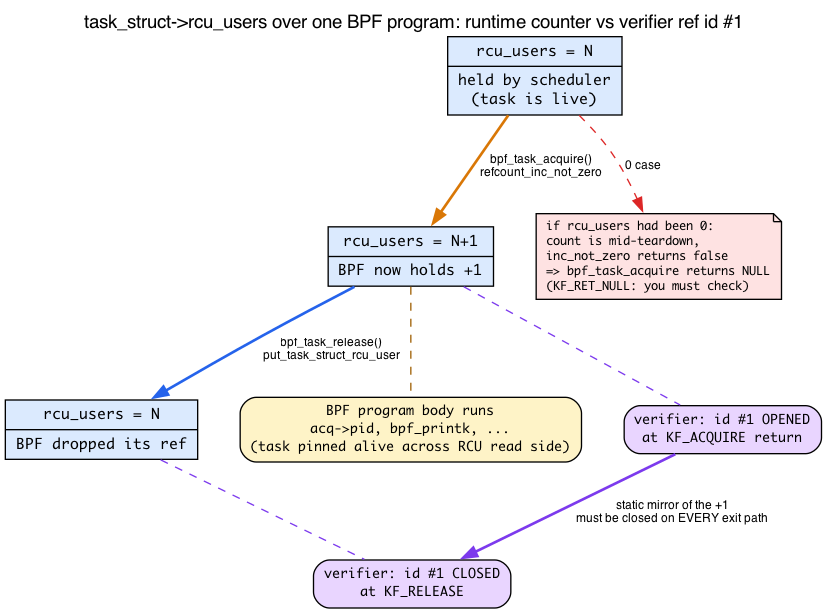
bpf_task_acquire deliberately bumps rcu_users, not usage. And bpf_task_release calls put_task_struct_rcu_user — the matching drop for that counter:
/* kernel/exit.c:234 */
void put_task_struct_rcu_user(struct task_struct *task)
{
    if (refcount_dec_and_test(&task->rcu_users))
        call_rcu(&task->rcu, delayed_put_task_struct);
}
See the contract in action: refcount_dec_and_test decrements and returns true exactly when the count reached 0; on that last drop it schedules the real free (call_rcu(...delayed_put_task_struct)). So while any holder keeps rcu_users > 0, the task stays alive — indefinitely, for as long as the reference is held. Only when the last holder drops rcu_users to 0 does refcount_dec_and_test fire and call_rcu defer the actual free until after the next RCU grace period. “Kept alive while held” and “freed one grace period after the final drop” are two distinct windows.
This is also why the release function is put_task_struct_rcu_user and not a plain put_task_struct: the two functions drop two different counters.
What about the KF_RCU flag on the registration (helpers.c:4725)? It is not a statement about the reference this kfunc returns or about the choice of rcu_users. As the flag list above already noted, KF_RCU constrains the input argument: it tells the verifier the passed-in p may be only RCU-protected (MEM_RCU) rather than fully trusted. An RCU-protected pointer is guaranteed not to be freed under you, but — per kfuncs.rst §2.5.6 — “the object’s refcount could have reached zero.” That is the real upstream reason the body must call refcount_inc_not_zero (the bump can fail) and the kfunc must carry KF_RET_NULL. The docs say it almost verbatim: “a KF_ACQUIRE kfunc that is KF_RCU should very likely also be KF_RET_NULL.” The causal chain is KF_RCU (arg may be RCU-only, refcount possibly 0) → refcount_inc_not_zero → bump may fail → KF_RET_NULL. The decision to bump rcu_users rather than usage is a separate, body-internal lifetime choice, invisible to the verifier and unrelated to the KF_RCU bit.
Why this makes BPF safer than hand-written kernel C
Now you can see exactly why the verifier makes BPF safer than ordinary kernel code in the reference-management dimension, in terms of the two functions above:
- In ordinary kernel C, forgetting a
put_task_struct_rcu_userleaks the task — the count never reaches 0, the memory is never freed. These leaks are notoriously hard to find because nothing crashes; memory just slowly disappears. - In ordinary kernel C, forgetting to NULL-check the result of
refcount_inc_not_zerois a use-after-free — you proceed to use a task that was already being destroyed.
Both bugs are classic and painful. The verifier turns both into load-time rejections: forget the release and you get Unreleased reference id=N; use an unacquired reference and you get reference has not been acquired before. That conversion of two whole bug classes into compile-time errors is the payoff this chapter is reaching for. Keep these two functions and the two counters in mind — everything below is the verifier mechanizing the contract you just learned.
Calling a kfunc from BPF
Declare it in your BPF source as an extern with __ksym:
extern struct task_struct *bpf_task_acquire(struct task_struct *p) __ksym;
extern void bpf_task_release(struct task_struct *p) __ksym;
The __ksym attribute tells libbpf “look this up by name in the kernel’s BTF at load time.” If the name doesn’t resolve, the load fails — no silent miss. (You met __ksym on Day 7; nothing new here.)
Use:
struct task_struct *cur = bpf_get_current_task_btf();   // Day 3
struct task_struct *acq = bpf_task_acquire(cur);
if (!acq) return 0;             // KF_RET_NULL: must check (refcount may have been 0)

/* now we hold a refcount on acq; verifier knows ref id #1 is open */

bpf_printk("acquired pid=%d", acq->pid);

bpf_task_release(acq);          // closes ref id #1
return 0;
That if (!acq) return 0; is not boilerplate — it is the load-bearing handling of the refcount_inc_not_zero-returned-false case you just learned. Skip it and the verifier rejects the program.
The verifier’s reference tracking
The single most important kfunc-related verifier behavior is the acquire/release lifetime check.
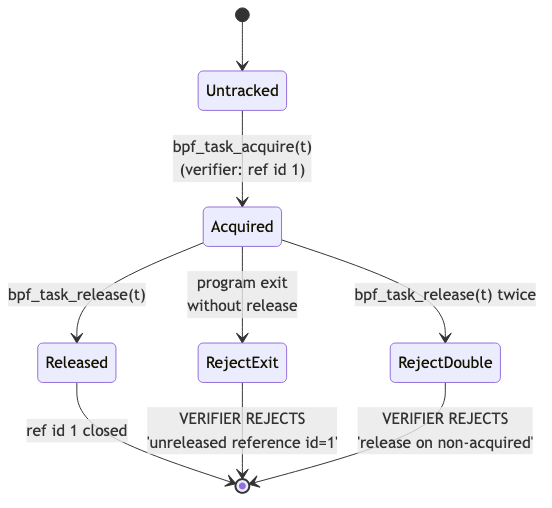
When you call a KF_ACQUIRE function, the verifier:
- Creates a fresh reference id (an integer, e.g., id #1).
- Marks the return-value register with that id.
- Tracks the id through your program’s flow: copies, branches, stores into maps.
- At every program exit point, requires the id to be either released or transferred to a place where the kernel can release it (e.g., a kptr-typed map slot).
The ref id is the verifier’s static stand-in for the runtime rcu_users increment: id #1 is “open” for exactly the span during which the real counter is sitting at +1. Closing the id corresponds to the put_task_struct_rcu_user that drops it back.
If you forget to release on any path:
Unreleased reference id=1 alloc_insn=2
If you release a non-acquired pointer:
kfunc bpf_task_release#0 reference has not been acquired before
If you release twice:
kfunc bpf_task_release#0 reference has not been acquired before
(The second release sees the ref id as already closed; same error.)
These are checked at load time, not runtime — runtime is safe.
Why reference tracking is necessary
This is the leak-on-forget / corrupt-on-stray-release pair from the refcount section — a BPF program that takes a reference but never releases it leaks kernel memory, and one that releases a reference it didn’t acquire drives the count toward 0 prematurely and frees an object other holders still use. Verifier-time tracking is what turns both into load-time rejections, making BPF safer than hand-written kernel C in this dimension. See the refcount section above for the full argument.
Per-program-type registration
Not every kfunc is available in every BPF program type. The registration is explicit:
register_btf_kfunc_id_set(BPF_PROG_TYPE_TRACING, &generic_kfunc_set);
register_btf_kfunc_id_set(BPF_PROG_TYPE_STRUCT_OPS, &cpumask_kfunc_set);
Tracing programs (fentry, fexit, etc.) get the generic set. struct_ops programs get the cpumask set. XDP also gets the generic set (it’s registered for BPF_PROG_TYPE_XDP too), so bpf_task_acquire does load in an XDP program — but it’s semantically meaningless there, because XDP runs in NIC-driver softirq context with no meaningful current task. The cpumask family, by contrast, is registered only for TRACING/STRUCT_OPS/SYSCALL, so calling bpf_cpumask_create from XDP genuinely fails the verifier with calling kernel function bpf_cpumask_create is not allowed.
Discovery: what kfuncs exist?
Three approaches:
-
Kernel source. Grep
BTF_KFUNCS_STARTblocks inkernel/bpf/and elsewhere:cd ~/code/linux grep -rn 'BTF_KFUNCS_START' kernel/bpf net/ drivers/ | headEach block lists kfuncs in one logical family.
-
Documentation.
Documentation/bpf/kfuncs.rstlists categories: cpumask, dynptr, lists, refcount, task, etc. -
bpftool BTF dump:
sudo bpftool btf dump file /sys/kernel/btf/vmlinux | grep "FUNC.*bpf_" | head -30Filters all
FUNCentries withbpf_prefix. Many are kfuncs (and many are helpers, mixed in).
Day 24 covers BTF spelunking in detail.
The lab
Continue in the repository’s ebpf/labs directory. make kfunc_demo compiles the exact anchored listing shown below.
kfunc_demo.bpf.c:
#include "vmlinux.h"
#include <bpf/bpf_helpers.h>
#include <bpf/bpf_tracing.h>

char LICENSE[] SEC("license") = "GPL";

extern struct task_struct *bpf_task_acquire(struct task_struct *p) __ksym;
extern void bpf_task_release(struct task_struct *p) __ksym;

SEC("fentry/filename_unlinkat")
int BPF_PROG(on_unlink)
{
    struct task_struct *cur = bpf_get_current_task_btf();
    struct task_struct *acq = bpf_task_acquire(cur);
    if (!acq)
        return 0; /* KF_RET_NULL: refcount may have been 0 */

    bpf_printk("acquired pid=%d", acq->pid);

    bpf_task_release(acq); /* KF_ACQUIRE -> must release on every path */
    return 0;
}
The userspace loader (kfunc_demo.c) is the same skeleton-driven open/load/attach pattern as earlier days; it attaches the fentry and then waits for Ctrl-C while the program writes to trace_pipe.
#include <errno.h>
#include <signal.h>
#include <stdio.h>
#include <string.h>
#include <unistd.h>

#include <bpf/libbpf.h>

#include "kfunc_demo.skel.h"

static volatile sig_atomic_t exiting;

static void handle_signal(int signal_number)
{
    (void)signal_number;
    exiting = 1;
}

static int install_signal_handlers(void)
{
    const struct sigaction action = {
        .sa_handler = handle_signal,
    };

    if (sigaction(SIGINT, &action, NULL) != 0 ||
        sigaction(SIGTERM, &action, NULL) != 0) {
        fprintf(stderr, "failed to install signal handlers: %s\n",
                strerror(errno));
        return -errno;
    }

    return 0;
}

int main(void)
{
    struct kfunc_demo_bpf *skel = NULL;
    int err;

    setvbuf(stdout, NULL, _IOLBF, 0);

    err = install_signal_handlers();
    if (err)
        return 1;

    skel = kfunc_demo_bpf__open();
    if (!skel) {
        fprintf(stderr, "failed to open kfunc_demo BPF skeleton\n");
        return 1;
    }

    err = kfunc_demo_bpf__load(skel);
    if (err) {
        fprintf(stderr, "failed to load kfunc_demo BPF programs: %s\n",
                strerror(-err));
        goto cleanup;
    }

    err = kfunc_demo_bpf__attach(skel);
    if (err) {
        fprintf(stderr, "failed to attach kfunc_demo BPF programs: %s\n",
                strerror(-err));
        goto cleanup;
    }

    puts("Attached fentry/filename_unlinkat; watch trace_pipe. "
         "Press Ctrl-C to detach.");
    while (!exiting)
        pause();

    err = 0;

cleanup:
    kfunc_demo_bpf__destroy(skel);
    return err != 0;
}
Build, load, attach, observe:
make kfunc_demo
sudo ./.output/day20/kfunc_demo &                # loads + attaches the fentry
sudo cat /sys/kernel/debug/tracing/trace_pipe &  # stream events live
for i in 1 2 3; do touch /tmp/x$i && rm /tmp/x$i; done
You should see one acquired pid=N line per delete:
            rm-12345   [001] ...1   842.713604: bpf_trace_printk: acquired pid=12345
            rm-12348   [000] ...1   842.714902: bpf_trace_printk: acquired pid=12348
            rm-12351   [001] ...1   842.716071: bpf_trace_printk: acquired pid=12351
filename_unlinkat fires once per rm, so the count of lines matches the number of deletes. The loader must stay backgrounded while you observe — killing it detaches the fentry. When done, tear everything down:
sudo pkill -f trace_pipe   # stop the streaming cat
sudo pkill kfunc_demo      # detach the fentry (loader was started with sudo)
What to break
Forget release
Comment out bpf_task_release(acq). Verifier rejects:
Unreleased reference id=1 alloc_insn=2
The number tells you which acquire was leaked (multiple acquires get distinct ids). In runtime terms: you bumped rcu_users and never dropped it — exactly the leak the static check exists to forbid.
Conditional release
if (acq->pid > 1000)
    bpf_task_release(acq);
return 0;
Verifier rejects — there’s an exit path (when pid <= 1000) where the ref is leaked. The rejection is the same class of leak error as the forget-release case:
Unreleased reference id=1 alloc_insn=2
The id is 1 because there is only a single acquire in this program. The verifier requires release on every exit path. Fix: release before any conditional return:
__u32 pid = acq->pid;
bpf_task_release(acq);
if (pid > 1000) return 0;
Double release
bpf_task_release(acq);
bpf_task_release(acq);
Rejected: the second call sees the id as already closed. (Statically this is the verifier refusing; at runtime an unchecked double-drop would push rcu_users below the live set and free a task other holders still use.)
Call a kfunc the program type isn’t allowed
extern struct bpf_cpumask *bpf_cpumask_create(void) __ksym;
extern void bpf_cpumask_release(struct bpf_cpumask *cm) __ksym;

SEC("xdp")
int xdp_prog(struct xdp_md *ctx) {
    struct bpf_cpumask *cm = bpf_cpumask_create();
    if (cm) bpf_cpumask_release(cm);
    return XDP_PASS;
}
Unlike the three breaks above, this one can’t be reproduced by editing the fentry lab — cpumask kfuncs are allowed for tracing programs, so the edit has to be a separate, complete XDP object with its own loader (the program above is loadable as written). The cpumask kfunc family is registered only for TRACING, STRUCT_OPS, and SYSCALL program types (kernel/bpf/cpumask.c), not XDP. The verifier rejects at the call site — before it ever reaches the return-path or reference-leak checks — with:
calling kernel function bpf_cpumask_create is not allowed
(Note: the generic set — including bpf_task_acquire — is registered for XDP, so that one would load; it’s just meaningless there. The cpumask family is the one that genuinely isn’t in XDP’s allowance set.)
There are no Dumb Questions
Q: Why does
bpf_task_acquirebumprcu_usersinstead ofusage? Wouldn’tusagekeep the struct alive too?A: Both counters keep the allocation alive, but they express different intents.
usageguards the raw allocation;rcu_usersguards the task’s reachability across an RCU grace period — which is the lifetime model BPF programs run under (RCU read sides). Bumpingrcu_userskeeps the task valid for exactly as long as a BPF program is allowed to look at it, and the matching drop,put_task_struct_rcu_user, schedules the real free viacall_rcuonly after a grace period. Usingusagewould be the wrong lifetime for the RCU-based access pattern. (Don’t confuse this body-internal choice with theKF_RCUflag — that flag is about the input argument’s trust level, not which counter the body bumps.)Q: If the verifier guarantees I release every reference, why does
refcount_tstill need runtime overflow/underflow protection?A: Because BPF is not the only thing touching that counter. The same
rcu_usersis incremented and decremented by ordinary kernel code throughout the task’s life.refcount_t’s saturation is a defense-in-depth property of the counter itself, independent of who holds it. The verifier proves your BPF program is balanced; therefcount_tAPI protects the counter against bugs anywhere in the kernel.Q: The error says
reference has not been acquired beforefor both a stray release and a double release. Are they really the same thing?A: To the verifier, yes. It tracks open ref ids; a release either closes an open id or it doesn’t. A double release closes the id on the first call, so the second call is releasing something with no matching open id — indistinguishable from releasing a pointer you never acquired. Same internal condition, same message.
What to read in the kernel
-
Documentation/bpf/kfuncs.rst— official categories and flags. Read top to bottom; ~10 pages. The reference for what each KF_* flag means. -
kernel/bpf/helpers.c:2733and surrounding —bpf_task_acquire,bpf_task_release, and friends. Real kfunc implementations. Note the__bpf_kfuncannotation and how short these are — kfuncs are usually thin wrappers around kernel APIs (here, aroundrefcount_inc_not_zeroandput_task_struct_rcu_user). -
include/linux/refcount.h:333—refcount_inc_not_zero. Read the comment block above it: the “increment unless zero” rule and the__must_checkannotation are the runtime reasonbpf_task_acquirecan return NULL. -
include/linux/sched.h:840and:1564— the two task refcounts,usageandrcu_users. See them declared side by side; notercu_userssits next tostruct rcu_head rcu. -
kernel/exit.c:234—put_task_struct_rcu_user. Six lines:refcount_dec_and_testthencall_rcu. The release half of the contract. -
kernel/bpf/helpers.c:4703—BTF_KFUNCS_START(generic_btf_ids). The big “general purpose” kfunc set;bpf_task_acquireis registered at:4725withKF_ACQUIRE | KF_RCU | KF_RET_NULL. Skim the list — it’s the catalog of what a tracing program can call. -
kernel/bpf/cpumask.c— a complete kfunc family in one file (~530 lines). Read top to bottom. Notice the pattern: short C functions + aBTF_KFUNCS_STARTblock + aregister_btf_kfunc_id_setcall at module init. This is the template for adding new kfuncs. -
kernel/bpf/btf.c:8996—register_btf_kfunc_id_set. The registration entry. Short function (~15 lines). Note the per-enum bpf_prog_typeregistration. -
kernel/bpf/verifier.c— searchKF_ACQUIRE. The verifier check that creates a new ref id. Trace forward to see howacquire_reference_stateinteracts withrelease_reference_state. -
tools/testing/selftests/bpf/progs/task_kfunc_*.c— test programs exercising every aspect of acquire/release/store-in-map. Real, working examples.
Bullet Points
- A
refcount_tis a saturating, overflow-protected atomic counter the kernel uses to decide when to free a shared object: holders increment on acquire, drop on release, and the drop that reaches 0 frees. The verifier’s acquire/release tracking statically enforces this runtime contract. refcount_inc_not_zeroincrements only if the count is > 0. A 0 count means the object is already dying, so the bump fails andbpf_task_acquirereturns NULL — which is exactly why it carriesKF_RET_NULL. “Must check for NULL” and “refcount could be zero” are the same fact.- A
task_structhas two refcounts:usage(sched.h:840) guards the allocation;rcu_users(sched.h:1564) guards the RCU-grace-period lifetime.bpf_task_acquirebumpsrcu_users;bpf_task_releasecallsput_task_struct_rcu_user. Separately,KF_RCUon the registration constrains the input arg (it may be RCU-only, so its refcount could be 0) — which is why the body needsrefcount_inc_not_zeroand the kfunc needsKF_RET_NULL. - kfuncs are in-tree kernel functions exposed to BPF via BTF. Not UAPI; can evolve.
- Marked
__bpf_kfunc, registered inBTF_KFUNCS_STARTblocks. KF_ACQUIRE/KF_RELEASEflags drive verifier reference-tracking.- Declare in BPF code with
extern T name(args) __ksym;. - The verifier statically tracks reference lifetimes — leaks (
Unreleased reference id=N) and stray releases (reference has not been acquired before) are rejected at load time, turning two classic kernel-C bug classes into compile errors. - Per-program-type registration: not all kfuncs everywhere.
- Discover: kernel source
BTF_KFUNCS_START,Documentation/bpf/kfuncs.rst,bpftool btf dump. - New BPF features (cpumask, dynptr, lists, refcount, …) ship as kfuncs, not helpers.
Check question
Why does the verifier check release lifetimes statically rather than at runtime?
Click to reveal answer
Answer: Static checking is fast and total. A runtime ref-leak detector would either (a) impose per-call overhead on every BPF program (fail at scale where BPF is in the data path), or (b) only catch leaks after the fact, which is too late — by then the rcu_users increment has already happened and the kernel resource is unrecoverable.
Static analysis catches every leak at load time, before the program ever runs. The cost is paid by the author (writing release-correct code) instead of by every kernel that runs the program. The verifier already tracks every register’s type, so adding reference-id tracking — one ref id per KF_ACQUIRE return, closed by the matching KF_RELEASE — is a small extension of the existing analysis. The tradeoff is well-understood: more friction at load time in exchange for guaranteed safety at runtime.
The same principle drives the rest of the verifier — bounds checks, pointer types, register typing — all done statically. BPF’s safety story is: prove it before running it. And it goes one step further than ordinary kernel C: the very refcount_t operations that a kernel developer must balance by hand (forget one and you leak; double one and you corrupt) become things the verifier proves balanced for you.
Tomorrow
Day 21: store an acquired kptr in a map across program invocations.