Day 21 — kptrs in maps: cross-invocation refcounted state
Today’s mission: save a
task_struct *into a hash map at one event, retrieve it later in another, and use the fields — all with refcounts that the verifier proves correct end to end. Along the way you’ll learn three things:
- the one mechanism behind “auto-release on map delete” (the kernel’s
btf_record),- why a release kfunc is necessary-but-not-sufficient to stash a pointer,
- and exactly why the slot op must be an atomic exchange and not a plain store.
Total time: ~110 minutes.
The problem with raw pointers
Day 20’s lab acquired and released a kernel pointer within a single BPF program invocation. That’s safe because the resource’s lifetime is bounded by the function call — you ran in the task’s own context, so the task was trivially alive the whole time.
But often you need to save a pointer across invocations. Examples:
- A tracing program that tags an outgoing connection with the originating task, looks the task up later when the connection completes.
- A sched_ext program that remembers a task’s last-seen state across enqueue and dispatch.
- A networking program that associates an L2 socket with the parent process.
Naively saving an acquired task_struct * into a plain (non-__kptr) map value field fails — the verifier rejects storing the referenced pointer:
R1 leaks addr into map
(the real message, verifier.c:6355). The verifier doesn’t trust that the pointer will remain valid. The task could be freed between the save and the read; reading would be a use-after-free. That last sentence is the whole problem, and to believe today’s solution defuses it you need to know exactly what keeps a task_struct alive — so let’s pin that down before we reach for the fix.
Refresher: the rcu_users refcount that keeps an exited task readable
Day 20 walked through the mechanics: bpf_task_acquire does refcount_inc_not_zero(&p->rcu_users) and bpf_task_release calls put_task_struct_rcu_user(p). The one new point that makes cross-invocation stashing sound is what that dedicated rcu_users count (refcount_t rcu_users; at include/linux/sched.h:1564) buys you: it keeps the task_struct allocation alive for safe reading even after the thread has called do_exit(). So between your fentry-time save and your fexit-time read (or a read minutes later), the traced thread may exit — and the bytes your stashed pointer points at are still a valid task_struct, not freed-and-reused memory.
Two consequences fall out of this:
- The NULL check on acquire isn’t ceremony.
refcount_inc_not_zeroreturns false if the task is already at zerorcu_users— i.e. fully dying. That’s whybpf_task_acquireisKF_RET_NULL(Day 20) and the lab below checksif (!acq) return 0;. The NULL case is literally “task already gone.” - Releasing can free the struct. When the last
rcu_usersref drops — whether via yourbpf_task_releaseor via the destructor the kernel runs at map-delete time —put_task_struct_rcu_userschedules the final free (after an RCU grace period). The stashed ref genuinely participates in the task’s lifetime; the kptr machinery isn’t a side-channel.
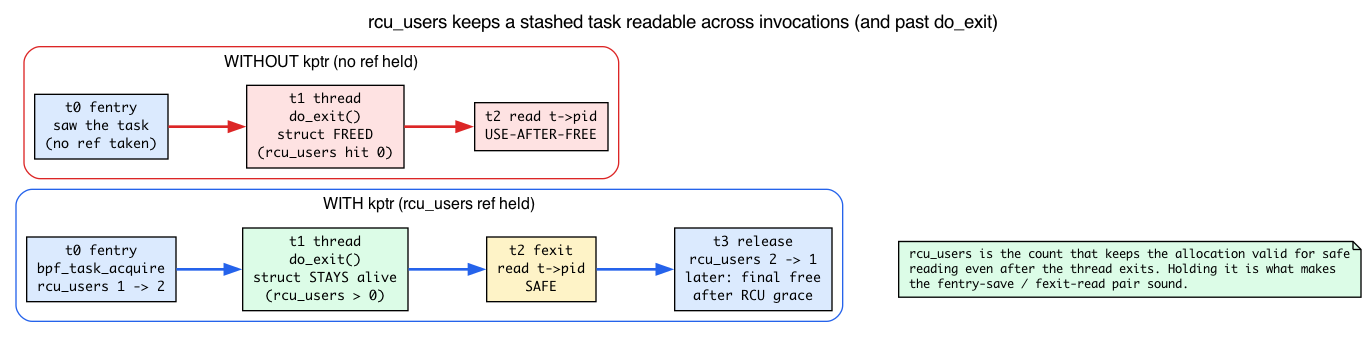
So the lifetime guarantee is real. What we need now is a way to hold that rcu_users ref inside a map slot, and to drop it correctly later — even if no BPF program is running when “later” arrives.
kptrs: refcounted pointer slots
The solution is __kptr — a struct annotation that tells the verifier “this slot holds a refcounted kernel pointer; track it like the kfunc machinery does, but stored persistently in a map.”
struct val {
    struct task_struct __kptr *t;
};

struct {
    __uint(type, BPF_MAP_TYPE_HASH);
    __uint(max_entries, 1024);
    __type(key, __u32);
    __type(value, struct val);
} stash SEC(".maps");
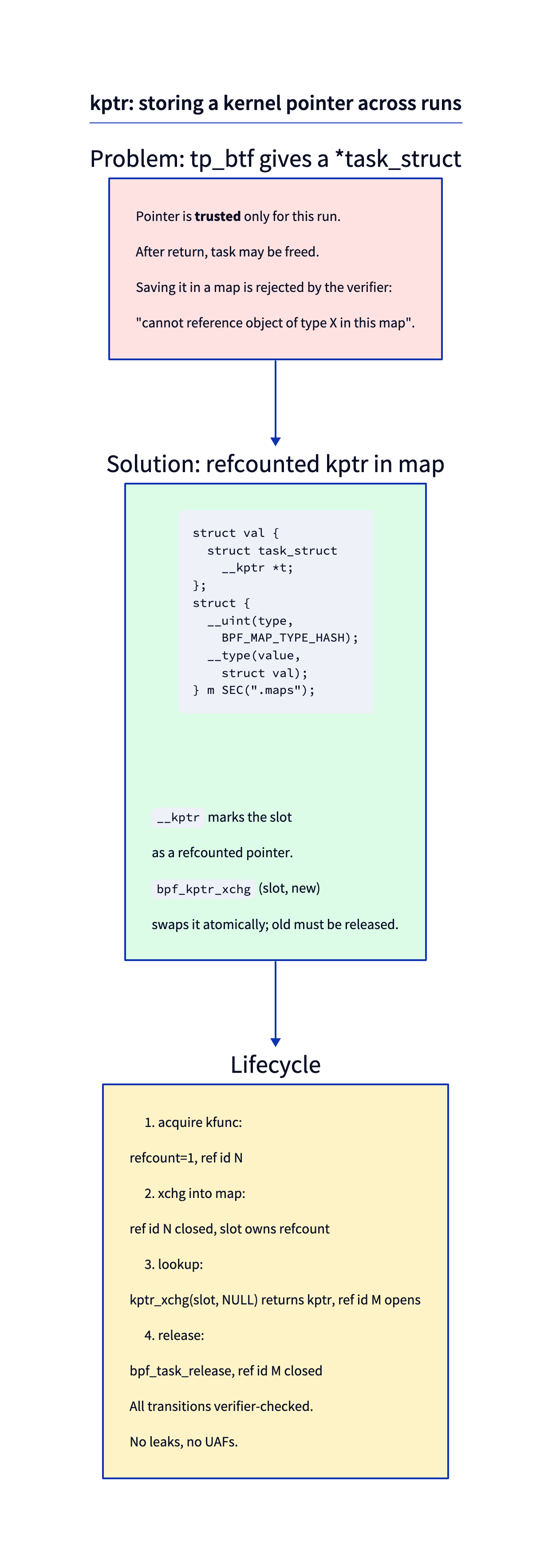
The __kptr annotation modifies the field: the verifier and the BPF runtime both treat that 8-byte slot as a refcounted pointer that may be NULL or may hold a valid kernel object. The runtime knows how to release it (via the kptr’s registered destructor) when the map entry is deleted.
Two flavors:
__kptr— the slot owns a refcount. Inserting must consume an acquired reference; reading must take ownership atomically. (Older code may use__kptr_ref, but that spelling was removed — current libbpf defines__kptr,__kptr_untrusted,__percpu_kptr, and__uptrintools/lib/bpf/bpf_helpers.h:193-196, each abtf_type_tagattribute.)__kptr_untrusted— an untrusted kptr: no refcount, no liveness guarantee. It may be stored with a plain assignment and loaded directly, but the loaded pointer is markedPTR_UNTRUSTED, so dereferences are treated as potentially-faulting (probe-read) accesses rather than trusted ones.
We focus on __kptr (refcounted).
But “the runtime knows how to release it” is doing a lot of work in that paragraph. How does the runtime know that one particular 8-byte field, out of all the bytes in your value struct, is special? And how does it know which function to call to free it? That’s the mechanism the rest of this chapter is built on, so we’ll teach it before the lab — not after.
How the kernel knows a field is special: btf_record
Here is the central idea, and once you have it the whole “auto-release on delete” story stops being magic.
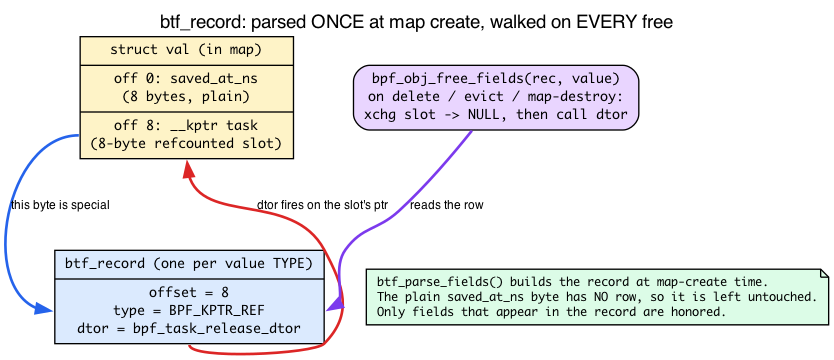
When you create a map whose value type contains a __kptr (or a bpf_spin_lock, a bpf_timer, a bpf_list_head, …), the kernel parses the value’s BTF once, at map-creation time, and builds a small table called a btf_record. The record lists each “special” field: its byte offset, its type tag, and — for kptrs — the destructor to call when the field is freed.
A __kptr is not a language feature the runtime understands intrinsically. It is just one entry in a general “this field needs special handling” framework. The field-type tags live in enum btf_field_type (include/linux/bpf.h:194):
/* include/linux/bpf.h:194 */
enum btf_field_type {
    BPF_SPIN_LOCK   = (1 << 0),   /* :195 */
    BPF_TIMER       = (1 << 1),   /* :196 */
    BPF_KPTR_UNREF  = (1 << 2),   /* :197  — the __kptr_untrusted slot */
    BPF_KPTR_REF    = (1 << 3),   /* :198  — refcounted; what THIS chapter uses */
    BPF_KPTR_PERCPU = (1 << 4),   /* :199 */
    BPF_KPTR        = BPF_KPTR_UNREF | BPF_KPTR_REF | BPF_KPTR_PERCPU,  /* :200 */
    BPF_LIST_HEAD   = (1 << 5),   /* :201 */
    /* ... timers, lists, rbtrees, refcount, workqueue ... */
};
The builder is btf_parse_fields() (kernel/bpf/btf.c:4072). It walks the value struct’s members and recognizes the btf_type_tag("kptr") that the __kptr macro emits; when it finds one it records {offset, BPF_KPTR_REF, dtor}. This is the deep reason a plain v->t = ptr is meaningless to the runtime: the slot is “special” precisely because it appears in the btf_record, and only operations the verifier routes through that knowledge (the xchg, the free walker) honor it.
Now the payoff. On every element free — userspace map delete, whole-map destroy, hashtab eviction — the kernel calls bpf_obj_free_fields(record, value) (kernel/bpf/syscall.c:810), which loops the record and dispatches per field type:
/* kernel/bpf/syscall.c:810 — bpf_obj_free_fields, abridged */
for (i = 0; i < rec->cnt; i++) {
    ...
    switch (fields[i].type) {
    case BPF_SPIN_LOCK:           break;                       /* nothing to free */
    case BPF_TIMER:               bpf_timer_cancel_and_free(...); break;
    case BPF_KPTR_UNREF:          WRITE_ONCE(*(u64 *)field_ptr, 0); break;  /* just zero it */
    case BPF_KPTR_REF:
    case BPF_KPTR_PERCPU:
        xchgd_field = (void *)xchg((unsigned long *)field_ptr, 0);  /* atomic-take */
        if (xchgd_field)
            field->kptr.dtor(xchgd_field);    /* call the registered destructor */
        break;
    ...
    }
}
This loop is the “automatic release.” Notice three things:
- It’s the same loop that cancels timers and drains lists — kptrs are not a special case, they’re one
casein a general walker. - For a refcounted kptr it does an
xchg-to-NULL first, then callsfield->kptr.dtor— the destructor thatbtf_parse_fieldsstored in the record at map-creation time. - It runs unconditionally on free. That is the precise reason you can’t leak by deleting: whether userspace deletes one entry, the map is torn down, or your program crashed and userspace drains the map afterward, every path routes through
bpf_obj_free_fields. You can see the hashtab call sites for yourself atkernel/bpf/hashtab.c:475, 852, 1022, 1032, 1040— per-element free and delete all funnel here.
There are no Dumb Questions
Q: Is the
btf_recordper-map or per-entry?A: Per-map (really per value type). It’s built once when the map is created and shared by every entry. An entry is just bytes; the record is the schema that says which of those bytes are special and how to free them.
Q: What if my value struct has no special fields?
A: Then
btf_parse_fieldsreturns a NULL/empty record, andbpf_obj_free_fieldsearly-returns (IS_ERR_OR_NULL(rec)). Plain maps pay nothing. The machinery only kicks in when you actually declare a kptr (or spinlock, timer, list, …).
What you can store — and the destructor registration table
So bpf_obj_free_fields calls field->kptr.dtor. Where does that function pointer come from, and why can you stash a task_struct but not a struct sock? This is the part that trips up everyone fresh off Day 20.
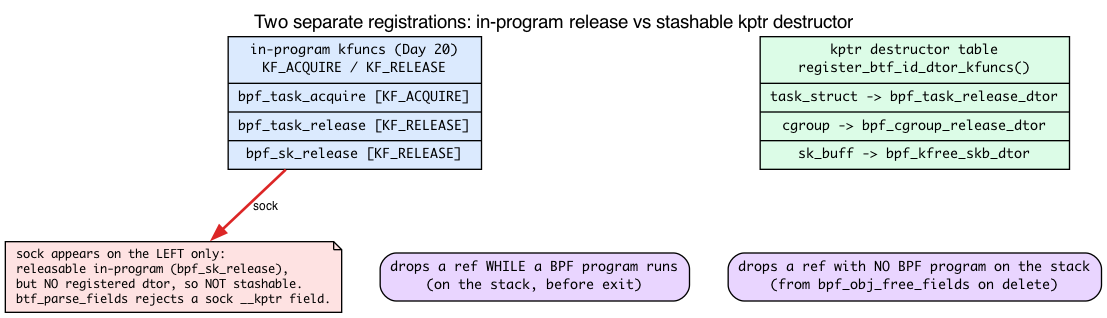
Day 20 taught acquire/release kfuncs (KF_ACQUIRE / KF_RELEASE). Those govern refcount handling within a single program run — a BPF program calls bpf_task_release itself, on the stack, before it exits. Stashing a kptr needs something extra: the kernel must be able to drop the ref later, from bpf_obj_free_fields, with no BPF program on the stack at all. That requires a separate, independently-registered lookup table mapping type → destructor function.
That table is installed by register_btf_id_dtor_kfuncs(dtors, count, module) (kernel/bpf/btf.c:9083, EXPORT_SYMBOL_GPL at :9156). It takes an array of {btf_id, kfunc_btf_id} pairs meaning “for objects of this struct type, call this function to release one ref.” Only types that appear in some registered dtor table can be a __kptr (BPF_KPTR_REF) map slot. If btf_parse_fields finds a kptr field whose type has no registered destructor, it rejects the map.
There’s a subtle shape difference worth seeing. The destructor entry point is a thin void(void *) wrapper, distinct from the typed release kfunc:
/* kernel/bpf/helpers.c:2744 — the typed kfunc BPF programs call */
__bpf_kfunc void bpf_task_release(struct task_struct *p)
{
    put_task_struct_rcu_user(p);
}

/* kernel/bpf/helpers.c:2749 — the void* destructor the kernel calls generically */
__bpf_kfunc void bpf_task_release_dtor(void *p)
{
    put_task_struct_rcu_user(p);
}
CFI_NOSEAL(bpf_task_release_dtor);   /* :2753 */
The void * shape is what bpf_obj_free_fields can call without knowing the type; the typed bpf_task_release is what your program calls. They drop the same rcu_users ref — which ties back to the refresher above: “auto-release on map delete” and your in-program release are the identical operation, reached two different ways.
The pairing is built from a BTF id list (kernel/bpf/helpers.c):
/* helpers.c:4768 area */
BTF_ID(struct, task_struct)            /* :4769 */
BTF_ID(func,   bpf_task_release_dtor)  /* :4770 */
#ifdef CONFIG_CGROUPS
BTF_ID(struct, cgroup)                 /* :4772 */
BTF_ID(func,   bpf_cgroup_release_dtor)/* :4773 */
#endif
and registered as generic_dtors[] (helpers.c:4877) via register_btf_id_dtor_kfuncs(generic_dtors, ...) at helpers.c:4896.
The supported set (and the sock/nf_conn gotcha)
The stashable set is assembled across subsystems, each calling register_btf_id_dtor_kfuncs at init — which is why “the list grows each release.” As of 7.x:
struct task_struct __kptr *— released bybpf_task_release(dtorbpf_task_release_dtor, registered inkernel/bpf/helpers.c).struct cgroup __kptr *— released bybpf_cgroup_release(dtor athelpers.c:2779).struct bpf_cpumask __kptr *— released bybpf_cpumask_release(registered inkernel/bpf/cpumask.c:529).struct sk_buff __kptr *— released bybpf_kfree_skb_dtor(net/sched/bpf_qdisc.c:205, registered atbpf_qdisc.c:471, BTF id at:458).struct bpf_crypto_ctx __kptr *— released by the crypto dtor (registered inkernel/bpf/crypto.c:394).
Note: struct sock is released by a legacy helper (bpf_sk_release, BPF_FUNC_sk_release — a BPF_CALL_1 at net/core/filter.c:7199, not a KF_RELEASE kfunc), while struct nf_conn is released by a release kfunc (bpf_ct_release, KF_RELEASE, net/netfilter/nf_conntrack_bpf.c:513). Different mechanisms — but neither type is registered as a kptr destructor via register_btf_id_dtor_kfuncs, so neither is stashable in a __kptr map slot. “Has a release helper/kfunc” and “is registered as a kptr destructor” are two different registrations. bpf_sk_release/bpf_ct_release exist and are callable in-program; nobody registered a struct sock → destructor or struct nf_conn → destructor entry, so btf_parse_fields finds no dtor and rejects the field. Acquire/release within a single program works; cross-invocation map storage does not.
The list grows with each kernel release. Check Documentation/bpf/kfuncs.rst for the current set.
How operations work: the xchg-only API
The only legal operations on a __kptr slot are via bpf_kptr_xchg:
struct task_struct *bpf_kptr_xchg(struct task_struct **dst, struct task_struct *new);
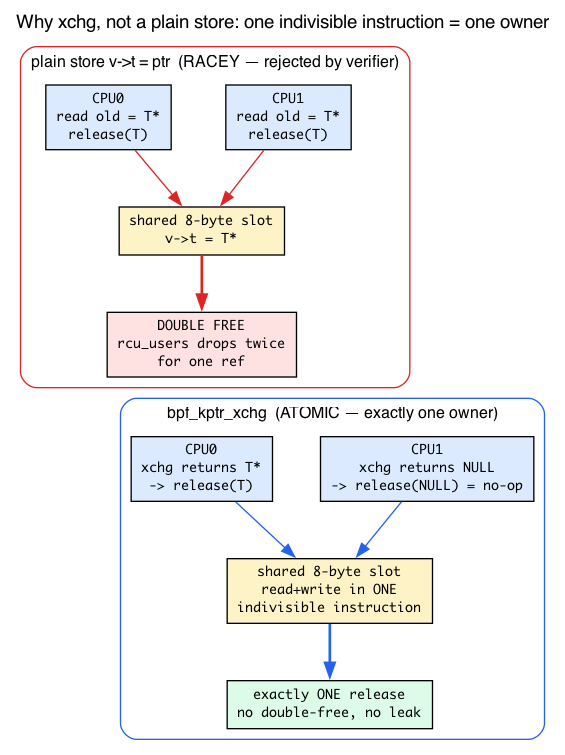
It atomically swaps *dst with new and returns the old value. Plain stores (v->t = ptr;) are rejected. Before we list the rules, let’s understand why it must be an atomic exchange — because that “why” is exactly what the Check question at the end leans on.
Why an atomic exchange, not a plain store
Recall from Day 2 that a map slot is shared kernel memory, readable and writable concurrently across CPUs — that’s why bumping a counter there needs an atomic __sync_fetch_and_add. The same is true of a kptr slot: two program invocations on different CPUs can touch the same 8-byte field at the same instant.
Here’s the kptr-specific twist Day 2 didn’t cover: ownership of a refcount must move atomically. xchg(slot, new) reads the old pointer and writes the new one in a single, indivisible instruction, so exactly one caller observes each old value. Picture the alternative — two steps, “read old” then “store new”:
- Two CPUs both read the same non-NULL old pointer, both call
bpf_task_releaseon it → double-free (thercu_userscount drops twice for one ref). - Or a store clobbers a pointer whose ref nobody released → leak (an
rcu_usersref stranded forever).
A plain store v->t = ptr is rejected at verify time for exactly this reason: it writes the new pointer but never hands back the old one, so the previous occupant’s refcount is silently dropped on the floor — and it isn’t indivisible anyway. bpf_kptr_xchg is the only op because it’s the only one that both transfers ownership and surfaces the previous owner for you to release.
The “take” direction is the same trick: bpf_kptr_xchg(&slot, NULL) atomically lifts the pointer out and zeroes the slot, so a concurrent taker on another CPU gets NULL instead of a second copy of the same ref. That’s what makes the retrieve path in the lab safe.
The implementation is literally one instruction (kernel/bpf/helpers.c:1731):
/* kernel/bpf/helpers.c:1731 — bpf_kptr_xchg */
BPF_CALL_2(bpf_kptr_xchg, void *, dst, void *, ptr)
{
    unsigned long *kptr = dst;
    return xchg(kptr, (unsigned long)ptr);
}
All the safety is in the hardware atomicity plus the verifier’s insistence that you account for the returned old value.
The ref-tracking rules
- To store an acquired pointer into the slot:
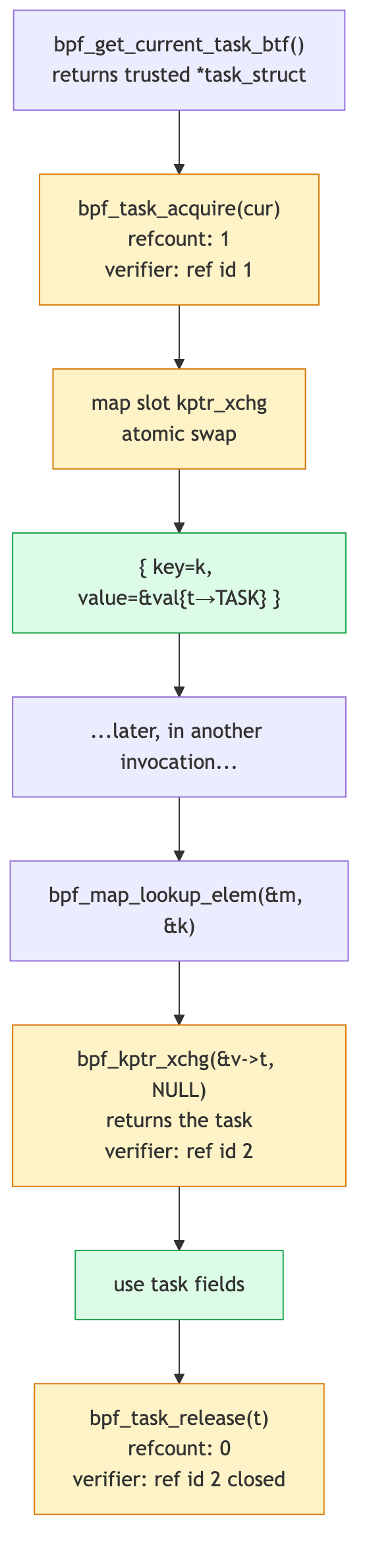
bpf_kptr_xchg(&v->t, acq). The verifier transfers the ref id fromacq(your local variable) to the map slot. The slot now owns the refcount. - The return value of
bpf_kptr_xchgis the previous occupant. You must release it. If non-NULL, callbpf_task_release(old). - To take the pointer out:
bpf_kptr_xchg(&v->t, NULL)— atomic-take, leaving slot empty. The returned pointer carries a fresh ref id you must release later. - If the map entry is deleted while the slot is non-NULL, the kernel automatically calls the registered destructor (
bpf_task_release_dtorfor tasks) on the slot’s pointer atbpf_obj_free_fieldstime — the walker we dissected above. No manual cleanup needed; you can’t leak by deleting.
Multiple kptrs in one value struct
You can have multiple kptr fields in the same value:
struct val {
    struct task_struct __kptr *task;
    struct cgroup       __kptr *cg;
    __u64 saved_at_ns;
};
Each is exchanged independently. The btf_record for this value type has two kptr entries (one per offset) plus nothing for saved_at_ns — which is plain memory. When the map entry is destroyed, bpf_obj_free_fields walks the record and releases every kptr field in turn; the non-kptr bytes are ignored. Same mechanism, two rows in the table.
The lab
#include "vmlinux.h"
#include <bpf/bpf_helpers.h>
#include <bpf/bpf_tracing.h>

char LICENSE[] SEC("license") = "GPL";

extern struct task_struct *bpf_task_acquire(struct task_struct *p) __ksym;
extern void bpf_task_release(struct task_struct *p) __ksym;

struct val {
    struct task_struct __kptr *task;
    __u64 saved_at_ns;
};

struct {
    __uint(type, BPF_MAP_TYPE_HASH);
    __uint(max_entries, 1024);
    __type(key, __u32);
    __type(value, struct val);
} stash SEC(".maps");

SEC("fentry/filename_unlinkat")
int BPF_PROG(on_unlink)
{
    struct task_struct *cur = bpf_get_current_task_btf();
    struct task_struct *acq = bpf_task_acquire(cur);
    if (!acq)
        return 0;

    __u32 tid = bpf_get_current_pid_tgid() & 0xffffffff;

    /* Initial map upsert with NULL kptr + timestamp */
    struct val v = { .task = NULL, .saved_at_ns = bpf_ktime_get_ns() };
    bpf_map_update_elem(&stash, &tid, &v, BPF_ANY);

    /* Lookup the slot to xchg the kptr in */
    struct val *vp = bpf_map_lookup_elem(&stash, &tid);
    if (!vp) {
        bpf_task_release(acq); /* couldn't insert; release manually */
        return 0;
    }

    /* Move acq into the map slot. xchg returns previous occupant. */
    struct task_struct *old = bpf_kptr_xchg(&vp->task, acq);
    if (old)
        bpf_task_release(old);

    return 0;
}

SEC("fexit/filename_unlinkat")
int BPF_PROG(on_unlink2)
{
    /* Genuinely "later": fexit fires on the function's *return*, after the
     * fentry program above has already stashed the task on entry. */
    __u32 tid = bpf_get_current_pid_tgid() & 0xffffffff;
    struct val *vp = bpf_map_lookup_elem(&stash, &tid);
    if (!vp)
        return 0;

    struct task_struct *t = bpf_kptr_xchg(&vp->task, NULL);
    if (!t)
        return 0; /* slot was empty */

    bpf_printk("retrieved pid=%d, was saved %llu ns ago",
               t->pid, bpf_ktime_get_ns() - vp->saved_at_ns);

    bpf_task_release(t);
    return 0;
}
Why filename_unlinkat? It’s a real, stable function — int filename_unlinkat(int dfd, struct filename *name) at fs/namei.c:5536 — on the path of every rm/unlink. The fentry program runs on the way in and stashes; the fexit program runs on the way out (the function’s return) and retrieves. So the save and the read are genuinely separated in time by the body of filename_unlinkat, which is the cross-invocation scenario this whole chapter is about.
Note the manual-release path inside the failed-lookup branch: if the bpf_map_lookup_elem right after the upsert somehow returns NULL, acq still holds an rcu_users ref that the map never took ownership of, so you must bpf_task_release(acq) yourself or leak it. The kptr machinery only auto-frees what actually made it into a slot.
Build and run (the loader is the standard skeleton open/load/attach pattern and attaches both the fentry and fexit programs):
#include <errno.h>
#include <signal.h>
#include <stdio.h>
#include <string.h>
#include <unistd.h>

#include <bpf/libbpf.h>

#include "task_assoc.skel.h"

static volatile sig_atomic_t exiting;

static void handle_signal(int signal_number)
{
    (void)signal_number;
    exiting = 1;
}

static int install_signal_handlers(void)
{
    const struct sigaction action = {
        .sa_handler = handle_signal,
    };

    if (sigaction(SIGINT, &action, NULL) != 0 ||
        sigaction(SIGTERM, &action, NULL) != 0) {
        fprintf(stderr, "failed to install signal handlers: %s\n",
                strerror(errno));
        return -errno;
    }

    return 0;
}

int main(void)
{
    struct task_assoc_bpf *skel = NULL;
    int err;

    setvbuf(stdout, NULL, _IOLBF, 0);

    err = install_signal_handlers();
    if (err)
        return 1;

    skel = task_assoc_bpf__open();
    if (!skel) {
        fprintf(stderr, "failed to open task_assoc BPF skeleton\n");
        return 1;
    }

    err = task_assoc_bpf__load(skel);
    if (err) {
        fprintf(stderr, "failed to load task_assoc BPF programs: %s\n",
                strerror(-err));
        goto cleanup;
    }

    err = task_assoc_bpf__attach(skel);
    if (err) {
        fprintf(stderr, "failed to attach task_assoc BPF programs: %s\n",
                strerror(-err));
        goto cleanup;
    }

    puts("Attached fentry+fexit/filename_unlinkat; watch trace_pipe. "
         "Press Ctrl-C to detach.");
    while (!exiting)
        pause();

    err = 0;

cleanup:
    task_assoc_bpf__destroy(skel);
    return err != 0;
}
make task_assoc
sudo ./.output/day21/task_assoc &
touch /tmp/x && rm /tmp/x       # fentry stashes on entry, fexit retrieves on return
sudo cat /sys/kernel/debug/tracing/trace_pipe
You’ll see one line per filename_unlinkat showing the retrieved task and elapsed time.
When you’re done watching, stop the loader so the fentry/fexit programs detach:
sudo pkill -f task_assoc # or, since it's job 1: kill %1
What to break
Plain store
vp->task = acq;
Verifier rejects with a distinct message — not the leak-class Unreleased reference of the next two items, but:
store to referenced kptr disallowed
The kptr field can only be assigned via bpf_kptr_xchg. As the atomic-exchange section explained, a plain store writes the new pointer but never hands back the old one — so it would leak a refcount by overwriting, and it isn’t indivisible against a racing CPU. The check lives in check_map_kptr_access (kernel/bpf/verifier.c:4721); the rejection of any non-load store class targeting a BPF_KPTR_REF/BPF_KPTR_PERCPU field — store to referenced kptr disallowed, returning -EACCES — is at verifier.c:4747.
Forget to release the previous occupant
bpf_kptr_xchg(&vp->task, acq);
/* discarded the return value */
Verifier rejects with Unreleased reference id=N alloc_insn=M. The xchg returned a (possibly non-NULL) old value with its own ref id; discarding that id is a leak.
The pattern is always:
struct task_struct *old = bpf_kptr_xchg(&vp->task, acq);
if (old) bpf_task_release(old);
Forget to release the retrieved kptr
struct task_struct *t = bpf_kptr_xchg(&vp->task, NULL);
if (!t) return 0;
return 0;     /* leak: t still holds a refcount */
Rejected at exit: Unreleased reference id=N alloc_insn=M.
Map deletion releases automatically
When userspace deletes a map entry whose kptr slot is still populated, the kernel runs the registered destructor (bpf_task_release_dtor → put_task_struct_rcu_user for tasks) on the slot’s pointer at bpf_obj_free_fields time — the exact BPF_KPTR_REF case of the walker we read earlier. No leak, no manual cleanup, even if your program terminates abnormally and userspace drains the map afterward: the free walker runs whether or not any BPF program is on the stack.
The trouble with demonstrating this in the lab as written: the fexit handler already bpf_kptr_xchg’s the slot back to NULL on return (the struct task_struct *t = bpf_kptr_xchg(&vp->task, NULL) block through bpf_task_release(t) in on_unlink2), so by the time any userspace delete runs, the slot is empty and deletion frees nothing. To actually see the destructor fire, temporarily comment out that fexit retrieval in on_unlink2 so entries stay populated, then delete them from userspace:
/* userspace — fd and key are real, not placeholders */
int fd = bpf_map__fd(skel->maps.stash);

/* tid is a per-rm-process key you don't know a priori, so iterate: */
__u32 key = 0, next;
struct val v;
while (bpf_map_get_next_key(fd, &key, &next) == 0) {
    bpf_map_lookup_and_delete_elem(fd, &next, &v);   /* delete fires the kptr dtor */
    key = next;
}
Observe the destructor firing — in a second terminal, before you delete:
sudo bpftrace -e 'kprobe:bpf_task_release_dtor { @releases = count(); printf("dtor fired\n"); }'
Probe bpf_task_release_dtor, not bpf_task_release — they are the two distinct symbols we dissected above (the void * destructor the kernel calls generically vs. the typed kfunc your program calls). The map-delete path runs bpf_obj_free_fields → field->kptr.dtor, which is bpf_task_release_dtor; it does not go through the typed bpf_task_release. So this probe fires only on the kernel’s auto-release path.
Expected result: @releases increments once per deleted populated slot — that is the kernel invoking the registered kptr destructor on your behalf. Without the kptr machinery you would leak one task refcount per stashed entry.
Nice consequence: because bpf_task_release_dtor is a separate symbol from the typed bpf_task_release(t) your fexit path calls, this probe naturally isolates the map-delete releases — it does not count the in-program release at all, so there’s no need to disable the fexit path or compare counts. (If you instead probe kprobe:bpf_task_release, you’d catch the in-program release and miss the dtor entirely — the opposite of what you want here.) To confirm the slots were populated before deleting, dump the live map first with sudo bpftool map dump pinned /sys/fs/bpf/stash (if you pin the map).
What to read in the kernel
-
kernel/bpf/helpers.c:1731—bpf_kptr_xchg. The implementation. Tiny — it’s justxchg()plus return. The complexity is in the type checking, not the runtime. -
include/linux/bpf.h:194—enum btf_field_type. The catalog of “special” field tags (BPF_KPTR_REFat:198, plus spinlocks, timers, lists). A kptr is one entry in this general framework. -
kernel/bpf/btf.c:4072—btf_parse_fields. Walks struct fields, identifies kptrs (and other special types), builds thebtf_record— looking up each kptr’s destructor at parse time and storing it. Read this to understand what makes a struct field “special.” -
kernel/bpf/btf.c:9083—register_btf_id_dtor_kfuncs. Thetype → destructorregistration entry point. Grep for its callers (helpers.c:4896,cpumask.c:529,crypto.c:394,bpf_qdisc.c:471) to see the stashable set assembled across subsystems. -
kernel/bpf/syscall.c:810—bpf_obj_free_fields. The destructor walker. When a map entry is deleted, this iterates the value’sbtf_recordand dispatches per field type —xchg-to-NULL then dtor forBPF_KPTR_REF. This is what frees your kptrs at map-delete time; the hashtab call sites are athashtab.c:475, 852, 1022, 1032, 1040. -
kernel/bpf/verifier.c—check_map_kptr_access(:4721) for the store-rejection logic; searchmark_btf_ld_regfor how the verifier types kptr fields at use sites, and tracecheck_kfunc_callfor the acquire/release reference-tracking logic. -
tools/testing/selftests/bpf/progs/cpumask_*.c— extensive kptr tests, including kptr-in-map patterns.
Bullet Points
- kptrs let BPF programs store refcounted kernel pointers in maps across invocations.
- Annotation:
__kptrin the value struct. - The kernel knows a field is a kptr because
btf_parse_fieldsbuilds abtf_recordat map-creation time — a table of{offset, type, dtor}for each special field. A kptr is one entry inenum btf_field_type, alongside spinlocks/timers/lists. - On every element free,
bpf_obj_free_fieldswalks that record and fires each kptr’s destructor — the same loop that cancels timers and drains lists. That is the “automatic release”; it runs with no BPF program on the stack. - A type is stashable only if some subsystem registered a
type → destructorpair viaregister_btf_id_dtor_kfuncs— a separate registration from Day 20’s acquire/release kfuncs. (sock/nf_connhave release kfuncs but no registered dtor, so they’re not stashable.) - The destructor (
bpf_task_release_dtor) and the in-program release (bpf_task_release) drop the samercu_usersref — the count that keeps atask_structreadable even after the thread exits. - All access via
bpf_kptr_xchg(atomic exchange). Plain stores rejected — onlyxchgboth transfers ownership and surfaces the previous owner for you to release; a plain store would leak or race into a double-free. - xchg returns the old value — you must release if non-NULL.
- Map deletion automatically releases stored kptrs (registered destructor invoked) — you can’t leak by deleting.
- Multiple kptrs per value are independent — each is its own
btf_recordrow, released individually on free. - Supported types (registered kptr destructors): task_struct, cgroup, bpf_cpumask, sk_buff, bpf_crypto_ctx; more added each release.
Check question
You xchg a new task into a map slot but don’t capture the return value. The slot was previously empty. Why does the verifier still reject this?
Click to reveal answer
Answer: Because the verifier doesn’t know statically that the slot was empty. Even if your program logic guarantees the slot was just initialized to NULL, the verifier has to assume the slot might hold a previously-stored kptr (e.g., from another concurrent invocation that ran in a different CPU context — the lookup-then-xchg pattern is only “atomic” at the xchg, not over the whole sequence).
So bpf_kptr_xchg(&v->t, acq) may return a non-NULL refcounted pointer, and the verifier requires every possible non-NULL return to be released. The check is conservative (over-rejects in cases where you happen to know the slot was empty) but it’s the only way to be sound — the alternative is “trust the programmer’s analysis” which has historically gone badly for kernel safety.
The runtime cost is a no-op when the slot is empty: bpf_task_release(NULL) is a NULL-check-then-skip, ~1 ns. The verifier requirement adds zero runtime cost; it just demands you write the conditional.
Tomorrow
Day 22: struct_ops. Replace a kernel function-pointer table with BPF programs.