Day 22 — struct_ops: BPF replaces kernel vtables
Today’s mission: load a BPF-implemented TCP congestion control algorithm and use it on a real connection. But first, understand the machine underneath: what a kernel vtable is and how the kernel calls through one, what TCP congestion control actually does as an algorithm, and where a connection’s per-socket scratch state lives. Then watch struct_ops turn BPF from “tracing hooks” into “kernel extension language.” Total time: ~120 minutes.
For 21 days, every BPF program you wrote was an observer. A kprobe fires, you read some state, you return. An XDP program inspects a packet, you decide pass or drop. Even when you modified things — rewrote a packet, set a sockopt — you were standing at a fixed call site the kernel had pre-drilled for you, doing your thing, and handing control back. The kernel did its job; your program watched and nudged.
Today that flips. Today your BPF program becomes the kernel’s job. It doesn’t watch the congestion-control algorithm run — it is the congestion-control algorithm. To see how that’s even possible, we need to understand the mechanism the kernel already uses to swap algorithms in and out of itself: the vtable.
We’ll teach three pieces of background before the lab, because without them the canonical example (bpf_dctcp.c, which the kernel ships and which this chapter tells you to read end to end) is just opaque slot names:
- What a vtable is — a struct full of function pointers — and how the kernel calls through one to get runtime polymorphism in plain C.
- What TCP congestion control means —
cwnd,ssthresh, slow-start, and the per-ACK callback rhythm — so the slot namesssthresh/cong_avoid/undo_cwndstop being noise. - Where a CC algorithm keeps its per-connection state — the inline
icsk_ca_privscratch buffer that everybpf_dctcpcallback reaches viainet_csk_ca(sk).
We’ll teach each as we hit the part of struct_ops that depends on it.
What a vtable is: function-pointer tables and runtime polymorphism in C
Start with a problem the kernel faces constantly. There is one TCP stack, but there are many congestion-control algorithms — CUBIC, BBR, Reno, DCTCP — and a given connection uses exactly one of them, chosen at runtime. The stack’s fast path can’t if (using_cubic) … else if (using_bbr) … at every ACK; that’s unmaintainable and slow. C has no classes, no virtual methods. So how does one call site invoke many different implementations?
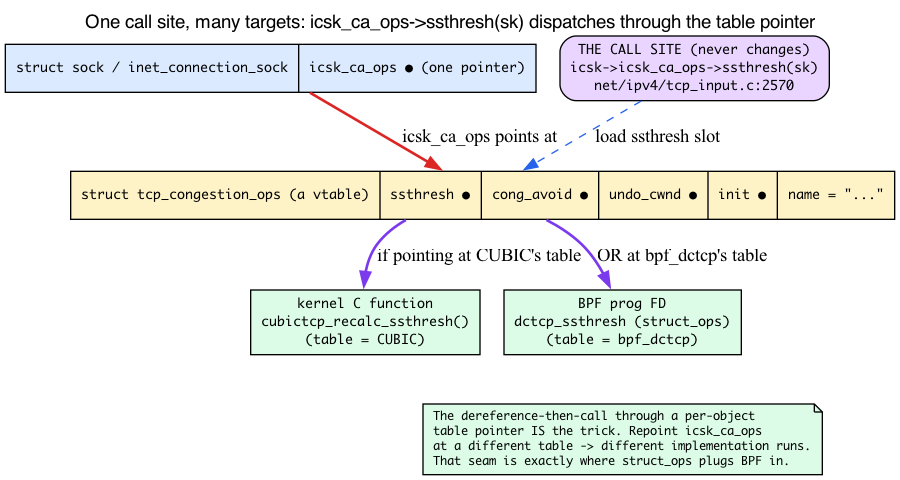
The answer is a struct of function pointers — a vtable. You declare a struct whose members are pointers-to-functions, one per operation. Each algorithm fills in a separate instance of that struct, pointing each member at its own implementation. To swap behavior, you don’t change the call site — you repoint the object at a different filled-in struct. One call site, many implementations, selected by which table you’re pointing at. That is C’s way of doing what C++ would call runtime polymorphism.
The kernel’s congestion-control vtable is struct tcp_congestion_ops. Here it is with fields reordered and trimmed for first reading:
/* include/net/tcp.h:1316 — fields reordered/trimmed for readability;
 * the real layout puts fast-path callbacks first and init/release LAST */
struct tcp_congestion_ops {
    u32   (*ssthresh)(struct sock *sk);
    void  (*cong_avoid)(struct sock *sk, u32 ack, u32 acked);
    void  (*set_state)(struct sock *sk, u8 new_state);
    void  (*cwnd_event)(struct sock *sk, enum tcp_ca_event ev);
    void  (*in_ack_event)(struct sock *sk, u32 flags);
    void  (*pkts_acked)(struct sock *sk, const struct ack_sample *sample);
    u32   (*undo_cwnd)(struct sock *sk);
    /* ... ~10 callbacks ... */
    char name[TCP_CA_NAME_MAX];
    /* ... */
    void  (*init)(struct sock *sk);     /* private-data setup, called last */
    void  (*release)(struct sock *sk);  /* private-data teardown */
};
That ordering is honest about being rearranged: in the real include/net/tcp.h:1316, the struct opens with a comment saying “fast path fields are put first to fill one cache line,” the fast-path callbacks (cong_avoid, cong_control, ssthresh) come first, the control/slow-path fields and init/release come last, and the whole struct ends ____cacheline_aligned_in_smp — the same cache-line discipline you met for sk_buff on Day 1, now applied to a vtable.
How the kernel actually calls through it
A vtable is useless until something dispatches through it. Each TCP socket carries one pointer to the tcp_congestion_ops it’s currently using:
/* include/net/inet_connection_sock.h:97 */
const struct tcp_congestion_ops *icsk_ca_ops;   /* "Pluggable congestion control hook" */
Selecting an algorithm for a connection is nothing more than pointing icsk_ca_ops at that algorithm’s table. And the TCP fast path calls operations indirectly, through that pointer, never naming a concrete algorithm:
/* net/ipv4/tcp_input.c:2570 — on a loss/ECN event, ask the CC for the new threshold */
WRITE_ONCE(tp->snd_ssthresh, icsk->icsk_ca_ops->ssthresh(sk));

/* net/ipv4/tcp_input.c:3517 — per ACK, let the CC advance the window */
icsk->icsk_ca_ops->cong_avoid(sk, ack, acked);

/* net/ipv4/tcp_input.c:3864 — or, if the CC took full control, hand it everything */
icsk->icsk_ca_ops->cong_control(sk, ack, flag, rs);
Read icsk->icsk_ca_ops->ssthresh(sk) slowly. It means: follow the socket’s CC pointer to a table, load the ssthresh slot out of that table, and call whatever function lives there. If icsk_ca_ops points at CUBIC’s table, this calls CUBIC’s C function. If it points at BBR’s, it calls BBR’s. The call site never changes; the target does. That indirection — the dereference-then-call through a per-object table pointer — is the entire trick, and it is exactly the seam struct_ops plugs BPF into.
Registration is how a table joins the pool of selectable algorithms: tcp_register_congestion_control() adds the table to a global list (tcp_cong_list) so it can later be looked up by name and assigned to a socket’s icsk_ca_ops.
Why this is “kernel extension,” not “tracing”
Hold the two models side by side, because this is the whole thesis of the day:
- A tracing hook (kprobe, tracepoint, fentry — everything up to Day 21) observes at a fixed, pre-drilled call site. The kernel reaches the site, runs its own logic, and on the way past lets your program peek. Your program is a spectator with write access.
- A struct_ops program becomes the call target. There is no separate “kernel logic” running alongside it — when
icsk_ca_ops->ssthresh(sk)fires, your BPF program is the function that runs. You’re not watching the algorithm. You are the algorithm.
That is why this earns the name kernel extension language rather than tracing. And it ties back to BTF, which you’ve leaned on since Day 1’s vmlinux.h and CO-RE (Day 3): the kernel publishes the layout of struct tcp_congestion_ops in its own BTF, so when you supply BPF programs for the slots, the verifier can match each callback’s signature slot by slot against the C struct’s declared types. The vtable’s shape is the contract; BTF is how both sides agree on it.
The classic example is exactly this — TCP congestion control. CUBIC, BBR, Reno, DCTCP are all implementations of tcp_congestion_ops in C, each registered via tcp_register_congestion_control(). Now you can write one in BPF.
What TCP congestion control actually does
The slot names above (ssthresh, cong_avoid, undo_cwnd) are opaque until you know what the algorithm they implement is for. The ebpf book hasn’t taught congestion control — Day 19 only named one via bpf_setsockopt(..., "bbr"). So here’s exactly enough to read bpf_dctcp.c without a networking textbook.
The problem CC solves. A TCP sender can’t see the network. It doesn’t know how much bandwidth is free or how deep the queues are. If it sends too fast, routers drop packets and everyone’s throughput collapses; too slow and the link sits idle. Congestion control is the sender’s guessing game: probe the network, react to feedback, converge on a sending rate.
cwnd — the congestion window. This is the sender’s self-imposed cap on how many segments (MSS-sized packets) it will let be “in flight” (sent but not yet ACKed) at once. (Linux’s tp->snd_cwnd and tcp_snd_cwnd() count segments, not bytes — RFCs define cwnd in bytes conceptually, but the field and the tooling are in segments.) It’s TCP’s running guess at how much the network can absorb. cwnd is literally what ss -ti prints as cwnd:10 in today’s lab — cwnd:10 means 10 segments, the algorithm’s current guess.
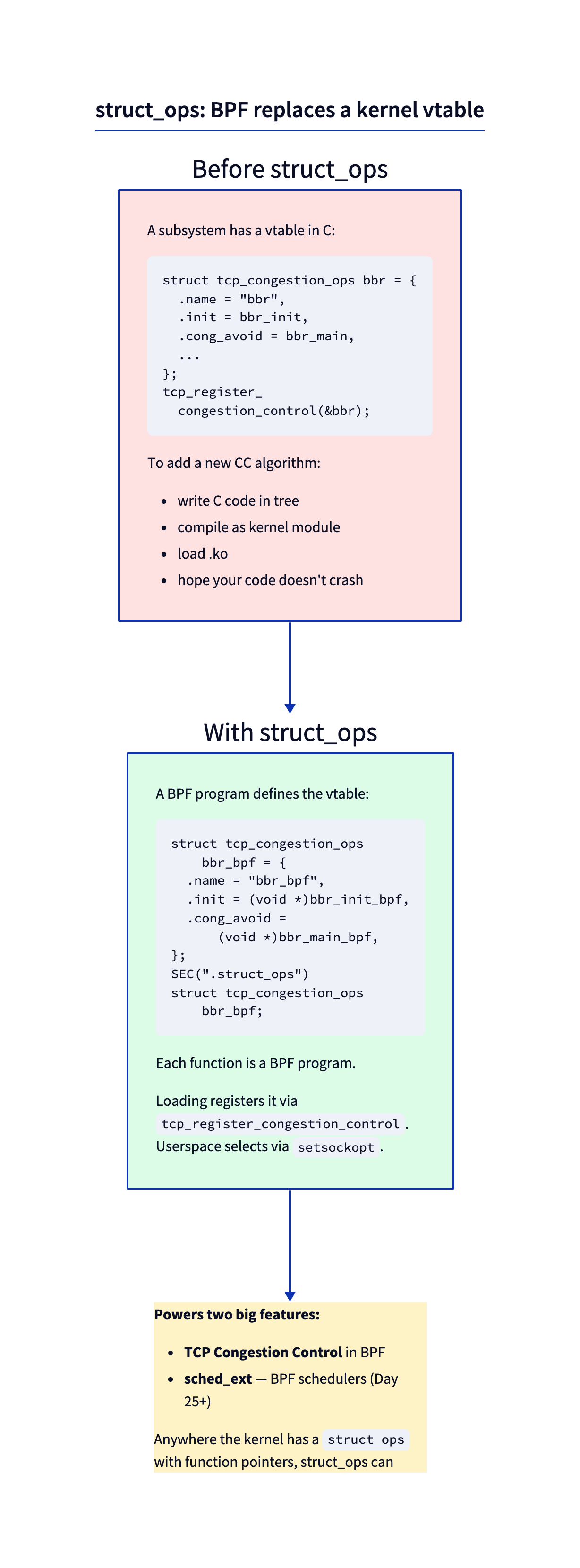
ssthresh — the slow-start threshold. cwnd grows in two different regimes, and ssthresh is the boundary between them:
-
Below
ssthresh: slow-start.cwndgrows roughly exponentially — it ramps up fast to find the network’s ceiling quickly. You can see the ceiling enforced directly:/* net/ipv4/tcp_cong.c:456 — tcp_slow_start() */ u32 cwnd = min(tcp_snd_cwnd(tp) + acked, tp->snd_ssthresh);Every ACK bumps
cwndby the number of newly-ACKed segments (acked), but it’s clamped tosnd_ssthresh. The momentcwndwould cross the threshold, slow-start ends. -
Above
ssthresh: congestion avoidance.cwndgrows roughly linearly — cautious probing, one segment per round-trip-ish, because we’re now near the suspected limit.
The ssthresh callback is invoked when the network signals trouble (a loss, or an ECN congestion mark) to compute the new threshold to drop down to. Reno’s is the textbook “cut in half”:
/* net/ipv4/tcp_cong.c:515 — tcp_reno_ssthresh() */
return max(tcp_snd_cwnd(tp) >> 1U, 2U);   /* halve cwnd, floor at 2 */
That’s why ssthresh is required: a CC algorithm must be able to say how far to back off on congestion. No back-off, no congestion control.
cong_avoid — the per-ACK heartbeat. Recall the dispatch site icsk->icsk_ca_ops->cong_avoid(sk, ack, acked) fires on every eligible ACK (whenever the CC doesn’t provide cong_control), and the callback itself picks the regime — slow-start below ssthresh, linear growth above it. Reno’s reference implementation routes through slow-start below the threshold and the linear tcp_cong_avoid_ai() above it (tcp_cong.c:496). This is why the framework requires either cong_avoid or cong_control: you either let the core stack drive (cong_avoid does just the cwnd math, the stack handles pacing/ECN/idle for you), or you take the wheel completely (cong_control gets every delivered-packet event and owns all of it). One or the other — that disjunction is real, and it’s the literal subject of today’s check question.
undo_cwnd — reverse a mistake. Sometimes TCP cuts cwnd for a “loss” that turns out to be spurious (the packet was just reordered, not dropped). undo_cwnd restores cwnd afterward (tcp_cong.c:523). It’s required so the framework can always reverse a reduction it later regrets.
Now the kernel’s required-ops gate reads as plain English — and this exact function is the answer to today’s check question:
/* net/ipv4/tcp_cong.c:78 — tcp_validate_congestion_control() */
if (!ca->ssthresh || !ca->undo_cwnd ||
    !(ca->cong_avoid || ca->cong_control)) {
    pr_err("%s does not implement required ops\n", ca->name);
    return -EINVAL;
}
A minimal real vtable fills exactly those three required slots — here’s Reno, the whole thing:
/* net/ipv4/tcp_cong.c:531 */
struct tcp_congestion_ops tcp_reno = {
    .flags    = TCP_CONG_NON_RESTRICTED,
    .name     = "reno",
    .owner    = THIS_MODULE,
    .ssthresh = tcp_reno_ssthresh,    /* required */
    .cong_avoid = tcp_reno_cong_avoid, /* required: cong_avoid OR cong_control */
    .undo_cwnd  = tcp_reno_undo_cwnd,  /* required */
};
The rhythm and the timing. These callbacks fire on the data-path ACK processing, which runs in softirq context. That’s why — recall Day 12 — congestion-control struct_ops programs are non-sleepable: you cannot block on the ACK fast path. Keep that in mind; it shows up again in “What’s verified.”
DCTCP specifically. Data Center TCP reacts to ECN CE marks (explicit congestion notification set by switches before they drop) rather than waiting for actual loss, and it adjusts a fractional alpha estimate of how congested the path is. That’s why bpf_dctcp.c implements set_state, in_ack_event (to fold in ECN feedback), and a cong_avoid that leans on Reno’s — enough context now to read it without a textbook.
Where a connection keeps its CC state: inet_csk_ca()
One more piece, because every callback in bpf_dctcp.c opens with the same line and you need to know what it touches:
struct bpf_dctcp *ca = inet_csk_ca(sk); /* the first line of nearly every callback */
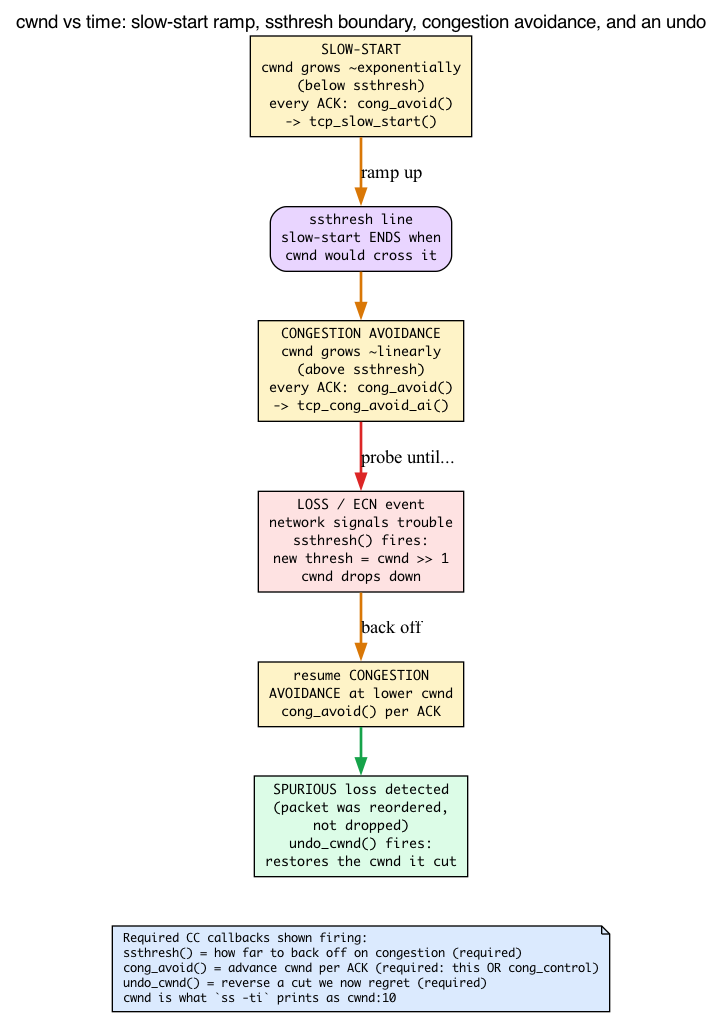
DCTCP needs to remember things per connection — its alpha estimate, a CE-state flag, byte counters. Where does that live? Not in a separate allocation per socket — that’d be a malloc on every connection. Instead, every TCP socket reserves a fixed inline scratch buffer for whatever CC algorithm it currently uses:
/* include/net/inet_connection_sock.h:141 */
u64 icsk_ca_priv[104 / sizeof(u64)];   /* 104 bytes of inline per-socket CC scratch */
#define ICSK_CA_PRIV_SIZE sizeof_field(struct inet_connection_sock, icsk_ca_priv)
That’s 104 bytes sitting inside every inet_connection_sock, costing nothing extra to allocate. The accessor just hands back a pointer into it, reinterpreted as the algorithm’s private struct:
/* include/net/inet_connection_sock.h:153 */
static inline void *inet_csk_ca(const struct sock *sk)
{
    return (void *)inet_csk(sk)->icsk_ca_priv;
}
So inet_csk_ca(sk) is just “give me this socket’s CC scratch, typed as my struct.” This is why the vtable has init and release slots, and why init is described as “called last”: when a socket adopts an algorithm, init runs to lay out that scratch (zero the counters, set initial alpha); release tears it down. The slots exist precisely to manage this inline buffer’s lifecycle.
There’s a hard constraint hiding here: the buffer is size-bounded by ICSK_CA_PRIV_SIZE (104 bytes). A CC algorithm’s private struct must fit. That bounds what a BPF struct_ops CC can stash per connection — worth one sentence of respect.
And it connects straight to the lab. bpf_dctcp.c declares:
/* tools/testing/selftests/bpf/progs/bpf_dctcp.c:40 */
struct bpf_dctcp {
    __u32 old_delivered;
    __u32 old_delivered_ce;
    __u32 prior_rcv_nxt;
    __u32 dctcp_alpha;
    __u32 next_seq;
    __u32 ce_state;
    __u32 loss_cwnd;
};
That 28-byte struct is exactly what lands in icsk_ca_priv (well within the 104-byte cap). It’s the state init writes once, that cong_avoid/ssthresh/in_ack_event read and update on each ACK, and that release would tear down.
How struct_ops works
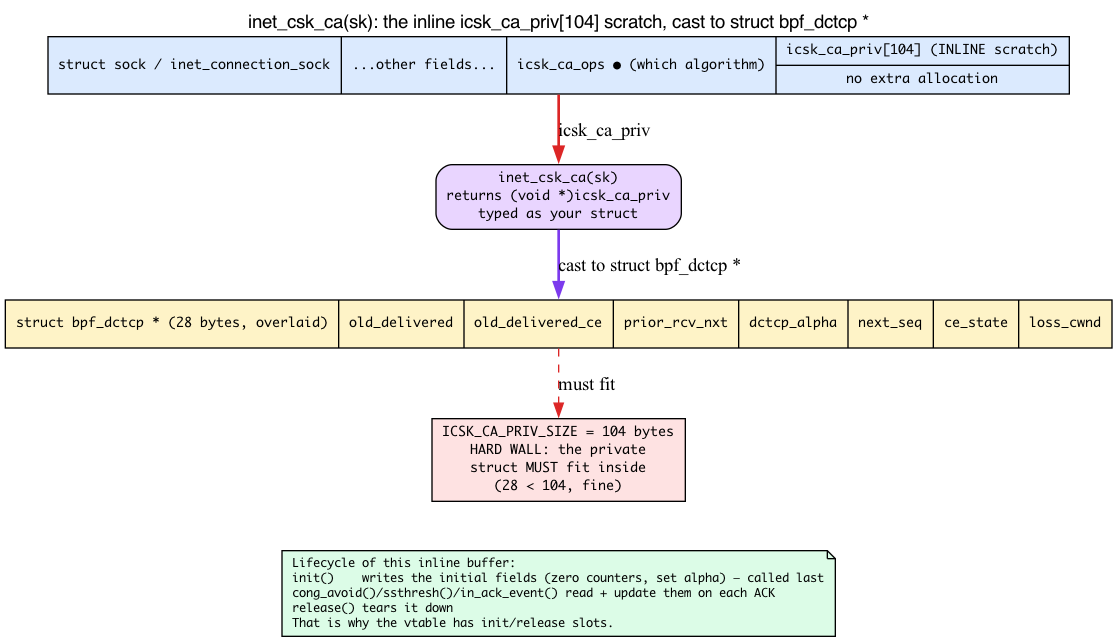
Now the mechanism. A struct_ops module has three parts in BPF source:
- Each callback is a separate BPF program with
SEC("struct_ops/<callback_name>"). - The vtable instance is declared in
SEC(".struct_ops")(orSEC(".struct_ops.link")for the modern link-based variant) — a struct of the right type with function pointers pointing at the BPF programs. - The kernel reads the BTF at load time, validates each callback’s signature against the vtable’s expected types (the slot-by-slot match we described), and calls
register_${subsystem}(e.g.,tcp_register_congestion_control) automatically.
Example skeleton:
SEC("struct_ops/dctcp_init")
void BPF_PROG(my_init, struct sock *sk) { /* ... */ }

SEC("struct_ops/dctcp_ssthresh")
u32 BPF_PROG(my_ssthresh, struct sock *sk) { return /* ... */; }

/* Reuse Reno's cwnd math without rewriting it: declare the kernel's
 * exported function as a kfunc, then CALL it from a one-line BPF program. */
extern void tcp_reno_cong_avoid(struct sock *sk, __u32 ack, __u32 acked) __ksym;

SEC("struct_ops")
void BPF_PROG(my_cong_avoid, struct sock *sk, __u32 ack, __u32 acked)
{
    tcp_reno_cong_avoid(sk, ack, acked);   /* tail into Reno's linear growth */
}

/* ... other callbacks ... */

SEC(".struct_ops.link")
struct tcp_congestion_ops my_dctcp = {
    .init       = (void *)my_init,
    .ssthresh   = (void *)my_ssthresh,
    .cong_avoid = (void *)my_cong_avoid,   /* a BPF program that calls Reno */
    .name       = "my_dctcp",
};
Notice the .cong_avoid = (void *)my_cong_avoid line. A struct_ops slot always holds a BPF program — never a raw kernel function. So how do you “reuse” Reno’s existing C math? You don’t drop tcp_reno_cong_avoid into the slot; you declare it as a kfunc (extern ... __ksym;) and call it from inside a one-line BPF program (my_cong_avoid), then assign that BPF wrapper to the slot. The slot is BPF; the BPF body tail-calls into Reno’s linear-growth math. (This is exactly what the kernel’s own bpf_dctcp.c does at bpf_dctcp.c:231-236,253: extern ... tcp_reno_cong_avoid(...) __ksym;, a bpf_dctcp_cong_avoid program whose body is just tcp_reno_cong_avoid(sk, ack, acked);, and .cong_avoid = (void *)bpf_dctcp_cong_avoid.) Required and optional slots are subsystem-specific. TCP congestion control demands the required-ops gate from earlier (tcp_validate_congestion_control); other callbacks may be left NULL only if the TCP CC framework defines that as optional.
A note on the
SECsuffix. We writeSEC("struct_ops/dctcp_init")with a named suffix, but the suffix is optional — the kernel’s ownbpf_dctcp.cselftest uses a bareSEC("struct_ops")on every callback and lets the assignment in the.struct_opsvtable bind each program to its slot. Both work; libbpf resolves the binding from the vtable struct, not the section name. Don’t be confused if the source you’re comparing against omits the suffix.
The lifecycle
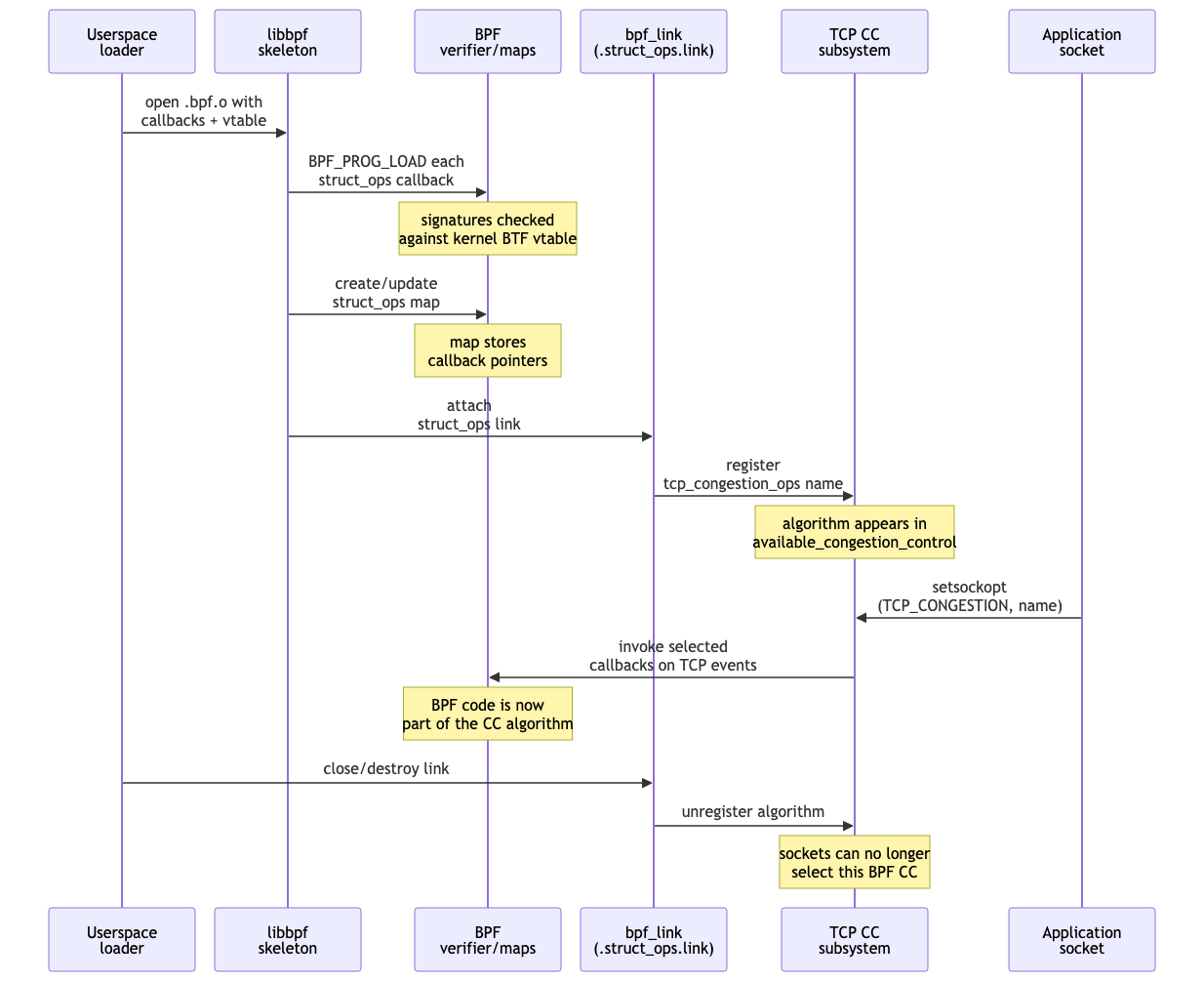
When you load a struct_ops object via libbpf:
- Each callback is loaded as a separate BPF program (separate prog FD).
- A struct_ops map is created — keyed by function-pointer slot, valued by the BPF program FDs that implement each. (This map is the in-kernel
tcp_congestion_opstable that a socket’sicsk_ca_opswill eventually point at.) - The kernel calls the registration function of the relevant subsystem. For TCP CC:
tcp_register_congestion_control(my_dctcp). The new algorithm name appears in/proc/sys/net/ipv4/tcp_available_congestion_control. - Userspace selects it via
setsockopt(TCP_CONGESTION, "my_dctcp")per socket, orsysctl tcp_congestion_control=my_dctcpsystem-wide — which, under the hood, repoints that socket’sicsk_ca_opsat your table.
When the BPF object is unloaded, the registration is reversed and the algorithm goes away.
What’s verified
The verifier does extensive checking on struct_ops modules:
- Each callback’s signature must match the kernel’s vtable definition. Mismatches are rejected at load time — this is the slot-by-slot BTF comparison from earlier.
- Each callback’s BPF program follows normal verifier rules (no unbounded loops, all pointers checked, etc.).
- Helper allowance is per-callback-context. A
struct_ops/dctcp_initcallback runs in TCP slow-path; certain helpers are allowed; XDP-only helpers aren’t. - Sleepable / non-sleepable is per-callback. TCP CC callbacks aren’t sleepable (they run in softirq on the ACK path, exactly as the CC section explained); some struct_ops vtables (sched_ext) have sleepable subsets.
The type matching uses BTF: the kernel knows struct tcp_congestion_ops from its own BTF, the BPF object’s BTF describes its callbacks’ signatures, and the framework (in bpf_struct_ops.c) walks the field-by-field comparison. The subsystem also gets a final say: bpf_struct_ops.c:861 calls st_ops->validate(kdata) before st_ops->reg(kdata, ...) at :883 — for TCP CC, validate is the very tcp_validate_congestion_control required-ops gate you read.
Why this is huge
It’s how sched_ext works. Sched_ext exposes struct sched_ext_ops — enqueue, dispatch, init, select_cpu, etc. A sched_ext BPF scheduler is just a struct_ops module against that vtable. Same plumbing as TCP CC, different vtable — the CPU scheduler’s dispatch loop calls through sched_ext_ops exactly the way TCP calls through icsk_ca_ops.
It’s how Cilium plans to do certain bits of advanced policy (still evolving). It’s how you’d implement a custom HMAC or compression algorithm. Anywhere the kernel has a function-pointer table, struct_ops can let BPF supply implementations.
The general structure of the kernel was already vtable-heavy (file_operations, net_device_ops, sched_class, …) — every one of those is a tcp_congestion_ops-shaped seam: a struct of function pointers the kernel dispatches through. struct_ops makes most of them potentially BPF-pluggable, given suitable kernel-side enabling and verifier rules. One plumbing, many vtables.
The lab — load BPF DCTCP
The kernel ships tools/testing/selftests/bpf/progs/bpf_dctcp.c — a BPF reimplementation of DCTCP that you can load directly. Everything you just learned is in there: the struct bpf_dctcp that lands in icsk_ca_priv, reached via the inet_csk_ca(sk) line each callback opens with, and the assembled tcp_congestion_ops vtable filling the required slots.
Because that program is part of the moving kernel tree, this repo does not copy it. Instead the lab ships thin wrappers under ebpf/labs/day22/ that compile the canonical in-tree object from the verified v7.1 source and drive its registration. They read the target’s locked identifiers from ebpf/labs/day22/config.env and resolve the kernel source through the shared scripts/linux-source.sh (which honors $LINUX_SRC if you set it, else the pinned/fetched default) — so nothing needs LINUX_SRC exported by hand.
Build and load
The build wrapper is what the lab dispatcher runs for this day (make -C ebpf/labs day22). It generates a narrow v7.1 TCP type header from the locked kernel tree, then builds the canonical bpf_dctcp.bpf.o into ebpf/labs/.output/day22/ with the pinned bpftool:
#!/usr/bin/env bash
# SPDX-License-Identifier: GPL-2.0
#
# build.sh — build wrapper for the Day 22 kernel-selftest DCTCP target.
#
# The central dispatcher (scripts/build-day.sh) execs this with no arguments for
# the "kernel-selftest" backend. It does not copy the upstream program; it builds
# the in-tree selftest from a verified v7.1 kernel source tree, resolved through
# scripts/linux-source.sh (which honors $LINUX_SRC if set, else the pinned/fetched
# default) — nothing needs LINUX_SRC exported by hand.
set -euo pipefail

HERE=$(cd -- "$(dirname -- "${BASH_SOURCE[0]}")" && pwd)
LABS=$(cd -- "$HERE/.." && pwd)
# shellcheck source=/dev/null
. "$HERE/config.env"

JOBS=${JOBS:-$(nproc 2>/dev/null || echo 1)}

fail() { printf 'day22-build: %s\n' "$*" >&2; exit 1; }

LINUX_SRC_DIR=$("$LABS/scripts/linux-source.sh" path) ||
    fail "could not resolve a verified ${DAY22_KERNEL_TAG} kernel source (see scripts/linux-source.sh)"
SELFTEST_DIR="$LINUX_SRC_DIR/$DAY22_SELFTEST_DIR"
BUILD_DIR="$LABS/.output/day22"

[[ -f "$LINUX_SRC_DIR/$DAY22_DCTCP_SRC" ]] ||
    fail "upstream DCTCP source missing: $LINUX_SRC_DIR/$DAY22_DCTCP_SRC"
VMLINUX_H=$("$LABS/scripts/kernel-btf.sh" tcp)
BPFTOOL=$("$LABS/scripts/linux-bpftool.sh")
mkdir -p "$BUILD_DIR"

printf 'day22-build: make -j%s OUTPUT=%s %s in %s\n' \
    "$JOBS" "$BUILD_DIR" "$DAY22_DCTCP_OBJ" "$SELFTEST_DIR" >&2
# Request the generated DCTCP object directly. Building the monolithic
# test_progs runner also compiles hundreds of unrelated BPF programs and test
# modules; registration below only needs this canonical upstream object.
make -C "$SELFTEST_DIR" OUTPUT="$BUILD_DIR" \
    BPFTOOL="$BPFTOOL" VMLINUX_BTF="$VMLINUX_H" VMLINUX_H="$VMLINUX_H" \
    -j"$JOBS" "$BUILD_DIR/$DAY22_DCTCP_OBJ"

[[ -s "$BUILD_DIR/$DAY22_DCTCP_OBJ" ]] ||
    fail "DCTCP BPF object was not produced: $BUILD_DIR/$DAY22_DCTCP_OBJ"
"$BPFTOOL" btf dump file "$BUILD_DIR/$DAY22_DCTCP_OBJ" >/dev/null ||
    fail "DCTCP object has no readable BTF"
printf 'day22-build: verified %s\n' "$BUILD_DIR/$DAY22_DCTCP_OBJ" >&2
The operator wrapper drives that object. Its default selftest subcommand creates a PID-scoped pin directory, registers the valid DCTCP vtable, verifies bpf_dctcp appears, unregisters it, and removes the directory on every exit. The separate register/inspect/unregister commands manage an explicitly persistent registration in /sys/fs/bpf/dctcp:
#!/usr/bin/env bash
# SPDX-License-Identifier: GPL-2.0
#
# run.sh — Day 22 operator for the kernel's in-tree BPF DCTCP struct_ops
# selftest. It does not copy the upstream program; it drives the artifacts that
# day22/build.sh produced from a verified v7.1 kernel source tree (resolved via
# scripts/linux-source.sh — no need to export LINUX_SRC).
#
# Subcommands (each owns only what it creates):
#   selftest    (default) temporarily register the canonical DCTCP object,
#               verify it appears, then unregister it and remove owned state
#   available   print tcp_available_congestion_control
#   register    register bpf_dctcp.bpf.o into the owned bpffs pin dir (persists)
#   inspect     bpftool struct_ops list / dump name dctcp
#   unregister  unregister the algorithm and remove the (empty) pin dir
#
# Privileged subcommands (selftest/register/inspect/unregister) are opt-in and
# require root, mirroring scripts/smoke.sh.
set -euo pipefail

HERE=$(cd -- "$(dirname -- "${BASH_SOURCE[0]}")" && pwd)
LABS=$(cd -- "$HERE/.." && pwd)
# shellcheck source=/dev/null
. "$HERE/config.env"

SELFTEST_DIR=
BUILD_DIR="$LABS/.output/day22"
SELFTEST_ACTIVE=0
SELFTEST_PIN=

log() { printf 'day22: %s\n' "$*" >&2; }
fail() { printf 'day22: %s\n' "$*" >&2; exit 1; }

require_priv() {
    if [[ ${EBPF_LABS_ALLOW_PRIVILEGED:-0} != 1 ]]; then
        fail 'set EBPF_LABS_ALLOW_PRIVILEGED=1 to acknowledge privileged BPF operations'
    fi
    (( EUID == 0 )) || fail 'run with sudo after setting EBPF_LABS_ALLOW_PRIVILEGED=1'
}

require_struct_ops() {
    require_priv
    [[ ${EBPF_LABS_ALLOW_STRUCT_OPS:-0} == 1 ]] ||
        fail 'set EBPF_LABS_ALLOW_STRUCT_OPS=1 to acknowledge TCP struct_ops registration'
}

resolve_tree() {
    [[ -n $SELFTEST_DIR ]] && return
    local src
    src=$("$LABS/scripts/linux-source.sh" path) ||
        fail "could not resolve a verified ${DAY22_KERNEL_TAG} kernel source"
    SELFTEST_DIR="$src/$DAY22_SELFTEST_DIR"
    [[ -d $SELFTEST_DIR ]] || fail "selftest tree not found: $SELFTEST_DIR"
}

cleanup_selftest() {
    local status=$?
    trap - EXIT INT TERM
    if (( SELFTEST_ACTIVE )); then
        bpftool struct_ops unregister name "$DAY22_VTABLE_OK" 2>/dev/null || true
    fi
    [[ -z $SELFTEST_PIN ]] || rmdir "$SELFTEST_PIN" 2>/dev/null || true
    exit "$status"
}

cmd_selftest() {
    require_struct_ops
    resolve_tree
    [[ -s "$BUILD_DIR/$DAY22_DCTCP_OBJ" ]] ||
        fail "run 'day22/build.sh' first: missing $BUILD_DIR/$DAY22_DCTCP_OBJ"
    command -v bpftool >/dev/null 2>&1 || fail 'bpftool is required at runtime'
    grep -qw "$DAY22_CC_NAME" /proc/sys/net/ipv4/tcp_available_congestion_control &&
        fail "$DAY22_CC_NAME is already registered; refusing to unregister state this run does not own"

    SELFTEST_PIN="${DAY22_PIN_DIR}-selftest-$$"
    [[ ! -e $SELFTEST_PIN ]] || fail "owned pin directory already exists: $SELFTEST_PIN"
    mkdir "$SELFTEST_PIN"
    SELFTEST_ACTIVE=1
    trap cleanup_selftest EXIT INT TERM

    log "temporarily registering $DAY22_DCTCP_OBJ"
    # The intentionally incomplete dctcp_nouse vtable can make bpftool return
    # non-zero after the valid dctcp vtable has registered, so assert state.
    bpftool struct_ops register "$BUILD_DIR/$DAY22_DCTCP_OBJ" "$SELFTEST_PIN" || true
    grep -qw "$DAY22_CC_NAME" /proc/sys/net/ipv4/tcp_available_congestion_control ||
        fail "$DAY22_CC_NAME did not appear in tcp_available_congestion_control"

    bpftool struct_ops unregister name "$DAY22_VTABLE_OK"
    SELFTEST_ACTIVE=0
    rmdir "$SELFTEST_PIN"
    SELFTEST_PIN=
    ! grep -qw "$DAY22_CC_NAME" /proc/sys/net/ipv4/tcp_available_congestion_control ||
        fail "$DAY22_CC_NAME remained registered after cleanup"
    trap - EXIT INT TERM
    log "temporary registration verified and removed"
}

cmd_available() {
    cat /proc/sys/net/ipv4/tcp_available_congestion_control
}

cmd_register() {
    require_struct_ops
    resolve_tree
    [[ -f "$BUILD_DIR/$DAY22_DCTCP_OBJ" ]] ||
        fail "run 'day22/build.sh' first: missing $BUILD_DIR/$DAY22_DCTCP_OBJ"
    [[ ! -e $DAY22_PIN_DIR ]] ||
        fail "refusing to adopt existing pin directory: $DAY22_PIN_DIR"
    mkdir "$DAY22_PIN_DIR"
    log "registering $DAY22_DCTCP_OBJ (the $DAY22_VTABLE_REJECT decoy is expected to be rejected)"
    # bpftool prints a non-fatal error for the incomplete dctcp_nouse vtable and
    # still registers the valid one, so tolerate its non-zero exit.
    bpftool struct_ops register "$BUILD_DIR/$DAY22_DCTCP_OBJ" "$DAY22_PIN_DIR" || true
    grep -qw "$DAY22_CC_NAME" /proc/sys/net/ipv4/tcp_available_congestion_control ||
        fail "$DAY22_CC_NAME did not appear in tcp_available_congestion_control"
    log "$DAY22_CC_NAME is now registered (run '$0 unregister' when done)"
}

cmd_inspect() {
    require_priv
    bpftool struct_ops list
    bpftool struct_ops dump name "$DAY22_VTABLE_OK"
}

cmd_unregister() {
    require_priv
    log "unregistering $DAY22_VTABLE_OK and removing $DAY22_PIN_DIR"
    bpftool struct_ops unregister name "$DAY22_VTABLE_OK" 2>/dev/null || true
    if [[ -d $DAY22_PIN_DIR ]]; then
        rmdir "$DAY22_PIN_DIR" ||
            fail "pin directory is not empty; refusing recursive removal: $DAY22_PIN_DIR"
    fi
}

case ${1:-selftest} in
    selftest)   cmd_selftest ;;
    available)  cmd_available ;;
    register)   cmd_register ;;
    inspect)    cmd_inspect ;;
    unregister) cmd_unregister ;;
    *)
        printf 'usage: %s {selftest|available|register|inspect|unregister}\n' "$0" >&2
        exit 2
        ;;
esac
So the build-and-load flow is:
make -C ebpf/labs day22            # dispatcher → day22/build.sh

EBPF_LABS_ALLOW_PRIVILEGED=1 EBPF_LABS_ALLOW_STRUCT_OPS=1 \
  sudo --preserve-env=EBPF_LABS_ALLOW_PRIVILEGED,EBPF_LABS_ALLOW_STRUCT_OPS \
  ebpf/labs/day22/run.sh selftest
You should see temporary registration verified and removed. The check loads the exact upstream BPF struct_ops object, asserts that its bpf_dctcp algorithm joined the available list, then tears it down before returning. Check afterward and you will see no bpf_dctcp:
ebpf/labs/day22/run.sh available
# reno cubic bbr
Note there’s no native dctcp in that list by default: on this kernel DCTCP is built as a loadable module (CONFIG_TCP_CONG_DCTCP=m) and isn’t loaded unless you sudo modprobe tcp_dctcp. Its absence here is expected, not a sign the lab failed. (If you do load the module, the dctcp you’d then see is the kernel’s native C implementation, net/ipv4/tcp_dctcp.c — not our BPF one; don’t mistake native dctcp for proof the BPF lab worked.)
To make the BPF version persist so the next steps have something to use, register the prebuilt object yourself. register installs the struct_ops map in the kernel, which is what keeps the algorithm alive after bpftool exits (this object’s vtable uses the map-based SEC(".struct_ops"), so nothing is actually pinned into the directory — it stays empty). The operator refuses to adopt an existing pin directory and runs bpftool struct_ops register ebpf/labs/.output/day22/bpf_dctcp.bpf.o /sys/fs/bpf/dctcp:
EBPF_LABS_ALLOW_PRIVILEGED=1 EBPF_LABS_ALLOW_STRUCT_OPS=1 \
  sudo --preserve-env=EBPF_LABS_ALLOW_PRIVILEGED,EBPF_LABS_ALLOW_STRUCT_OPS \
  ebpf/labs/day22/run.sh register
bpf_dctcp.bpf.o carries two vtables (dctcp → name bpf_dctcp, and dctcp_nouse → name bpf_dctcp_nouse). On v7.1 only bpf_dctcp registers — dctcp_nouse is intentionally incomplete (it defines only init/set_state, not the required ssthresh/undo_cwnd/cong_avoid), so tcp_validate_congestion_control rejects it with the does not implement required ops error and bpftool prints a non-fatal error while still registering the valid one (the wrapper tolerates that non-zero exit and then asserts bpf_dctcp actually appeared). This is the required-ops gate from earlier firing in real life:
# Error: can't register struct_ops dctcp_nouse: Invalid argument
# Registered tcp_congestion_ops dctcp id <id>
# ... and `available` now prints:
# reno cubic bbr bpf_dctcp
# (registration is purely additive — the base algorithms stay; bpf_dctcp is appended)
When you’re done with the whole lab, unregister the algorithm. Because bpf_dctcp.c uses the map-based SEC(".struct_ops") (not .struct_ops.link), register does not pin a link into the directory — so removing the directory alone does not unregister it. The operator’s unregister runs bpftool struct_ops unregister name dctcp and then removes the (empty) pin dir:
EBPF_LABS_ALLOW_PRIVILEGED=1 \
  sudo --preserve-env=EBPF_LABS_ALLOW_PRIVILEGED ebpf/labs/day22/run.sh unregister
Use it on a connection
In a small C program:
int sock = socket(AF_INET, SOCK_STREAM, 0);
setsockopt(sock, IPPROTO_TCP, TCP_CONGESTION, "bpf_dctcp", 9);
/* now this connection's icsk_ca_ops points at our BPF table */
Or via iperf3 against a local loopback server (install iperf3 if it’s missing). This needs bpf_dctcp registered from the step above. An unprivileged setsockopt(TCP_CONGESTION) only accepts algorithms in tcp_allowed_congestion_control, which by default is a subset of the available list — so add bpf_dctcp to it first (save the original to restore later):
ORIG=$(cat /proc/sys/net/ipv4/tcp_allowed_congestion_control)
sudo sysctl -w net.ipv4.tcp_allowed_congestion_control="$ORIG bpf_dctcp"
In terminal 1:
iperf3 -s
In terminal 2, run a transfer long enough to inspect mid-flight, asking for the BPF CC:
iperf3 -c 127.0.0.1 -C bpf_dctcp -t 30
In terminal 3, while the transfer runs, confirm the socket actually negotiated it. ss -ti prints the congestion-control name at the start of each connection’s TCP-info line, so a substring match is enough — and the cwnd: field you’ll see there is the exact congestion window the CC section taught:
ss -ti dst 127.0.0.1 | grep bpf_dctcp
#	 bpf_dctcp wscale:7,7 rto:204 rtt:0.05/0.02 ... cwnd:10 ...
A hit proves this connection is running BPF-provided DCTCP — that socket’s icsk_ca_ops is pointing at a table whose slots are your BPF programs, and the kernel’s cong_avoid/ssthresh dispatch sites are calling into them on every ACK. (Don’t use grep -A1 — the CC name is inline on the info line, not the line after.) If iperf3 -c fails with unable to set TCP_CONGESTION: Supplied congestion control algorithm not supported on this host, the algorithm isn’t registered or isn’t in the allowed list — go back and run the bpftool struct_ops register and sysctl ... tcp_allowed_congestion_control steps. When you’re done, restore the allowed list: sudo sysctl -w net.ipv4.tcp_allowed_congestion_control="$ORIG".
Inspect
These need the struct_ops live, so run them only after the persistent register step above (after selftest exits, nothing is loaded and list prints nothing while dump returns []). The registered map takes the name of its SEC(".struct_ops") variable — dctcp — not the algorithm name bpf_dctcp set in .name, so dump name dctcp is what matches (and dctcp_nouse was rejected at register time). The operator’s inspect subcommand runs both bpftool struct_ops list and bpftool struct_ops dump name dctcp:
EBPF_LABS_ALLOW_PRIVILEGED=1 \
  sudo --preserve-env=EBPF_LABS_ALLOW_PRIVILEGED ebpf/labs/day22/run.sh inspect
# <id>: dctcp            tcp_congestion_ops
# ... followed by the field-by-field vtable dump
dump shows the vtable field-by-field, with each implemented function-pointer slot (ssthresh, cong_avoid, init, undo_cwnd, …) resolved to the BPF prog id that serves it. That’s the payoff, and it’s the literal picture from the start of the day: a kernel function-pointer table whose entries are BPF programs, ready for a socket’s icsk_ca_ops to point at.
There are no Dumb Questions
Q: If a vtable is just a struct of function pointers, what stops me from writing garbage into a slot and crashing the kernel?
A: The verifier and the BTF signature match. You don’t write a raw pointer — you supply a BPF program for each slot, and the kernel checks that program’s signature against the vtable field’s declared type (slot by slot, via BTF) before it’ll bind it. A type mismatch is rejected at load time. Then the subsystem’s own
validatecallback (bpf_struct_ops.c:861) gets a veto — for TCP CC that’stcp_validate_congestion_control, which rejects you for missing required ops. C lets kernel code stuff any function pointer into a vtable; struct_ops deliberately does not extend that trust to BPF.
Q: I want Reno’s
cong_avoidmath without rewriting it — can I just put.cong_avoid = (void *)tcp_reno_cong_avoidin the slot?A: No — a struct_ops slot can only hold a BPF program, never a raw kernel function. Writing the kernel symbol directly into the
.struct_opsvtable emits a relocation against an undefined extern, and the object fails to load (libbpf demands every slot resolve to aBPF_PROG_TYPE_STRUCT_OPSprogram). The trick is one level of indirection: declaretcp_reno_cong_avoidas a kfunc (extern void tcp_reno_cong_avoid(struct sock *sk, __u32 ack, __u32 acked) __ksym;), write a one-line BPF program whose body just calls it (tcp_reno_cong_avoid(sk, ack, acked);), and assign that BPF wrapper to the slot. So the slot holds your BPF trampoline; the dispatch site calls your BPF program, which tail-calls into Reno’s C math. That’s the kernel’s own pattern inbpf_dctcp.c.
Q: Where does my per-connection state actually live, and what bounds its size?
A: In the socket’s inline
icsk_ca_priv[104]buffer, reached viainet_csk_ca(sk). Your private struct (the BPFstruct bpf_dctcp) is overlaid onto those 104 bytes — no separate allocation. The hard cap isICSK_CA_PRIV_SIZE(104 bytes). If your CC needs more per-connection memory than that, you’d have to stash the overflow in a BPF map keyed by socket, not inicsk_ca_priv.
What to read in the kernel
-
kernel/bpf/bpf_struct_ops.c— the framework. ~1500 lines. Read top to bottom (it’s surprisingly readable). Key entry points:bpf_struct_ops_map_alloc_check(line 1021) — validates a struct_ops map type.bpf_struct_ops_map_alloc(line 1043) — creates the map and binds BPF prog FDs to vtable slots.st_ops->validatethenst_ops->reg(lines 861 / 883) — the subsystem’s signature/required-ops check, then the actual registration.bpf_struct_ops_link_create(line 1360) — forSEC(".struct_ops.link"), creates a bpf_link.bpf_struct_ops_test_run— used by selftests to invoke a callback in a controlled environment.
-
include/net/tcp.h:1316—struct tcp_congestion_ops. The vtable shape that BPF DCTCP implements. Read each callback’s docstring; that’s what your BPF program is expected to do. Note the “fast path fields first / control paths last” comments. -
net/ipv4/tcp_cong.c— the CC framework core. Readtcp_validate_congestion_control(line 78 — the required-ops gate),tcp_slow_start(line 456 — thessthreshceiling), and the Reno reference (tcp_reno_cong_avoid/tcp_reno_ssthresh/tcp_reno_undo_cwndat 496/515/523, assembled intotcp_renoat 531). This is the minimal real vtable to compare yours against. -
net/ipv4/tcp_dctcp.c— the C reference implementation of DCTCP. Compare againsttools/testing/selftests/bpf/progs/bpf_dctcp.cfield-by-field. The BPF version is a near-mechanical port; reading both side-by-side teaches the conversion idiom. -
tools/testing/selftests/bpf/progs/bpf_dctcp.c— the canonical BPF struct_ops example. Read end to end. Notice theinet_csk_ca(sk)line atop each callback (yourstruct bpf_dctcpoverlaid onicsk_ca_priv), the bareSEC("struct_ops")per callback, and theSEC(".struct_ops")containing the assembled vtable. -
kernel/sched/ext.c— sched_ext. ~10000 lines. The other big struct_ops user. Same pattern: a vtable (struct sched_ext_ops), per-callback BPF programs, dispatched through a function-pointer table. -
Documentation/bpf/struct_ops.rst— official guide. Brief but pointed. (Not present in the v7.1 tree; check the in-treeDocumentation/bpf/index for the current struct_ops write-up.)
Bullet Points
- A vtable is a struct of function pointers; the kernel keeps one pointer per operation and dispatches indirectly (
icsk_ca_ops->ssthresh(sk)) so one call site can invoke many implementations. Swapping behavior = repointing the table pointer. That indirection is the seam struct_ops fills. - Tracing observes; struct_ops becomes the target. A struct_ops BPF program is the function the kernel calls — that’s why it’s “kernel extension,” not “tracing.”
- TCP congestion control:
cwndis the in-flight cap in segments (thecwnd:10inss -ti= 10 segments);ssthreshis the slow-start→congestion-avoidance boundary;cong_avoidruns per ACK;undo_cwndreverses spurious cuts. CC callbacks run in softirq → non-sleepable. - Required ops (TCP CC):
ssthresh,undo_cwnd, and eithercong_avoidorcong_control— enforced bytcp_validate_congestion_control(tcp_cong.c:78). - Per-connection state lives in the socket’s inline
icsk_ca_priv[104]buffer, reached viainet_csk_ca(sk);init/releaseset it up and tear it down; it’s size-capped atICSK_CA_PRIV_SIZE. - struct_ops lets BPF supply implementations for kernel function-pointer tables. Each callback is a separate BPF program (
SEC("struct_ops/X")); the vtable struct lives inSEC(".struct_ops")or.struct_ops.link. - Loading the map auto-registers the implementation with the kernel subsystem (TCP CC, sched_ext, etc.). The verifier checks each callback’s signature against the kernel’s BTF for the vtable struct — mismatches caught at load time.
- Partial implementations are subsystem-specific: TCP CC requires the three ops above; optional slots may remain NULL. To reuse a kernel C routine like Reno’s
cong_avoid, you can’t put the C function in the slot — declare it as a kfunc and call it from a one-line BPF program assigned to the slot. - Used by: TCP CC, sched_ext, congestion-control modules, struct_ops growing per release. Inspect with
bpftool struct_ops list/dump.
Check question
If you load a BPF struct_ops module that defines only some callbacks (e.g., init and ssthresh but not cong_avoid), what happens to TCP connections using your CC?
Click to reveal answer
Answer: For TCP congestion control, that object is rejected unless the required callbacks are present — the required-ops gate from earlier (tcp_validate_congestion_control, net/ipv4/tcp_cong.c:78; the required-ops if is at :81-82) pr_errs does not implement required ops and returns -EINVAL. (That’s exactly why dctcp_nouse in the lab — which defines only init/set_state — fails to register.) If you want Reno’s cong_avoid behavior, you can’t drop the C function into the slot: declare tcp_reno_cong_avoid as a kfunc and call it from a one-line BPF cong_avoid program, then assign that program to the slot.
Struct_ops does not have a universal “unset slots fall back” rule. Each subsystem decides which callbacks are required, which are optional, and what a NULL optional callback means. sched_ext, TCP CC, and future struct_ops users have different contracts.
Tomorrow
Day 23: actually modify BPF DCTCP. Add ringbuf logging that emits per-ACK telemetry, and watch a real iperf3 run produce per-segment data — reading your struct bpf_dctcp state out of icsk_ca_priv as each ACK fires.