Day 24 — BTF spelunking: finding and using kfuncs you haven’t met
Today’s mission: find a kfunc on your kernel that you’ve never used, read its signature from BTF, write a program that calls it. Along the way: learn how BTF stores a function (the surprising answer is “in two pieces”), where the vmlinux BTF blob physically comes from, and how to make a program degrade gracefully on a kernel that’s missing the kfunc you want. Total time: ~95 minutes. End of Phase 4.
Why discoverability matters
The kernel has hundreds of kfuncs. They’re partially documented in Documentation/bpf/kfuncs.rst but the doc is incomplete and lags behind the kernel. The authoritative source is BTF in your running kernel.
Today’s skill: navigate that authoritative source — and to navigate it confidently, you have to know two things the earlier days only name-dropped. First, where the BTF blob comes from (so you can trust it as ground truth). Second, how BTF physically stores a function — because the way it stores a function is the whole reason today’s central trick, bpftool btf dump ... format c, exists.
How BTF describes the kernel
You’ve met BTF before. Recall from Days 3–4: BTF is a compact, deduplicated table of every type and (selected) function the kernel exposes; it lives at /sys/kernel/btf/vmlinux (the running kernel’s BTF, a ~5–10 MB binary blob) and at /sys/kernel/btf/<module> for loadable modules; libbpf reads it for CO-RE; and Day 4 enumerated the ~19 BTF kinds (INT, PTR, STRUCT, FUNC, FUNC_PROTO, …) — each entry in the table is one struct btf_type whose info field encodes which kind it is. BPF programs reference kernel symbols by name against this table; libbpf and the verifier resolve those names to BTF entries at load time.
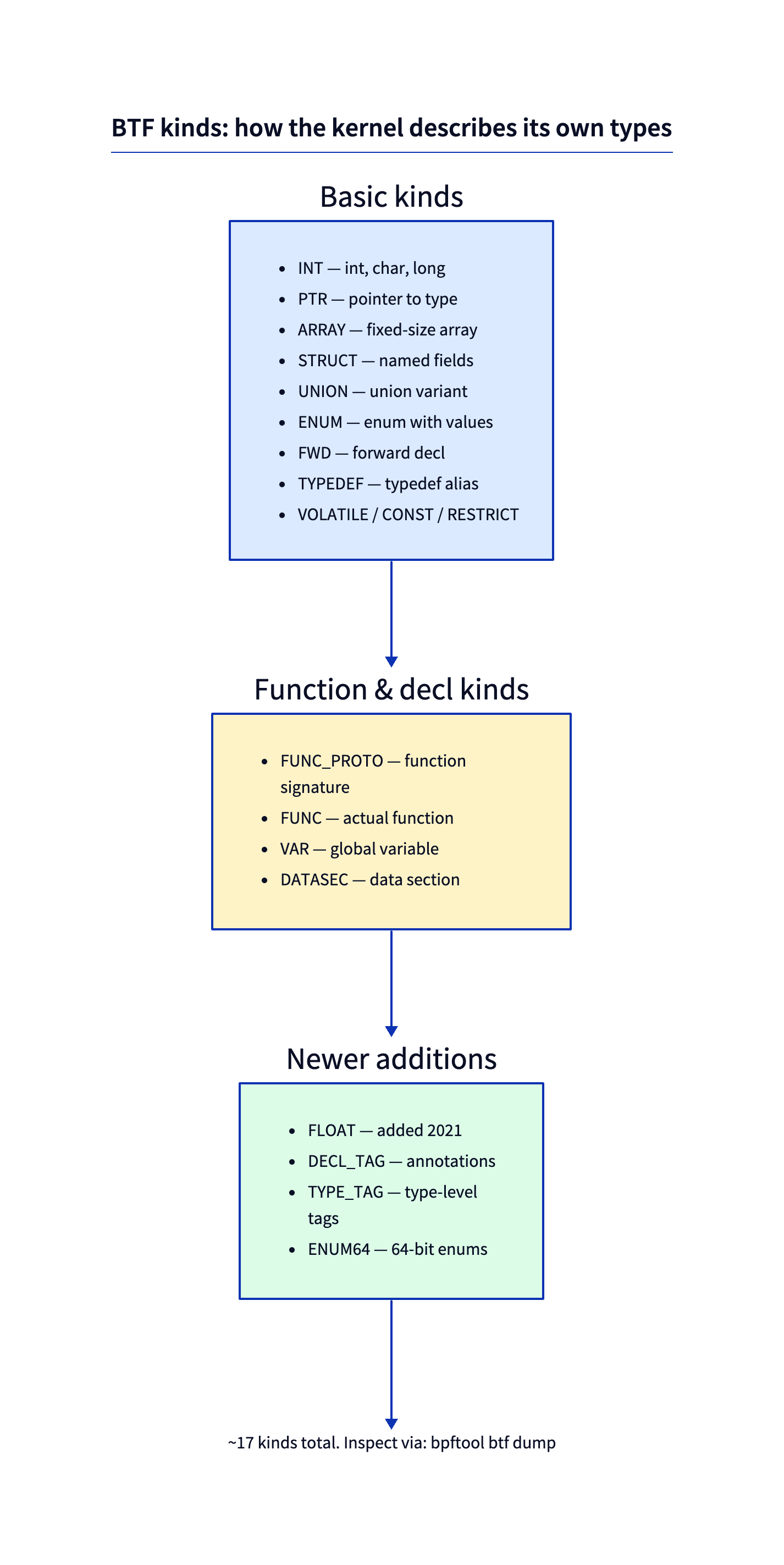
Two of those kinds — FUNC and FUNC_PROTO — are the ones that matter today, and the relationship between them is the single fact this whole chapter turns on. We’ll get there in a moment. First, the question Days 3–4 left open: where does the vmlinux blob actually come from?
Where vmlinux BTF physically comes from: pahole + DWARF
Nobody hand-writes /sys/kernel/btf/vmlinux. It’s a build artifact. When the kernel is compiled with CONFIG_DEBUG_INFO_BTF set, the build first compiles the kernel with ordinary DWARF debug info, then runs pahole over that DWARF to emit a compact, deduplicated .BTF section, which gets linked into vmlinux and exposed at /sys/kernel/btf/vmlinux at boot. Per-module BTF (/sys/kernel/btf/<module>) is produced the same way, gated by CONFIG_DEBUG_INFO_BTF_MODULES.
That’s the production side; Days 3–4 only showed the consumer side (libbpf/bpftool reading the blob). You don’t need more than three sentences of it — its only job here is to justify trusting BTF as ground truth. But one detail pays off later: the pahole feature flags are version-gated. In v7.1, scripts/Makefile.btf selects --btf_features=...,decl_tag_kfuncs for new-enough pahole — and decl_tag_kfuncs is what annotates which FUNC entries are actually kfuncs. That’s why a newer kernel’s BTF can tell you more about kfuncs than an old one’s: the inventory is only as rich as the pahole that built it.
scripts/Makefile.btf:3—pahole-ver := $(CONFIG_PAHOLE_VERSION);:17the--btf_features=...,decl_tag_kfuncsflag (pahole-driven, version-gated).lib/Kconfig.debug:398—config DEBUG_INFO_BTF(the switch that turns vmlinux BTF generation on);:428—config DEBUG_INFO_BTF_MODULES(depends on DEBUG_INFO_BTF && MODULES).

A function lives in BTF as two entries, not one
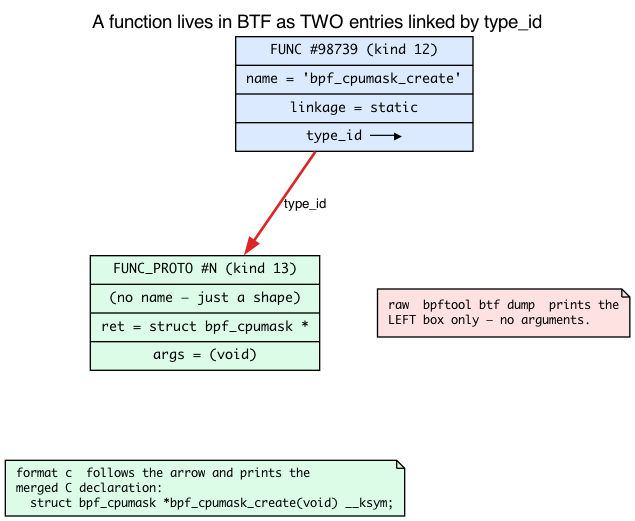
Here is the fact that makes today’s tooling make sense. When BTF describes a function, it does not put the name and the arguments in one record. It uses two separate btf_type entries linked by a reference:
- A
BTF_KIND_FUNCentry (kind = 12) carries only the function’s name, alinkagefield, and atype_idthat points at — - a
BTF_KIND_FUNC_PROTOentry (kind = 13), which carries the return type and the ordered argument types. The FUNC_PROTO has no name — it’s just the shape of a signature.
The FUNC’s type_id is the only link between the name and the arguments. Concretely, every BTF entry is a struct btf_type (include/uapi/linux/btf.h:43) whose first field is name_off (:44, an offset into the string table) and whose info field packs the kind — extracted by the BTF_INFO_KIND(info) macro (:68). The kind constants are BTF_KIND_FUNC = 12 (:85) and BTF_KIND_FUNC_PROTO = 13 (:86). For a FUNC, the type_id reuses the btf_type union’s type slot — it is the pointer to the FUNC_PROTO.
This is why a raw bpftool btf dump line for a function shows no arguments:
[98739] FUNC 'bpf_address_lookup' type_id=59431 linkage=static
The name is bpf_address_lookup, in single quotes (there is no name= token — that’s why the grep idiom below matches the quoted name). The linkage is static. And the arguments? They’re not here. They live in entry #59431, a separate FUNC_PROTO that this line merely points at via type_id. To see the signature from the raw dump you’d have to go find that entry and read it yourself.
linkage comes from enum btf_func_linkage (include/uapi/linux/btf.h:169-172): BTF_FUNC_STATIC = 0, BTF_FUNC_GLOBAL = 1, BTF_FUNC_EXTERN = 2. Most in-kernel functions are static. The kfuncs you call from BPF show up as extern references from your object’s BTF — your .bpf.o says “I need an external symbol of this shape,” and libbpf resolves it against the kernel’s BTF at load time.
What format c does that the raw dump can’t
So reading a signature out of the raw dump means manually chasing type_id from FUNC to FUNC_PROTO and decoding the argument list. Nobody wants to do that. bpftool btf dump ... format c does it for you: it walks the FUNC → FUNC_PROTO link, resolves every argument and the return type, and reconstructs a complete C declaration —
extern struct bpf_cpumask *bpf_cpumask_create(void) __weak __ksym;
— which is almost exactly what you’d paste into your BPF source. (format c decorates every kfunc with extern ... __weak __ksym — more on that decoration below; for now, note that you can copy the line verbatim, or drop __weak if you want a hard dependency that fails the load when the kfunc is absent.) That resolution step is why format c is the right tool for reading signatures and the raw dump is not. (Note: Day 3 ran the raw dump on parent.bpf.o to inspect a small program’s own BTF; the format c reconstruction is the new tool today.) You can see both forms side by side:
sudo bpftool btf dump file /sys/kernel/btf/vmlinux | head -20            # raw: FUNC one-liners, no args
sudo bpftool btf dump file /sys/kernel/btf/vmlinux format c | head -30    # resolved: full C header
Three approaches to finding a kfunc
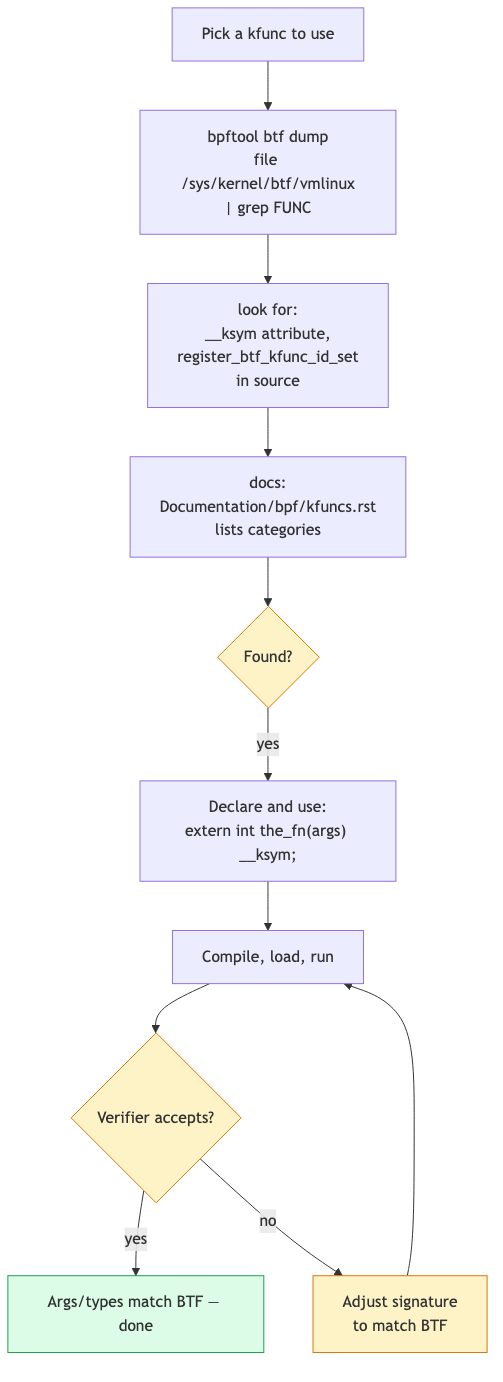
1. Search kernel source for BTF_KFUNCS_START
Each kfunc family is declared in a block:
cd ~/code/linux
grep -rn 'BTF_KFUNCS_START' kernel/bpf net/ drivers/ 2>/dev/null
You’ll see ~30+ hits. Each block looks like:
BTF_KFUNCS_START(generic_kfunc_set)
BTF_ID_FLAGS(func, bpf_obj_new_impl, KF_ACQUIRE | KF_RET_NULL)
BTF_ID_FLAGS(func, bpf_obj_drop_impl, KF_RELEASE)
BTF_ID_FLAGS(func, bpf_refcount_acquire_impl, KF_ACQUIRE)
BTF_ID_FLAGS(func, bpf_list_push_front_impl)
/* ... */
BTF_KFUNCS_END(generic_kfunc_set)
This tells you what kfuncs exist and their flags (KF_ACQUIRE, KF_RELEASE, KF_RCU, KF_TRUSTED_ARGS, etc.). Kernel source is the source of truth.
2. Dump kernel BTF and search for FUNC entries
sudo bpftool btf dump file /sys/kernel/btf/vmlinux \
    | grep "FUNC 'bpf_" | head -20
The raw (non-format c) dump prints each function as a single line with the name in single quotes and no args (recall: the args live in the FUNC_PROTO that type_id= points at):
[98739] FUNC 'bpf_address_lookup' type_id=59431 linkage=static
[98740] FUNC 'bpf_adj_branches' type_id=59432 linkage=static
[98744] FUNC 'bpf_arch_text_copy' type_id=59434 linkage=static
...
This filters all FUNC BTF kinds whose name starts with bpf_ — on this kernel there are ~1700 of them. Many are kfuncs; many are helpers; many are internal kernel functions exposed for other reasons. To narrow down to actual kfuncs, cross-reference with the source method (the BTF_KFUNCS_START blocks) — or, on a kernel whose pahole emitted decl_tag_kfuncs, the kfunc FUNCs carry a decl-tag you can spot. (If you prefer JSON, bpftool btf dump -j ... | grep '"name":"bpf_' matches the name key instead — note the compact JSON has no space after the colon.)
3. Documentation
Documentation/bpf/kfuncs.rst lists categories: cpumask, dynptr, lists, refcount, task, etc. Get the names from there, then look up signatures in BTF for the latest details. The doc is a useful tour map but not an inventory.
Reading a kfunc signature from BTF
Once you have a name (say, bpf_cpumask_create), get the signature with format c, which resolves the FUNC → FUNC_PROTO link for you:
sudo bpftool btf dump file /sys/kernel/btf/vmlinux format c \
    | grep -B2 -A5 'bpf_cpumask_create'
Output:
extern struct bpf_cpumask *bpf_cpumask_create(void) __weak __ksym;
That’s what you’d write in your BPF source (drop __weak if you want a hard dependency — see below).
For more complex signatures (multiple args, struct returns), use the same format c approach:
sudo bpftool btf dump file /sys/kernel/btf/vmlinux format c \
    | grep 'bpf_dynptr_from_skb('
extern int bpf_dynptr_from_skb(struct __sk_buff *s, u64 flags, struct bpf_dynptr *ptr__uninit) __weak __ksym;
Don’t read those args from the raw dump — the FUNC line has no adjacent arg block. For the definitive signature, read the __bpf_kfunc int bpf_dynptr_from_skb(...) definition in net/core/filter.c (net/core/filter.c:12176) — it matches the format c output above, argument for argument.
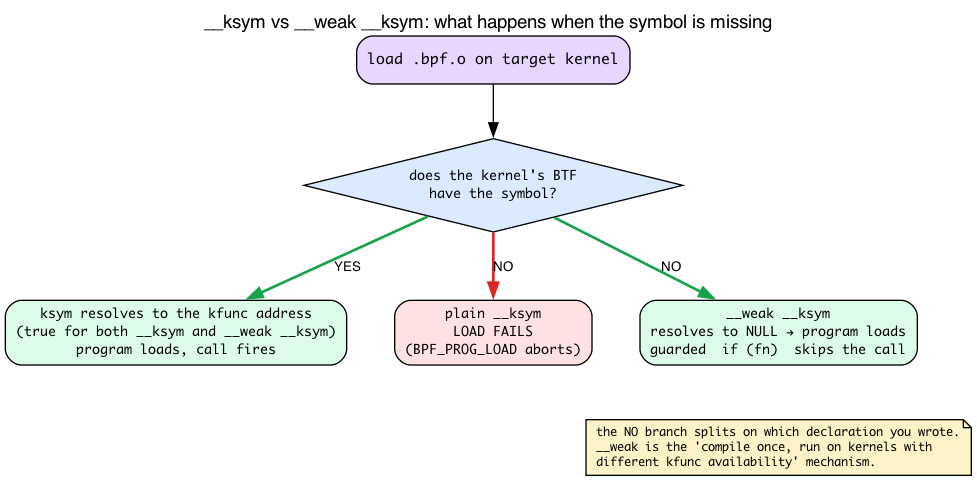
__weak __ksym: the kfunc might not be there
You’ll have noticed that every declaration format c printed — bpf_cpumask_create, bpf_dynptr_from_skb, all of them — ends in __weak __ksym, not just __ksym. That’s not per-kfunc: bpftool marks every kfunc weak by default. It can do this precisely because pahole’s decl_tag_kfuncs (the version-gated feature from earlier) tags which FUNC entries are kfuncs, so bpftool emits the safe weak form uniformly. The decoration is a tool default, not a property of any one kfunc. But what __weak __ksym means is genuinely new and worth a section — and it’s also what tells you when you’d want to drop the __weak and ask for a hard __ksym instead.
Recall from Day 20: plain __ksym is a hard dependency. The macro expands to __attribute__((section(".ksyms"))) (tools/lib/bpf/bpf_helpers.h:192); it tells libbpf “resolve this name against the running kernel’s BTF.” If the name doesn’t resolve, libbpf aborts the entire BPF_PROG_LOAD. No silent miss — the load fails.
__weak __ksym downgrades that to a soft dependency. __weak is just the toolchain’s __attribute__((weak)) (tools/lib/bpf/bpf_helpers.h:60-61). Combined with __ksym, it changes libbpf’s relocation behavior: an unresolved weak ksym resolves to address 0 (NULL) instead of failing the load. The program loads either way — on a kernel that has the kfunc, the symbol points at the kfunc; on a kernel that lacks it, the symbol is NULL.
That NULL is the catch. Because the symbol can be NULL at runtime, you must guard the call site yourself — the verifier won’t save you from calling through a NULL weak ksym:
extern int bpf_some_kfunc(...) __weak __ksym;

if (bpf_some_kfunc)                 /* skip the call when the kfunc is absent */
    bpf_some_kfunc(...);
This is the mechanism behind “compile once, run on kernels with different kfunc availability”: the same .bpf.o loads on a kernel missing the kfunc (the guarded call is skipped) and on one that has it (the call fires). The kernel’s own bpf_helpers.h ships the canonical example — the bpf_iter_num_* family is declared exactly this way:
/* tools/lib/bpf/bpf_helpers.h:345 */
extern int  bpf_iter_num_new(struct bpf_iter_num *it, int start, int end) __weak __ksym;
extern int *bpf_iter_num_next(struct bpf_iter_num *it) __weak __ksym;
extern void bpf_iter_num_destroy(struct bpf_iter_num *it) __weak __ksym;
For a stronger guard than a raw NULL check, pair __weak with bpf_core_type_exists(...) (tools/lib/bpf/bpf_core_read.h:240), which tests at load/run time whether a given type exists in the target kernel’s BTF. We use exactly that pattern in today’s Check question.
A complete example: bpf_cpumask_*
bpf_cpumask_* is a family of kfuncs for working with CPU masks (one bit per CPU). Useful for: scheduler hints, CPU affinity inspection, sched_ext.
The family is defined at kernel/bpf/cpumask.c. Read the file’s BTF_KFUNCS_START block to see what’s available:
BTF_KFUNCS_START(cpumask_kfunc_btf_ids)
BTF_ID_FLAGS(func, bpf_cpumask_create, KF_ACQUIRE | KF_RET_NULL)
BTF_ID_FLAGS(func, bpf_cpumask_release, KF_RELEASE)
BTF_ID_FLAGS(func, bpf_cpumask_acquire, KF_ACQUIRE)
BTF_ID_FLAGS(func, bpf_cpumask_first, KF_RCU)
BTF_ID_FLAGS(func, bpf_cpumask_setall)
BTF_ID_FLAGS(func, bpf_cpumask_set_cpu)
BTF_ID_FLAGS(func, bpf_cpumask_clear_cpu)
BTF_ID_FLAGS(func, bpf_cpumask_test_cpu)
BTF_ID_FLAGS(func, bpf_cpumask_or, KF_RCU)
BTF_ID_FLAGS(func, bpf_cpumask_equal, KF_RCU)
/* ... */
BTF_KFUNCS_END(cpumask_kfunc_btf_ids)
This block is real: kernel/bpf/cpumask.c:477 opens BTF_KFUNCS_START(cpumask_kfunc_btf_ids), :478 flags bpf_cpumask_create as KF_ACQUIRE | KF_RET_NULL, and :479 flags bpf_cpumask_release as KF_RELEASE. Each entry is a regular C function in the same file. Read the __bpf_kfunc definitions to see what they actually do.
Using them
#include "vmlinux.h"
#include <bpf/bpf_helpers.h>
#include <bpf/bpf_tracing.h>

char LICENSE[] SEC("license") = "GPL";

extern struct bpf_cpumask *bpf_cpumask_create(void) __ksym;
extern void bpf_cpumask_release(struct bpf_cpumask *cpumask) __ksym;
extern void bpf_cpumask_set_cpu(__u32 cpu, struct bpf_cpumask *cpumask) __ksym;
extern bool bpf_cpumask_test_cpu(__u32 cpu, const struct cpumask *cpumask) __ksym;

SEC("fentry/filename_unlinkat")
int BPF_PROG(p)
{
    struct bpf_cpumask *m = bpf_cpumask_create();
    if (!m)
        return 0; /* KF_RET_NULL - must check */

    /* Set bits for CPUs 0, 2, 4 */
    bpf_cpumask_set_cpu(0, m);
    bpf_cpumask_set_cpu(2, m);
    bpf_cpumask_set_cpu(4, m);

    /* Test some bits */
    bool b0 = bpf_cpumask_test_cpu(0, (struct cpumask *)m);
    bool b1 = bpf_cpumask_test_cpu(1, (struct cpumask *)m);

    bpf_printk("cpu0=%d cpu1=%d", b0, b1);

    bpf_cpumask_release(m); /* KF_ACQUIRE -> must release */
    return 0;
}
Note the cast (struct cpumask *)m — bpf_cpumask_test_cpu takes the base type (struct cpumask), not the BPF-specific wrapper (bpf_cpumask). The verifier accepts the cast because bpf_cpumask embeds cpumask as its first field, so a bpf_cpumask * and a cpumask * point at the same address. You can see it in the struct definition:
/* kernel/bpf/cpumask.c:25 */
struct bpf_cpumask {
    cpumask_t cpumask;     /* first field — same address as the wrapper */
    refcount_t usage;
};
and bpf_cpumask_test_cpu really does take const struct cpumask * (kernel/bpf/cpumask.c:195: __bpf_kfunc bool bpf_cpumask_test_cpu(u32 cpu, const struct cpumask *cpumask)). The cast is therefore sound, and this idiom shows up across the kfunc family.
Run
The userspace loader (cpumask_demo.c) is the standard skeleton open/load/attach pattern; it attaches the fentry and waits while the program writes to trace_pipe.
#include <errno.h>
#include <signal.h>
#include <stdio.h>
#include <string.h>
#include <unistd.h>

#include <bpf/libbpf.h>

#include "cpumask_demo.skel.h"

static volatile sig_atomic_t exiting;

static void handle_signal(int signal_number)
{
    (void)signal_number;
    exiting = 1;
}

static int install_signal_handlers(void)
{
    const struct sigaction action = {
        .sa_handler = handle_signal,
    };

    if (sigaction(SIGINT, &action, NULL) != 0 ||
        sigaction(SIGTERM, &action, NULL) != 0) {
        fprintf(stderr, "failed to install signal handlers: %s\n",
                strerror(errno));
        return -errno;
    }

    return 0;
}

int main(void)
{
    struct cpumask_demo_bpf *skel = NULL;
    int err;

    setvbuf(stdout, NULL, _IOLBF, 0);

    err = install_signal_handlers();
    if (err)
        return 1;

    skel = cpumask_demo_bpf__open();
    if (!skel) {
        fprintf(stderr, "failed to open cpumask_demo BPF skeleton\n");
        return 1;
    }

    err = cpumask_demo_bpf__load(skel);
    if (err) {
        fprintf(stderr, "failed to load cpumask_demo BPF programs: %s\n",
                strerror(-err));
        goto cleanup;
    }

    err = cpumask_demo_bpf__attach(skel);
    if (err) {
        fprintf(stderr, "failed to attach cpumask_demo BPF programs: %s\n",
                strerror(-err));
        goto cleanup;
    }

    puts("Attached fentry/filename_unlinkat; watch trace_pipe. "
         "Press Ctrl-C to detach.");
    while (!exiting)
        pause();

    err = 0;

cleanup:
    cpumask_demo_bpf__destroy(skel);
    return err != 0;
}
make cpumask_demo
sudo ./.output/day24/cpumask_demo &
touch /tmp/x && rm /tmp/x
sudo cat /sys/kernel/debug/tracing/trace_pipe
Output: cpu0=1 cpu1=0.
What to break
Forget release
struct bpf_cpumask *m = bpf_cpumask_create();
/* ... use ... */
return 0;   /* without bpf_cpumask_release */
Verifier rejects: Unreleased reference id=1 alloc_insn=M. bpf_cpumask_create is KF_ACQUIRE; the rules from Day 20 apply.
Use a kfunc not registered for your program type
Try bpf_cpumask_create from an XDP program:
SEC("xdp")
int xdp_prog(struct xdp_md *ctx) {
    struct bpf_cpumask *m = bpf_cpumask_create();
    /* ... */
}
Verifier rejects: calling kernel function bpf_cpumask_create is not allowed. Check kernel/bpf/cpumask.c’s registration:
register_btf_kfunc_id_set(BPF_PROG_TYPE_TRACING, &cpumask_kfunc_set);
register_btf_kfunc_id_set(BPF_PROG_TYPE_STRUCT_OPS, &cpumask_kfunc_set);
register_btf_kfunc_id_set(BPF_PROG_TYPE_SYSCALL, &cpumask_kfunc_set);
Cpumask is registered for tracing, struct_ops, and syscall — not XDP (verified at kernel/bpf/cpumask.c:526-528). The verifier knows.
Discover a new family
Try bpf_dynptr_*:
sudo bpftool btf dump file /sys/kernel/btf/vmlinux format c | grep 'bpf_dynptr'
You’ll see bpf_dynptr_data, bpf_dynptr_read, bpf_dynptr_write, bpf_dynptr_from_skb, etc. These let BPF programs handle variable-size buffers safely. Try one in a program; the kfunc family is a good way to learn the dynptr pattern (a verifier-tracked variable-size pointer). And you can read each one’s full signature straight from BTF.
There are no Dumb Questions
Q: The raw dump shows
type_id=59431. Can I just dump entry 59431 directly to see the args?A: Yes —
bpftool btf dump file /sys/kernel/btf/vmlinux | grep '^\[59431\]'shows the FUNC_PROTO and its argument entries. But it’s a chase: the FUNC_PROTO’s arguments are themselvestype_idreferences to other entries (a PTR to a STRUCT, an INT, …), so you’d be hand-walking a graph.format cwalks it for you and prints C. Use the raw dump to find a function by name; useformat cto read its signature.Q: Why does BTF split FUNC from FUNC_PROTO at all? Why not store the args next to the name?
A: Deduplication. Two functions with the same signature (
void f(int)andvoid g(int)) can share one FUNC_PROTO entry — only the FUNC entries (name + linkage + atype_id) differ. Since the kernel has thousands of functions and far fewer distinct shapes, the split shrinks the BTF blob. It’s the same dedup principle that lets onestruct task_structBTF entry back every pointer to a task.Q: If
__weak __ksymresolves a missing kfunc to NULL, why doesn’t the verifier just reject the program for a possible NULL call?A: Because at load time on a kernel that has the kfunc, the symbol is a valid address, and your guarded
if (bpf_some_kfunc)is provably true on that path — there’s nothing to reject. On a kernel that lacks it, the symbol is NULL but your guard skips the call. The verifier checks the program against the target kernel’s reality, and the guard is what makes both realities valid. Drop the guard and you’re on your own.
What to read in the kernel
-
Documentation/bpf/kfuncs.rst— the official tour. Read end to end. ~10 pages. -
kernel/bpf/cpumask.c— full kfunc family in one file (~700 lines). Read top to bottom. The structure is:- Implementation —
__bpf_kfuncfunctions. - ID list —
BTF_KFUNCS_STARTblock (:477). register_btf_kfunc_id_setcalls at module init (:526-528).
This is the template for adding kfuncs. If you ever want to add one, this is what your patch will look like.
- Implementation —
-
kernel/bpf/helpers.c— searchBTF_KFUNCS_START. The biggest set of generic kfuncs (generic_btf_idsat:4703,common_btf_idsat:4776). Skim to know the catalog. -
kernel/sched/ext.c— sched_ext registers many sched-specific kfuncs. The eBPF book’s Day 25–27 use these. -
tools/lib/bpf/btf.c— userspace BTF library. Thebtf__find_by_name_kindfunction (:1166) is what libbpf uses to resolve__ksymreferences against BTF at load time — it’s literally how a name likebpf_cpumask_createbecomes a FUNC entry, which then leads (viatype_id) to its FUNC_PROTO. -
include/uapi/linux/btf.h—struct btf_type(:43), theBTF_KIND_*constants (FUNC:85, FUNC_PROTO:86), theBTF_INFO_KINDmacro (:68), andenum btf_func_linkage(:169-172). The vocabulary of BTF. (include/linux/btf.his the in-kernel companion with the helper API.) -
bpftoolsource attools/bpf/bpftool/btf.c— useful to read just to learn what BTF queries are easy from the CLI, including howformat creconstructs declarations.
Bullet Points
- BTF is a build artifact: the kernel is compiled with DWARF, then
paholeemits the.BTFsection linked intovmlinuxand exposed at/sys/kernel/btf/vmlinux— gated byCONFIG_DEBUG_INFO_BTF(modules:CONFIG_DEBUG_INFO_BTF_MODULES). Trust it as ground truth. - A function is two BTF entries. A
BTF_KIND_FUNC(kind 12) holds the name +linkage+ atype_id; thetype_idpoints at a separateBTF_KIND_FUNC_PROTO(kind 13) that holds the return type and argument types. The raw dump shows only the FUNC line (no args);format cfollows the link and prints a full C declaration. - Discover kfuncs via: kernel source
BTF_KFUNCS_STARTblocks,bpftool btf dump, orDocumentation/bpf/kfuncs.rst. - Signatures come from BTF; read them with
bpftool btf dump file ... format cand declare in BPF code withextern T name(args) __ksym;. __ksymis a hard dependency (load fails if unresolved);__weak __ksymis a soft one (unresolved → NULL, program still loads) — so you must guard the call site. This is how one.bpf.oruns across kernels with different kfunc availability.- Acquire/release semantics from Day 20 apply uniformly — every kfunc family follows the same model.
- Per-program-type registration: not all kfuncs are everywhere; the verifier rejects unregistered combinations (cpumask: tracing/struct_ops/syscall, not XDP).
- The kernel’s kfunc set grows release-by-release; check
bpftool feature probefor what’s available.
Check question
You write extern int my_fn(int x) __ksym; and reference my_fn. The kernel doesn’t have a kfunc by that name. What happens at compile time vs at load time?
Click to reveal answer
Answer: Compile time succeeds. The __ksym attribute is a marker for libbpf, not a compile-time check; the C compiler treats extern as “this exists somewhere.” The reference compiles fine into a relocation entry in the .bpf.o file (saying “I need a symbol named my_fn”) — recorded in your object’s BTF as an extern-linkage FUNC.
At load time, libbpf fails: libbpf: cannot find kernel BTF type ID of 'my_fn'. libbpf walks the program’s relocations, looks up each __ksym reference against the running kernel’s BTF (via btf__find_by_name_kind), and aborts if the name doesn’t resolve.
This is the right design: __ksym references are resolved at runtime against the target kernel’s BTF, not at compile time against the build kernel. That’s how you compile once and run on multiple kernels with potentially different kfunc availability — a kernel that has the kfunc loads your program; a kernel that doesn’t returns the descriptive error.
For graceful degradation across kernel versions, combine the __weak __ksym form with bpf_core_type_exists() checks: declare the kfunc weak so an absent symbol resolves to NULL instead of failing the load, then test at runtime whether it (or a type it needs) is available and skip the call if not. That’s the full “load everywhere, call only where supported” pattern — the same shape the kernel uses for its own bpf_iter_num_* family.
End of Phase 4
You can now use kfuncs, store kptrs in maps, write struct_ops modules, instrument them with ringbuf, and discover new kfuncs by reading BTF and degrading gracefully with __weak __ksym when a kfunc might be absent. That’s the modern BPF surface as of 2026.
Phase 5 (Days 25–30) is the frontier — sched_ext, BPF schedulers, and a capstone project.
Tomorrow
Day 25: sched_ext. We leave tracing behind and start steering the kernel — writing a scheduler in BPF via struct_ops, calling the sched-specific kfuncs registered in kernel/sched/ext.c that you can now discover and read straight from BTF.