Day 25 — sched_ext: a BPF scheduler
Today’s mission: load
scx_simpleon your system, watch it actually scheduling tasks, understand the enqueue/dispatch cycle, and see why this is the most ambitious BPF feature shipped to date. Along the way you’ll learn what a CPU scheduler even is — task states, time slices, preemption, context switches — and what “fairness” means underneath CFS, so the whole chapter stops being vocabulary you nod along to. Total time: ~100 minutes.
Phase 5 starts here. Days 25–30 are about the frontier. You’ll run a BPF scheduler, modify it, then build a capstone project of your choosing. By Day 30, you’ve shipped one substantial piece of BPF work.
What sched_ext is
The Linux scheduler decides which task runs on which CPU at which time. Until 2024, this logic lived entirely inside the kernel — kernel/sched/fair.c (the CFS implementation), with policy hardcoded. Changing scheduling required a kernel patch, kernel rebuild, reboot, and hope that you didn’t break things in subtle ways.
sched_ext (merged into 6.12, October 2024) makes the scheduler pluggable via BPF. You write a struct_ops module against struct sched_ext_ops. Loading it activates your scheduler. Unloading it reverts to CFS.
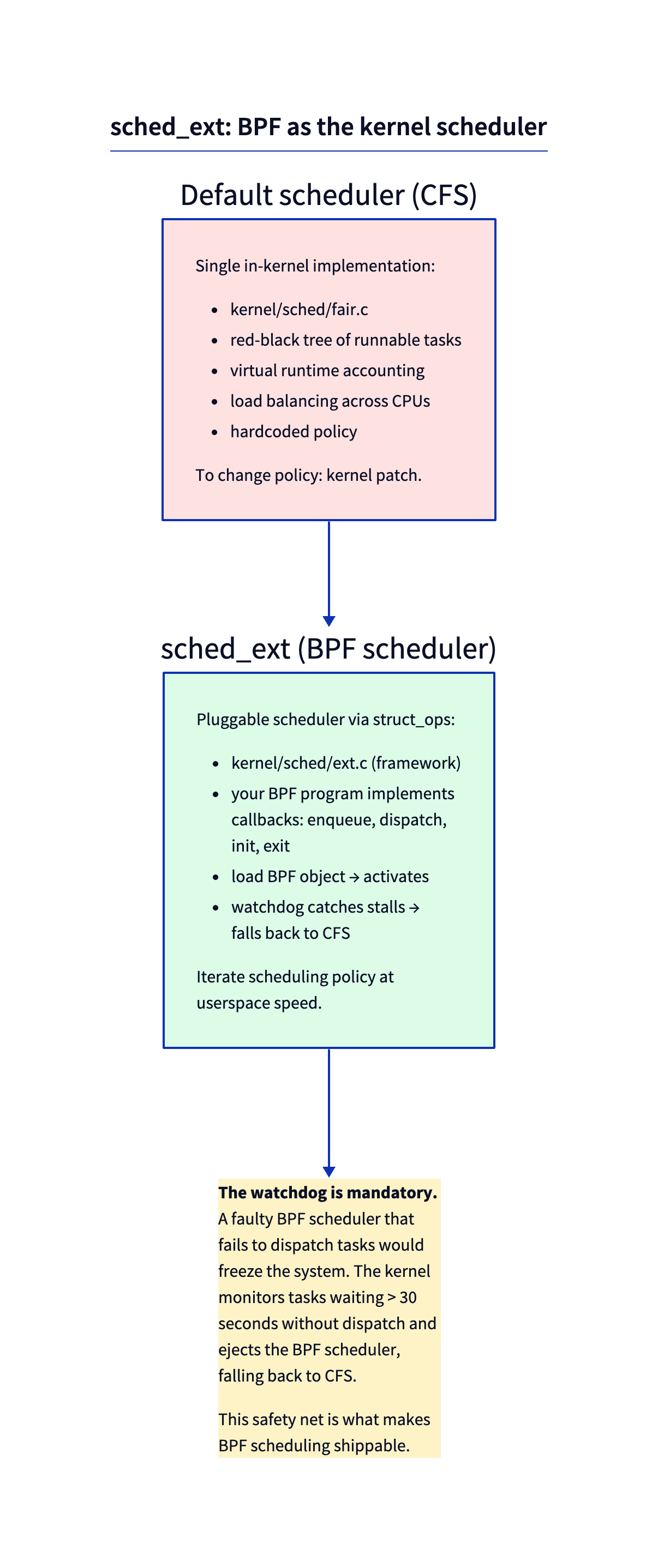
This is qualitatively different from previous BPF features. Tracing programs observe. Networking programs filter. sched_ext programs make scheduling decisions — the most performance-critical, ultra-hot-path code in the kernel.
The motivation: scheduling policy isn’t one-size-fits-all. Cloud workloads want fairness across cgroups; HFT wants latency at all costs; mobile wants energy minimization; gaming wants frame-time stability. Each has been argued for in academic papers and tested in research kernels. Sched_ext lets researchers and operators iterate on scheduling policy at userspace velocity — change BPF code, rebuild in seconds, load, measure, iterate.
Quick refresher (from Phase 4, “Modern primitives”): a struct_ops is a BPF object whose programs fill in a kernel vtable — a struct of function pointers the kernel calls at the right moments. Loading and attaching the struct_ops link installs your callbacks. sched_ext is just struct_ops where the vtable happens to be
struct sched_ext_ops(kernel/sched/ext_internal.h:292) and “attach” means “become the system scheduler” (the install path isscx_enable(struct sched_ext_ops *ops, struct bpf_link *link)atkernel/sched/ext.c:7447). Everything you already know about struct_ops — the vtable, BTF, link attachment — applies unchanged.
First, what a scheduler actually does
The rest of this chapter throws words like runnable, blocked, time slice, preempted, and context switch at you constantly. If those are fuzzy, sched_ext will feel like magic. They aren’t magic — they’re a tiny state machine. Let’s nail it down first; it pays off immediately.
Every task is in one of three situations
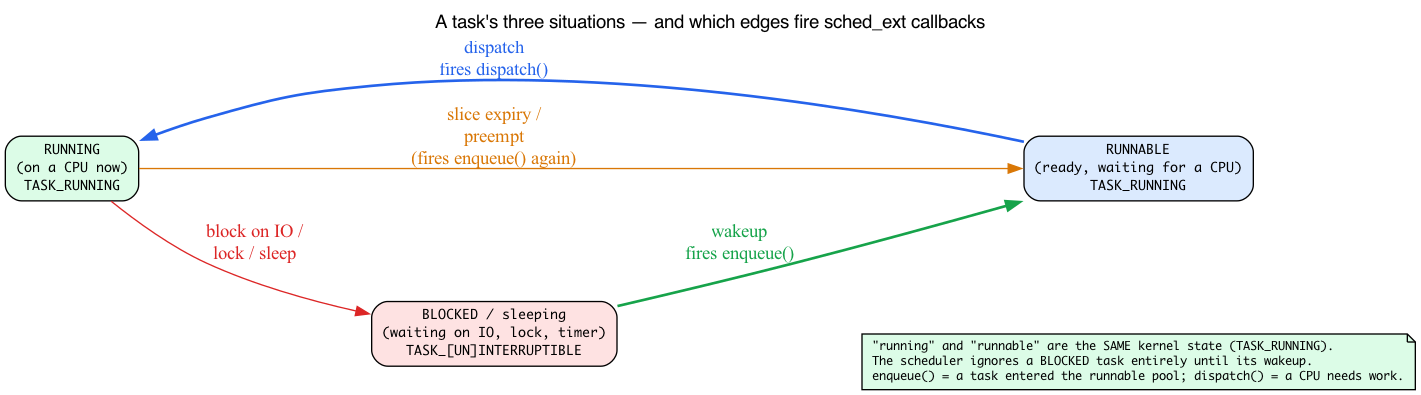
A task (a thread — the kernel’s unit of scheduling, one struct task_struct each) is always in exactly one of these:
- Running — it is right now executing on some CPU.
- Runnable — it is ready to run and just waiting for a CPU to become free. Nothing is stopping it except that there are more runnable tasks than CPUs.
- Blocked (sleeping) — it is waiting for something before it can make progress: a disk read to finish, a lock to be released, a timer to fire, a packet to arrive. It is not a candidate for the CPU at all until that something happens.
Here is the subtlety the kernel encodes, and you should internalize it: “running” and “runnable” are the same kernel state. Both are TASK_RUNNING:
/* include/linux/sched.h:107 */
#define TASK_RUNNING            0x00000000
#define TASK_INTERRUPTIBLE      0x00000001   /* sched.h:108 — blocked, wakeable by signals */
#define TASK_UNINTERRUPTIBLE    0x00000002   /* sched.h:109 — blocked, not signal-wakeable */
A TASK_RUNNING task is “schedulable” — it belongs in the scheduler’s pool of candidates, whether or not it has a CPU at this instant. A blocked task is TASK_INTERRUPTIBLE (can be woken by a signal — e.g. read() on a pipe) or TASK_UNINTERRUPTIBLE (must wait for the exact event — e.g. a disk I/O), and the scheduler simply ignores it. It isn’t picked again until its wait condition is satisfied and the kernel flips it back to TASK_RUNNING — that flip is a wakeup.
There are no Dumb Questions
Q: If “running” and “runnable” are the same
TASK_RUNNINGstate, how does the kernel know which tasks are actually on a CPU right now?A: That’s tracked separately. Each CPU’s runqueue records its currently-running task in
rq->curr.TASK_RUNNINGonly means “eligible to run” — being on a CPU is a property of the runqueue, not of the task’s state field. So the state machine has three task states but only two task-state values, and the CPU-occupancy bit lives elsewhere.
The scheduler’s job, in one sentence
Of the set of runnable tasks, the scheduler picks which one runs on each CPU, and for how long.
That “how long” is the time slice — a budget of CPU time. When a task’s slice expires, the kernel preempts it: yanks it off the CPU (even though it would happily keep running), drops it back into the runnable pool, and re-picks. Preemption is what keeps one CPU-hog from freezing everyone else — without it a busy loop would own a core forever.
The act of taking task A off a CPU and putting task B on is a context switch: save A’s registers, program counter, and stack pointer; load B’s. It’s the physical transition the scheduler causes. It isn’t free (you pay cache and TLB costs), which is why schedulers don’t switch on every nanosecond.
The two events a scheduler must handle
Boil all of the above down and a scheduler really only reacts to two moments:
- A task enters the runnable pool (it was just created, just woke from I/O, or was just preempted). Something has to decide where it goes and with what slice. This is enqueue.
- A CPU finishes with its current task (the task blocked, or used up its slice) and needs the next one. Something has to hand it a task. This is dispatch.
That enqueue → dispatch cycle is the entire skeleton of a scheduler, and — you guessed it — it’s exactly the two callbacks sched_ext makes you implement. “Wakes up from I/O” now reads precisely: a blocked task’s wait condition was satisfied, the kernel flips it to TASK_RUNNING, and that wakeup is what fires select_cpu/enqueue to re-place it.
Where sched_ext hangs its per-task data
Each task already carries its scheduling bookkeeping inside struct task_struct. sched_ext bolts its own per-task data on through an embedded member:
/* include/linux/sched.h:876, inside task_struct */
struct sched_ext_entity        scx;
So when scx_simple reads p->scx.dsq_vtime, it’s reading a field the kernel keeps per task, right there in the task structure:
/* include/linux/sched/ext.h:231, inside struct sched_ext_entity */
u64                     dsq_vtime;
Hold onto dsq_vtime — the next section explains what that number means.
What “fairness” means: CFS and virtual runtime
The scheduler sched_ext replaces (and reverts to on unload) is CFS, the Completely Fair Scheduler, implemented in kernel/sched/fair.c. The chapter will keep saying “falls back to CFS,” “CFS’s fair-share guarantees,” and “vtime-ordered.” You can’t evaluate any of that without knowing CFS’s one big idea.
The idea: charge every task for the CPU time it uses
Imagine you want N runnable tasks to each get a fair, equal share of a CPU. The naive approach — round-robin fixed slices — falls apart the moment tasks have different priorities or sleep at different times.
CFS’s trick is virtual runtime (vruntime): each task accumulates a running tally of how much CPU it has consumed, scaled by its priority/weight.
/* include/linux/sched.h:594, per scheduling entity */
u64                     vruntime;
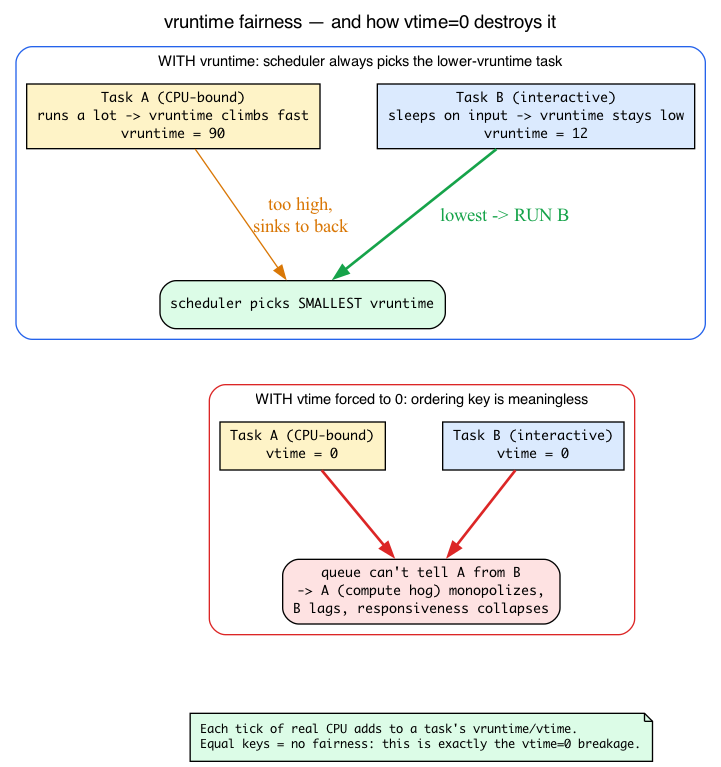
The fairness intuition is simple: a task that has run a lot has a high vruntime, so it sinks to the back; a task that has barely run has a low vruntime, so it floats to the front. Over time everyone’s consumed time stays roughly equal — that is what “fair” means.
The exact selection algorithm in this kernel is a refinement of that intuition. Since 6.6 the fair class is EEVDF (the file is still kernel/sched/fair.c and the class is still called CFS, but the picking logic changed). The runqueue’s red-black tree (cfs_rq->tasks_timeline at kernel/sched/sched.h:695) is ordered by each entity’s virtual deadline, not its raw vruntime: entity_before() (fair.c:589) compares deadlines and __entity_less (fair.c:974) builds the tree on that. Selection is pick_eevdf() (fair.c:1136), which walks for the leftmost eligible entity (entity_eligible(), fair.c:939) — eligibility roughly meaning the task hasn’t yet consumed more than its fair share. So it’s selection-by-deadline-among-eligible, not literally “smallest vruntime wins” (that was the pre-6.6 CFS rule). The fairness outcome is the same — a CPU hog earns a later deadline and becomes ineligible, sinking to the back — which is the intuition you should hold onto.
Why new and just-woken tasks don’t get a free lunch — or a penalty
What vruntime does a brand-new task get? Or a task that just woke after sleeping for a minute? If it started at 0, it would have a much smaller vruntime than everyone else and would hog the CPU until it caught up. If it inherited its old stale value, a task that slept a long time would be penalized for sleeping.
EEVDF splits the difference: a new or just-woken task is placed around the runqueue’s weighted-average virtual time, computed by avg_vruntime() (kernel/sched/fair.c:780), with a lag adjustment (the PLACE_LAG path in place_entity(), kernel/sched/fair.c:5381) so the task keeps its prior virtual lag rather than being reset to a floor:
/* kernel/sched/sched.h:687, the runqueue's virtual-time zero-point */
u64                     zero_vruntime;
The runqueue’s virtual-time zero-point is cfs_rq->zero_vruntime, and placement uses the weighted average avg_vruntime() — not the minimum. Placing a newcomer at the average means it gets to run soon but can’t hoard the CPU by having been idle (placing it at the minimum would hand a long-sleeper an unfair head start, which EEVDF deliberately avoids). This is exactly mirrored later when scx_simple clamps an idling task’s budget so a long-sleeping task can’t accumulate unlimited priority.
Watch the names: the per-task
min_vruntimeatinclude/linux/sched.h:580is a different thing. It lives insidestruct sched_entity(which opens at line 575), where it’s the augmented-rbtree subtree minimum used by the deadline tree — not a runqueue-wide floor. The classic per-runqueuecfs_rq->min_vruntimefloor was removed in the EEVDF rework;struct cfs_rq(kernel/sched/sched.h:678) has nomin_vruntimemember anymore.
sched_ext’s vtime-ordered DSQ is the same trick
A sched_ext dispatch queue can be ordered two ways, and the kernel header says so plainly:
/* include/linux/sched/ext.h:76 */
 * A dispatch queue (DSQ) can be either a FIFO or p->scx.dsq_vtime ordered
A FIFO DSQ is just a queue — first in, first out, no notion of fairness. A vtime-ordered DSQ keeps its tasks sorted by their dsq_vtime key, in a red-black tree, the same structure CFS uses:
/* include/linux/sched/ext.h:85 */
struct rb_root          priq;   /* used to order by p->scx.dsq_vtime */
You insert with scx_bpf_dsq_insert_vtime(..., vtime, ...), the queue stays sorted, and dispatch pulls the lowest vtime — reinventing CFS fairness in BPF. This is also why a built-in FIFO DSQ like SCX_DSQ_GLOBAL can’t be used as a vtime priority queue (you’ll see this note again below): a FIFO has no ordering key to sort on.
This is exactly why the vtime=0 breakage is a breakage
Later you’ll deliberately set every task’s vtime to 0 and watch interactivity collapse. Now you can see why: with all vtime equal, the ordering is meaningless. A CPU-bound compute hog and a keystroke-waiting editor look identical to the queue, so the hog is never sunk to the back and the editor never floats to the front. That’s precisely the unfairness vruntime was invented to prevent.
The watchdog: what makes this safe
A faulty BPF scheduler that fails to dispatch tasks could freeze the system. The kernel catches this:
- Dispatch stall watchdog. If any task stays runnable but undispatched past the stall timeout, the kernel concludes the BPF scheduler is broken, ejects it, and re-enables CFS. The timeout defaults to 30 seconds (
SCX_WATCHDOG_MAX_TIMEOUT = 30 * HZ) and can be tightened viaops.timeout_ms— but never lengthened past 30 seconds (the kernel caps it). - Fallback to CFS. Recovery is automatic — worst case, up to a 30-second freeze, then back to normal CFS.
This safety net is what makes sched_ext shippable. Without it, no one would risk loading user code into the scheduler hot path.
Where “30 seconds” comes from: HZ and jiffies
The constant is written 30 * HZ, not 30. To read kernel timing code you need two units:
- HZ is the kernel’s timer-tick frequency — how many scheduler/timer ticks happen per second.
- A jiffy is one tick. So a duration of N seconds is
N * HZjiffies. Kernel timeouts are very often expressed this way.
On this kernel:
/* ~/code/linux/.config:542 */
CONFIG_HZ=1000
So HZ = 1000, and 30 * HZ = 30000 jiffies = 30 seconds:
/* kernel/sched/ext_internal.h:14 */
SCX_WATCHDOG_MAX_TIMEOUT        = 30 * HZ,
That’s the literal derivation behind the “30 seconds” the watchdog enforces — no black box. Whenever you see a kernel constant written as N * HZ, mentally divide by CONFIG_HZ to get seconds.
The core cycle: enqueue → DSQ → dispatch
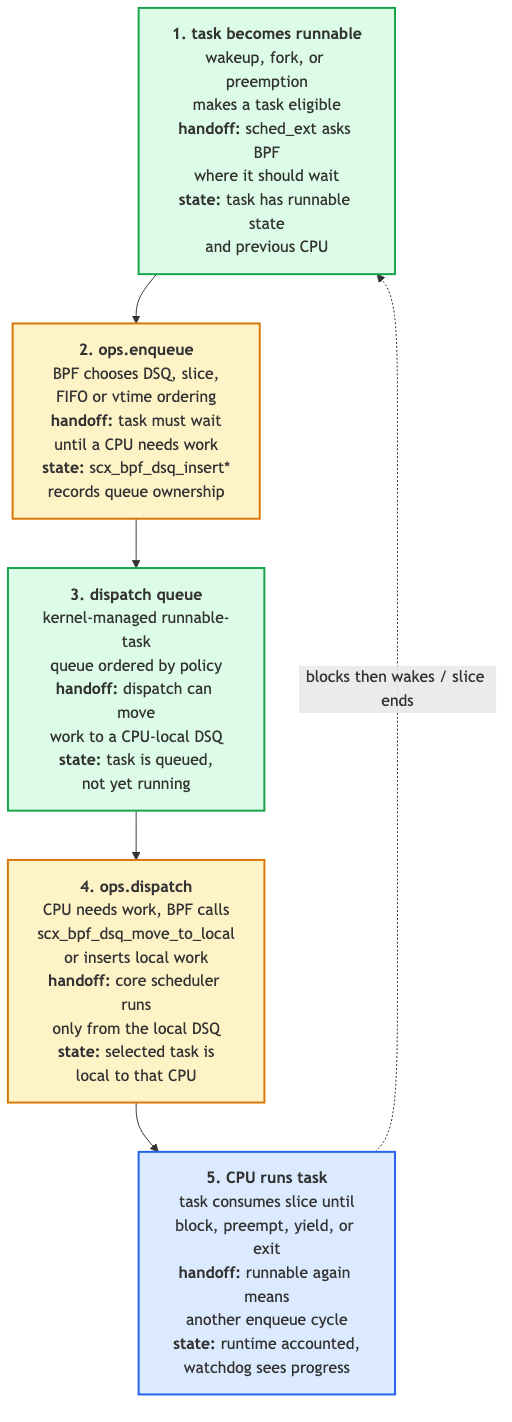
Every BPF scheduler implements callbacks for two main events — the same enqueue/dispatch pair we derived above.
enqueue(task, flags)
A task becomes runnable (it just woke up from I/O, was created, or was preempted — i.e. it just entered the TASK_RUNNING pool). The BPF scheduler decides where to put it — on which DSQ (Dispatch Queue), in what order, with what slice (time budget).
dispatch(cpu, prev)
A CPU has nothing to run (its current task blocked or used up its slice). The BPF scheduler decides which task to give it — typically by pulling from a DSQ.
select_cpu(p, prev_cpu, wake_flags)
When a task wakes up, this callback decides which CPU to wake it on. Optional; defaults to “the CPU it last ran on, with some adjustments.”
Other callbacks
init, exit, running, stopping, update_idle, cpu_release, set_cpumask — all defined in struct sched_ext_ops (kernel/sched/ext_internal.h:292). The full vtable has ~37 callbacks; most BPF schedulers implement only 4–8 of them and let CFS-equivalent defaults handle the rest.
DSQs (Dispatch Queues)
DSQs are kernel-managed queues that hold runnable tasks waiting to be dispatched. You don’t implement them; you consume an API:
scx_bpf_dsq_insert(p, dsq_id, slice, flags)— enqueue taskponto the FIFO DSQ identified bydsq_id, with time sliceslice(ns).scx_bpf_dsq_insert_vtime(p, dsq_id, slice, vtime, flags)— enqueue taskpinto a vtime-ordered DSQ (the fairness mechanism from the CFS section: the queue stays sorted byvtime).scx_bpf_dsq_move_to_local(dsq_id, flags)— move the next task from a DSQ to the current CPU’s local DSQ; called fromdispatchto make a task runnable locally.scx_bpf_create_dsq(id, node)— create a new DSQ with the given numeric id, on NUMA nodenode. (NUMA node: on multi-socket machines, memory is physically attached to a particular CPU socket — a “node”; creating the DSQ on a given node keeps its memory local to the CPUs that use it.scx_simplepasses-1for “any node.”)
Built-in DSQs:
SCX_DSQ_GLOBAL— single shared queue, all CPUs pull from it. (Note: a built-in DSQ likeSCX_DSQ_GLOBALcannot be used as a vtime priority queue — you can’tscx_bpf_dsq_insert_vtimeinto it, because a FIFO has no ordering key. That’s whyscx_simplecreates its own custom shared DSQ instead; see below.)SCX_DSQ_LOCAL— per-CPU queue. Each CPU has its own.
Custom DSQs (created via scx_bpf_create_dsq) let you implement more complex policies: per-cgroup queues, priority queues, NUMA-local queues, etc.
The lab — run scx_simple
scx_simple is the “hello world” of sched_ext: a BPF scheduler that dispatches everything to a single shared queue. (scx_simple creates its own DSQ rather than SCX_DSQ_GLOBAL — see the DSQ section for why a built-in FIFO can’t be vtime-ordered.)
Repo lab: build and run the exact upstream scheduler
The book’s lab doesn’t reimplement scx_simple — Day 25 is about running the
unmodified in-tree example. make -C ebpf/labs day25 builds it straight from
the locked Linux v7.1 tree with the kernel’s own tools/sched_ext Makefile,
sending every artifact under .output/ so the pinned source stays clean:
Day 25 build wrapper: build the EXACT upstream scx_simple from the locked
Linux v7.1 source tree, using the kernel’s own tools/sched_ext Makefile.
Nothing here is repo-owned scheduler code: the point of Day 25 is to run the
unmodified in-tree example. O= redirects every build artifact into
.output/day25/build so the pinned kernel source tree is never written to.
set -euo pipefail
HERE=$(cd – “$(dirname – “${BASH_SOURCE[0]}”)“ && pwd) ROOT=$(cd – “$HERE/..” && pwd)
SRC=$(“$ROOT/scripts/linux-source.sh” path) # verified locked v7.1 tree OUT=“$ROOT/.output/day25” VMLINUX_H=$(“$ROOT/scripts/kernel-btf.sh” sched-ext) BPFTOOL=$(“$ROOT/scripts/linux-bpftool.sh”)
mkdir -p “$OUT”
make -C “$SRC/tools/sched_ext” O=“$OUT”
BPFTOOL=“$BPFTOOL” VMLINUX_BTF=“$VMLINUX_H” VMLINUX_H=“$VMLINUX_H”
scx_simple
The kernel Makefile emits scheduler binaries under build/bin/.
BIN=“$OUT/build/bin/scx_simple” test -x “$BIN” printf ‘day25: built upstream %s\n’ “$BIN”
run.sh is the opt-in, self-cleaning runner: it loads that binary for a bounded
interval on a disposable sched_ext-capable VM, then ejects it so CFS is restored:
Day 25 opt-in runner: load the exact upstream scx_simple, let it schedule the
whole machine for a bounded interval, then eject it cleanly.
sched_ext replaces the live CPU scheduler, so this is deliberate: it refuses
to run without EBPF_LABS_ALLOW_PRIVILEGED=1 and root, bounds the run with a
timeout, and a trap SIGINTs the scheduler on any exit so CFS is restored.
Run it only on a disposable, sched_ext-capable VM.
set -euo pipefail
HERE=$(cd – “$(dirname – “${BASH_SOURCE[0]}”)“ && pwd) ROOT=$(cd – “$HERE/..” && pwd) SCHED=“$ROOT/.output/day25/build/bin/scx_simple” DURATION=${DURATION:-10} SCHED_PID=
fail() { printf ‘day25 run: %s\n’ “$*” >&2; exit 1; }
cleanup() { local status=$? trap - EXIT INT TERM if [[ -n $SCHED_PID ]] && kill -0 “$SCHED_PID” 2>/dev/null; then kill -INT “$SCHED_PID” 2>/dev/null || true wait “$SCHED_PID” 2>/dev/null || true fi exit “$status” } trap cleanup EXIT INT TERM
[[ ${EBPF_LABS_ALLOW_PRIVILEGED:-0} == 1 ]] || fail ‘set EBPF_LABS_ALLOW_PRIVILEGED=1 to acknowledge replacing the live scheduler’ [[ ${EBPF_LABS_ALLOW_SCHED_EXT:-0} == 1 ]] || fail ‘set EBPF_LABS_ALLOW_SCHED_EXT=1 to acknowledge replacing the live scheduler’ (( EUID == 0 )) || fail ‘run with sudo after setting both acknowledgement variables’ [[ -x $SCHED ]] || fail “missing $SCHED; run scripts/build-day.sh day25 first” [[ -r /sys/kernel/sched_ext/state ]] || fail ‘kernel has no sched_ext support’
“$SCHED” & SCHED_PID=$! sleep 1 kill -0 “$SCHED_PID” 2>/dev/null || fail ‘scheduler exited early (see its output above)’
printf ‘day25 run: scx_simple active for %ss; state=%s\n’
“$DURATION” “$(cat /sys/kernel/sched_ext/state)”
sleep “$DURATION”
printf ‘day25 run: stopping; sched_ext state should return to disabled\n’
The rest of this section is the same thing done by hand, so you can watch each step.
Build
cd ~/code/linux/tools/sched_ext
make
ls build/bin
# scx_central  scx_cpu0  scx_flatcg  scx_pair  scx_qmap  scx_sdt  scx_simple  scx_userland
Note: the compiled scheduler binaries are emitted under build/bin/, not in the source directory — a bare ls in tools/sched_ext shows the .c/.bpf.c (and a few .h) sources, the Makefile, Kconfig, README.md, include/, and the build/ directory.
Run
sudo ./build/bin/scx_simple
Output (the line reprints about once per second with cumulative counts that climb under load):
local=842 global=58
local=1577 global=141
local counts tasks dispatched straight to a CPU’s local DSQ (because select_cpu found an idle CPU for them); global counts tasks that went through the shared, vtime-ordered DSQ via ops.enqueue. On a busy system global is normally non-zero. That climbing counter is the proof tasks are flowing through scx_simple’s enqueue/dispatch cycle.
These two counters live in a per-CPU map. Recall per-CPU maps from the Phase 2 tracing days:
scx_simpledeclares itsstatsmap asBPF_MAP_TYPE_PERCPU_ARRAYwithmax_entries 2 /* [local, global] */, so each CPU bumps its own private slot with no locking, and the userspacelocal=/global=totals are the sum across all CPUs. That’s why a busy multi-core box racks up counts fast without any contention on the counters.
That’s it. Your system is now scheduled by BPF.
Run something that exercises scheduling. stress-ng isn’t part of a base install — install it first (sudo apt-get install -y stress-ng on Debian/Ubuntu, sudo dnf install -y stress-ng on Fedora/RHEL). If you can’t install a package, a portable fallback is for i in $(seq $(nproc)); do yes >/dev/null & done (stop it later with pkill yes).
# In another terminal:
stress-ng --cpu 4 --timeout 30
While it runs, confirm scx_simple is actually in control:
cat /sys/kernel/sched_ext/state
# enabled
(When no BPF scheduler is loaded this reads disabled.) Watch the local=N global=M line scx_simple prints each second — both counters should climb as stress-ng’s workers cycle through the scheduler. With scx_simple, basic responsiveness is preserved (it’s a working scheduler, just simple) but you’re not getting CFS’s fair-share guarantees — it’s literally a shared queue, FIFO-ish.
Read the source
tools/sched_ext/scx_simple.bpf.c. The whole scheduler is ~30 lines of BPF:
void BPF_STRUCT_OPS(simple_enqueue, struct task_struct *p, u64 enq_flags)
{
    /* Place into the shared vtime-ordered DSQ with the default slice */
    u64 vtime = p->scx.dsq_vtime;
    /* cap idle budget at one slice (the min_vruntime trick) */
    if (time_before(vtime, vtime_now - SCX_SLICE_DFL))
        vtime = vtime_now - SCX_SLICE_DFL;
    scx_bpf_dsq_insert_vtime(p, SHARED_DSQ, SCX_SLICE_DFL, vtime, enq_flags);
}

void BPF_STRUCT_OPS(simple_dispatch, s32 cpu, struct task_struct *prev)
{
    scx_bpf_dsq_move_to_local(SHARED_DSQ, 0);
}
That two-line clamp is the min_vruntime-style floor from the CFS section, reappearing verbatim: it caps how much priority a long-sleeping task can bank to a single slice.
The real source wraps this in an if (fifo_sched) toggle (a FIFO mode vs. the default vtime mode); we show only the default vtime branch — that’s the line you’ll edit in the experiments below.
Read those two functions against everything above. simple_enqueue is the “a task became runnable, where does it go?” callback — it reads the task’s per-task p->scx.dsq_vtime and inserts into the vtime-ordered SHARED_DSQ, so fairer (lower-vtime) tasks sort to the front. simple_dispatch is the “a CPU needs work” callback — it pulls the front task into the local DSQ. Enqueue and dispatch, exactly the two-event skeleton.
(BPF_STRUCT_OPS already expands to SEC("struct_ops/"#name) internally — you never write the SEC() line yourself, and doing so would cause a section conflict.)
Plus init, exit, and the vtable instance. That’s the whole scheduler.
The userspace component (scx_simple.c) is ~110 lines and handles:
- Loading the BPF object.
- Attaching the struct_ops link.
- Periodic stats output.
- Graceful exit on Ctrl-C (which causes the kernel to revert to CFS).
Stop it
Ctrl-C in the scx_simple terminal. The watchdog’s not needed — scx_simple exits cleanly, the kernel detects the link drop, CFS takes over. Confirm: cat /sys/kernel/sched_ext/state now reads disabled. Re-run stress-ng and watch per-thread CPU share with pidstat -t 1 or top -H — under CFS the worker threads converge to roughly equal CPU% (that’s vruntime fairness at work), in contrast to scx_simple’s single shared FIFO-ish queue. (Stop the yes fallback, if you used it, with pkill yes.)
What to break
Don’t dispatch
Comment out scx_bpf_dsq_move_to_local(SHARED_DSQ, 0) in simple_dispatch. Run; CPUs have nothing to run; tasks pile up in the queue. After ~30s, watchdog ejects:
sched_ext: BPF scheduler "simple" disabled (runnable task stall)
sched_ext: simple: stress-ng[12345] failed to run for 30.000s
Check dmesg. The system recovers automatically. Don’t break dispatch in production. Production sched_ext schedulers all have safety paths to fall back if their custom logic can’t dispatch.
Always dispatch with vtime=0
Set vtime = 0 in simple_enqueue. Every task has the same priority. As the CFS section explained, with all vtime equal the vtime-ordered queue can no longer distinguish a compute hog from an interactive task — long-running tasks dominate; interactive tasks lag. CFS’s vtime accounting is the simplest fairness mechanism; copying it is the path of least surprise. Try it without; observe responsiveness drop.
Add per-CPU DSQs
Replace SHARED_DSQ with per-CPU DSQs. Each CPU pulls from its own. No cross-CPU contention but no automatic load balancing — you’d manually rebalance in dispatch when own DSQ empty. This is what scx_central does (Day 27).
Add a tracepoint
Inside simple_enqueue, emit to ringbuf:
struct event *e = bpf_ringbuf_reserve(&rb, sizeof(*e), 0);
if (e) { e->pid = p->pid; ...; bpf_ringbuf_submit(e, 0); }
You’re now observing every scheduler decision in real time. Throughput consideration: at high context-switch rates (1M+/sec), even a few ns per emit becomes meaningful. Filter aggressively (sample 1 in N, or only emit specific tasks) or aggregate in BPF.
What to read in the kernel
-
kernel/sched/ext.c— the framework. ~10,000 lines. Read the file’s top comment for the design overview. Don’t try to read everything today; just orient. -
kernel/sched/ext_internal.h:292—struct sched_ext_opsdefinition. The vtable shape: every callback your BPF scheduler can implement. -
kernel/sched/ext.c:7447—scx_enable(struct sched_ext_ops *ops, struct bpf_link *link). The function called when a struct_ops scheduler is loaded; activates it as the system scheduler. -
kernel/sched/ext_idle.c— idle CPU integration. How sched_ext schedulers handle the case “no task to run; CPU should idle.” -
kernel/sched/fair.c— the fair-class (EEVDF) implementation: the scheduler sched_ext replaces while loaded and reverts to on unload. Skimpick_eevdf()andplace_entity()to see how virtual deadlines andavg_vruntime()drive selection and placement — that’s the fairness model your vtime-ordered DSQ is imitating. -
tools/sched_ext/scx_simple.bpf.c— read in full. The minimal example. -
tools/sched_ext/include/scx/common.bpf.h— kfunc declarations and helpers your BPF scheduler will use. -
Documentation/scheduler/sched-ext.rst— official guide. Read once. Concise.
Bullet Points
- A scheduler picks, from the runnable (
TASK_RUNNING) tasks, which runs on each CPU and for how long (its time slice). Blocked tasks (TASK_INTERRUPTIBLE/TASK_UNINTERRUPTIBLE) aren’t candidates until a wakeup. Slice expiry causes preemption; swapping tasks is a context switch. The two events: enqueue (task becomes runnable) and dispatch (CPU needs a task). - CFS is the default scheduler; its fairness comes from
vruntime(CPU time consumed, weighted) — the intuition is “run the task that’s run least.” (In this kernel the fair class is EEVDF: it picks the leftmost eligible entity by virtual deadline viapick_eevdf(), same fairness outcome.) New/woken tasks are placed near the runqueue’s weighted-average virtual time (avg_vruntime()), not a minimum floor. sched_ext’s vtime-ordered DSQ reproduces this;vtime=0everywhere destroys it. - sched_ext lets BPF programs implement Linux schedulers via
struct sched_ext_ops(struct_ops). Per-task scheduling data lives intask_struct.scx(e.g.p->scx.dsq_vtime). - DSQs are kernel-managed dispatch queues, either FIFO or vtime-ordered. Built-in:
SCX_DSQ_GLOBAL(FIFO only),SCX_DSQ_LOCAL. Custom viascx_bpf_create_dsq. - Dispatch stall watchdog ejects stalled BPF schedulers and falls back to CFS. Default and max timeout is 30 seconds (
SCX_WATCHDOG_MAX_TIMEOUT = 30 * HZ; HZ=1000 here, so 30000 jiffies), tunable shorter viaops.timeout_ms. scx_simpleis the minimal example;scx_central,scx_flatcg,scx_lavdare progressively richer.- Loading a BPF scheduler is a system-wide operation — every task on the system schedules through it.
- Source:
kernel/sched/ext.c(~10,000 lines) +kernel/sched/ext_internal.h(struct definitions) +tools/sched_ext/.
Check question
What guarantees that loading a BPF scheduler doesn’t permanently freeze your machine?
Click to reveal answer
Answer: The dispatch stall watchdog. The kernel monitors task wait times across all CPUs; if any task has been runnable but not dispatched past the stall timeout, the framework concludes the BPF scheduler is broken, ejects it, and re-enables CFS. Recovery is automatic.
The watchdog timeout defaults to 30 seconds (SCX_WATCHDOG_MAX_TIMEOUT = 30 * HZ in kernel/sched/ext_internal.h). A scheduler can request a shorter timeout via ops.timeout_ms, but the kernel caps it at 30 seconds — you can never disable or lengthen it past that. The default threshold is conservative — long enough that no legitimate scheduling delay would trigger it, short enough that a fully-stalled BPF scheduler doesn’t make the system hang for minutes.
This is the design that makes BPF scheduling practical. Without it, an infinite loop in dispatch (or a logic error that fails to consume any DSQ) would deadlock the system requiring a power cycle. With it, the worst case is a 30-second pause, then full recovery and CFS-managed normalcy. The barrier to “let me try this scheduler” drops from “are you sure” to “sure, why not — worst case, 30 seconds.”
Tomorrow
Day 26: modify scx_simple to prioritize a specific cgroup. See your changes affect a real workload.