Day 26 — Modify scx_simple: priority for one cgroup
Today’s mission: make a custom variant of
scx_simplethat gives scheduling priority to tasks in a chosen cgroup, and watch that workload get preferential treatment under load. Three small things will bite you along the way — what a cgroup really is in v7.1, which cgroup id to match on, and how oneconst volatileglobal becomes load-time configuration — and the body sections introduce each as we hit it. Total time: ~110 minutes.
Why this exercise
Yesterday you ran a stranger’s BPF scheduler. Today you change one and observe the effect. This is the most important sched_ext skill: small, surgical modifications to a working scheduler.
The goal is to get comfortable with the iteration loop:
- Edit one callback.
- Compile, load.
- Generate a workload.
- Observe the effect with measurements.
- Tune; iterate.
Today’s specific modification: tasks in /sys/fs/cgroup/priority get a 2× time slice and lower vtime (so they run earlier). Tasks elsewhere use the default.
That one sentence hides three things that will bite you if you don’t understand them, and most of today is about making them obvious:
- What a cgroup is, how the kernel arranges them into a tree, and why the BPF code has to walk that tree with a kfunc instead of following a
parentpointer (there isn’t one). - Why the id you match against is the full 64-bit kernfs id — on 64-bit Linux it equals the inode
statprints, but on a 32-bit kernel it doesn’t, so we read it the portable way — and why getting it wrong silently disables the whole feature. - How a
const volatileglobal becomes a knob userspace sets once, before load, that the verifier then bakes in as a constant.
We’ll teach each as we hit the part of the lab that depends on it. A few things you’ve already met carry over and we’ll only refresh, not re-teach: vtime-ordered DSQs and p->scx.dsq_vtime (Day 25), kfunc acquire/release reference discipline and KF_ACQUIRE/KF_RELEASE (Day 20), bpf_cgroup-as-a-refcounted-type and bpf_cgroup_release (Day 21), bounded loops with bpf_for (Day 5), the null-check-must-dominate-deref rule (Day 4), and per-callback sleepable struct_ops (Day 22).
What a cgroup is, and the tree it lives in
Before we touch the scheduler, let’s get concrete about the thing we’re prioritizing.
A cgroup (control group) is a node in a tree of processes. Every task on the system belongs to exactly one cgroup, and a cgroup can hold many tasks. In cgroup v2 — the “unified hierarchy” — there is a single tree for all controllers (cpu, memory, io, …), mounted at /sys/fs/cgroup. That filesystem is the tree: each directory is a cgroup, and nesting directories nests cgroups.
You build the tree with ordinary filesystem operations:
mkdir /sys/fs/cgroup/prioritycreates a child cgroup of the root.- Writing a PID into
/sys/fs/cgroup/priority/cgroup.procsmoves that task — and every process it later forks — into that cgroup.
That is exactly what the setup section does below: it makes one new cgroup and drops your shell into it.
Each cgroup knows its depth: level
Here is the field the whole modification hinges on. In v7.1, struct cgroup carries an int level:
/* include/linux/cgroup-defs.h:474 */
struct cgroup {
	/* self css with NULL ->ss, points back to this cgroup */
	struct cgroup_subsys_state self;

	unsigned long flags;

	/*
	 * The depth this cgroup is at.  The root is at depth zero and each
	 * step down the hierarchy increments the level.  This along with
	 * ancestors[] can determine whether a given cgroup is a
	 * descendant of another without traversing the hierarchy.
	 */
	int level;          /* cgroup-defs.h:486 */
	/* ... */
	struct kernfs_node *kn;   /* cgroup kernfs entry — cgroup-defs.h:526 */
	/* ... */
	/* All ancestors including self — cgroup-defs.h:636 */
	struct cgroup *ancestors[];
};
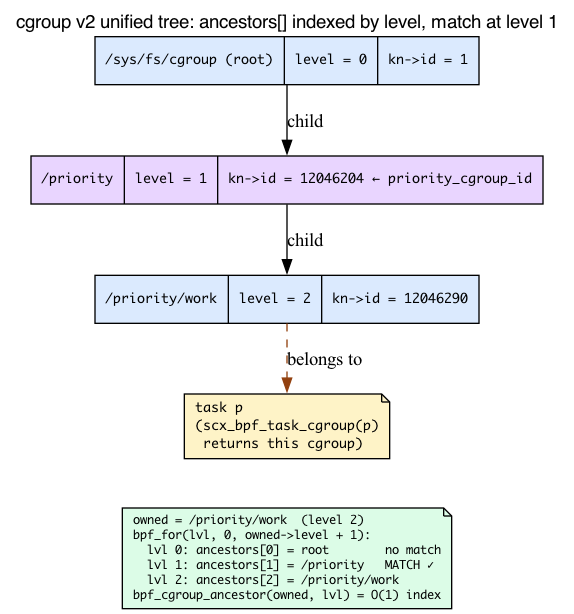
Read the comment carefully, because it tells you the trick the kernel — and our BPF code — uses. The root cgroup is level == 0; each step down adds one. /priority is level 1; /priority/work is level 2. And crucially, every cgroup keeps an ancestors[] array indexed by level — ancestors[0] is the root, ancestors[1] is its level-1 ancestor, up to ancestors[level] which is the cgroup itself. So asking “what is my ancestor at level N?” is an O(1) array lookup, not a pointer-chase up the tree. That is what makes a verifier-friendly bounded loop possible: we iterate lvl from 0 to owned->level, indexing ancestors[lvl] each time.
There is deliberately no cgrp->parent
Now the subtle part, the one the chapter leans on hard. You might expect to walk the tree by hand: for (cg = mine; cg; cg = cg->parent). You can’t — struct cgroup has no parent field at all. Look back at the struct: level, kn, ancestors[], but no struct cgroup *parent.
Where did the parent go? It lives one level down, on the cgroup’s embedded self css. Every cgroup contains a struct cgroup_subsys_state self, and that is where the parent link sits:
/* include/linux/cgroup-defs.h:246, inside struct cgroup_subsys_state */
struct cgroup_subsys_state *parent;
So the parent of a cgroup is reachable as cgrp->self.parent — but notice the type: it’s a struct cgroup_subsys_state *, not a struct cgroup *. You can’t write cg = cg->parent and you can’t even write cg = cg->self.parent and expect a cgroup * back. Hand-rolling the walk means juggling css↔cgroup conversions, and a manual pointer-chasing loop is hard to make the verifier accept anyway.
That is why the BPF side uses the bpf_cgroup_ancestor() kfunc instead. It takes the ancestors[] shortcut for you:
/* kernel/bpf/helpers.c:2792 */
__bpf_kfunc struct cgroup *bpf_cgroup_ancestor(struct cgroup *cgrp, int level)
{
	struct cgroup *ancestor;

	if (level > cgrp->level || level < 0)
		return NULL;

	/* cgrp's refcnt could be 0 here, but ancestors can still be accessed */
	ancestor = cgrp->ancestors[level];
	if (!cgroup_tryget(ancestor))
		return NULL;
	return ancestor;
}
It’s a guarded array index — return NULL if level is out of range, otherwise hand back ancestors[level] with a fresh reference taken on it. “Walk the hierarchy” is really “index the ancestors array, one level per loop iteration.”
Each cgroup is a kernfs directory: cgrp->kn
One more field from that struct: cgrp->kn, a struct kernfs_node *. kernfs is the in-kernel pseudo-filesystem machinery that backs /sys/fs/cgroup (and /sys generally). Every cgroup directory is a kernfs node, and that node carries a stable identifier — cgrp->kn->id — which is the value the BPF side matches against to recognize “this is the priority cgroup.” We need to understand that id precisely, because it’s the single most common way to get this lab wrong.
Setting up the priority cgroup
sudo mkdir /sys/fs/cgroup/priority
stat -c %i /sys/fs/cgroup/priority     # cgroup's kernfs inode — equals kn->id on 64-bit Linux

# Put a shell into it (subprocess inheritance)
echo $$ | sudo tee /sys/fs/cgroup/priority/cgroup.procs
echo $$    # this shell now lives in /priority
Anything spawned from this shell will be in /priority until you move it back.
Heads up about that
stat -c %i. On your 64-bit box this prints the directory’s inode, which equals the id the BPF side compares against (kn->id) — so it would actually work here. We still read the id withname_to_handle_at()in userspace because that’s the portable choice: it returns the full 64-bit id on a 32-bit kernel too, wherestat’s inode would be truncated. The next section explains the split.
The id you match on: the full 64-bit kernfs id
The BPF side matches on cgrp->kn->id, which is a u64:
/* include/linux/kernfs.h:226 */
/*
 * 64bit unique ID.  On 64bit ino setups, id is the ino.  On 32bit,
 * the low 32bits are ino and upper generation.
 */
u64			id;
Read the comment carefully, because the behavior splits by platform:
- On 64-bit
ino_tsystems — x86-64, arm64, essentially every modern 64-bit Linux, including this lab machine — the id simply is the inode. There is no packing:kernfs_id_ino(id)returns the whole 64-bitidandkernfs_id_gen(id)is a fixed1. The inode is set from that same full id (iget_locked(sb, kernfs_ino(kn)),kernfs/inode.c:252), andi_inois anunsigned long(64-bit), sost_ino == cgrp->kn->idexactly, high bits and all. - On 32-bit
ino_tbuilds (32-bit kernels) the id packs two things — the inode in the low 32 bits and a generation counter in the high 32 bits — becauseino_tcan’t hold all 64 bits.
The kernel hands you helpers whose two branches make exactly this split explicit:
/* include/linux/kernfs.h:347 */
static inline ino_t kernfs_id_ino(u64 id)   /* low bits: the inode */
{
	if (sizeof(ino_t) >= sizeof(u64))
		return id;                  /* 64-bit ino: the WHOLE id */
	else
		return (u32)id;             /* 32-bit ino: low 32 bits only */
}

/* include/linux/kernfs.h:356 */
static inline u32 kernfs_id_gen(u64 id)     /* high 32 bits: the generation */
{
	if (sizeof(ino_t) >= sizeof(u64))
		return 1;                   /* 64-bit ino: no generation, fixed 1 */
	/* else: id >> 32 */
}
So on your x86-64 box stat -c %i would in fact print the correct matching value — I verified this against name_to_handle_at() for /sys/fs/cgroup, /init.scope, and /system.slice and the two agreed in every case. Truncation only bites on a 32-bit-ino_t build, where stat’s ino_t carries just the low 32 bits and would drop a nonzero generation.
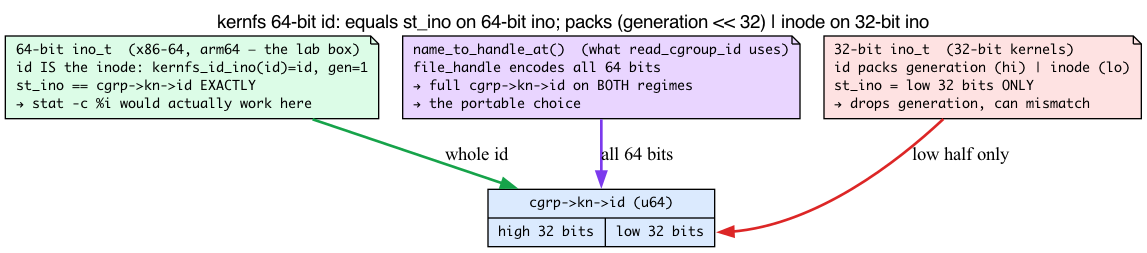
We still read the id with name_to_handle_at() rather than stat, because it is the unambiguous, portable choice: it returns the full 64-bit kn->id on both regimes, so the lab works the same on a 32-bit kernel as on your 64-bit one without a platform caveat. That’s the load-bearing reason the userspace driver below uses a syscall instead of stat(). (For confidence that kn->id really is the canonical cgroup identifier: production sched_ext code uses it directly — scx_flatcg.bpf.c:391 does scx_bpf_dsq_insert(p, cgrp->kn->id, ...), keying a whole DSQ on it.)
There are no Dumb Questions
Q: Why match on
kn->idinstead of the cgroup path string? A: The path can change (a cgroup can be renamed/moved) and string-comparing paths on the scheduler hot path would be slow and verifier-hostile.kn->idis a stable 64-bit integer the kernel already has oncgrp, so the match is a singleu64compare.Q: Why not just hard-code the id as a literal in the BPF source? A: The id doesn’t exist until you
mkdirthe cgroup at runtime, so there’s nothing to hard-code at compile time. That’s exactly the gap theconst volatileglobal fills — userspace reads the live id and sets it before load (next section).Q: Why release the ancestor reference on the no-match path too, not just on a match? A:
bpf_cgroup_ancestor()isKF_ACQUIRE— it hands back a refcounted reference every time it returns non-NULL, match or not. The verifier forces abpf_cgroup_release()on every path that holds one, or the program won’t load. (More on this in “Reference discipline” below.)
Configuring a BPF program at load time: const volatile and .rodata
The BPF side needs to know which cgroup id is “the priority one.” It can’t be hard-coded — the id is only known at runtime, after you mkdir the cgroup. But it also shouldn’t be a per-packet map lookup on the scheduler hot path. The idiom for “a constant chosen by userspace, baked in before the program runs” is a const volatile global.
const volatile __u64 priority_cgroup_id = 0; /* full kernfs id; set from userspace */
This is not an ordinary runtime variable. libbpf places every const volatile global into the program’s .rodata ELF section, which becomes a single-entry, read-only BPF array map. The two qualifiers each do a job:
consttells the verifier the value is fixed once the program loads. Because the verifier then treatspriority_cgroup_idas a known constant, it can constant-fold and dead-code-eliminate — for example, if the value is0, the entireif (priority_cgroup_id) { ... }branch is provably dead and gets removed.volatilestops the compiler from doing that folding too early. Without it, clang would see the initializer= 0, conclude the value is always0, and fold the branch away at compile time — before userspace ever gets a chance to set it.volatileforces clang to emit a real load from.rodata, leaving the value “unknown until load.”
Userspace can write this map only in the window between skeleton open and load:
skeleton open → write skel->rodata->priority_cgroup_id → load (map frozen read-only) → verifier constant-folds the if() → attach
Setting skel->rodata->priority_cgroup_id = ... mutates the map’s backing memory; load then freezes it read-only. That’s why the driver sets it before scx_simple__attach(), and why we describe rodata as “settable before load, read-only after.” It’s the same .rodata idiom already in the file you’re editing — scx_simple.bpf.c:27 declares const volatile bool fifo_sched; the same way.
The flip side is the failure mode that makes the fail-loud guard matter: because the verifier sees priority_cgroup_id as a constant, leaving it 0 doesn’t just “skip” the feature at runtime — the gated branch is removed at verification time. A 0 here truly compiles the feature out. So a wrong id (from stat’s truncation, say) and an unset id fail the same silent way, which is exactly why we check it loudly below.

The modification
Two files to change: tools/sched_ext/scx_simple.bpf.c and the userspace driver tools/sched_ext/scx_simple.c.
BPF side: read a config variable, branch on cgroup
The complete derivative lives in the lab as scx_priority.bpf.c — a copy of
scx_simple.bpf.c with exactly this change. First the one new load-time global:
/*
- The one knob this derivative adds: the full 64-bit kernfs id of the priority
- cgroup. It is a
const volatileglobal, so it lives in .rodata — userspace - writes it once between skeleton open and load, and the verifier then treats
- it as a known constant (a value of 0 dead-code-eliminates the whole priority
- branch, which is why the userspace driver fails loudly on a 0 id). / const volatile __u64 priority_cgroup_id = 0; / full kernfs id; set from userspace */
/*
- scx_bpf_task_cgroup(), bpf_cgroup_ancestor(), and bpf_cgroup_release() all
- come from <scx/common.bpf.h> (scx_bpf_task_cgroup is a compat macro in
- <scx/compat.bpf.h>). Do NOT re-declare them with your own
extern ... __ksym; - — that collides with the header and fails to compile. Just call them, as
- scx_flatcg.bpf.c does. */
and then the rewritten simple_enqueue (the two lines that clamp idle budget are
carried over unchanged from stock scx_simple):
void BPF_STRUCT_OPS(simple_enqueue, struct task_struct *p, u64 enq_flags) { u64 vtime = p->scx.dsq_vtime; u64 slice = SCX_SLICE_DFL;
stat_inc(1); /* count global queueing */

/*
 * Limit the amount of budget that an idling task can accumulate to one
 * slice (carried over unchanged from scx_simple). This floor is also
 * what keeps the priority decrement below bounded: a task can never sit
 * more than one slice ahead of vtime_now, so it cannot starve the rest
 * and trip the runnable-task-stall watchdog.
 */
if (time_before(vtime, vtime_now - SCX_SLICE_DFL))
	vtime = vtime_now - SCX_SLICE_DFL;

/*
 * Walk up the cgroup hierarchy looking for the priority cgroup.
 * bpf_cgroup_ancestor(cgrp, level) returns the ancestor at the given
 * level (0 = root) as an ACQUIRED reference we must release. We iterate
 * with bpf_for(), the same idiom scx_flatcg uses: it gives the verifier
 * a provable bound on a runtime limit (owned->level), which an ordinary
 * `for` on a memory-read value would not. A match anywhere on the path
 * (own cgroup or any ancestor) counts, so tasks nested below /priority
 * inherit priority too.
 */
if (priority_cgroup_id) {
	struct cgroup *owned = scx_bpf_task_cgroup(p);
	if (owned) {
		int lvl;
		bpf_for(lvl, 0, owned->level + 1) {
			struct cgroup *anc = bpf_cgroup_ancestor(owned, lvl);
			if (!anc)
				continue;
			if (anc->kn->id == priority_cgroup_id) {
				vtime -= 1000000; /* push 1 ms earlier in queue */
				slice *= 2;	  /* longer time slice */
				bpf_cgroup_release(anc);
				break;
			}
			bpf_cgroup_release(anc);
		}
		bpf_cgroup_release(owned);
	}
}

scx_bpf_dsq_insert_vtime(p, SHARED_DSQ, slice, vtime, enq_flags);
}
Two effects:
- Lower vtime = pushed earlier in the vtime-ordered DSQ; runs sooner.
- Longer slice = more CPU time per scheduling round before being preempted.
Reading the loop line by line
Several things you’ve met before are doing quiet work here; let’s name them.
Vtime, refreshed (Day 25). A task’s p->scx.dsq_vtime is its accumulated virtual runtime, and the vtime-ordered DSQ dispatches the lowest vtime first — it’s literally an rbtree keyed on vtime (struct rb_root priq; /* used to order by p->scx.dsq_vtime */, include/linux/sched/ext.h:85). So subtracting from vtime pushes a task earlier in line. The base slice we double is SCX_SLICE_DFL = 20 * 1000000 (20 ms, sched/ext.h:30).
The ancestor walk uses bpf_cgroup_ancestor(), not cg->parent. As the cgroup section established, struct cgroup has no parent field, so we use the bpf_cgroup_ancestor(cgrp, level) kfunc — it returns the ancestor at a given depth as an acquired reference (release it with bpf_cgroup_release).
bpf_for(lvl, 0, owned->level + 1) is a bounded loop (Day 5). The verifier needs a provable iteration bound even though the limit (owned->level) is a runtime value read from memory; bpf_for() supplies it, where a plain for comparing against owned->level would be rejected. The upper bound is owned->level + 1 precisely because ancestors[] is indexed 0 .. level inclusive — we want to check the root (0), the task’s own cgroup (level), and everything between. This is the exact idiom scx_flatcg.bpf.c:207 uses: bpf_for(level, 0, cgrp->level + 1). You don’t need to add any include for it: <scx/common.bpf.h> (already included by scx_simple.bpf.c) pulls bpf_for in transitively — exactly as scx_flatcg.bpf.c uses it with no bpf_experimental.h include. (Adding #include <bpf/bpf_experimental.h> yourself actually breaks the scx build: that header isn’t on the sched_ext include path and clang fails with 'bpf/bpf_experimental.h' file not found.)
Reference discipline (Day 20/21) plus one new wrinkle. Both scx_bpf_task_cgroup(p) and bpf_cgroup_ancestor() are KF_ACQUIRE kfuncs — each returns a refcounted cgroup the verifier forces you to release on every path, which is why there’s a bpf_cgroup_release() on the match path, the no-match path, and the outer owned. You can confirm the flags in the source:
/* kernel/bpf/helpers.c:4738 */
BTF_ID_FLAGS(func, bpf_cgroup_ancestor, KF_ACQUIRE | KF_RCU | KF_RET_NULL)
/* kernel/bpf/helpers.c:4737 */
BTF_ID_FLAGS(func, bpf_cgroup_release, KF_RELEASE)
/* kernel/sched/ext.c:9798 */
BTF_ID_FLAGS(func, scx_bpf_task_cgroup, KF_IMPLICIT_ARGS | KF_RCU | KF_ACQUIRE)
The new wrinkle: notice bpf_cgroup_ancestor is also KF_RET_NULL (and KF_RCU). That means anc can be NULL, and the verifier applies the same null-domination rule you learned on Day 4 — you must guard if (!anc) continue; before you dereference anc->kn->id. The if (!anc) continue; isn’t defensive politeness; the program won’t load without it.
Userspace side: pass the cgroup ID
The lab’s scx_priority.c is the stock scx_simple.c driver plus a portable
cgroup-id reader:
/*
-
The BPF side matches against cgrp->kn->id, the full 64-bit kernfs id.
-
On 64-bit-ino Linux (x86-64, arm64) that id equals st_ino, so stat would
-
work; on a 32-bit-ino kernel st_ino is only the low 32 bits and would drop
-
the generation. name_to_handle_at() returns the full 64-bit id on both, so
-
use it for a portable read. */ static __u64 read_cgroup_id(const char *path) { struct { struct file_handle fh; __u64 id; } h = { .fh = { .handle_bytes = sizeof(__u64) } }; int mount_id;
if (name_to_handle_at(AT_FDCWD, path, &h.fh, &mount_id, 0) < 0) return 0; return h.id; }
Both sides must use the same 64-bit value or the equality at anc->kn->id == priority_cgroup_id never fires: the kernel stores the full u64 in kn->id, and read_cgroup_id() copies the first __u64 out of the file handle — the same 64 bits. (rodata->priority_cgroup_id is the userspace handle for the BPF program’s const volatile __u64 priority_cgroup_id — settable before load, read-only after, as the .rodata section above explained.)
Confirm the printed id is NON-ZERO — it should look like:
priority cgroup id = 12046204
If it prints 0, name_to_handle_at() failed (wrong path, or the directory isn’t on cgroup2). Verify /sys/fs/cgroup/priority exists and mount | grep cgroup2 lists /sys/fs/cgroup. A 0 here is dead-code-eliminated by the verifier (see the .rodata section), so the feature is compiled out entirely — which is why the driver sets the id and fails loudly, all in the .rodata window before load:
/*
 * Set the priority cgroup id in the .rodata window (after open, before
 * load). A 0 id means name_to_handle_at() failed (wrong path, or the
 * directory is not on cgroup2) — and because the verifier constant-folds
 * this global, a 0 would silently compile the priority branch out. So we
 * fail loudly instead of loading a scheduler that does nothing.
 */
skel->rodata->priority_cgroup_id = read_cgroup_id(cgroup_path);
fprintf(stderr, "priority cgroup id = %llu (%s)\n",
	skel->rodata->priority_cgroup_id, cgroup_path);
if (skel->rodata->priority_cgroup_id == 0) {
	fprintf(stderr, "FATAL: could not read priority cgroup id; "
			"create %s first\n", cgroup_path);
	scx_priority__destroy(skel);
	return 1;
}
Build and run
The repo lab builds this derivative against the locked v7.1 sched_ext support
(make -C ebpf/labs day26) and ships a safe, self-cleaning runner. run.sh
creates a throwaway priority cgroup it owns, starts a small workload in it,
loads scx_priority pointed at that cgroup for a bounded interval, and on any
exit ejects the scheduler and removes only the cgroup it made:
Day 26 opt-in runner: load the scx_priority derivative against an OWNED,
throwaway priority cgroup, run it for a bounded interval, then fully clean up.
Safety contract (this replaces a live kernel scheduler, so it is deliberate):
* refuses to run without EBPF_LABS_ALLOW_PRIVILEGED=1 and root;
* creates ONE cgroup it owns (ebpf-day26-$$) and never touches any other;
* a single trap moves our children back to the root cgroup, ejects the
scheduler, and rmdir’s the owned cgroup on any exit path;
* bounds the run with a timeout so a mistake cannot wedge the box.
set -euo pipefail
HERE=$(cd – “$(dirname – “${BASH_SOURCE[0]}”)“ && pwd) ROOT=$(cd – “$HERE/..” && pwd) SCHED=“$ROOT/.output/day26/build/bin/scx_priority” CGROUP_ROOT=/sys/fs/cgroup OWNED=“$CGROUP_ROOT/ebpf-day26-$$” DURATION=${DURATION:-10} SCHED_PID= WORK_PID=
fail() { printf ‘day26 run: %s\n’ “$*” >&2; exit 1; }
cleanup() { local status=$? trap - EXIT INT TERM [[ -n $WORK_PID ]] && kill “$WORK_PID” 2>/dev/null || true if [[ -n $SCHED_PID ]] && kill -0 “$SCHED_PID” 2>/dev/null; then kill -INT “$SCHED_PID” 2>/dev/null || true wait “$SCHED_PID” 2>/dev/null || true fi # Move any survivors back to root and remove only the cgroup we created. if [[ -d $OWNED ]]; then if [[ -r $OWNED/cgroup.procs ]]; then while read -r pid; do [[ -n $pid ]] && echo “$pid” > “$CGROUP_ROOT/cgroup.procs” 2>/dev/null || true done < “$OWNED/cgroup.procs” fi rmdir “$OWNED” 2>/dev/null || true fi exit “$status” } trap cleanup EXIT INT TERM
[[ ${EBPF_LABS_ALLOW_PRIVILEGED:-0} == 1 ]] || fail ‘set EBPF_LABS_ALLOW_PRIVILEGED=1 to acknowledge loading a live BPF scheduler’ [[ ${EBPF_LABS_ALLOW_SCHED_EXT:-0} == 1 ]] || fail ‘set EBPF_LABS_ALLOW_SCHED_EXT=1 to acknowledge loading a live BPF scheduler’ (( EUID == 0 )) || fail ‘run with sudo after setting both acknowledgement variables’ [[ -x $SCHED ]] || fail “missing $SCHED; run scripts/build-day.sh day26 first” [[ -r /sys/kernel/sched_ext/state ]] || fail ‘kernel has no sched_ext support’ [[ -w $CGROUP_ROOT/cgroup.procs ]] || fail “$CGROUP_ROOT is not a writable cgroup2 mount” [[ -e $OWNED ]] && fail “owned cgroup $OWNED already exists”
1. Create the owned priority cgroup and start a small CPU workload inside it.
mkdir “$OWNED” ( exec sh -c ‘echo $$ > “$1/cgroup.procs”; exec yes >/dev/null’ _ “$OWNED” ) & WORK_PID=$!
2. Start the scheduler pointed at the owned cgroup, bounded by a timeout.
“$SCHED” -c “$OWNED” & SCHED_PID=$! sleep 1 kill -0 “$SCHED_PID” 2>/dev/null || fail ‘scheduler exited early (see its output above)’
printf ‘day26 run: scx_priority active for %ss; state=%s\n’
“$DURATION” “$(cat /sys/kernel/sched_ext/state)”
sleep “$DURATION”
3. cleanup() ejects the scheduler and tears down the owned cgroup.
printf ‘day26 run: stopping; sched_ext state should return to disabled\n’
To explore the effect by hand instead — the manual, contrast-driven workflow the rest of this section walks through:
Prerequisites. This step needs three non-default tools — install them first:
sudo apt-get install -y stress-ng sysbench # load generator + CPU benchmark
(It also assumes the kernel built at ~/code/linux with sched_ext enabled, established on earlier days.)
cd ~/code/linux/tools/sched_ext
make
sudo ./scx_simple &

# The "Setting up" section moved THIS shell into /priority. Move it back to the
# root cgroup first, so the heavy load below inherits root (NOT /priority) —
# otherwise BOTH the load and the benchmark run in /priority and there is no
# contrast to observe.
echo $$ | sudo tee /sys/fs/cgroup/cgroup.procs

# Heavy load (root cgroup, NOT /priority):
stress-ng --cpu 8 --timeout 60 &

# Prove the split before benchmarking:
cat /proc/$(pgrep -n stress-ng)/cgroup    # expect 0::/   (stress-ng in root)
cat /proc/$$/cgroup                        # expect 0::/   (shell still in root)

# NOW move this shell into the priority cgroup and run the benchmark:
echo $$ | sudo tee /sys/fs/cgroup/priority/cgroup.procs
cat /proc/$$/cgroup                        # expect 0::/priority
sysbench --threads=1 --cpu-max-prime=20000 cpu run

# Compare to running WITHOUT the priority modification (revert and re-test).
The two cat /proc/.../cgroup lines are the contrast check: the load shows 0::/ while the benchmark shell shows 0::/priority. Your sysbench in the priority cgroup should complete faster than baseline despite the competing stress-ng.
Measure
Measure throughput directly — run the same benchmark once from inside /priority and once from the root cgroup, both while stress-ng loads the box, and compare the events per second lines. (Don’t wrap it in schedtool -p N: that sets a real-time policy, which moves the task OUT of the sched_ext class entirely, so it would no longer exercise your cgroup-priority logic.)
stress-ng --cpu 8 --timeout 60 &

# Run A — inside the priority cgroup:
echo $$ | sudo tee /sys/fs/cgroup/priority/cgroup.procs
sysbench --threads=8 --cpu-max-prime=20000 cpu run | grep -E 'events per second|total time'

# Run B — back in the root cgroup:
echo $$ | sudo tee /sys/fs/cgroup/cgroup.procs
sysbench --threads=8 --cpu-max-prime=20000 cpu run | grep -E 'events per second|total time'
Under contention, Run A (in /priority) should report a noticeably higher events per second than Run B. Cross-check with the per-cgroup CPU accounting:
cat /sys/fs/cgroup/priority/cpu.stat
cat /sys/fs/cgroup/cpu.stat
Compare the usage_usec fields — /priority should have accumulated more CPU time:
usage_usec 20946205000
user_usec 16795163000
system_usec 4151042000
...
With the priority modification, the priority cgroup gets noticeably more CPU under contention; without it the two runs should be roughly equal.
What to break, in order
Walk the cgroup hierarchy correctly
If your priority cgroup contains child cgroups (e.g., /priority/work and /priority/play), tasks in those children should also count. The bpf_cgroup_ancestor walk above handles this — it checks every ancestor from the task’s own cgroup up to the root, so a match at the /priority level still triggers for tasks nested below it. This is exactly the payoff of the level/ancestors[] design: a task in /priority/work (level 2) has ancestors[1] == /priority, so iterating lvl from 0 to 2 finds the match at lvl == 1.
To verify it triggers, give the matched branch a direct observable. Throughput alone is too noisy to confirm a nested match. Add a bpf_printk inside the matched-ancestor branch in simple_enqueue, right before the break:
if (anc->kn->id == priority_cgroup_id) {
    vtime -= 1000000;
    slice *= 2;
    bpf_printk("prio match: comm=%s\n", p->comm);   /* observe the hit */
    bpf_cgroup_release(anc);
    break;
}
Then create the child cgroup, run a task in it, and watch the trace:
sudo mkdir -p /sys/fs/cgroup/priority/work
echo $$ | sudo tee /sys/fs/cgroup/priority/work/cgroup.procs
sudo cat /sys/kernel/debug/tracing/trace_pipe &
sysbench --threads=1 --cpu-max-prime=20000 cpu run
Expect trace_pipe to print a line like prio match: comm=sysbench for the task spawned in /priority/work, confirming the ancestor walk matched at the parent (/priority) level for the nested task. (p->comm is the right field for the task name.) If you’d rather not print on the hot path, increment a file-scope counter — u64 prio_hits = 0; then prio_hits++; in the branch — and read it with sudo bpftool map dump name scx_simp.bss; the count should climb once the nested task is enqueued.
Negative vtime
vtime -= 1000000000; /* huge decrement */
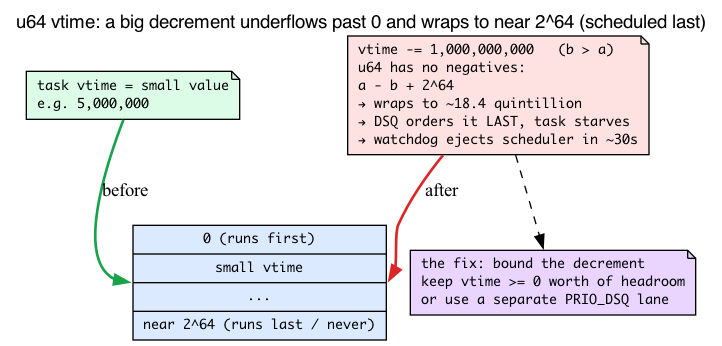
This is where signed intuition betrays you. dsq_vtime is a u64 (include/linux/sched/ext.h:231 — u64 dsq_vtime;), so there is no such thing as a “negative” vtime. Subtracting more than the task has accumulated doesn’t make the value small or negative — it wraps around near 2^64, producing an enormous number. The wraparound rule, stated plainly: a -= b on a u64 where b > a gives a - b + 2^64. So a moderate decrement on a task with a small accumulated vtime underflows to a value near 2^64, which the vtime-ordered DSQ treats as “schedule this task last, basically never” — the opposite of what you wanted. Push the decrement the other way (a small vtime that keeps winning) and the priority tasks monopolize the CPU and starve everyone else. Either way the symptom is the same end state: some runnable tasks never get dispatched, and the watchdog ejects your scheduler after ~30s.
To confirm the watchdog actually fired (rather than the box just being slow), watch two things. The backgrounded scx_simple process exits on its own and prints an exit reason to its terminal. On the kernel side, run this in another terminal to catch the disable message:
sudo dmesg -w | grep sched_ext
Within ~30s of the stall you’ll see a line of the form:
sched_ext: BPF scheduler "simple" disabled (runnable task stall ...)
The exact reason text varies by kernel version (a non-stall fault shows (runtime error) instead), but the BPF scheduler "..." disabled shape is constant. If scx_simple is still running and no such line appears, the watchdog has not ejected — the box is just slow.
Bound your decrement to reasonable values, or use a separate priority queue. (See “alternative: per-cgroup DSQs” below.)
Don’t break the watchdog
Make sure even priority tasks get dispatched promptly. Don’t, e.g., refuse to enqueue them. Don’t loop in dispatch waiting for “the right” task. The watchdog catches stalls regardless of why they happened.
Per-cgroup DSQ — a cleaner alternative
Instead of vtime tricks, give the priority cgroup its own DSQ that you consume from first:

#define PRIO_DSQ 1ULL

/* init creates a DSQ, and scx_bpf_create_dsq is a sleepable kfunc, so the
 * callback MUST use BPF_STRUCT_OPS_SLEEPABLE — a plain BPF_STRUCT_OPS init
 * won't load. */
s32 BPF_STRUCT_OPS_SLEEPABLE(simple_init)
{
    /* This snippet REPLACES the stock simple_init, so it must still create
     * SHARED_DSQ. SHARED_DSQ (#defined as 0 in scx_simple.bpf.c) is a
     * user-created DSQ — id 0 routes through find_user_dsq, not a built-in
     * global DSQ — so inserting into it without creating it first triggers a
     * scx_bpf_error and the scheduler is ejected on the first non-priority
     * enqueue. Create both. */
    s32 ret = scx_bpf_create_dsq(SHARED_DSQ, -1);
    if (ret)
        return ret;
    return scx_bpf_create_dsq(PRIO_DSQ, -1);
}

void BPF_STRUCT_OPS(simple_enqueue, struct task_struct *p, u64 enq_flags)
{
    u64 vtime = p->scx.dsq_vtime;
    bool priority = false;

    if (priority_cgroup_id) {
        struct cgroup *owned = scx_bpf_task_cgroup(p);
        if (owned) {
            int lvl;
            bpf_for(lvl, 0, owned->level + 1) {
                struct cgroup *anc = bpf_cgroup_ancestor(owned, lvl);
                if (!anc)
                    continue;
                if (anc->kn->id == priority_cgroup_id)
                    priority = true;
                bpf_cgroup_release(anc);
                if (priority)
                    break;
            }
            bpf_cgroup_release(owned);
        }
    }

    if (priority)
        scx_bpf_dsq_insert(p, PRIO_DSQ, SCX_SLICE_DFL, enq_flags);
    else
        scx_bpf_dsq_insert_vtime(p, SHARED_DSQ, SCX_SLICE_DFL, vtime, enq_flags);
}

void BPF_STRUCT_OPS(simple_dispatch, s32 cpu, struct task_struct *prev)
{
    /* Priority queue first */
    if (scx_bpf_dsq_move_to_local(PRIO_DSQ, 0)) return;
    /* Fall back to default queue */
    scx_bpf_dsq_move_to_local(SHARED_DSQ, 0);
}
Why must simple_init be BPF_STRUCT_OPS_SLEEPABLE and not plain BPF_STRUCT_OPS? Recall from Day 22 that struct_ops sleepable-ness is per-callback, and sched_ext exposes a sleepable subset: a callback declared BPF_STRUCT_OPS_SLEEPABLE may call kfuncs marked KF_SLEEPABLE; a non-sleepable callback may not, and the verifier rejects the load. scx_bpf_create_dsq is such a kfunc — kernel/sched/ext.c:8815 registers it BTF_ID_FLAGS(func, scx_bpf_create_dsq, KF_IMPLICIT_ARGS | KF_SLEEPABLE). So the “must be sleepable” claim is verifiable, not folklore — and the stock simple_init is already BPF_STRUCT_OPS_SLEEPABLE(simple_init) (scx_simple.bpf.c:134) for exactly this reason.
This is more deterministic than vtime tricks. Closer to how production schedulers work — strict priority lanes plus a default lane.
What to read in the kernel
-
kernel/sched/ext.c— searchscx_bpf_dsq_insertandscx_bpf_dsq_move_to_localto see how DSQ ops bind to internals. The functions are kfuncs registered forBPF_PROG_TYPE_STRUCT_OPSwith sched_ext-specific properties. -
kernel/sched/ext.c— searchscx_bpf_task_cgroup. The kfunc that returns a task’s cgroup pointer. -
tools/sched_ext/scx_central.bpf.c— production-grade example with multi-DSQ. Read after today’s exercise. -
tools/sched_ext/scx_flatcg.bpf.c— cgroup-aware scheduler. Read this if you’re interested in how production sched_ext schedulers handle cgroups at scale; note the samebpf_for(level, 0, cgrp->level + 1)ancestor idiom at line 207 andcgrp->kn->idused as a DSQ key at line 391. -
include/linux/cgroup-defs.h—struct cgroupdefinition. Note that there is noparentfield; the parent iscgrp->self.parent(acgroup_subsys_state *). The fields you commonly deref from BPF arecgrp->kn->id(the full 64-bit kernfs id) andcgrp->level. -
include/linux/kernfs.h— theu64 idfield (line 226) and thekernfs_id_ino()/kernfs_id_gen()helpers (lines 347/356). Theirsizeof(ino_t) >= sizeof(u64)branch is whyst_inoequals the id on 64-bit Linux but only carries the low 32 bits on a 32-bit kernel. -
Documentation/scheduler/sched-ext.rst— particularly the section on cgroup integration.
Bullet Points
- Modifying a sched_ext example is the fastest way to learn the API in depth.
- A cgroup v2 is a node in the single unified tree at
/sys/fs/cgroup;mkdirmakes a child, writing a PID tocgroup.procsmoves a task.struct cgroupcarriesint level(root = 0) and anancestors[]array indexed by level, so “find my ancestor at level N” is an O(1) array lookup. scx_bpf_task_cgroup(p)returns an acquired cgroup reference; walk ancestors withbpf_cgroup_ancestor(cgrp, level)(eachKF_ACQUIRE | KF_RET_NULL, so null-check then release every ref withbpf_cgroup_release()).struct cgrouphas noparentfield — the parent link iscgrp->self.parent, acgroup_subsys_state *— so don’t hand-roll acg->parentwalk; drivebpf_cgroup_ancestorwithbpf_for(lvl, 0, owned->level + 1).- Match on the full 64-bit
cgrp->kn->id— on 64-bit-ino_tLinux (x86-64, arm64) it equalsst_ino, sostatwould work; on a 32-bit-ino_tkernel the id packs(generation << 32) | inodeandst_inodrops the generation. Read it withname_to_handle_at()for a portable result that’s the full id on both. - A
const volatileglobal lives in.rodataas a frozen one-entry map: settable viaskel->rodata->...only between open and load, then read-only. The verifier treats it as a known constant and dead-code-eliminates theif (priority_cgroup_id)branch when it’s0— which is why an unset/wrong id silently compiles the feature out, and why the fail-loud guard matters. - Vtime is a
u64(p->scx.dsq_vtime): lower runs sooner, but a big decrement underflows near 2^64, not “negative” — either way runnable tasks stall and the watchdog ejects. - An init callback that calls a sleepable kfunc like
scx_bpf_create_dsq(registeredKF_SLEEPABLE) must beBPF_STRUCT_OPS_SLEEPABLE, not plainBPF_STRUCT_OPS. - Per-cgroup DSQs are cleaner than vtime tricks: separate priority lane consumed first.
- The watchdog catches mistakes — develop with confidence. Test under realistic load (
stress-ng+ benchmarks), not just synthetic timings.
Check question
If your priority cgroup gets too much CPU (starves other tasks for >30s), what happens?
Click to reveal answer
Answer: The watchdog ejects your scheduler. Other tasks have been runnable but undispatched (because you kept favoring priority tasks). The 30-second watchdog detects this and reverts to CFS. Fairness is restored automatically; the priority logic is gone until you reload.
The watchdog enforces a minimum service guarantee: no matter how clever your prioritization policy, every runnable task on the system must be dispatched within 30 seconds. If your policy can’t meet that, your scheduler is rejected.
This is good. It means you can experiment aggressively — try aggressive prioritization, see the watchdog kick in, refine. The recovery loop is short. In production schedulers (scx_layered, scx_lavd), aging logic explicitly bounds how long any task can wait, ensuring the watchdog never fires; that aging code is what distinguishes a “tested example” from a production scheduler.
Tomorrow
Day 27: read scx_central — production-grade BPF scheduler with central-dispatch architecture.