Day 27 — scx_central: read a real BPF scheduler
Today’s mission: read
scx_central.bpf.c— a more sophisticated sched_ext scheduler with central-dispatch architecture. Learn the cross-CPU machinery a real scheduler is built on: what an IPI actually is and the three flavors ofscx_bpf_kick_cpu, BPF queue maps, BPF timers and tickless preemption, how a DSQ id encodes a target CPU, why per-CPU kthreads jump the queue, and the dispatch-buffer batching limit. Understand the patterns experienced sched_ext authors use. Total time: ~110 minutes. Reading-heavy, not coding-heavy.
Why read this one
scx_simple (Days 25–26) is illustrative but trivial. It dispatches everything to one shared queue with vtime ordering — a thin shell over CFS-equivalent fairness. scx_central is the next step up: realistic. It handles per-CPU dispatch queues, cross-CPU coordination, central scheduling decisions, tickless preemption, and the kinds of details you’d hit on day one of writing a real scheduler.
Reading code that someone else wrote — and understanding why they wrote it that way — is a separate skill from writing your own. Today is for that skill.
But there’s a wrinkle. The real scx_central.bpf.c leans on five mechanisms no earlier day has taught: inter-processor interrupts, BPF queue maps, BPF timers, the SCX_DSQ_LOCAL_ON | cpu id trick, and a forward-progress hack for kernel threads. If you opened the file cold you’d hit twenty lines you have no framework for. So today is structured as background first, then the file. We teach each mechanism with intuition, then point at the exact line in the source where it earns its keep.
DSQ patterns: three architectures
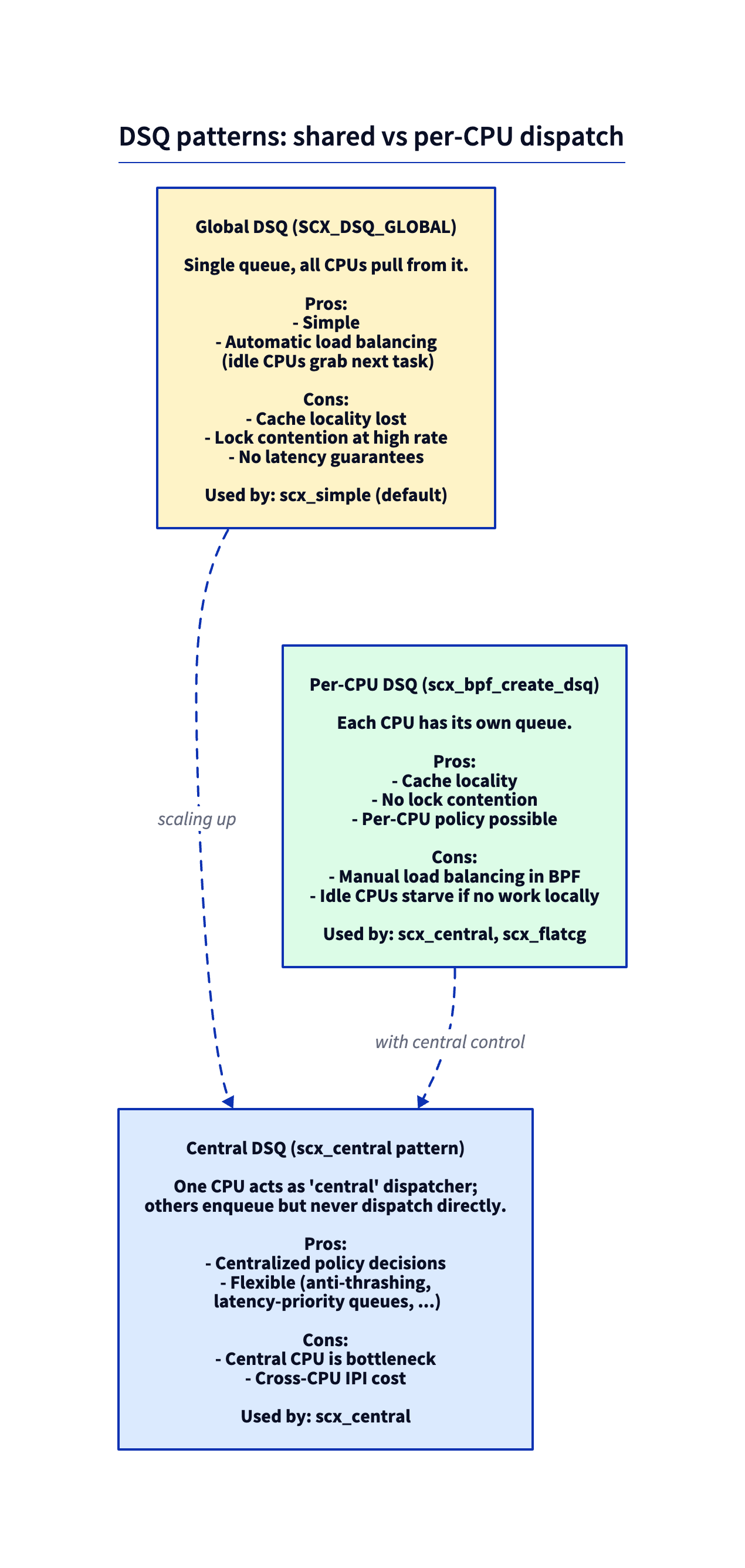
Three architectures show up across the in-tree examples:
1. Global DSQ (scx_simple)
One queue, all CPUs pull from it. Easy to write. Suffers from cache locality (any task can run on any CPU) and lock contention at scale. Fine for ~few-CPU systems or low-rate scheduling. This is exactly what you read in scx_simple on Day 25 — everything goes into SHARED_DSQ, every CPU’s dispatch pulls from it.
2. Per-CPU DSQs
Each CPU has its own queue. Tasks inserted directly to the CPU they should run on; CPUs only pull from their own queue. Excellent cache locality. Cross-CPU coordination requires explicit logic — when one CPU’s queue is empty and another’s is full, the empty one steals work. This is what CFS does in C with elaborate load-balancing logic.
3. Central DSQ (scx_central)
One CPU is designated central. Other CPUs only consume from per-CPU DSQs. The central CPU runs the dispatch logic for everyone — handles enqueue, decides which CPU each task should go to, IPI-kicks the destination CPU when work arrives.
This sounds like a bottleneck — and it is — but the central architecture trades throughput for simplicity. All scheduling decisions live in one place; no cross-CPU coordination logic; the central CPU is just a single-threaded decision-maker. For research workloads or specialized scheduling (anti-thrashing, latency-priority queues, gang scheduling), this is often the easiest path to a correct scheduler.
That “IPI-kicks the destination CPU” phrase is doing a lot of work in that paragraph, and nothing so far has explained it. The whole central design is built on who kicks whom, with which flag. So that’s where we start.
Background 1 — IPIs and the three flavors of kicking
What an IPI is
Here is a fact that’s easy to forget because most code never confronts it: on a multi-core box, CPU A cannot directly run code on CPU B. A CPU only runs the instruction stream in front of it. If CPU 0 decides “CPU 5 should stop what it’s doing and reschedule,” CPU 0 has no way to reach into CPU 5 and make that happen by writing a variable.
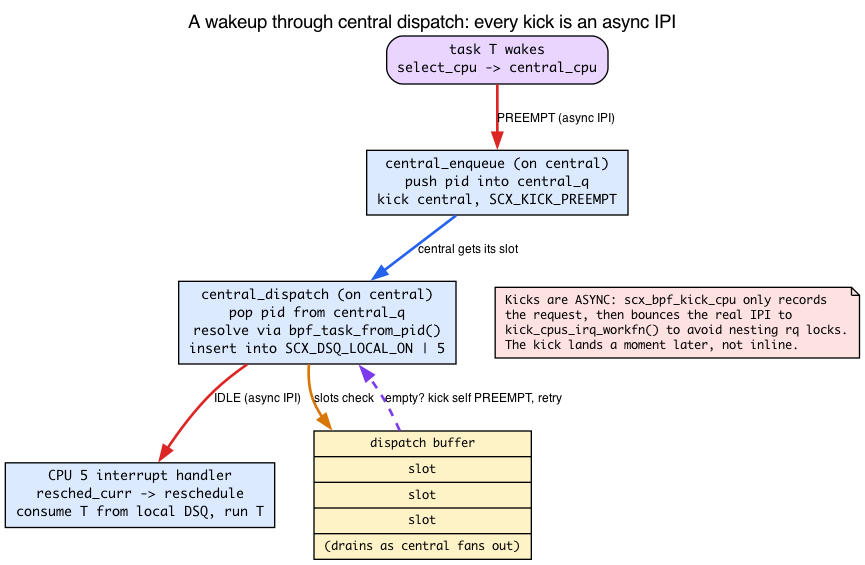
The hardware mechanism that does let one CPU poke another is an IPI — inter-processor interrupt. CPU 0 writes to the interrupt controller saying “raise an interrupt on CPU 5.” CPU 5’s hardware traps into the kernel’s interrupt handler, and that handler, running on CPU 5, does the work — in our case, marks the current task as needing reschedule so CPU 5 picks a new task to run. An IPI is the cross-CPU coordination primitive the entire central design leans on. Every time this chapter says “kick a CPU,” it means “send that CPU an IPI so it re-enters the scheduler.”
scx_bpf_kick_cpu — and why it’s asynchronous
The kfunc your scheduler calls is scx_bpf_kick_cpu(cpu, flags). The signature in v7.1 is at kernel/sched/ext.c:8945:
/* kernel/sched/ext.c:8945 */
__bpf_kfunc void scx_bpf_kick_cpu(s32 cpu, u64 flags, const struct bpf_prog_aux *aux)
(The aux is a hidden implicit argument the kernel injects; from BPF you just call scx_bpf_kick_cpu(cpu, flags).)
Here’s the subtlety that explains a lot of the file’s shape: the kick does not happen synchronously inside the kfunc. You’re calling this from inside enqueue or dispatch, which already hold the runqueue lock for the current CPU. Sending an IPI and immediately processing it would risk nesting runqueue locks and deadlocking. So the kfunc just records the request and defers the work to a local irq_work (it queues kick_cpus_irq_workfn on the caller’s CPU). The comment is explicit at kernel/sched/ext.c:8902:
/* kernel/sched/ext.c:8902 */
/* Actual kicking is bounced to kick_cpus_irq_workfn() to avoid nesting
 * rq locks ... */
The deferred handler kick_cpus_irq_workfn (kernel/sched/ext.c:7906) then walks the pending CPUs and calls resched_curr on each target via kick_one_cpu() / kick_one_cpu_if_idle() — that’s what sends the actual cross-CPU reschedule IPI, the function that marks “you need to reschedule.” So the model is: you ask; the kick lands a moment later, asynchronously. Keep that in mind every time you see a scx_bpf_kick_cpu call — it’s a request posted to a queue, not an instant context switch.
The three flags — they are different policies
flags is not a yes/no. The three SCX_KICK_* bits encode genuinely different policies. Their definitions and the kernel’s own comments are in kernel/sched/ext_internal.h:
/* kernel/sched/ext_internal.h:1201 */
SCX_KICK_IDLE     = 1LLU << 0,   /* nudge only if the CPU is idle / going idle; noop otherwise */
/* kernel/sched/ext_internal.h:1209 */
SCX_KICK_PREEMPT  = 1LLU << 1,   /* clear the running task's slice to 0 so dispatch runs NOW */
/* kernel/sched/ext_internal.h:1217 */
SCX_KICK_WAIT     = 1LLU << 2,   /* block until the target's current SCX task switches out */
SCX_KICK_IDLE— only wake the CPU if it’s idle (or about to go idle). If the target is already going to reschedule on its own, this is a no-op. Use it when you’ve given a CPU work and want it to notice, but you don’t want to disturb it if it’s already busy doing useful things.SCX_KICK_PREEMPT— force the issue. The kernel clears the currently-running SCX task’s->scx.sliceto zero so the task “expires” immediately and the dispatch path runs now. Use it when you need dispatch to happen promptly — e.g. fresh work just arrived and the central CPU must process it.SCX_KICK_WAIT— the call returns only after the target’s current SCX task switches out. This is for gang/core scheduling, where you need to know a sibling actually vacated.scx_centraldoesn’t use it; you should know it exists.
PREEMPT/WAIT and IDLE are mutually exclusive. ORing SCX_KICK_IDLE with either is a usage error, and the kernel raises scx_error for it:
/* kernel/sched/ext.c:8909 */
if (unlikely(flags & (SCX_KICK_PREEMPT | SCX_KICK_WAIT)))
    scx_error(sch, "PREEMPT/WAIT cannot be used with SCX_KICK_IDLE");
And a flag value the older bullet list got wrong: flags == 0 is not “kick only if idle.” Zero means an unconditional reschedule kick with no special policy — neither the idle-only restriction nor the slice-clearing preemption. scx_central uses plain 0 exactly once, in init (tools/sched_ext/scx_central.bpf.c:355), purely to bootstrap the central CPU into its very first dispatch:
/* scx_central.bpf.c:355, in central_init */
scx_bpf_kick_cpu(central_cpu, 0);
Now you can read every kick site in the file and know why each picked the flag it did:
| Call site | Flag | Why |
|---|---|---|
central_enqueue (:131) | SCX_KICK_PREEMPT | new task queued — make central run dispatch promptly |
dispatch_to_cpu (:174) | SCX_KICK_IDLE | just fed a remote CPU work — wake it only if idle, don’t disturb a busy one |
central_dispatch self-retry (:251) | SCX_KICK_PREEMPT | dispatch buffer drained mid-fan-out — kick self to retry with a fresh buffer (see Background 6) |
non-central dispatch branch (:273) | SCX_KICK_PREEMPT | a CPU ran dry — force central to refill it now |
central_timerfn (:328) | SCX_KICK_PREEMPT | a CPU outran its slice — preempt it |
central_init (:355) | 0 | one-time bootstrap kick to start the central loop |
Background 2 — BPF queue maps
The hand-off from enqueue to dispatch in scx_central doesn’t go through a DSQ. It goes through a BPF queue map called central_q. No earlier day taught queue maps — Days 12–13 covered ringbuf and arrays, Day 21 covered kptrs — so here it is.
A BPF_MAP_TYPE_QUEUE (include/uapi/linux/bpf.h:1036) is a value-only FIFO. Unlike the hash and array maps you already know, it has no keys. You don’t look anything up; you push a value onto the back and pop the oldest off the front:
bpf_map_push_elem(&q, &val, flags)— append a value.bpf_map_pop_elem(&q, &val)— remove and return the oldest value.bpf_map_peek_elem(&q, &val)— look at the oldest without removing it.
(The uapi describes the QUEUE/STACK push/pop/peek semantics at include/uapi/linux/bpf.h:589, :598, :605. BPF_MAP_TYPE_STACK at :1037 is the LIFO sibling — same API, pops newest instead of oldest.)
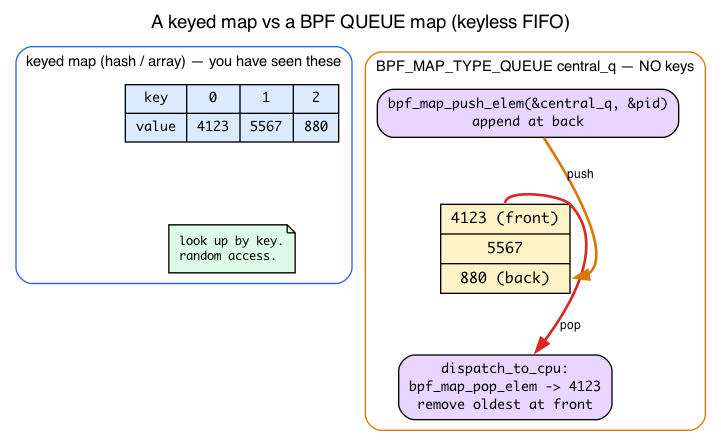
In scx_central the queue is declared at the top of the file holding raw s32 pids, 4096 deep:
/* scx_central.bpf.c:70 */
struct {
    __uint(type, BPF_MAP_TYPE_QUEUE);
    __uint(max_entries, 4096);
    __type(value, s32);
} central_q SEC(".maps");
Two design choices worth noticing:
- It stores pids, not task pointers. Holding a refcounted
task_structacross the enqueue→dispatch boundary would mean acquiring and releasing a reference (the kptr dance from Day 21). Storing a bares32pid sidesteps that entirely; the pid is resolved back to a task only at pop time, viabpf_task_from_pid()(:145). - Why a queue map at all, instead of a DSQ? The file’s top comment is refreshingly honest (
scx_central.bpf.c:3): bouncing through one global BPF queue “isn’t the most straightforward… It’d be easier to bounce through per-CPU BPF queues. The current design is chosen to maximally utilize and verify various SCX mechanisms.” In other words,scx_centralis partly a test of SCX features. A more practical scheduler would do something simpler.
The push and pop are the literal backbone of the hand-off:
/* scx_central.bpf.c:122, in central_enqueue */
if (bpf_map_push_elem(¢ral_q, &pid, 0)) {
__sync_fetch_and_add(&nr_overflows, 1);
scx_bpf_dsq_insert(p, FALLBACK_DSQ_ID, SCX_SLICE_INF, enq_flags);
return;
}
/* scx_central.bpf.c:140, in dispatch_to_cpu */
if (bpf_map_pop_elem(¢ral_q, &pid))
break;
Always check the return of bpf_map_push_elem. A push can fail if the queue is full (4096 entries deep). When it does, scx_central falls back to the user DSQ FALLBACK_DSQ_ID and bumps nr_overflows. That fallback DSQ is only the overflow path — used here when the push fails (:122) and in one other spot when a task can’t run on its target CPU (:157, a cpumask mismatch). The normal path is always queue→pop.
Background 3 — BPF timers and tickless preemption
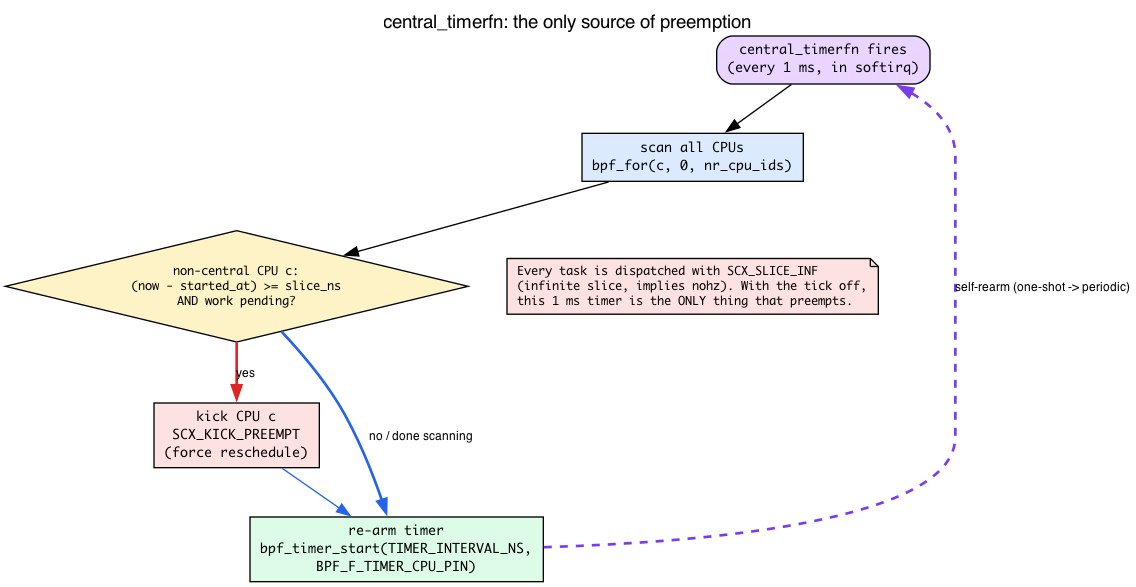
Here’s a puzzle. scx_central dispatches every task with an infinite time slice — SCX_SLICE_INF, which is literally U64_MAX:
/* include/linux/sched/ext.h:32 */
SCX_SLICE_INF = U64_MAX,   /* infinite, implies nohz */
A task with an infinite slice never expires on its own. So what ever preempts it? In a normal scheduler, a periodic scheduler tick fires HZ times per second on every CPU and forces the running task to yield. But scx_central is built for tickless operation: on CONFIG_NO_HZ_FULL kernels, a CPU running a single task can stop its periodic tick entirely to cut overhead (you can watch the tick interrupts dwindle in /proc/interrupts). The file’s top comment spells this out at scx_central.bpf.c:16.
If the tick is off and slices are infinite, preemption has to come from somewhere else. That somewhere is a BPF timer.
What a BPF timer is
A bpf_timer is a kernel hrtimer you arm from BPF code. The lifecycle is a three-step dance, documented in kernel/bpf/helpers.c:1148:
/* kernel/bpf/helpers.c, comment block ~1143 */
/* bpf_timer_init() allocates 'struct bpf_hrtimer', inits hrtimer ...
 * bpf_timer_set_callback() ... assign bpf callback_fn.
 * bpf_timer_start() arms the timer. */
So in code: bpf_timer_init(&t, &map, CLOCK_MONOTONIC), then bpf_timer_set_callback(&t, fn), then bpf_timer_start(&t, interval_ns, flags). The callback fires later, in softirq/timer context — not inline at the call site. One hard rule: the struct bpf_timer must live inside a map value. The uapi struct is just a placeholder; the kernel allocates the real bpf_hrtimer behind it during bpf_timer_init, and the map owns it. That’s why scx_central wraps its timer in a one-element array map:
/* scx_central.bpf.c:80 */
struct central_timer {
    struct bpf_timer timer;
};
struct {
    __uint(type, BPF_MAP_TYPE_ARRAY);
    __uint(max_entries, 1);
    __type(key, u32);
    __type(value, struct central_timer);
} central_timer SEC(".maps");
init does the init + set_callback (:352–:353), and the timer is armed via start_central_timer(). The interval is TIMER_INTERVAL_NS = 1 * MS_TO_NS — 1 ms.
The self-rearming trick
bpf_timer_start arms a one-shot timer. To get a periodic 1 ms tick, the callback re-arms itself at its own tail:
/* scx_central.bpf.c:331, last lines of central_timerfn */
bpf_timer_start(timer, TIMER_INTERVAL_NS, BPF_F_TIMER_CPU_PIN);
__sync_fetch_and_add(&nr_timers, 1);
Every 1 ms, central_timerfn (:293) wakes up, scans all CPUs, and for each non-central CPU checks: has the running task outrun its slice_ns, and is there work pending? If so, it kicks that CPU with SCX_KICK_PREEMPT (:328) to force a reschedule. The timer is the only source of preemption in this scheduler — without it, the first task to grab each CPU would run forever.
A graceful-degradation pattern worth stealing
The timer is armed with BPF_F_TIMER_CPU_PIN (include/uapi/linux/bpf.h:7665), which pins it to the calling CPU so it stays on central:
/* scx_central.bpf.c:198, in start_central_timer */
ret = bpf_timer_start(timer, TIMER_INTERVAL_NS, BPF_F_TIMER_CPU_PIN);
But BPF_F_TIMER_CPU_PIN is new (≥6.7). On an older kernel, bpf_timer_start returns -EINVAL. Rather than fail, scx_central retries unpinned and remembers it did:
/* scx_central.bpf.c:206 */
if (ret == -EINVAL) {
    timer_pinned = false;
    ret = bpf_timer_start(timer, TIMER_INTERVAL_NS, 0);
}
And because an unpinned timer might run on the wrong CPU, central_timerfn defensively checks at runtime (:300) and errors out if it finds itself off-central. This is a CO-RE-flavored “use the new feature if present, fall back cleanly if not” pattern — the comment even laments that the unnamed enum prevents using bpf_core_enum_value_exists() here.
Background 4 — encoding a target CPU into a DSQ id
On Day 25 you learned that DSQ ids name queues: SCX_DSQ_GLOBAL, SCX_DSQ_LOCAL, and custom numeric DSQs you create with scx_bpf_create_dsq. What you didn’t learn is that the id space is bit-tagged, and you can OR a CPU number into a built-in id to target a remote CPU’s queue. That trick is the heart of “central decides where each task runs.”
The id is a 64-bit value. Bit 63 is a flag marking the id as built-in rather than a user-created numeric DSQ:
/* include/linux/sched/ext.h:54 */
SCX_DSQ_FLAG_BUILTIN  = 1LLU << 63,
SCX_DSQ_FLAG_LOCAL_ON = 1LLU << 62,
/* :58 */ SCX_DSQ_GLOBAL   = SCX_DSQ_FLAG_BUILTIN | 1,
/* :59 */ SCX_DSQ_LOCAL    = SCX_DSQ_FLAG_BUILTIN | 2,
/* :61 */ SCX_DSQ_LOCAL_ON = SCX_DSQ_FLAG_BUILTIN | SCX_DSQ_FLAG_LOCAL_ON,
So:
- User DSQs (like
FALLBACK_DSQ_ID = 0here, orSHARED_DSQfrom Day 25) are plain small numbers with the high bit clear. SCX_DSQ_LOCALmeans “the local DSQ of whichever CPU I’m currently on.” That’s allscx_simpleever used.SCX_DSQ_LOCAL_ONis the parameterized version: it sets bit 62, and you OR in the target CPU number in the low bits.SCX_DSQ_LOCAL_ON | 5means “CPU 5’s local DSQ” — a specific, possibly remote CPU.
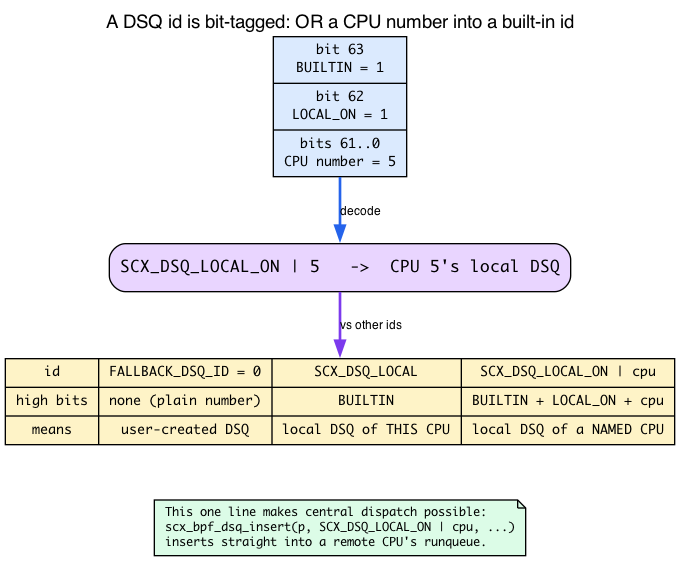
This is the one line that makes central dispatch possible. The central CPU inserts a task straight into a different CPU’s local runqueue and then kicks it:
/* scx_central.bpf.c:171, in dispatch_to_cpu */
scx_bpf_dsq_insert(p, SCX_DSQ_LOCAL_ON | cpu, SCX_SLICE_INF, 0);
Contrast with Day 25/26’s scx_simple, which only ever moved tasks to the current CPU’s local DSQ via scx_bpf_dsq_move_to_local. A per-CPU scheduler never needs LOCAL_ON | cpu because it only ever touches its own queue. Central needs it because it makes decisions for every CPU from one place. (One exception: per-CPU kthreads, which central inserts into SCX_DSQ_LOCAL — the current CPU’s queue — at :117; more on that next.)
Background 5 — per-CPU kthreads and the forward-progress trap
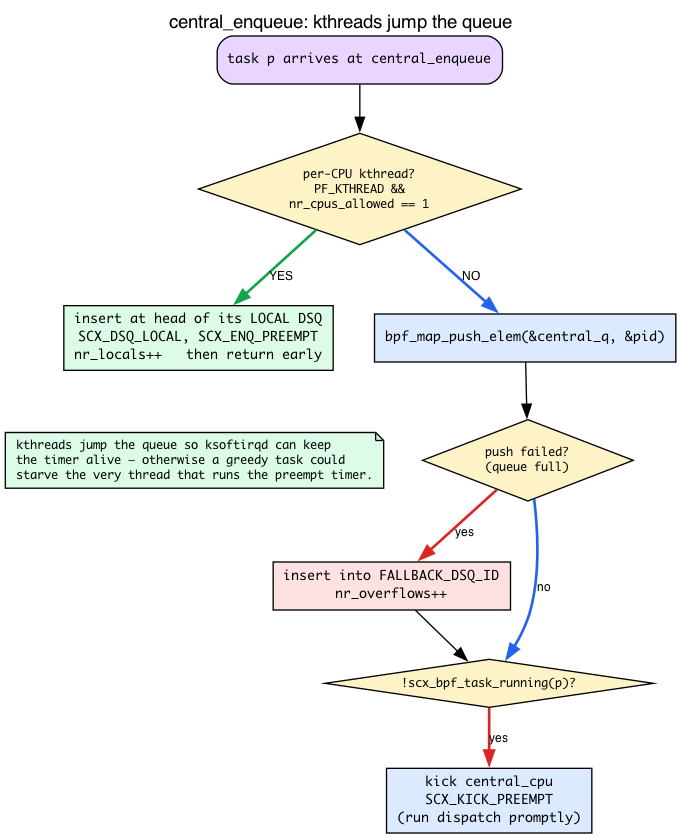
This is the single biggest thing the simplified pseudocode below hides, and it’s a correctness requirement, not an optimization. When you open the real central_enqueue you’ll find it does not push per-CPU kernel threads through central_q at all. Understanding why requires two new concepts.
What a kthread is. A kthread is a kernel thread — a task with no userspace address space, marked by PF_KTHREAD in p->flags:
/* include/linux/sched.h:1779 */
#define PF_KTHREAD  0x00200000  /* I am a kernel thread */
Some kthreads are per-CPU: pinned to exactly one CPU (p->nr_cpus_allowed == 1) to do that CPU’s housekeeping. ksoftirqd/N is the classic example — it processes CPU N’s softirq backlog.
The forward-progress trap, unique to central dispatch. Remember from Background 3 that the only thing preempting tasks is the BPF timer. And BPF timers fire in softirq context — which may run from ksoftirqd. Now picture the deadlock: a greedy user task is hogging a CPU. The timer that would preempt it needs ksoftirqd to run. But ksoftirqd is a normal task too — if the central scheduler queued it behind that same greedy user task, ksoftirqd can’t run, so the timer can’t fire, so nothing preempts the user task, so ksoftirqd never runs. The scheduler has wedged itself.
The fix: per-CPU kthreads skip the central queue entirely and go straight to the head of their own CPU’s local DSQ with an enqueue-time preempt flag, guaranteeing they always outrank user threads:
/* scx_central.bpf.c:115 */
if ((p->flags & PF_KTHREAD) && p->nr_cpus_allowed == 1) {
    __sync_fetch_and_add(&nr_locals, 1);
    scx_bpf_dsq_insert(p, SCX_DSQ_LOCAL, SCX_SLICE_INF,
                       enq_flags | SCX_ENQ_PREEMPT);
    return;
}
SCX_ENQ_PREEMPT is an enqueue flag, not a kick flag. It rides along with a DSQ insert and means “preempt whatever is running on that local DSQ’s CPU to run this task.” Don’t confuse it with the SCX_KICK_* flags from Background 1 — those target a CPU via IPI; this one is a property of the insertion itself:
/* kernel/sched/ext_internal.h:1107 */
SCX_ENQ_PREEMPT = 1LLU << 32,
There are no Dumb Questions
Q: If the central CPU is a bottleneck, why not just run
dispatchon every CPU like a per-CPU scheduler? A: You can — that’s exactly whatscx_layered/scx_lavddo, and what “a more practical implementation” means in the file’s own top comment. The price is cross-CPU coordination logic: work stealing, per-CPU locking, deciding who refills whom. Central trades throughput for having all policy in one single-threaded place, which is far easier to get correct. It’s the right call for research and specialized scheduling, not for max scheduling rate.Q: Why store pids in
central_qinstead of task pointers? A: Atask_struct *is refcounted — holding one across the enqueue→dispatch boundary means the kptr acquire/release dance from Day 21. A bares32pid sidesteps refcounting entirely; the pid is resolved back to a task only at pop time viabpf_task_from_pid()(:145).
One more vtable flag this explains: SCX_OPS_ENQ_LAST. By default the kernel can skip calling your enqueue for the last runnable task on a CPU — an optimization, since there’s nothing to choose between. But central offloads all decisions, so “being the last task” means nothing special; it still must go through central’s logic. Setting SCX_OPS_ENQ_LAST (kernel/sched/ext_internal.h:130) forces enqueue even for that last task. The comment in the vtable explains it at scx_central.bpf.c:366.
Background 6 — the dispatch buffer and scx_bpf_dispatch_nr_slots()
The last mechanism. When you call scx_bpf_dsq_insert from inside a dispatch() callback, it does not commit immediately. Inserts are staged in a bounded per-CPU dispatch buffer and flushed by the core afterward. scx_bpf_dispatch_nr_slots() (kernel/sched/ext.c:8448) returns how many staged inserts you have left before that buffer is full.
Overflowing it is fatal — the core raises an error:
/* kernel/sched/ext.c:8139 */
scx_error(sch, "dispatch buffer overflow");
For most schedulers this never matters: they dispatch one or two tasks per call. But scx_central dispatches for every CPU in one pass through its bpf_for loop, so it can easily exhaust the buffer mid-fan-out. That’s why the loop checks slots and bails:
/* scx_central.bpf.c:230, in central_dispatch */
if (!scx_bpf_dispatch_nr_slots())
    break;
And it’s why, after the fan-out, central may have skipped some CPUs and not yet dispatched for itself. The retry pattern is “I couldn’t finish; schedule myself to try again with a fresh buffer” — which ties straight back to Background 1:
/* scx_central.bpf.c:249 */
if (!scx_bpf_dispatch_nr_slots()) {
    __sync_fetch_and_add(&nr_retries, 1);
    scx_bpf_kick_cpu(central_cpu, SCX_KICK_PREEMPT);   /* kick self, retry */
    return;
}
The dispatch_to_cpu mismatch path checks slots too (:165), for the same reason: it just pushed a task onto the fallback DSQ without satisfying the target CPU, so it must stop before the next insert fails.
Reading scx_central.bpf.c
Now you have every mechanism the file uses. Open tools/sched_ext/scx_central.bpf.c — ~380 lines — and walk through it in this order: globals → init → select_cpu → enqueue → dispatch → vtable.
Repo lab: build and run the exact upstream scheduler
Like Day 25, the lab runs the unmodified in-tree scx_central. make -C ebpf/labs day27 builds it from the locked Linux v7.1 tree with the kernel’s own
tools/sched_ext Makefile, emitting artifacts under .output/:
Day 27 build wrapper: build the EXACT upstream scx_central from the locked
Linux v7.1 source tree, using the kernel’s own tools/sched_ext Makefile.
scx_central is read, not modified, on Day 27, so this builds the unmodified
in-tree example. O= redirects every artifact into .output/day27/build so the
pinned kernel source tree is never written to.
set -euo pipefail
HERE=$(cd – “$(dirname – “${BASH_SOURCE[0]}”)“ && pwd) ROOT=$(cd – “$HERE/..” && pwd)
SRC=$(“$ROOT/scripts/linux-source.sh” path) # verified locked v7.1 tree OUT=“$ROOT/.output/day27” VMLINUX_H=$(“$ROOT/scripts/kernel-btf.sh” sched-ext) BPFTOOL=$(“$ROOT/scripts/linux-bpftool.sh”)
mkdir -p “$OUT”
make -C “$SRC/tools/sched_ext” O=“$OUT”
BPFTOOL=“$BPFTOOL” VMLINUX_BTF=“$VMLINUX_H” VMLINUX_H=“$VMLINUX_H”
scx_central
BIN=“$OUT/build/bin/scx_central” test -x “$BIN” printf ‘day27: built upstream %s\n’ “$BIN”
run.sh loads it for a bounded interval on a disposable sched_ext-capable VM,
then ejects it — the central-dispatch scheduler drives every CPU from one, so it
is strictly opt-in:
Day 27 opt-in runner: load the exact upstream scx_central, let its central
CPU dispatch the whole machine for a bounded interval, then eject it cleanly.
scx_central makes ALL scheduling decisions from one CPU, so this is
deliberate: it refuses to run without EBPF_LABS_ALLOW_PRIVILEGED=1 and root,
bounds the run with a timeout, and a trap SIGINTs the scheduler on any exit so
CFS is restored. Run it only on a disposable, sched_ext-capable VM.
set -euo pipefail
HERE=$(cd – “$(dirname – “${BASH_SOURCE[0]}”)“ && pwd) ROOT=$(cd – “$HERE/..” && pwd) SCHED=“$ROOT/.output/day27/build/bin/scx_central” DURATION=${DURATION:-10} SCHED_PID=
fail() { printf ‘day27 run: %s\n’ “$*” >&2; exit 1; }
cleanup() { local status=$? trap - EXIT INT TERM if [[ -n $SCHED_PID ]] && kill -0 “$SCHED_PID” 2>/dev/null; then kill -INT “$SCHED_PID” 2>/dev/null || true wait “$SCHED_PID” 2>/dev/null || true fi exit “$status” } trap cleanup EXIT INT TERM
[[ ${EBPF_LABS_ALLOW_PRIVILEGED:-0} == 1 ]] || fail ‘set EBPF_LABS_ALLOW_PRIVILEGED=1 to acknowledge replacing the live scheduler’ [[ ${EBPF_LABS_ALLOW_SCHED_EXT:-0} == 1 ]] || fail ‘set EBPF_LABS_ALLOW_SCHED_EXT=1 to acknowledge replacing the live scheduler’ (( EUID == 0 )) || fail ‘run with sudo after setting both acknowledgement variables’ [[ -x $SCHED ]] || fail “missing $SCHED; run scripts/build-day.sh day27 first” [[ -r /sys/kernel/sched_ext/state ]] || fail ‘kernel has no sched_ext support’
“$SCHED” & SCHED_PID=$! sleep 1 kill -0 “$SCHED_PID” 2>/dev/null || fail ‘scheduler exited early (see its output above)’
printf ‘day27 run: scx_central active for %ss; state=%s\n’
“$DURATION” “$(cat /sys/kernel/sched_ext/state)”
sleep “$DURATION”
printf ‘day27 run: stopping; sched_ext state should return to disabled\n’
Heads-up: the code blocks below are simplified pseudocode, not literal quotes from the file. They capture the central-dispatch shape so you can follow the logic; the real
scx_central.bpf.cuses acentral_qqueue map of pids, per-CPU kthread bypass,SCX_DSQ_LOCAL_ON | cputargeting, slot checks, and abpf_timer— all taught in the Background sections above, and each### Nwalkthrough cross-links the relevant one. Read the simplified versions for intuition, then read the real file for the details.
1. Globals
Look near the top:
const volatile s32 central_cpu;        /* which CPU is "central" — set from userspace */
const volatile u32 nr_cpu_ids = 1;     /* number of CPUs; !0 for veristat, set during init */
const volatile u64 slice_ns;           /* per-task slice the timer enforces */
central_cpu is set from userspace at attach time. Alongside these you’ll see the central_q queue map (Background 2), the central_timer array map (Background 3), and a pile of u64 counters (nr_total, nr_queued, nr_overflows, nr_timers, nr_retries, …) that the userspace driver prints as stats.
2. The init callback
s32 BPF_STRUCT_OPS_SLEEPABLE(central_init)
{
scx_bpf_create_dsq(FALLBACK_DSQ_ID, -1); /* the overflow DSQ */
bpf_timer_init(timer, ¢ral_timer, CLOCK_MONOTONIC);
bpf_timer_set_callback(timer, central_timerfn);
scx_bpf_kick_cpu(central_cpu, 0); /* bootstrap central's first dispatch */
return 0;
}
Three jobs: create the fallback DSQ, set up (but don’t yet arm) the timer, and fire one plain flags=0 kick to bootstrap the central CPU into its first dispatch. Because scx_bpf_create_dsq is a sleepable kfunc, the callback uses BPF_STRUCT_OPS_SLEEPABLE (not plain BPF_STRUCT_OPS) — a plain version won’t load. The timer is actually armed later, in start_central_timer() on the first dispatch (Background 3).
3. The select_cpu callback
s32 BPF_STRUCT_OPS(central_select_cpu, struct task_struct *p, ...)
{
    /* Always steer to central_cpu. */
    return central_cpu;
}
When a task wakes, route it to the central CPU. This is the key inversion: in scx_simple, tasks wake on whatever CPU last ran them. In scx_central, tasks wake on the central CPU so it can do all the dispatch work. The real comment notes this is safe because select_cpu is only a hint — if p can’t run on central, the kernel picks a fallback automatically.
4. The enqueue callback
void BPF_STRUCT_OPS(central_enqueue, struct task_struct *p, u64 enq_flags)
{
/* (real file) per-CPU kthreads jump the queue — see Background 5 */
/* push the pid into the central queue; central CPU will pick it up */
bpf_map_push_elem(¢ral_q, &pid, 0); /* on failure: fallback DSQ + nr_overflows++ */
/* make sure central CPU is awake to handle this */
if (!scx_bpf_task_running(p))
scx_bpf_kick_cpu(central_cpu, SCX_KICK_PREEMPT);
}
The real central_enqueue (:103) does three things in order: the per-CPU-kthread bypass (Background 5), the bpf_map_push_elem into central_q with a fallback-DSQ overflow path (Background 2), and finally — only if p isn’t already running — a SCX_KICK_PREEMPT at central so dispatch runs promptly (Background 1). It guards the kick with !scx_bpf_task_running(p) to avoid a redundant kick when the task is already on a CPU.
5. The dispatch callback
void BPF_STRUCT_OPS(central_dispatch, s32 cpu, struct task_struct *prev)
{
    if (cpu == central_cpu) {
        start_central_timer();
        bpf_for(c, 0, nr_cpu_ids) {
            if (!scx_bpf_dispatch_nr_slots())   /* Background 6 */
                break;
            /* if CPU c asked for work, pop a pid from central_q,
             * resolve it, and insert into SCX_DSQ_LOCAL_ON | c, then
             * kick c with SCX_KICK_IDLE */
            dispatch_to_cpu(c);
        }
        /* ran out of slots? kick self with PREEMPT and retry */
        /* otherwise dispatch one task for central itself */
    } else {
        /* non-central CPU: try the fallback DSQ; if dry, set gimme=true
         * and kick central with PREEMPT to refill me */
    }
}
Only central_cpu’s call into dispatch does real work. It arms the timer on first entry (Background 3), fans out to every CPU that asked for work via dispatch_to_cpu (Background 4 + 6), retries by kicking itself if the dispatch buffer drained (Background 6 + 1), then dispatches one task for itself. A non-central CPU that runs dry just flags gimme = true and kicks central with SCX_KICK_PREEMPT (:273) to get refilled.
6. The vtable
SCX_OPS_DEFINE(central_ops,
               .flags      = SCX_OPS_ENQ_LAST,   /* Background 5 */
               .select_cpu = (void *)central_select_cpu,
               .enqueue    = (void *)central_enqueue,
               .dispatch   = (void *)central_dispatch,
               .running    = (void *)central_running,
               .stopping   = (void *)central_stopping,
               .init       = (void *)central_init,
               .exit       = (void *)central_exit,
               .name       = "central");
In-tree schedulers don’t hand-write a SEC(".struct_ops.link") struct sched_ext_ops. They use the SCX_OPS_DEFINE(...) macro (from tools/sched_ext/include/scx/compat.bpf.h), which expands to exactly that — a SEC(".struct_ops.link") struct, which creates a link FD whose lifecycle is bound to the userspace process (it closes when userspace exits). Note the real file sets .flags = SCX_OPS_ENQ_LAST (Background 5) and adds .running, .stopping, and .exit callbacks: running/stopping record per-CPU started_at timestamps (:277, :285) so the timer can tell when a task has outrun its slice; exit records the exit info for userspace.
Why central architecture works
The central CPU is a bottleneck for scheduling decisions, but not for actual task execution. Tasks run on every CPU; only the decision of where to run is centralized. For workloads where:
- The total scheduling rate is bounded (hundreds of thousands to a few million decisions per second per central CPU).
- The scheduling logic benefits from global state (the central CPU sees all decisions, can apply global policy).
- Cache locality of the running task matters more than cache locality of the scheduling.
…this trades a single CPU’s worth of overhead for simpler, more correct scheduling logic.
For workloads where the scheduling rate exceeds what one CPU can sustain, you need per-CPU dispatchers (scx_layered, scx_lavd, real production schedulers). The file’s own top comment agrees: “A more practical implementation would likely put the scheduling loop outside the central CPU’s dispatch() path and add some form of priority mechanism.”
scx_flatcg — read after this one
If you have appetite for more reading, open tools/sched_ext/scx_flatcg.bpf.c. ~950 lines. Same shape as scx_central but cgroup-aware: each cgroup gets its own DSQ; vtime is per-cgroup; dispatch picks the cgroup with the lowest vtime first.
This is closer to how a real “fair-share + isolation” scheduler looks — like CFS with cgroup awareness, but in BPF.
What to read in the kernel
-
tools/sched_ext/scx_central.bpf.c— the file we just walked through. Read end to end with the diagrams and the six Background sections as a guide. Pay special attention tocentral_enqueue(:103),dispatch_to_cpu(:134),central_dispatch(:219), andcentral_timerfn(:293). -
tools/sched_ext/scx_central.c— the userspace driver. ~125 lines. Note how it setscentral_cpubefore attach and runs a stats loop printing thenr_*counters. -
tools/sched_ext/scx_flatcg.bpf.c— the cgroup-aware scheduler. Read after central. Notice the per-cgroup vtime tracking. -
kernel/sched/ext.c— search forscx_bpf_kick_cpu(:8945). The kfunc that triggers an IPI. Read how the kick is bounced tokick_cpus_irq_workfn(:7906) and lands onresched_curr. Also readscx_bpf_dispatch_nr_slots(:8448) and the “dispatch buffer overflow” error (:8139). -
kernel/sched/ext_internal.h— theSCX_KICK_*flag definitions with their comments (:1201,:1209,:1217),SCX_OPS_ENQ_LAST(:130), andSCX_ENQ_PREEMPT(:1107). -
include/linux/sched/ext.h— the DSQ id bit-encoding (SCX_DSQ_FLAG_BUILTIN:54,SCX_DSQ_LOCAL_ON:61) andSCX_SLICE_INF(:32). -
include/scx/common.bpf.hintools/sched_ext/include/scx/— kfunc declarations. The “API” your BPF scheduler can call. -
Documentation/scheduler/sched-ext.rst— particularly the section on patterns and best practices.
Today’s experiment
You don’t write a scheduler today. You watch the one you just read.
Watch the central timer’s tick
scx_central arms a 1 ms self-rearming BPF timer. Trace its callback firing:
sudo bpftrace -e 'kfunc:bpf_timer_start { @[comm] = count(); } interval:s:5 { exit(); }'
(You’ll see timer arming activity across the system; the central scheduler’s re-arm at :331 shows up when it’s loaded.)
Watch IPIs fly
The whole architecture is built on cross-CPU kicks. Watch reschedule IPIs per CPU:
sudo cat /proc/interrupts | grep -i 'rescheduling\|Function call\|Local timer'
Run it twice a few seconds apart and diff the counts. Under a central scheduler the kicked CPUs accumulate reschedule interrupts driven from the central CPU. On a NO_HZ_FULL kernel, also note how the local timer (LOC) interrupt counts on a single-task CPU stay nearly flat — that’s tickless operation, the thing SCX_SLICE_INF enables. (If no scx scheduler is loaded the LOC line may simply read 0 on idle CPUs.)
Observe the kick flags in the source
No tool needed — just confirm the table from Background 1 against the file:
grep -n 'scx_bpf_kick_cpu' ~/code/linux/tools/sched_ext/scx_central.bpf.c
Six hits: :131 (PREEMPT), :174 (IDLE), :251 (PREEMPT, retry self), :273 (PREEMPT), :328 (PREEMPT), :355 (0). Read each in context and say out loud why it picked that flag.
Bullet Points
scx_centralshows the central-dispatch pattern: one CPU makes all scheduling decisions; others consume from per-CPU DSQs and kick central when they run dry.- An IPI (inter-processor interrupt) is how one CPU forces another into the kernel to reschedule.
scx_bpf_kick_cpu(cpu, flags)posts a kick asynchronously (bounced tokick_cpus_irq_workfnto avoid nesting rq locks).SCX_KICK_IDLE= nudge only if idle;SCX_KICK_PREEMPT= clear the slice and run dispatch now;SCX_KICK_WAIT= block until the target switches out. PREEMPT/WAIT can’t be ORed with IDLE.flags == 0is a plain unconditional reschedule kick (used once, to bootstrap central), not idle-only. - A
BPF_MAP_TYPE_QUEUEis a keyless FIFO:bpf_map_push_elem/bpf_map_pop_elem.central_qholds raw pids (not task pointers) for the enqueue→dispatch hand-off; always check the push return and fall back on overflow. - A
bpf_timerlives in a map value and is armed with init → set_callback → start; the callback runs later in softirq context and re-arms itself for a periodic tick. With every task onSCX_SLICE_INF(infinite slice, implies nohz / tickless), the 1 ms timer is the only source of preemption. - DSQ ids are bit-tagged: bit 63 marks built-in ids.
SCX_DSQ_LOCAL_ON | cpunames a specific CPU’s local DSQ, which is how central inserts into a remote CPU’s runqueue. - Per-CPU kthreads (
PF_KTHREAD && nr_cpus_allowed == 1) bypass the central queue and go to their local DSQ head withSCX_ENQ_PREEMPT— a correctness requirement soksoftirqd(which runs the timer) can’t be starved.SCX_OPS_ENQ_LASTforcesenqueueeven for the last runnable task, since central decides everything. scx_bpf_dispatch_nr_slots()bounds how manyscx_bpf_dsq_inserts you can stage per dispatch; overflowing it is fatal, so central’s fan-out checks slots and kicks itself to retry when the buffer drains.SEC(".struct_ops.link")(via theSCX_OPS_DEFINEmacro) creates link-managed scheduler instances; closes with the userspace process.- Read order: globals → init → select_cpu → enqueue → dispatch → vtable.
- scx_flatcg is the next step up: cgroup-aware fair-share with per-cgroup DSQs.
Check question
In scx_central, every task wake-up is routed to central_cpu. Why doesn’t this catastrophically increase wake-up latency?
Click to reveal answer
Answer: Because select_cpu returning central_cpu doesn’t actually run the task there — it just routes the enqueue and dispatch logic to that CPU. The task itself is dispatched (in the dispatch callback’s loop) to whichever CPU has capacity. The central CPU is a policy bottleneck, not a mechanism bottleneck.
The flow:
- Task
Twakes up.select_cpu(T)returnscentral_cpu→ kernel’s wake-up logic targets central_cpu. - Central CPU’s
enqueue(T)runs: pushes T’s pid ontocentral_q, kicks central_cpu withSCX_KICK_PREEMPT(no-op if T is already running). - Central CPU’s
dispatch()callback runs (because the kernel just gave central CPU its slot back): pops T’s pid fromcentral_q, resolves it withbpf_task_from_pid(), decides “T should run on CPU 5,” places T on CPU 5’s local DSQ viascx_bpf_dsq_insert(T, SCX_DSQ_LOCAL_ON | 5, ...), and kicks CPU 5 withSCX_KICK_IDLE. - CPU 5’s interrupt handler reschedules, CPU 5 consumes T from its local DSQ, runs T.
So T actually runs on CPU 5. The central CPU’s overhead is one trip through dispatch logic plus an IPI; T’s wake-up latency is ~microseconds, dominated by IPI delivery (which, recall, is itself bounced through an irq_work — asynchronous, not instant).
The bottleneck only matters at the rate of scheduling decisions: one CPU’s worth of decision-making caps the system somewhere in the range of hundreds of thousands to a few million scheduling events per second. Past that, you need per-CPU dispatchers.
Tomorrow
Days 28–30: capstone. Pick one project, build it, ship it.